Showing posts sorted by relevance for query gluten. Sort by date Show all posts

03 April 2017

Sticky situation

Perhaps unusually among beer obsessives I have never fantasised about owning my own brewery. But plenty do, and some of them go on to realise that dream, and fair play to them. You do have to feel a pang of sympathy, however, for Don O'Leary, publican and co-founder of 9 White Deer brewery. Not long after production began at his micro in rural Co. Cork he was diagnosed with a gluten intolerance, severely limiting the beers he was able to drink. Of course, he did have a workaround that's not available to most of us, and so a couple of weeks ago 9 White Deer launched a range of five gluten-free beers across the most popular styles. The company very kindly shipped me a set so I could try them out.

They're branded the 9 White Deer "Stag Saor" range, and there already was one beer called Saor in the brewery's line-up, reviewed here. As part of the set, this has now been rebadged as Stag Saor Kölsch Style (with the typo on the label due to be corrected on a later run). Still a darkish gold colour with a slightly sharp waxy edge on a soft honeyish body, it's not as clean as lager, not even a top-fermented one, but for a bitter-ish blonde ale it's not bad. I was on the look-out for telltale signs of thinness, but it's perfectly rounded and filling, with a properly long floral aftertaste.

On to Stag Saor Red, then. I got lots of spume as this poured, giving it a beehive hairdo to start out, gradually collapsing to a firm cream-coloured layer of foam. There's a sweet and fruity aroma and I couldn't put my finger on what it was until I tasted it. Jam. Raspberry, in particular, I think. Though it could be strawberry, and it might even be a lah-di-dah coulis, but it's definitely something in that line. Balancing this is a gunpowderish roasty dryness and in combination they make for pretty much the ideal profile for the style. Red ale isn't exciting and isn't supposed to be, but this one is full-flavoured and easy drinking.

No huge pile of foam on Stag Saor Pale Ale: the head is quite loose-bubbled and casky-looking, in fact, and the carbonation is as low as expected. The label promises "generous late hopping" but it tastes and smells downright parsimonious in that department to me. There's a vaguely sickly tartness in the aroma while the flavour, though not suffering any technical brewing flaws that I can detect, just isn't very hop-forward. In fact the main thing I get from it is more of that berry jam from the Red, though this time without any of the balancing dark roast. Eyes closed it could easily be a red ale. I doubt the lack of gluten is the problem here: it's just not a very good pale ale.

So my hopes were set low when I turned to Stag Saor IPA in which the ABV gets a small boost from the Pale Ale's 4.5% to 5% here. It looks better from the get-go: a wholesome deep orange-amber under a fine white head. There's a definite hum of floral and spicy English hops in the aroma. A green bitterness opens the flavour, followed by lighter orange zest notes. This is a pretty decent interpretation of English IPA: it has all the proper coarse-shred marmalade on thick-sliced whole-grain toast character. A sharp pinch of lime finishes it off. An absolutely rock solid beer, this, and it's good to find that one of them offers proper full-on hopping.

All of which just leaves Stag Saor Stout, the ABV dropping back to 4.2% ABV, but thrown into the random flavour generator is chocolate and vanilla, although neither actually appears on the list of ingredients for some reason. But there's definitely vanilla in here: it tastes overwhelmingly of sweet pipe tobacco, right down to a dry, harsh woody note. The texture is medium-to-full and there's a pleasant sparkle, but that honkingly sweet and artificial taste gets bigger and nastier as the beer goes along, picking up a yucky plastic twang on the finish. I get what they've tried to do here but it's not working: a flavour combination like this, chocolatey sweet and smooth, needs to have everything integrated and harmonious, and this tastes like experimental homebrew that didn't work out.

My main question for this lot was: do they taste compromised from being gluten free? And they don't: they're flavoursome and, best of all, not in any way thin or watery. But that doesn't make them good beers. The IPA and the Red are pretty decent: classic examples of the styles they purport to be, but there's something just off about the others and I don't think it has anything to do with gluten. A bit of fine tuning and this could be a genuine range of options for the gluten-avoiding fan of quality beer.

23 July 2015

Shaking my confidence daily

Gluten-free beer seems to be where it's at these days. More and more brewers appear to be going after a slice of the intolerance dollar and, whereas once gluten-free beers were very much a compromise option not tasting convincingly like beer, more recent offerings like Wold Top Against The Grain and the quinoa beer UCC presented at Franciscan Well last Easter, have been closer to the mark.

The latest exhibit is Celia, a lager brewed in Žatec with, predictably, Saaz hops. Organic barley is high on the ingredients list and no other fermentable is named so I don't quite see how the claim of under 0.5mg of gluten per 100ml at 4.5% ABV was achieved, but there you go.

It's an enticing red-gold colour and smells like a proper Czech výčepní: gently grainy with a seasoning of fresh mown grass. The texture is light and smooth though pleasantly prickled, and the flavour perfectly clean. The hops are on the down-low and there are some additional soft fruit esters: a bit of peach, maybe. Really it's quite an unremarkable-tasting beer, delivering everything that most consumers of 33cl bottles of lager want. Good news for any of them that have found they aren't able to handle gluten, then.

Cheers to DrinkStore for the sample bottle.

08 June 2016

A question of etiquette

What is the correct occasion for a bottle of Green's Golden Ale, left to you by a visitor and rotting in the back of the fridge for the previous eight months? I went for early on a Friday evening, when all I really wanted was a beer. Could this Belgian gluten-free delight live up to even that low expectation?

Not really. For a start, it's not golden, pouring out more of a coppery colour. The head is enthusiastic at first but shies away quickly. Is gluten a factor in head retention? The aroma is... let's say, basic. It has grain of the lightly roasted sort, a fair portion of syrupy sugar and just a whisper of pilsy hops: not exactly promising, but far from offensive.

On to the flavour, so, and finding it was a bit of a chore as there's a lot of fizz to push past, and even then a carbonic bite remains. Pleasingly, the hops are a big part of how it tastes: old-world green hops making it taste beery and grown-up. Unfortunately this is quickly spoiled by a sickly twang: that syrupy malt I detected in the aroma. This hangs around, sharply saccharine, as the aftertaste.

A beer this thin at just 4.8% ABV should be chuggable and refreshing, but it's not. And I think there's a sad irony in something with the gluten taken out tasting sticky. Not that I'm blaming the no-gluten compromise: this is just a poorly put-together effort all round.

04 April 2012

The Tykely Lads

Three from that Yorkshire today, part of the ever-expanding range of English bottled beers currently knocking around Dublin's offies.

My first is Thoroughbred, a pale ale from Hambleton's. I confess I wasn't expecting much, the brewery being better known in these parts for its lacklustre gluten-free efforts. Thoroughbred is all of 5% ABV and a hazy shade of light orange. There's not much by way of aroma but the flavour more than makes up for that. You get lovely big, ripe juicy mandarins followed by a stimulating sandalwood spice all set on an assertively waxy bitter base. Subtle it ain't, but I really enjoyed the combination of tastes. Harvey's Best in hobnail boots, as well as one of the closest-tasting beers to draught Timothy Taylor Landlord that I've met. And I'm including bottled Landlord in that.

Wold Top's Mars Magic next: a dark red-brown beer, looking not far off some of the Irish reds, and Carlow's in particular. It's the dose of roast barley that does it. There's a thick boozy, beery drip-tray aroma, though the taste isn't as sweet as I expected from that. The roast barley jumps in early with quite an assertive dryness. In the middle there's just a flash of black cherries or blackberries, and then its dryness as usual at the end, with a dash of dark chocolate and more than a little bit of metallic bite. It's heavy going and quite fizzy with it: one of those beers I found myself wishing was over before I was half way through.

And finally Against the Grain, another one from Wold Top. This beer caused a bit of a nine-day wonder when it was launched here at the end of last year, sharing its name as it does with one of Dublin's top beer pubs. The name comes from the fact that it is gluten-free, and lists maize and lager malt on the ingredients. Lager malt is gluten-free? Really? (Sort of.)

Behind the punky distressed lettering (yawn) is an exceedingly pale yellow beer with a sharp and citric smell: quite a wake-up call after the boozy bloaty dark beer which preceded it. And the taste is... convincing. Yes it's a bit thin for the serious hopping it's been given, presumably to cover up for flaws in the compromised grain bill, but it's genuinely enjoyable to drink. I'm reminded of crappy pseudo-lagers I've made from kits and then loaded with dry hops to render them drinkable: it's a very easy and cheap way of making palateable beer. Were I to be sentenced to a gluten free lifestyle tomorrow I would definitely view this as a welcome comfort, depending on what the doctor says about lager malt.

04 October 2024

Distant horizons

The temperature hit the mid-30s when I was in Plovdiv. That necessitated some split-shift tourism, visiting sights in the morning and evening, with the sweltering afternoons spent cowering under air-conditioning at the hotel. Hot-weather beers were also a necessity and, via the good offices of the Beertherapy off licence in town, I found these potentially suitable candidates, from Helsinki's CoolHead brewery. The name alone seemed apt. 

Naked Sauna Sour was where I started. This is described as a Nordic sour, using mixed fermentation. It's a hazy orange with no real head, so nothing unusual there. Both the flavour and aroma seemed the very opposite of Nordic to me: downright tropical. I was getting a Liltish mix of pineapple, mango and grapefruit, although unfortunately the brewery doesn't tell us what the actual ingredients are, though they do say that coriander seed is part of it, which I never would have guessed. It could be that the fruit is entirely hop-derived, in which case I'm very impressed. At only 4% ABV it's light-bodied and very refreshing with lots of cleansing sparkle, if not a very pronounced sourness. Still, I liked what it does. There's no excessive sweetness or syrup, and it served up some very welcome hot-weather refreshment. As far as I can see, they've been making this for a few years now, and seem to have it finely honed.

That was enough of a success to have me back in the CoolHead section of the Beertherapy fridge the following day, for more of the similar. Round two opened on CoolHead Gose, seemingly a simple example, only 3.5% and classically constructed with only salt and coriander as add-on ingredients. The first impression I got from tasting it was that the earlier one definitely wasn't made with fruit. This is also a mixed fermentation beer, presumably using the same microbes, and it tastes massively of sweet and juicy pineapple. The salt gives the body a briney boost, which lessens its refreshment power a little, but the spritzy fizz and a solid helping of sourness mean it still gets the job done. I couldn't taste any coriander, just some extra fruit complexities, like Golden Delicious apple, cranberry and whitecurrant. I can't say this tastes exactly like a classic gose, even when it's made from the same stuff, but it's not some candied concoction either, and is very palatable indeed.

The next one is a candied concoction, and with Nordic honesty is labelled as a "candy sour". The name is Pineapple Grapefruit Sour, which could have been applied to the first beer. This is quite a different creature, however. It doesn't appear to be mixed fermentation, and doesn't have anything like the same flavour profile. It's 5% ABV and a murky dark orange colour, quite heavily textured and smelling of a grapefruit soft drink more than beer. This is very much one of those theoretically sour jobs, tasting sweet and sugary. The grapefruit adds a little zest to the flavour but not enough to balance it with any significant tartness. The pineapple is no more than a faint trace, mostly in the aftertaste: real, but unobtrusive. As these things go, it's good. They haven't loaded it with vanilla or lactose or suchlike unpleasantness, but in a sequence with the previous two beers it doesn't stack up so well.

Finally, tropical heat calls for Tropical Sour, this one with mango, passionfruit, lychee and peach, and looking like a blend of the juice of all of them, one with sizeable chunks of what I hope is fruit pulp bobbing about inside. We're back down to 4% ABV, and back to a light and fizzy body. For all that it probably has a high proportion of real fruit in it, it doesn't taste especially fruity; only of a general mish-mash of unspecified tropicals. I guess the passionfruit is to the fore, but a good deal less than in most passionfruit-flavoured beers. The aroma is rather brighter and fresher, suggesting a fleshy juiciness that never gets delivered in the taste. It's OK, but not their best work.

I think what we might have here is a clear demonstration of the benefits of mixed fermentation. Those ones were much more complex and, frankly, much more fruity than the ones with actual fruit in them. Overall, there's a Nordic thoroughness to each -- all are as the brewer meant them to be, I'm sure. But that's not to say that they're equals.

On the early train out of Plovdiv I opened Tundra, Põhjala's non-alcoholic pale ale. I guess I thought that this reputable brewery would be better at this sort of thing than most, but they're not. It's a very typical example of the genre with all the attendant problems. The main one is an unpleasant metallic bitterness right at the centre, nasty and inescapable. There are some nicer features behind this, suggesting that this would be quite enjoyable, were it a regular beer. The texture is soft and creamy, with some sweetly pleasant tangerine and satsuma notes, very much in New England territory without going overboard on the vanilla. It's just a shame that the aspirin honks all the through it, from opening to aftertaste. My quest for acceptable non-alcoholic pale ale will continue, when I can be bothered.

With the sun over the yard arm it was booze yes, gluten no, for the next one: Helge pale ale at 5% ABV. Often, gluten is stripped out by a clarifying agent, but not here: it's a very hazy pale shade of yellow. There was a distinctive and unusual aroma and flavour and it took me a while to pin it down to sherry, of the dark cream sort. I would be surprised if this were the result of oxidation so I suspect it's the result of whatever gluten-avoiding grains they've used, although only oats and barley are named on the can. The hops add a seriously tropical character: a concentration of passionfruit and pineapple with lots of juiciness. There's a little of haze's typical grit, but well hidden under the sherry oddness. It's not bad, overall, and certainly an interesting take on hazy pale ale. No gluten doesn't mean it's lacking in flavour or individuality.

We finish sour, with Meri, a gose. It's a straight-up example, something much easier to find in Bulgaria than at home. In the glass it's a pale amber colour, the head quickly fizzling away. Its aroma is spritzy lemon, suggesting a generous quantity of hop, but that doesn't get realised on tasting. First up there is a jaw-pinching sourness, followed by a smooth yet assertive salinity. Is pink Himalayan rock salt a more salty salt than ordinary salt? From the taste of this beer, it might be. But no hops and no coriander to speak of, even though both are in the ingredients, which is disappointing. The salt is all that's left in the finish and aftertaste. This is OK but unexciting. Straight gose is such a novelty that finding one is always a treat, but there are ways of zhushing them up without doing anything weird. This doesn't bother with either approach.

I associate Põhjala more with strong, dark and/or barrel-aged beers. These three middling efforts in the light and pale space indicate why that may be.

And that's the end of the Bulgaria posts. I'm very glad I went; I commend Plovdiv in particular to anyone into visiting cool European cities; but the beer scene didn't seem to be quite there in summer 2024. A final shout out to everyone involved in keeping it running. I appreciate how difficult that is.

28 September 2018

Barley dodgers

Belgian beers have become a bit of a rare sight on this blog of late. Two today from the Green's gluten-free range brewed at De Proef. They've been around forever (ie slightly longer than the blog) but these dry-hopped variants were new to me. Unlike most gluten-free beers, they haven't been formulated normally and then had the gluten (or most of it) stripped out; instead "alternative grains" have been employed, though the label does not deign to tell us which ones. I'm guessing sorghum.

First opened was Gold Dry-Hopped Lager. It's a fairly watery-looking gold, appearing somewhat washed out. The aroma is sweet and peachy, promising soft and ripe stonefruit. That's not really what the flavour delivers, however. There's quite a harsh bitterness, the sting of tasted perfume, after which it tails off suddenly. It's only 4% ABV and I suspect the base beer is quite a plain affair. Whatever hops they've used on it make it taste artificial and strangely stale. A check of the best-before revealed that it wasn't an old bottle. In fact it had a year and a half still to run. The whole smacks of a brand that doesn't take beer seriously. Anyway, this lager is not recommended and I apprehensively move on to its sibling.

The muddy colour of Grand India Pale Ale is at least partly my fault as it's bottle conditioned and I had it sitting on its side in the fridge. The poor carbonation is entirely theirs. Once again the aroma starts us off well: it smells of juicy watermelon, which is granted not a customary beer aroma but is a perfectly acceptable and attractive one. The flavour is not unpleasant, but it is odd. There's a candy sweetness; a touch of bubblegum or other luridly-coloured confectionery. This settles for a moment into a real tropical fruit note -- mango and passionfruit -- before fading out and leaving a punchy bitterness behind. It's another thin effort, and I guess that's what not brewing with glutinous grains gets you. The flavour combinations would be interesting in a fuller-bodied beer, and I don't even miss the fizz: there's enough of a sparkle.

The IPA is actively nice to drink; the lager definitely isn't. But neither really tastes like actual beer. There's a reason our ancestors selected barley and wheat for brewing.

21 July 2023

Post-gluten

It's another Post Card post, concerning beers brewed in Kildare but named after places in Dublin. Both of today's are gluten free, a new move for the brand.

First it's a lager, called Samuel Beckett Bridge. It's in the Helles style and is a little dark on it, shading towards amber with a bit of a haze. It makes sense that this gives it a certain richness, particularly on the nose: an aroma of biscuits and bread. In the flavour that's how it begins, before adding a grassy green bitterness in the finish. The two aspects don't really balance each other out, keeping apart from each other, but that's OK. It's a clean-drinking job with just enough distinctive character to be interesting, in an unfussy way.

And speaking of unfussy, it's an Irish red next: Dublin Castle. It may be a mainstream style but "intriguing hop additions" are promised on the label. It pours very murky, and is paler than red -- more an orange shade. What they mean by the hop comment is immediately apparent on tasting: there's a bright and very new-world fruit foretaste, suggesting satsuma and mango. That's fun, and almost distracted me from the fact that none of red ale's more orthodox features appear: no caramel, no roast, nothing malt-forward. As a pale ale, it's not bad, but I can't imagine any red ale purists will be happy with it.

Not exactly stellar work by Post Card here, but gluten-free beer has come a long way. These didn't taste in any way compromised.

26 December 2022

The epic of Gill

Blimey. Lough Gill is no friend to the slow-paced beer reviewer. While my attention has been elsewhere, their new releases have flourished, eventually claiming a whole wing of my beer fridge to themselves. Nevertheless I knuckled down and have, heroically and at great personal cost, written a review of them all. Here we go then.

We start very normally with Breakers, a pale ale of 4.2% ABV and gluten free. Interestingly, for something that presumably uses a clearing agent to strip out gluten, it's somewhat hazy. Mosaic is among the hops and it's very apparent in the aroma with its bright tropical melon and passionfruit. Strata and Chinook are the others, and I think the juicy mandarin foretaste is a result of the former. From Chinook I normally expect bitterness but there's precious little of that on show here, only a tiny piquancy in the finish. I don't mind, however. Fresh and juicy is how it wants to play things, and it's very successful at it. This doesn't taste in any way compromised and I would quite happily drink a few in a row.

"Keep it pale and slightly hazy but load it with gluten" said someone, presumably. That resulted in Sligo Bay, slightly stronger at 4.6% ABV but looking identical. We're not told the hops, only that they're American. The aroma is similar to the above, though a little more citrus than tropical, and tangerine or satsuma in particular. Very good, though. So it was a surprise to find a flavour that goes nowhere. There's a vague tang of orange peel, fading quickly to leave a mildly unpleasant rubbery residue. It's not badly flawed, but it's not quite right and overall very basic. Hop it like Breakers, please.

Sour ales with fruit in are inevitable. We just have to accept that, and especially with Lough Gill. First up is a mere 4%-er called Pain & Perfection, brewed with mango, passionfruit and guava, alongside lactose. Not too much lactose, mind: for a "pastry sour" this is nicely tart and sharply refreshing. The billed fruits are all discernible, though pushy passionfruit is loudest, as always. There is a smooth pulpy thickness to the texture, but more like you'd get from pure smushed fruit than a milkshake, which is good. Above all, though, that cleansing lightly sour tang absolutely makes this beer. If the aim was to be bright and sunny, complex yet low-strength, then it has achieved it perfectly.

"Gose IPA" is a new designation on me, but that's what Gose Again is: 5% ABV and containing coriander, salt and lemon zest. It does, in fairness, smell like an IPA with a blast of piney American hops -- El Dorado and Idaho 7 says the can, helpfully. The texture is slick and saline, more like a gose, and the salty tang rides right up front in the foretaste. So it's strange that everything is muted thereafter: no coriander and little by way of hopping. There's only a faint sourness too. Instead, it's dry and crisp, like a water biscuit, but similarly lacking in character. All told, this didn't really give me what I want from an IPA or a gose.

The sour ones finish with a hardcore 7.3% ABV offer called Speaks For Itself. I wasn't expecting much actual sourness, given that it includes raspberry, coconut and marshmallow. Marshmallow! Still, it doesn't look thick and gloopy, being pale orange and quickly headless. It smells like a Mikado biscuit, a mix of  jam and and coconut, so the special ingredients are pulling their weight. That's how the flavour goes too: raspberry jam, pink marshmallow and a brush of coconut oil to finish. No sourness, but a clean and neutral base on which the daftness dances without impediment, boosted by a high gravity that makes it extra syrupy as it warms. Props, then, for it being every bit the novelty beer that the description suggests. I found the jangling sweetness quite tough going, however.

On to the IPA section, beginning with a Wrong Turn. The label specifies that it's a "decoction west coast IPA", which is interesting on a very nerdy level. What difference would decoction mashing make to a presumably hop-forward beer? In the glass it's pretty hazy, which is frankly unacceptable when the "west coast" designation is trotted out. The aroma goes very big on west coast pine, with touches of lighter lemon candy around the edges. Simcoe is one of the four hops named, and I suspect it's the busiest of them. The body is surprisingly light for 6.5% ABV, though the hops aren't unbalanced as a result. More citrus and pine is on offer, the lemon turning to grapefruit and the pine to Amsterdam alleyway. But there's a sweet side too, which I'm guessing is the decoction at work, intensifying the malt lending the beer extra balance. It works rather well. Big hops on big malt was the defining feature of the original American IPAs, whose profile now gets called "west coast" so perhaps I'll forgive the haziness this one time.

They were at it again with the subjunctive-dodging If I Was In LA, described as "California IPA" but  distinctly clouded. It smells juicy and tropical too, with a delicious but inappropriate waft of tinned pineapple. On tasting there's a bit more of a resinous bitterness, but not much, and the peachy-mangoey tropical side is still in charge. Citra and Mosaic are the hops, and I get a slight buzz of onion as it warms, for which I blame the latter. Otherwise it's all enjoyable in its own way, even if it's a long long way from Sculpin or Torpedo. It is a little on the thin side, despite the murk, and definitely doesn't taste the full 6.8% ABV.  

Last year the brewery brought out a quartet of imperial oatmeal stouts, of which I could only track down three. I was delighted to see them back for 2022, meaning I could finally get my hands on Shield, the one I missed. It's a whopping 12% ABV and brewed with coffee, so I was expecting an Irish coffee effect but doesn't really have that. The texture is quite light, not creamy, and the spirit/barrel side is understated, arriving as a late waft of vapour but without any real contribution to the taste. That does leave plenty of coffee, so maybe an espresso martini is a better cocktail analogy. Whether it's the grains or the coffee that's providing the roast dryness I can't say -- perhaps it's both -- but there's plenty of it. This is nice; easy going; nothing to scare the horses. Let it be noted without comment that it was 14% ABV last year. Regardless, I'm hoping for something louder from the next ones.

There are three new Celtic-themed barrel-aged stouts in the series for 2022, and I immediately detect further signs of cold feet around ABV as two are a trifling 10% ABV. We'll begin with one such: Ogham, a bourbon barrel milk stout with cocoa nibs. The barrel absolutely plays the advantage here, piling sticky vanilla into the flavour, leveraging the milky chocolate to produce something sickly sweet beyond the bounds of decency. The stout loses out in this, with no roast and negative quantities of bitterness. A cola dryness is the only faint saving grace, but I could still feel it curdling in my stomach. This is too big and too sweet. Perhaps a point or three more on the ABV might have rescued it.

As they say at Lough Gill: Onward! The other 10%-er is Life, again a bourbon barrel milk stout and again with cocoa nibs. But here they've added actual vanilla as well. After the last one I am apprehensive to say the least. It doesn't smell horrifically sweet, so that's a plus, the chocolate coming across as quite dark. It's milkier to taste, for sure, but nowhere near as sickly as the previous. The flavour is all rather well balanced and integrated, and I think the key is in the bourbon -- it's much less loud and pervasive here, allowing the stout to stay a stout despite the add-ons. There's maybe a little too much milkshake for serious stout drinkers, but they should lighten up anyway. Life is fun.

My third of the new ones, perhaps appropriately, is Trinity. I didn't even look at what it's made with before taking the first sip. I couldn't detect any novelty here, just the basic good imperial stout formula of fresh black coffee, dark chocolate and a shot of plain whiskey. In fact there's no addition, it's a straight oatmeal stout at 12% ABV aged in bourbon barrels. They're well-behaved bourbon barrels again too, giving up their warmth but not the yucky cloying vanillins. There's even a faint fruit complexity, in the finish -- damson or raisin. Overall, it's a classy sipper and tough to fault.

Unless there's been a late add, and I wouldn't put it past them, that's all from Lough Gill from this year. There's some impressive stuff in the above, showing a brewery that's good at what it does in several different ways at once.

19 January 2026

On the Marches

A family Christmas in Shropshire afforded the opportunity for a little bit of pub-going in the area. That began in Shrewsbury, at The Coach & Horses, recently re-opened and given a thumbs up by local pub maven Laura. Shortly after opening on the day before Christmas Eve, I thought I would have had it to myself, but it was bustling -- all drinking and dining tables occupied. I was lucky to find a draughty spot to sit by the door. 

Local brewery Noble had a couple of beers on, and I picked Jester, described as an amber ale, so a bitter with notions, then. It is, in fairness, fairly amber coloured: a clear garnet shade. The aroma is predominantly dark fruits, suggesting plums and black cherries, with a hint of Christmas cake spice. Tannin features heavily in the flavour. It is achingly dry, to the point of acridity, and I wasn't a fan of that. The nutmeg and pepper spice helps ease the severity a little but there's none of the fruit, and no malt sweetness from the caramelised one which provides its colour. The end result is certainly bold and flavourful, and brimming with old fashioned beery tradition of a distinctly English sort. I found it a little too rough and unbalanced to be properly enjoyable, unfortunately.

Noble showed up again at The Red Lion in Longden Common, in the form of Scruffy Jon. They've badged this simply as a dark ale, though it has a lot in common with stout, I thought, starting with the pure black colour. Dryness -- perhaps a house trait -- features also, but there's more besides. I don't get to drink a lot of English old ales, beyond good old Old Peculier, but this had a bit of that character: a mature, vinous quality with woody cork notes. We're back to stout again when the roasty finish kicks in. Like the Jester before it, it's a little severe and very grown-up -- don't expect any chocolate or vanilla softness here. I liked it, however: serious black beer is more my thing than serious amber.

Christmas day at The White Horse in Pulverbatch involved a long wait for a pint of Monty's MPA, the Welsh brewery's session IPA. The freshly-tapped cask had to be run through the lines, and was foaming furiously when eventually poured, even with the sparkler twisted off. I don't know that it was entirely worth the wait, but it's a decent beer. Pale gold, it has a punchy lemon bitterness, building gradually to a more intense wax bite. Seasonal factors meant it was served keg-cold, but I think that suited it, upping the refreshment factor, something aided by its 4% ABV. It's unfussy, quality stuff, one of those cask ales that manages to deliver big flavours in a modestly sized package.

Nipping in to The Mytton Arms for a swift one on Stephen's's Day yielded a pint of Dorothy Goodbody's Christmas Cracker. This is another one of those English Christmas ales which aren't especially different to the year-round output. Wye Valley is generally a good brewery so I trust them with this. Take a best bitter at 4.7% ABV and make it a little darker than the norm, plum coloured though not plum flavoured. It is unsurprisingly malt forward, though dry with that: something like the toasted crust of a fruitcake, seasoned by earthy English hops, and with a strong mug of black tea on the side. It's filling, and even a little warming. There's nothing fancy going on, and certainly no seasonal spice silliness, but it's solid.

That's the pubs covered, but my sister had some bottled beers laid in too. Here are my picks from the cellar selection.

I'm reasonably sure the beer buyer included Tower Brewery's Ale to the King as a wind-up. It's a strong ale of 5.6% ABV and a beautiful clear mahogany colour. The aroma is unsurprisingly malt-forward, all toffee and nougat. That's a big part of the flavour, the toffee in particular, while the hops manifest as stickily bitter liquorice, completing the Victorian sweetshop effect. As such, it's not an easy drinker. There's a bit of a sweaty note, a hit of rubber and an earthiness from the all-English hops, all barely tolerable, though doubtless part of the design. Like the monarchy, this belongs to a different age and I'm not sure it should still be around today.

Wrexham Lager's first claim to fame is that it's Britain's oldest lager brewery. The second is that it was recently part-acquired by two Hollywood medium-to-big shots. There's a flagship lager, and then there's this: Wrexham Lager Export. Drinking it in Shropshire meant it hadn't been exported very far. It looks like... lager: pale gold, and perfectly clear. Claiming to be in the Dortmund style, the aroma is sweetly malt-driven and the texture has a bit of chew to it, more than might be expected at 5% ABV. When German lagers use hop extract I tend to get a tang of plastic, and this has that. There's a candyfloss sugary quality and a touch of popcorn, none of which says good lager. I liked the general beefiness of this, but it doesn’t get the finer details right. Maybe the new ownership can fix that.

Gluten free oatmeal stout? How does that work? The label on Monty's Dark Secret says the gluten has been removed ("and laboratory tested". Eh?) but wouldn't that also remove the point of having oatmeal there in the first place? Anyway. 5.5% ABV and full- on black. The aroma is a beautiful wintery mix of cocoa, rosemary and brown toast. I wind my critical neck in from the first sip, which is fully full, with all the beautiful round sumptuousness that we come to oatmeal stout for. The flavour uses that to deliver big coffee and chocolate, matched with herbal hops for a mildly tangy bitterness. It's superbly put together, the contrasting tastes complementing each other perfectly. I opened this with a big cynical head on me but came away utterly charmed. It's an extremely well-made stout, which I fear might put drinkers off by proclaiming its gluten-freeness. The dark secret is it's excellent anyway.

Monty's also has a barley wine, called Magnitude 8.0, named for its ABV. It's a pale one, showing a light ochre colour, one which clouds up when the significant quantity of dregs at the bottom of the bottle went in accidentally. Ahem. Turns out, the bottle is a full three years old, and I detected a definite maturity here: the roundness and warmth of a dark sherry. An aroma of stewed raisin starts us off, while the flavour puts them in a cake, with some bonus honey, a hint of seasonal cinnamon, and a less-cake-like leafy savoury bitterness. It's an unorthodox barley wine, lacking the toffee, roast and general darkness they often have. It works, though. I like a change, and pale, light-ish barley wine is a valid one.

Aldi UK has enlisted Hall & Woodhouse, the Badger people, to brew its Specially Selected Chocolate Stout. It's a sturdy fellow, at 5% ABV, pouring with a substantial head of rough, loose-bubbled foam. The chocolate appears to have been laid on very heavily, and it smells rather sickly, more of vanilla and butterscotch than chocolate. That's actually a little unpleasant. The flavour isn't quite so extreme, and there's a modicum of balancing roast before the chocolate kicks in. The texture is light too, so don't expect much by way of creaminess. The vanilla sweetness does build, however, and light body or no, it does leave one with a fully candy-coated palate, which is even less pleasant than it sounds. I get what they were trying to do with this, and it is unmistakably A Chocolate Stout. They have significantly over-chocolated it, however, and I recommend it only to those with a taste for sweet beer which is even more pronounced than mine.

A palate-cleanser was needed after that, for which we turned to Aldi's arch-rival. This is one of those stubby-bottled French lagers, not normally spotted in the wild at this time of year. Saint-Bertin, named for the patron saint of beers you buy for guests but have no intention of drinking yourself, is 2.6% ABV and by golly is it watery. The aroma is slightly sugary, but I don't think I can dignify it with the descriptor "malt". What flavour there is arrives late, and does actually manage to combine golden-syrup malt with a tang from hop extract. Nothing is anywhere near intense enough to be problematic, but it is extremely plain: the final exam for the beer reviewers' certificate. This is one for very hot days only, but even under those circumstances I think I'd prefer something which tasted of beer.

The stock of alcohol-free beer proved to be somewhat surplus to requirements, so, as a final gesture of goodwill, I drank one of them before leaving: Adnams Ghost Ship. This version of their flagship pale ale is 0.5% ABV and a clear rose-gold colour. There's not much head to speak of, though the aroma has a decent hop kick, a Lilt-like lemon, lime and pineapple. The body is decent at first, turning watery towards the finish. In the flavour, I was on alert for nasty cooked vegetables, metallic twangs, unfermented wort and similar bum notes of the genre, but there's none of that, just more of that tropical sweetness, finishing with a gentle poke of bittering. And yet it doesn't come across as a soft drink, but genuinely beery. The watery aspect is the only thing that would prevent me from substituting the real thing for it. As non-alcoholic beers go, though, this is a class act.

That's almost every beer I drank over Christmas, though I've singled out two oddities for their own post, next.

02 July 2019

A zero-three of...

Wrocławski Festiwal Dobrego Piwa -- The Wrocław Festival of Good Beer -- has solved all those things you don't like about beer festivals. Admission: free. Receptacles: glass. Beer tokens: nope. Food options: excellent. Drinking and rinsing water: plentiful. And because it's held at a football stadium, the seating and toilet capacity is far in excess of what's required.

Not that it's a small gig. There are 77 stands arranged on the concourse around two sides of the 40,000 seater, with some brewers doubling up, and most with a lengthy list of beers on offer. The choice was dizzying, and represented a significant chunk of Poland's booming beer scene. From three days of flitting randomly around the bars I did, however, get a certain sense of generic Craftonia about the offer. It seemed like everyone had the traditional styles -- their pils, their weizen and their Baltic porter -- and then a plethora of trend-chasers: New England IPA, fruited sour ales, barrel-aged imperial stouts, much of it indistinguishable or unremarkable from one brewer to the next. Next to none of them seemed to specialise in particular styles or processes. I did make an effort to pick unusual-looking beers when I saw them, so hopefully the reviews which follow won't be too generic in turn.

I liked the glass arrangement: three official designs were available to buy at the festival shops, but most of the brewers had their own branded glasses for sale and you could use those if any took your fancy. Presumably you could also have brought your own from home, or there was the default option of the plain plastic tumbler. Servings for most beers were offered in 0.2cl and 0.3cl (plus plenty of 0.5cl offerings, Ron), and since I was in no rush I opted for the middle measure. "A zero-three" was how the brewers all phrased it to this bewildered monoglot, so "a zero-three" was the order.

I mentioned yesterday a dry visit to the Widawa brewery, and so that's where we started upon arriving at the festival just after opening on Friday afternoon. Our guide Tomasz had created a beer with them, a pale ale which claimed to be Poland's hoppiest. Beware of Shark is only 4.7% ABV. It's a hazy orange colour and has a thick New England texture. The flavour is an odd mix of savoury and sweet: blending strawberry and sesame. There's not very much going on beyond that. I waited for a bitter flourish to arrive in the aftertaste but it never came. I think I expected something more spectacular from this.

Widawa also created a Baltic porter for it's 7th Anniversary, an 11.5% ABV monster with a luxuriously rich blend of coffee, chocolate and whiskey. Silky smooth yet incredibly powerful, it's up with the best of Europe's barrel-aged imperial stouts. You'd never guess it's a lager, that's for sure.

Next up is Dwóch Braci and the first fruited sour beer of the gig: Juicy Rider. It follows the frustrating pattern I mentioned yesterday in that it's not at all sour. Mango is the fruit they've used, to 15% of the total ingredients, and it produces something at 4.3% ABV which looks like egg yolk and tastes like a smoothie. It's bitty, it's gritty and it doesn't taste like beer. Not my bag at all.

The daft name and branding of Funky Fluid meant I almost gave them a swerve, but that would have been a terrible mistake. It doesn't look like the sort of operation than can turn out a superb pils but its Pils Please is exactly that. Clear gold with a herbal aroma, it simply exudes freshness. There's a clean and crunchy green cabbage bitterness as well as a soft honey-and-syrup sweetness. I'd call it more Czech style than German, but it's absolutely classical in how it's put together.

That made me brave enough to chance one of their fruity sour numbers, rejoicing in the name of Funk You #4. They've piled everything into the juicer here: passionfruit, mango, apricot and lime. The last of these adds a lovely tang which almost makes up for the fact that, once again, there's pretty much zero sourness. Fruit pulp is what it tastes of, but at least there's an interesting blend of flavours this time. It wouldn't work at all without the lime bitterness.

Back to the pils, then, and Długi Weekend from Za Miastem, just outside Poznań. It's clear, of course, and quite a dark gold; the ABV a middle-of-the-road 5%. Immediate plus points are awarded for the creamy texture, and a follow-up bonus for the fresh and grassy Saaz flavour. This gets intense very quickly, leaning a little too close to plastic for comfort but I got used to it and by the end of the glass was having a wonderful time. This can be sipped to enjoy the hop kick slowly, or slurped for a satifyingly filling sort of refreshment. Bang on.

Hajer had a dinky little scam running at their stall. Buy one beer, get a złoty off your next. I'd only gone over for their RIS imperial stout. It's a moderate 8.3% ABV but came on very thick and hot from the first sip. Fortunately the strong bitterness helps temper this, as does a roasted burnt caramel effect. All the classic features of the style, then, in good proportion. Maybe I've been drinking too many barrel aged or weirdly-enhanced variants, but I found it a little boring too: missing any real distinguishing features. I'm probably just spoilt; there's nothing at all wrong with this.

What could follow that but another stout: Farorz, claiming to be American style, and just 5% ABV. From the description I should have expected the massive rush of citrus which almost drowns out the sweet coffee roast. That calms down after a moment to become a kind of urinal-cake, herbs-and-flowers effect. It's difficult to argue with the concept, though: you want a hoppy stout? That's what you get. The different elements are still just distinct enough for it to be considered balanced, albeit in a slightly extreme way. All of which is to say I'm not sure if I enjoyed it or not.

Time for another one of those sweet so-called sour beers? I hadn't totally given up on finding one that was actually sour, and pinned my latest hope on Rozgwiazda from Gorzka Prawda, a purported gose with cherries. It's only 3.7% ABV, light and soft with effervecent sherbet fruitiness and some novelty bathsalts thrown in for good measure. Tangy is as close as it gets to tart, but it's very much in a candy sort of way -- cherry sweets more than the real thing. It's hard to be angry with a silly fluffy number like this, but it wasn't what I was looking for. I called it a night there.

Next day, with the gates open at 12, I stopped first by the Dobry Browar stand for their Czarna ("black") IPA z Gniezna (Gniezno is the brewery's home town and they seem inordinately proud to represent it). This is pleasantly heavy and thick, though also manages an intense dryness on the finish. Before that there's a flower bomb of hops: violet and lavender, plus a powerful burst of spritzy citrus. There's a slightly harsh edge which makes it more serious than is ideal, but I enjoyed it.

The brewer was very keen to show off his other wares, including a Martell-aged Baltic porter, Porter z Gniezna. This is still a Baltic porter to its core, 8.3% ABV, clean and bitter, with a mix of liquorice and dark chocolate in the ascendant. The spirit adds a superb extra dimension: a warmth and a smoothness, rounding off the harder edges beautifully. A real luxury sipping beer, this.

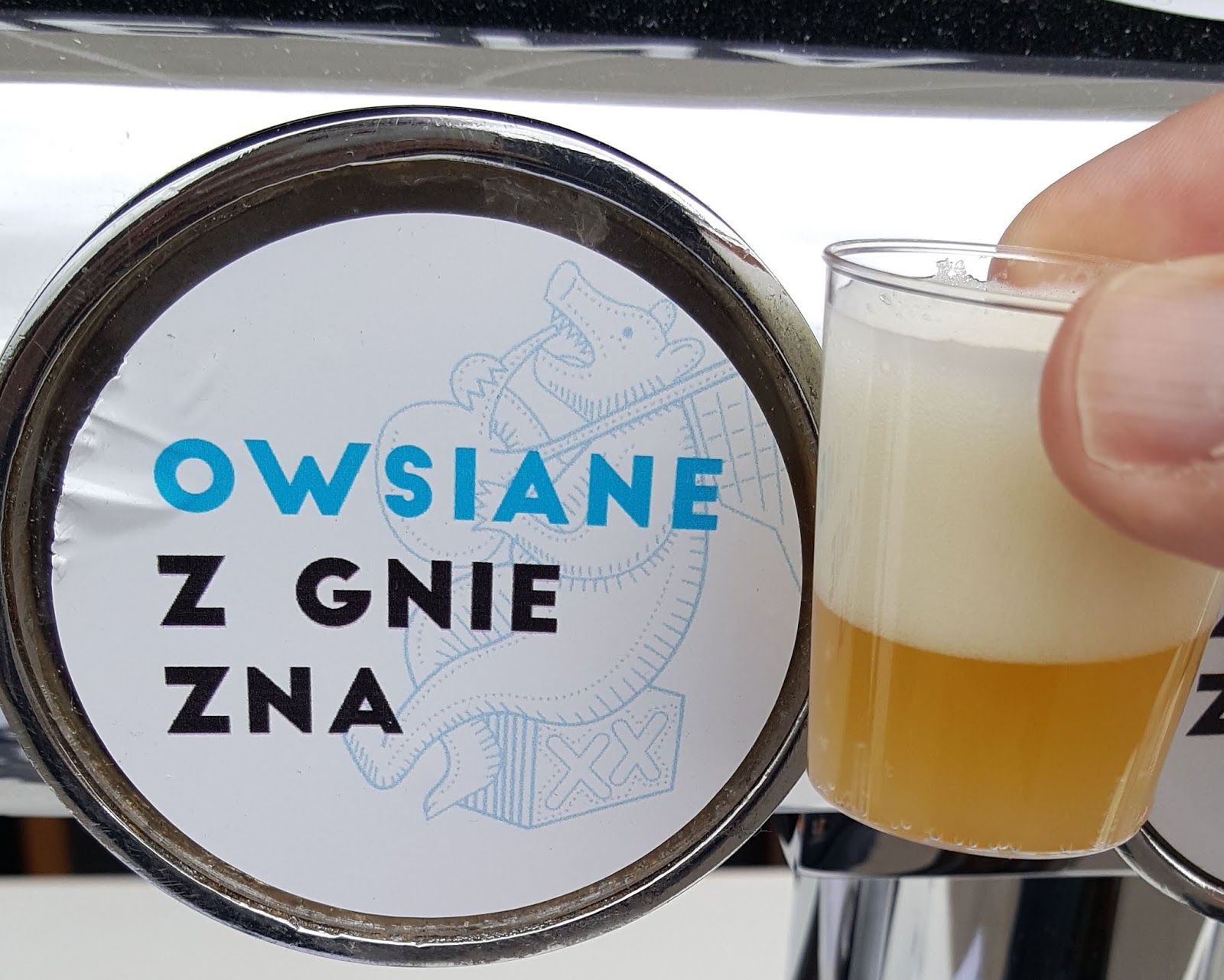
The next two he wanted me to taste were both gluten-free, seemingly a new direction for the brewery and they're desperate for feedback. Owsiane z Gniezna is brewed from a 100% oat grist and is a milky yellow colour. Despite Simcoe, Rakau and Fuggles hops it's rather sweet, offering a summery hit of strawberry jam. I found it a little sickly, though I'd never have believed there's no gluten.

NEIPA z Gniezna employs an unorthodox mix of sage and chamomile, and as a result has a massive herbal sage aroma. A soft texture is the only nod to New England IPA that I could find; no hop fruit or vanilla. I like sage in a beer, but I still wasn't sure what to make of this. I'm sure the gluten-dodgers will find it as interesting as I did. Onwards.

My favourite branding of the festival -- and there were lots of superb examples -- was the modernist style of Cztery Ściany. I paid tribute to that with a zero-three of Squat, described as an apple sour saison. It's a bright and clear gold colour and smells like appleade, all apple concentrate and fizz. There's a floral honey foretaste followed by an inrush of booze which made me check the ABV. 7.6%! The syrupiness is the dominant feature all the way through here, which is a bit of a shame. Only a slight saison earthiness in the background provides any balance, and it not really enough. Unacceptable sweetness strikes again!

That set me on a quest for the most convoluted sour beer I could find, which led me to the Maryensztadt stand, and a glass of their Joyride, which came with a whopping 17zł (€4) price tag. It's brewed with ariona (black chokeberry) and aged in Rioja wine barrels, finishing up at 8% ABV. It's a pinky-purple colour with a strong oak aroma and tastes like a good, if slightly clumsy, take on a Flemish red ale -- cherry is the main flavour, actual real sour cherry, for once. The relief of finding something properly tart allowed me to overlook the overdone barrelling.

I sat with that a while, during which time I was joined by Martyn Cornell. He was bearing an even more expensive beer: Swidnica's Jopejskie, an authentically-brewed Danzig jopenbier, starting with a Baltic porter wort of 50° Plato, boiled for 24 hours with spruce, cool fermented, wild fermented and then barrel-aged. You can read what he thought of it in his account of the trip here. I was less impressed. It tasted like hot autolytic gravy to me, like paradoxically savoury caramel, and the sort of thing that cannot be doing the drinker any good. Bleurgh. We agreed to disagree. And then we went to the pub.

What we found in the pub will follow later in the week; the rest of the fest continues tomorrow.