14 March 2013

Tír Chonaill a-brew

The growth in Ireland's craft brewing scene seems to be concentrating in the north west at the moment: not terribly surprisingly since it's woefully under served with drinkable beer, though it's nice to see that some people at least think there's a market for something different. Tyrone's Red Hand brewery launches its first beer at The Brewer's House this coming weekend, while nearby Poker Tree is expected to be in production later this year, but Donegal has been quietly turning out the ales for a while now.

The label on my bottle of Donegal Blonde claims a foundation date of 2011 though I understand it was late into 2012 before anything was pouring. The brewery is based at Dicey's pub and off licence in Ballyshannon, a long-time supporter of better choice in Irish beer. The bottle styling is simple, though the first note of concern came with the less than generous fill level (left). Sure enough, coaxing a head onto the beer took a bit of splash work and the foam didn't last long. The sparkle is the lightest imaginable, but at least it's not flat, and the colour is more an attractive red-gold than generic blonde.

No qualms whatsoever about the aroma. Expecting something very plain there's actually a gorgeous spring garden floral smell. If washing powder ads had an aroma, it would be this. The flavour doesn't quite live up to it, being watery for the most part, with dry grain hitting the back of the palate and those flowers just gradually infusing the senses at the end. But, surprisingly for a brewery that hasn't mastered the art of filling bottles, there are no off flavours or nasty surprises. The recipe is flawless and I suspect that a bit more fizz would do wonders to lift it. I can easily imagine settling in to a session on this at the source, or at any of the nearby pubs who have the good sense to stock it.

Meanwhile, up the other end of the county, Kinnegar Brewing has been turning out beer on a very small scale for a couple of years now. Distribution down in these parts is sparse to say the least, but Geoff from the Bull & Castle was kind enough to nab me a bottle. There are three in the range and this one is the amber ale: Devil's Backbone. No undercarbonation problems in this bottle conditioned job: it's wild fizzy so it is, hi. (Reuben found the same.) When the foam subsides the 4.9% ABV beer underneath is revealed to be quite a minerally one, reminding me in general of the better sort of English brown bitter, and Adnams's in particular. I was sort-of expecting more of a hop perfume, given that "amber ale" carries particular US connotations and the brewer is himself an American. But the hops here are all about the bitterness, adding an assertive bite to the one already provided by the carbonation. It's very tannic, which I love, with the tea effect turning a little towards earl grey thanks to the subtle hopping.

Wonky carbonation notwithstanding, if these two are anything to go by, the future is very bright for microbrewing in west Ulster. Sadly, neither brewery is represented at the Irish Craft Beer Village which opened yesterday at Dublin's IFSC and runs to Monday, but there's plenty of other good stuff to drink, including a new Eight Degrees stout, a double IPA from Carlow Brewing and a rare opportunity to taste Irish craft cider on draught.

11 March 2013

Ancient beer

Poking around in the back of the fridge turned up this bottle of Gruut Bruin which I'm sure has been there longer than a year at this stage. At least I don't have to worry about the hop character fading as the gimmick here is that none are used, with just "herbs" taking their place on the ingredients list. I've had a few of the others in the range, finding them quite decent.

The Bruin is on the pale side for the style: more of a red colour, and is almost totally flat. But neither of those are the most striking thing about it. It's already quite a sweet style and the lack of hops isn't going to do anything to bitter things up, but this is like getting hit in the face with a candy shop. Toffee in abundance, as well as overtones of Cadbury's Crème Egg interior. The finish is a very Belgian alcohol burn, unsurprising as it's 8% ABV.

It's not a million miles from other strong sweet brown Belgians, and Kwak in particular. But the absence of hops really helps raise the sugar factor, and not in a good way.

07 March 2013

Crosstown traffic

A couple of new American double IPAs took me on a bit of a tour of the Cottage Group's Dublin pubs recently.

Starting at Against the Grain on the southside there was Anderson Valley Imperial IPA, an 8.7% ABV affair which claims 100 IBUs. The aroma is its strongest feature, full of gorgeous sandalwood and booze notes, almost reminiscent of a fine cognac. Tasting opens up a candystore of sherbet and toffee, as well as some very adult supervision from the alcohol burn. The hops don't really sing, however. There's kind of a heavy and muffled orange cordial flavour, but neither zip, zing nor zest. Still thoroughly enjoyable all the same.

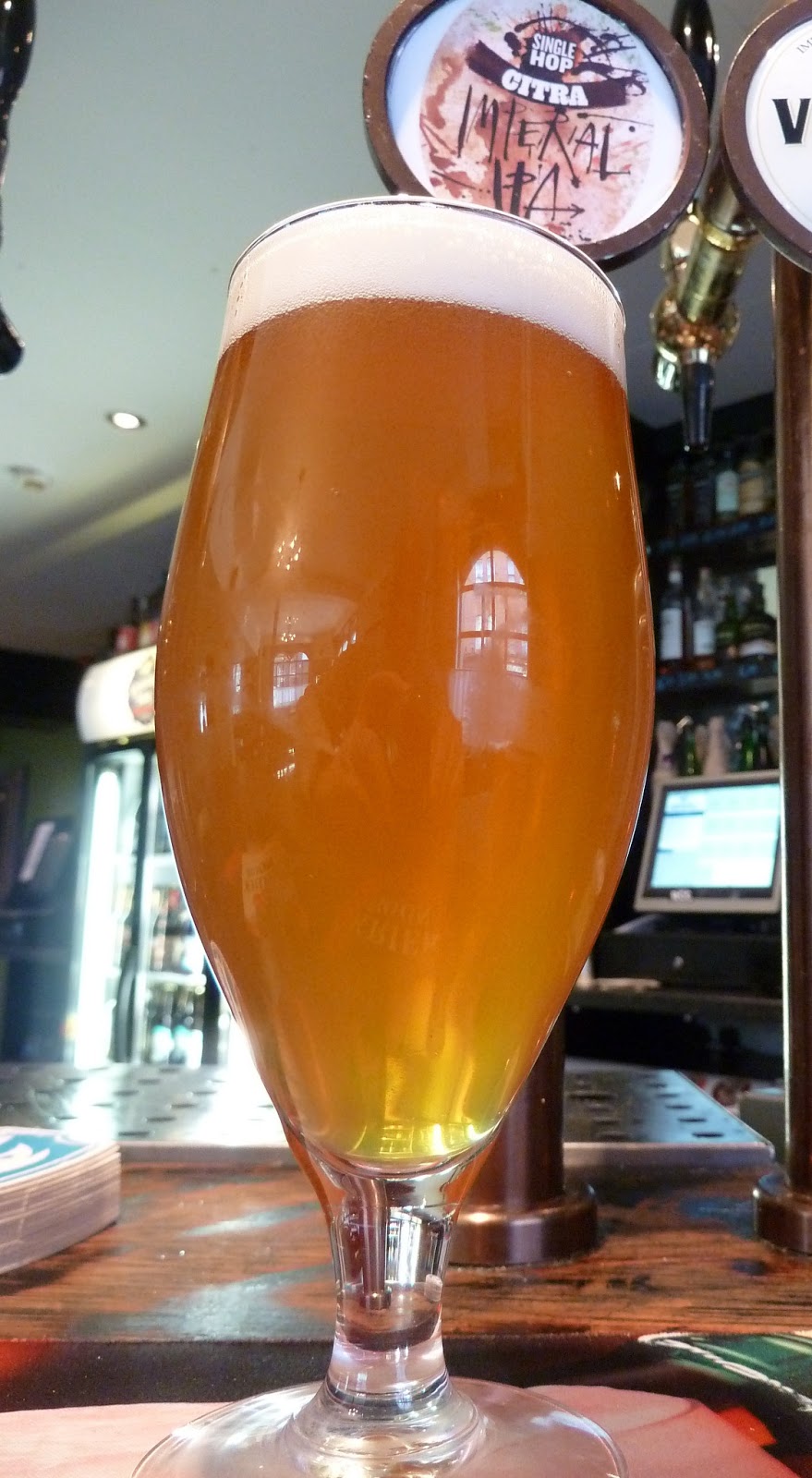
We cross the Liffey and head for the far end of Capel Street next, to The Black Sheep. This is the Group's cask specialist but that didn't stop them having Flying Dog's Single Hop Citra Imperial IPA on keg. This is all of 10% ABV but more than makes up for the extra malt with a very generous dose of hops. It presents a hazy pale orange shade and is surprisingly light on aroma, giving just a tease of orange sherbet. There's no shortage of flavour, however. It's nowhere near as sharp as I was expecting, with the Citra citrus mellowed by the heavy biscuit base and alcoholic warmth. Fresh grapefruit notes give way to a final pepperiness while the weight allows it to coat the palate leaving a long-lasting aftertaste. Despite the gung-ho branding and vital statistics this is an artfully assembled beer.

I thought I was done when word came through that its brother Single Hop Nelson Sauvin Imperial IPA had been tapped up over at The Brew Dock, so I headed off across town in a different direction. Odd that this beer looks darker, since the specs are the same, but when it comes to the aroma there's no mistaking the Nelson: mee-ow! But beneath the serious bang of cat pee there's a nicely assertive bitterness to make the mouth water, overlaid with with some lovely succulent nectarine notes, a flavour I've never never noticed from Nelson Sauvin before. Unfortunately, the pissyness is just inescapable and undid a lot of the beer's good points for me.

One thing that struck me about all three keg beers is that they were served California-cold, and yet didn't suffer a lack of flavour because of it. Low temperature and high hops seem to have worked together to allow these strong IPAs stay properly refreshing.

What's that? The Single Hop Chinook has been tapped back at The Black Sheep? Some other time, maybe...

04 March 2013

Too much too soon

International craft brewing's current affinity for saison shows no sign of slowing down so I guess we'll just have to weather it out. I didn't realise I was a saison hater until recently: I've enjoyed lots of them, back when they were a Belgian thing. The only one I know ever to have been brewed commercially in Ireland was lovely, and Oblivious has given me some fantastic homemade ones. But elsewhere it's not been so much fun.

In my amateur opinion, saison is a style that's all about nuance and subtlety, and the likes of Wild Beer Co.'s Epic Saison and Freigest's Sauer Power ignored that and went for bombastic, all-guns-blazing, barnstormers. Sadly this criticism can also, to an extent, be levelled at the latest one to cross my path: Wallonia by Thornbridge, recently on keg in Against the Grain. We are spared any of the more extreme burnt plastic of the other two I've mentioned, but there's also none of that mild pepperiness which good saison always has. Instead the hazy orange beer exhibits something of an aftershave spice, putting me more in mind of a heavy clovey weissbier than anything else. It's quite a decent sipper, but the dry fruit and spice flavours become a little overwhelming as it goes down.

How about keeping it simple, saison brewers? That might work.

01 March 2013

Counting them in

Session logoI have far too much beer. Belgian beer, mostly, due to the good offices of my wife who travels there a lot. It gathers in my attic and my beer fridge and I just don't seem to get through it as quick as I should. Freshness isn't so much of an issue with strong, dark, yeast-centric beers, but I've already missed the best of one Belgian IPA through my slow drinking habits. What's required is a constant audit of what's old, and what needs to be consumed sooner rather than later.

And it so happens that beer auditing is the topic for this month's Session, hosted by Adam at Pints and Pubs. I'm using the opportunity to clear a couple of long-anticipated beers from the to-drink list.

Both are by De La Senne, and the first is Schieven IPA, bearing a giant black hop cone on the label, one which is destroying Brussels with its heat rays. Okaay. It's 6.5% ABV and quite a dark shade of amber. As usual with De La Senne's pale ales I did my best to pour carefully and leave the sediment out, but as usual also I still ended up with a cloudy glassful. Lots of interesting things kick off the aroma: peaches and spices, reminiscent of the best beers from the Odell stable. On tasting it's a sharp citric tang to begin with, closely pursued by a very American crystal malt toffee flavour, adding a warmth to the bitterness. And then those spices, I guess from the rogue yeast -- cedarwood, frankincense -- as well as an almost saisonesque dryness. Right at the end there's a return visit from the soft juicy peach we met at the beginning. A tour de force and one of the very few Belgo-American hybrid IPAs from Belgium to pull it off. I'm glad I didn't let this get any older: an object lesson in the benefits of auditing, I guess.

Secondly Zwarte Piet, and I don't know what that guy wants with that chicken. Maybe it was set as bait by the lion hiding in the shadows. Lots of foam out of this one, over a dark red-brown body. The nose gives little away: just a sort of sour yoghurty yeast thing and a spirituous hit from the obvious 8.2% ABV. The taste is complicated, but not really in a good way: jarring metallic hops giving way to sweet cocoa: the evil twin of Wrassler's XXXX. Thoughts of De La Senne's Equinox crossed my mind, and subsequent research shows that this is in fact just a slightly tweaked version. The only improvement is that the bottle is now smaller.

Right: that's two more spaces cleared in the fridge. The endless fight against hoarding continues...

27 February 2013

Hope springs Italian

Spring? But I haven't finished my winter beers yet! Oh well, back in the stash they go.

First of the new season is New Morning from Birrificio del Ducato near Parma. It's 5.8% ABV and the label lists a cocktail of grains including wheat, rye and oats, plus some unspecified "spices". Bottle conditioned but well settled, it's a lightly hazy pale amber. The aroma offers a pleasant blend of clovey weissbier and hop bitters, but the latter almost vanishes on tasting.

What's left is mostly sweet cinnamon biscuits, dusted with apricots. It's the sort of combination that could get a little difficult to drink, except the high carbonation helps dry it out and the gravity is modest enough that it isn't in any way thick or cloying.

I don't see what makes it particularly springy, though. Surely cinnamon (or the cinnamon effect - research indicates that it's ginger and chamomile at work) is more a winter thing. Decent as it goes but probably not worth the €4.50 DrinkStore took off me for it. I certainly won't be rushing to spend the €14 they're asking for Ducato's barley wine and imperial stout, even though I know the latter, Verdi, to be lovely.

25 February 2013

What's in a name?

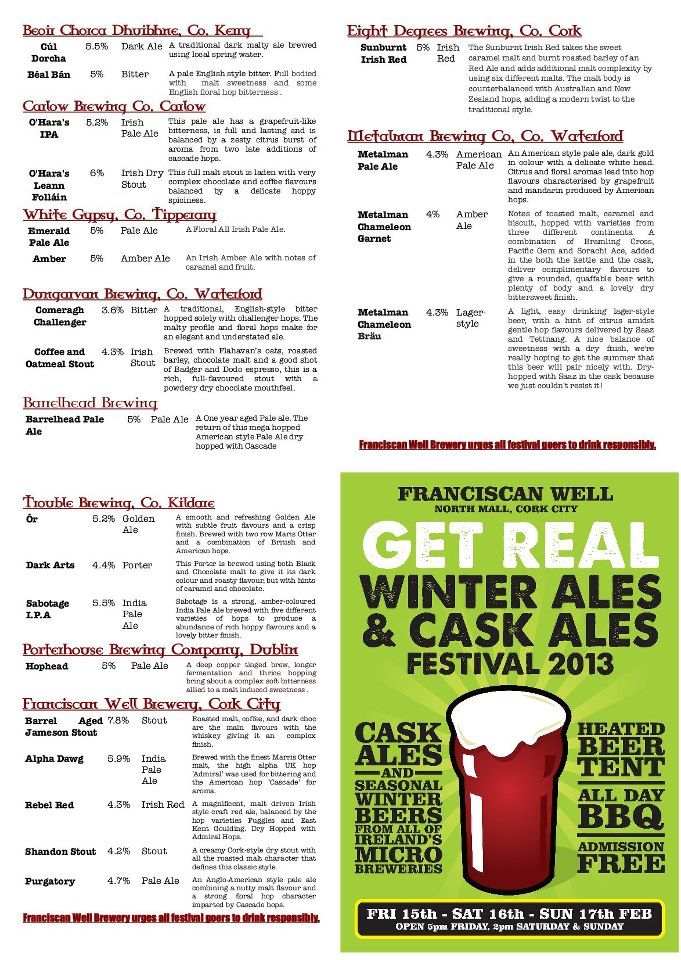
Festival season kicked off a couple of weeks ago with the first of 2013: the Franciscan Well's Cask and Winter Ale Festival in Cork. The emphasis was very much on the first part of the offer, with a little over 20 cask beers available in the covered beer garden, though not much that was particularly wintery.

Among the highlights was a return of Franciscan Well's wonderfully spicy Alpha Dawg IPA and a superb dry-hopped edition of Trouble Brewing's Ór golden ale. Just two on the list were completely new to me, and curiously enough they had something in common.

One was White Gypsy's Amber, a 5% ABV pale ale which I'd narrowly missed at the big festival in Dublin last September. It's a pale amber shade and quite sweet: packed with all manner of fruit flavours. The tasting committee around the table picked out peach, lychee, banana and vanilla. I got more than a hint of chewy Refresher sweets too. Not suitable for hopheads but I really enjoyed it. It's not the first beer from White Gypsy to be called Amber: a couple of years ago Amber was an excellent Munich-style lager. Hopefully nobody was expecting the lager when they ordered this, and hopefully also we'll see the old award-winning Amber back at some point, under the same badge or another.

The second new one was Chameleon Bräu, a "lager-style" blonde by Metalman. It's quite a simple beer but does what it does exceedingly well, blending dry grain notes with clean lemon zest. There's perhaps a hint of diacetyl butterscotch on the finish, but nowhere near enough to spoil it. So I was perfectly happy about the taste, but the name makes me grumpy.

Originally, Chameleon was a single beer which was altered in various ways before serving, so there was a chilli version and a variety of dry-hopped editions: a neat idea and fun to explore. But then late last year there came Chamelon Garnet: a completely new beer with a recipe unrelated to the earlier Chameleons. Now Chameleon Bräu is something different again. The official line from the brewery is that the Chameleon range is a series of small batches and experiments, just like the first ones were. That's fair enough, but surely the customer should be allowed to expect that a beer with the same name has something in common with previous ones. I could understand "Bräu: part of the Chameleon series", but "Chameleon Bräu" raises a customer expectation that isn't met. In this customer, at least. Galway Bay Brewery used to practise this unfriendly naming method with their Strange Brew series, but thankfully that has been knocked on the head now: every beer gets an individual name and this makes them much easier to talk about.

Still, it's nice to be whinging about beer nomenclature rather than beer quality. No complaints about the latter at this festival.

While in Cork I also took the opportunity to call in at the new branch of the Porterhouse in the Mardyke Centre, not far from Franciscan Well. They've done a lovely job here, creating a comfortable spacious pub with an atmospheric vaulted ceiling, the usual great range of Porterhouse beers and best of all, a full-length shuffleboard table:

Every pub should have one.