15 February 2017

Stay woke

We only get a limited range of Magic Rock beers in Ireland. "Just what the brewery has available" the importer told me once. I was pleased when Common Grounds, the Magic Rock coffee porter, showed up, and I grabbed a can at the first opportunity.

It pours a deep dark brown, the head crackling up before fading away to almost nothing. It smells of... coffee, funnily enough. Freshly brewed dark-roast coffee to be specific, with just a hint of brown sugar on the side. This softens on tasting to more of a mocha effect, with a slightly milky chocolate streak running through the coffee. The desserty fun is spoiled a little by a slightly harsh dry burnt finish, though that's also perfectly in keeping with the style. My favourite feature is the way the coffee oils hang around on the tongue long after swallowing: that's getting value for your beans.

At a modest 5.4% ABV it's not a beer that's trying to do too much, jumping around with busy coffee and heavy alcohol. Instead it's a refreshing drinking beer that would work just as well by the pint as the small can.

13 February 2017

None more Belgian

Sorry, that should read "some more Belgians" because this is another cross-section of Belgian beers, as picked by my wife from Brussels off licences.

De Poes has a pretty label, which is presumably why she picked it, but it's very short on information. We know it's 8% ABV and is flavoured with two unnamed sorts of hops and some equally anonymous spices. No style designation is given, but from the strength and the hazy yellow-orange colour I'm calling it a tripel. The aroma is estery but thankfully not overly hot: there's just a little banana and some orange juice as well. The flavour is certainly spicy: I get sparks of pink peppercorn and grains of paradise. Behind this there's jaffa flesh leading to a dry wheaty finish. It's quite decent: Belgian without being too Belgian, if you get me. I'd happily have another.

The cat theme continued with Black {C}, a "craft Belgian stout". 8% ABV says the label but it's hard to believe because this beer is dryyy. It smells like burnt toast, and tastes like very burnt toast. And not much else. I let it warm, sipped carefully, gave it the full sensory, and maybe there's a warmer fruity hint somewhere buried deep. Cream sherry, perhaps, or ruby port. But at every angle the acridity rises anew to rasp on the palate and scorch the throat. It's not a nice beer. Maybe the snarling panther was meant to be indicative.

To follow, Kerst Pater, a "special Christmas beer" from Van Den Bossche. It's 9% ABV and a properly festive mahogany colour. Served cold from the fridge, it took a bit of sitting out for it to start tasting of something. When it did, I got dark chocolate and rum-soaked cherries: all very luxurious. There's a cola sweetness, an effect enhanced by a texture that's surprisingly thin and fizzy for 9% ABV. I liked how it tastes but feel it should have more substance. I doubt I've ever criticised a dark Belgian strong ale for not being hot enough, but this one isn't. Go figure.

Also from the Christmas offerings, and also 9% ABV, is Noël de Silenrieux: chestnut red and rather murky. It was a bad sign when it gushed from the bottle and a worse one when it began smelling of marker pens. But things settled down after that. There's a happy jammy strawberry foretaste, leading seamlessly into a woody balsamic tartness which may not be intentional but left me thinking nice thoughts about Flemish red ale. A sprinkle of peppery cedar finishes it off. I have absolutely no idea what this is meant to be, but I enjoyed its busy complexity, even if it was too fizzy for Christmas.

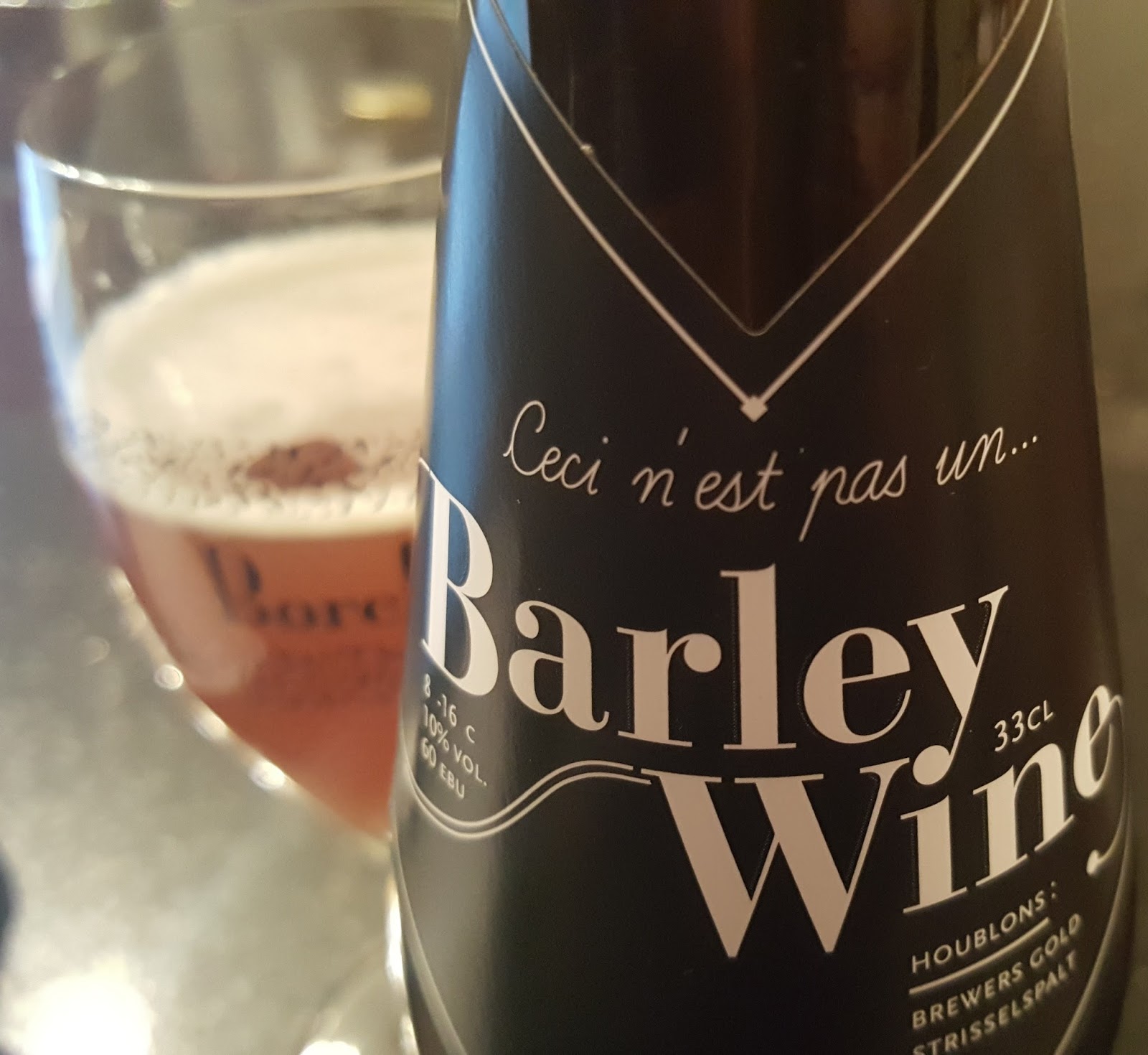
Next up, the little barley wine that isn't. It's called Ceci N'Est Pas Un Barley Wine and comes from Brasserie Sainte Hélène in Florenville. An ugly beast, it's 10% ABV and a dirty ochre colour. It smells ugly too: powerfully sickly and hot, like emulsion paint. The flavour is a little more charitable, with a wholesome wheat and oatmeal cereal sweetness and juicy raisin and fig fruit, shading towards cola. We're not a million miles from the plum-pudding stylings of dubbel here, but sweeter, boozier, and without the dark malt richness. Balance is not in this beer's remit, though there is a tiny pinch of white pepper piquancy right on the end which helps offset its other excesses, but it's still a challenge to try and enjoy it.

A honey beer next: Zatte Bie ("drunken bee", if my Flemish is correct). It's a dark chestnut-brown colour and, perhaps unsurprsingly for 9% ABV, leans very heavy on the malt. The aroma is wholesome and grainy, turning to light sweet toffee on tasting. There's not much Belgian yeast character and the honey seems to pick up the slack: there's a waxy honeycomb effect which definitely tastes real rather than some sort of honey essence or flavouring. This is not the super sweet novelty beer I was expecting from the comedy label and instead is rather pleasant, balanced and drinkable.

What could be more Belgian than beer, bicycles and bande dessineé? They feature together on the label of De Bie's Vélo, though as far as I can see a style designation does not. It's roughly a tripel, being a murky orange colour, 7.5% ABV and with a complex aroma of herbs, spices and mint. The flavour starts refreshing and juicy but the sweetness level builds and the needle creeps over to tinned pineapple, at which point it becomes tough drinking. The sweet fruit and bitter herbs are quite jarring; too much so for this to be suitable post-cycle refreshment, though in fairness I think it's actually pitched at the spectators.

Another strong winter seasonal to round this post off: Ter Dolen Winter at 9.1% ABV. It's a murky red colour and gives off a heady, and very Belgian, fruity warmth in the aroma. I was somewhat surprised to get a hit of herbal medicinal spices on tasting, and a check of the label says honey and cinnamon are the secret ingredients but I'd never have guessed. It's a strange combination of menthol and pine, fading to leave just a thick brown sugar base. Overall it's not terribly complex, but it does the job of central heating adequately, which I'm sure was the intention.

That should be the end of the Belgian winter beers for this season. I'm hoping for something a little sunnier next time out.

10 February 2017

The loneliness of the long distance ligger

I was invited along to the launch of the revamped Milano restaurant on Haddington Road the other week. I went because, hey, free pizza, but I wasn't expecting to get any blog content out of it. Chain pizza restaurants (UK readers will know Milano as Pizza Express) are not known for their diverse beer offerings, at least in these parts. I had a look at the uninspiring beer menu in advance and realised that I had never committed a review of Italian staple Peroni Nastro Azzurro to this blog. So here goes...

I've drank it a few times over the years and my abiding memory of it is as extremely watery, but from the fridge in Milano it was a little bit warmer than expected and I think that helped give at least a token bit of substance. Malt flavour? No... not really, just a kind of vague wheaty grain. Poking around for hops I found a sort of rough cabbage-water flavour, one which I'm sure disappears completely when the beer is chilled all the way down. So cellar-temperature Peroni is still pretty damn bland, but at least it's not watery, so that's a win.

For dessert I took a punt on Peroni Gran Riserva which, from the name, I assume is drawn from the casks cellared deep beneath Signor Peroni's castello. It's very much in the German pale bock style, 6.6% ABV, a lurid orange colour and brimming with sticky golden syrup flavours. A real bock would throw in some weedpatch noble hops but this doesn't really bother, showing just a very short-lived green bitterness in the middle. It's not unpleasantly sugary, however, settling down after a few mouthfuls to be merely bland rather than cloying. The only off-putting part is that its density leaves one expecting a big flavour, for better or worse, but none is forthcoming. I found myself actually missing the harsh nettles and spinach of bock.

Aaanyway, the pizza was nice, the service was good, and I had Reuben and his other half for company. And I got a blog post out of it. I'm chalking this up as a win. And as soon as Milano starts stocking LoverBeer, I'll be straight back.

08 February 2017

Black mystery

An addendum to Monday's post about the recent Cask Ales & Strange Brews festival at Franciscan Well. Three beers from Black's of Kinsale had been kept back in growlers for the competition judging, presumably having been on the bar earlier in the festival. I could find almost no mention of them anywhere online but felt I needed to throw in a description of them anyway. This blog is nothing if not completist. Edit: thanks to IrishCraftCaps for subsequently providing the details I missed.

The one I think I have a proper name for is Don't Beet Around the Bush, though it was labelled simply as a beetroot and chocolate stout. It's pretty good too: a silky sweetish stout with a waft of Turkish delight rosewater wrapped in smooth milk chocolate and then just a mild earthiness provided, I assume, by the beetroot. That makes it sound a bit more complex than it actually is: the various flavours meld together into a delicious harmonious single entity.

There was a Cherry Chocolate Stout (official name: Faraoise Dubh) too but it wasn't as much fun as the beetroot one. I think the chocolate was a bit overdone and the end result wound up tasting like cheap drinking chocolate: far too sweet, for one thing. There's a light touch on the fruit, which I wouldn't have been able to identify as cherry. This one needs its stoutiness turned up a notch or two.

Finally, a Lime Leaf and Pineapple Saison (official name: Tropical Farm), the first time I've encountered that particular combination, I think. It sounds a lot more exciting than the reality, which is like watered-down Diet Lilt sprinkled with white pepper. There's a vague herbal character which adds the flavour of an elderly medicine cabinet. None of this is helped by a dull flat finish either.

Experiments are fun and it's great that breweries like Black's are using occasions like this festival to put some of their more daring ones in front of the drinking public. What have we learned? That Ireland needs more beetroot beers, for one thing.

06 February 2017

Caskstravaganza!

Franciscan Well's winter festival returned with a bang in late January. Now titled Cask Ales & Strange Brews, the 2017 iteration was bigger than any previous one, almost competing with the Easter festival with several dozen cask beers on offer, plus a handful of kegged specials. I went down as part of the Beoir judging team to help out with the competition on the Saturday.

I started my afternoon with a keg beer, however: Metalman's new Sgt. Pepper sage and pepper saison. It's a cheeringly light 4.8% ABV and presents equally cheerily as a clear dark gold colour. Much as I enjoy sage-infused beers it does have a tendency to dominate flavours but that wasn't the case here. At its core this is a clean, light and refreshing saison in which the herb seasoning is only barely perceptible. I would easily have assigned the pepper to the action of the Belgian yeast while the green wintery notes tasted more like rosemary to me than honkingly oily sage. Either way, it's very nicely balanced and started the day on a positive note. Look out for this fella on draught and in cans for the next while.

Herself picked one of the many YellowBelly beers to begin, their raspberry-flavoured Berliner weisse Raspberry Shower. I say "flavoured", but that's an understatement. From what was served it looks like a mass of pulped raspberries has been shoved into a cask and the beer poured in on top of it to fill the remaining spaces. It's an opaque bright pink with discernible lumps of fruit. And it tastes how it looks: of raspberries and lots of them. Behind that sits a very plain and thin Berliner weisse, mildly sharp and vaguely wheaty, but the flavours of fruit and beer didn't really meld together.

I'm wondering if it was just the bottom of the cask or something, because YellowBelly's Blackcurrant Shower was also on the go and it was very different. It was clear, for one thing: a flawless pinky-purple. Unsurprisingly the flavour was much cleaner too. Though presumably made the same way as the raspberry one, this opened with a classic wholesome grainy taste, imbued with a tangy sharpness. The fruit plays second fiddle to it, not distinctively blackcurranty but more of a generalised summer berry vibe. If guessing I'd actually have suggested there were raspberries in this. It's very refreshing and quaffable: smooth, without being a smoothie.

One more from Metalman before getting to work and that's their Raspberry Saison, from cask. It's another clear golden one with just a very slight haze. Despite the lack of pinkness the fresh raspberries are very apparent, in both the aroma and the flavour. At the slightly warmer-than-keg temperature there's a roundness and fullness to the tangy fruit taste, complemented by signature saison pepperiness. It's not particularly complex but I enjoyed it, though I think its refreshment power would benefit from being served slightly colder.

To the upstairs bar, then, and to the judging table. I was on the dark beers team and all entries were served blind, with Steve organising the operation and John doing runner duty. Like last year, I took my own notes as we worked through the entries and matched them to the names afterwards. The field was solely cask beers, no kegged ones were entered.

Only two were completely new to me, though there was a new barrel-aged version of Brehon's Shanco Dubh porter, which ended up being the whole judging team's pick for best dark beer of the festival. It's out in bottles now and I recommend it highly. Brehon's other entry was Pop Your Cherry (groh!), a cherry-chocolate stout of 5.2% ABV. It's intensely floral, with a sharply pink hibiscus taste. The chocolate, and indeed general stoutiness, is almost mute behind this, offering more by way of texture than flavour. After a couple of sips the flowers build to an almost perfume level of sharp bitterness that sits on the palate a long time. Too long, by my reckoning. With a bit of toning down this could be a great beer but it was just too busy to be enjoyable as is.

At last year's festival I had fun with YellowBelly's 7.5% ABV brown porter. Now it's back, ramped up to 8.1% and given the name Ursa Major. And it's even better than before. Still dangerously easy drinking, with a silky smoothness and a crisp, dry background. But what really makes it interesting is the up-front complexities, and I reckon these were particularly accentuated by the cask dispense. There's this beautifully sweet summer fruit flavour, all succulent cherries and ripe strawberries. They meld sumptuously into the soft milk chocolate in an extremely moreish way. Like its predecessor you really do need to keep an eye on how much you're drinking because this beer screams to be quaffed.

As I mentioned, Shanco Dubh took the top dark beer prize, with the host's Chieftain winning best pale beer, Dungarvan's Dark Mild taking best red/amber and YellowBelly's passionfruit lager winning both best specialty beer and best beer overall. Deservedly so, in my opinion. And back to the festival...

YellowBelly Mosaic IPA does make regular appearances in Dublin bars, though at almost €7 a pint for a 4.8% ABV beer I've so far resisted the temptation. The festival was far more reasonably priced so I took the opportunity to give it a spin, and it's very nice. The Mosaic flavour balances deftly on the line between honeydew melon and raw white onion, the fruit side helped by a distinct juiciness and a substantial amount of peach character. Soft and sessionable, yet complex, it's pretty much exactly what you'd want from an IPA at the strength, and it doesn't suffer in any way from being a single-hopper.

With time running short I only just remembered to try Torc Grodziskie but was very glad I did. This style of pale smoked wheat beer can sometimes be rather harsh and overwrought but this one, at an even 4% ABV, is light and very easy drinking. Which isn't to say it's bland or watery: you get a substantial hit of pure hickory bacon all the way through, but the finish is quick and the body is full enough to make it enjoyable.

Chugged down as my fellow travellers were leaving was The Beacon, a new one from Baltimore's West Cork Brewery whose wares we rarely see in my part of the world. This is an IPA and I didn't realise at the time that there was added grapefruit and orange in it. They got their money's worth out of them anyway, because there's a lot of sharp pithiness in this. The fruit blends seamlessly into what I suspect is a generous quantity of hops, which give it a thick and oily dankness set on a chewy malt base. To my mind it's very much IPA in the English mould, but a particularly aggressively bitter example, more lime and grapefruit marmalade than just orange shred. Not so easy to drink, but fun while you do it. I made my best effort at draining the glass and ran after my companions.


I caught up with them along the quays at The Bierhaus. Among the usual stellar selection they were pouring Cotton Ball Vienna, a Vienna Lager, by Cotton Ball. It's a pretty good example, even if the style is rarely an exciting one. 5% ABV and full-bodied with it, featuring a flavour that's all about the dark crunchy grain husk, finishing on a slightly roasty note. There's the classic lager cleanness which means for all its weight it doesn't get difficult to drink. Just as well, as train time approaches.

To the off licence for some train beers and I continued the lager theme. Among my picks was Švyturys Amber, which I don't recall ever having before. I'd been hoping for something a bit like the Vienna, but this is much thinner, with a light spongecake sweetness and a smooth texture, making it resemble a helles, including its colour: you call that amber? Inoffensive, but not terribly exciting. Perhaps I'd had enough beery excitement for one day.

A big thanks, of course, to the team at Franciscan Well for running another superb festival, and to everyone who pitched in with the competition and/or supplied me with pizza. If you haven't yet made it to one of Franciscan Well's festivals, the Easter gig will be on 15-16 April this year. Mark it!


03 February 2017

Once you go brown

Session logoThe announcement of the topic for this month's Session came just a day after one of the most sublime experiences of my year in beer so far. Our host is Joe at The Fatal Glass of Beer, and his topic is "Brown beer" signifying, as indeed it does, old-fashioned beer from "a bygone corduroy-trousered era". Well there's nothing wrong with corduroy beer and I'm here to tell you why.

Among the handful of beer recipes I brew repeatedly at home is a low-gravity job I call a brown porter. It uses brown malt as the primary speciality malt -- about 10% or so of the grist -- seasoned with just a token bit of roast barley or black patent. I love the moreish mocha flavour that brown malt delivers when used in sufficient quantity, and it's something that one rarely seems to encounter in commercial beers. Until a couple of weeks ago, anyway.

The gloriously named Touching the Scald was brewed by Galway Bay Brewery in collaboration with the author of Scaldy Porter, Whiplash. It's 4% ABV, badged as a brown porter, and tastes extremely similar to the sort I make myself, though haven't done so in quite some time.

The visuals aren't great, possibly in keeping with the name: it's a muddy dun colour with a rubbish head that disintegrates soon after pouring. There's a flinty aroma of burnt grain husks coupled with very dark-roasted coffee beans. I was expecting something quite harsh, but no. The first impression on tasting is creaminess: a sweet and frothy cappuccino effect, with a Galaxy chocolate bar on the side. But despite the latte smoothness, it's lightly textured with a busy sparkle and a dry finish which makes it supremely thirst-quenching and refreshing. It was an absolute joy on a winter's evening but I think it would really come into its own in the summer.

As it happened, head brewer Will from Galway Bay was in Against the Grain as I was drinking it, and when I quizzed him for details he mentioned that the brown malt was difficult to work with, requiring some very delicate temperature controls in the mash. That's not a problem in my brewing because I just steep the stuff, but maybe there's a reason that brown malt, and therefore supremely delicious brown beers, aren't so commonplace.

I don't know how long this one will be around for, so grab it if you see it. It may just change your perceptions of boring brown beer.

01 February 2017

Monkey shines

The newest (I think) addition to the busy brewery scene in Co. Cork is Clonakilty Brewing Company. I hadn't expected to see their beers up here so soon but they landed recently in Drinkstore and the shop was kind enough to donate one of the samples left by the rep to this blog.

Tojo is an American-style pale ale, named in honour of the monkey that US airmen brought to Clonakilty during The Emergency. Its ABV is on the money for the real thing at 5.5% ABV, which is slightly above where Irish examples usually clock in. It's a murky orange colour, aided in no small part by the bottle conditioning and my sloppy pouring. The aroma is promising: a mix of sweet mandarin and bitterer orange pith, a little like the better sort of English bitter. Could this be Ireland's answer to Harvey's Sussex Best? Not quite.

The flavour doesn't unfold in quite the right way, being watery to begin with, and the first thing to loom out of the depths is a savoury yeast note. Behind this there is a pleasant waft of sherbet orange and lemonade, sweetly effervescent with a hint of Burtonish sulphur. But that fades quickly, replaced by more gritty yeast. At the strength I'd expect something of a rounded marmalade-on-toast effect from this hop-malt combination.

The base recipe here is absolutely sound, even excellent, but the execution needs a bit of work. I'm not sure that bottle conditioning really suits a beer with such a delicate hop profile, or at least not the way they've done it here. Well-kept on cask, however, this would be a stunner. But the chances of that showing up anywhere are probably slimmer than a monkey landing in Clonakilty.