15 October 2021

Herbs and spices

Hops are over-rated. Did you know they're not even native to Ireland? Disgraceful that they're even allowed. Today's beers are from two breweries determined to do things a more traditional way.

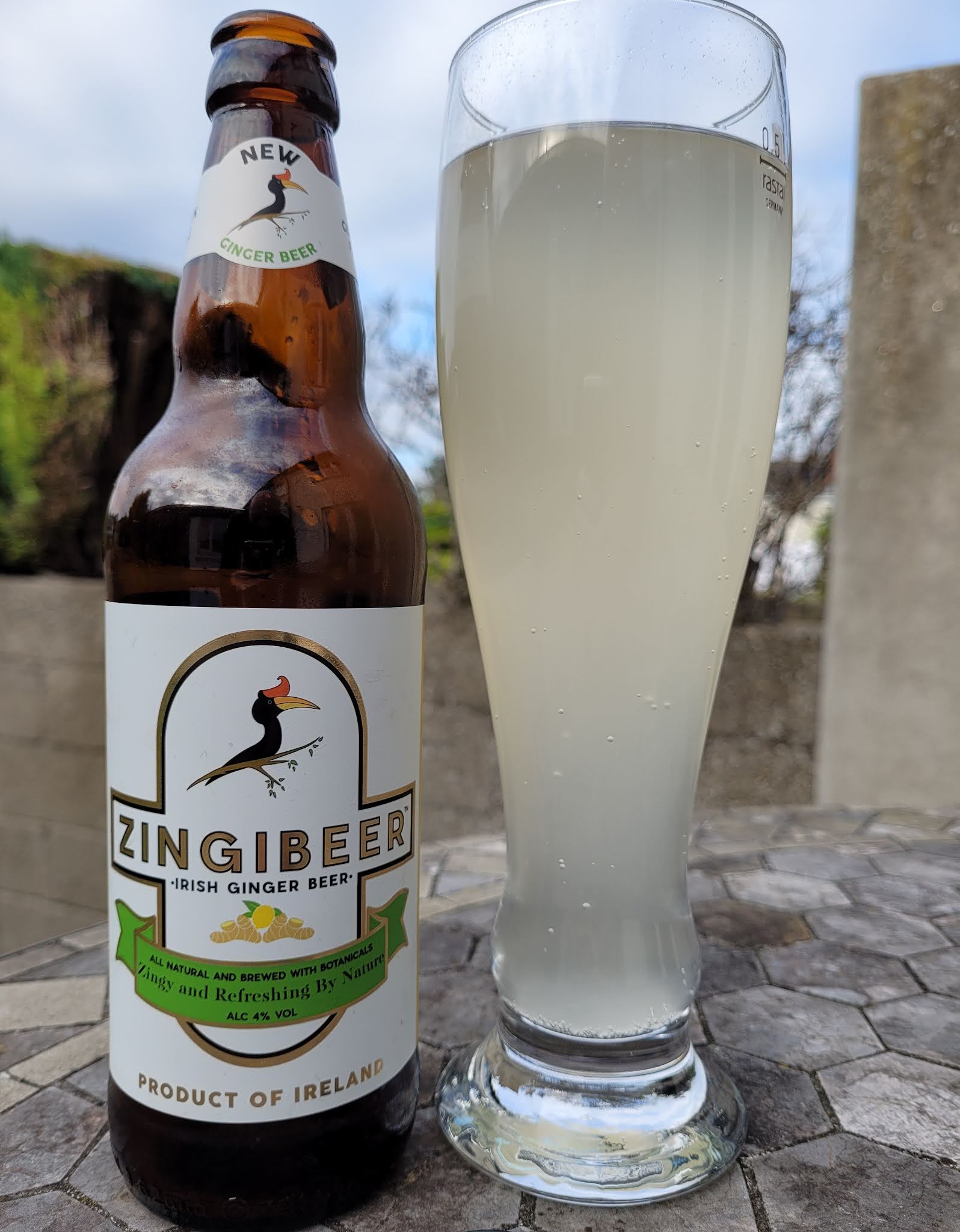
OK, fine, ginger isn't native to Ireland either. I'm intrigued by Zingibeer on a number of levels. For one, it's that rarely-produced style: proper ginger beer, with minimal malt involved, just sugar, water, yeast and spices. For another it's from Persistence, a brand that hitherto has only produced pintable pub beers in orthodox styles, mainly sold at a cluster of scenester bars in Dublin's south city centre. This is the first bottled offering and very much not what they normally do. No provenance is given so I don't know if this came from their usual host brewery JJ's.

The product is 4% ABV and silver-coloured, pouring with plenty of fizz and an absence of head, which begs for ice-and-a-slice to take the bare look off. There's a pleasing savoury botanical aroma, suggesting rosemary and sage to me. It's predominantly sweet but not excessively so and there's a decent amount of substance to the body: it does feel like a beer, albeit a very highly carbonated one. I think it could have done with more ginger as the spicing is a little muted to my taste, the buzz only really arriving late, with no accompanying burn. Before that, the herbs are busy, creating more of that savoury roast-dinner effect. I'm quite partial to the occasional roast dinner. The sugary aftertaste is where it resembles your more standard ginger ale mixer. It's a bit of fun, and does fill a gap in the market. It's not a beer for pinting through, however. Half a litre on a warm evening was plenty.

Beoir Chorca Duibhne has used botanicals from the brewery garden in All Seasons. This gruit contains gorse, dandelion, dock, primrose, yarrow and, oh... hops. Oh well. It took an age to pour from the 75cl bottle due to the masses of off white foam forming on top of a dark red-brown body. It smells sweet and wholesome,  freshly baked bread combining with oily and nutritious greens. I was expecting a heavy and sweet flavour to go with that but it's surprisingly light and clean; pleasingly so. A crisp fizz and no dark malt character makes it seem almost lager-like. I wasn't able to pick out any specific herb flavours, and I thought gorse's coconut would be the easiest to spot. Instead there's just a general sense of botanicals set against a dry background, a little like a vermouth without the wine character. I wouldn't have minded a little more flavour intensity, but I still really liked this. At only 5.5% ABV it manages to offer an excellent refreshment factor alongside the subtle gruit complexity. Nicely done.

It's easy to complain that everything is a hazy IPA these days, but there has been some very interesting and diverse stuff coming out of Irish breweries lately. I'll be writing about what I've found in due course. Plus a load of hazy IPAs from Whiplash, obvs.

13 October 2021

Tall, dark and fizzy

The frosted black 75cl bottle is stately, and the name "Abbaye de Vauclair Imperiale" very grand. The wording beneath reading "French lager with orange peel" lets the side down a little, however, and we won't mention that it was purchased in Lidl for pocket change.

Its appearance poured lives up to that of an orangey lager: it's clear and fizzy, with an amber tint. Mind you, it is 7.5% ABV so a certain level of colour depth is to be expected. The aroma is clean and crisp with a hint of oily concentrated orange. Clean and crisp continues in the flavour, barely troubled by the orange and with the tiniest hint of raspberry and cherry, like pink bubbly. It was my first beer on a Friday evening and did a great job of washing the week's stresses out of my parched gob. There is very little sign of the hefty alcohol, something that should have been particularly problematic in a lager but -- hooray! -- wasn't.

I have a lot of time for this. I hadn't seen it before and supply may be limited, but I reckon it could serve a multitude of purposes: as a food accompaniment, a summery lager, birthdays, weddings, bar mitzvahs, whatever. Despite the imposing presentation it's not to be taken seriously. Just enjoy.

11 October 2021

Gän-stal style!

I've been chasing the goose ever since I discovered Gänstaller's magnificent smoky masterpiece Affumicator in 2009. None of their other beers have quite lived up to it, but I was still delighted to see a selection of their cans landing in locally. Let's see what we have here.

First it's Gänstaller Helles. This looked to be a little dark for the style as I poured it, but in the glass it's a gorgeous rich, almost glowing, golden. Biscuits and bread for an aroma is par for the course and you have to wait for hops. They arrived in the flavour, bringing quite an assertive bitterness: boiled spinach, crisp sprouts and shredded red cabbage. Three of your five a day. The malt side is crisp too, bread crust rather than crumb, something I associate more with pilsner than Helles, but maybe that's just me. The texture is still appropriately soft even if the bitterness puts an unexpected edge on it. A dry and slightly metallic finish closes proceedings. I emptied my glass in pretty quick time while writing this, and I think that's the beer's main feature and raison d'être: you're meant to quaff it and order another, not write notes. Bigger cans, please, Mr Gänstaller.

Stronger and hazier is Gänstaller Zoigl. Not a real Zoigl, of course, but an "homage" to the beer culture of the Oberpfalz. It's a nicer word than rip-off. The flavour has a fuzziness to match the appearance and there's a sharp bitterness, similar to the Helles but more severe; waxy and earthy. What you get is your hop-forward pale lager but very much minus the clean crispness, which for me is a lot of the point. Were I drinking this at the source, poured from an heirloom wooden barrel by the brewer at a barely-commercial inn, I'm sure I'd have sung its praises, but a 440ml can in a Dublin backyard makes me feel less charitable. It's a rough and dirty lager. If that's how you like it, I won't judge you, but I generally prefer something more precise.

I couldn't figure out why the brewery had named its weissbier, Smaragdweiß, after a kind of conifer. It turns out that this is in the hopfenweiss style so maybe it's a gentle dig at what they think new-world hops taste like. Not that it's particularly hoppy. The aroma is a green-banana sharpness which perhaps suggests extra bittering but is still well within the parameters of standard weissbier. The appearance is not, however: it's clear of body and thin of head. What's going on? Bavarian weissbier tends to be richer and fruitier than northern knock-offs but this tastes altogether more Prussian than the norm, with a dry grainy rasp next to the banana and an abrupt finish. There's a resinous extra hop kick, but I would be surprised if they used any American varieties as it's much more grass than grapefruit. It's fine but nothing special and doesn't offer anything that the big names of Bavarian weissbier don't do better.

My quest for something as good as Affumicator continues. Actually, maybe the Irish importer would consider getting hold of a few cans of that?

08 October 2021

Back to the pub

Normality comes dropping slow. I haven't exactly been rushing back to the pub since they began re-opening, though it's been nice to return to The Porterhouse and 57 the Headline on occasion. One evening in late August I found myself in one of my locals for the first time in a couple of years, and got a bit of a look at the post-pandemic landscape of normal pubs.

I had seen branding for Madrí Excepcional in a few places around town. This Spanish lager has been newly introduced by Molson Coors, perhaps to add a classy side to their portfolio which neither Molson Canadian nor Archway was giving them. Interestingly, it's presented as a "collaboration" with the parent brewery LA SAGRA (why the shouting?), suggesting it's not actually brewed there.

What do you get if the branding appeals and you order a pint? It's clear and an appropriately rich golden colour, so full marks for the visuals. Less so for the taste: I got a substantial whack of diacetyl from this, the buttery taste matched with a slick and greasy texture. And that's pretty much it: there's a lightly crisp biscuity malt base but no hop character to speak of. I'm not especially diacetyl-averse so I wouldn't consider this spoiled, but it's not impressive. If it makes you feel part of a more Mediterranean drinking culture, then I wish you the joy of that, but I can't think of any other reason to buy it.

And then there's Island's Edge. There has been much online commentary about this new stout from Heineken — the company which already brews two of Ireland's three biggest-selling stouts — from the name which clearly came from a very short brainstorming session where "Rockshore" was written on the whiteboard, to the downright offensive claim that the stout sector in Ireland is stagnant and un-innovative. The supposed innovation here comes from the inclusion of basil and tea in the recipe. Heineken had a shortlived tea-flavoured stout on the market a couple of years ago — Kettle Brew — but it disappeared before I got the chance to try it. I guess this is the next phase in that project. So what's it like?

Well, first of all it's a nitrokeg stout, and only 4% ABV so I wasn't expecting a wow-factor from the taste. The brewery has stated that it wants to attract new drinkers by dialling back the bitterness, and that made it extra unlikely that we would end up as friends. There is a pleasant creamy chocolate element here, and the novel ingredients are manifest as a kind of dry leafiness. It seems that when you combine black tea and basil you end up with something that tastes of green tea, which probably shouldn't be surprising. This builds to become a concentrated cabbage effect by the end. It's not a good stout. Although it isn't thin, and it's bland enough so that the odd flavours aren't jarring, it's missing the elements that make session stout worthwhile. No roast, no bitterness; no point, frankly. As with a lot of new-release industrial beers I can see it being a distress purchase for me for a while, until the novelty wears off, if it lasts that long. I don't see what it offers drinkers of the established big stout brands, or the stout-curious, however. 

And that's why I tend to stick to the pubs where they serve the beer I like.

06 October 2021

Nicely toasted

I'm wondering if I've misunderstood the remit of the Curious Society project. I had thought they were intended as accessible beers for normal people, but the last one, a double IPA, raised an eyebrow, and now a toasted coconut stout at 8% ABV has caused the other one to go up too. Maybe the Curious Society tribe has been convinced to be more adventurous. Or maybe the brewers are bored. Either way, I like a big stout so in I go.

Coco looks very handsome in the glass, a properly dense black with a properly thick pillow of head. The coconut keeps its powder dry in the aroma and instead you get quite standard notes of chocolate and espresso. Nothing wrong with that. Oily coconut flesh sambas right to the centre on tasting, making the Bounty bar comparison irresistible. There's a creamy density to go with this, entirely in keeping with the strength, and a perfect balancing roast bitterness on the end. All is harmonious, integrated and complementary, with no silly tricks or extreme manoeuvres. 

Perhaps I should adjust my surprise. While this is not a run-of-the-mill stout stout, it's no daft novelty either, nor in any way challenging. It is exceptionally well made, the ingredients balanced and the flavour journey conducted at a leisurely pace. Anyone even vaguely interested in Level 2 of craft beer will do well with it.

04 October 2021

Where do they all come from?

The downside of being a DOT beer drinker is that you really need to keep your stash under control. This one ended up taking over most of the fridge before I set aside the time to enjoy them. I've done that daft thing of turning my leisure activity into a chore. So... what's in there?

We start very small with Good Behaviour, an IPA at a teeny tiny 2.5% ABV. Vic Secret and Citra give it quite an assertive aroma, with lime marmalade and matchhead spicing in the mix. Oats are used too, presumably to bulk out the body but I don't think it quite works: it's still very thinly textured. Luckily the flavour is bold enough to compensate, turning the wateriness to an acceptable, refreshing, quaffable character. Said flavour begins sweet and tropical, and I get mango in particular from it. I would have liked that to continue but it decides to take a sudden and sharp turn towards bitterness and ends up a little harsh. It's not one to sit about crying over, however. There's plenty of hop buzz to enjoy, and then it's gone and no harm done.

Before that landed, the record for DOT's weakest was held by Martin's Micro IPA created for Martin's Off Licence in Fairview, one of DOT's many frequent collaborators. This one is 2.6% ABV and is a happy white-gold colour. Nothing small about the aroma, however: it's bright and tropical, suggesting all the joy of pineapple and passionfruit to come. But come it does not. The flavour is plain to the point of non-existent; fizzy water with very little on top. A tiny pinch of metallic bitterness on the end? Maybe, but I had to work hard to find it. I'm all in favour of the low-strength genre -- plenty of breweries do great work in this space and I know from the above that DOT can too. But while inoffensive, this beer is not a good example of what's possible, certainly when compared to Good Behaviour.

The theme continues somewhat with High Note, claiming to be a full-size session IPA though with only 3.5% ABV. In the glass it's a sickly shade of pale yellow, misted with some half-hearted murk. Things pick up in the aroma which is fresh and peachy with a light spritz of citrus zest. While nowhere near as watery as the above, it's still slightly unpleasantly thin. Turns out that oats don't magically create body in a low-gravity ale. Vic Secret is one of the principal hops, and there's an enjoyable herbal bitterness stemming from that but not a whole lot else going on here. Once again, the aroma is a triumph but the rest just seems compromised. I have a feeling that, with occasional exceptions, this genre doesn't suit DOT particularly well. 

To Blackrock next, and the second batch of Joël's Gold Blend, the tea-infused pale ale blended with stock that's been aged in French wine barrels. I really liked last year's and am happy to report that its intrinsic character hasn't changed much this time around. There's still that beautiful mix of ripe white grapes, cool refreshing tea and a seasoning of oaky spice. Between the fruit and the vanillin, it veers towards turning too sweet, but the tea does a fantastic job of pulling it back. While not quite an easy-quaffing thirst-quencher (it is only 4.6% ABV) it offers an accessible sort of complexity that I really enjoyed. DOT seems to have cornered the market in barrel-aged pale ales, as we move on to...

The next collaborator, another of DOT's regulars, is Teeling Whiskey, and it's another barrel-aged pale ale, this one called Sunshine In The City. The misshapen can is my own fault; it was entirely normal when I bought it at the distillery and then I dropped it. That said, there's plenty of carbonation in this 5.6%-er. It literally crackled in the glass the whole way through. I get a subtle pear and lychee effect from the aroma while the flavour is white grape and gooseberry, finishing on a sweeter clove-rock stickiness. It's all done with bourbon barrels, it seems, and frankly it makes better use of them than all those vanilla-laden imperial stouts. The fizz in this is definitely overdone, however: a busy champagne sparkle that I found interfered with the fruit fun a little too much. Letting that subside, I found a happy, approachable-yet-complex pale ale, and one that does something different with barrels compared to most breweries.

DOT's collaborations with Redmond's of Ranelagh have yielded some absolute gold over the years. I'm a fan of Tokaji wine, too, so when I saw that the latest was Barrel Aged Tokaji Pale I was very keen to try it. It's only 5.6% ABV and quite a pale yellow shade. From the high-filled can it frothed out enthusiastically, making pouring a bit of a chore. On the nose: nothing special, some happy citrus and stonefruit but nothing to suggest wine-barrel action. It's no palate-pounder, instead showing gentle notes of pear and lychee on a clean and sorbet-like base. I don't get any of the sticky-sweet honey taste of Tokaji but don't mind its absence. What's there is light and deliciously refreshing while still extremely flavourful. Another top-class Redmond's/DOT two-hander, then.

Craft Central is not being left out of the Cool Offies' Club. For it, DOT has created Central Station, a pale ale but a big 'un at 7.8% ABV. Armagnac barrels became Single Malt barrels became beer barrels but their contribution is subtle in the end, and this is still very much a hop-forward beer. At the centre of the flavour is a spritzy citric sweetness, reminding me of Loop-the-Loop ice lollies more than anything. The texture is light and summery, making for a dangerous sort of cleansing refreshment, given the strength. The sharp and sappy oak effect is pretty much limited to the aroma, and it smells a lot like a whiskey sour. Actually, a hybrid of whiskey cocktail and American-style pale ale is a pretty succinct way of describing this. And that may sound busy and a bit overblown but it's straightforward, flavourful and enjoyable on whichever level you take it.

There's one more Blackrock Cellar special to come: Taking Liberties, a red ale aged in peated whiskey casks from Teeling's. This poured thickly, refecting the 7.9% ABV, and settled almost like it was nitrogenated, a thick off-white foam over a dark brown body. It goes very much for the straight malt character: big and rich and wintery-warming. There's a tiny tang of barrel-derived acidity and the faintest wisp of peaty iodine but it's all kept on the down-low, a subtle seasoning rather than a blast of whiskey. What's left is a comforting sipper, hiding its big alcohol well and offering lots of sumptuous chocolate, coffee and brown sugar.

We step away from the barrels for a couple of moments, to go back on the straight-up IPAs. Heading West gets us going, a classic west coaster at a modest 5.4% ABV. "Classic" here means Cascade, Centennial and Citra hops, as well as an amber-coloured body from Vienna malt. There's a palate-sharpening grapefruit aroma right from can-pop, and lots of foam too, making me glad of my oversized glass. It's very well balanced in the flavour. A big and pillowy texture carries medium-sweet caramel and fudge qualities which provides a perfect foil to the hops' citric bite. It's not sharp and punchy, as some of these can be, but smooth and gentle while retaining the classic characteristics of American pale ale. I found myself thinking of it as a softer take on Sierra Nevada's iconic flagship, something I would be very happy to see more of.

A double IPA named Calling All welcomes us to the upper reaches, at an even 8% ABV. Vermont ale yeast is billed on the can which had me lazily expecting a yellow emulsion but it's only slightly hazy and very much orange coloured. There's a sweet tropical candy aroma, thanks no doubt to all that malt, in conjunction with Mosaic, Citra and BRU-1 hops. I think I would place this closer to the old fashioned American double IPAs rather than any new-fangled juice. It's not bitter, sure, but neither were the old guard, solely: they had a big caramel sweetness supposedly balancing the daft macho hops. This is an altogether more mature and nuanced take on that. The hops bring a distinct zesty spritz, mostly sweet and tropical with just an edge of Citra's citrus. This sits on a soft bed of marmalade and candyfloss: all nicely warming and comfortable. It's a gentle sort of DIPA, no audacious claims or sensory extremes, so the hazebois might be disgruntled, but that just makes it taste better.

Our first barrel-aged big-boy is Two Rights Dont Equal A Left, described by the brewer as "a barrel aged sour, aged in PX sherry and bourbon for 12 months" and by me as a dull-looking, dun-coloured affair, smelling of sweet fruit salad with a sharper acidity behind. There is zero indication that it's 8.2% ABV but it is. It's dangerously smooth and refreshing, and I was a couple of mouthfuls in before remembering the wallop it packs. The flavour, which by rights should be roaring with whiskey, sherry and vanilla, is actually a clean blend of pear slices, lime juice, mandarin segments and champagne toast. 440ml went indecently fast. I'm not sure whether to love this or disapprove of it, but I thoroughly enjoyed my time drinking it.

The penultimate is version VI of Rum Red Dark. I reviewed VII back in June but VI was largely shipped to the Netherlands except for a small quantity which Yards & Crafts got hold of and sold on, so I have them to thank for letting me fill the gap. As with all the recent iterations they've used Teeling's peated whiskey barrels for some of the blended constituent beers and it's very apparent from both the aroma and flavour. It's a sweet sort of smoke, the peat mixed with warming toffee and caramelised sugar. Its body is surprisingly light for 8.6% ABV though the quite intense flavour means it's no easy-drinker. You need to really like that peat smoke taste to enjoy it. I think I'd prefer it if it were richer and heavier with more malt to bring the smoke into balance.

Finishing the set, and also the latest DOT beer to come my way, is Kiss of a Barrel -- not DOT's first double IPA but I can't think of another that's been barrel aged. At 9% ABV we have a bit of a bruiser on our hands. It looks hefty: a deep orange-red colour, and barely translucent with it. It smells heavy and boozy and sweaty and loud, with a concentrated clove-rock spiced sweetness, plus sticky toffee and one of those oozy antisocial cheeses. That's a lot from a mere noseful. There's a fruity side to the flavour, a sharply autumnal damson and blackberry effect, leading on to a dry splintery wood tang. That cheesey funk shows up again in the aftertaste. This is a beer to be taken seriously and taken slowly. The various characteristics just about hold together into a single entity without clashing too much with each other. It took me a while to decide if I like it or not, and in conclusion I think I respect the wallop but the tangy sweaty thing is a deal-breaker. I can't say it's flawed, but it's missing the good points of double IPA and of strong darkish barrel-aged beer. 

That's probably enough DOT produce for today. My main question at the end of the thirteen is: wot no stout?

01 October 2021

See how they brew too

We've come to the end of my summer holiday blog posts. Not before time, given that it's October and time to start planning that mid-term break. I'm finishing up with a visit to two of Amsterdam's breweries, both new ground for me.

The first I'm a little dubious about. There is nothing written that I could find that says Lion's Head doesn't brew on site, but this South African theme restaurant in the Oude Pijp keeps its brewkit well out of sight of enquiring beer geeks and had nothing by way of point-of-sale material about house beers, which most brew-restaurants would promote mercilessly as their selling point. I'm not saying that they're hiding their beer's real provenance, but they're doing the same things that fake brewpubs do when they hide theirs.

Anyway: the beers. Only two house beers were on when I visited, though the balance of styles was good. To the left, Watermelon Wheat, that near cliché of daft craft. I was hoping for light and summery refreshment but it's a bit of a bruiser, 5% ABV and very sweet. The aroma is of boiled sweets and only watermelon in the estery Jolly Rancher way. That gets a little more realistic on tasting but still very sweet and with lots of fizz instead of wheaty softness. It hits the novelty mark bang on, so I can't ding it for stylistic accuracy, but I guess I have different personal standards for watermelon wheat beer as this didn't do it for me.

The other beer was a Dark Lager, and a big fellow at 6.5% ABV according to the server. It arrived a murky brown colour with a light coffee and liquorice aroma, so perhaps Baltic porter would have been a more suitable designation. No matter. There was a lovely crisp and fizzy foretaste with well-done toast in the middle and a precisely clean finish. No silly tricks here: it's palate-cleansing and simple, with enough toasty-roasty character to be distinctive. Perfect brewpub material, designed for gulpable serving sizes.

The other brewery was rather more production-oriented. Butcher's Tears is to the south-west of the city centre, near the old Olympic Stadium. Next to the small production brewery (a proportion of their beer is still contract brewed in Belgium) there's a sparse taproom with some outdoor seating. It being a Sunday afternoon, I was able to summon up Ron Pattinson for some company. Amsterdam's great like that.

My first pick from the menu was a mild, of all things: The Dark Possession. It's not of the typical modern English variety, being 5% ABV and quite a pale ochre-brown colour. The texture is thin and while there's a pleasant chocolate taste at its core, there's a sharp and mucky homebrew-ish quality around it that I didn't care for. Not the mild I'm looking for.

A double brown stout of 7.5% ABV is more like it, and that's the one on the left. Headroom has a delicious aroma of rosewater so I was surprised by the intense bitterness, with very serious notes of smoke and iodine. Then there's dark chocolate, espresso and green beans for even more kinds of bitterness. It's all the big stout characteristics all at once. My preference in this line is for something mellower, though I tip my hat to the insane multidimensional complexity on show here.

I got something calmer next: Sucker, described as a "wild session ale" and only 4.5% ABV. Golden-coloured, it's quite watery, which was fine by me at that point. There's a mildly funky quality and some gummy Bretty peach, all set on crunchy brown breadcrust. I needed the palate cleanser, though had begun finding it a little plain and boring by the end.

Not plain and boring is the darker beer beside it: Chrysippus Lowlands. Chrysippus is a strong IPA and this version has been aged in a Scottish whisky barrel resulting in an 8.5% ABV double IPA. It smells like a vodka and orange: very sweet and a little cloying, in quite a '70s or '80s way. The mango and pineapple which came next was much more modern, however. The spirit heat is mercifully minimal, with a long aftertaste that's still sweet but not difficult. It's a balanced sort of whisky-aged double IPA.

Having danced with mild and brown stout, we may as well hit up another retro British style: Burton ale. Aruspex is a peated Burton, which I'm sure is not typical of how this strong and wintery ale was brewed way back when. It's 8% ABV and shows a lovely mix of kippers and toffee in the flavour, backed by a warming peat fire. There's a touch of vestigial vegetal hops as a nod to authenticity. I thought it was rather fun overall, if a bit silly. Ideal cold-weather drinking, though, as Burton should be.

But it's palate cleansing time again, and that brought Animal Space, described as a "wit saison": the ultimate in deciding the style after you've brewed the beer, I guess. It really does do both, as advertised, however: the clean peppery spice of a saison with the citrus zest of a witbier. There's a tiny touch of witbier's downfall soapiness, but nothing too unpleasant. I'm deeming wit saison an acceptable new style, at least when it's presented in this best-of-both-worlds way.

I spotted an interloper in the taproom fridge, a beer I didn't even know had been distributed commercially. A couple of years ago, Ron had assisted Goose Island of Chicago in producing as authentic a 19th century English porter as possible. The result is called Obadiah Poundage. With a nod to the company I was in, Butcher's Tears very kindly gave me the bottle for free. It's 6.3% ABV and the first thing I noticed was a surprisingly wine-like aroma. This unfolded on tasting into a brisk tartness, almost like a Belgian oude bruin, blending coffee with cherry. Ron looked confused when I said this but confirmed it with his own tasting, so it seems three years in the bottle has changed old Obadiah somewhat. As it is now, it represents a half-way point between dark and sour Belgian beer and big roasty porter, with a peppery spice belonging to neither and both. It's a pleasant space to occupy, and while this is not a revelatory beer, it is quite nice. And that's all porter needs to be.

We were homeward bound not long after that, glad to have been out in the world once more. The next flights are already booked.