
31 May 2023

Who goes there?

Part two of my account of the Happy Days festival at Rascals last month is about the guest breweries, and six of them in total had something new for me.

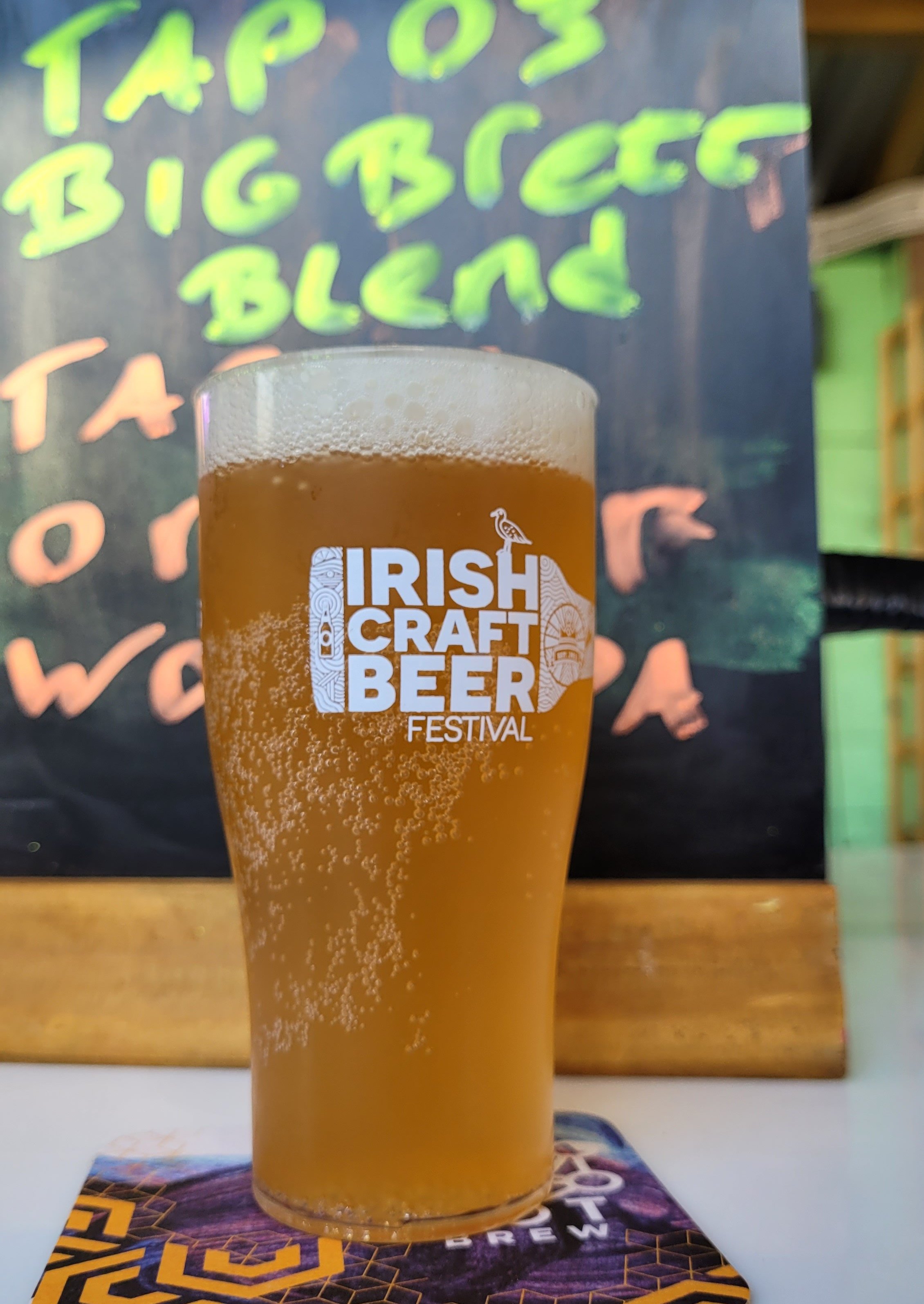
It shouldn't be surprising that Dublin 8 neighbours DOT was one of them. I was immediately drawn to something called Big Brett Blend which turned out to be a pale beer of only 6% ABV but blended from liquid aged in rum, Chardonnay and French oak barrels. It came out of that remarkably crisp and clean, with a certain slickness but little weight on the palate. Oddly there wasn't much wood character, suggesting the virgin oak component was quite small, though I got no rum or wine either, really. Instead, the Brettanomyces has control, adding a tasty peach and orange fleshy fruit note. It's decent fare, if not as "big" as the name implied.

DOT also turns out IPAs from time to time, and here they were pouring On Our Way, another 6%-er. Maybe it was the sunshine on the day but this too seemed lighter and more easy-going than expected. It's brewed with Centennial and Mosaic and is somewhat hazy without going full-on opaque murk. The flavour is very much in the New England manner, however, blending juicy citrus with smooth sweet vanilla for that orange ice pop or lemon meringue pie effect that's showing very little sign of going out of fashion. I'm wasn't complaining, for once.

Around the corner from DOT we had Hopfully, who brought a beer which normally only goes to export: the Simcoe single hop IPA called Wolfhound. As such, it expresses what I associate with the hop very well: a dense and resinous funky side that's dank to the point of tasting cheesy; damp silage meeting mature cheddar. It's 7% ABV but not hot or boozy, and I think needs a gravity of that size to carry the hops. It's not really a beer built for balance but there is a dryer side to its malt base: an element of brown breadcrust or rye cracker to keep the oily hops in check. Full-on Simcoe can be a difficult one for me to handle but I got the hang of this one quickly and was having fun drinking it by the end.

A total contrast was on offer at Kinnegar: their third Taproom Only special getting an airing: the 10% ABV Barrel Aged Imperial Brown Ale. Just like with DOT, the barrel (Bushmills, in this case) didn't have a big impact on the final product, but it's still every bit as mellow and sippable as one would expect for a strong dark beer of this nature. Dark chocolate is at the centre, shot through with sparks of dry roast, with a wisp of smoke and a daub of butter. I think it could stand to be richer, and I would have liked more of a coffee element. If they used brown malt, they didn't use enough for my tastes. While it's good, I don't see any reason to take it beyond the small-batch experimental phase.

We cross the yard to visit Wicklow Wolf, who were showcasing a new India Pale Lager, brewed in collaboration with Lost & Grounded and named (of course) Running With Wolves. They've managed to cram a lot into quite a small package here, including brightly zesty lime and grapefruit; a more savoury fried onion and then a weighty herbal dankness. The lager cleanness means that each element is distinct and can be enjoyed separately instead of being smushed together the way they might be in an IPA. 5.6% ABV is on the strong side for an IPL, but since hardly anyone makes them any more, that barely matters. This will do nicely.

The foreign visitors were given one stall between them and I made a point of trying something from each, even though €5 a half was very much on the pricey side.

The Kernel justified it, unsurprisingly, with their Sour Cherry Saison. This is 4.7% ABV and a clear scarlet colour. The cherry is fully infused through it, covering up any underlying saison character there may have been, so you get lots of succulent maraschino as well as a more bitter cherry skin. There's a strong sour side to it as well, contrasting pleasingly with the cherry's sweetness. This is another one of those beers uninterested in complexity but so boldly flavoured that it doesn't matter. Typical high-end Kernel quality.

Beside them was the skull-fixated Lübeck brewery Sudden Death, offering assorted murk. I unenthusiastically picked Synaesthesia Mosaic from the line-up, a 6.3% ABV IPA which was, of course, totally opaque. For all that, it was decently clean tasting and opened with an assertive bitter smack of satsuma and mandarin peel. Later on, vanilla custard and green leafy spinach enter the picture as well, and all get along harmoniously. It's an absolutely typical NEIPA of the sort you've likely drank many times before from breweries like this, but I will concede it's one of the better examples.

My round-up ends there. Cheers to Rascals and the visiting breweries for a fun day out. Festivals can sometimes be overwhelming in their breadth; this one is much more of a manageable boutique affair, which has its place on the calendar too.

29 May 2023

It's my party

This year was the first time I attended the Happy Days festival held at Rascals in west Dublin. It's a bijou affair, three rows of stalls gathered around the yard behind the brewery where invited guest breweries plied their wares. But I'll get to them in the next post. Rascals itself had a wide range of new and recent special edition beers to offer so I'll take a look at those first.

Something light and sour to start with, sort of. I was intrigued by the idea of the Lemon, Lime & Coconut Sour served nitrogenated, and I was charmed by the result. Due to the gas, the texture has a lot in common with lactose-laden pastry jobs but without any of the residual sticky sweetness. Clever. The flavour doesn't seem to be dulled by it either, opening with a sharp lime sorbet effect with lighter lemon zest following behind. There's no discernible coconut and not much sourness beyond the citric, and I could criticise it for being a smidge too strong for what it is, at 5.3% ABV. As the opening beer at a sunny beer festival it gets nodded through with approval, however.

Next it was something in the Kölsch style, with Sabro, called Sabro Kölsch. Brewer Josh admitted that this didn't turn out as planned when I remarked on the absence of coconut, pith or other Sabro character in it. Seems that got inadvertently stripped out in the effort to clear the beer. It's not the first time a brewer at a festival told me I should have tasted it from the tank. What's left is a decent but uneventful 4.8% ABV blonde ale with light orangeade notes on a crisp, cracker-dry base. Had I known in advance I would have saved this as a palate-cleanser for later in the day.

In the reverse of my normal pattern at festivals, I dropped the strength even further for my third beer, the 4.7% ABV Session IPA '23. Josh was very keen to show off his use of the next generation of hop products: Mosaic in "Incognito" form and Eclipse as "Spectrum". I don't know if there's meant to be any appreciable difference for the drinker but I didn't get anything unusual, good or bad, from this. Maybe it's just easier to use than those messy leaves or pellets. The beer is lightly hazy, its mouthfeel starting soft but finishing dry, so incorporating elements of both schools of American IPA thought. There's bags of resinous, oily dankness, and maybe that's a benefit of the extract. I got a strong hit of garlic and red onion too, telling me that Mosaic can misbehave, even when it arrives at the brewery in a bottle. So, the complexity and depth of flavour were enjoyable, but a bit busy. This is definitely better suited as a one-off for taproom and festival rather than anything more regular. A session on it would be hard going.

There's yet more Spectrum involved in Rascals's Cold IPA, and although I can't see a reference to Mosaic in any available documentation, it's very oniony again, though fried rather than raw this time. The ABV is 5.6% and it's warm fermented, giving it a bigger and smoother texture than most other cold IPAs I've had. To balance that with the required lighter crispness they've included rice as an adjunct. I guess that's meant to dull the fruity side but I still found some pleasant nectarine in with the onion. I enjoyed it overall but it is a bit intense, shading to harsh at times. I reckon that fancy new hop juice is meant for bigger-flavoured beers than either of these recipes were designed to be.

It was back to the silly stuff later, with a Strawberry Lime Gose, just like they make in Leipzig -- a orangey-pink emulsion at 3.9% ABV. It tastes of yoghurt, with strawberries, but in a sharp way at first, leading to a pink-tasting candy-sweet finish. I found it a bit basic, all told, with no fun twists. Only a mildly savoury tang in the middle provides any callback to the gose specification. I can't help thinking this was brought to the festival with a particular drinking audience in mind, which wasn't me.

With things winding up for the day at 9pm, my finishing beer was Rascals Oatmeal Stout. Rather like the Coffee & Oatmeal Stout I had on my last visit, this is quite intensely flavoured, the strong coffee and high-cocoa dark chocolate being a surprise after only a gentle coffee roast in the aroma. The oatmeal serves its purpose of bulking up the body well, and there's lots of satisfying substance for just 4.4% ABV. That helps sweeten things as well, so after an initial bitter jolt there's a gentler cake and cookie middle. It took me a while to make my peace with the contrasting sides but I was enjoying it by the end. I wouldn't call it a worthy successor to the stout, necessarily, but I like that they seem to have decided they must have something like this on tap at all times. Everyone should.

In between all of that, I drank beers from the visiting guest breweries. The next post covers what they served me.


26 May 2023

JR Mahon's: an appraisal

This is part three in the ongoing saga of 1-2 Burgh Quay, Dublin, as relates to beer and brewing. Anyone who has ever crossed O'Connell Bridge with a thirst on them will know that between 1998 and 2013 the building was the Messrs Maguire multistorey brewpub. Then, following the economic crash and a change in ownership, it became JW Sweetman. I wrote about the first incarnation here, and the revamp here, with plenty of posts about the other beers they released in between. Then at the end of 2022, having not quite made a full recovery from Covid, it was sold again. The new owners re-opened it under their own name, so it's now "JR Mahon's". They've done a substantial refit of the interior, although the first casualty of that was the groundfloor brewhouse, unceremoniously yeeted out the front window. Sensibly they have retained Rob Hopkins as the house brewer, and he now has his own set-up not far away in Smithfield, from which he supplies three beers for the pub. Let's have a look at them.

In the Sweetman days, the house pale ale was a dark and resinous affair, often to be found outside the pub under the Barrelhead brand. I assumed it would be getting another lease on life as JR Mahon's Pale Ale but on my first visit in April that's not what I found. The beer was lighter, fruitier and altogether more modern tasting with a touch of tropicality about it. The brewery says the recipe has "evolved" and now uses whole-flower hops, which wasn't possible with the Burgh Quay brewhouse. I was quite pleased with the evolution. And then a couple of weeks later I was back and drinking the pale ale again. And this time the resin was back too. I could be imagining it -- different palate, different day, different mood -- but it is possible that two iterations of the pale ale are on the go, both good, but quite different from each other.

JR Mahon's Red was the most disappointing of the three. It's wan and murky looking but doesn't even have the character strength to taste dirty. Instead it's very plain indeed; thin and fizzy like Diageo's mainstream Irish red brands. That does mean full marks for tasting true to style, but most Irish microbreweries play with the basic specs a little, raising the roast or the hops above the industrial lowest-common-denominator level. Not here, more's the pity. This is a beer for those who like their red ale to be unchallenging, even by the standards of red ale.

Now the JR Mahon's Stout was challenging. There was a choice of two versions on my last visit and the straightforward kegged version was absolutely packed with diacetyl. A little mild caramel shows up afterwards, still sweet, and there's a tiny hint of charcoal cracker in the finish, but other than that it's big butter all the way through. Sensitivity varies but I found it quite intrusive, taking away drinkability from what should be a sessionable stout at 4.1% ABV.

Redemption came from the handpump. There was also a version of the stout which had been dry-hopped, presumably in the cask from which it was served. The result was staggeringly different. First of all, the gooey, sickly butter was gone without trace. Covering it up was a fresh burst of American style citrus, occupying the foretaste then giving way to toasted grain, providing a different sort of bitterness. This was much more like it, and I didn't mind a jot that the overall picture resembled a black IPA much more than an Irish stout.

So I won't be rushing back to JR Mahon's for the house beers, and at €7+ a pint, they're charging above the odds for independently brewed beer in central Dublin these days. But that little bit of variation is promising. Cask fun and special editions will get me back in the door in due course.

24 May 2023

Asylum granted

They're not taking sides in the off licence section of supermarket Polonez. You can still buy Russian beer but I recently came across a Ukrainian lager in the Mary Street branch: Obolon Premium, claiming to be "the first Ukrainian beer". Good for them.

It seems pretty standard macro stuff: a half-litre can of 5% ABV, brewed with rice. It's a medium gold with lots of fizz and a fast-fading head. The adjunct doesn't seem to have thinned it out any because it's very nicely full-bodied, properly süffig in the German way. In fact, although it's a little weak for it, I got certain Märzen vibes from it, delivering smooth cottage-loaf breadiness at the base of the flavour, adding a tangy green cabbage and spinach noble hopping on top. It veers a little into the high-strength cheap lager mode in the finish, with an off-kilter banana fruitiness and an unwelcome heat. Neither spoils it, though.

I know next to nothing about Ukrainian beer, but if this is the national flagship, it's a jolly decent one, and much more characterful than I was expecting. And if Polonez has a pipeline for Ukrainian beer (via Barry & Fitzwilliam, by the looks of things) I'd be very interested in getting more from it.

22 May 2023

Return to the wild

One month isn't too much of a delay? Swifty Simon was critical of my general tardiness in writing up beer events when we met at the second Mullingar Wild Beer Festival. If there's one thing all the brewers there understood, it's that you can't rush quality.

Nobody demonstrated that better than Land & Labour, which had a sizeable line-up of old favourites and exciting new offers. The Spon 4-Year Blend which impressed me at BXL last year was back with a new season-specific name -- Geimhreadh -- and was still tasting marvellous. Irish winter is followed by Irish summer, and Samradh is brewed with elderflower and gooseberry. It gets a superb complexity from that, the elderflower very prominent amongst the flinty sour notes, with added peach and apricot soft stonefruit. There's a very slight sweaty tang in the finish but it doesn't spoil things: the whole remains calm, integrated and very classy.

Also new for me from the Land & Labour stall was Aibreoga, a geuzealike with actual apricot. This didn't work so well for me, tasting powerfully sour, like spirit vinegar. It does taste of apricot but only as an afterthought past the initial acidic rush. I took a while over it to figure out exactly what's missing, and I think the answer is mellowness. There's none of the rounded mature oak flavour that is an essential, but often overlooked, aspect of the good sour beer experience. Maybe a few more years will fix that. I'll come back to it then.

Land & Labour played host to Wide Street when they collaborated on Many Hands, a blend of mixed-fermentation saisons from both breweries given two years of ageing. The result is magnificent: light-bodied and golden, the flavour opening on a fun and refreshing spritzy citrus. This turns funky quite quickly, summer zest giving away to cool misty orchards and strong warming tea. I liked that it has all the in-depth multi-faceted nature of serious sour beer for chin-stroking grown-ups while also being zippy and zingy and happy to drink. That can't be easy to achieve.

Wide Street had also given their Mill Pils the wild treatment with an addition of Brett to make it Brett Pils. That does seem to have thoroughly removed any proper pils-like elements: no crispness and no grass is on display here. Instead the Brett brings a combination of ripe peaches and spicy pepper in the fortaste, turning to bitter grapefruit and a hint of soggy cardboard late on. I liked it, but the expectation of calling it a pilsner wasn't met -- it has become something else and the name should reflect that.

Otterbank missed the festival last year, so it and I had a lot of catching up to do. The cask engine on the bar was serving a new version of the Cake Dealer Chocolate Brownie imperial stout. The first version had been aged in mezcal barrels while this one, still 10.5% ABV, was treated to rye whiskey. It worked much better. The mezcal brought too much of a sourness whereas this let the stout speak for itself, with a glass of whiskey to hand. The overall effect is similar to an Old Fashioned, bittersweet and spirit laden, with added elements of espresso and gooey chocolate sauce. That all sounds a bit busy, and it is, but it's an excellent sipping beer to take time over. Not that I did.

As plainer fare, Otterbank had Just the One, and I wasn't sure if the name was meant to be ironic or not because although it's a substantial 6.7% ABV it's quite thin and poured a little flat. The flavour, however, is spot on for something attempting to be lambic: all the damp and bricky nitre spices backed by citrus pith and hard bitter wax before a quick, clean and refreshing finish. It doesn't really bring the firework intensity of geuze but would pass as a good example of straight and uncomplicated lambic. That's still damn impressive. I'd love to see something like this become a readily available core beer from some Irish brewery.

There were a couple of stronger and darker offerings from the Donegal brewer, including A Wee Drop: kveik fermented, soured with Roeselare yeast, funked up with Brettanomyces and aged for two years in whiskey barrels. House! The result is 7.1% ABV and does manage to cram in elements from all of its convoluted production history, tasting a lot like an Irish coffee with a glass of blousey Spanish red wine on the side. I was rushing a bit by the time I came to this one so may not have fully fathomed what it was offering, but I liked what I found.

And stronger still was the Burgundy coloured Brothers, aged in and blended from actual Burgundy barrels. It's broadly in the Flanders red category, and raspberry notes feature big on both the flavour and aroma. In the latter that mixes with heady forest resins while in the flavour it accompanies rich and smooth notes of cherry and dark chocolate. 8.2% ABV makes this one not a beer to rush, and as I sipped I appreciated the smooth and round maturity, where the sourness is brisk but not sharp, staying mellow from end to end. If it were a Flanders red it would be one of the special edtions in the 75cl bottles. Not for the first time on the day I felt that lashing through these to get to my train wasn't really the appropriate context for the beers on offer.

That was it for the Irish beers on show but four UK breweries also brought, or sent, beers for the gig. The brewer from Glasgow's Epochal did a good job of selling The Primum Mobile stout to punters (me) as they gathered early doors. This is 8.8% ABV, loaded with Brettanomyces and apparently based on an historical recipe from a Glasgow brewery. It didn't work for me, in the way that soured stouts generally don't. The Brett is fully in control, bringing busy and cloying notes of aftershave and sweaty horses, much like Orval, although quite thin as well. There's chocolate next to that, but who wants watered-down chocolate-flavoured Orval? Not me. A small glass was OK, and let me appreciate the many things happening in the flavour, but I doubt I could handle any more of its busy antics.

There were two offerings from Cambridgeshire brewery Pastore and I got to try them side-by-side. The darker one on the left is Black Shuck, breaking my rule that beer with a colour in the name should be actually that colour. This 6%-er  was aged in sherry barrels but unfortunately doesn't taste of sherry, being very tart and mixing balsamic vinegar, sweet white wine and citrus zest. Mostly, though, it's just sour for sour's sake, lacking any deeper or more interesting character. Meh.

Sometimes, beers with complex production process do get away with a lack of complexity, and Pastore's other offer was a case in point. Cuvée di Rabarbaro is, as the name suggests, a rhubarb beer. And it is extremely rhubarb, to the point of tasting squeaky. There's a little bit of vanilla for complementary balance, but that's your lot: rhubarb is offered and rhubarb is delivered, in bulk. I liked the single-mindedness of the flavour profile and enjoyed the beer as a result.

Little Earth Project sent a strong but sippable beer in the form of White Horse Reserve (right of picture), an amber-coloured mixed fermentation saison at 7.4% ABV, given 18 months of barrel ageing. A spicy geuze-like aroma contrasts with a substantial, but welcome, hop bitterness and then a touch of coconut in the finish. Though the flavour is sharp, the texture is smooth and it makes for relaxing drinking. It feels like they've taken a very traditional geuze recipe in an interesting and different direction. I'm here for that, when it's done this well.

Finally, I was faced with a choice for my single Burning Sky beer. It was late enough at this point that I eschewed the Table Beer and went instead for Wild Rose at 6.5% ABV, another mixed fermentation saison. It's a hazy golden colour and has a wonderful balmy-summer aroma of elderflower and meadowy herbs. The flavour is rich and fruity, suggesting white grape to me, concentrated and tasting almost botrytised. It's absolutely delicious and I wasn't long getting though it despite the heft.

That brings MWBF II to a close, and not a Rennie in sight. The organisers did a great job in improving on the original, expanding the offer while maintaining the boutique atmosphere. I'm not sure how much space for further expansion there is in Smiddy's but you might get a few more tap lines, and it would be fun to have other international guests of the same calibre swapped in. One suggestion I would make, if it's feasible, is to have more/some information available on the beers: perhaps a printed guide. Regardless, all going well, I will be back for round three.


19 May 2023

Spring when you're winning

The Wicklow Wolf project seems to be bombing along nicely. Its big fancy brewery, opened in 2019, is now producing a very decent core range, widely available in mainstream shops and pubs, while the various seasonals and special editions arrive like clockwork. It's everything you would want from a large-ish microbrewery. Today it's two from their collaborative series and the new spring special.

Dutch brewer Jopen provided input to this peach, apricot and mango "pastry sour" called Papa Don't Peach. It's 5.2% ABV and an innocent bright yellow in the glass. The fruit aroma is powerful: a sticky, syrupy mix of concentrated tropical notes, heavily processed and melded together so that, yes, it smells like the idea of all three fruits, but at the same time like nothing which exists in nature. And then the flavour doesn't taste like any of that. It opens spicy -- cinnamon, mint and peppercorns -- and then proceeds directly to a different sort of sweetness, more like cordial or even real peach nectar, onto which is grafted a dry mineral sourness. It is very strange. "Pastry sour" suggests something thick and milky to me but there's no sign of the lactose listed in the ingredients and the mouthfeel is very thin. I should award this marks just for its sheer oddness, but it's too weird. The various loud flavours and aromas don't integrate well and it ends up as a cacophony, difficult to drink and impossible to enjoy. I expect it's a divisive one, though, so your mileage may prove better than mine.

Do matters improve when we move along to double New England-style IPA? Exhibit B is Another Brique in the Wall, 8% ABV and created in collaboration with Lille brewery Brique House. The visuals are great: it's a lovely warm amber colour, intimating the strength, though also properly fuzzily hazed. The aroma is tropical, though in a much calmer way than the previous beer, and again the strength is indicated, here with a little heat. And that's pretty much how the flavour does things, with pineapple and cantaloupe up front (Talus and Idaho 7) and then a smooth, wholesome, wholemeal, warmth. Beers like this trade on their freshness but this is the first I've known where fresh fruit is matched to fresh baked bread and it works wonderfully. The alcohol is unhidden and delicious, giving it fun Belgian vibes. Malt-forward double NEIPA is an idea whose time has come.

Last up is a solo performance: Locavore Spring 2023: Honey Hefeweizen. This seasonal series uses all-local ingredients, including honey from Wicklow bees and wheat from a field behind the brewery. It's pale yellow, looking a little wan and not like its sizeable 6% ABV. The aroma is more spice than fruit: it smells lovely, but much more like a Belgian witbier than Bavarian weisse. It is extremely thick and low on carbonation, making it a bit tricky to drink. The herbal effect in the aroma unfolds to become the floral, medicinal honey in the flavour, a presence that brings both bitter and sweet. More traditional notes of green banana and celery arrive late on. I like my weissbier to be lighter and fizzier than this, so it didn't really work for me. The honey didn't add anything I liked, backing up my general assertion that German beer styles like this work better when they're done absolutely straight. This isn't offensive, but it misses the mark, both as a weissbier and as a member of the Locavore series.

OK, so your excellent large-ish microbrewery doesn't have to produce all winners in its temporary ranges. As is often the case, I respect the hustle with these three a little more than I enjoyed the beers. I'll take more of that double IPA, though.

17 May 2023

Solidarność

Today's handsome swingtops are from Browar Staropolski in the vicinity of Łódź. They're both branded as "Worker's Beer" -- Piwo Robotniczo Ludowe -- and feature a dude with a hammer and a dude with a rake on the label to underline this.

4.7% ABV PRL Piwo Jasne is, as the name suggests, the pale one, and to complete our Polish lesson for now is "niefiltrowane", unfiltered. As a result it's a rather murky looking shade of amber. The aroma is sweet and cake-like, so no crisp cleanness here. That's borne out even more so in the flavour. There is a little hint of dry-ish seedcake in the finish but before that it's a sugary dessert, almost wort-like in its sweetness. It tastes wholesome and nutritious, if a little unfinished, so not quite what I was seeking but I'll take it. Maybe better suited to a winter's working day than summer.

PRL Piwo Pełne ("full beer") is filtered but makes up for it with a substantial 5.8% ABV. It's not quite perfectly clear, but I'm taking that as a good sign. It's still pretty sweet to smell, though that's less surprising given the extra heft, and I think I detect a tiny, tinny, hint of hop bitterness. Although the mouthfeel isn't especially heavy, it's strangely unfizzy, with just token carbonation. It tastes strong too, in a kind of concentrated and syrupy way, a bit like the undiluted gunk in a homebrew beer kit. There's a headachey higher-alcohol ester effect which strongly implies that more than one of these would be a poor decision. While not a disaster, redeeming features are thin on the ground here.

I guess they're going for old-fashioned and unfussy with both the branding and recipes of these, to make you feel like you're someone who does a proper job, after a day on the spreadsheets and Zoom calls. The pale one pulls it off but I would be raising the second one with my union representative at the earliest opportunity.