03 June 2022

In the loup

A new pair of Wicklow Wolf beers arrived in early May, adding respectively to the brewery's collaboration and limited edition series.

Mayo's Mescan is not really known for its collaborations, and as a steadfast producer of Belgian-style bottled beers, their logo on a can is an odd sight. At least the beer is Belgian style, a witbier called Wit or Witout You. The specs are almost orthodox: 5% ABV with coriander and orange zest, though there's an extra addition of black pepper too, just for fun. It's quite fruit forward on that, with a definite sweet mandarin juicy quality. The herbs and spices are subtle, and meld into the spicy effects of the Belgian yeast. That in turn adds a banana sweetness as well. I hoped for more black pepper than I got, and it leans a little too far on the sweet side than is ideal, but it's still a very nice beer and a worthy interpretation of witbier. I think the host brewer got their money's worth out of their guest's expertise.

Is This Pop Art? they ask next. The name references the use of the Cryo Pop hop blend, as though that's still a novelty. It's an 8% ABV double IPA, seemingly on the New England side of the house, judging from the custardy orange-yellow appearance. The aroma is coconut with a bit of tropical fruit, making me think I was in for a cloying piña colada experience. But no, the flavour picks the fruit direction and runs with it in a big way. Bouncy boinging pineapple, mango, apricot, guava and passionfruit all feature, given a quick squirt of lime and a glug of something cleanly alcoholic. It's beautiful, and completely devoid of any hazy pitfalls, even as it warms. The only quibble I can think of is that it doesn't taste properly double: it's stupidly drinkable and impossible to sip. I'm sceptical about advances in hop technology in general, and haven't been wowed by Cryo Pop before, but if this is what it's meant to do, I'm on board.

Last time, I remarked that Wicklow Wolf was very good at making stouts. Well here's a couple more strings to their stylistic bow.

01 June 2022

Third time... lucky?

Gueze is hard to resist. That's why I've come back to Lambiek Fabriek, even though I don't think their beers are as good as those of their more established competitors. But they're available here now, and faced with a bottle of an unfamiliar one in Molloy's I was compelled to buy it. Maybe this will be the breakthrough.

Natur-Elle's signature feature is that it's organic. That doesn't mean it'll automatically be brilliant, but hey: it works for Cantillon. The beer had been in the bottle for almost a year and had developed quite a lot of gunky sediment, necessitating very careful pouring. The aroma is decent but unspectacular with an understated level of gunpowder spicing. The flavour carries that along well, but is plagued by the same issue as the flagship Brett-Elle: a thin vinegary sharpness in place of the richer and smoother sour quality of good geuze. 6.2% ABV is a significant strength so I feel I have every right to expect something more rounded as a result, but this is all pointy angles with not enough of what makes geuze enjoyable.

So they're not there yet. And perhaps they never will be. Will I eventually be buying a fourth bottle to test this further? Bank on it.

30 May 2022

Home and Garden

In the summer of 2019 I spent a pleasant sunny afternoon in the taproom of Garden Brewery in Zagreb. Their beer does get out and about as well, and today I'm at home getting reintroduced.

I've had most of the core range, though the India Pale Ale has eluded me for some reason. Until now. "West Coast" is in small print on the can but writ large on the beer as it pours: an almost-clear amber colour with a lovely grapefruit-on-toffee aroma. There's a pleasing softness about the texture, though a continent away from New England fluff. This is 6% ABV but feels like it could be more. That emphasis on malt dampens the hop impact a little and it lacks the initial zesty sharpness of the best west coast IPA. Give it a minute, however, and the pine and citrus gradually rise, eventually coating the palate in classic American resins. We're not told what hops are used but I would fully expect that Cascade is the driver. Anyone in search of the proper American IPA experience will not be disappointed by this.

At the other end of the spectrum, Milkshake IPA is Still A Thing™, though it's not a beer style I go running to. Garden's looks to be taking the IPA part of the equation seriously, using six different hop varieties, plus lactose, of course. It's quite a deep orange colour and 6.2% ABV, smelling sweetly of strawberry and kiwifruit. No syrups are involved so I'm guessing it's the Summer and Hallertau Blanc hops bringing that fruit effect. Still, the hops don't prevent it from seeming like a milkshake on tasting. The texture is horribly sticky and the lactose gives it an intense and cloying sweetness. The realistic fruit in the aroma isn't delivered in the flavour and instead it's gummy and artificial. My brief moment of thinking that maybe milkshake IPAs aren't so bad ended abruptly with the first sip. This is one for the MIPA purists alone.

Bière de Garde is a style which doesn't get messed about with as much as IPA does, but Garden has had a go, in cahoots with Brooklyn's Stillwater. The result is a Peach, Nectarine & Camomile Bière de Garde. It looks like orangeade in the glass: sunset orange and pouring with a head which instantly crackled away to nothing. It smells normal for a BdG: cracker-dry and crisp with a light peppery spicing. The flavour too is clean and unfussy, adding in some apple to the grain and spice as it warms. The fruit add-ons are detectable, however, though they're subtly done, bringing a zesty spritz to the grain dryness, one that's entirely complementary. There's a floral side too, which I'm guessing must be the chamomile though it tastes more like elderflower to me. It's all done at just 5.5% ABV and served in a tall can, making it a great summer thirst-quencher. I always think of old Bière de Garde as a somewhat stuffy and serious kind of beer, but here's proof that it can be fun while also staying true to its essence.

We wrap things up for today with a simple Imperial Flat White Coffee Porter. I sneer at the name, and at the cacao nibs and vanilla pods, but it looks gorgeous: a rich velvety brown as it cascades into the glass, forming a decadent café crème head. The aroma is all about the coffee, and more like raw roasted beans than the finished drink. And while that's a big part of the flavour too, the chocolate gets heavily involved also, for a tasty mocha effect. The vanilla shuts the hell up, as it should do. At 8.4% ABV, this is a finisher, a nightcap, but it's also beautifully smooth and effortless drinking with no excess heat or cloying sugar. The sweet chocolate is balanced perfectly by the dry roasted coffee: both highly unsubtle yet working together in harmony. All sneers were gone before the glass was a quarter empty.

No surprises that the milkshake one wasn't for me, but the others have raised Garden's standing in my eyes. I had thought of them as experts in sour and little else, but from this is appears they have chops across the beer style spectrum.

27 May 2022

Dry state of the art

It's time for one of my periodic checks on the state of non-alcoholic beer. Brulo (formerly Coast) is one of the new wave of UK brewers who make nothing but. The company is headquartered in Edinburgh with beer brewed in Belgium by De Proef. What attracted me most was the stylistic variation in their range: not just the usual IPAs and lagers.

The first one claims to be a 5 Fruit Gose, containing mango, passionfruit, guava, apricot and orange. It looks like juice, being orange, hazy and quite lifeless in the glass. There's a faint sparkle but no proper fizz. The fruit is present in a big way, meaning it tastes much more like a soft drink than a beer. Behind it there's a subtle note of salt, as well as the worty malt sweetness that most non-alcoholic beers exhibit. What's missing is any bite of sourness. Modern craft gose with fruit in it doesn't bother much with sourness but they usually make more of an effort than this. It's a fine thirst-quencher, and genuinely enjoyable, but not as a beer and certainly not as a gose. I think they've over-reached themselves a little here.

Maybe an IPA is safer. This one is a Centennial IPA, and is extremely pale -- a disturbing wan yellow, the colour of very dilute lemon squash. I don't think it's the visuals alone that made me think of lemons when I smelled it: there's a proper citrus here, though quite a lot of malt sweetness is promised as well. Again, there's lack of proper carbonation, though it does manage to form and keep a thin head. The flavour is... odd. I get a kind of squeaky, mineral, asparagus bitterness that's quite sharp. And then running in parallel with this is too-sweet malt extract, which eventually comes to dominate the whole picture. Both aspects are loud and brash, to the extent that this, too, doesn't really taste like a beer. Disappointing.

It looks like Brulo is falling into all the old traps. The last-chance saloon is pouring stout: the style which I think suits the non-alcoholic format better than any other kind of beer. If they mess this up I despair. The ambitious feature here is that it's a Dry Hopped Stout, Simcoe and Columbus doing the honours. Problem one: it's not black, being more of a reddish-brown. The aroma is lovely, though perhaps better suited to a black IPA than a stout, being all about the bitter and vegetal dankness. The hops were clearly added in abundance. It's more stoutlike on tasting with a strong coffee character. I don't get the wort or malt extract thing, but there is a sweetness, like the coffee has had a couple of spoons of brown sugar added. Despite the hopping, the bitterness is on the low side and that reduces the extent to which it tastes like a proper stout. I'm filing this one with the gose as something that's fun to drink but doesn't deliver a substitutable beer experience.

It's a mixed welcome for Brulo then. I appreciate their efforts at trying to provide something more interesting in the non-alcoholic space, but these aren't convincing. I'm more likely to reach for an actual soft drink than any of them.

25 May 2022

Oi oi oi

The recent surprise realisation that I'd never posted a review of Augustiner Dunkel on here had me checking the status of the rest of the range. Sure enough, Augustiner Pils was absent too. It would not do to have such gaps in my personal assessment of one of the planet's great breweries, so I picked up a bottle.

It wasn't the freshest, mind, caught just inside its best-before. The big 5.6% ABV suggests a baroque Bavarian luxuriousness, as against the skinny and severe north-German pilsners. That said, there's plenty of hop, and it's the dominant feature of the flavour, just as it should be. I get a grassy Czech effect with a sharper citrus-rind edge. A decently full and fluffy malt body balances this, contributing richness without sweetness, then it's back to pilsner-as-usual with a dry finish scraping the back of the throat pleasantly.

As expected, it's very good, let down only by the most unBavarian 33cl bottle: I could happily drink this in quantity. I also don't see how much better it would be if fresh; mine showed no staleness nor signs of faded hopping.

Augustiner Pils is a pure class act and fully worthy of carrying the brewery's name. If you haven't had it in a while, treat yourself.

23 May 2022

Stout mask replica

When Dublin City Brewing first graced these pages, I mentioned that their intended line-up included "Parnell Porter". That never materialised but they do have a new dark beer, simply called Irish Stout. The blurb on the back still has a bit about Parnell, though, so I suspect a last-minute name change. I still have no idea if this is brewed at the Parnell Street brewery, which remains all boarded up from the outside, or if it's contract brewed at Dundalk Bay. I suspect the latter.

Anyway, to the beer. I expected quite straightforward stuff from a 4.2% ABV stout, and I pretty much got it, but that's not a criticism. The body is attractively smooth and black, and there's a decent but not excessive amount of rocky foam. It smells sweet and roasty and this unfolds on tasting into caramel, liquorice and well-done toast, with the sweet side maybe a little more prominent than is ideal, especially in the finish. The mild roasted side helps balance that and there's even a little green squeak of vegetal hops. Its best feature is the drinkability: no trace of stickiness and no hard edges or odd twangs means it slips back very easily and is pleasingly refreshing. Perfect summer stout, wherever they brew it.

Backyard Brewing is a new operation, based in Tullamore but currently availing of midlands solidarity and using the facilities at Dead Centre in Athlone. Their first beer is a Cascade Oatmeal Stout. It's 5.5% ABV and looks very proper: an even jet-black with an old-ivory-coloured head on top, every inch the wholesome and old-fashioned glassful. The interloping American hop hasn't been overdone and there's a mere pinch of zest in the aroma, plus a little more in the flavour. The initial grapefruit settles to a weighty dankness in the finish. This is entirely complementary with the smooth dark chocolate and dark toast notes. Overall vibes are not far from Sierra Nevada's excellent hop-forward stout. Its mouthfeel could maybe stand to be a little fuller given the oatmeal, but otherwise I have very few criticisms to give: it delivers very well on the promise of the name, tasting at once traditional and modern, but always a proper stout. I hope this is a flagship rather than a one-off, because nobody else is making beer like it in these parts.

Before we get into the properly strong stuff, a gateway export stout from The White Hag, called Balor. This is 6.5% ABV, the recipe boosted with brown sugar. There is a certain molasses sweetness in it, rubbing up against an espresso roast and some significant hop bitterness, this time of the more traditional sort -- metallic and vegetal. It's not a beer for the soft pastry crowd, showing a robustness that's not in fashion which I enjoy scouring my palate from time to time. Again, though, the texture isn't quite right and it's a little thin for 6.5% ABV, with a knock-on harshness. Maybe I'm softer than I thought. Anyway, it's a jolly decent stout, full of flavour, if maybe a bit of an acquired taste.

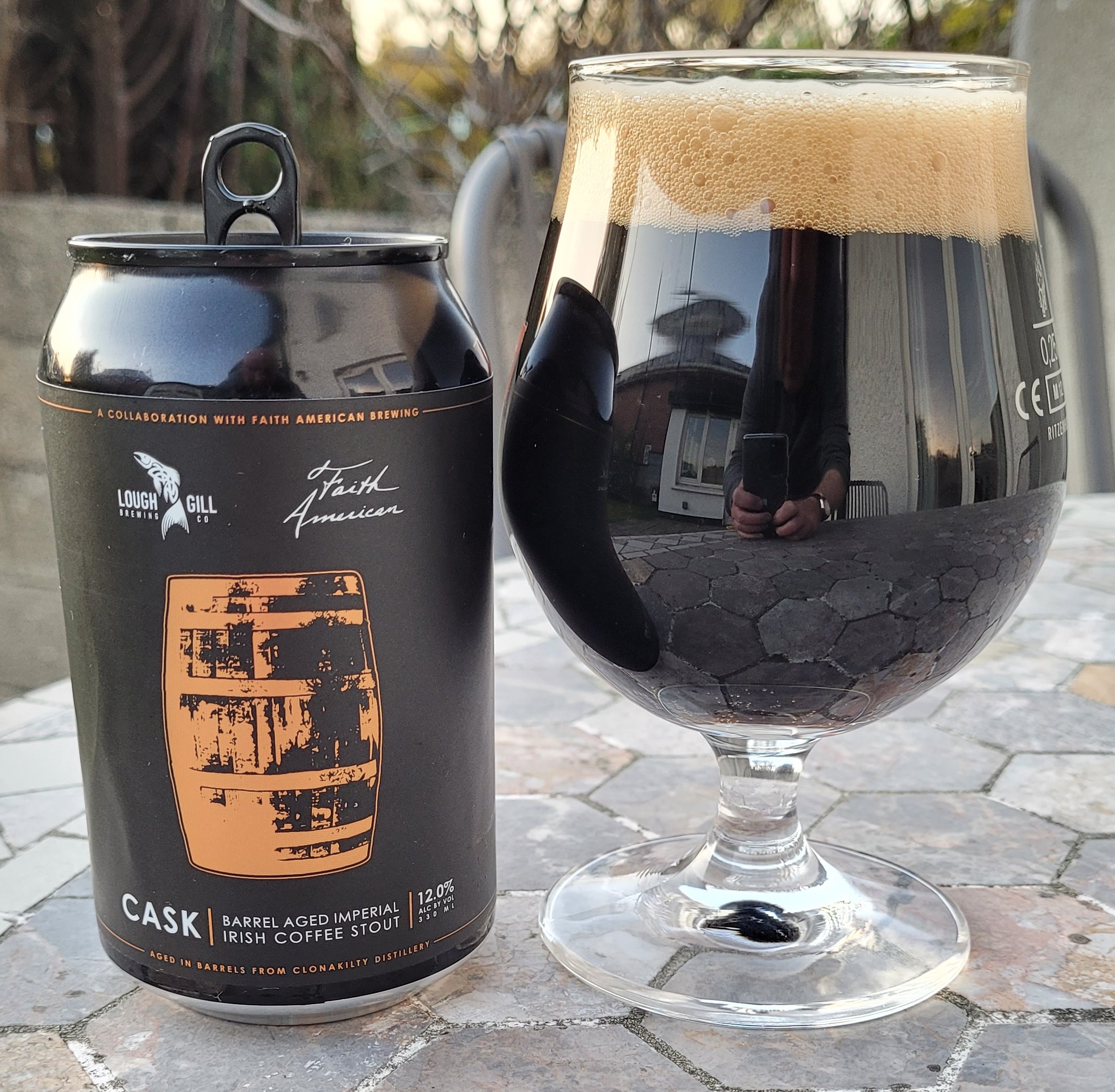
Something big to start the wrap-up with. Cask is a collaboration Lough Gill did with Faith American Ales, and the can bears the signature of Faith's frontman, Kelsey Grammer, off of the telly. It's a coffee-infused milk stout which has been whiskey-barrel aged for the full Irish coffee effect. Not an original idea, but one that turns out good results more often than not. Honey is the quintessential Irish whiskey flavour for me, and this has plenty of it: a sticky honeycomb or honey-nut cereal is the centrepiece. Though 12% ABV it's not especially hot, though it is as creamy and full-bodied as one might expect. Other flavours include hazelnut, milk chocolate and a lacing of espresso in the finish. It's enjoyable, but I felt it all could have been dialled up a few notches. Beer like this shouldn't be as easy drinking as this is. Make me work a bit harder.

Perhaps the answer is Sixty Ships Down. This is another 12%-er, brewed by Galway Bay in collaboration with La Pirata. They've added vanilla and tonka beans, calling to mind, to an extent, one of the special versions of Two Hundred Fathoms they released in 2020. The first impressive feature is the head: deep brown, looking like a chocolate milkshake, on top of a velvety dark brown body. The cinnamon and brown sugar of tonka dominates the aroma, as it tends to in all beers where it features, and there's a complementary note of chocolate behind this. So far, so churro. The texture is fabulously smooth, and only a somewhat assertive kick of spirituous alcohol prevented me from slurping the whole thing down indecently quickly. Luckily the complexity builds as it goes along, and what starts as mere pinches of dark chocolate, pipe tobacco, cinnamon, nutmeg and ristretto coffee, become properly bitter and properly spicy within a few mouthfuls. By the half way point it had switched from a lush liquid dessert to a serious sipper. At €10+ a can, it's not cheap, but while I might not be rushing out for a second tin I very much enjoyed the one I had.

It's nice to see such diversity, even just in Irish stout. All of these have a welcome place in the drinking ecosystem.

20 May 2022

CANarchist party

"CANarchy" would be a ridiculous name for a start-up microbrewery with delusions of youth appeal, but as the collective brand of several fully mainstream American producers it's downright cringeworthy, and even moreso now that it's a wholly-owned subsidiary of the Monster Beverage Corporation, and therefore partly within Coca-Cola's portfolio. That's some soundly financed can-anarchy.

Anyway, I picked up three beers from two of the brands recently and am starting at Cigar City. Frost Proof seems like a pretty straight-up witbier, or "Belgian-style white" as the Americans would have it. Coriander and orange peel are present and correct, though the ABV is somewhat on the high side at 6%. Despite this, and the rather dark colouring, it's light and refreshing. The aroma is crisp and wheaty but there's a delightful juicy sweetness in the flavour: tinned pears and lychees. This leads on to a slight fusel-esque burn, a wisp of nail varnish, which puts a more serious note on it. While maybe not as quaffable as it first appeared, and quite two-dimensional flavourwise, it's a jolly affair. I have no complaints.

From Florida to Colorado, and Oskar Blues. Western Mutant IPA is an intriguing offer: purportedly west coast style though quite hazy with it, and brewed with a combination of American, German and New Zealandish hops. The aroma is mostly quite fruity and tropical, with a hint of Nelson Sauvin's hard diesel headiness. That turns to a pithy bitterness on tasting, but there's a sizeable juice quotient as well: mandarin segments and lime jelly. Though 7% ABV it's very accessible -- complex but not busy, with resins, fruit and mineral all playing nicely together. It doesn't deliver the palate-scouring punch that "west coast" ought to, but I'll give it a pass. Stylistic concerns aside it's a very enjoyable modern American IPA.

The Oskar Blues flagship is Dale's Pale Ale: famous as the originator of canned craft beer. I was a bit disconcerted to see it getting souped up and tricked out to become Double Dale's Imperial IPA. What have those Monsters done to you? This looks more west-coast, being clear and golden. The aroma is lightly citric, but nothing extreme. The flavour isn't very extreme either, even though it's a beast at 9% ABV. You get a very clean heat with strong coconut foretaste. Behind this there's a an old-school citric bitterness set on chewy malt. Compared to the others it's a bit plain, and not an improvement on friendly little Dale's. That's a brand that didn't need extending.

Though not CANarchic, there's some genuine creativity on display here. Western Mutant in particular is a reminder that messing about with hop varieties can bring fun results. Let's have more of that.