

 It was atmospherically foggy when I arrived into Ghent, for the judging of this year's Brussels Beer Challenge. Before getting stuck in to the contenders, there was the informalities of the opening evening's social programme, including a historic walking tour of the city.
That swung by the Marriott, an architectural accomplishment and landmark all by itself, where we indulged in a round of a city flagship beer, Gentse Gruut from the Stadsbrouwerij Gruut. This beer, around since 2009, is supposed to recreate the unhopped herbal beers of the middle ages. I like these odd meadowy novelties, but this one desn't lean in to the gimmick. Instead of herbs, this tastes like a pretty standard weissbier, all banana esters. A hint of sourness at the edge is the only nod to weirdness. It's OK, but not the kooky fun I was expecting.
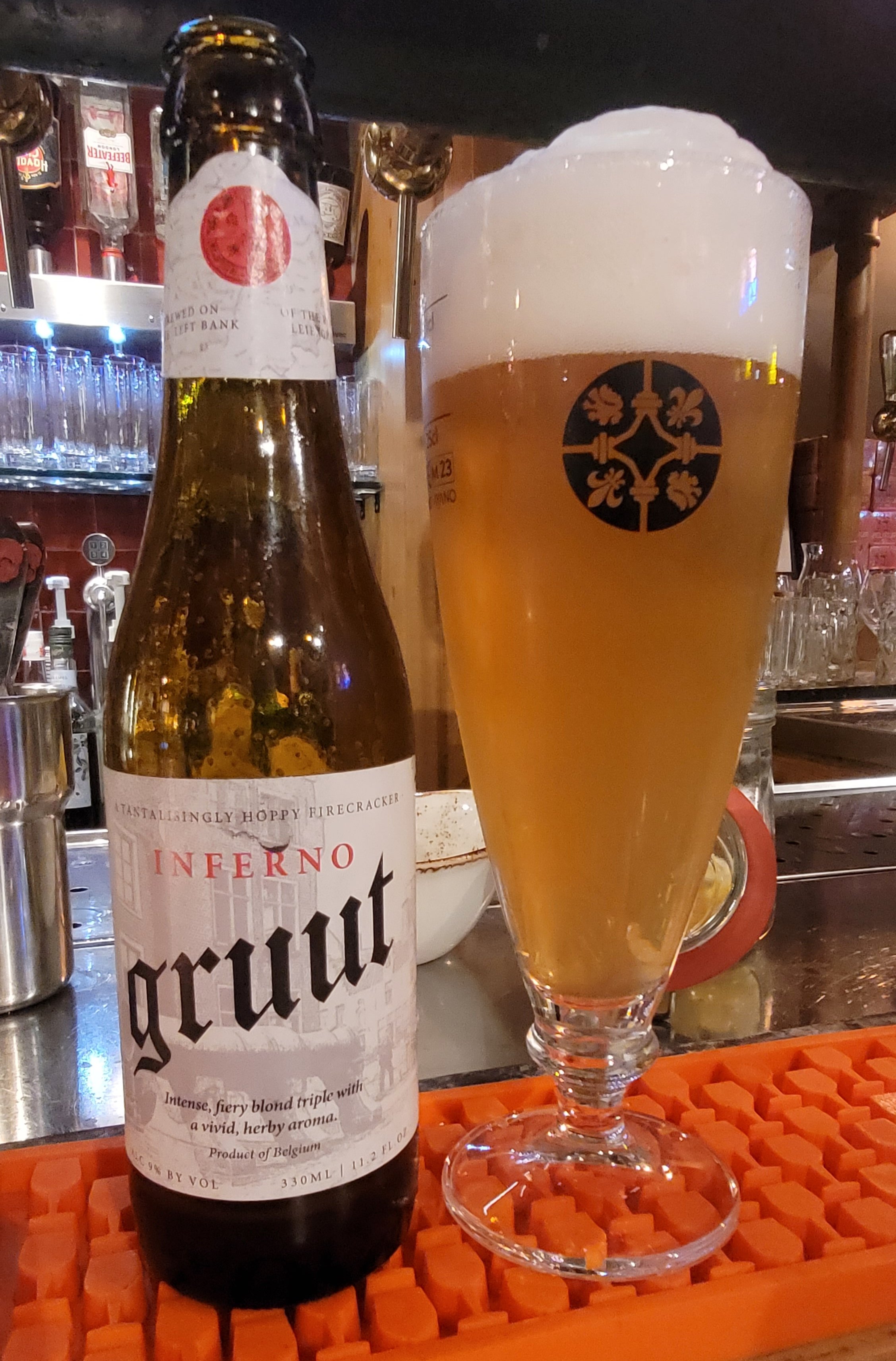 "Inferno Gruut" sounds too interesting to pass up, so I gave that a go in the Ghent branch of pub chain Bier Central. It's broadly in the tripel style, being blonde in colour and 9% ABV. I braced myself for the inferno, but alas it proved quite lukewarm. The aroma is a pleasant but unobtrusive white pepper effect, and there's both that and green peppercorn in the flavour, but that's as spicy as it gets. The rest is quite standard tripel: honey and cereal, with a strong alcoholic warmth. Yes it's a little more spicy than typical tripel, but honestly I'm not sure I would recognise it as having been enhanced, since you can get a similar effect from some Belgian yeast strains. For a brewery with a fascinating unique selling point, the Stadsbrouwerij seems to be playing things very safe indeed.
 There was time for one more at Bier Central and I choose an IPA from the Belgoo brand, Bloemekei. This arrived a brilliant clear golden colour, smelling of ripe and fresh grapefruit peel: bitter, but with a spicy edge. The flavour does an about face from this, however, delivering a dollop of meringue pie sweetness and not much else. The whole thing is closer to a blonde ale than the 6.5% ABV IPA it purports to be. It's decently made, but very plain fare, and doesn't give much by way of either Belgianness or IPAness. This was my last beer of day one and I had hoped for something with a bit more wallop.
 We had a visit to local brewery-restaurant Dok on the cards for later, and they had beer pouring at the opening reception, including their pilsner Dok 13. I'm not especially enamoured of the style labelled "Belgian pils", but this Belgian pils didn't taste like a "Belgian pils" to me. Instead, it's far more north-German, with a heady, funky aroma of fermenting grass. The taste is softer, with a balanced crispness meeting a bite of fresh lemon. There's a fair amount of haze, and it benefits from the slight textural softness that this brings. All round, it's rather decent: accessible and sessionable, but with plenty of points of interest.
 The same can be said of their flagship pale ale, Waar is Loca. 6.5% makes it a heavy contender, and you certainly get full value from that: not only the malt richness and alcoholic warmth, but a thick and resinous hop napalm as well. For all that, it looks quite innocent: an easy-going clear gold. But beware, this has hidden, and delicious, depths.
 Dok itself occupies a hangar-like former warehouse space called Hal 16 (Up the Dubs!), converted to a restaurant and bar, with the brewing kit behind and above the counter. Contract brewing takes care of the flagships, but the onsite brewery produces a staggering array of beers, almost all of them one-time-only recipes. You can expect a couple of dozen options, plus guest beers, should you visit.
 They had just launched a beer they made for a local dumpling restaurant: a lager made with rice and kombu seaweed, called Tina. "Crisp" doesn't begin to describe this one; it's incredibly dry and tastes more like a rye cracker than a beer. It does begin to get a little bit fruity as it warms, but by then it had already lost me. I found it quite harsh, almost ashen, and I'm sure something of this nature isn't meant to be difficult drinking. Still, the brewer seemed quite pleased with it, so what do I know?
 Silly long names have gone somewhat out of fashion in beer, I'm happy to say, but Dok are keeping the tradition alive. If Ryan Got Hit By A Bus, There Would Be Another Ryan is a collaboration with Canadian wild beer specialist Trial & Ale. We were given an explanation of the name but I have too much respect for your time to recount it. This is in a rare old Belgian beer style called uytzet, which they describe as a kind of wild-fermented dubbel. It is only 5.5% ABV, however, and a cloudy dark amber colour. The first thing I noticed was the powerful Brettanomyces aroma: dry and funky, very much like the signature smell of Orval. And of course that's the centrepiece of the flavour, along with a beeswax bitterness. It's very highly attenuated, making it quite sharp and a little acrid. For me, it was one of those historical recreation beers that are academically interesting but not really much fun to drink. I would have got more enjoyment from an Orval.
 Cherry Wally is a weak pun on the name of legendary Belgian singer Eddy Wally. It's a grape ale, blended with a barrel-aged saison, with cherries added in. That sounds quite convoluted but it absolutely pays dividends. Though it's an unattractive murky red, the aroma is almost lambic-like: funk mixed with gunpowder. The carbonation is low, which gives it a velvety texture and allows a beautifully rich real cherry flavour to coat the palate. It was designed for summer drinking, and is light-bodied, even though the ABV is a substantial 6.7%. The grape adds a balancing tannic dryness to the finish, and the whole thing is rounded and mature-tasting. You get all of the promised fruit with this, tasting very real, but also as though it belongs in the beer, not tacked on to it. It's beautifully done, and not the sort of high-end output I would expect from a brewpub.
 The last beer they wanted to show off to us was Tsuchinshan-ATLAS, a white IPA brewed with (as the name makes clear) Comet hops. The collaborating brewery, Daoravida, is Brazilian, and both Brazilian and Belgian Comet hops went into the kettle. And the hops are the main feature here: I didn't detect any contribution from the herbs and spices that so often muck up the IPA element of white IPA. Here, it's a straightforward and attractive zest and resin aroma, leading to a sharp and invigorating lime and sweet onion flavour, before finishing long and dank and oily. Job done: it's a beaut. The name and recipe have nerdy self-indulgence written all over them, but I cannot argue with the top-notch quality of the result.
 Show-and-tell ended and we were left to our own devices. With a list as long as this brewpub's, it was inevitable that there were a few more I wanted to try before leaving. Is that a black IPA? Even my seen-it-all Belgian fellow judge was amused by its name: Black & Lekker. Surely someone has done that one before. Regardless, this Black & Lekker proved to be exactly as described, starting beautifully floral and doused in rosewater, before a tingly jolt of spiced red cabbage and then a long, luxurious, chocolate finish. 7% ABV means it's nicely full-bodied, but not hot nor heavy nor any way unbalanced. There's a lightness of touch to the whole thing; a polish, which makes it incredibly enjoyable and moreish. I don't know how long it'll be around for, but black IPA enthusiasts should seek it out.
 My deoch an dorais at Dok was in another relatively rare craft style: Scotch ale. I absolutely did not ask anyone why it was called Louwee Kan Het Niet Aan ("Louwee Can't Handle It"), but I'm sure it's hilarious to at least three people. This is a bumptious 8% ABV and smells heavily of toffee, but is surprisingly not hot, coming across as smooth and sweet. There's a hint of smoke and burnt caramel to add character to what's otherwise a warm and chewy malt-driven dark amber ale. I didn't do any judging of Scotch ale (I don't think there were any in the competition), but I would deem this to be fully true to style and a particularly good example.
 Where next? I discovered that there was one Craftonian beer bar in Ghent, something which I think is still very rare in provincial Belgium. The owner/manager/barman of Bar Beenhouwer says he sources much of his stock in the Netherlands. We had plenty of time to chat, what with me being the only customer in the little L-shaped bar at 9pm on a Wednesday night, while the traditional cafés along the street were teeming.
I opened my tab with Saison Pot de Fleur, from SPO, a brewery in eastern France. This is a golden wild ale that's been aged in Islay whisky casks. It's a strange idea, but it works, and draws in characteristics from each of the elements. It's clear and cleanly sour, with a sharp bite of primarily citric acidity. I didn't think that would match well with warm peaty whisky, but it does, almost like there's a tumbler of decent malt served alongside. The saison side of the equation gets a little bit lost, but there is an earthy, farmy, straw dryness in here which is in keeping with that. This is daring, very interesting, and most importantly enjoyable to drink: exactly what I come to bars like this for.
 The draught menu's one nod to local was Sunrise, from Ghent's own Stroom brewery. It was early November, so still just about socially acceptable to be serving a pumpkin beer. This 6%-er covers all the basics but little else. It's quite heavy and sweet, with lots of crisp brown sugar and an oily, syrupy, pecan-pie sweet side. Autumnal and American is the spec, and that's exactly what you get with no further embellishments. I can't see this convincing any sceptics of the benefits of pumpkin, and pumpkin-spiced, beer, but I liked it as a desserty confection, albeit not the more extreme sort. I doubt there are many Belgian breweries on the pumpkin bandwagon.
 Once again, I wanted something big to go out on, and figured the 10% ABV hazy American triple IPA would be a good bet. That was Dank Hunt from Ohio brewery DankHouse. The name makes a big promise as regards the sort of hop flavours to expect, but they didn't really materialise. Instead it's vanilla all the way through, with only some minor sweet topnotes of baked peach and pear. Surprisingly, there's no real heat from all of this, and it's easy drinking in a way that triple IPA probably shouldn't be. I got on OK with it, liking the cleanness in particular, but the lack of hop fireworks is a bit of a serious flaw.
 Today's post finishes on a sad story. When I was first discovering Belgium, Waterhuis aan de Bierkant in Ghent was deemed one of the nation's great pubs. I've visited a couple of times over the years and had always found it a charming little place; a touch ramshackle, but well-kept and with a great beer list. At some point in recent years, local megabrewer Huyghe, the Delirium Tremens people, took ownership and have done a most unsympathetic renovation while skewing the beer list heavily towards their own products. For me, it has sucked all the charm out of the place.
I can't complain too hard, however, as I was there to claim the free beer which brewery was offering all the judges. Huyghe has revived (commandeered, perhaps) one of Ghent's historic local beer brands: Artevelde. I chose Artevelde Leute: the people's beer? It's a 6.2% ABV blonde ale and very sweet with it, piling in layers of vanilla-flavoured custard and bubblegum. What nuance is present is a kind of nutty almond or marzipan, one which only adds to the cakey, dessertish feel. The brewery claims it has pilsner character, making me immediately unlikely to drink any of their pilsner. I was as disappointed by the beer as I was with the pub.
Of course, Huyghe featured big in my few days in Ghent. More on that, as well as their arch-rival Ghentish family brewer, in the next post.


