01 April 2022

Try your luck

The big Wetherspoon on Camden Street, Keavan's Port, does seem to be quite good at what I want a Wetherspoon to do: turning over the cask ales with decent regularity and having them on a few at a time, plus Jaipur as a regular. Irish cask ale would be a double-plus bonus, and it does happen, though it's a rarity. Today's post begins with three beers from a random dismal Sunday in February.

Brains's flagship bitter The Reverend James has appeared on these pages previously, back in 2006, when I found it assertively hoppy. That seems weird, now, for a bitter, so I thought it would be worth a revisit to see if 2022-me's palate finds it any different. It settled a clear and attractive dark garnet colour and from the first sip I understand what 2006-me was getting at. This is no twiggy brown bitter nor chewy malt bomb, despite the appearance. The primary flavour is lemon: an almost spritzy freshly-squeezed effect. The body is light for 4.5% ABV and there's a dry tannic quality providing backing support for the citrus. A very mild soapy quality is the only slight bum note, but it's minor. This is a highly quaffable, thirst-quenching bitter, perfect for the session, though my session wasn't going that way.

Next it's Wolf Brewery from Norwich, and Granny Wouldn't Like It. I'm not sure why she wouldn't: it's a 4.8% ABV red ale which was SIBA's Supreme Champion Cask Ale in 2005. Granny should be all over it. A dark chestnut red, it smells sweetly of milk chocolate and tastes even sweeter. To the chocolate you can add strawberry jam and a wood-sap bite in lieu of bitterness. The pumpclip says it's "oaky" and I guess that's what that is. I'm not wowed -- it's a red ale, after all -- but I enjoyed it. The cask dispense really moves it up a bracket for me: I can't imagine it would be up to much served cold and fizzy from the keg, but cellar temperature with a faint sparkle makes it a real charmer.

Two good beers in a row is unusual for a Wetherspoon session. What are the chances of making it three? The decider was Kingsdown Special Ale from Arkells. There's a whopping 5% ABV to deal with so of course I left it to last. It's a dark brown colour, though still clear. This is one of those plummy English dark strong ales, with notes of port and cork. For all that it's quite easy drinking: you get the sweet fruit up front but it fades quickly off the palate without any sticky residue. I think I'd like some sticky residue. As-is there's a certain blandness to the offer. I enjoyed it, but I think I wanted something bigger and more rounded to finish on. Oh well.

I was back a few days later when Loddon Bamboozle had been added to the line-up. I've not been a big fan of Loddon's wares so far but this is a good one. Their beers, in my experience, tend to be quite thick and soupy, and this bright golden one has a bit of that, but the malt is plastered over with a layer of floral perfume and honey which improves it no end. While still no thirst-quencher, it works well as a dessert, sweet and sippable, feeling far above its 4.8% ABV. One pint was plenty, though.

Regardless, I can't say there was a bad beer in this lot: all well-made and well-kept. There are worse ways to spend €11.80 on beer on Camden Street.

30 March 2022

How rude!

Another event? Already? This one actually took place a few days before the Athlone trip I wrote about on Monday, marking the beginning of the new era of Going To Places Where There's A Beer Thing On. The occasion was the launch of two new beers from Rascals at their brewery taproom. The ska theme meant the mods and mopeds were out in force, which added a lovely bit of colour to the evening.

The headlining double act began, for me, with Rude Boy, a white stout. I'll say in advance that I don't think I've ever encountered one of these that works. The attempt to recreate the sensory impressions of a stout in a pale beer is something I went in believing couldn't be done. This one looked the part: a thick and even creamy head sits atop a pale golden body. The brewery says they used an immense amount of coffee in it, but I didn't get so much of that, finding it mostly relegated to the finish. The centre is dominated by chocolate, but while proper stout tends to give the classic sort of dark chocolate, often with a decent seam of bitterness, this tasted like pale and cheap milk chocolate, and not really like a stout. It is enjoyable: a sweet bit of fun at a modest 4.5% ABV, so perhaps I can say that it's as good as white stout gets, but it's an unconvincing attempt at reconstructing the dark stuff.

In a pleasing symmetry, the companion piece is in another paradoxical style, though a much safer one. Of course it's called Rude Girl, and is a black IPA. I love these when they're done well, and this one is done brilliantly. Again, the strength is modest, at 5% ABV, but there's no lack of character here. That begins at the aroma which offers a basket of berries, with redcurrant and raspberry most prominent. They're still present to an extent in the flavour, but here things are very dry and bitter, with the classic spiced red cabbage and pink peppercorn notes which are unique to good black IPA, as well as a more serious hot-tar quality. It's full-bodied too, with a lip-smacking stickiness. I can't fault it. I'd love to see something like this in more regular circulation.

In keeping with the ska theme, I also tried the specials: three of them from the Rascals pilot kit.

Pilot #48 is a table beer; pale and hazy and 3.5% ABV, so much as you might expect. You might expect it to be thin, watery even, but they've managed to give this one a fabulous creamy texture that completely belies the strength. It's used to carry a fresh lemon flavour, sharp at first, then turning to a smoother balm. Without knowing the style I would be guessing it's some sort of hybrid of session IPA and witbier. I tend to assume table beer will have a predominant saison/farmhouse quality, but this isn't that. Instead, it's all about the hops, which is fine too. Something this light and characterful is a must for every taproom.

A sour cherry beer is next, Pilot #46. It's a murky pink, because I suppose it has to be, and is quite artificial tasting, much more lurid cherry candy than actual fruit. The sourness is dialled down, only really making an appearance in the finish. Usually, beers like this are quite low-strength but this one is a full 5.2% ABV, which seems a little excessive. I do like cherry flavours and sweet beers, but this one didn't really work for me. While worthy of the pilot kit, it's not one I'll be demanding gets scaled up for wider release.

My nightcap was an aged barley wine of 10% ABV and judging from the name -- Pilot #25 -- it's been sitting in the brewery for a while. That hasn't done it any harm and it presents a big toffee flavour first, lit up by sparks of citric bitterness. It fades out to smooth caramel and pinches of aniseed. The overall picture gives me serious vintage Bigfoot vibes: exactly the same clean classiness, that manages to go all-in on both sweetness and bitterness without the two sides clashing. Perfection, and exactly what I was looking for from it.

The party was only just kicking into gear when it was time for me to leave. I look forward to more beer launches at Rascals, and some more quality time among the ever-changing pilot line-up.

28 March 2022

Journey to the Centre

Events are back! Hurrah! My first out-of-town Irish beer excursion since February 2020 was to Athlone, for the third birthday of Dead Centre Brewing's bar, and a first in-person social event by one of the pandemic's great success stories, Craic Beer Community. CBC had teamed up with a number of Irish breweries to create a set of specially-created beers and this was an opportunity to try some of them on tap.

But before that, and since I was early, some new ones from Dead Centre itself. Brand new was a stout, named after a long-gone Athlone brewery: Messrs Boswell. As it's a very sessionable 3.9% ABV I figured a pint was called for. There's a very light touch on the nitrogen here, making it smooth but not excessively foamy. It's pretty much on point for an everyday drinking stout, hitting the right notes of chocolate, coffee and dry cereal with a pinch of Guinness-like sourness that tends to be missing from other microbrewed examples. While designed to be accessible and unchallenging, there's enough of interest here to make it properly engaging. Nicely done.

I followed that with an English-style bitter called Six Decades. I wasn't so impressed with this, and I think that the cold keg serve didn't do it any favours. At 4.5% ABV it's on the strong side for the genre, and while accomplished bitter brewers across the water can build in a lot of character on that spec, this one is a little thin and dull. A modicum of marmalade isn't quite enough to give it a personality and I found myself at the bottom of my pint without much else to say about it, and not for want of trying. Moving on...

Triple A was next, billed as a brown ale but not very brown with it, an only slightly darker shade of amber than the bitter. That hides the whopping ABV of 7.3%. Classic American hops Cascade and Centennial meet traditional English Northern Brewer, resulting in a curious but perfectly pleasant minty herbal foretaste with a peppery spice after. Some citrus arrives late, but no more intense than you'd get from lemon sherbet. I like a good bit of chocolate and coffee in a brown ale and that's not on offer here, with merely a light caramel effect as the only nod to its dark malts. Maybe again it was the cold draught serve to blame, but I expected more from this. Perhaps the canned version is a better option.

Finally from the regular line-up there was Trif3cta. Stylewise it's its own thing, described on the badge as a "dark ale with ginger and lime, aged in rum barrels", so kind of like a Dark & Stormy cocktail, then, only stronger at 8.3% ABV. Here's the brownness I would have liked in the previous one: a deep and rich shade, and there's a smoothness of texture which matches that perfectly. Despite the spice and spirit, it's the lime which greets the palate first, setting a lovely clean spritz on which it builds the heavier and sweeter malt. Add in the ginger and you get a kind of ginger cake effect which I really enjoyed. While I like rum, I tend not to be much of a fan of other rum-aged drinks -- they can be a bit cloying and overpowering. This isn't one of those, and while I'm sure the rum makes a contribution, the beer doesn't honk of it. Only the fact that the evening was still young had me taking my time over this, because it's very tasty and dangerously easy to drink.

And so to the three specials. Brewery representatives were conveniently on hand to talk us through what they had made.

Of the three, I was particularly interested in Hope's Craic'd Black Pepper Saison: I like black pepper flavours in beer, whether from peppercorns or a spicy Belgian farmhouse yeast, and this promised both. Alas it delivered neither. The pale blonde 6%-er tastes predominantly of banana. Richie said he didn't fancy letting a voracious saison yeast loose in the brewery so went with something plainer, a descendant or close relative of La Chouffe's yeast. That should have given some modicum of spice but I really couldn't taste it. The pepper flavour from the pepper was present to an extent, but without the kick I craved. The result is a very average sort of sweet blonde ale and not something I would normally cross half the country to taste.

Ballykilcavan had brought their own cask engine to serve Export Bambrick's, a souped up 8% ABV version of their flagship brown ale. Between the recipe upgrade and the dispense, the beer's complexity level shot upwards, so as well as caramel and chocolate, I was getting raspberry, strawberry, cork oak and a warm savoury beefiness as well. There was a real sense of old-fashioned beer about this, far from the homogeneity of style strictures and consistent production, and the result was all the better for it. A freshly drawn tot of this would be an excellent finisher to any evening's drinking.

But my evening wasn't quite done. By law there has to be an IPA in the line-up, and Dead Centre did the honours there with Daredevil, a red one. Red IPA isn't usually my thing but this was a good one, letting the Centennial and Amarillo hops do the talking without any toffee interference from the crystal malt. A raspberry sharpness in the foretaste was the only way it tasted red, while after that it was all dank and oily hops coating the palate and creating a long resinous finish. Someone voiced a comparison with BrewDog's 5 AM Saint, back when that was bold and impressive, and I concur: this had a similar level of wow factor.

The beer aside, it was wonderful to just get out and about of a Saturday, and to catch up with beer friends I haven't seen since The Unpleasantness started. A big thanks to Liam and the Dead Centre team for hosting, and Brian of Craic Beer Community for being the catalyst. Less thanks to Irish Rail for making my train home into a bus replacement. I've now seen parts of the midlands no one should ever have to see.


25 March 2022

Hopswitching

All of today's beers have featured on the blog before. Well, sort of. Breweries change their recipes all the time: hop availability, or lack of it, can be a bit of a random factor so change is inevitable. But there are plenty of other reasons too. It's generally a good sign when the brewery is up front with the drinker about it, and that's the case with each of these.

Lineman is first, with version four of their Electric Avenue pale ale, this one with Idaho 7, Citra and Chinook. As well as the hops, the ABV is the lowest yet at 5.1% ABV and it's considerably paler than previous iterations. The aroma is a luscious sort of bitterness, with honeydew melon gradually sharpening through kiwi fruit into full-on lime. No limes in the flavour, however. All is soft and sweet and summery, suggesting strawberry, mango, passionfruit and pineapple. If I hadn't read the varieties on the label I would have said with conviction that Mosaic was among them: there's even a tiny hint of savoury caraway, but otherwise a lot in common with White Hag's Little Fawn. It's beautifully refreshing and very downable. I love its brightness and freshness, and I'm somewhat surprised that it's done with dank badboys like Citra and Chinook. Regardless, very tasty stuff.

I was also surprised to learn it's coming up on four years since Rye River released its Whiplash homage Miami J. Back in 2018 it was a cutting-edge hazy IPA though the hops were mostly classics like Amarillo, Citra and Mosaic: not a thing wrong with them. But the edge needs sharpening and this new version is officially a collaboration with hop merchants BarthHaas, utilising Lupomax, Incognito and Spectrum from the drawer labelled "New Stuff". The rest is presumably the same: 6.5% ABV and a medium hazy orange. The aroma is funky and dank, and that's even more intense in the flavour. I get a mix of over-ripe apricots, extremely ripe and runny cheese, and fermenting silage. It's like it's gone through freshness and out the other side. As such, it's a bit extreme for my tastes. I like juicy tropicals but I don't think you can keep turning up the volume on that and expect it to improve. While I appreciate the artisanship that's gone in here, and what it's meant to be, I found it quite sickly and difficult, which wasn't the case with the much more balanced original.

I didn't really need an excuse to pick up another can of Western Herd Flora and Fauna, the champion Beoir Beer of the Year for 2022, but I got one. With a 10-hop double IPA I imagine there's plenty of room for switching things about, and with batch two they've replaced the Strata with Galaxy. It's still 9.45% ABV and a flawless golden colour, and still low on aroma, with only a kind of white lemonade sweetness to speak for all that malt and all those hops. The pine and the lime are still there, but I'm not getting the same level of oily dank richness that was a big part of the original. It's still beautiful: constructed with precision and not a thing out of place. But I can't help thinking there's something missing, and I don't know if that's because of the hop substitution or not. Still, if you have yet to have the pleasure of Flora and Fauna, this version is absolutely worth your while.

I haven't seen hop shortages in the beer news for quite a while. I guess that means that changes to recipes are more often at the brewer's discretion these days, which is good. I do wonder at what point a recipe deserves a new name, though. Those Electric Avenues don't have much in common with each other, for example.

23 March 2022

CA'mon!

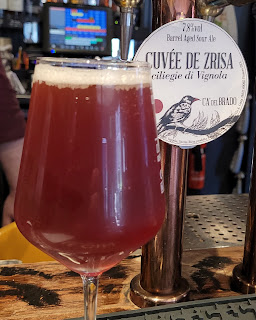
Continuing with the guest taps at Galway Bay Brewery bars, as mentioned last week, another I got my mitts on was Cuvée de Zrisa by one of my favourite Italian brewers, CA' del Brado.

It's cherry-infused, Brett-fermented and barrel-aged but don't dare call it a kriek. It is a kriek, though: absolutely on a par with what the better class of lambic breweries are doing in Belgium. The whopping 7.8% ABV gave me pause but it wears it well, and lightly. There's a little wine-like fullness to the body while staying crisp, and with none of the flabby heat I dislike in this sort of beer when they're brewed strong. A sharp lactic bite introduces the flavour, seguing seamlessly into a different sort of sourness from the very real-tasting cherries. Brett funk and oak spice are present, but mere afterthoughts, adding complexity without trying to dominate proceedings.

And I think that's deliberate: this is a stylish, honed beer; shaped precisely, like the best Italian tailoring and football.

A couple of weeks later that was succeeded by Piè Veloce Brux Cascade, one with no fruit but which includes the strain of Brettanomyces and the American hop it uses in its name. It's a bright and cheery gold in the glass; an innocence that belies its substantial 7.4% ABV.

I went in a little sceptical about bold new world hops against wild yeast -- lambic brewers shy away from hop flavour for a reason -- but the aroma of this is inarguably gorgeous. The spritzy citrus combines with Brux's own soft and luscious fruit, creating a kind of spicy bath-bomb effect, not subtle, but not overdone either. The flavour is altogether smoother and in no way a novelty. Luscious white wine is the first thing I get: Chablis, shading towards Gewürztraminer. A peppercorn spice next suggests to me that this is fundamentally a saison. For a strong beer it is depressingly refreshing: drinking it slowly requires restraint. There's a little dry grapefruit rind towards the finish, so the hops too are being restrained. That sits next to a more unashamed, but quite delicious, mucky-farmyard funk.

I'm sorry I used up my tailoring and football analogies above, because this is just as poised a beer. I'm sure I'm not the first to remark that "wild" is an inappropriate label for beers like this because the good ones are very controlled and crafted indeed.

21 March 2022

Nice try

English brewery Wild Beer Co. came up with this wheeze for the just-finished 2022 Six Nations rugby tournament: six collaborative beers produced with brewers from the competing countries. Of course I bought all six, and at a fiver a can they weren't cheap. I had every right to expect something special from each.

The Irish entry started me off, and Carlow Brewing was the guest on this. It's a red ale with coffee called Shoulder to Shoulder. It struck me as quite pale for a red, being more amber or even orange in hue. The head faded quickly on pouring, another blow to the visuals. Still, the aroma was good, showcasing the coffee as fresh and invigorating, with the summer fruit of a good red ale in the background. The roles reverse in the flavour, and it's a bang typical red ale first, with strawberry and a little cherry on a firm base of caramel malt. The coffee roast then dries it out, as does quite an aggressive carbonation. For all the fun going on in the flavour, the texture is a little thin, more so than I would expect at 4.9% ABV. I guess this, and the others, have been designed to be match-drinkable and not too distracting from the action on the pitch. Overall, I like this one: not too ambitious but still quite a distance from by-the-numbers red.

The hometown derby is with Manchester Union brewery, Wild in Union being the name. It's an amber lager and as such I was expecting it to be redder, but it's well within the colour parameters of a traditional continental example, the rose-gold of a bock, say. Its aroma is quite continental too: grassy noble hops and light toast. The dark malt is a little more pronounced in the flavour, bringing quite a cakey richness and even a little summer fruit. We're still in bock territory though, because there's a hefty dose of herb and cabbage looming in the background and kicking in after a second or two. Indeed there's a decent amount of heft in general for just 4.8% ABV. The overall picture is a clean, crisp and complex lager with an assertive hop bite and a nicely chewy consistency. Even if the appearance isn't what I thought it would be, I still wouldn't change anything.

Staying on lager, we move to Italy. Those guys have a better reputation for their hoppy lager than for their rugby skills, wha'? Anyway, this is Qui Ora, "citrus Italian pils", from Ora, an Italian-run brewery in London. No problems with the visuals here: it's a stunning bright gold with a gorgeous quiff of pure white foam. Even with my crap photography skills it looks like a 1920s advert. The hops get right to work in the aroma, no gentle lemony spritz but a full-on pith-and-wax bitterness. In the flavour that becomes more funk than fruit, a resinous weedy quality with fishy overtones. It's a bit much for me. The resin adds to the texture too, taking away any crispness. I am reminded that this sort of hop-forward pilsner, be it in the trendy Italian style or "India pale lager", rarely suits me. The clash of flavours in this one is a good example of why.

Representing France is La Chasse, a pale ale co-created by Piggy Brewing. This is lighter again at 4.6% ABV and a beautiful clear pale golden, looking almost like a pilsner. The aroma is bright and fresh with lots of zingy, zesty lemon plus a more herbal grassy kick. The hops dominate the flavour too, though are more serious and intense at first, with notes of pith and burnt plastic. That settles to a cheerier lemonade and pink grapefruit juice after a moment. The varieties aren't named but I wonder if Sorachi Ace or a relative was involved as there's a certain amount of coconut too. As with the previous beer, there's lots going on the flavour, but it's still an approachable quaffer, if a little on the fizzy side.

Wales next, and a collaboration with Polly's Brew Co. I think I may be the last beer geek on these islands to have never tried any of their beers. This is called Iechyd Da! (Welsh for "sláinte") and is a pale ale with mixed fermentation, or "mixed ferm pale ale" if you're in a hurry. It's 5% ABV and pale yellow with a wit-like haze. The aroma is beautifully tropical, showing pineapple in  particular, plus passionfruit and mango. The flavour is a little more serious, with significant pithy bitterness and flavours of lemon peel and lime rind. The farmhouse funk is not much more than a seasoning on top of this, but it's an enjoyable extra bit of character, softening a bitterness that might be harsh on a cleaner base. It's a modest sort of wild-fermented beer, of the kind that Wild Beer originally built its reputation on. Beginner level, but wholly enjoyable.

Bringing up the rear is Scotland, where Fierce Beer does the honours. Raging Storm is described, oddly, as a "session Scotch ale", eschewing the more traditional "very wee heavy". That means it's only 5% ABV, though still a handsome dark ruby. Perhaps it's the lower gravity which means it's the hops which are most present in the aroma, spicy and grassy over the top of raisin and plum. As I've now come to expect from these it's light-textured and easy-drinking. There's a certain cakey malt richness but lots of fizz too. The flavour balances autumnal fruit and nuts with a brighter and punchier citrus. It's a profile which left me wishing for something denser, stronger and with more malt character, which I'm sure wasn't the intention. The apparent overall aim of the project to create beers that don't require too much attention is fine for the likes of Irish red but isn't so compatible with Scotch ale.

While doing the Wild thing, a couple of others from there for inclusion today. 

Liripip is a table beer at 2.7% ABV. As one would expect, it's yellow and hazy in a grisette-saison sort of way and has a similar sort of lightly spiced thing going on. To the white pepper and nutmeg you may add a soft and luscious honeydew melon, nectarine and white plum affair, making for something both dazzlingly complex and down-the-hatch refreshing. An ice tea dryness complements the succulent fruit side beautifully. They've presented it in a 33cl can, but 75cl bottles would be wholly appropriate; serving size for one. This is a fun fusion of what Belgian and English beer do incredibly well and I could drink a lot of it. But we move on to...

Brett Brett 2021. This was sailing close to its best before date so was marked down. Dry-hopped or not, I figured there'd be nothing wrong with a less-than-fresh Brettanomyces-infused double IPA. It may even have improved while ageing. It's a bright and cheery pale orange colour, and hazy with it. There's a certain amount of funk in both the aroma and taste, but it's not strongly Brett-y. Rather, it's more the weedy resin you get from large amounts of American hops. The body is nicely weighty, as befits 8% ABV, and there's plenty of fun lemon candy at the centre of the flavour. Anyone looking for a multi-faceted sensory experience will be disappointed, but it's a decent double IPA and that's no bad thing.

Going back to the Six Nations six-pack, my only real quibble is with the price. Each can cost €5 and for that I expected something a bit more special. I get why they've gone for accessible and medium strength; I would just prefer that for a euro or two less. Maybe the overpriced beer is a way of making me feel like I'm at the stadium on match day.

18 March 2022

Tap pirates!

Oh it's good to see guest taps coming back, as Dublin's beer-geek pub life settles into whatever the new normal will be. With UnderDog gone, the brewery-owned pubs are the best offer in the city centre, and both The Porterhouse and Galway Bay/BRÚ understandably have been pushing their own wares at the expense of guests. But, some international visitors have crept in lately, including today's pair from La Pirata of Barcelona.

Viakrucis is badged as an "American IPA". How retro. It's a mostly-clear orange colour so I guess we're on the west coast. The aroma is pithy, suggesting orange zest and peel, though hinting that juice may be on the cards too. A sip tells me it's not really, unless you count grapefruit juice. While the flavour is clean, it's also very bitter, in that old-school American way, minus the big malt that the Americans used to balance it with. They knew what they were doing, because I found this one rather unbalanced. The hop smack is fun for the first moment, delivering an explosion of lemon, jaffa and grapefruit citrus. But like most explosions, it stops being fun quite quickly, and there are consequences to deal with, in this case the harsh acidic burn and a savoury vegetal note that doesn't sit well with the fruit. On balance, it's OK. There are no problematic off-flavours and it's certainly not boring. The aftertaste brings an altogether sunnier sorbet buzz too. I think this can be filed under "not really my sort of thing". Give it a go if you crave the west-coast puch but don't really remember how west coast IPAs used to taste.

Their Barcelona Tropical, a collaboration with Les Trois Mousquetaires of Quebec, lays its cards on the table more clearly. It's no murk-fiend, though, pouring again a transparent orange-amber. You still get the juice, although it's not the sweet pineapple and passionfruit implied (to me) by the name. Instead I get a softer mandarin and Seville orange: sweet, but not exotic sweet. The juice is interrupted at the finish by a dry and savoury twang, suggesting misbehaving Mosaic. It doesn't ruin the beer but took the shine off it for me. Overall, this is disappointing. There are fun features but not enough of them, and badgered by the less nice bits. 33cl was no hardship but I'm in not in any rush back for more.

With no idea of when I'll next see Barcelona, it was nice to get a couple of tasters of its current beer scene. That'll do for now.