30 May 2025

The Citizen and the King

Barney mavourneen's be it, says I.

For The Session this month, Phil Cook has asked us to consider "beer and pubs in arts and fiction" and I'm glad he phrased it that way, not simply looking for made-up pubs. While my choice appears in a very famous work of fiction, it is a real place and still, just about, standing.

There are few more groanworthy topics in all of art and literature than that of James Joyce's Ulysses, and how impenetrable it is, and so easy to start and impossible to finish. That's not everyone's experience, and some of us made our peace with the more difficult parts as we went through it. To avoid it is to miss some wonderful prose, and the part I recommend to the casual reader, whether or not they have any intention of reading the whole book, is chapter 12: Cyclops.

The scene is not directly related to the story of the rest of the novel, and none of the main characters are at the centre of it, which is why it works as a standalone piece. For the most part it takes place in a pub: Barney Kiernan's of Little Britain Street in the North Inner City. While Joyce interjects with some very, err, Joycean paragraphs to the dialogue, most of it is a transcript of the everyday banter of a group of acquaintances, meeting for a couple of drinks one summer afternoon. The main aim is to capture the wit and repartee of such everyday occasions, and I like to think Joyce enjoyed writing it, stringing together all his favourite turns of phrase that he heard in Dublin pubs before he left the city many years before, and inhabiting the personas of Proper Dub pub characters as he remembered them.

The antagonist of the piece (whom I had always interpreted as the landlord, until the first comment below arrived) is mostly fictional. Named only The Citizen, he's a parody of spittle-flecked 19th century Irish nationalism, and reputedly based on GAA founder and teacher Michael Cusack. But the pub itself is real. At the time Ulysses is set, it was a sizeable concern, occupying three units along the street.
...the house of Bernard Kiernan and Co, limited, 8, 9 and 10 Little Britain street, wholesale grocers, wine and brandy shippers, licensed for the sale of beer, wine and spirits for consumption on the premises.
The pub, I understand, was in the middle, with the wholesale office on one side and a goods yard on the other. That yard is now the location of a high-end cocktail pub which I've never been in, but which makes no mention of the literary connection in its menus or marketing. The building which housed the pub has been boarded up for decades. It gets an occasional lick of paint, it has had its brickwork repaired in recent-ish years, and it goes up for sale now and again, but nobody has ever put it to any new use nor relicensed it as a pub. Davy Byrne's, across town, is a Joycean pilgrimage spot, even though it's the location of a much inferior scene. Barney Kiernan's remains unloved, a victim of the dereliction that Dubliners like to decry in their city but nobody seems to want to do anything to fix.

Except the hoteliers, of course. The area next to Little Britain Street, and the North Inner City in general, has seen some gigantic modern aparthotels and hostels built on sites that were once warehouses, tenements, and other parts of the fabric of central urban life. A few minutes' walk from Barney's is Clink, an upmarket hostel for upmarket young'uns, part of a Dutch chain, with branches in Amsterdam and London. Beyond reception, there's a comfy lounge with a small bar and -- hello! -- a house beer. The AI which generated its pumpclip seems to have drawn on elements of the jolly Augustiner and St Bernardus friars, and given him six digits on his left hand, as is traditional in this artistic vernacular.

Clink Lager is 4.9% ABV and came served in a König Pilsner mug. Nothing about the taste suggested it wasn't a straight rebadge of König. That's not a beer that's commonly available here, though I have seen it on draught in a handful of other local pubs, and while it may not be Germany's finest, decent pilsner is not to be sniffed at, and certainly not at €6.50 a pint in central Dublin. There's a proper snap of noble-hop-accented lager malt, suggesting sun-dried grass clippings and pale straw. That's fun, but the real teutonic expertise shows in the finish: a strong herbal greenness that's almost oily, evoking basil or rosemary. Equally, you can happily ignore the understated complexity and enjoy it as a cold quaffing lager: the balance is perfect. I know that several Irish breweries are well capable of making and selling pilsner this good, but so few do. That's why I'm sticking with König as my guess for the provenance.

That's about as close to investigative journalism as you'll get on this blog. Clink also stocks a couple of beers from Black's of Kinsale, and from the décor, it looks like Rascals was one part of the offer too. I'm not sure I'll be making it one of my regular haunts -- dear god, I felt old in there -- but nipping in on a warm afternoon for a looksee with a pint of decent pils was no hardship. 

Ah! Ow! Don't be talking! I was blue mouldy for the want of that pint. Declare to God I could hear it hit the pit of my stomach with a click.

28 May 2025

The guest room

As a follow-on from Monday's post about Whiplash, today's two are from the Catalan client Oddity, which brews at Whiplash so counts as local for me. These cans haven't been closer to the Mediterranean than Ballyfermot.

First it's an IPA called He Got The Tunes. It's a foamy job, taking up a chunk of my time with the pouring. "West Coast" they say, though it's distinctly, and indistinctly, hazy. Hmm. Aroma-wise, you get a familiar soft mandarin and vanilla effect, and I'm happy to say that the lack of hoppy follow-through I noted in the Whiplash beers doesn't happen here. Instead, you get your money's worth: a sparky mix of citrus zest, pillowy juice and a slightly rough minerality from the floaty dregs; dry like plasterboard, but not quite as severe. Together, it works. There's more than enough zingy hop freshness to counterbalance the dreggy murk. I give it a pass, though I'm sure haze aficionados will love it. Isn't it nice that breweries are still making beer for them, almost a decade later?

Shadow Light, a double IPA, also calls itself "West Coast" but is, again, opaque; this time a dun orange colour. The flavour is nicely, clean, however, showcasing jaffa orange and candied lemon, with minimal heat from the 8% ABV. I think I'm within my rights to expect a decent kick of bitterness here, but there isn't very much at all. After the initial sweet citrus, there's a quick finish with only the faintest hint of zesty peel. I think I may have got lucky with the last one, because here it seems we're back to Whiplash-brewed beers lacking in hop intensity and complexity. Perhaps the can wasn't the freshest, though it still had four months to go on the best-before, but it tasted older: dulled by time. It's an easy drinking fellow, and decent with it; but the fireworks are lacking. As double IPAs go, this one feels a little phoned-in.

That wraps it up for this round. These beers were fine, though not brilliant. My only real complaint is that they're both IPAs. Other styles exist you know, guys.

26 May 2025

No sudden movements

A flurry of activity from the Whiplash brewery resulted in today's offerings.

Having already done a beer for burger chain Bunsen, they're continuing to be down-with-the-kids, at least where meat sandwiches are concerned, with one for Chimac, the Korean-style chicken place. It's a rice lager named Rise. Unusually for a restaurant beer it comes in a 440ml can, but as it's a 4.5% ABV golden lager, that's about the minimum recommended dosage. It's pale and mostly clear in the glass, with little aroma other than fizzy water and a touch of grain. I became concerned that this is one of those microbrewed beers designed to mimic industrially-produced ones. Served ice cold it was very refreshing; light-bodied without being thin, and I can see how good a match it would be for fiery fried chicken. By itself, there's not a whole lot going on. There's a faint Helles sweet side from the malt base, but that's barely noticeable until the beer has warmed up in a way it's not supposed to. I thought it would be crisper because of the rice, so the mild fruitiness was a surprise. And of course, no hop character to speak of is discernible. I'm not sure there was a whole lot of point releasing this for consumption outside of the context for which it was designed. It's fine, and the brewery is entitled to make what it wants, but there are imports hitting these beats at considerably more competitive prices. This does nothing to premiumise itself.

I had to go to Fidelity to get Cold Facts, a New Zealand hopped pilsner which seems, so far, to be draught-only. The chiller console tells me they serve this at 5°C but it seemed colder on the nippy April evening I drank it. That seemed to have cut the flavour down a notch or two, which is a shame because there's plenty to enjoy here. Both aroma and flavour are centred on a balanced sampler of lovely Kiwi goodness, incorporating sharp botanicals, luscious tropical fruit and a harder mineral edge on the finish. It's exactly the sort of experience for which one comes to New Zealand's hops, and I wanted more of all of it. Maybe it's not possible to maintain the beautiful balance while also ramping up the hops but I'd be willing to take that chance. A word of praise also for the mouthfeel. For a modest 4.5%-er it has a gorgeous soft and pillowy texture; properly carbonated but not so much that the fizz upsets the delicate flavour. It's very easy to drink, so while I would like to report on how the hop character fared when it was a bit warmer, I had already emptied the glass. Oh well.

Pale ales are more Whiplash's milieu, and that's where we stay for the next two. Sailing Shoes gets immediate points for the daftly literal can artwork. "West coast" pale ale, they say and, like the lager above, it's mostly clear, and a pale yellow shade, so crystal malt is not part of this interpretation. In fact, we're helpfully told it's a mix of Marris Otter, Vienna and Caramalt, hopped with Vic Secret, Amarillo and Chinook, so potentially lots going on there. It's Amarillo's orange candy that I get primarily from the aroma, though a little of Vic Secret's aniseed spicing features as well. Again, there's a pleasingly weighty mouthfeel despite a modest ABV of 4.8%. In the flavour, the hops are all smushed together, with a general orangey tang being expressed, but nothing more nuanced than that. OK, maybe a little background sharpness to balance the sweet citrus, but nothing significant. This is another straight-up drinkin' beer, not trying to do anything fancy and presenting as approachable, easy-going and fun. I'm fine with that. I don't know that telling us to expect "West Coast" was worthwhile, but then since Whiplash are the worst offenders when it comes to no-warning murk in their pale ales, it may serve to shift a few cans to the haze-dodgers. It's cute that the brewery has decided to look after them for once. A broad thumbs up for Sailing Shoes from me.

Going Through Some Stuff is an example of the issue, labelled simply as an IPA but looking like custard with a head once poured. It's Nelson Sauvin and Vic Secret for the antipodean vibe, with a bit of Citra for American balance. The aroma is juicy first, hinting at mineral diesel, suggesting that the Nelson is making its presence felt. The haze is a little too present in the flavour, adding a plasterboard alkalinity which interferes with the proper beer side. Underneath, there's Vic Secret's pinching aniseed, a subtle squirt of Citra lime and, maybe, if I'm not imagining it, some squishy white grape from the Nelson. None of it is very loud or pronounced, and I think that at 6.8% ABV, something should be. It's hardly surprising that a man of my age thinks this beer would be better if it were cleared up. It's a decent hazy IPA, but the well-chosen hop combination would shine better on a clean base. I'm sure that's possible, even if it's not fashionable.

Another brief flurry before I got the above notes published consisted of a matching pair of IPAs. The single one is called Sure Look and seems to have quite a fruit-forward hop list, featuring El Dorado and Azacca. It's a very pale yellow, looking a bit thin, even though it's a full-fat 6.8% ABV. Credit where its due on the lasting fluffy head, something too rare in hazy IPAs for some reason. The aroma is broad-spectrum tropical, as I suspected it would be, but the flavour is rather less sweet. At the front it's very estery, with a slightly chemical pear-essence vibe. That rounds out to jaffa orange and lemon zest after a moment; a reminder that Citra is also here and didn't come to play. But there's also a nasty touch of savoury grit, and an annoyingly quick finish. It's a lot like the beer above, in fact, only with less fun hops. The aroma is the best feature, though doesn't quite make up for its other shortcomings. 

I suppose the route-one move would be for the double IPA companion, Sure Listen, to be made with the same hops, but it's not. Citra and El Dorado are back, joined by Amarillo. Still, it looks almost the same, only a little darker than the last one, though a deal stronger at 8.2% ABV. The aroma is densely sweet, of overripe stonefruit and undiluted squash. It's as thick as it smells and needs a strong drag to get it out of the glass. Once again, the flavour intensity is a degree or two lower than the aroma. I got a hint of coconut oil, a light bitterness no more assertive than peach skin, and a thin smear of apricot jam. But again, you don't get long to explore this. It doesn't have the nasty gritty side; replaced by an alcoholic warmth that's much more cosy. Again, though, it doesn't deliver the bam-pow fun that I know Whiplash can do.

This is all fairly typical Whiplash fare, with no real surprises. I didn't need confirmation that my personal taste runs much more to Kiwi-hopped lagers than hazy IPAs, but here it is anyway.

23 May 2025

Rock lager

Who's up for some tenuously-connected lagers? Of course you are. It's probably better to think of these as a random cross-section rather than exploring any actual theme. But there might be a theme...

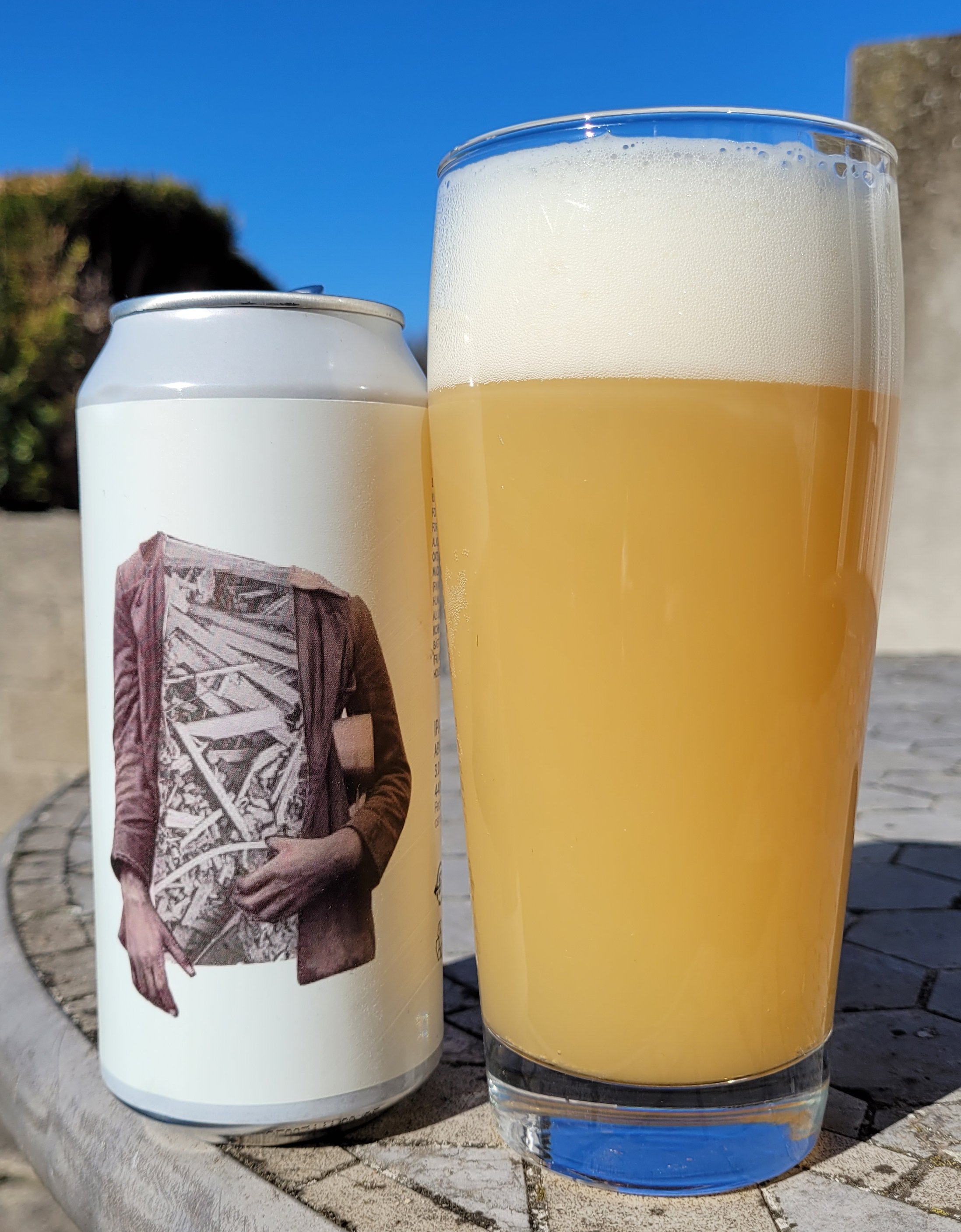
I assume that WhiteField named Oldtown after the Phil Lynott song, although the Staré Město of Prague might equally have something to do with it. This is a Czech-style pilsner, made with Bohemian barley and Saaz hops. There are immediate points off for the haze: this is very much the unfiltered sort of pilsner, and I tend not to enjoy them as much as the pin-bright ones.

The aroma is surprisingly fruity, with uncharacteristic pear and apricot. The herbal hops are reduced to a background player. It's pretty strong for the style, at 5.4% ABV, and leverages this into a satisfyingly big body, akin to a Festbier. The flavour doesn't quite measure up, unfortunately. The hops are very muted, lacking the grassy sharpness that I particularly look forward to from Saaz. There's little evidence of the fruit from the aroma, so it's the malt that's the centrepiece here. Admittedly, that is enjoyable, with a wholesome bready richness. As a Helles or Kellerbier it would be pretty good, but it doesn't hit the mark for me as a pils. It needs polishing up and some more hops for that.

We're off to Germany next, for a palate calibration. The musical connection for this one is a little more obvious: Trooper: Progressive Lager is one of the beers officially endorsed by Iron Maiden. I had thought these were all brewed by Robinson's in England but this is via Crew Republic, that most unBavarian of Bavarian breweries. Here in the post-craft era, they're still going. That's as much of a surprise as discovering that Iron Maiden are too.

This one isn't very clear either, but there's considerably less murk than in the previous. They don't tell us what the hops are, but I'm guessing they're not classical noble varieties as there's more than a hint of American citrus about this. The aroma is zesty while the flavour centres on a summery lemonade spritz. That it's a lager is almost incidental to this, the format providing a clean base for the hops but it's not really a headline feature. It's a fine drinking beer, and tastes lighter that its 5% ABV. I guess by calling it a "progressive" lager, they just mean it tastes like American pale ale, which is disappointing to an extent. The overall experience was still pretty good, however.

And the only musical connection for the next one is that it's from Foxes Rock. I hadn't noticed that Pearse Lyons brewery had added an Italian Pilsner to their core range, available in Tesco alongside beers they make especially for the chain.

And it's hazy again. Can nobody make clear lager any more? It does, at least, have a proper pilsner aroma, redolent of freshly cut grass. Crispness and fizz follows, though there's a pleasing softness to the texture: it's a little thin but not watery, with sufficient bounce to the pillowy malt. The hop flavour isn't exactly full-on, and it's apparent that we're dealing with a beer designed for a supermarket price point. What's there is good, however, with a twin stream of classic noble hop grassiness meeting a seam of more modern lemon and lime. You don't get long with either and it all fades away quite quickly, leaving nothing much of note behind. This is no classic, of the style nor of beer in general, but the fact that Pearse Lyons is brewing a pilsner in the chic Italian mode to be sold in Irish supermarkets is a positive sign. That the result tastes good is a bonus. The brewery may be on the verge of joining Boyne Brewhouse as another Carlow sub-brand, and if that happens, consider this my pitch for keeping the Italian Pilsner in the range.

None of these turned out quite as I expected, and the lack of clarity and crispness left me a little unsatisfied. This rock 'n' roll rebellion has gone too far, quite frankly. Get a haircut and clean up your lagers.

21 May 2025

Keep it fruity

Summer's (almost) here and the time is right for sour beers with some fruit.

"Limoncello sour" is the offer on the label of Wicklow Wolf's Bittersweet. This is 3.8% ABV, brewed with lemon and lactose, and pale hazy yellow. As always, I took it out of my not-too-cold beer fridge, and that might have been a mistake. While it was far from warm, cool doesn't suit it, making it feel thicker and jammier than it ought to. Probably to be expected given the lactose, it tastes mostly like lemon curd, and can only make the woolliest of claims to being sour. It's barely even bitter. Half way down I decided to add ice, and honestly I think it improved it. The flavour became less blurry, more spritzy, although less beery as well. I suppose that with "limoncello sour" it's unsurprising that it would taste quite like an alcopop. As such, it's a nice and undemanding summer drink, but it doesn't press the beer buttons. And doesn't even know where the sour buttons are. I'm unimpressed but I see what they were trying to do.

Galway Bay, meanwhile, is back on its Catharina sour kick. I was delighted because they've all been magnificent so far. Lolla is the new addition, 5% ABV and including blackberry, raspberry and yuzu. I'm guessing it's the blackberry which gives it the dense maroon hue. There's a certain jamminess to the aroma, but light and tart with it, not sugary or syrupy. Indeed, the texture is appropriately light: gently sparkling and very refreshing, making one wonder why anyone ever thinks to bring lactose into a picture like this. I haven't eaten enough yuzu, or any yuzu, to know how much of its character is on show, but there is a certain citric quality, matching a subtle underlying sourness. I'm very happy to report that it doesn't just taste of common or garden berries, and that's an achievement because neither raspberry nor blackberry are usually shy about their contribution. Here, the brewer has put some manners on them and they show polite restraint, giving us a third dimension of tartness. While I definitely prefer the more full-on tropical versions of this style, this one is still very good, and absolutely perfect for the season.

If any of this takes your fancy, make haste, because the current sunny spell may not last much longer.

19 May 2025

How do you like your murk?

I missed the most recent beer launch event by O Brother at UnderDog, but fortunately the taps were still extensively taken over when I called in a few days later.

Infinite Jest, a pale ale, was not brand new but I hadn't drank it before, so that's where I started. It's a hazy one, very much in O Brother's style. The aroma is brightly zesty but the texture is quite thin for 5.6% ABV -- it doesn't even have the puffy fluff common to the hazy genre. That leaves the flavour rather hollow, though it does hit the important points, albeit softly. You get your vanilla, satsuma, some garlic and a slightly earthy bitterness. Maybe it's for the best that the flavour didn't come on very strong. After that initial fun aroma, it's all down hill. It's not the first beer I found too dreggy to be enjoyable, and unfortunately I doubt it will be the last.

Something more creative, if not entirely original, follows next: Maybe I Like The Misery, a bitter with Earl Grey tea. It certainly looked lovely, a pin-bright copper colour. And although it's a keg bitter, the texture is soft, not spiked with unwelcome carbon dioxide. At its core it's just a rather decent English-style ale with little by way of gimmick. The flavour centres on a crisp and slightly toasted cereal character with lots of tannin, which I guess you have to be into, but it is how I like my bitter. The Earl Grey isn't a complete dead loss, adding a subtle hint of citrus and some herbal notes which tasted like fennel or basil to me. It's easy to complain about gimmicky recipes, but equally lovely to find one where an unorthodox ingredient has been added in a way that helps the core beer rather than smothering it.

O Brother is prolific with its double IPAs, and this set included Moments Yet To Come, which is very much in their usual vernacular. That is to say it's hella murky and thick: a dense orange shade in the glass. It's sickly-sweet to begin, and this is despite Citra being the headline hop, and proceeds from there to hot 'n' harsh onion before a burnt rubber finish. Needless to say this one didn't suit me. Props for the lack of earthy grit, but everything else the brewery has put together to present as the flavour profile of this beer is disastrous. You might like it, though.

Another O Brother double IPA popped up in Aldi recently. Deis, like the above, is exactly 8% ABV and is a similar dense opaque yellow colour. We're not told what the hops are but it seems altogether more restrained, which is a good thing. The aroma is strangely spicy, almost sulphurous, but the flavour gets right down to fruity business. There's a banquet of pineapple, passionfruit, mango and peach on offer, all tasting bright and fresh like they haven't just spent the last few weeks on Aldi's warm shelves. Beware the yeast slop at the bottom of the can, though: when I accidentally poured that into my glass it didn't improve matters any. Overall, it's simplistic fun, lacking any deeper complexities or any kind of long finish: simply collect your fruit and go. I enjoyed it for all that, and found it happy easy drinking, despite the significant amount of alcohol. I had heard this one was in short supply at Aldi and I can see why.

Maybe I just don't have a taste for the fancier sort of haze, but it seems telling that the one made for a discount supermarket tasted better, to me, than the premium examples sold in the pub.

16 May 2025

By the power of sour

No trip to Brussels would be complete without a sampling of its sour specialties, and I found these at a number of locations. First, it was La Fleur en Papier Doré -- my first visit since it re-opened after several years closed. It's still a beautiful café, although the beer list isn't an especially long one. Of interest was Mirakel, by De Ranke. The brewery isn't in Pajottenland so gets around the geographic restriction on lambic by sourcing the two- and three-year-old beer for this blend from established lambic brewers. The one-year-old element they produced themselves, allowing them to style it after their local river: "Spierelambic".

It achieves its goal of tasting like a proper geuze, with a green apple tartness and sparks of nitre. At 5.5% ABV it's lower strength than most new-wave lambics, and I think the complexity suffers somewhat from this. The finish is quite abrupt, with all the lovely wild features clearing off the palate with indecent haste. This lack of depth means it's not a contender for best geuze ever, but it's a pretty good one, and superb for a first effort.

Down the hill at Moeder Lambic Fontainas, they were pouring one from Boerenerf, and it would not do to pass that by. Alsacien is a plum lambic, 6.5% ABV, and the requisite shade of pinkish purple. There was no carbonation to speak of, which was disappointing, and it's light-textured as well. The flavour offers a simple sourness, and the fruit is non-specific and mostly confined to the aroma. There's no spark or spice and the whole thing is rather underwhelming. I wouldn't call it a misstep -- it's a perfectly decent beer -- but Boerenerf's wares are normally more impressive than this.

Among the bars I visited for the first time on this trip was Beer Capital -- a vast barn of a sports pub, right in the middle of town. The draught beer selection is pretty good, and included this oddity from Heineken-owned Mort Subite: Juicy Crime of Passion. It seems Mort Subite is following the example of Lindemans by releasing ever more gaudily branded super-sweet lambics. This is not as offensive as those ones. Yes, it's absolutely saturated in passionfruit syrup, but it's not sickly and smells like the genuine article. The flavour doesn't offer much other than passionfruit, though there is a certain tart kick to it as well, to give it a little bit of grown-up character. This is as silly as the tap badge, and not very beer-like, but neither is it unpleasant to drink.

Finally, we come to Cantillon. I didn't think it would be busy early on a Monday afternoon but had reckoned without the Quintessence festival which was kicking off the following day and which seemed to have brought the crowds a day early.

After a short wait, I picked Tarlantillon from the tasting room menu. The name is a portmanteau of the brewery and Domaine Tarlant, a Champagne producer whose grapes were included in the blend with two-year-old lambic. It's 6.5% ABV and the deep russet of orange wine. The sourness is very strong, with lots of mineral spicing and just a hint of marmalade citrus. It mellowed a little as it went along, but was still a workout for the palate by the end of the bottle. I liked it, but it wasn't an easy sup.

A most generous visitor from Australia was sharing further bottles around the table, and I have him to thank for getting to try Wild Friendship, a three-way collaboration between Cantillon and American sour beer gurus Russian River and Allagash. I say "thank" mainly because I had considered buying a bottle and having tasted it, I'm very glad I didn't. It's not very good. The oak side of it has been completely overdone, resulting in a raw and honking sappiness which covers any good features the beer may have had. This is where I would suggest a couple of years' cellaring to mellow it out, but it was released three years ago already, so I don't think that will work. Approach with caution.

Finally, a bottle labelled simply as Pineau d'Aunis, presumably blended with that grape variety. It's a dark amber colour and smells strongly of grape. There's a beautifully soft and full-bodied texture at a modest 6% ABV and a flavour stuffed with spicy gunpowder; the berry-like grape flavour limited to the background. I loved the mix of spice and smoothness, making it incredibly moreish. This is the sort of thing I had come to Cantillon, and indeed Brussels, for.

But it was time to leave; the brewery and the city. Brussels remains a fantastic city in which to spend a few days of casual beer drinking. I hope to be back before the year is out.