14 May 2015

Meeting Cornelius

We were introduced to Cornelius yesterday, via its rather tasty Baltic Porter. It's a subsidiary brand of the Sulimar brewery, a big one, mostly turning out standard lager but which has recently given itself a bit of a shake-up to take note of the way the Polish beer market is evolving. Cornelius is the on-message yoof label, hoping to surf the wave of cool to the next big thing in beer. Or something equally cringeworthy spitballed by middle-aged men in a conference room.

We had the whole arrangement explained to us by one of the company execs at an EBCU event in Łódź Polytechnic. The brewery also provided beers for the lunch afterwards, giving us a chance to taste the strategy in action. To begin, though, one of Sulimar's non-fancy lagers, Trybunal Export, named after the royal law court that was once based in the brewery's home town of Piotrków Trybunalski. It's 5% ABV and hits all the visual cues: clearest gold, topped by a fine white froth. It smells bitter and tastes just as sharp and waxy as the aroma suggests, with more than a hint of sulphurous skunkiness, even though I assume this bottle arrived straight from the brewery. It's a beer that really needs to be served cold to be enjoyed, I reckon. But even then I'm not sure it would be any good. Moving on...

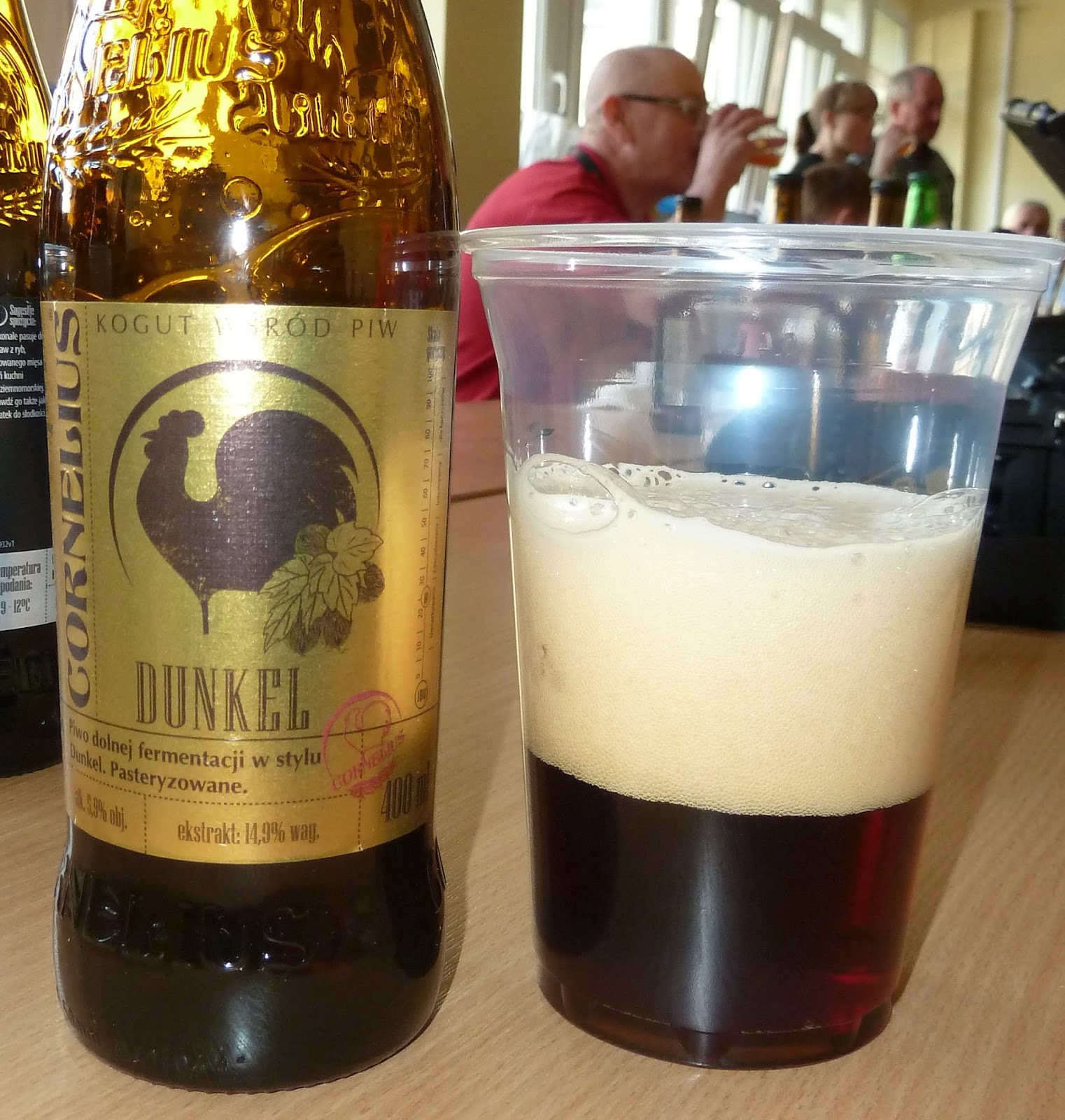
Cornelius Dunkel is a pretty spot-on copy of the classic Munich style: 5.9% ABV, a clear dark red and packet-loads of  bourbon cream biscuits in the flavour, with added muscovado sugar and an aroma that's all damson and plum. It's perhaps not quite as clean as the real thing, with some lightly marker-ish phenols floating about, but it does a satisfactory impression for the casual observer. Or the person who's drinking it for free.

Sticking with the Bavarian stylings, next up is Pszeniczny, a 5% ABV weizen. The bang of banana off this is insane: pure, distilled essence of banana. The platonic ideal of curved yellow fruit, right up your nose holes and making noise. Remarkably it's the clove elements that present in the flavour but that's not the main feature. This is, by a long way, the sweetest straight-up wheat beer I have ever tasted. The body is riddled with heavy residual sugar and every mouthful is like shovelling another spoonful of granulated into your gob. It tastes like diabetes in a glass and I didn't get too far with mine. Having achieved this feat, the geniuses at Sulimar reckoned what they needed to do next is add more sugar.

And they were probably right too. Fruit-flavoured radler-type beer mixes are the fastest growing segment of the Polish beer market and the one that is answering the perennial problem of how to get women to drink beer. Perhaps it explains why brewers closer to home, until recently, persisted with lurid coloured, tissue-box branded, sugary concoctions in the belief that it would woo the female drinker. It Poland it seems to have, and more besides.

Before us, then, were two Cornelius offerings, both based on that sugarbomb weizen, though oddly neither tasted as sweet as it did. Bananowy is made with added banana, like that was what the base beer needed. 3% ABV, a light haze and not much aroma. The scale on my sweetness analogy meter doesn't go this high so I'm going to grope blindly at "children's medicine": it has a similar sort of unpleasant plasticky artificial thing too. I managed to scrawl the words "fizzy Yop" in my notebook before I stopped drinking it and moved on to...

Grejpfrutowy, made with grejpfrut, er, grapefruit. I actually really enjoyed this one. Right from the start, up from the hazy pink liquid, there's that acidic spiciness you get from the outside of real grapefruits, and it's real grapefruit all the way in the flavour, with maybe a sprinkling of sugar over the top. It's fantastically refreshing and I'd be very happy to drink it, in the right circumstances. To give an idea of the circumstances the brewery has in mind, they're launching this in a can with a built-in straw. Everyone will be using these by next summer, mark  my words.

One last beer from Cornelius before we go in search of more pubs, and yet another pitch change in the branding. Triple Blond, is young, colourful, vibrant, and fairly horribly sexist. But it was pouring at the festival I attended and I wanted to complete the set. And it's not bad: too sweet (again) for your classic tripel but with peach and melon notes that, with the estery Belgian booze, bring it close to the spec for a decent Belgian IPA.

We shall leave Cornelius there. Between the lager and the straws and the radlers and the tripel they certainly seem to have a lot of plates spinning. I'm sure they can well afford to let one or two smash, and I'd be happy to make recommendations.

13 May 2015

Baltic cruise

There was a full house in the upstairs lecture room at the Polish Regional Brewery festival in Łódź for a tutored horizontal tasting of the beer Poland considers its own: Baltic Porter. Eight examples were set out, sequenced to place the award-winners, and multi-award-winners at the end.


So, starting in the wooden-spoon zone on the right of the picture: Grand Imperial Porter. It's grand, like. Really. Light-bodied but with lots of warm, Horlicks-like, malt on the nose and a sweet main flavour: mostly chocolate plus a very understated bitterness. Moving left to Witnicki Porter Lubuskie and espresso is the dominant theme here: a thick and oily roasted quality, mainly in the aroma but coming out in the taste, next to higher-alcohol marker pens and a softer brown sugar caramel thing. It's intense stuff and I was surprised to discover it's one of the weakest beers in show at only 8.5% ABV. Lwówek Baltic Porter was quite the palate cleanser after that, or maybe its attributes were simply drowned out by the foregoing. It's a simple, plain little number, some light liquorice bitterness but nothing more troubling than that. And bringing us to the half way mark, Cornelius Baltic Porter, a 9%-er and rather hot with it, though smooth enough to keep its drinkability intact. There's low-key liquorice again and no sharp edges. It's a slow sipper, but an enjoyable one. More from Cornelius in the next post, when we flip the tasting from horizontal to vertical.

I'm certain Grand Imperial Porter: Chili was put in to wake us up at this point. As you'd expect, this is based on the first beer and still tastes very much like it. But they haven't been shy with the chilli and the beer is big enough to bear the heat. The end result is a lovely late burn and a catch in the back of the throat. There's no real flavour contribution from the chilli but the extra heat alone makes it a more interesting beer than the original. This was followed by one from the big boys: Perła Porter Bałtycki. Though Perła is part of Danish giant Royal Unibrew, its Baltic Porter certainly seems well-regarded by the locals, and I liked it too. While the style has a certain tendency to dourness, this one is fun, with giggly notes of strawberry milkshake in with the chocolate and coffee. There's nothing off-style about the 9.2% ABV, however, even if it is very well hidden.

The two medal winning beers left for the end were, first, Kormoran's Porter Warmiński, a deftly balanced beer which takes the weight off its dense body with light and dry coffee and cocoa complexities. And to see us out: Komes Porter Bałtycki by the Fortuna brewery in Miłosław. This one won its plaudits through complexities, adding more than a strawberry milkshake into the Baltic Porter flavour repertoire. The aroma is an apothecary shop of bittersweet herbs, while the flavour packs in classic smooth chocolate and assertively bitter liquorice. It's like every element of the flavour has been taken out, examined, polished and put back in place. No shortcuts here.

I'll confess I went into the tasting as not the biggest fan of Baltic Porter, but I enjoyed the session and came out of it a lot more likely to choose one when the opportunity arises. I guess that was the point of the event.

12 May 2015

Pillar to post

There was one pub missing from yesterday's pub crawl through Łódź: Fermentacja is in a cramped basement down a narrow staircase off the street. It's well-kept, however, and offers a good selection of Polish beers, mostly by the bottle. The one relevant to this post is Ciechan AIPA, Ciechan being the craft offshot of the Jakubiak brewery. It's low in ABV by the standards of the other Polish IPAs I drank, at just 5.4% ABV, but there's plenty of weight here: sweet malt and oily hop resins. And while the chewy biscuit malt dominates the taste, there's a nice burst of fresh grapefruit right on the finish. Decent stuff, if not spectacular.

I mentioned Z Innej Beczki in yesterday's post. Subsequent visits turned up beers like Pinta's Stare Ale Jare (left), a pretty much bang-on 5% ABV alt, limpid red and perfectly balanced between sweet dark malt and a green noble hop bite; and also their Ota Mata IPA: a clear yellow job brimming with juicy honeydew and tart, refreshing grapefruit. They were also pouring Opactwo Olbrachta, a Belgian-style IPA by Jan Olbracht. I'm not sure exactly where the Belgian credentials of this 7% ABV dark amber beer lie, but I do know it has some fantastic dry lemon tea flavours for supreme refreshment in what should be quite a weighty mouthful.

Don't get too comfortable there: we also have a beer festival to go to. A few dozen of Poland's regional brewers had taken over the city's Expo hall to stage a compact but interesting festival of their wares. We didn't have long to explore it, but from the queues at one stand it was clear that one brewery in particular was giving the people what they want.

Browar Bednary is in central Poland, about half way between Łódź and Warsaw, and trades under the Łowickie brand. Łowickie Pale Ale is a reasonable enough beer: there's a little bit of bath-bomb herbs and flowers in it and quite a sticky texture for just 4.7% ABV, but there's enough mandarin and jaffa pith for it to pass muster. Bednary Hop Artifact black IPA, however, is the one that had people returning to the end of the line as soon as their glass was filled. It's a veritable explosion of straight-from-the-freezer fresh hop aromas, leading on to deliciously mouth-coating tropical fruit oils and yet, very cleverly, hardly a hint of bitterness. The texture is pure sherbet and the whole drinking experience sublime. Certainly one of the best black IPAs I've ever encountered.

The other beers at the festival didn't come close to that. The cod-mystical branding of Celtyckie was more entertaining than the amber lager itself: a saccharine-sickly malt base and a dull metallic clang of boring hops. And finishing on Czarny Kot because, hey look, a cat. It's a 6% ABV dark lager, though tastes unpleasantly stronger and once again is far too sweet, even for my palate.

More and better dark lagers to come tomorrow, but on to the final engagement of the weekend: Bractwo Piwne's birthday party, combined with the regional beer and brewing awards. At the gala dinner afterwards I mostly drank Kormoran IPA, yet another dark malt-forward Polish IPA imbued with an oily, spicy bitterness. The resins are as apparent in its aroma as they are in the flavour. Invigorating when cold, it's definitely one to enjoy before it gets too close to room temperature and all that sticky caramel malt starts to wake up.

Just at the end of the night our hosts put a keg of Reden's rauchbier on, the delightfully-branded Darth Lager. It's the same murky brown colour as the Schlenkerla classic with just a nonchalant wisp of smoke in the aroma. It goes full heavy-metal-stage-effects in the flavour, though: a thick, heavy fog of smoke and a distinct tang of iodine. There's no messing about here, and I rather liked it for that. Or respected it, at least.

That's enough running about for the moment. Tomorrow we'll sit down, relax, and take our time over Poland's national beer style.

11 May 2015

Wotcha Łódź!

The biannual summit of Europe's beer consumer organisations took place in Poland last month, hosted by Bractwo Piwne which was celebrating 20 years of campaigning. The venue was Bractwo's mother city of Łódź, a place which grew large and wealthy in the textile trade but is now more famous for its universities and the imaginative uses it has found for grand nineteenth-century industrial buildings. The beer scene is healthy and thriving, much like most other Polish cities, it seems. Reuben and I managed to squeeze a bit of pub-hopping around the busy business schedule over our three days there.

Most of the venues are just off the long straight spine of Piotrkowska, the main commercial street. Our first port of call was Rademenes, where we followed a sign advertising regional beers through an archway and into a diner-style pub, all tiled floors and vinyl banquettes. The pub's mascot is a black cat who likes to drape herself across the patron's shoulders as he goes about his duties. The taps are few and unmarked so we opted for pointing at bottles from the sizeable collection on display. Funnily enough the first one I noticed was Lublin to Dublin, brewed by Carlow Brewing as a collaboration with Pinta, a brewing company down south near Katowice. Next to it, some other Pinta beers, so that's where I started.

Atak Chmielu ("Hop Attack" - chmielu is about the only word of Polish I learned all trip) is a 6.1% ABV IPA. Quite a sweet one too, despite the name: I got lots of brown sugar in the aroma and caramel in the flavour. There's a very slight herbal citrus element and an acrid bitterness, both of which put me in mind of hop-forward beers that are past their best. I'm not sure if that's the case here, but it's certainly one that didn't live up to the promise of its name. You can read more about the iconic status of Atak Chmielu on Zythophile here. Reuben chose Hopus Pokus, also by Pinta. This black IPA is 6.3% ABV and big on hop bitters and stout-like roast. Smooth, drinkable, but maybe shading a little towards bland, especially given the strength.

The next stop was rather more geek-focused. Piwoteka is a long narrow sequence of rooms on the ground floor of a grand building, with a short bar up at one end. A blackboard lists a dozen or so draught options, including several on cask. And it was to the handpumps I turned first, choosing Black Hope by AleBrowar, a contract brand from up near Gdańsk. This was altogether more complex than Pinta's effort, with lots more roast up front, giving way to crunchy green vegetal depths. So far so stout-like but then there's this odd floral flourish in the finish indicating some generous late hopping. The low carbonation makes it a very gulpable beer, though I wonder if the hops might be more pronounced in a keg version. I enjoyed it, though. Reuben's choice was Reden's Zabobon. Thankfully the descriptions were in English because I don't know how long it would have taken us to decipher that this is designated a smoked imperial India brown ale. Chestnut red, it opens with a lovely freshly-grilled kipper aroma and the smoke really dominates the flavour to begin. Underneath there's a smooth and sweet red ale given just an edge by assertive bittering. But you only get a glimpse before the smoke clouds cloak the palate once again. I'm normally quite sceptical about the place of smoke in heavy sweet ales like this, but it really works well here.

On the next round I wanted the black saison by Kraftwerk (another contract operation) but it was just about out so I had to content myself with the small sample in the middle of the photo there. Południca is advertised as merely containing "spices" but that's not the half of it. It smells strongly, we agreed, of stuffing and gravy, all dark meat and oily sage. That sage is so strong in the flavour it made my tongue numb and totally destroyed any other flavours present. Even the signature dry saison bite was barely detectable. An unsettling beer, and I'm slightly glad there wasn't a full measure left.

As a substitute, Reuben chose a different saison, Niezłe Ziółko brewed especially for the pub by local brewer Jan Olbracht. This is herb infused as well, but a little more subtly. It's a hazy gold colour and offers an enticing crispness in its aroma. It tastes quite gruit-like and there's a complex mix of basil, parsley and pepper, resulting in a strange but pleasant sausage flavour. It's another one that may disappoint saison purists, but I liked it.

And on the left of the picture, So Far So Dark, another one from AleBrowar. Fresh coffee and beefy autolysis are the aroma but on tasting it's much less weird, being mainly quite dry with some very pleasant lavender and chocolate. The texture is one of its best features, heavy and filling, and I was surprised to find it's a mere 6.2% ABV.

Off the other side of Piotrkowska from Piwoteka is probably my favourite bar in the city, Z Innej Becki. This rambles through the large vaulted basement of a grand villa and is reached via a spacious beer garden below street level. Like Piwoteka, draught beer selection is done via a numbered blackboard but the range is even bigger here.

First up for me was a Mosaic IPA by a Wrocław-based contract brand which operates under the trustworthy name of Doctor Brew. And it does everything you'd want from something calling itself by that name: an aroma of fresh and tinglingly spicy mandarins and a zippy, zesty fruit flavour, all nectarine and mango, just shading into dense herbal dank in the finish. One of those beers to give a ticker pause when choosing what to have next. Not me though, obviously.

Reuben didn't have such good fortune with his choice of AleBrowar's Crazy Mike double IPA. This is a dense amber beer and smells as much of caramel as citric hops. There are lots of heavy resins and heavier toffee in the flavour, and a big bitter bite, so I guess it meets the specification for the style, but there's no real fruit flavour present to make it stand out.

The final pub on the first evening was The Eclipse Inn: a dark, cosy, vaguely English-style basement watering hole. The first beer was on the house, and was the only non-Polish one I drank all trip: Rohozec Skalák Tmavé from the Czech Republic. It's a bang-on Czech dark lager, weighty and wholesome, with all the liquorice and coffee appropriate to the style. I followed it with Reden's Zniwa Chmielarzy on cask. The name (there's that word again!) means "Hop Harvest" as it's brewed with a variety of Polish hops. It's 6% ABV and arrived a murky dark red. There's lots of fake-fruit candy in the flavour, which I quite liked, and traces of mandarin too. A dash of coffee is as grown up as it gets. It could have stood to be colder and became a little cloying as it warmed, but not at all bad if consumed quickly.

Also on the bar of the Eclipse was Birbant White AIPA, a beautifully mellow and mild beer with all the juicy fruits and invigorating spices typically found in white IPAs, but none of the jarring harshness they sometimes show. Spicebomb of the night was Deep Love, a rye IPA with Amarillo, Mosaic, Simcoe and Chinook hops fermented with a saison yeast, the creation of AleBrowar in collaboration with international saison fiends Nøgne Ø. Resins loom large here, and there's an almost burning incense quality to the flavour. It prickles the palate, like popping candy. A very interesting combination of ingredients, even if I wouldn't be on for drinking lots of this.

A return to Pinta for the last beer of the evening: Rai z Rais, one of the brewery's monthly experimental series, and a 7.9% ABV "double rice Galaxy IPA" . Well OK then. It's surprisingly easy drinking, given the strength, and the masses of tongue-coating hop oils. There are some gentler floral qualities too, helping cool the alcohol heat and take the edge off any harshness. No idea what the rice is doing there, but no harm done.

We decided that was probably enough beer for the first evening. More pub action next, and maybe a beer festival too.

07 May 2015

Lash it in, sure

Today is all about Irish brewers playing about with odd ingredients. Though some more unusual than others.

To begin with the more avant-garde offering, Jack Cody's Duxie is billed as a grapefruit tea pale ale. The smallprint further elaborates that pink grapefruit, lime and earl grey tea have been employed. I came to it on a warm afternoon after mowing the lawn, in need of quite serious refreshment. It's a dark gold amber colour and with the fill level a little low on the bottle I had to coax a head on it as I poured. And it's not as thirst-quenching as I'd hoped. The earl grey really stands out prominently as an almost harsh smoky quality and rather drying. The citrus behind this is again sharply bitter and there are no softer fruit or malt notes. My only other experience of earl grey in beer was the IPA that Marble and Emelisse made together and I wasn't a fan of that for similar reasons. Full marks for daring here but I think I'd prefer a trade down to Lyon's Gold Blend or the like.

Not a tea person? How about coffee instead? The Brown Paper Bag Project's latest bottle is a collab with Kompaan, brewed at Gadd's with input from Dublin coffee pioneers 3FE. It's called Black Coffee IPA but is really a coffee black IPA: 6% ABV, pouring like black silk and topped by a café crème head. There's the bathsalts aroma often found in black IPAs but a hint of just-walked-in-to-the-coffee-place too. And the coffee is even more up front on tasting: outstandingly fresh and smooth with the flavour-bearing oils really working their arses off on a molecular level. The bitter, vegetal hopping sits alongside this, not interfering but not really integrating either. I get a flashback to Arendsnest and some non-specific Dutch beer, possibly De Molen and possibly Mout & Mocha. But that was pitched as a stout and I think there's the right level of bitterness and roast for this also to be viewed as a stout, albeit a very assertive old-fashioned one. All style witterings aside, this is a fine beer which gets great mileage from its ingredients.

And from possible stout to actual stout. I've had a couple of examples of home brewed chocolate orange stout, all highly enjoyable, but James Brown Brews' Chocolate Orange Stout is the first commercial one in Ireland. It's also the company's first beer and was brewed at Brú Brewery. All is normal at the outset: 5% ABV, pouring a dense opaque black with a pale beige head. The aroma is mostly dry roast with a bit of extra sweetness but nothing that hints at the unusual ingredients. You have to wait and taste it before they come through, and they're only barely there. The chocolate is smooth and not overly sweet while the orange is little more than a suggestion, a fleeting tang at the back of the palate. Of the three beers tasted, this one makes the least use of the additives, but I don't know that that's necessarily a criticism. What you're left with is a damn decent Irish stout, balanced between dry roasted grain crunch and a softer chocolate quality. The whole thing slips down very neatly without too much fuss.

I'm a little surprised to find Duxie is the one that suited me least out of these three. Perhaps the robustness of darker beers offers a better canvas for recipe playfulness.

04 May 2015

Extension to the mouse house

Once an excitingly different craft brewery, 32 year-old Harviestoun of Alva is near enough part of the scenery at this stage, turning out reliable classics like Old Engine Oil and Bitter & Twisted. So I was pleased to be offered these new ones, sent as samples to Steve and passed on to me. Good as the core beers are, they could always do with some company.

The Ridge is an Amarillo and Fuggle pale ale, named after the pointy bit in the middle of the Atlantic. It arrives the purest shade of spun gold and while it looks light and breezy, 5% ABV gives it enough gravitas to be more than a sunny day quaffer. The aroma is mild, offering the earthy metallic qualities of the English hop as well as the zestier notes from the American one. The double act continues its routine in the flavour: there's the assertive bitterness I associate with a certain sort of old-fashioned brown English bitter, accompanied by the spritz of grapefruit and softened with the bubblegum malt which shows this up as the golden ale it really is. Ultimately, the old world qualities win over the new, but The Ridge is no less enjoyable for that.

There's a bit of a haze to Broken Dial, a 4.5% ABV amber ale, and while the label boasts of Simcoe I get more of a Cascade-meets-crystal funk from the aroma. The carbonation is caskishly light and the mouthfeel almost creamy on the first pull. Burnt caramel vies with mango and boiled spinach, finishing on an intense oily lime astringency. I think I prefer my amber ales to be a bit more jolly than this, but if you're in the mood to have one slap your palate around a bit then this is for you. Whatever about the harsh flavours, the silky texture kept me coming back until, hey presto, the glass was empty. A brave beer, and one that's destined to shock more than a few with its "Fruity - Malty" strapline.

The curveball in the set was Òrach Slie, a whisky-aged pale lager. I was already wary, but the alarm bells really started when I saw it was 6% ABV. It looks innocent enough: a pure clear gold, while the aroma is subtle and interesting, carrying a gentle air of malt whisky, like a lowland distillery coach park on a cold day. The awful woody sickliness I feared never actually materialised, though it is definitely sweet and you can taste the barrel for sure. But it's tastefully done, especially when consumed at appropriate lager temperatures. There's an overall effect of honey on porridge which I thought worked surprisingly well. I guess a certain other Scottish whisky-aged beer brand has spoiled the concept for me, but this is an example of how it can be done well.


Finally, an extension of a classic: Old Engine Oil Engineer's Reserve. This is sort-of the opposite of a barrel-aged beer as it's the 9% ABV base used to make the whisky-matured Ola Dubh series. Obviously it's an opaque pitch-black and tarry in both texture and taste. The big surprise for me was that it's not sweet. Instead, the aroma is dry and rather harshly acrid, while the flavour is crisp and crunchy, from the use of very highly toasted grain, I guess. Given a little time to play on the palate there's a hint of soft red berry in the taste, but really I can see why this isn't usually sold as-is: it's an unrefined quarry of raw materials, ready to be smoothed and shaped by time and wood and whisky. An interesting accompaniment to some Ola Dubh for reference, but not much of a beer in its own right.

Nothing here really has the beatings of the Harviestoun classics, but they do show a brewery confident in its strengths and very much playing to them. There's every chance they'll be seen as classics themselves, given time.

01 May 2015

We're all mild now

"Localising mild" is the subject that Al, of Fuggled and American Mild Month, wants us to tackle for this month's Session. If America can develop her own sort of mild then why can't everywhere else? It's at this point that I go all historically pedantic and point out that almost every beer we drink nowadays is mild. Originally, the term just meant ready to drink immediately rather than requiring ageing. But, to put a bit more of a specification on the task Al has set, I went looking for Irish beers that fulfil the basic promise of mild: unfussy straightforward beers designed to provide the basics of refreshment without too much by way of sensory bells and whistles. By coincidence, I had two potential candidates in the fridge, both from the Kildare brewery Kelly's Mountain.

So, to begin, Revolution (not to be confused with the red ale of the same name from Big Hand). It's a little higher on the ABV scale than normal for the style, 4.8% ABV, but no harm there. The colour is a perfect dark copper, a nod sideways at the English bitter in which Irish red's roots lie. There's summer fruit in the aroma but it's somewhat drowned out by a sickly tang, all harsh metals and stomach acid. And that's what comes out in the flavour too, though to a less shocking extent. There are enough strawberries for it to pass as a sweet Irish red, and also enough dry tannins to bring brown bitter to mind also. It only takes a minute of warming for the beer to soften, with gentler roasted notes soothing the jangling harshness. By the time I was half way through I realised I had something quite complex on my hands, but at the same time it's not one I'd be running back to: that metallic saccharine tang never quite goes away.

To follow, Revenge ("best served cold" - arf!) a 4.5% ABV ruby porter. Of course, until well into the 19th century*, the idea of a mild porter would have been nonsensical, but since I doubt this porter has spent much time in giant oak vats I think it's fair game. Ruby? Oh my, yes. Flawlessly crystalline and a deep blood red. The aroma offers up some lovely dark chocolate while it tastes... well, it tastes like dark mild. There's that glorious plummy damsony tartness with just enough wholesome cereals set on a carefree light body and gently carbonated. Thirst-slaker or pinky-out sipper, you can take your pick. You can do both. But it's not a beer to drink only one of, and if that isn't a hallmark of proper mild, I don't know what is.

My only beef with Revenge is that it's one of those beers that adds fuel to the myth that dark mild and porter are somehow historically related. On this evidence, however, I couldn't be happier that these days our porters are mild.

*ninja edit, prompted by Ron's comment below.