09 November 2016

Into the cluster

In the last post we had just left Mt Tabor Brewing on the east side of Portland. We'd actually got there via a couple of other breweries, the ones grouped together in the neighbourhood just beyond the Willamette river. Crossing over the Morrison Bridge, the first brewery you come to is one of Portland's icons: Hair of the Dog.

Inside it's a sparse place, little more than tables on a bare concrete floor. The brewery itself is out back, and proprietor Alan was kind enough to take me through and show me around. They've been going for 23 years but, astoundingly, are still using the same brewkit cobbled together from old dairy equipment that they've always had. It still does everything required of it so Alan doesn't see the point in upgrading. There have been add-ons, of course: the serving tanks are new and there's an intriguing space-capsule-like concrete egg over in the fermenting zone. These are commonly used in the wine industry and apparently improve the texture and flavour of the liquid: the porous container allows it to breathe as it does in a barrel, but without picking up any flavours. The brewery's menu offers a variety of beers both "from the wood" (barrel ageing is up the other end of the room) or "from the stone".

But the demands of the schedule meant we didn't get to explore this as far as I'd have liked: just two beers and back on the road. My eye was caught by Little Dog's description as a mild. In fact this pale 3.2% ABV job is really more of a table beer, produced from the first runnings of a variety of stronger regulars. In this case it was Fred, the brewery's strong ale, which did the honours. Little Dog had a touch of saison about it, with a dry and earthy yeast bitterness, but also generously hopped, giving off oranges and lemons in both aroma and aftertaste. Nicely refreshing though might also benefit from a bit of cleaning up. I guess it's not designed to stay long on the premises.

For herself, the 6% ABV Cherry Lager. I was expecting lots of sticky sweetness from this, but no, it smells of properly dark sour cherries, in keeping with its blood-red colour. The dominant flavour is an exotic spiciness, a little like cherry pipe tobacco, perhaps — sweet but not sugary. This is closer to quality kriek than a novelty candy beer, clean but without the sourness.

Thanks to Alan for the tour and for comping the beers. On deeper into eastern Portland next.

A few blocks along the street (and one up), one comes to The Commons Brewery. It's a big open space, having been a tile and flooring warehouse until last year, and most of it is occupied by the 15-barrel production facility which wraps around three sides of a kitchen and bar area.

Originally founded in the owner's garage in 2010 and now in its third home, The Commons specialises in dry Belgian styles: anything wild or farmhouse is within its remit, and I had a great view of the big wooden foeder from where I was sitting.

L: Flemish Kiss; R: Stay Awhile
That vessel fulfilled its marketing role perfectly as my first beer choice was the foeder-aged Flemish Kiss, a pale ale with Brettanomyces. It's 6.5% ABV and a dark burnt ochre colour. The Brett doesn't make much of a funky contribution and fresh peachy hops are the centrepiece of the flavour. There's a refreshing tart edge to this, and a touch of woody cedar spice. Though not resembling anything I've tasted from Belgium, it is exceedingly well executed, being both boldly tasty and subtly complex.

Across the table, a rather more American session IPA, called Stay Awhile. This had a slightly alarming sweet aroma, sickly like orange cordial. Thankfully, on tasting, this pivots to become an oily hop character, adding an intense citrus acidity to the thick sweetness. It also tails off nicely quick instead of haunting the palate longer than it's welcome. Another great beer by The Commons and another brewery I wish I could have spent more time with. But onwards!

Very close by sits the Cascade Barrel House. It looks like a brewery, being a low-rise flat-roofed light-industrial building with a big front porch full of tables, leading into an open and airy bar room, but this isn't where Cascade makes its beer — that's further out of town, and there's a bar there too, of course. Cascade is another one that likes having fun with Belgian methods and styles so, with just one beer to judge them on I ordered Cascade Kriek. It's a bit of a monster: a dark red-purple colour, smelling funky and salty, like low-tide on a hot day. The texture is very thick while the flavour piles in unctuous cherry flesh, effervescent sherbet and a sharp acetic tang. It's like a child's drawing of proper kriek: all the prominent points exaggerated beyond real-life proportions. Which is not at all to say I didn't enjoy it. It's fun. Loud, brash, American fun.

Herself went for the IPA again, another knockabout beer, called Slamarillo, brewed with fresh hops, to 6.3% ABV. It's a hazy orange colour and has an insanely dank aroma, followed by a massive sweet and oily flavour. This builds on the palate, eventually coming to resemble chewing raw hop pellets — not recommended however much one professes to love hops. It's a bit of a palate burner and we both found it hard to enjoy. I pity anyone whose lupulin threshold has shifted this far.

Due north of Cascade we come to the last of today's breweries: Base Camp. As the name suggests this place is going for a serious outdoorsy theme, the bright and airy taproom bedecked with a kayak and mountaineering gear.

The wife's choice was Trailside ESB, which I guessed from the style designation wasn't a good idea, and I was right. Unlike real ESB this is all hot and cloying, tasting of toffee and marmalade with a dense and unpleasant mouthfeel. A bit like at Cascade, it seems to be all about piling as much flavour in as possible without considering whether it works or not.

I had much better luck with Bretta Livin' Apricot: a fairly self-explanatory farmhouse fruit beer. The apricots have been used very effectively, filling the aroma with their enticing scent and the flavour with a fresh juiciness. There's no funk, perhaps oddly, but I definitely get a certain tartness, one which helps the fruit shine even more. Perhaps this could be criticised for being one-dimensionally apricotty but I really enjoyed its simple and clean profile.

We'll be back on the east side for some pubbing before we go, but tomorrow it's north Portland's turn. And maybe the chance to stay in a couple of breweries for more than one beer. Luxury!


08 November 2016

Being thorough

I first encountered beer from Portland's Breakside Brewery quite inadvertently. We had just arrived into town and lacked the energy for any proper exploring so settled for dinner in a decent-but-pricey restaurant near the hotel. The missus picked Breakside's Toro Red from the blackboard beer list and it arrived a clear copper-garnet colour. Toasty caramel is the aroma while the flavour presents a very clean sort of smokiness but not very much else. It struck me as a simple but elegant sort of beer, reminding me a bit of the Schlenkerla range. I've just this minute discovered that it contained chillies as well, but they passed me by completely. On one taste I enjoyed it but didn't immediately put Breakside on my list of Portland essentials.

It's on Jeff Alworth's, though, and he made a point of bringing us out there for an al fresco dinner and a deeper inspection of its wares. The brewery is in a north-western residential district of the city, though typical of the mock industrial style of US brewery restaurants, with those signature pull-up doors allowing the outside into the space, and the tables and chairs to spill outwards in return.

Set up the IPAs! Starting with Breakside IPA, of course: 6.4% ABV and dark amber in colour. There's a sweet and crunchy grain background with the hops all savoury at the front. It maybe veers a little towards oniony but never goes all the way there, staying nicely balanced and drinkable, as a core beer ought to be.

Breakside Passionfruit Sour
Similar savouriness can be found in Wanderlust, which takes a paler approach to the malt selection, coming out a clear bright yellow. It's much drier than the previous one, however, and I think suffers from the lack of malt as the hop bitterness turns a little harsh in the finish. I never thought that the one with the crystal malt would be my favourite out of two IPAs.

Next it's the single-hopped Tall Guy. No lightweight at 6.9% ABV and utilising only Citra: I was expecting a monster, but while it's certainly pungent — roaring with greasy, funky hop volatiles — it's incredibly smooth and easy-drinking. Bitter, yes, but not sharp or harsh: a trick which I'd say is not easy for any brewer to pull off, especially when there's nothing but Citra in your back pocket.

The inevitable double IPA is called Back to the Future. This is a hazy orange colour and is fairly by-the-numbers, being thick and boozy with the hops adding jaffa notes to a full-on biscuity malt base which has moments of being almost chocolate-like. After the super-clean IPAs which preceded it, this felt like a step backwards.

Tired of hops, I went for Breakside Passionfruit Sour as my dessert. It's one of those ones where the fruit forms most of the flavour while the sourness is really just there to provide a sparkling clean surface on which it can shine. This offers a kind of a passionfruit sorbet effect which is extremely cleansing and refreshing.

That was it for the evening, but Jeff had something else up his sleeve for the following day. Mt Tabor Brewing, originally set up on a tiny scale just across the state line in southern Washington, had recently opened a new brewery and taproom in east Portland. They'd arranged for the local beer media to drop by and sample the line-up and Jeff kindly finagled us onto the list.

Here, the production side is very much what the place is about, with just a straightforward bar counter in one corner of the premises which was formerly a printworks. It has a sparseness which reminded me of London's Howling Hops: that slightly transgressive thrill of drinking on a factory floor. In a city where hops are king and breweries are becoming increasingly specialised, Mt Tabor has gone for a rather quaint something-for-everyone approach, with nothing too extreme, though everything well-made, of course. Head brewer Ben came from reliable Portland institution Widmer Brothers and has brought some of their ethos to this 15-barrel microbrewery.

The first sample passed around was Lamp Post, which Ben helpfully described as "My take on a shitty domestic lager." And so it is: crisp, dry and with a teensy touch of sulphur which adds a tiny bit of complexity that's probably not meant to be there but of which I was glad.

Powell Butte
This was followed by Ash Street, the brewery's amber ale. It's less sweet than I was expecting, with just a light toffee note plus quite a strong bitterness, finishing with a hard saccharine tang. I think this recipe could do with a little softening.

Powell Butte (it's an extinct volcano cone in Portland) is Mt. Tabor's pale ale: 5.1% ABV and combining Herkules, Cascade, Chinook, Mosaic and Galaxy hops, though only to 35 IBUs. There's a fantastic hop complexity here, the aroma full of spicy resins while the flavour starts as a delicate citrus sherbet but builds to an earthy, funkier conclusion. This is one of those beers that performs equally well as a quaffer and sipper.

The corresponding IPA, Asylum Avenue, ramps the ABV up to 6.3% and the IBUs to 65. It smells sweeter, with the lurid fruit candy buzz of Skittles, but the flavour is properly biting: harsh resins digging into the palate and refusing to move. After a little while a softer citrus fruitiness creeps in and the aftertaste is a bitter but balanced orange rind effect. This is definitely a lot less ambitious than your typical Portland IPA, but still makes for perfectly pleasant drinking. I certainly enjoyed it a lot more than the other IPA they had, Grocery, which had a soapy twang amongst the big orangey flavours which I didn't care for.

Crown Point
And hallelujah, a dark beer! Crown Point Porter made me realise how much I'd missed these fellas. It's a stonking 6% ABV and capitalises well on the strength, the aroma pouring out huge and enticing coffee notes, while the flavour mixes sumptuous dark chocolate into that. It's thick and satisfying, warming yet clean and refreshing too. Much as I love hopped-up versions of this kind of beer I'm glad the temptation was sucessfully resisted here. I could drink a dangerous amount of this in a sitting.

Everyone visiting was very impressed by Cowboy's Lament, a (get this) Mexican-style lager. It's a much-cherished beer style, apparently, and one mustn't mention C****a in its presence. My experience doesn't go much beyond Negro Modelo, and I didn't think much of that. This is fine though: a pale amber colour with an almost altbier-like biscuit aroma and middling-sweet flavour. There's not much to be said about it other than it's a decent malty lager, which is all it's trying to be.

Next to it there is Mt. Tabor's session IPA (or "India session ale", as they more clumsily put it), called Little Dutch Boy. Lots of savoury qualities here: not only garlic which is getting to be par for the course these days, but also an aquavit-like caraway seed taste. It's interesting, but possibly a bit too interesting to be an easy-going session beer.

And sticking with the Low Countries theme, we finish on Oranje Leeuwin, the 6.5% ABV Belgian-style blonde with added orange peel. The classic heavy Belgian fruit esters completely dominate this one and don't leave much room for complexity or nuance. It's the sort of heavy-handed analogue that might stay one's cravings for Belgian beer temporarily but isn't a substitute for the real thing.

I think that's probably enough imposing on Mt Tabor's hospitality. Thanks to Ben, Nicole and Eric for the tasting, and of course to Jeff for getting me in. So, as I briefly mentioned yesterday, we're over on the hip and indie east side of Portland, where one by one the garages and plumbers' merchants are becoming breweries. Let's have a look at who else is out there...


07 November 2016

Specific north-west

Portland, Oregon divides roughly into two halves. The Willamette river bisects the city on a north-south axis, with downtown — the main commercial district — on the west side, and an industrial (and post-industrial) hinterland on the east, stretching out into residential suburbs. This split has a certain effect on the kinds of breweries you find in the respective zones. And I should mention here that by "breweries" I mean something other than the functional production facilities of European breweries. All of the breweries in the following posts offer some level of drinks service, whether it's just putting out a few tables a couple of days a week, or having a more serious bar and taproom, right up to a full-on pub and restaurant where the beer-making is almost an ancillary part of the operation.

But back to the split. I got the impression in this most-breweried of cities, that the west side attracted the bigger, more well-funded set-ups while the indies gathered more in recently re-purposed sites over on the east. Hopefully the difference will become apparent as we go through this week of posts. I darkened the doors of a mere 14 breweries — barely scratching the surface of Portland's brewing — but hopefully enough to get, and give, an idea of the place.

My explorations started on the west side, where a group of breweries are scattered close together in the Pearl District, where they form part of a large urban renewal scheme including restaurants, galleries and the like. Think Temple Bar, only bigger, and done properly. The first port of call was Deschutes, a Portland footprint of the much larger brewing organisation headquartered across the Cascade mountains in Bend. This place is pretty swish, all carpets and varnished wood, but you can just about make out the steel tanks behind glass above the bar, and they helpfully mark on the menu which beers are produced in-house and which are from the mothership.

I opted for a flight to start off with, intrigued in particular that Deschutes Fresh Squeezed IPA was available on keg and cask: an irresistible opportunity to assess the value of cask in America. Both arrived clear and cold although, perhaps unsurprisingly, there was less head on the cask one. The common flavour is a wonderful two-parter stacking spicy orange marmalade against soft and juicy mandarin. The cask is more softly textured and shows the oily orange skin bitterness more than the keg, where the hop flavours just seem brighter and better defined. Both fine drinking beers, and I've no qualms at all about how the cask was conditioned and served, but I definitely think keg suits the style better.

Clockwise from top: InVersion 2.0, Hop Slice, Fresh Squeezed cask,
Fresh Squeezed keg, Mirror Pond, Inversion, Pacific Wonderland.
A tough act to follow and Pacific Wonderland was next from the tray, a golden lager of 5.5% ABV. The name promises much but the beer doesn't deliver, being little more than a glass of fizz. Palate-cleansing, I suppose, but rather boring.

Next up is the session IPA Hop Slice, brewed with Meyer lemon, a fruit I'd never even heard of. It's 4.5% ABV and a deep gold colour giving off a clean and bright citrus aroma. The foretaste delivers a surprise musky sandalwood taste but it fades out quite quickly and there's little behind it other than a raw lemonskin bitterness. I was very surprised there wasn't more hop depth in the flavour, especially given that aroma, but I was thoroughly wrongfooted. Onwards.

Mirror Pond was next, an all-Cascade pale ale at 5% ABV. It shows off the hop wonderfully, making the best of its earthy orangey aroma and flavour for a simple, full-bodied and downright satisfying no-nonsense session beer. The secret, I reckon, is they've kept the bitterness levels low so it doesn't get twangy, as Cascade sometimes can. This is a real blue-collar quaffer and was done no justice at all by the effete measure I drank of it.

Last on the rack was Inversion. Billed as an IPA again, and 6.8% ABV, but a dark red-amber colour and smelling of hot ripe strawberries. I guess they must be going for an English style, despite the strength, as there's a big tannic quality to the flavour, some Harvey's-esque sandalwood spice and a raw vegetal bitterness. It's a big beast, but not terribly pleasant to drink. They also had a 2.0 version of it which was lighter in colour and with extra hop aroma. While it's certainly more approachable I think it lacked the better features of the original — the tannins and spice — while retaining the same hard acridity. No pleasing some people, though the missus enjoyed her pint of it.

L: Sagefight; R: Pinedrops
For round two she switched to Pinedrops, a pale IPA of 6.5% ABV: now we're really on the west coast. A banging whiff of grapefruit and lime greets the nostrils, though the flavour is a little more muted, with a bit of garlic (despite no advertised Mosaic) and plenty of fresh mown grass which I suppose could pass for pine if you squint a bit. It's decent stuff but definitely one of those beers that smells far more delicious than it tastes.

And for me a double IPA (or "imperial" IPA, as America seems to insist on calling them — sounds more stately, I guess) to finish: Sagefight. It's not all that often that double IPA gets dicked around with, unlike its weaker siblings, but this one has had sage and juniper stuffed up it for fun. It's a deep red colour and smells of sage and sugar. As expected, sage features heavily in the flavour, as sage normally does when it's let near a brewing vessel, but the oily herbiness is offset with a more traditional pine bitterness, and while I wouldn't say the two fight exactly, they do hold each other in check. And the drinker gets to enjoy this because the rest of the beer is lightly textured with no horrible boozy heat. Not a classic, of IPA or herbal beer, but a fun and interesting experiment.

L: IBUsive; R: Head Hunter
That's a lot of beers and we're still on brewery one. Time to pick up the pace. Around the corner is Fat Head's, and this time the head office is all the way over in Ohio. It's an altogether brighter and sparser space, and unlike Deschutes was almost deserted when we wandered in.

7.5% ABV IPAs all round: IBUsive for me, an orange-gold colour with lots of fresh dank hop resins plus a slightly dry acrid burn, but then balanced very nicely by luscious mango fruit. Almost boringly predictable, but beautiful to drink. And for herself, Head Hunter: the same colour and with similar banging hop resins, but this time with spices rather than fruit. It's a little harsher than the other one though still a classic hop-heavy US IPA and probably just needed a bit of getting used to. But who has time for that? On to the next brewery.

Here we cross into the dark side, to 10 Barrel: once a darling of the Oregon beer scene (HQ is in Bend) but having since taken the poisonous adjunct-crusted shilling of A-B InBev. Not that most of the punters seemed to care: the place was packed, especially its sunny rooftop terrace. By this time we'd been joined by Mr Beervana himself and his other half, and we sulked indoors with our beers. I went with Saazall, a pilsner the brewery seemed very proud of but which I found dry, musty and badly lacking in fresh hop character. Also around the table there was XS IPA, a super savoury 5.2% ABV job with a delicate sprinkle of hop spicing but not nearly enough to make it noteworthy; and Simcoe Smash Bro, a golden, 6.9% ABV IPA which, like IBUsive, pulls off that trick of balancing heavy hop oils with lighter fruit, in this case peaches. It's a winning combination and one I think I'd find it very difficult to tire of.

So those are the big fish on the west side, and I'm sure there are shoals of smaller fry around them too. We went to just one: Pints. Far from an elaborate multifunctional gastro-zythological destination, this is a simple neighbourhood tavern that happens to have a brewkit out back. From their surprisingly extensive line-up I picked the single-hopped Citra Pale Ale. It wasn't quite what I expected, having a bubblegum candy flavour and none of the edge I'd have thought given the hop variety used. It suffers from the one-dimensionality that can sometimes affect single-hop beers, though beneath the hopping the malt plays a strong game, giving it a nicely rounded mouthfeel. I didn't feel too gypped.

Though we only stayed for one, I liked Pints. It has the feel of a proper local about it, and it would have been nice to explore the menu more. But, as always, there are more places to go and more IPAs to drink. Jeff was quite keen we visit one of his favourite Portland breweries — one out beyond the reach of most tourist pub crawls — so it was into the car and off to the suburbs.
04 November 2016

Curiosity and the skunk

I went to the USA with a small mental list of well-known American beers that tend not to get described in the general beer discourse. They're frequently mentioned as background references, as though everyone already knows what they taste like, so other beers can be said to be like them, or indeed unlike them. I needed to try them for myself.

And at the top of that list was New Belgium Fat Tire, a beer which sits alongside Sierra Nevada Pale Ale and Samuel Adams Boston Lager as the most mainstream of craft beers. And yet... it's the one I've never seen on this side of the Atlantic, and also the only one of these three I actually saw on tap in America. So I ordered a pint. It's an amber-red colour, quite heavy of texture and very sweet. The aroma is verging on sickly while the flavour piles on toffee. Too much toffee, in fact. There's a vague green hop bitterness but not enough to balance something that would sit very comfortably among the sweet red ales of Ireland. I'm quite surprised this beer has any credibility at all. Takes all sorts.

Second on that list was Yuengling Lager, a beer which occupies that weird hinterland between craft and mainstream. The brewery claims to be America's oldest and survived both Prohibition and the predations of mid-20th century brewery consolidation. It's ended up big enough to be well distributed and popular in its home territory yet small enough to just duck into the Brewers Association's definition of craft, turning out about as much beer as Boston Beer Co. does these days. Not seeing it on tap anywhere, I picked up a six-pack in a grocery store in mid-town Manhattan and worked through that over a couple of evenings. It's a dark orange-brown colour, nicely full-bodied with soft carbonation and a cereal malt flavour topped with a light central-European-style grassiness. All of which would make it an accessible classically-styled pils, or even a hoppy Vienna lager, if it hadn't been absolutely outrageously skunked. The shop must have been keeping it on a tanning bed overnight. It was horrible, though just about tolerable when fully cold. Beware bottled Yuengling, is my takeaway lesson.

Last on this list was Texas classic Shiner Bock, another Prohibition veteran. It's a dark red colour and all about the malt, mixing in dry grain husk with a light caramel element. It's perhaps not that different from ol' Fat Tire up there, but I enjoyed it more, perhaps solely because my expectations were lower. It may lack distinctive flavours but it's a perfectly satisfying conversation beer, and pretty much on-style, for the dunkel side of the spec.

A few other bottled odd and sods before we go. I had expected to see lots of Southern Tier beer around the place but there was surprisingly very little. In one Williamsburg restaurant Southern Tier IPA was the most interesting choice. It's a heavy clear 7%-er, orange in both colour and taste, and I guess you could regard its hot sweet candy character as some way classical for American IPA. I just found it tough drinking and totally lacking in refreshment power.

At one point I ventured into the classy Manhattan food hall Eatily, just for a looksee, but ended up gravitating to the beer section, and ended up buying some bottles to take away. They had Dogfish Head! I wanted to see how that brewery was getting on since it ceased exports a few years ago.

Namaste is a witbier, employing lemongrass and peppercorns alongside the usual stuff, and brewed to a refreshing and approachable 4.8% ABV. It's a pale hazy yellow, as one would expect, with a solid jaffa orange flavour at the centre. The spices are just present on the edge of perception, adding an understated complexity, and there's a certain lemon-cookie citrus bitterness as well. But you don't need to deconstruct it: it works equally well as a down-the-hatch thirst-quencher, something well-made witbier is especially adept at.

Burton Baton is a very different proposition altogether. I honestly wavered a bit at the thought of buying an oak-aged IPA: it does sound like a recipe for disaster. But in Sam we trust and it was duly purchased, opened and consumed. The biography is that it's a blend of mild and aged IPA and that's very much in its favour as it means fresh hops are still part of the flavour profile. It's also 10% ABV and has a thick napalm heat and a sweetness that sometimes verges on cough mixture. By way of balance, as well as the hops, there's a strong jasmine spice, though thankfully no oaky vanilla. I thought the wood was going to ruin this but really it's just the sheer strength and density of it which make it difficult to drink. The concept is otherwise fine and I'd like to try a lower-gravity version of it.

And that was my last beer in New York, sipped and scribbled about as I packed up and got ready for the following day's journey west. The next landfall was in Chicago for a swift change of planes, but not so swift that I couldn't perch at O'Hare's Goose Island bar long enough to drink an overpriced pint of Green Line pale ale, a new addition to their core line-up. And there was me thinking the IPA already filled that pale ale niche. This is, understandably, a simple affair: yellow with a slight haze to it, tasting pleasantly and accessibly sweet, the hops offering a modest flash of cheeky peach before it all wraps up neatly and drily at the end. It's another perfectly decent conversation beer: you can decide for yourself whether that gets classified under "sessionable" or "boring". I was just glad to be able to put it away quickly before running for the next plane.

The adventure continues in Portland, Oregon, next week.

03 November 2016

Brooklyn brews

Time constraints meant I didn't get to do anything like as much exploring of Brooklyn's beer scene as I'd wanted to on my recent visit to New York. It all ended up being squeezed into one frantic Saturday afternoon in Williamsburg.

We emerged out of the subway just at Keg & Lantern, and while it wasn't on the list it was still a brewpub, and serving food, so in we went. The place rambles a bit from the high-tabled front bar with big-screen sports, to a roomy lounge, to a beer garden at the back. I took the unusual step of ordering a flight of their offerings, and got...

Country Time, a clear Berliner weisse the colour of white gold. It's sharply sour, desperately seeking to impress with how properly tart it is. There's a strange sort of pear fruitiness, but not acetone or a similar off-flavour. This is clean and, while maybe something of a drama queen, a very decent refresher, calling to mind quality old-fashioned lemonade. Aaaand I've just figured out why it's called that.

L-R: Mr White, Mirage, Country Time, Green Eyes
The other sour beer on the paddle was Mr White, a barrel aged one. It's a slightly hazy pale gold colour with the same lack of head as its country cousin. The flavour is a strange mix of sweet and funk, with overtones of Gewürztraminer -- that sort of unctuous grape thing -- mixed with a musky aftershave spice. This one just doesn't gel together at all well.

The session IPA is called Mirage and is nicely full-bodied, though I suppose at all of 4.6% ABV that's not too difficult. There's a spicy sandalwood quality in the foretaste which I enjoyed, and some orange juice freshness. But again there's a parallel strand of unpleasantness: a saccharine metallic twang and a totally out-of-place lactic sourness in the aftertaste. Very nearly very good, but just misses the mark.

Finally the straight-up IPA Green Eyes. It's quite a thick beastie, the heavy texture doing a good job of floating some seriously intense hop flavours. Classic pine resins form the aroma while the flavour is an invigorating fresh green grass bite. This one is definitely not trying to be too complex or clever, playing its three chords competently and entertainingly.

Tørst was next, and I covered that yesterday. From there we ducked around some derelict blocks, into a part of Williamsburg still in the throes of redevelopment, with the garages and building merchants mostly gone but not every building yet turned into a nightclub or boutique hotel. In amongst this lot is the Brooklyn Brewery, and there was a queue outside.

We'd had a couple of Brooklyn beers already, in the days leading up to this. Brooklyn Oktoberfest, for example, on the first evening. It's a hot and biscuity number, roaring with melanoidins, for something wholesome and warming but rather plain. Brooklyn Pilsner had also shown up, quite a workaday example of the style with a good malt base but sadly lacking in hop character other than an odd tinny tang.

But back to Williamsburg on Saturday afternoon. Queuing to get into a brewery was a new one for me, and not something I'm planning to make a habit of, but it didn't take long. Inside the party was in full swing and another line had formed for the bar. With five beer tokens to spend, we figured that two at a time was the way to handle it.

L: Lacto Futura. R: Bel Air
I went sour again for my first round, starting with Lacto Futura, a Berliner weisse of 4.4% ABV. It's a clear yellow colour and very much down-the-line as regards the style, pushing soft fruit and wheaty cereal to the fore, backed by only a very mild tartness. It might come across as dull to some but I found it very refreshing and drinkable.

I followed it with Bel Air, described on the board as "a breezy, tart, dry-hopped sour ale". Sounds like my sort of thing, even at a rather hefty 5.8% ABV. It looked innocent enough, though: a hazy pale yellow, but first sip delivered a power combo of two kinds of sharpness. First there's a clean hit of sour tartness, followed swiftly by a bitter hop bite. The fruit from the hops hovers just around the edges, and I'd have liked more of this. It's quite fun as-is, however, and definitely not the sort of thing one associates with reliable old Brooklyn Brewery.

L: Defender. R: Area 291
For the lady, Brooklyn Defender, described as a West Coast IPA, but presumably they mean the west coast of Williamsburg because this 6.7%-er is a dark amber colour with lots and lots of malt character. The hops contribute a heavy green bitterness and some lighter spices but not enough to hide the worty quality of the main flavour.

Rather better was Area 291, an IPA Brooklyn brews especially for Whole Foods. It's a whopping 7.5% ABV and a dark gold colour. There's a mildly fruity hop aroma and the hops are in charge in the flavour too, though with a light hand on the tiller. The malt element is gentle: just a clean dry grain taste, and then the fruit candy hop notes sit on top of this. It's well balanced, deftly elegant and does not taste one bit like its powerhouse strength.

One final token was mine to do with as I wished, and I picked Shortsleeve Jacket, a Belgian-style pale ale. And it tastes very Belgian, bursting with juicy pear and lychee esters, giving it a warmth and complexity far beyond its modest 4.5% ABV. Behind this there's a husky cereal quality, adding a bit of a sharp edge to help balance it. I don't think I've ever had another beer quite like it: normally brewers pile on the booze to produce something like this.

If you like your brewery visits with a raucous rock 'n' roll atmosphere, Brooklyn Brewery at weekends is the place to be, and there's even an option of touring the production side for free if you get there early enough. But five beers was plenty for us and time to move on.

A couple of blocks north, in the Greenpoint neighbourhood, sits a brewery with almost as original a name as Brooklyn's. Greenpoint Brewery occupies a corner premises with tables spilling out through the roll-up garage doors into the street. Inside there's a large open barroom with the brewery itself tucked away unobtrusively behind that. It was in full swing when we got there, grabbing one of the last tables just inside the door, within reach of the early evening sunlight.

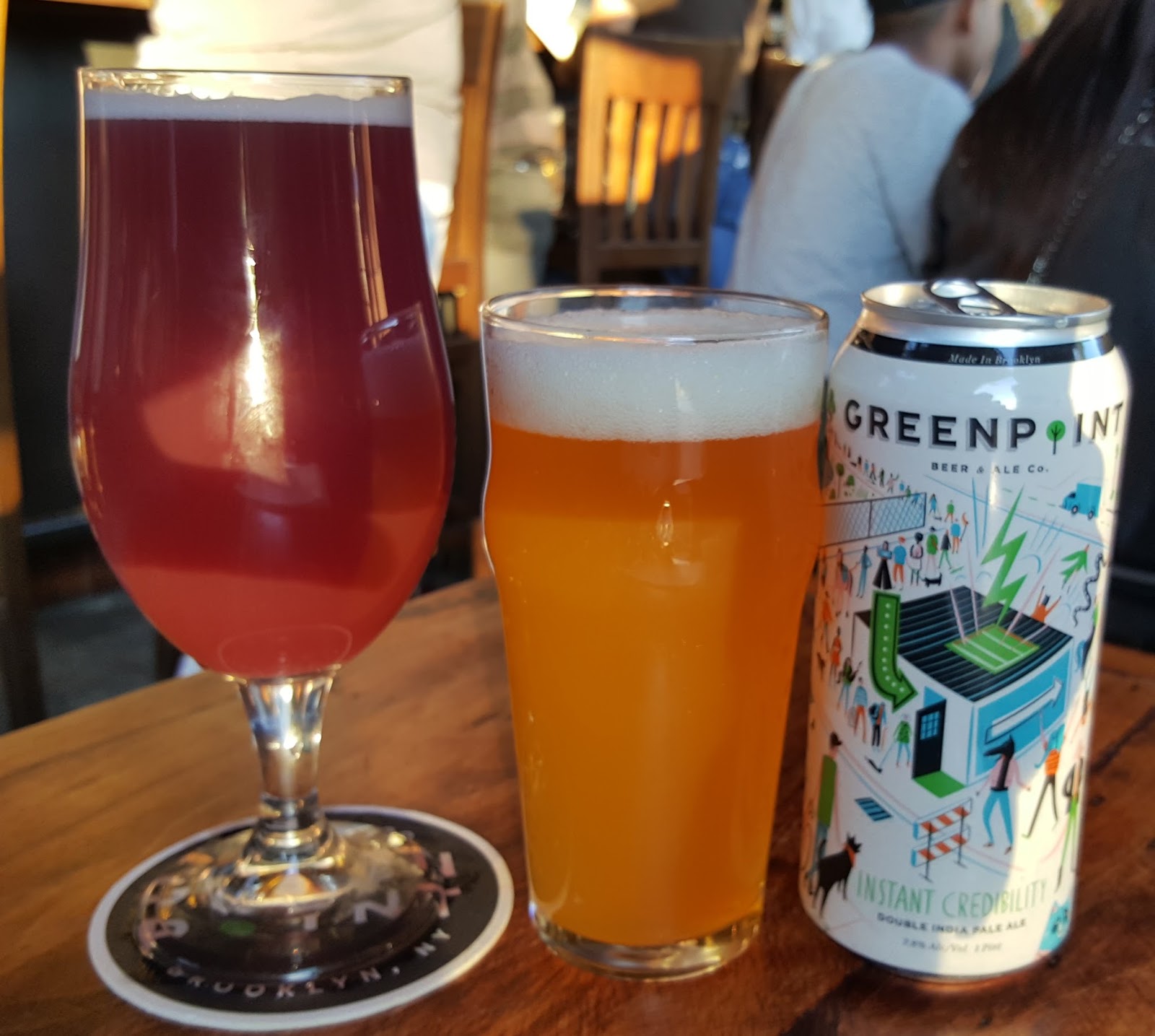
With boring predictability I ordered the weirdest thing on the menu, described as Blueberry Lime Sour and arriving an opaque beetroot-maroon. The first sip brought... ginger, bizarrely. There's a certain spike of lime sharpness, kind of a mild margarita effect, but the blueberry's contribution seems to be limited to the colour and a touch of berry skin tannins. Not the crazy beer I was expecting and, if I'm honest, hoping for, but it was nice, in a cocktailish sort of way.

My wife got some Instant Credibility, possibly the most apt name for a beer ever, as it only took one sip for me to decide Greenpoint is a fantastic brewery. It's a double IPA, though on the low side of the ABV scale for the style at 7.8%. Despite this, the alcohol is laid on fairly thickly, with a hot dank aroma and lots of smooth malt in the flavour. And yet it's perfectly balanced, the hops throwing out intense grassy resins which keep the palate on its toes and ready for the next sip. Ultra-drinkable double IPAs are very thin on the ground, but this is one. I'm not at all surprised that the can I bought was the last in the brewery on the day.

That fact removed the incentive to stay for another round, so we toddled off into the sunset. And that pretty much concludes my craft beer explorations of New York. But before we head for La Guardia and beyond, a final post to mop up some miscellaneous beers that have slipped past unmentioned this week.


02 November 2016

Serious craft

I'm a daytime drinker by preference, especially when on holidays. But there was so much to cover on the trip to New York that some places only got an evening visit, a time when I'm not at my best and they're too busy to be bothered about giving me a good impression. We saw this with Rattle N Hum in Monday's post and Swift Hibernian yesterday. And so it was with another craft beer highlight of the Big Apple: Blind Tiger Ale House, where Free Will Brewing of Pennsylvania had taken over a swathe of the taps, pouring to a large and enthusiastic crowd. This corner bar doesn't have much of a capacity and it was definitely straining here. But we managed to nab a couple of stools and enough of a server's attention to get a couple of beers.

I can't remember what I ordered but what I was given was Bear Republic Barrel 100 and I was happy to stick with it. This is based on their Hop Rod Rye, soured and barrel-aged. It comes out 10% ABV and a dark purple-brown colour. The process gives it both an old-oak smoothness but also a sharp Flemish red edge, as well as hedgerow berry flavours and some sappy wood resin. Beautifully complex yet all perfectly integrated for some quality sipping.

I just had a tiny sip of the wife's Free Will Techno IPA, enough to find it was rather plain and unimpressive. I moved on to Free Will myself next and had their Pomegranate Sour. There are raspberries in this too, both presumably making a contribution to the hazy pink appearance, though the flavour is much more raspberry than pomegranate. It is strikingly clean, the sharp tartness a knitting needle through the palate, digging a channel to pour the tangy fruit in after. Exquisite and refined, this is not at all gimmicky as I'd expected.

The next IPA to cross the table was Hop Showers by Other Half. This is a murky orange colour with a lovely fresh and resinous aroma. The flavour is similarly oily and definitely 100% hop-derived, tasting of menthol and old fermented grass. It's a serious beer with no fun fruit to lighten the mood but the quality and freshness is beyond question.

At this point we gave up our table to some other standing folk and headed off in search of food.

We were back in the West Village the following afternoon, this time to try out Upright Brew House. It's not, as the name suggests, a brewpub, just a bright neighbourhood beer café, reminiscent of the sort you might find in the Netherlands.

Jolly Pumpkin was on the list, their Gratzer, so that was my choice. There's a surprising saison-like quality to the aroma of this: a kind of peachy fruit. The smoke only emerges on tasting, where it's dry and nicely understated, fading politely away to let the citrus and sour elements come through. With those US hops it's probably some distance from what the style is supposed to offer, but I don't care: it's delicious.

Other Half showed up again, with the best of their range that I got to try. Topical Depression is a "zero IBU" double IPA with passionfruit, brewed in collaboration with Veil Brewing in Virginia. It's an opaque custard yellow, smelling spicy and bitter, like grapefruit skin. The texture is surprisingly light given the strength, which is one way it enhances its drinkability. The other is the massive juiciness, though more peach than passionfruit. A spicy grassy middle gives it some level of perceived bitterness but there's no acidity in the finish and, remarkably, no yeast bite either. Overall this is a fantastically clean, upbeat, feel-good double IPA, in spite of the rather grim foggy and headless presentation.

It would have been nice to stay a while longer at Upright but there was more touristing to do. There always is in New York. The next pitstop was in Hell's Kitchen where we chanced upon The Pony Bar, not on my list but quite highly regarded by the Ratebeerians. It's a pleasant open space on a vaguely Western theme and Happy Hour was on, meaning the beer was merely pricey, not obscene. What looks good on the list?

SixPoint's Tesla caught my eye. It's a recently-released strong wheat lager: a clear pale gold and an electrifying 7.2% ABV. Sadly it hit all the points that "imperial pils" usually does for me, being all heavy and sticky, the sweetness problem exacerbated rather than balanced by a burnt-plastic-and-nettles blast of German hops. It's all just too loud and too harsh to be enjoyable.

To the right of it there is Here Come The Drums, an IPA from Interboro in Brooklyn. It's a hazy orange colour and has a mildly pleasant resinous aroma. It tasted a little unfinished, however. There's a bit of a yeast fuzz covering the hop brightness, with an orange citrus note buried behind it. I found it a rather dull beer but I think it could be much improved if given a further polish in the bright tank.

For round two I turned to Stone. I didn't see much of the San Diego brewery's offerings around New York, but Pony had a couple. Farking Wheaton w00tstout is a new one in a series of imperial stouts they've made with the kid off of Star Trek. This one is 13% ABV, the recipe incorporating rye, wheat and pecans before the whole lot got shoved in a bourbon barrel. And what came out? Well, the pecans are definitely still there: there's an enjoyable sweet and oily nuttiness which matches with the thick creaminess for a kind of pecan pie effect. Beyond that there's not much by way of subtlety: big hot marker-pen phenols loom large, reducing the warmth and smoothness that I value in beers like this. I'd say it's one that will age well but is a bit one-dimensional at the moment.

Herself managed to get two in while I was finding my way around all of that. First was Forever Ever session IPA by Other Half: a wan hazy yellow with a sharp spicy bitterness but not much going on otherwise, tailing off quickly to a watery finish. She followed that with Stone's Citracado, a 9% ABV amber coloured double IPA with added honey. And surprisingly this is another quite bland one, opening on an odd farmyard sort of aroma with an alcohol burn on the tongue and then nothing but a mild lick of green pine to shore up its IPA credentials. It's often the case that honey doesn't impart as much flavour as the brewer expected and this could be one of those.

And that's where the beering around Manhattan more-or-less ends. I'd set aside the whole of the following day to visit some breweries in Williamsburg, of which more tomorrow, but of course we had to go to Tørst as well. This is Evil Twin's tap and a place often described in hushed tones by the crafterati. I've heard the phrase "world's best craft beer bar" mentioned in relation to it. On this particular Saturday afternoon it was quite quiet, though a single layer of punters had accumulated on the spindly stools around the bar. We occupied one of the tables. In keeping with its Danish heritage, design is a major part of the Tørst experience and everything is coordinated, angular and uncluttered. Your beer arrives in a customised thin-stem wine glass.

L: Daddy Warbucks.
R: Erase & Rewind
My beer was Daddy Warbucks, a double IPA from Barrier Brewing on Long Island. It's a pale hazy yellow with a light citrus aroma. The hops are shy on the palate as well, imparting a weighty oiliness but no striking flavours from the American IPA repertoire. I got through it OK but was left underwhelmed.

Her beer was Evil Twin's Erase And Rewind, version 2 of it. This is a 7% ABV IPA, hazy gold in colour with a cereal malt aroma plus a touch of savoury garlic Mosaic. With Azacca, El Dorado and Citra billed I had been expecting something much more tropical but instead it delivers a spiced marmalade bitterness, which was nice, but not what I was anticipating. Again, I expected bigger and brighter.

So not much luck with regard to the beers at Pony or Tørst, but they're both fine establishments and I commend them to you, hoping you'll fare better. But now we're in Williamsburg: time to hit some breweries!

01 November 2016

Big Apple turnover

Yesterday's post left off with me leaving McSorley's Old Ale House and crossing a couple of New York city blocks to visit the next bar on my list: Proletariat. It's a small space, most of its narrow length taken up with the counter. If it were in Madrid or Venice it would be lined with men eating ham and olives while drinking coffee or grappa, but it's in the East Village so attracts hip young things in search of expensive beers. How expensive? North of €7.50 for the American half-pint (237ml) which seems to be their preferred measure, served in a TeKu glass, despite those being, like, so 2013.

I kicked off with Invasive Species, a 5.7% ABV sour ale by Brooklyn outfit Greenpoint, which incorporates Motueka and Citra hops. It's a pale hazy yellow colour and smells very farmyard. The first hit on tasting it is an eye-wateringly sharp green acid effect from the Motueka and then a surprising candy-sweet middle. The Citra succeeds in turning this into 7-Up while the sourness is merely a tangy afterthought. A chalky fruit-flavoured antacid tablet flavour finishes it off. This really didn't work well for me: hoppy and sour I like, but sweet and sour is for chicken.

L: Invasive Species. R: Elephant
My hopfiend wife ordered the double IPA: Elephant from Rushing Duck Brewery somewhere upstate. An 8.7% ABV beast with an alchemically complex aroma, twirling out an assortment of spices on a greasy grassy base. It tastes nicely dry with a huge, clean-burning, hop bitterness with more spices and lashings of citrus fruit. Most importantly there's no booze heat at all, making it the sort of DIPA that wakes you up instead of putting you to sleep. I approve.

Feeling gypped by the first round I doubled down and spent a smidge over €10 for a half-US-pint of Jolly Pumpkin Saison X, a beer of just 4.5% ABV. There's a sharp bricky aroma, like good lambic, though almost tipping over into vinegar. On tasting there's an immediate gritty funk which is much more saison-like, huge juicy peach and honeydew fruit, which was a surprise, and then a classic oaky sour finish, bringing us back to lambicland. It's only barely to-style, though admittedly saison does have a pretty broad set of parameters. But it was absolutely beautiful: combining the best bits of several different kinds of beer in exquisite balance. Which, at that price, it would want to.

Something a bit more down-to-earth was called for next and we went off hunting barbecue. We settled on Mighty Quinn's, a small chain based around New York and New Jersey, its East Village branch being bright, clean, friendly and serving decent scran. There's a small but well-chosen array of draught beers and I went for the house one: Mighty Quinn's Pilsner, brewed for them by Jersey's River Horse brewery. "Surgically crisp" says my notes, so I guess I liked it. It's clean and has a clear green celery and spinach hop edge to it. In short, much more what I was hoping to find in American pils compared to the two I mentioned yesterday.

While tweeting my way round to annoy the folks back home, because that's what you do on holidays, I got a recommendation from Jon Urch to visit Swift Hibernian Lounge since we were in the neighbourhood, so we stopped in for a nightcap. It's hard to get an impression of the place since it was so dark, but it's big, service was slow and they sell corned-beef-and-cabbage tacos. Perhaps that's all you need to know. I ordered a SixPoint Dark Mild which was nitrokegged and absolutely terrible, full of cloying oversweet toffee; a Hershey bar as beer. Bleurgh. Time to call it a night.

The following afternoon we were down in the Financial District and I insisted on dropping in to The Fraunces Tavern, the New York footprint of Dublin's Porterhouse brewery and pub chain. It's a vast rambling place and has a very competent selection of local beers. I still had a Wrassler's though, and it tasted just like at home. Except the glass was smaller. M'lady went for Nirvana from Ommegang, the Belgian-owned, Belgian-themed New York brewery's first US IPA. It's still a little off-kilter, but in an interesting way, showing spicy jasmine in its aroma. Bitterness is low despite a solid 60 IBUs, and likewise the 6.5% ABV doesn't make it too heavy or warm. At the centre is a bagful of juicy jaffa, mandarin and peach, making it deliciously thirst-quenching and flavourful. Classy stuff.

Just one more pub before I bring this post to a close, but it's a biggie. The Ginger Man in mid-town is another enormous one, ostensibly on an Irish theme but with its bright windows, high ceilings and wood-panelled walls has more of a Bavarian bierhalle feel to it. Conversion would take little more than a change of furniture. We settled into wing chairs in a comfortable corner to peruse the substantial beer menu.

L: Powder Monkey. R: Hopstate NY
Sensing the upmarket and conscientious vibe of the place, I decided I'd take a punt on a cask offering, with Powder Monkey from Heavy Seas Beer in Maryland being one of the two options. It's a 4.8% ABV pale ale so I expected something not too dissimilar from bitter. And I was sort-of right, but not in a good way. Though the condition was decent the beer tasted tired: slightly sharp with a complete absence of hop freshness. It smelled of over-ripe strawberries and the red fruit flavour continued into the flavour. I was left with an impression of brown bitter on the turn, and am minded to place the blame on the pub. If the problem isn't with their cellarman it's with their buyer.

The Ommegang fan next to me chose Hopstate NY, an amber ale which arrived a dark red-gold colour. There's a sweet orange sherbet aroma but a strangely dry and wheaty main flavour with little more than a minor tang from the hops. The flavours are doing their best to lug around a stubborn heavy body, making it difficult drinking despite being only 5.6% ABV. But hey, the pub is nice so let's order something else.

For me, a session IPA from Interboro called La Dee Da Dee, for reasons best known to themselves. 4.7% ABV, bright orange in colour though quite hazy and smelling of that enticing modern combo of serious dank resins and carefree juicy citrus. The downside of all this comes in the flavour, led by garlicky savoury hops and fuzzy yeast interference, bringing us to an abrupt watery finish. It was promising but it needs more zing; there's a palpable zing deficit.

And for her, Cubano Espresso by Cigar City, a 5.5% ABV brown ale with added coffee. It smells very coffeeish, with that oily fresh bean quality I always enjoy in coffee beers, alongside a convincing dark roast. There's a creamy sweetness of the sort often found in brown ales and the coffee swings in behind this leaving a lasting roasty aftertaste. This is one of those unsubtle but what-the-hell fun beers; difficult to drink with a straight face.

And that's The Ginger Man done. The Village was calling again, and that other famous New York craft beer bar. You know the one I mean.