08 December 2017

Wrapping up

I haven't mentioned the Scott Duff pub in my week of Milan posts yet, even though we visited it on three of the four days we were there. It's a roomy and rambling venue, the large tables and tiled floor reminding me most of a central European inn where foaming mugs of one type of lager are the mainstay. And though you can get excellent lager here -- Keesmann Herrenpils on my visit -- there's plenty more besides on offer.

Sucker for a house beer that I am, my first choice was Scott Joplin 3, brewed by Opperbacco for the small chain of which the pub is a part. Broadly, it's an American IPA, but a dark amber one, and 6.4% ABV. The flavour is quite severe: very dry and bitter loaded with pith and tannin. Doubtless there's a market for this sort of thing but it's not me: I generally prefer a level hop fruitiness to be at least some way present.

A late-nighter on Friday, staggering home from Lambrate, brought me into contact with Nordic Lean, produced jointly by Lervig and Stillwater. It's a sour IPA and I'm a fan of them at any time of the day or night. A variety of berries went into this too, and I'm less keen on fruit in IPA, but the pink cherry taste they create is inoffensive. The use of Brettanomyces brings a heady funk, and then the hops give it a slick of resin on top. It's perhaps not terribly sour, missing the palate-scrubbing tartness of the best of them. It is massively complex and interesting though, even if badging it as an IPA is a bit of a reach.

And then we come in where I left you in the last post, hurriedly quaffing the last beers before almost missing the airport train. I went for CocoBänger, a coffee and coconut imperial stout from Põhjala. A café crème head sits over a dense black body. Unsurprisingly it smells like a Bounty bar, and there's a bonus chilli spice as well, wherever that's from. A dense and intense first mouthful presents an Irish coffee creaminess, all arabica beans and warmth. An unctuousness lingers on the lips and coats the insides but it doesn't get hot or cloying, and is almost easy drinking for 12.5% ABV. Excellent stuff.

Beside it is John's Aeromancia, a wheat IPA from Valencia's Zeta Beer. In, I guess, typical Valencian style, it leans towards the orange in a big way, in colour and flavour. The aroma offers an invigorating citrus zest while the flavour is sweeter, showing chew sweets in particular. A clanging metallic aspirin taste finishes it on a bum note. I'm not sure I'd like this, even if I hadn't been drinking a powerhouse imperial stout at the same time.

Redemption for Zeta comes in the next round with My Name Was Barack, a barley wine. It's a dark brown colour, with a density that directly reflects its 10.5% ABV. There's a heady mix of incense and cedar spicing, sparking against lavender and bathsoap. Given more time I'd probably have found more in it, but what was there was good.

And bringing us out the door, Back to Black by De Ranke, a strong barrel-aged porter. It smells like a kriek: very tart with balsamic notes. The flavour is a lot cleaner and more integrated, with fruit but also a mild coffee element. Nine months in an oak foeder has given it a fantastic smoothness and it's very easy to forget the 9.5% ABV. Another beer I would have liked to have spent time over.

Of time we had plenty when we got to the airport. In a posh bar on the concourse they were serving Baladin beers so we ordered one each. For me, Birra Nazionale, quite a generic number, smelling and tasting like a straightforward witbier, though all of 6.5% ABV. The brewery claims it's the first beer brewed entirely from Italian ingredients and I guess that bit of novelty explains why the flavour isn't up to much.

John went for Super Bitter, a beer that piles in the hop resins which combine with 8% ABV to produce a pleasant warming experience with overtones of orange and cedar.

I had noticed Itala Pilsen in a couple of the airport cafés and was interested in finding out if that's any good before leaving Italy. It turns out this is a legacy brand, acquired and killed off by by Peroni in the 1970s and revived last year, presumably in a desperate rummage through the archives for something to give them a bit of class. It's fine: nicely balanced, with a sweet base and just enough hop kick to pass as a decent pilsner.

For balance, something much shittier by Peroni next to it: Peroni Forte, an 8%-er that lends Italian panache to your park-bench drinking. This is a dark amber colour with a sticky texture and an unpleasant earthy mushroom flavour. It's possible to drink without gagging, but classy it is not.

And that's Milan, as drank by me. Northern Italy certainly has a lot going on beer-wise. I'd love to get further into it at my own pace, but some other time.

07 December 2017

Freedom!

Alessio Selvaggio heads up Unionbirrai, the Italian microbreweries' association which is affiliated with the European Beer Consumers Union. He also owns a brewery, Croce di Malto, in Trecate. For the EBCU's autumn meeting in Monza, he brought one of his beers along to share with the delegates at lunch.

Magnus is in the Belgian dubbel style, if a little bit of a lightweight at 7.3% ABV. The flavour is no slouch, however, with all the prunes and dark chocolate of many a quadrupel. The intensity builds as it goes, peaking on a slightly harsh astringency. I don't know that it's better than any of the classic Belgian dubbels, but I enjoyed this local take.

I'll be honest: after nine hours in Carrobiolo (see last post) I had pretty much given up on ever being anywhere else and was preparing to spend the rest of my life there. My liberator came in the form of Monza's other beer specialist, SoloBirra, and a few of us made a break for there once it opened for the evening.

It's a sparse cube of a pub, and as the name suggests, you come here for the beer and the beer alone. There's a bar at one end and a giant blackboard with the rotating draught list at the other. Our merry band of beer geeks was happy, and around the table we had: Sun Flower, a simple golden ale by Birrificio Valcavallina -- 4.3% ABV, light, clean and peachy; Spils, an attempt at pilsner by Birrificio Argo which was far too sweet, floral and perfumey to be enjoyable; and an Italian Brown Ale, created in collaboration by Birrificio Italiano and Stone, which was very tasty: a monster at 9.3% ABV, and boozy as hell, but balanced by a light-touch spiciness which adds a jovial dimension and renders it embarrassingly easy to drink.

For my part, I brought a Birrone Fuckin porter, because haha, sounds a bit rude. Did I mention I'd been drinking since 10am? It's a damn fine example of the style: low octane at 4.2% ABV with a lovely soft texture and warm milk chocolate notes you can just sink into. It manages this without being sweet or claggy, sweeping off the palate quickly and bringing your thirst away with it.

We took the train back to Milan next and ended up on the south side of town, at La Belle Alliance, a narrow L-shaped pub with an excellent international draught line-up, including our own White Hag and Kinnegar. I'm still not used to seeing great Irish beer when abroad. I'm sure it'll be normal soon.

I started with a beer from Rurale, a brewery we see a bit of in Dublin, though not this particular beer: Castigamatt. It's a black IPA with a big ABV of 7.5%. That's well hidden, however: the flavour subtly roasty, with an effervescent baking soda or bathsalts texture plus a sweet seam of lavender and violet. I tend to like my black IPAs a tad punchier, but I found the smooth stylings of this elegant example very enjoyable nonetheless.

Keeping it dark with a stout next: HumanFish Stout, from the HumanFish brewery in Slovenia, served on cask. Something wasn't right with this one, and I don't know if that's the beer or the dispense, or a combination. It was highly astringent and far over-attenuated: thin and sharp and just too off to get a sense of what it was supposed to be.

I moved to Slovakia and switched to IPA for the next round, choosing  IPA 14° by Svätojánsky. No joy here either. It's one of those hard, mineral talc-and-aspirin IPAs I've encountered in eastern Europe before, as dour and penitential as Moldovan arthouse cinema. This one adds an extra twang of saltiness for extra punishment. What it lacks is any proper hop flavour, or possibility of fun.

We stayed for a possibly ill-advised last one and I wasn't in the mood for something terrible after the previous two. A Bavarian doppelbock? That will most certainly do. Palmator from Prösslbräu Adlersberg is classic perfection in a glass: packed with sweet chocolate and bitter liquorice; fantastically smooth and easily sinkable by the half-litre despite the 7.5% ABV. After that I felt ready for anything, which is just as well as we were on the wrong side of an unfamiliar city after the last metro had left and it had just started to lash rain.

The evening trudge was a distant memory by the time Sunday dawned. And it did actually dawn: the fog clearing and a genuine blue sky for the first time all weekend. For a late lunch I followed a recommendation for a restaurant called Al'Less, one which also alleged a decent beer offer. The food was excellent, ingredients fastidiously chosen and prepared, with everything strictly local. The beer options had been wound down for the winter, with just one available, so we had that.

Agricola Bionda is a saison from the 2 Sorelle brewery in Piedmont. It was interesting to try saison in its natural habitat, ie when you're thirsty and it's the only beer there is. This one acquitted itself well: dry and spicy with subtle notes of cardamom and coriander. No fancy fruit or funk and a modest 5.5% ABV. Unexciting, perhaps, but very decent.

With Sunday afternoon drinking options limited (thanks as always, southern Europe!) we ended up in the Pilsner Urquell bar next. It's noteworthy how the transfer of SABMiller's former brands into the Asahi portfolio has happened seamlessly in Italy, and wherever you see Urquell there'll be Meantime and Peroni too.

There was also Du Bocq's abbey brand, St. Benoît, and I opted for St. Benoît Blanche. This is a pale, bright opaque yellow. The foretaste is floral, but takes a turn for the soapy almost immediately, coming through like fabric softener. The coriander is very prominent, and there's a star anise bitterness. A soft soda texture helps it stay drinkable but overall it's a smidge too sweet and lacking the crisp wheatiness of good witbier. One was plenty, especially since one of our favourite pubs had just opened for the day and we had time for one more before heading home.

06 December 2017

Bonza Monza

Early on a dark and dismal Saturday morning in October, Dr John and I made our way through northern Milan to Porta Garibaldi station. The venue for the second day of the autumn EBCU meeting was Monza, a small city around 20 minutes north of the metropolis.

Our host for the day was the Carrobiolo bar, brewery and restaurant. Not the largest space to spend a nine-hour day in, but it did at least allow for a very thorough investigation of what they brew there. Pleasingly it's only house beers too: I always grant extra kudos to a brewpub that doesn't admit guest beers.

You know what came first, of course: Carrobiolo Pils. No mere placeholder for the Peroni-bibbers this, it's smooth and creamy; bitter and grassy; with a generous dollop of candy malt for good measure. A wiser man might have stuck drinking this all day. It's certainly built for it.

The next lager for me was Carrobiolo Keller, another clear, smooth and clean one. In fact it resembles the Pils quite closely, just missing the big hops, showing a very mild waft of meadow flowers instead, as well as a touch of astringency in the finish. It's very unexciting, and I guess that's why the brewery has used it as a base for some of the more out-there experimental recipes, of which more anon.

The brewery's gluten-free American Pale Ale is less hop-forward than either of the lagers, weirdly. It's very dry and quite dusty tasting, the clear amber colour making it look a lot more full-flavoured than it transpired to be. What hop character there is is a muted caraway seed thing. I had to wonder what sort of pale ales the brewer had been drinking that he thought they were supposed to be like this.

There's also something off about the double IPA, Amanipa Phalloide, too. It's one of those thick and funky US-style ones, going all out for dankness. In doing so, however, it misses any fresh qualities in the hop profile: it's dark and serious, unlit by tropical sunshine or invigorating forest pine. There isn't even a proper bitterness to the resins. I get the feeling that US styles are really not the brewery's area of expertise. Moving on...

Estiva summer ale brings us back to the light. This one is hazy and definitely doesn't taste as clean as the lagers, having a touch of yeast bite and a slightly gummy New England IPA vanilla flavour. Beyond that, however, there are plenty of bright fresh hops, with the zing of grapefruit pith and and heavier oiliness as well. This is the beer to go to if you're after a pale ale, even though it isn't badged as such.

A trilogy of novelties follows next, beginning with Monza Mule. Not for the first time, I found myself the only person in the room enjoying a beer that everyone else was passing around while grimacing. It's brewed with ginger and cucumber, and tastes massively of both: a green salad foretaste starts things and is followed by a rasping ginger burn. Interestingly, the cucumber doesn't go in until the end of the production process, pretty much as a dry-hop equivalent. It certainly ends up tasting fresh and real. Yes it's a very silly beer but it works, even if the light pale base doesn't really stand up to the additions.

The beer the place seems proudest of is ITA, and that's possibly because it's a real rarity. Based on the Keller, the addition this time is local tomatoes, as well as a seasoning of basil. And like the Mule, these additions come through loud and clear in the finished product: fresh and juicy tomato and slick oil-rich leafy basil. There's a dry and peppery quality to the whole thing which lends it the air of a classic saison. Overall it's very well integrated and doesn't seem like the novelty it undoubtedly is.

The next one is definitely not a novelty, and is the sort of beer I hoped to find lots of on this trip to Italy. Mo'scanzati Azzo is a grape ale, pinkish purple in colour, and just as complex as a fine Italian wine. Black pepper is the first flavour I noticed, resolving into spicy oak. A fresh supple leather character follows it, then finally the fruit: a luscious summery grape juiciness, as you'd find in a young Barbera. This mix of serious maturity and youthful frivolity is achieved at an amazing 5.6% ABV. Why would you ever drink wine again?

For dessert at lunch there was Stanislao barley wine: 10.2% ABV though remarkably pale and light-bodied. The flavour is superb, however: crammed with Madeira and prunes, livened by a gentle sparkle and showing just a hint of sherryish oxidation. If the previous beer was your Barbera, this is your oloroso for afters.

We're back on more orthodox ground next with Carrobiolo Tripel. It probably shows that I'm just trying to get to the end of the line-up before it's time to go. This smells Belgian from the get-go and the flavour demonstrates all the big alcohol and esters that are typical of the style, though perhaps more common in non-Belgian tripels than the usually-cleaner native versions. By way of balance this has a strong but fun bitterness, with intense jaffa pith and a floral jasmine spice. I have no arguments with it as a tripel, though it's definitely more than a by-the-numbers job, showing a real personality of its own.

The brewery's weizen, Weisse Al Farro, was less successful. It has the crisp noble-hop celery flavour that some German weissbiers have, but there's none of the banana, bubblegum or clove style markers, and the texture is crisp and angular rather than round and fluffy. Think of it as a lager and it's fine, if not very characterful.

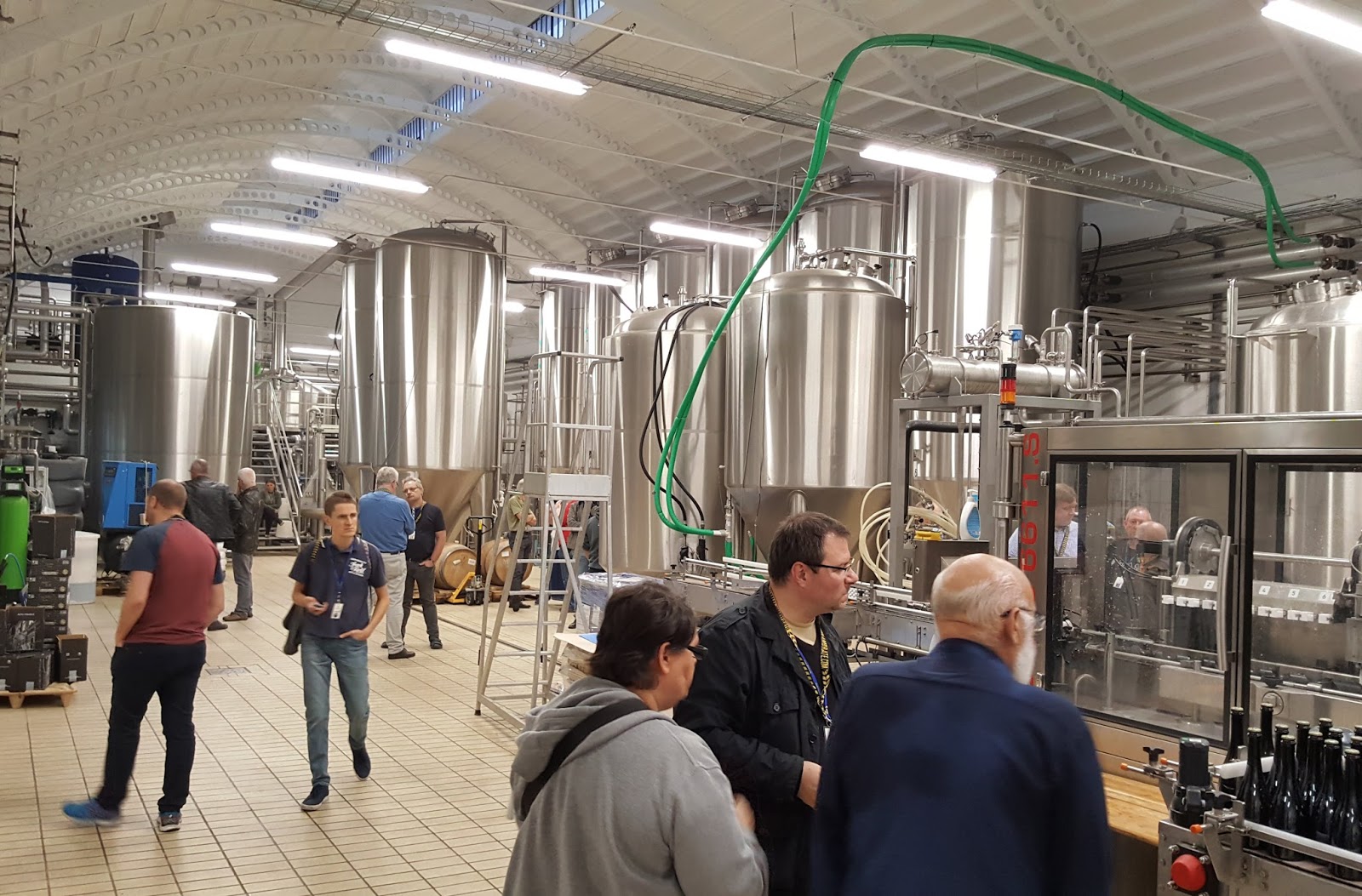
A tour of the brewery next turned up a few final interesting fellows which weren't on tap. The Christmas beer was still being matured in the bottle and we got a sneak preview. They have decided to confound expectations with this winter release, opting for a Christmas Framboise. It's another that started life as Keller but aged a year with added raspberries. It's mostly quite dry and crisp, so that much hasn't changed, though there's a slightly sour complexity and a bite of tannin as well. A bright and fresh spritzy quality suggests that it still had a little more maturation to go, though as an unusual alternative to dark and heavy Christmas beers I can see it working well.

Coffee-Brett imperial stout was another one still a few weeks away from release. It was tasting pretty good though, with a massive fresh and oily coffee bean flavour, all but burying the stout. The Brett hadn't really asserted itself, and perhaps that will come later. Here it supplied a slight earthy funk but no more than that. A tang of bitterness finishes it off. This one is 11% so will doubtless keep well in the bottle. I think it'll be interesting after a year or two when the Brett has really gone to work on it.

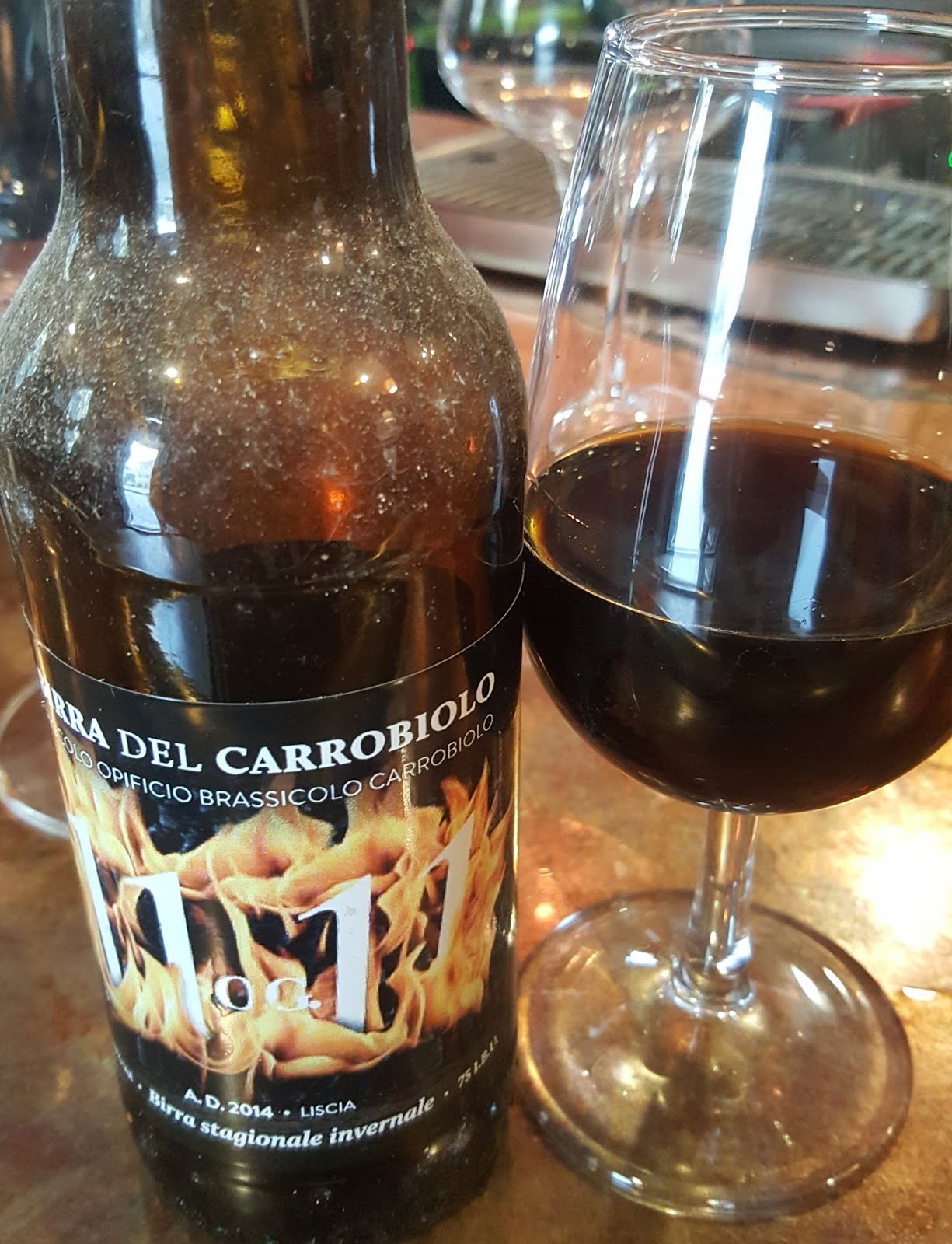
And finally OG 1111, of which our host seemed to have a particular personal affinity. It's named after the original gravity and is a peated strong ale, coming out at 13% ABV. We got to taste the 2014 vintage which was flat, viscous and earthy, mixing funk and smoke with a beefy autolytic quality. There's a lot of going on, but I think slightly too much of it was what generally get called off-flavours. Any attractive complexity is offset by tastes that are just not quite right, in any beer. I'd chalk it up as a draw: it's fine, but probably better when not aged.

That concludes the day's Carrobiolo beers, but we don't get to escape just yet...

05 December 2017

Hung for a lamb

I promised you a brewery in yesterday's post, and yes our group of delegates from EBCU did indeed visit Birrificio Lambrate on our trip to Milan in October. We got the full tour of this ever-evolving 1996-vintage micro, but didn't get any beer. That had to wait until we walked a few blocks over, to their neighbouring pub.

It's an odd but charming little place, in a vague dark-wooded English style, decorated with maritime and tram bric-à-brac -- Milan being a tram-spotter's dream. A raucous Friday evening crowd was already filling the cramped place out, spilling into the street outside, though it thinned gradually as the evening rolled on.

At the bar, a dozen or so taps supply Lambrate beer and everything except the cask is pouring high. This means a wait at the counter while your glass of foam settles and is topped up repeatedly. Thankfully the bar staff are expert at remembering who ordered what.

Well I ordered the pils, starting out, as I often do. Montestella is part of the brewery's original line-up. I was parched, unprepared for the powerful Pavlovian thirst engendered by leaving a brewery without having a beer there. This absolutely hit the spot and was almost gone by the time I realised I should be considering how it tastes. It tastes fine: mostly quite dry with a mild noble hop bite in the finish and a growing cake sweetness as it warms. Unremarkable, then, but sometimes that's all a golden lager needs to be.

I followed it with something a bit more showy: The Magic Tram, a New England-style IPA brewed with the assistance of Magic Rock. It starts bitter: heavy on grapefruit, with an acceptable lacing of garlic. The pithiness fades after a moment allowing a pineapple and jaffa juiciness to flow in. The finish is quite sweet, with a pinch of real vanilla accentuated by the creamy body. It's very nicely done, at once immensely complex, hitting every beat of the style, yet still effortless to drink.

For reasons known to themselves, Lambrate brews a pilsner with the attractive name of Magut. I had a variation of it next: American Magut. This had a lot of the issues found in the Montestella: there's really not a lot to it. Yes, it does offer a more hop-forward experience, but it's overly bitter and quite sharp, lacking the malt weight to balance it. There's nothing technically wrong with it but I didn't enjoy it and failed to see what was supposedly American about it.

Another brand extension next, this time to the Baltic porter Ghisa, one of the few Lambrate beers I had tasted previously. Imperial Ghisa is a mere 8.5% ABV but tastes like far more, offering a whole range of unusual flavours. It starts dry and tannic then brings in huge billowing wafts of liturgical incense. Chocolate, red wine and candlewax follow this. It's a serious beer: the lack of sweetness places it as far away from pastry stout as it's possible to be on the strong dark beer scale. Majestic and baroque, this is one to savour.

The city's patron saint gets his own Lambrate beer: S. Ambroeus. It's a strong golden ale, roughly in a Belgian style, though is another dry beastie. Sharp herbal grass flavours are tempered only slightly by softer stonefruit, and that's all you get. An amateur but inoffensive attempt at making something like Leffe, it says in my notes, somewhat cattily.

The other blonde ale, Ortiga, was much more enjoyable, and lighter too at just 5% ABV. It's a riot of fruit-chew flavours, orange and lemon in particular, and despite the unabashed sweetness it's clean and easy going. I was getting the impression that Lambrate beers divide into the serious ones and the frivolous ones. This is definitely the latter.

My parting shot was 60D-01, a seriously heavy American-style IPA. Amber in colour it tastes as thick as it looks, absolutely saturated in sharp and dry hop resins, all but sucking the moisture from the drinker's mouth. A fruit seam runs through it, but that's more tannic red grape than anything citrus. At 6.5% ABV it's not even that strong, packing a lot in, including the body and warmth of a much bigger beer. I was impressed, though I didn't expect to be able to taste anything else for a while so left it at that.

Tomorrow we're striking out on an excursion beyond Milan itself.


04 December 2017

Buongiorno Milano!

It seemed I was only just back from Stockholm when it was time to go to Milan and the autumn 2017 meeting of the European Beer Consumers Union. I was accompanied by Dr. John and we landed into a foggy Milan which was to stay foggy for almost all of the four days we were there. We were both keen to get stuck into exploring where the Italian beer scene is at these days, and said as much to the waiter at our first pub, Sloan Square, beside Cadorna station. Seems we picked the wrong place.

Sloan Square doesn't serve Italian beer. It does have a very impressive line-up of international offerings, however, specialising in UK beer as, in retrospect, the pub's name implies. A glass front on the bar counter displays the array of KeyKegs and they've chosen to hook most of them up to handpumps, cask-style. It's a fun gimmick and perhaps surprising that more places don't do this, just for the theatricality. I doubt it makes much difference to the beer that comes out.

But back to John's quest for an Italian beer. The nearest our server could offer is Last Minute, a porter from Moor of Bristol but brewed in collaboration with Milan's own Birrificio Lambrate. Pretty good it was too. Ostensibly a porter, it's 7.1% ABV, with a suitable rich body balanced with quite a gently dry smokiness. There's a lot of the Christmas cake about it, which shouldn't be surprising as it contains orange, lemon, ginger and raisins, as well as liquorice and allspice. This could easily have been a mess of clashing flavours but everything holds together extremely well.

I had to stop drinking his beer when he came back from the bathroom, and concentrate on my own instead. I'd had a good run of luck with Brew By Numbers beers lately so opted for 11|09, a session IPA. Motueka and Citra are the hops in this pale cloudy yellow job. The former brings its signature medicinal eucalyptus flavours and I was expecting that to be harshened further by the Citra, but there's actually a soft fruity counterbalance instead, juicy melon and tangy apricot. Bitter resins finish it on a flourish. The texture on which all this is set is beautifully smooth while the ABV is just 4%. A very session session IPA, then.

I was impressed enough to follow it with an other from the same brewery, and look: here was 01|01: well, you've got to start somewhere. It's a saison, and a surprisingly clear and pale one. There's Citra here too, and this time it's true to form, adding a lime-and-urinals tang to the aroma. The flavour is more gentle, thankfully: peach and melon with a slight lacing of coconut. It's clean and refreshing, and not overdone at a respectably modest 5.5% ABV. Maybe it lacks the more obvious farmhouse qualities but it's still a rock-solid beer.

With the sun presumably over the yardarm above the fog somewhere, John went with an imperial stout: To-Øl's Goliat. The head is loose-bubbled and a dark tan colour, rather caskish in appearance. There's lots of creamy malt running all through the flavour, making it seem almost wort-like. A brown sugar sweetness accentuates the impression of something not quite finished. In parallel to this there's a huge herbal bitterness, dominated by cardamom, followed by a sweet coffee finish and some drier background tannins. It takes a bit of getting used to, but it's enjoyable once that happens. The chewy mouthfeel is probably its best feature, making it a beer that forces the drinker to sip and savour.

We got properly introduced to the Italian beer that evening at LambicZoon. Here's another one where the pub's specialism is right there in the name, though this place has a much broader range beyond its fine selection of sour Belgian classics.

I opened my account with Black Cherry Drop by Birrificio Stradaregina, in western Lombardy. It's a 9.5% ABV imperial stout with cherries but doesn't make very good use of either element. At the base it's quite a plain beer: smooth and chocolatey but having no more character than that. The fruit puts a Black Forest gateau spin on it though there's also a hot solvent quality too that spoiled my enjoyment rather. Not an auspicious start.

I ploughed on with the brewery anyway, picking Sourflowers 02 Robinia next. 01 used elderflower, this pale sour 6%-er uses black locust flower. I still got a lot of elderflower from it, perhaps because I have no reference point for black locust. There's a hint of watermelon candy but mostly it is sour: an intense acidity. It just manages to avoid harshness, however, with enough balance to make it well-constructed and invigorating. And exactly  the sort of thing I came to Italy in search of.

Beside it there is an English beer, Imperial Leisure by Brighton Bier. It's billed as a brown ale though is a little pale for that, an ugly and unattractive shade of amber. The flavour is good, though: tannic and peachy, laced with incense spicing. I'd probably be calling it a bitter more than a brown ale: it shares more characteristics with the better sort of brown bitter than with any actual brown ale, not that style counts for much.

Dinner was downstairs. I switched breweries to Hammer, from near Bergamo, and their Koral IPA. This is a medium-gold colour, throwing a slight haze, and topped by a thick stack of foam. It's grapefruit all the way, making for an instant classic: from the intensely citric aroma, through the sharp and pithy flavour, to the waxed-rind finish. There's just enough malt weight to balance it while still leaving the hops in control, resulting in an IPA that is at once powerfully bitter yet approachable and delicious.

John's pick was Belka, a saison by  local brewer Muttnik. I was already well-disposed towards this when I saw it was only 4.6% ABV. It's very pale, even for a saison, but there's plenty going on: all the white pepper, honeydew and peach in both the aroma and flavour. There is a strong earthy, gritty, yeast component to it which does drain a little of the fun away. Luckily that still leaves enough fruit and spice in place to save it. Overall a really good job of a low ABV saison.

My finisher here was Flos Alba Bergamotto from Birrificio Italiano. It's badged as a Berliner weisse though aged in white wine barrels and pumped up to a stonking 5.8% ABV. The end result is something much more like a real lambic, complete with the gunpowder aroma and damp bite of nitre  in the flavour. The juicy citrus fruit softens it and adds to the drinkability. I was really impressed with this one, far exceeding my expectations of what I was going to get.

The EBCU meeting started the next day, and these tend to be long and very dry. There was respite at lunch, where the restaurant was serving Isenbeck Premium, seemingly an Argentinian macrolager but I would guess brewed locally. When cold it's an absolutely fine glass of generic fizz but develops a mustiness in the aroma and a plastic off-flavour if it's allowed to warm up at all. Consider this a public service announcement to drink it quickly should you ever be stuck with it.

Finally, when the talking was over for the day, we got to visit a brewery, and that's in tomorrow's post.

01 December 2017

Let's party

Session logoThis month's Session, hosted by Portland's Brian Yaeger, is on the subject of festivals and catches me just at the end of writing about a big one. Brian asks us to "write about how you would design your dream beer festival" and that's a tall order. I've been to a lot of beer festivals this year, covering every format from a few casks in the back yard of a small pub to large marquees to hangar-sized event halls; indoor, outdoor; tokens, cash, flat rate; local and international; minimal new ticks and impossible to know where to start. And I have enjoyed them all. Yes I'm a ticker primarily: I go to festivals with the aim of tasting lots of unfamiliar beers, but I also experience genuine relief when there aren't any more and I can put the notebook away and relax into a pint.

For that reason, I think my ideal festival is one that changes format and venue every year. It has no abiding theme, no set way of operating. Sometimes there's food, music, talks, and sometimes there isn't. But what it does provide, consistently, is information. You know what breweries will be there, what beers they're bringing, the price of admission, the serving sizes and the seating arrangements. I call it the No Surprises Festival and if you don't like the plans for this year, come next year instead.

Back to the real world, and wrapping up the final handful of Swedish beers at the Stockholm Beer & Whisky Festival 2017. New England-style IPA hasn't really featured thus far, but of course it was available. Beer Monkey had one they called Fuzzy Gorilla, and yes it's fuzzy: an appropriate hazy yellow-orange. It pretty much drops the ball after this point, however. The aroma is full of phenolic solvents, and so is the flavour. The hops are perceptible behind this, showing caraway and a little softer honeydew, but the dreadful infection shouts loudly over the top of that and it's pretty grim drinking.

Next it's Ella, a brown ale from Roslags Näsby, to the north of Stockholm. The first surprise was how dark it was; almost black, with an aroma of very bitter liquorice. Its flavour is stout-like, based around a wholesome and uncomplex roasted cereal flavour. More typical coffee and caramel sweetness arrives after this and balances it nicely. It doesn't deliver what I look for in a brown ale but rebadge it as a porter and you'd have a winner.

A barrel-aged barley wine next: the operatically-titled Valkyrians Välkomst by Gotlands. A Sauternes cask did the business here, and the end result is infused with a sweet, almost mead-like, perfume. That includes the sharp beeswax and the sickly honey too, unfortunately. A hard bitterness arrives in the finish, but too late to provide balance. I found this hard going, overall. It's a big 11% ABV and I think a lighter and cleaner beer would have complemented the wine barrel's contribution better than one which was already strong and sweet.

I couldn't have left without trying at least one beer from Ocean. The brewer here has an Irish connection having previously worked at Messrs Maguire in Dublin, and indeed Ocean beers were briefly available there. My choice was Arbetarporter, a 9%-er but tasting even stronger with tonnes of concentrated boozy chocolate. It's smooth and sweet, warming and filling, and perfectly pitched as the worker's reward.

And an imperial stout to take us out the door: Whiteout by Mohawk Brewing. Nine malts, honey and cane sugar have gone into this, bringing it to 9.7% ABV. I had to double check if it, too, was barrel aged because I get a kick of fortified wine from it, as well as a herbal bitter liqueur element, like Fernet Stock. A little bit of chocolate sits in parallel with this and helps balance the severity, while the dry finish means none of it lingers on the palate. It's a challenging beer, but worth acquiring a taste for.

Just time to finish off the hotel room stash now. Black Soil is a black IPA from Sigtuna, a big 7.5% ABV with an enticing Turkish delight aroma. The flavour doesn't really follow through on this eastern promise, offering not much more than some dry roast. Let it warm up and there's a hint of rosewater and a waft of smoke, but nothing spectacular, and certainly no proper IPA hopping. This really needs more of everything, except maybe alcohol.

Finally the heavy metal stylings of Dark Skull by Electric Nurse, the sort of beer that sounds like it should have an elaborate gatefold sleeve. "Imperial coconut stout" says the label but oddly I got far more of a coffee flavour from it. I'm guessing the coconut was roasted, and hence the effect. The bitterness is understandably low and I quite like the way the dark malts are given centre stage without making the beer too sweet, while the coconut doesn't turn it into a gimmicky novelty beer. It's a more serious and considered recipe than the branding might imply.

And that was it for Stockholm. It just remains for me to thank BrewDog for sending me over, and especially Grace and Beth who did the logistics work. The perfect beer festival? Probably not, but it's definitely its own thing with a unique personality and perhaps that's the important bit.