15 February 2019

Taken to cask

Can you believe it's already the ninth year of Franciscan Well's winter celebration of cask beers? I made my way down as usual on the Saturday, tasked once again with helping a panel of Beoir judges to decide the best beer of the festival. It was the last day of the gig, and samples of beers that had already been tapped and emptied had been kept aside for us. The standard was pretty good overall: daring small-batch recipes, which the festival encourages, often do not equate to quality beer, but there were fortunately few outright bloopers. The elegantly constructed Brettanomyces symphony that is Kinnegar's Phunk Bucket took the top gong on the day. In parallel with my scoring, I kept notes on the beers I was given to judge, matching them to their names afterwards. New to me there was...

Dungarvan Blackberry Milk Stout, an early highlight of the afternoon. The floral aroma lets you know you're in for something fun, without specifying exactly what. A massive fruit flavour follows, making me think of Raspberry Ruffle bars first: the intensely sweet berries balanced against a dark chocolate bitterness. The base stout is fantastically clean and smooth, showing just a little milk sweetness, and it does a great job of supporting the luscious and ebullient blackberries.

I liked the cheeky nod to Wild Beer's classic Millionaire stout in the name of Lough Gill's pecan salted caramel ice cream imperial stout Next Year Rodney. This is only 7.2% ABV and a purest black colour. The pastry isn't overdone and it's only gently sweet, though the lack of alcohol is also apparent. What you do get is a tremdously fun mix of cherry, cream, vanilla and cake. In short, a trifle. It's silly, unpretentious, and very tasty.

One pale beer made its way onto my team's roster later on, one which turned out to be Bullhouse's Roadtrippin' session IPA. It's a simple little chap, a light 4% ABV and with a thinness that goes with that. There's a pleasing lemony zip but not much other character and complexity. This offers unfussy refreshment, and I'm fine with that.

There were two hacked stouts from 9 White Deer, one of which I'll get to below, but the one that passed my way in the judging was the Cappucino & Tiramisu one. This arrived a hazy brown colour with a chocolate and nut aroma. It tasted horribly sweet, as though it were laced with concentrated fruit purée, and then there's a weird sour tang in the finish. I don't think it was infected -- I certainly couldn't pick out any recognisable off-flavour -- but it was very tough drinking, with its loud and clanging combination of tastes.

Wicklow Wolf had a couple of interesting new offers. We judged Few Scoops, described as a vanilla Perle porter. There wasn't much aroma, but the taste was much more interesting than the name suggests, in a good way. There's a strong spice component, cinnamon in particular, and a floral rosewater perfume effect too. While only 4.8% ABV, the texture is wonderfully creamy. There's a certain exotic middle-eastern dessert quality about it all that I thoroughly enjoyed.

Down on the main festival floor afterwards I had a pint of their Breaking Borders lemongrass and carrot red ale. What? It wasn't red at all, more a watery-looking murky orange. It really does taste of carrot; specifically a ginger and carrot juice drink. As such it's rather nice, if quite un-beer-like. The finish is quick and clean with a smack of spice heat, and as such it's very refreshing. This would be a good one to bring back for summer.

Metalman's new offer for the gig was called Atomium, described as a Belgian amber and all of 7.2% ABV. I wasn't sure what to make of it, and I suspect it didn't quite know itself. There's a lot of alcohol heat but not in the rich and fruity Belgian way. Instead it's harsh and cloying, mixing caramel sugar with headachey solvent. It definitely didn't taste like anything I'm familiar with from Belgium. A vague peach fuzz is one redeeming feature, but it doesn't go nearly far enough to cover the flaws. Maybe cask just didn't suit it.

After the judging I grabbed a few from the leftover bottles that I'd missed to drink on the train home. Among them was Tóg go Bog É, a seaweed IPA by Dick Mack's in Dingle. It doesn't look great: a murky brown colour, but the aroma offers an intriguing briny edge that set me thinking everything would be OK. And indeed it is. We leave normal IPA territory far behind and enter a seaside herbal wonderland of salty iodine, bitter marjoram and a condiment trug of white pepper, seasalt and sunflower seeds. I just love the off-kilter, no-rules vibe here. IPA creativity is something I thought had peaked, but no: it turns out there are plenty more ways to hack the style beautifully.

I don't know what the deal is with DOT's Barrel-Aged Saison Blend III, but here I am drinking it. It's pretty good too, a clear gold colour with a clean honey and golden syrup foretaste, turning to white pepper and green celery after. I don't get a lot of barrel from it, but there's definitely a complexity: a mix of fruits and spices that are very much part of what saison does. Through multiple sips I kept waiting for the killer app: the big jump that would let me verbalise how great this is. But it didn't happen. Instead it's start-to-finish solid, with no strange flavours or off-flavours: no gimmicks, no weirdness, and honestly no serious complexity. You can barrel age a saison and make it taste, well, nice. Is that desirable? I liked it.

Last of the plastic bottles on the way home was 9 White Deer's Wild Strawberry & Boysenberry Stout. It's only 4.2% ABV but it tastes a lot heavier, full of jam and candy. There's a dry sherbet and gunpowder complexity at the back but no escaping the gimmick here. It delivers what's promised: a forest fruit payload on a fairly basic chocolate-forward stout; but there's nothing fancy or interesting. Stir a dollop of jam into your pint and you'll get the same effect. There are no off-flavours but, between this and their other one, it also makes me think stout shouldn't be messed with.

On the way out I dropped into the Abbot's as usual. I don't think I'd ever had their Abbot's Lager, currently brewed by Cotton Ball, though apparently that changes. It's only 4% ABV though is a perfect example of the helles style: soft and fluffy with malt, adding a slight kick of noble hop bitterness for balance. It's not madly complex, nor is it meant to be, but it's properly rich without being difficult, and far better than a house-brand lager needs to be. If the plan is to turn industrial lager drinkers away from the big brands, this is exactly how to do it.

I just had time to follow that with another, picking White Gypsy's Sour Weisse, 5.2% and a deep red colour. It follows that light Flanders red thing, gently sour with a strong grainy backbone. It's not jaw-pinchingly sour but it's just sour enough, with a tang of raspberry and strawberry in the picture. This is the sort of accessible yet complex sour beer that you'd find on tap in any mature beer culture, so it's weird that Ireland has one. Good on the Abbot's and White Gypsy for making it possible. There's a teaching moment here.

All-in-all a fun and educational day out. And it's good to get the year's beer events calendar properly under way.

13 February 2019

Points of order

A rapid catch-up with some beers from London brewery Five Points today. They've been fairly throwing them at the Irish market and I can't hope to keep up. Here's what's in the backlog.

There's a series of single-hopped cask bitters which have been popping up at UnderDog in recent months. The only one to coincide with me visiting was Green Hop Fuggles, and I'm on record as not being much of a fan of this classic English variety, so I was apprehensive going in. I shouldn't have been. It's lovely. I suspect a lot of Fuggles went into this as it's sharply herbal and bitter, to the point of being spicy, and none of the nasty soil flavour I associate most with Fuggles. There's a decently sweet base to balance it, with notes of toffee and fruit candy. I tend to prefer a bit more tannin in my brown bitters, but this one is perfect without it. It's still English bitter with the volume turned all the way up.

I wasn't that impressed by the last fruited pale ale from the brewery, Field Day, back in April. I still took a chance on JUPA when it landed, claiming pineapple and mango flavours on the front of the tin but not listing either of them on the ingredients. I guess we have to use our imaginations. It's a pale hazy orange in the glass, with not much aroma. I braced myself for the wave of fruit in the flavour, but no: exactly like Field Day it's all savoury sesame and caraway; aggressively so, drying the palate and offering only the faintest, distant citrus fruit. Not offensive, but definitely disappointing.

The brewery's fifth birthday saw a slew of collaboration beers land in at UnderDog. I began working through them with the Table Beer, a copper-coloured offering at a daring 2.2% ABV, with Wiper & True sharing responsibility. I got an odd tinny tang from this, like you'd find in a cheap English supermarket bitter at around the same strength. It's saved somewhat by mild grapefruit and a surprisingly rich layer of toffee, serving to make it helpfully thirst-quenching. But that metallic tang kept niggling me all the way down.

I thought I was on safer ground with the Magic-Rock-assisted IPL, failing to notice the formidable 6.5% ABV. It's not shy about reminding you either: there's all the syrupy thickness of a super-strength lager with a powerful, and slightly harsh, bitter finish. "Tropical" said the breweries' description, something I didn't get from it at all. It tasted classically German to me; a weighty, chewy märzen or Dortmunder. I'm sceptical about the India Pale Lager style to begin with, and this was a classic example of the "India Pale" being superfluous.

Good old Belgian Wit, that most reliable and accessible of styles, wasn't going to let me down, was it? This one, aided by Burning Sky, was a middle-of-the-road 5% ABV. But that's where the safe and mainstream aspects end. Witbier generally has a gentle citrus bite; this one was pure meringue pie perfection, concentrating the lemon sweetness into a luxuriously smooth confection. And yet it's not hot or sweet, the dessert aspect giving way to an aperitif (stay with me) full of spicy black pepper, thyme and rosemary. The texture is soft yet light and the combination is a bright and summery zippy homemade-lemonade thing. I have a tendency to fall back on the classics with witbier -- St Bernardus and even Hoegaarden. If you're going to tamper with it, however, here's a masterclass in how.

The most outré of the lot is the Blueberry Sour on which our own YellowBelly collaborated. Deep purple with a cerise head, it lays on the fruit flavour strongly, giving a first impression of fizzy Ribena. It's only 4.3% ABV and is quite thin, but turns jammier as it warms up. There is a real blueberry flavour and a persistent Berliner weisse sourness, so it's exactly as advertised, even if it doesn't do anything very exciting within that.

We finish on a bottle of Old Greg's Barely Wine from 2016. It poured iceman-flat, a hazy dark red colour. There's still a strong aroma: a toffee and sherry buzz that reminds me of English classic Thomas Hardy's. The "wine" part of the name gets a proper outing in the flavour, a raisin and cedar richness, like something dark and red and Iberian. The "barley" bit elbows past that, bring malt's caramel and treacle. A scratch of old-world bitter green hops finishes it off. The sweetness is maybe a little too much in charge, but that's a minor quibble: it's an excellent beer. I fully expect later vintages are worth ageing.

And right on cue, a fresh bottle arrived at a bottle share, via brewery rep Francesca. Though labelled as the 2018 vintage, this was brewed in late 2017. It was very different to the above, starting with the colour: a bright orange-amber instead of wine-red. It showed a zesty, spritzy flavour on top of a toffee base: a bite of satsuma and kumquat. There's much less warmth here, despite the ABV climbing from 9.2% to 12.4, and there's no sign of the classy richness of the older one. I expect that will develop in time, though I can't imagine they'll end up identical. It's tasty now, and likely to remain so for a number of years. Win-win.

One of your classic mixed bags here. At least Five Points can't be accused of standing still.

11 February 2019

Take one down and pass it around

Bottle shares aren't usually my bag, but I'm not completely averse. When Wayne and Janice announced they were putting one together at Piper's Corner in late January I figured I'd tag along and offload a bottle I'd been keeping for just such a purpose.

As it happened, when we lined the beers out, mine was the lightest and palest of the set, so that's where we started. Matawin was a random pick from a Montréal liquor store last September. It's from Quebec brewery À la Fût and is fermented completely with a variety of Brettanomyces strains, beneath which it's a barrel-aged blonde ale of 5% ABV. It poured a pale yellow with lots of froth and gave off a powerfully tart aroma. I was poised for a sour assault on tasting, but no: it's much more typically Brett-ish, presenting luscious ripe peaches and an aftershave spice; jelly candies and white pepper. It's a wonderful expression of Brett in a beer, deliciously clean and only very slightly flawed with a plasticky twang on the finish. The tasting was off to a good start though the same can't be said for my photography.

Keeping the ABV at 5% the second bottle was a wild beer from Wild Beer. Squashed Grape is, obviously enough, a grape ale. This is a style I have high expectations of and this one didn't measure up for me. It's a hazy orange colour and has a somewhat harshly funky aroma with a scary twang of vinegar. This acetic quality comes through too strongly in the flavour. If you like the less subtle sort of Flanders red beer this might be for you, but its mere cursory nod at fruit flavours before going all-out vinegar did not suit me at all.

The squad voted for a sour break at this moment, and malt relief was provided by SchuppenBoer, a barrel-aged tripel by Belgian brewer Het Nest. I've no recollection of tasting anything in this sub-style before, and this example offers some very good reasons not to brew them. The diacetyl was rife, first of all: a slick and unpleasant butteriness. This was followed by a parallel seam of ethyl acetate: a hot and solventy nail varnish remover effect. There's none of the sparky spiciness that tripel ought to bring, just a lesson in the chemistry of off-flavours and a taster glass of toffee, banana and headaches.

Back to the sour, then, and Saturnalicus, a Flanders red from Speciation Artisan Ales in Michigan. It's a big 'un at 7.3% ABV and shows a lovely and spritzy red grape aroma. Despite the strength, its texture is quite light, and while it's plenty sour there's a proper balanced complexity in its jammy strawberry and raspberry flavours. I don't think this quite has the beatings of the Belgian classics -- the sourness is a little overdone -- but it reminded me a lot of Russian River's Supplication, a beer high up on the second tier.

To actual Belgium next, and one from Alvinne: their Cuvée de Mortagne, a beer I've tasted in smoked and fruited form, but never this 12.8% ABV wine-barrelled version. It got off to a bad start by gushing everywhere, doing nothing to offset my general belief that the brewery isn't fully in control of its ingredients. The beer which emerged was heavy, like a malt loaf with chewy crusts. There was a harsh waxy bitterness on top of this, and an acetic throat-burn of a finish. Maybe some people like this sort of weighty, busy, hot-and-sour palate-pounder but it was just too much work for me. I just wanted it to calm down, and was glad I only had a small sample to get through.

Another American Flanders red followed, this one from Odell, called Flemish Giant. It's only 6.5% ABV and presents a clear copper colour. Like the Saturnalicus beforehand, there's a lovely vinous nose, leading to a juicy grape foretaste, but after that it's a very different picture. I found this much too sweet: the taste of unfermented sugar intensifying until it reaches saccharine levels. A very poor finish after such a promising start.

A magnum of lager came next: the "dark imperial lager" (doppelbock, basically) called Sticks n' Stones, brewed by Stone in collaboration with Lost Abbey, as part of a series to mark the opening of the former's Berlin brewery. The doppelbock style points are present and correct: it's a dark brown colour and has a strong liquorice bitterness coupled with lots of dry roast, in a package that's 8.3% ABV. Some sticky butteriness is perhaps less in keeping with the Germanic style, leaning it more towards a Belgian dubbel. This, plus the musty noble hops, made it hard work for me, and I found it quite cloying in a way that properly-brewed German lager shouldn't be, regardless of the colour or strength. I'd chalk this one up as "interesting" more than "good".

Before we jump into the stouts there was an imperial red ale to deal with first: Brewdolf, the Christmas release from 5 Lamps. It poured a very dark red colour, smelling weirdly of sour toffee. They've aged it in bourbon barrels, resulting in a very unsubtle blast of oaky vanilla right in the middle of the flavour. This calms a little after a moment, fading to caramel, but it never quite loses its underlying harshness. The barrel ageing really adds nothing beneficial to this beer, and it's not at all fun or festive. I'd have been disappointed to get one for Christmas.

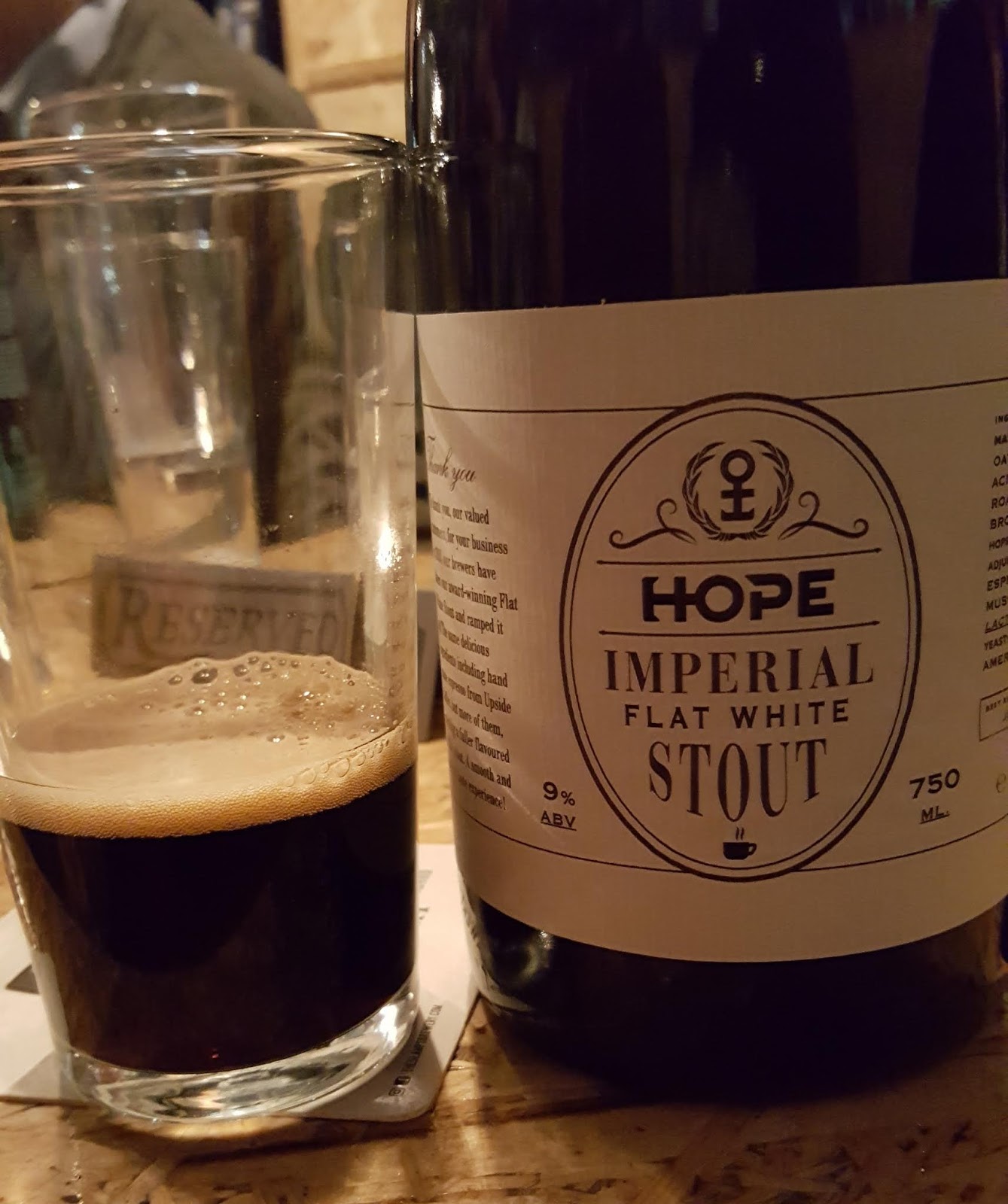
I was owed another win at this stage and it came in the form of Hope's Flat White Imperial Stout. I understand this isn't a general commercial release but was gifted to customers and friends of the brewery at the end of last year. 9% is the ABV, and it puts the coffee to work immediately. There's a huge raw coffee aroma, followed by a flavour that piles the oily cold-brew in as well. There's not much room in that for any beer character, but I was enjoying it too much to mind. The flavour is fresh and bright and the texture wonderfully silky. This is uncomplicated enjoyment, camply over-the-top but tremendous fun.

The next imperial stout came from Beer Nouveau in Manchester. This was a barrel-aged version of their Salacia, brewed with chocolate and oranges. Everything that goes wrong with barrel-ageing had gone wrong in this, the flavour an unpleasant mix of cork taint, stale oxidation and savoury Marmite autolysis. It finished with a sour tang that might have been the oranges but I suspect was more likely an infection of some sort. If it wasn't so busy with awfulness this would be a compact and instructive off-flavour testing kit. Next!

Next was Double Shot from Kees, a big 11%-er. As the name sort-of implies, this was brewed with coffee, and that gives it a bit of a sweaty flavour, like drip-filter which has been stewing too long. The aroma is the best part: a rich mix of caramel, nuts and chocolate. On tasting that turns harsh, dry and almost sour. Maybe it's an acquired taste, but the little sample I had didn't do much for me. At least it wasn't openly offensive.

The finisher was an iteration of BrewDog's Paradox imperial stout, still going 11 years after its début on this blog. The company has moved on a fair bit since the days of handwritten labels, and the whisky this one was aged in was BrewDog's own brand: Uncle Duke's. There's a massive vanilla aroma and a flavour of honeycomb and crème brûlée. That's fun for a moment or two but gets cloyingly sweet very quickly. Unlike the Paradox of old, there's no proper stout flavour and nothing really of the spirit about it either. This is Paradox re-imagined for the Omnipollo generation, all cupcakes and candy corn.

Considered together, a handful of standouts aside, it wasn't a great line-up, but obviously that's the sole fault of the brewers, not the event's organisers or participants. Thanks to everyone involved, and better luck next time.

08 February 2019

Get bent

The wild yeast wizards of Denver are today's subject, with a couple of cans from Crooked Stave.

Can one is the pastel-styled Sour Rosé, a light 4.5%-er, oak-aged and brewed with raspberries and blueberries. No single one of those dominates the flavour. Yes there are berries -- a definite fruity sweetness -- but I'm not sure I would have picked the varieties used. Raspberry is normally very obvious yet here it melds with the mellower blueberry creating something more floral, like lavender or rose petals. There's a properly tart buzz balanced with an almost creamy smoothness, while the oak makes little explicit contribution. I've no doubt it plays a role, however, rounding the whole thing out and bringing an element of spice to the acidity. This may be presented as some kind of girly frivolity but it's every inch a well-thought-out and expertly formulated mixed fermentation beer.

Which sets up St Bretta nicely. This one is subtitled a citrus saison, sub-sub-titled "artisan ale brewed with citrus, lemongrass and coriander". Phew. It's a slightly hazy gold and smells like a typically fruity and spicy saison. Balance is again the watchword when it comes to tasting. A tight lemony bitterness is first, then gummy peachy Brett notes. Sourness isn't advertised but there's a definite bite there on the end. Despite the convoluted recipe and higher strength (5.2%) this isn't as complex as the other one. It's still very enjoyable though, if not madly Bretty.

Lovely flavours aside, I'm particularly pleased that these two (and the Wild Sage one) come in cost-effective cans rather than lambic-style half-champagne bottle at twice the price. Accessible, high-grade, mixed fermentation beers is a genre I'm very much here for.

06 February 2019

Barcelager

The Barcelona Beer Company's range has been quietly chugging along on the shelves in these parts for a couple of years now. On a recent trip to Stephen Street News I noticed that there was one in the line-up I'd never had before so I used it to fill out a 4-for-€10 basket.

Santa Rita is a lager. I was expecting sunny Mediterranean refreshment so was surprised to find it pouring hazy, with almost a witbier-like yellow cast to it. That theme continues in the flavour: there's a spritzy lemon taste, a yeast-derived spice and some odd, but pleasant, tea-like tannins.

It's quite tasty, but not the crisp and clean lager I was prepared for. I'd say it still works as a summery thirst-quencher, however. The tannins give it the feel of a dry English bitter, a perfectly acceptable alternative on a warm day.

04 February 2019

Thorny thorny thorny

Three beer beers from Derbyshire's Thornbridge today. The brewery is probably tired by now of being told that they said they'd never can their beer and then they canned their beer. My first experience of metal-clad Thornbridge came, unexpectedly, via Tesco in Portadown. Both of these are available in Dublin now too, however.

Florida Weisse attracted my attention with the words "bracingly tart" on the blurb. This is a raspberry Berliner weisse of 4.5% ABV and it's certainly bracingly pink, its rosé head quickly crackling away to nothing. It tastes... authentic, in that it tastes like the pre-raspberried Berliner Kindl Weisse: artificially sweet, like candy or ice cream sauce with a very simplistic yoghurt sourness in the background. I guess the name is meant to suggest frivolous summer fun, which this does offer, but I was hoping for something more punchy, more interesting.

From the same shelf came Thornbridge's "Vermont Session IPA", named with a certain literalness Green Mountain and a mere 4.3% ABV. It's appropriately hazy topped by a pile of white foam this time. The flavour is odd. There's orangey juice, an almost margarita-like lime bitterness and then a very strange twang in the finish which begins as fried onion but grows more intense, turning to burnt plastic and acrid smoke. This last part really takes the shine off what should be a jolly and easy-going pale ale. I don't know if it's all down to the intense hops or if something more nefarious has happened, or if it's just me. Anyway, I kept wanting this to be softer and fruitier and it let me down all the way through.

Collaboration beers are ten-a-penny these days (not literally; they're often very expensive) but it's relatively unusual to see two breweries combine the recipes, and names, of their flagship beers. That's what we have here with Jai JAI from Cigar City and Thornbridge, their Jai Alai and Jaipur respectively. The ABV is exactly half way between the two at 6.7% and it's a clear golden colour, the first sign that Jaipur is the dominant partner. I get Jaipur's waxy green dryness in the aroma too. The flavour definitely has two sides: chalk and asparagus at the front, turning sharp and lime-like at the end; and also a sweet lemonade and Juicy Fruit gum sugariness running all the way through. Balance is preserved, and a smooth body ensures it's easy drinking. There's nothing special or different or outré about this collaboration, but no harm. It's a very tasty fruit-forward American-style IPA, refreshing, quenching and satisfying with no novelty factor at all. A real best-of-both-worlds job.

And then a lovely mixed box of Thornbridge bottles came my way as a Christmas gift. There were three new ticks in there, including Melba, a peach-infused IPA. It poured clear and headless, smelling powerfully of peachy syrup and tasting of it too. The texture is light to the point of thinness, which does at least mean it's easy drinking and doesn't get cloying. There's no real indication that it's an IPA, however. Pour peach cordial into vodka, prosecco, fizzy water, and you'll get the same effect. This is quite pleasant drinking but it doesn't particularly inspire or impress me. I'd file it along side those Lindeman's fruit concoctions, and Pêcheresse in particular.

I hoped for better crack from Crackendale, at the same strength and described on the label as a Citra pale ale. Turns out it's very pale indeed, and slightly hazy with it. It suffers a little from the same lack of substance as Melba, but again that serves to help the drinkability. There's a gently spritzy carbonation, propelling a light lime and pine flavour, with some bitter herbal notes tailing behind. I was hoping for a little more punch; maybe some sticky hop resins, but instead it goes for the lighter, more accessible aspect of American C-hops, and I can't fault it for that. I'm guessing this works better as a cask beer than bottled, but what I got was a very passable refresher.

Last up is Coco Cocoa, in the popular style of chocolate and coconut porter. Coconut is all the aroma has to offer, in a pleasingly bitter format. The flavour is mellower, presenting moist and chewy coconut flesh, a subtle dry roast and some sweet milk chocolate, but not too much. It's very well balanced overall, picking the best from its novelty elements without overusing them. This is another I could see working very well by the pint, especially with the ABV at just 5.5%.

So, on the balance of this lot, Thornbridge's best beers are still the bottled ones? Maybe this guy was right.

01 February 2019

The Art

A new raft of beers from Tipperary start-up Canvas arrived in DrinkStore late in 2018. I picked a handful to try over the quieter days of the Christmas vacation.

First up was Sweet Gale Ale, just as the name implies, and 4.6% ABV. I poured carefully, as advised on the label, leaving a few centimetres in the bottle. The resulting blonde glassful was then only slightly hazy, with a fine lasting white foam on top. It smells sweetly herbal, of basil, rosemary and the like, though there's a mild eye-watering sour tang too, akin to a Flanders red. The flavour is clean and sweet again, the herbs joined by a subtle peppery piquancy. Some esters like you'd find in saison or weissbier add a greasy substance and a hint of banana, but not too much. It's a nifty little number, crisp and clean, and avoiding any extremes of flavour. I'd place it closest to a light saison on the style spectrum, but the sweet gale makes it its own thing. At least, I'm assuming there's real sweet gale in here as it's mentioned on the name but not in the ingredients listing. For divilment I threw the lees from the bottle into the glass at the end. It doesn't affect the flavour. Pour carelessly and with abandon.

Bellagie came next, described as a "Belgian single with elderflower" and coming in at 5.3% ABV. It poured almost completely flat, which wasn't a good start. No carbonation means no aroma, so we skip past that to the flavour which is... fine. I like a good dollop of elderflower in a beer and this has that: meadowy and summerish. The base beer behind it is quite plain, but I think I can discern its Belgian roots in the complementary honey sweetness. I thought that was all that was on offer until the sourness arrived back unexpectedly -- the spicy saltpetre of proper lambic, drying out the sugars and cleaning them off the palate. Just a little more sparkle could turn this into a champagne-like champion, but I still enjoyed the one I had more than I was expecting to from the appearance.

Number three is a barrel-aged amber ale called... [dramatic pause] The Liminal. We're up to 5.6% ABV now, which is still fairly modest. I expect amber ale to be red, but this is paler, more a light shade of copper. The aroma is very roasty; dry with coffee notes, like a stout. What's going on? That roast is still present on tasting, but gentler, about the level you'd expect in the drier sort of Irish red, which is more in keeping with the purported style. Unfortunately that sits next to a curdling vinegar sourness which I'm blaming on the red wine barrel. There's oak for sure, and fruity red grape, but it's all harsh and horrible, clashing badly with the dry coffee grounds effect. Low carbonation yet again, coupled with a thin texture, accentuates the severity of it all. The whole thing is sickly and difficult; the opposite of the good kind of odd.

A dark beer to finish out on. Corylus looked the picture of porter perfection in the glass, deepest brown with an even layer of fine off-white foam. It's not a porter, though, it's a brown ale. There are added hazelnuts but nothing on the label suggests it should be sour, and it is. There's a sweet brown ale in the background somewhere, with chocolate and maybe even those hazelnuts, but up front a balsamic vinegar sourness reigns. It's thin too, all the dark malt richness attenuated away. It's not actively unpleasant, but I don't think it's the beer it's meant to be. At 6.7% ABV it's possibly strong enough to rebrand as a Flemish-style oud bruin, assuming every bottle turned out the same way.

Canvas remains, for me, a brewery of potential. There's no doubting the fantastic creativity, done without following the predictable fashion of contemporary "daring" beer recipes. But there are still clearly quality issues. I hope they can get these sorted out soon.