23 December 2020

The Twelve Brewers of Christmas 10: O Brother

We pay our third and final visit to a Wicklow-based brewery for this year's Twelve Brewers: the ever-so arty O Brother.

IPA of various stripes is the brewery's stock in trade and we begin with Deep Love at a relatively modest 6.9% ABV. It's dense and eggy-looking in the glass but smells inviting: a gentle waft of ripe tropicals. The taste is... familiar. Yellow fruit chews, more realistic mango, a little vanilla and an abrasive chalky minerality in the finish. Very much fan-service for the New England IPA crowd, with nothing even close to real bitterness. There's a substantial heat too, which I think is unjustified: the hop flavours aren't big and bold enough to warrant it. For the record, Azacca, Galaxy and Amarillo are the under-performers here. It's not a bad beer but those fruit-forward hops don't shine, and I blame the haze for that.

The IPA ABV gets a boost with Exploded View, 8% and single-hopped with Simcoe. That's clear from the aroma: a heady mix of lemonade, lime peel and hot fermenting grass cuttings. I thought I was in for a severe experience but the fluffy New England yeast stops that from happening, giving it a soft mouthfeel and turning the citrus zest into meringue pie. There are no sharp edges here, and no heat. Amid peach and white plum there's a slightly savoury side of red onion and garlic. This is Simcoe with manners on it, and while I appreciated the lack of harshness, I confess I missed the bad-boy edge it usually shows. A further point or two off for not marking it as New England style, which it very definitely is. Overall, a mellow sipper offering considerable complexity with just one hop.

Of course they had to go one better on themselves, hence the 10.4% ABV triple IPA Bat Country. It's hopped with Strata and Mosaic and smells beautifully Mosaicky, all melon and passionfruit. Flavourwise it's hot and heavy, as one might expect, but the bright and fruitsome hops are the saving of it. There's a certain jamminess and lots of resins but very little bittering: O Brother's grá for hazy softness is fully represented. A pinch of white onion balances the tropical juice. While not especially complex, it's a relaxing and sippable beer, presenting few challenges to the palate. That's pretty much what I want from a triple IPA, so thumbs up.

Enough IPAs for one post, then. A hefty porter finishes things off on a properly wintery note. One Beating Heart is 7% ABV. Blackest of the black; shiny with a deep tan head, it looks like it promises a good time. The aroma is fairly mild, but gives you all the cocoa you could want from a porter. The flavour is where it really excels. Well, flavour and mouthfeel: the two are inextricably linked. Big and creamy, and a little chewy is how it rolls; cakey, gooey. On that texture rides dark chocolate and liquorice for two kinds of sweetshop bitterness: a rich coffee roast and then a fruity plum pudding thing at the end. It's sumptuous, and one of those strong dark jobs that makes you wonder why breweries even bother with barrel ageing. More biggity-big no-gimmick porters please!

I guess I'll forgive O Brother any amount of murk if they can turn out the likes of One Beating Heart now and again.

22 December 2020

The Twelve Brewers of Christmas 9: Eight Degrees

For 2020, Eight Degrees picked Ireland's munroes as the theme to their special beers. There were six in total, the first three scattered through earlier posts but I've ended up collecting the second half into the below.

Fourth in the series was a Belgian IPA, no less. Remember those? Loral and experimental hop HBC 522 feature in Fort of the Fianna, a mostly-clear golden number, at 5.4% ABV. The aroma is modestly Belgian: honey and spices, rather than fruit and funk. There's a lovely citrus kick in the foretaste, with a rub of lime wedge and some lemon zest, before the smoother Belgian side takes over. Peachy esters arrive in the middle, and then the incense and allspice effect I associate particularly with tripel. The hoppy side could stand to be more pronounced: my preference for Belgian IPA does lean towards the American takes, while this tastes more Belgian. I have to damn it with the faint praise of being enjoyably understated. Part of me feels current extreme beer trends mean I should talk up the calm and balanced ones more, but at the same time I know Belgian IPA can be done better than this.

I thought that, as with last year, the series was concluding on a dark one, this time a 6.5% ABV porter called The Black Road. They've used smoked malt in this, and sure enough there's a faint hint of fiery roast in the aroma, while the flavour tails off on a note of peaty phenols, but otherwise the smoke is very much on the down-low. You'd hardly notice it. For the most part this is a straightforward medium-strong porter, big on dark chocolate, Americano coffee and creamy tiramisu. At first I was disappointed by the lack of novelty but then very happy with how solidly enjoyable it is. This is no-nonsense fun, albeit something I'd prefer to have by the pint or three rather than 440ml. But while we're all treading The Black Road, a can will have to do.

I was wrong about that being the last in series, though. It didn't finish dark but it did finish strong, with an 11.5% ABV sherry-barrel-aged tripel: Devil's Ladder. Back on that Belgian kick. You don't see barrel-aged tripel every day, and certainly not from Irish breweries, so I was expecting something special when the brewery kindly sent it out to me with a bunch of other Christmas goodies. It's a deep orangey gold colour in the glass with a gelatinous haze. The aroma is very vinous, in a sweet and dessertish way: tokaji, shading to mead and into hippocras. That spiced medieval feel is all over the flavour too: the pepper and clove of a real Belgian tripel but with added grape and honey and, to put not too fine a point on it, booze. It stays clean and quite crisp, though. Other supercharged tripels can burn and cloy; this one brings only a gently relaxing warmth. It was a daring experiment, but they've pulled it off, taking a good example of the base style and enhancing it without resorting to gimmickry.

I'm sure the creative theme for 2021's specials is already ready to go. Did someone say 10th anniversary? Ready when you are, Eight Degrees.

21 December 2020

The Twelve Brewers of Christmas 8: Wicklow Wolf

On the winter solstice we are visited by two wolves. Big stout ones.

The first is from Wicklow Wolf's Crossbreeds Series, a collaboration with Lough Gill. It's the second stout with peanuts in this sequence, following Third Barrel's back on day one. There's also cocoa for a purported peanut butter cup effect, and Beanut Putter is the name they've given it. It looked OK on pouring but that big beige head faded to nothing in minutes. The aroma is sweet, and says nuts, chocolate and caramel to me, like a Snickers bar. I should confess at this point I have never eaten a peanut butter cup. Its texture is surprisingly heavy for a mere 8% ABV; it actually took effort to pull it from the glass. As with the Third Barrel one, the peanut flavour is perfectly distinct, arriving on the palate right at the start. Milk chocolate and soft caramel follow, per the aroma, but that's pretty much it. I guess it delivers on what it promises, and is perfectly tasty. There aren't any subtle extra flourishes, but nor is it a sticky mess of silliness. A look-you-in-the-eye honest sort of peanut-butter-cup stout, you might say.

Wicklow Wolf's other regular series is Endangered Species: all the silliness of collaboration but with only one brewery to hold responsible. The latest is called Mad Mex, based on Mexican chocolate cake, another confection I've never actually eaten. The necessary ingredients list for this is quite involved: cocoa, cinnamon, peppers, coffee, vanilla, nutmeg and lactose. Phew! Cinnamon is the one which breaks out most in the aroma, but the flavour is a melange. I don't actually know where to start unpicking it. There's a certain spice side, but it's not sharp or hot, more aftershave or similarly musky male grooming products. The vanilla is next, a blanketing sweetness which doesn't really match with the spice, though the floral side which comes after works fine with it. And then the finish is all of them together, loudly, for ages. I tried to enjoy this but it's just too busy, pulling in too many conflicting directions. One might expect that a 10.5% ABV imperial stout would be able to smother such imperfections in dark warming malt but this one is distressingly thin. It's a bust. If you're going to do cake beer, make it cakey, and this is not cakey enough, so there.

My feel that Wicklow Wolf makes some of Ireland's best stouts remains unshaken by these offerings, but I think I'll be happier once the pastry craze has ended.

20 December 2020

The Twelve Brewers of Christmas 7: Otterbank

I wasn't a big fan of the first release from Otterbank as a standalone brewery. Numbers two and three are here, and in the spirit of the season I'm prepared to give them a fair shout, and at least they're not so strong.

To begin, Stick The Kettle On, a no-boil (geddit?) Brettanomyces-fermented pale ale of 5% ABV. It's a perfect clear gold in the glass with a steady head and an enticing stonefruit aroma. It's a little thin, which I think affects the impact of the flavour, but the flavour is gorgeous. It's a busy sequence of floral tastes; a wholesome meadowy blend of violet, lavender, clover and honeysuckle. The apricot and nectarine come later, bringing a different sort of sweetness. A white pepper spice finishes things off. And even with the lees from the bottom poured in, it's clean and bright, each taste polished and distinct. Half way down I remembered that Brettanomyces was involved. It's not funky, there's no farmyard, but instead it's that peachy Brett flavour, except without the sticky gumminess. It's a lovely beer; accessible but deliciously complex. I'd love to see it in regular production and for sale by the pint.

We move up to 6.5% ABV for What Time Do You Call This?, a saison created from a blend of four-year-old Chardonnnay-barrelled beer and a fresh one. It looks and smells like a gueuze: cloudy yellow with a sharply bricky nitre aroma. The flavour isn't especially sour, however, there's just a pinch of lemon and a little saltpetre. My favourite feature is the busy fizz: a cleansing scrape on the palate, and the reason for the beer's thick and lasting head. I was afraid this would turn a bit cloying but like the previous one it's fantastically clean and easy going. It lacks complexity, however: the flavour hints at the peppery, waxy joy of saison and lambic but doesn't follow through on either. While it's nice, I expected more. As the third beer from a new brewery I think it can be forgiven: everyone else would do well to produce something this good this early.

I'm back on board with Team Otterbank. These two have restored a faith which was wavering after the first beer. While I'd be perfectly happy if they just churned out more batches of these two, I'm intrigued for what comes next.

19 December 2020

The Twelve Brewers of Christmas 6: Ballykilcavan

Ballykilcavan looks to be aiming for all the trendy targets with its Clancy's Cans series. A fruited Berliner weiss was first, and they've followed that with a DDH IPA and a couple of pastry stouts.

Clancy's Cans #2, then, is the aforementioned IPA. It's a bit of a whopper at 7.5% ABV and does not present as expected. I normally assume "DDH", if it means anything, to mean hazy, while this is a pure limpid golden colour. It's thick, hot and bitter in a very west-coast sort of way, with an almost waxy tang adding to the lemon and bergamot flavours. I wasn't surprised to learn that American classics Simcoe, Amarillo and Citra are doing the work. The balancing malt is like golden syrup, and does a good job holding back the hop excesses without turning the beer sweet. This is one of those all too rare big-yet-balanced IPAs; solidly enjoyable and not trying anything fancy or clever. One expects a certain oddness from limited-edition small-batch beers. Maybe the normalness of this one is what makes it odd. Either way, I'll take it.

"Tiramisu Dessert Stout" is what we're dealing with for Clancy's Cans #3. This one is 7.8% ABV, so it's just as well I like my tiramisu with a kick to it. It smells of coffee and chocolate, which is promising, but the follow-through isn't great. For a self-proclaimed "dessert" beer, it's thin, roasty and rather dry. Fine for stout in general, but this sub-style demands a full body which isn't delivered. I liked the roasty bite, and there's a little chocolate, but you're on your own if you're looking for mascarpone or liqueur. So it's not a tiramisu dessert stout; it's an absolutely fine medium-dry extra stout, and should be happy with being that. If nobody else is saying it: maybe Ballykilcavan should have released a nice extra stout without trying to do anything gimmicky.

Regardless, we push on to Clancy's Cans #4, a "walnut whip stout", with vanilla and walnuts. That hasn't affected the head retention -- it's lovely and creamy looking, and the texture follows that up, aided by 7.4% ABV. There's a nice balance between the sweet and bitter sides: milk chocolate and custard bumps up against a dry and bitter roast. Brown sugar and mocha linger on the lips after swallowing. If the description "classic pastry stout" means anything, this beer is it. While inarguably dessertish, it's a proper extra stout to its core. As such, it's a delight to drink. I can't say it tastes much like walnut, but there's enough going on for that not to be a problem.

I guess Clancy is going to keep canning into 2021. The brewery seems to be having fun with them, and I'll gladly go along for the ride.

18 December 2020

The Twelve Brewers of Christmas 5: Wide Street

Wide Street has started going all arty with its cans. I don't know if I approve. I liked the earlier, uniform approach -- it showed a brewery that was about the beer. But I'm not here to review packaging. Funky Friday is described in no more in-depth terms than "wild pale ale". I thought "wild" referred to the yeast strains involved, but the beer proved tempestuous too, soaking the table and floor upon opening. It's a hazy yellow shade inside, much calmer once poured. The aroma is a crisp and spritzy mix of lemon sherbet and pickled onion. That's weirder than the actual flavour which turned out clean and only lightly funky. The lemon is still there, complementing the barnyard element beautifully. A woody spice calls young lambic to mind. From the Belgian flavour lexicon there's melon, lychee, apple, peppercorns and clove. It's also cool-fermented, giving it an even smoothness, with an undemanding finish. This is relaxing and sessionable while also complex enough to be interesting. After-work pints of this would be sublime, but a can offered the next best thing.

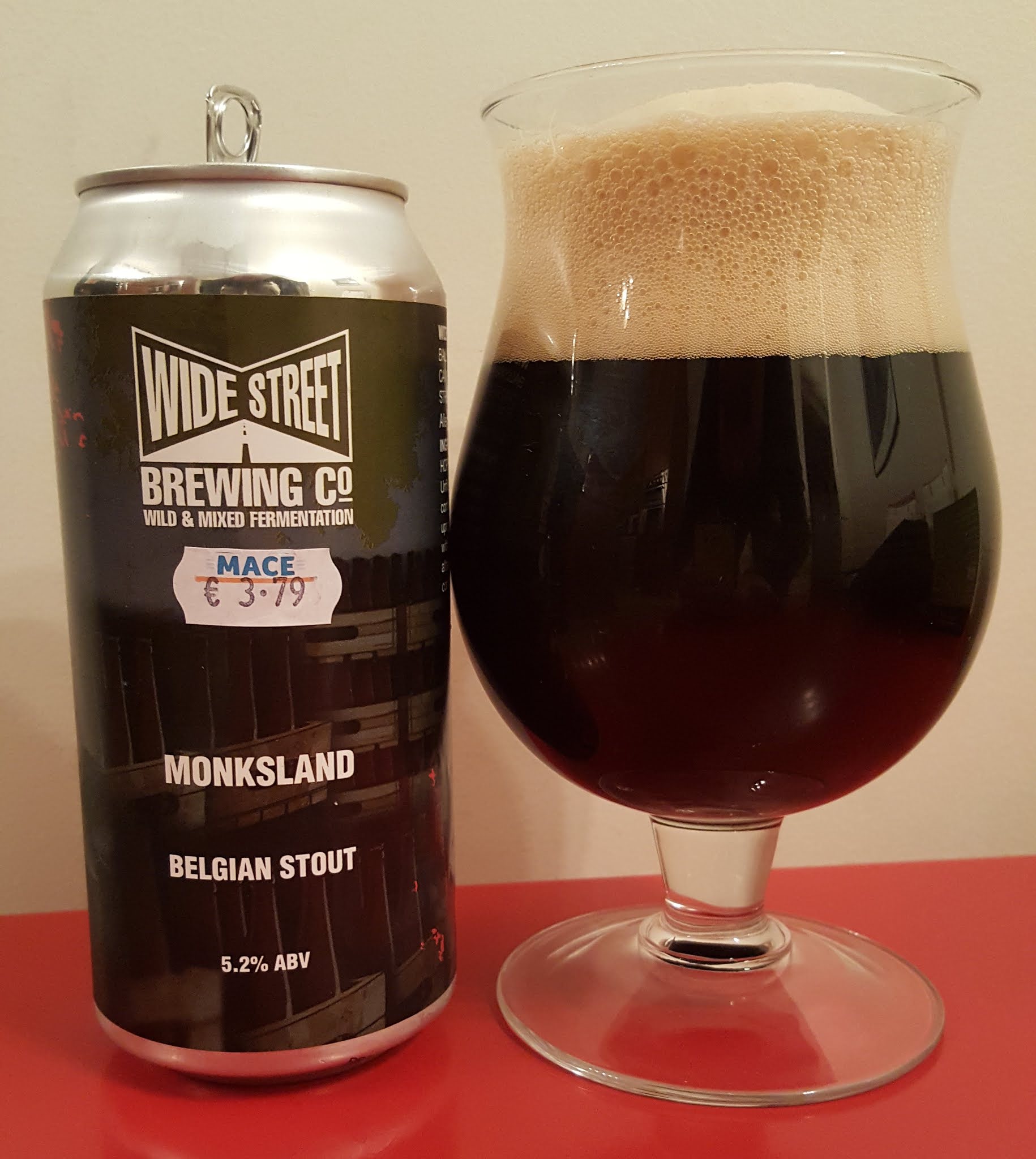
Monksland is a stout made with Belgian yeast and is over a euro cheaper. I don't know how beer pricing works. The can didn't gush either, making it even better value. It smells like a proper, unfancy stout, going big on roast. Same on tasting: dry and really quite ashen -- not unpleasant, but requiring some getting used to. The Belgian side is there too: fruity esters, and prunes in particular, like you might find in a bruin or dubbel. It's an interesting interplay, with each mouthful starting full and luscious before drying rapidly, becoming cigarette smoke by the end. It's an unsettling experience, not a bad one, but again something to which one needs to adjust. On balance this was harder work than I was after. You get your Belgian and your stout, but that burnt aspect wasn't part of the deal.

"Brewed in a traditional Berliner Weisse style" it says on the final can, and Wide Street is one of the few breweries I would trust for that to be accurate. Seems a bit odd, then, that they've made it a Peach Berliner. Peaches aren't exactly traditional, are they? Anyway, it's 4.6% ABV and a pale hazy yellow in the glass, with a few unsettling specks floating on the surface. The Brett side is apparent from the get-go: a farmyardy funk pervades it. That's overshadowed somewhat by a vinegar tang, one which matches the thin mouthfeel. It burns a little. And peaches? There are no peaches. It's good that there's no silly sugary sweetness, but I expected some quantity of fruit. Overall, this doesn't quite work for me. I appreciate the authenticity, but there's a reason most breweries don't make them like this. While far from actively unpleasant, the vinegar thing left me wincing a little with each sip.

This brewery is still a bit of a coin-toss for me. When they get things right it's a sublime experience, but that's not a guarantee. I'm happy to take my chances.

17 December 2020

The Twelve Brewers of Christmas 4: Hope

Seasonal deckchair dude is back for a new Hope seasonal. They've gone for a Red IPA as the Winter 2020 release. I was hoping for something ruby-clear but it's a bit muddy in the glass. The aroma is bright and fresh, letting the hops (unspecified American and Australian ones) take the lead, with minimal input from the dark malt. The flavour too is hop forward, but not bitter. There's an, ironically, quite sunny, summery feel to it: mango, pineapple and kiwi. Only in the finish does the caramel and toast side emerge. I'm not usually a fan of red IPA, but this one pulls the same trick of the best black IPAs: tasting it blind you wouldn't know its colour. I'll ding it on seasonal character but that's the worst I can say. This is a lovely beer.

Around the same time, we got the 21st in the Limited Edition series: a Double IPA. For no reason I thought this would be hazy, but it's not. They've gone properly West Coast, with a bright deep-gold colour and a slightly rough dry bitterness. The flavour starts at pithy grapefruit and deepens into a waxen sharpness. On the lighter side there are hints of strawberry and plum. 8.9% ABV isn't extreme but still gives it plenty of poke, and there's a rounded warmth alongside the dryness. Overall, it's a very decent show. I never thought I would miss old-fashioned US-style double IPAs but I find myself getting misty-eyed with nostalgia whenever I encounter one these days.

That was followed, logically enough, by Limited Edition 22, a more seasonally-appropriate Oak Aged Stout. This is based on a 7.5% ABV foreign extra stout, a style the brewery has done superbly in the past. It's been given a sackful of brandy-barrel oak chips for additional winter warmth. It looks handsome in the glass -- the tan-coloured head all creamy and thick, peeping over the rim. Oak features in the aroma, but not strongly, and there's a pleasing amount of freshly roasted coffee too. The creamy effect continues in the texture, lovely and rounded; ideal for sipping. I think I served it a little too cold as there wasn't as much flavour as I expected at first. Letting it warm up, I found bitterness to begin, the assertive sort entirely appropriate to a stout like this but too often omitted. Then there's vanilla, espresso and a kind of corky dryness. There's no brandy at all, but this one doesn't need any such novelty factor. It started out as a tasty old-fashioned stout and nothing in the production process has changed that, I'm happy to say.

Trust Hope to take beer styles I'm not terribly fond of and make versions which have me doubting my prejudices.