17 August 2022

Up all night

We don't get new beers from The Porterhouse very often. Since the last big rebrand a couple of years ago the only thing of note was their Around the Clock winter imperial stout, so it was a pleasant surprise to find another imperial one arriving mid-year: SLVRSKIN, a 13% ABV job with added coffee and aged in bourbon barrels. The description mentions that it gets a 24-hour boil so I suspect that the base recipe here is Around the Clock itself, or a close relation. No harm.

It pours as thickly as one might expect, a dense black colour with a dark tan topping. There's a lot of bourbon in the aroma, as well as a slightly off-putting autolytic umami tang. The predominant flavour is alcohol, showing all the heat of a spirit or fortified wine without really bringing much flavour complexity with it. Chocolate and coffee are mere traces, and there's surprisingly little sign of the bourbon, given how strongly it smells of it. 

A full day of boiling followed by 9 months of maturation means this wasn't a simple process to create but the effort hasn't really paid off, in my opinion. The fundamentals of imperial stout are missing, though I couldn't say whether that's the fault of the base recipe, the extra enhancements, or my palate. Either way, it was a disappointing experience. The beer improves a little as it warms but never quite makes it all the way to what I wanted it to be.

15 August 2022

Source mode

I find myself feeling guilty when I don't sufficiently avail of the good beery resources we have in this town. Post-pandemic there aren't as many as there used to be but that's no excuse not to get out and about. So, when a free Thursday evening popped up on my calendar I took myself to Rascals HQ.

They've been busy with their pilot series of brewery-only beers, having reached the lofty heights of Pilot #61, a Basil & Raspberry Saison. I'm sure I've had both in a saison before but not together. There's no reason it won't work. The result is a coppery pink colour and quite strong at 5.8% ABV. Served deliciously cold, that makes it dangerously refreshing and I had to restrain myself on the first few mouthfuls. Interestingly, neither of the added ingredients comes through in an especially novelty way: the base is a real saison; peaches and straw, white pepper and melon. There's a slight fruit-smoothie sweetness in both the aroma and the finish to represent the raspberry, but I think the basil has been subsumed into its general saisonosity. As such, I'm not sure the flavourings added much -- it's a perfectly good dry saison and still would be without them.
Left: v.2, Right: v.3

Some Teutonic hop-tinkering next. Pilots #58 and #59 are respectively tagged as versions 2 and 3 of the "house IPA", which I assumed means Wunderbar, hopped with Mandarina Bavaria and Hallertau Blanc. A barman telling tales out of school says that Wunderbar is due a recipe change and it may be one of these.  First surprise from the new kids is that they're different colours: v.2 a paler shade of amber than v.3.

v.2 is fairly quiet on the aroma but gives out a fabulously fresh and pure mandarin pithiness in the foretaste. It rounds out after a moment into oily orange peel and a hint of cedarwood spicing, before a quick and super-clean finish that's almost lagerlike. And all done with Hüll Melon, we're told.

After that, I found v.3 rather plainer. They've let the Americans into the brewhouse and added Amarillo and Ekuanot to the Mandarina. I think that's a regressive step. There's still a pleasing pith but it's a pinch not a punch. There's something else too, a herbal, medicinal quality that might be eucalyptus on a good day but TCP on a bad one. It didn't sit well with me, and the idea that perfectly-decent Wunderbar may soon be this fills me with dread. It's not a bad beer by any means, but  switching back to v.2 was like switching to a high definition picture.

I loved that I, along with every other punter, was able to participate unofficially in this bit of backroom recipe twiddling. This. Is. What. Taprooms. Are. For.

Seemingly a core part of the Rascals taproom line-up, but shamefully new to me, is Nitro Stout. The name needs work. It's an orthodox 4.4% ABV, properly black with a cream off-white head, albeit one which didn't dome over the top of the rim. But while the macro nitro stouts are all about that presentation, this one is flavour forward. There's a downright bold kick of high-end milk chocolate in the foretaste, all silky Galaxy bars and Flakes in a canoe under a waterfall (ask your parents). After a second, a balancing dry grass and spinach brings a bit of the old school to it, but the finish and aftertaste is back to chocolate again. Although it's not complex or fancy, I loved the boldness of it, and was reminded a lot of Leann Folláin, if it came in a more sessionable package. This isn't the sort of hopped-up hazed-out yoof-oriented beer that Rascals is built around, and perhaps that's why they haven't dignified it with a name yet, but it's jolly decent and is well able to go toe-to-toe with the Porterhouse/O'Hara's/BRÚ establishment of actually-good Irish stout.

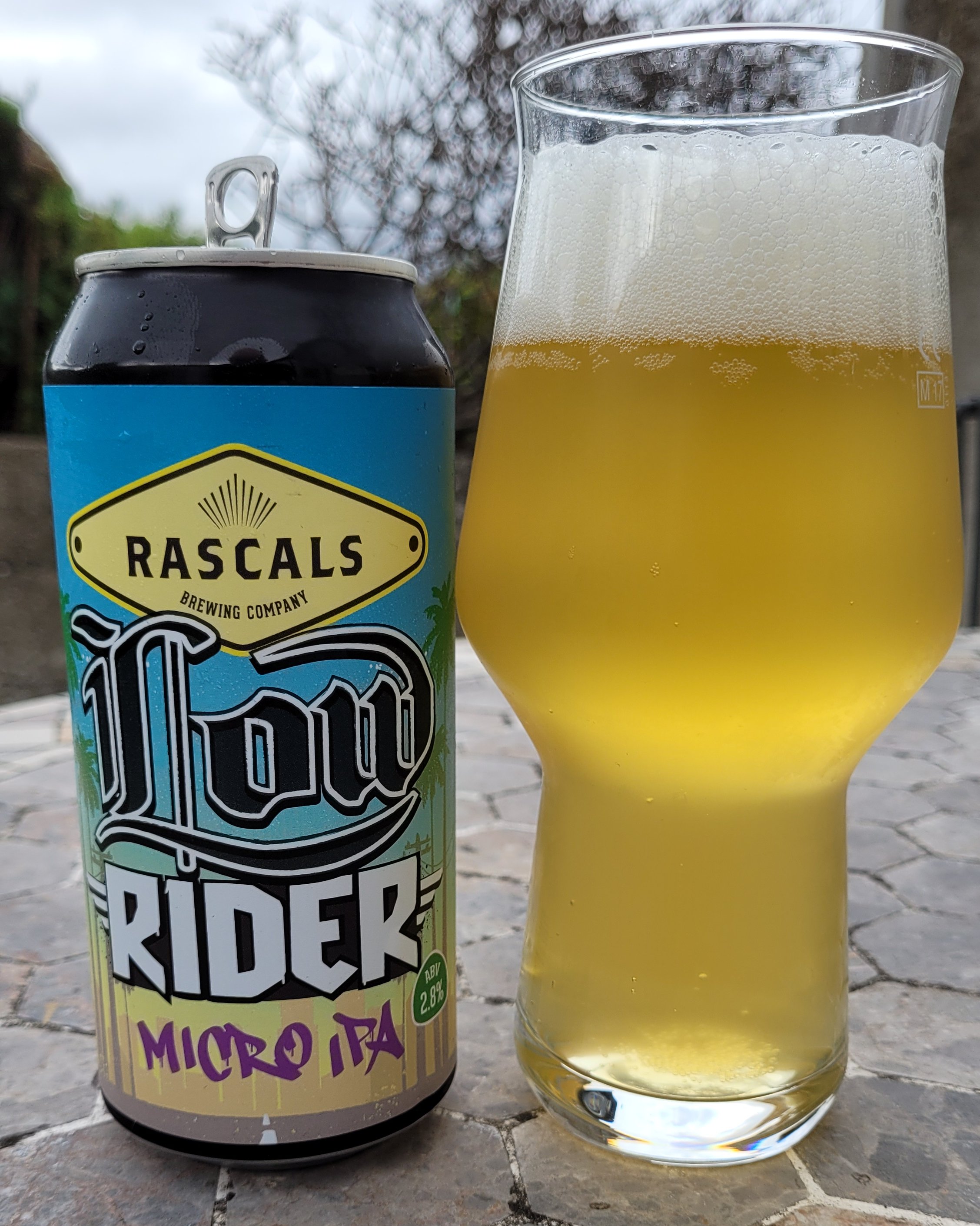
A postscript at home. Low Rider is a micro-IPA, a recent style whose merit I've yet to be fully convinced of. A graduate of the Rascals pilot programme, it's 2.8% ABV yet cost a substantial four euro twenty-five for a can. Yeah, yeah: inflation and that, but still. It had better be good. It's very pale in the glass though smells fresh and full-on, bursting with lime and assorted stonefruit. Clever use of oats boosts the mouthfeel so it doesn't feel any way watery, often a fatal flaw in beers like this. That said, the low strength does mean the flavour is a little muted and lacks a proper big finish. It's good while it lasts, however: west-coast grapefruit bitterness matched against juicier tropical notes. This is micro IPA done very well, though I'm still unconvinced about the price tag. It would be a short session on such spendy fare.

Rascals was stop one on a revisit of Dublin's prolific drink-in breweries. The series will continue shortly.

12 August 2022

Garden County sunshine

It's the summer releases from Wicklow Wolf today, beginning with the latest in the seasonal Locavore series of beers made entirely from local ingredients. Locavore Summer 2022 is once again a saison, and 6.5% ABV like last year, but they've swapped the foraged gorse for foraged elderflower, and I think that's a trade-up. The first surprise is that it's completely clear, looking more like a pilsner than anything with farmhouse ancestry. The aroma is pure saison, however, packed with soft apricot and melon, some of which I'm sure is due to the elderflower. That fruit doubles up in the aroma, where the elderflower really kicks in, and the end result is almost tropical tasting. It lacks the dry crispness and earthy rasp typical of Belgian saison, but I don't miss it. While a little too heavy to be a quenching quaffer, this is a lovely sunshine sipper, delivering lots of good saison qualities and, unless you like them palate-scorching, no flaws. I wonder what they'll bung in the kettle next year.

Released at the same time in early July was a hoppy weissbier called Heff Bezos, a clunkier pun than one normally gets on a Wicklow Wolf limited edition. In the glass it looks like a pretty normal weiss, a little on the pale and unhazy side. The aroma is startlingly tropical, then, brimming with pineapple and mango. They've badged it as a hopfenweisse, and often with these there's a clash between the fruity weissbier yeast and the bitter citric new world hops, something the original Schneider/Brooklyn versions overcame by ramping up the alcohol. Here, by going sweetly fruity with the hops they've avoided the clash while keeping the ABV relatively modest at 6.3%. There's still a trace of banana, butane and bubblegum left, mainly in the finish, as a reminder of what this is. You could still easily mistake it for a New England IPA, however, especially when it's cold. I liked it, it's fun and summery, even quite refreshing despite not being session strength. For the first time since the first time, I see the point of hopfenweisse.

I guess summer beers don't have to be 4% ABV. Wicklow Wolf has managed to cram the sunshine into altogether more sippable packages. Two further summer beers are available at The Big Grill festival this weekend and in cans from next week. All going well I'll have reviews on here some time before Christmas.

10 August 2022

Peak pastry

For reasons best known to itself, the normally sober and reliable brewery Thornbridge has chosen to try and recreate banoffee pie in imperial stout form. The result is Pardus Banoffee at 8% ABV. It has one of those annoying sneaky labels where you have to read the German to get a full list of ingredients, and that shows lactose to be the only adjunct. Where will the banana and toffee come from?

That it's intended as dessert is immediately apparent from the aroma: it is powerfully sweet, even from a distance, radiating honeycomb and, yes, foam banana sweets. There's nothing natural about the latter so I suspect the ingredients list isn't telling the whole story. The sweetness is dialled back a little in the flavour: it's not as gag-inducingly sickly as I had braced myself for. It is thick, however, seeming denser to me than the ABV suggests. There's no toffee in the taste to speak of, though it does have quite an assertive bitter roast, presumably an echo of the base beer which they were unable to dispel completely. On top of that, and outlasting any other feature, is that artificial banana essence thing, hanging around in a most unwelcome way.

This beer does not taste like banoffee, nor even give an impression of banoffee. It tastes like someone has compromised a perfectly decent imperial milk stout by adding an unnecessary chemical. It's not ruined, but it's definitely not improved. There is a series of these pastrified Pardi, as well as an original straight-up version. The latter I would be very interested in drinking if I can get hold of it.

08 August 2022

Normcore

I've long been a fan of Denver's Crooked Stave brewery, specialising as it does in the sort of barrel-aged mixed fermented beer that I like. That it arrives here with a very reasonable pricetag is a bonus. Today is an occasional foray into the Crooked Stave interpretations of more mainstream beer styles. I'm prepared to give them all the benefit of the doubt.

First it's Juicy East, a hazy IPA of 6% ABV featuring Azacca, Citra, Mosaic and Motueka, for what should be a fun mix of hard bitterness and soft juice. It looks like the classy sort of New England IPA, being fully opaque and a pale yellowish orange. It smells quite citric, with a sharp lemon and lime buzz to the fore, but there's a hint of vanilla too. In keeping with that, the texture is creamy and there's a vanilla base to the flavour. The hop fruit builds on this, not quite fleshy and tropical but still sweet and spritzy, with elements of lemonade, pineapple juice and lime cordial. It's no world-shaker -- I've had many a beer very like it -- but it's still a good example of the hazy IPA genre, doing pretty much everything that they're supposed to.

The companion piece is the oxymoronic Juicy West, described on the can as "new west coast style" which I read as "not west coast style". It's less hazy than the last one, but still pretty hazy; a golden colour and again 6% ABV. The hops are a simplified combination of Simcoe, Citra and Mosaic which gives it a savoury and dank aroma. While it smells a bit all over the place the flavour is more coherent, showing an almost German herbal eucalyptus subtly blended with grapefruit, kiwifruit and melon rind. It works, and is very tasty. It's not at all west coast, but neither is it a sweet 'n' juicy New Englander. This hits a sweet spot between the two, as is entirely appropriate for a Denver brewer. Regardless of style minutiae, this is a quality beer well worthy of the Crooked Stave name and reputation.

Two stouts represent the other half of this set, both 6.5% ABV so I'm guessing have the same base with different adjuncts. The first one I opened is Vanilla Milk Stout. It looks nicely dense on pouring, black with a beige head. A pleasing coffee aroma suggests a dryness I wasn't expecting. It's not dry as such, however, but neither is it sickly sweet, something I was fully prepared for. I'm very much on board with balance in modern milk stout, all too rare a feature. The vanilla and dark malt give it a kind of crème brûlée character, with a small shot of espresso on the side. There's even a faint hop bite for some properly old-fashioned stout charm. This is lovely, as much at home as a preprandial as an aperitif. It's weighty but not any way overdone. Again the Crooked Stave class shines through.

Can they top this with a Toasted Coconut Coffee Stout? The head seems a little paler on this, though the rest is just as black. The aroma is definitely sweeter, and although I wouldn't be able to immediately identify it as coconut, that what's responsible. The roast and coffee is still there, but here it's joined by very real and fleshy coconut, not tasting toasted at all. If Mars made an Espresso Bounty, and I'm not saying they don't, this is what it would taste like. As such, I really liked it. It's more fun than the previous one; more of a frolicsome candy bar than a serious beer, while still definitely a stout for grown-ups. The finish is maybe a little quick for something at 6.5% ABV, though there's some nice complexity before it vanishes off the palate; wisps of raspberry and rosewater. It's nearly brilliant, but I'll settle for very good.

I still prefer Crooked Stave's work in the wild beer sphere, although this lot shows that there's an attention to nuance and detail at work in the brewery that serves them well across the spectrum of genres. This is one of those breweries which seldom puts a foot wrong.

05 August 2022

That summer in Dublin

In its previous incarnations, Post Card wasn't the most prolific Irish beer brand but since they relaunched via the brewing facilities of Farrington's in Kildare they've kept the new beers coming. The beginning of July saw the launch of two summer specials.

First up is an extra pale ale called Irish Summer I, designed for easy warm-day drinking and it was on such an afternoon that I opened it. It's a bright golden colour with a little haze but not excessive amounts. The flavour is bright too, full of spritzy lemon -- bitter for the most part but with a hint of meringue pie sweetness as well. Said sweetness is derived from the malt base which is nicely full even though the ABV is a very modest 4.8%. After the initial zingy zesty burst, there's quite a long citric aftertaste as well. This is no lightweight and does a great job of filling the brief to be accessible, thirst-quenching, but also absolutely packed with clean new-world hop flavour. Something for everyone.

In a baller move, Irish Summer II is a black IPA: not something I'd have thought of as particularly summery but let's go anyway. At 6.8% ABV this one is not a quaffing beer on the same level as the above. It's a properly black black, though with a few of the unattractive floaty flakes that plagued the brewery's recent Mexican-style lager. The aroma is quite sweet and roasty, seeming all stout to me. Have we been gypped on the hops? To an extent. There's a certain amount of green vegetal bitterness in the flavour, and a slight hint of citrus, but no more than that. More prominent is the milk chocolate and milky coffee provided by the dark malts. While this may not be black IPA exactly as I like it, it's still very enjoyable. Once again the flavour is clean and precise, and there's a lovely smooth texture, exactly as promised by the strength. Without the hops it would be a superb extra stout, and with a handful or two more it would be a great black IPA.

These are both very accomplished beers, and not the sort of thing I would imagine a small in-restaurant brewery would be capable of. I've never been to Farrington's Mill but I like that Post Card is getting their delicious output to us here in the capital.

03 August 2022

Arrivederci

I fear we've reached the end of the draught Ca'del Brado goodies at The Black Sheep. My final one was Cerbero Purple, a barrel-aged old ale. It's not the kind of clean, pale and spritzy thing that I usually come to the brewery for but they've earned more than enough credit for me to take a chance.

The barrels were wine ones and in with the beer went a 4% dilution of wine must, resulting in a lovely kiss of red grape in the aroma, alongside sparks of spice and a farmhouse funk. The initial flavour is very much about the fruit: juicy grape, sweet raisin and a slice of red apple. After a moment it's possible to detect the warm chocolate of an old ale at 9.8% ABV, although that doesn't get much of a look in before the resinous, gummy Brett manifests, finishing on sparks of geuze-like gunpowder.

I feel they could have made more of the base beer in this. At the same time, I can't complain that they substituted it for bags of pure Ca'del Brado magic. This was just as much of a delight as their previous works. I hope to see them again before too long.