Showing posts with label o'hara's leann folláin. Show all posts

21 August 2026

Light verse

Three new beers from Heaney Brewery to round the week off.

Correct Me If I'm Wrong, with the brewery's sober logo playfully scrambled on the label, is a "farmhouse ale", which I'm taking to mean a saison. Reading that it's brewed with sichuan pepper made me do an involuntary approving lip-pucker. It pours hazy and golden, with a short-lived head. The aroma is all fruit and no spice, though still attractive, with cool fresh pear and lychee. It's surprisingly thin for 5.9% ABV, and I'm not sure it's conditioned the way it should be, feeling a bit lifeless, especially for a (maybe) saison. The flavour is different again: florally sweet rather than fruity, and the spice is no more than one would get from a light ginger beer. And nothing else happens: after an initial burst of flavour, it fades to nothing, and seems almost watery, which is all wrong for the style and strength. I had thought this would be much more interesting but it's a bit of a damp squib. The brewery may have been over-cautious, seeking to be creative without being weird. Never a good idea and I hope they don't do it again.

The other two are in more established styles. Whatever You Think Yourself is the most Northern Irish way of telling someone you think their idea is bad, so it's a bit of a worry for it to be the name of a hazy IPA. "tropical yearning, the ghost of a pineapple's ambition" as part of the description gives us the seriousness of tone intended by the beer. It's a pale orange colour and fully opaque, with an aroma which is strongly pithy, not tropical. It's another light one for the strength, this time up at 6% ABV. The pith is loud and proud in the flavour, very similar to the fibrous underskin of a big jaffa. I doubt Seamus would approve of such intense orangeism. Next to this is a rough gritty side; a regular stumbling block for hazy IPA. It doesn't mean the beer is unpleasant, but it does remove any possibility of it being soft, juicy or tropical. Drinking this is a bit of a workout, and I can recommend it only to those who want their hazy IPAs with a big whack of bitterness as the main feature. Personally, Heaney, I'd have given it a whirl in the centrifuge to clean it up, but wh...

Not a great opening pair, then. Surely redemption must come with the export stout? This is the sort of solidly traditional beer style with which Heaney has already proven its worth. I was immediately on guard when Lamp Light poured more of a dark garnet colour than proper black. Still, the aroma is decent, with the same rich fudgey quality as found in modern classics Leann Folláin and Nocturne. The flavour does not lack darkness, I'm happy to say, opening on quite an intense black-toast roastiness. This is balanced, quickly, by a softer milk chocolate character, which is then contrasted in turn by a leafy green hop bitterness, which is the often-forgotten piece of the Proper Stout puzzle. Again, though, it's weirdly thin-bodied for its 6% ABV, and I'm starting to think that may be a Heaney trait. This one, even more than the others, would have benefited from a greater heft; something to chew on. Here, however, that's a mere niggle. This is a damn decent stout, and I was right to think that the brewery would get the fundamentals right. Export stout is one of my favourite beer styles in general and I welcome this example of it. The process maybe needs some fine tuning, but no more than that.

Redemption indeed, then. I can't help thinking that Heaney really should put less work into trying to be a craft-era brewery and stick to playing the hits. Lamp Light would certainly be an excellent addition to its bottled range. Imagine a choice of three top-notch microbrewed Irish export stouts in glass. We wouldn't know ourselves.

29 December 2025

The Christmas menu

I hadn't noticed before that Wetherspoon publishes a quarterly leaflet of its upcoming seasonal rotational beers. Maybe it's a new practice, but it's great for us tickers. In the run-up to Christmas, I did some hunting around the Dublin branches for the late 2025 offerings.

That started with the appropriate Winter Draws On, by Brewsters. It's only 4% ABV and promises citrus and spice, so is one of those English winter ales. Still, it looks cosy with its warm copper glow. The citrus manifests as dried peel, like fruitcake mix without any of the actual cake. Complementing the lightly fruity bitterness is a tea-like dryness, adding a refreshment quality that isn't very seasonal but is very pleasant. This is a clean, characterful and well-balanced session beer, exactly the sort of thing that I associate with Brewsters. Your cockles won't be warmed but your thirst will be slaked.

A rare visit to The South Strand brought me Evil Elf by Rudgate. I would be quite willing to bet that this golden ale appears under a different name during the summer, because it has a very sunny disposition. Zesty, and slightly oily, lemon forms the aroma and continues in the foretaste. It's not bitter, however, tasting more like lemon candy than actual citrus fruit. The sweet side grows gradually, adding notes of honey and golden syrup. It verges on sticky but its modest 4% ABV keeps it on the right side of drinkable. This is solidly made and devoid of seasonal daftness. There's no way any sensible brewery would only roll out such a straightforwardly enjoyable recipe at Christmas.

Advent Ale is from Titanic, the brewery abandoning its sinking ship theme for the season of goodwill. This 4.6%-er is a medium gold in the glass and smells sweetly spicy, hinting at clove and nutmeg. Those spicy oils are present in the flavour but pleasingly low-balled, hinting at their presence but not the beer's whole thing. Unfortunately, the beer doesn't have a whole thing, its base tasting to me like a rather plain blonde ale: honey-sweet, gently floral, but otherwise nondescript. I guess Christmas beer doesn't have to be dark and strong, though at the same time I don't really get the point of doing them pale and light, except there's presumably a market for them. File this inoffensive chap with the other cod-seasonals, made for spring rugby and... actually, is that the only other time English breweries make lacklustre tie-in beers? Answers in the comments.

So far, so sessionable, but where are those big winter warmers? Otter's Otter Claus brings us all the way up to 5% ABV and is a wholesome-looking dark amber colour. Alas, it doesn't go anywhere special in the flavour, being the same as any number of malt forward, medium-dark, strong bitters. To wit, there's toffee, black tea, burnt caramel and a token measure of orange peel and meadow flowers from distinctly English hops. It reminds me a bit of Wetherspoon staple Abbot Ale but is much more enjoyable; lighter on the caramel and more drinkable as a result. It left me feeling a bit stiffed on Christmas vibes, but it's a decent beer. While it may be a brown bitter, I don't think it can be accused of being twiggy or boring. For €2.60 the pint, I have little to complain about here.

It's not all red suits and reindeer in the seasonal offerings. I also had my second encounter with the Bateman's sub-brand Salem, and their Dark Fruits porter. It's actually surprising that more cask breweries aren't taking a pop at Titanic's Plum Porter market share. I didn't get to try them side by side, but I deem this a worthy adversary. The berries are very prominent in the flavour, a jammy damson and cherry effect with just the right amount of restraint on the sweet side and a mild blackcurrant tartness. In proper Titanic style, the base is velvety smooth with oodles of creamy milk chocolate. The depth and roundness of its texture is especially impressive, given it's only 4.6% ABV. Mouthfeel for days. My one pint wasn't long being sunk, and while I'm not sure that a second would have been as enjoyable, in other circumstances I would have been quite prepared to try it. Quality stuff, this, and I say that as a fruit porter sceptic.

Ramping up the strength and the blackness, next is Hammerhead Stout by Nottinghamshire brewery Milestone. This is a very full 5.6% ABV and promises "a bite" on the clip. It arrived looking handsome: fully black with a thick pillow of foam and a dome of loose bubbles over the top. It's exactly the appearance Draught Guinness was invented to reproduce but never will. The aroma, however, is in the Guinness zone, being rather vague, just toasted grain and a mild metallic bittering. From that, the flavour was a surprise, opening up a ribbon-wrapped box of milk chocolates, adding a light smattering of latte coffee, butterscotch and vanilla, with a subtle dry charcoal note on the end for balance. I was impressed by the contrast between aroma and flavour: it smells almost acrid but is smooth and sumptuous to drink. While not exactly complex, it's perfectly balanced and wonderfully drinkable. In a less festive mood I might be inclined to complain that the ABV is excessive, but I'm willing to let that go because I'm sure the heft is a major part of its classy, understated gameplan. For me, this hit the same spots as Irish stout classics Leann Folláin and Nocturne, with bonus cask silk. At time of drinking I had recently finished reading Martyn Cornell's epic history of porter, and this beer fitted the hyperbolic descriptions that 18th and 19th century writers used when describing good product. I hope this isn't just a Christmas beer. It belongs on the bar year-round.

In summary, I think the breweries could have done better here. Light and pale just doesn't do it for me at midwinter. I was very glad to find at least some level of darkness in the selection. It would have been a wash-out without them.

12 December 2025

No stopping the hopping

For a dead brewery, Hopfully has sure been busy. The switch back to being a client brewer has seen no let-up in the release schedule, and this past autumn has seen four new ones.

The Vase arrived in mid-September, and is badged as a "west coast pale ale". Alas, it's a very Hopfully idea of "west coast", including oats in the grist and pouring with a very definite haze, even if it's not fully opaque. The hops are Amarillo, Citra and Mosaic, and the latter is dominant in the aroma, on its best behaviour with lots of juicy cantaloupe and passionfruit. There's not much juicy about the flavour, however, and maybe that's where the west coast element comes in. The Mosaic switches to its dry, caraway seed mode and there's a spiky citric bitterness which I suspect is the Citra's doing. It was a shock after the aroma, but I settled into it quickly and found myself enjoying it. The ABV is only 4.9% and it's a little on the thin side, with a slightly excessive amount of fizz, but it's refreshing and invigorating, just as the style is meant to be. Bold hops in a small package is to be celebrated. Well played, Hopfully.

Expectations were therefore high when the next pair landed. First open was Let It Drop, a 5.2% ABV IPA. It's hopped with Citra and Ekuanot, and also uses chit malt, which I had to look up. It's a malt with higher than usual protein and starch, used to boost the body of hazy IPAs. And this beer is, of course, hazy: a bright and sunny opaque yellow. There's a juice-laden yet sharp aroma, suggesting that the Citra is in control again. No harm. Although it has a certain bite of lime in its flavour, it's predominantly sweet, with a substantial degree of vanilla next to the citrus. It's a familiar flavour profile, done in a million other mid-strength hazy IPAs, though the execution is flawless, with none of the usual off flavours I complain about. The result is clean and easy drinking, but with bags of fresh hop complexity; unfussy, but far from dull. I don't mind the lack of originality at all. Good beer is good beer.

Released alongside it was Forest. It looks similar, though is a smidge duller than the previous beer. The ABV goes up to 5.6%, Columbus and Galaxy are the hops, and of course there's more chit malt. The aroma has much less to say, giving me a sniff of savoury spring onion but little else. The first taste is shockingly bitter, and while I'm sure the hops have a lot to do with that, it also tastes dreggy: of dry plaster dust and leafy hop detritus. I did my best to look beyond this, and while there's a certain pine resin element, it's doesn't have the zing and sparkle that good American IPAs show when they go this way. Columbus is not very fashionable, but I've enjoyed its peppery dankness in the past; Galaxy ought to bring orangeade and marmalade fun. There's no fun of any kind in this harsh and acrid beast, and it's a world away from the sunshine dessert of the last one. At least I can't accuse the brewer of turning out samey beers. My diagnosis is that they attempted to go big with hop varieties that aren't really meant for that. The technical aspects of the beer are fine, but the recipe is wildly unbalanced towards raw bitterness, and that's not what anyone wants from hazy IPA, and probably any IPA for that matter.

It's not all haze 'n' hops at Hopfully, and an export stout brings up the rear: the 6.7% ABV Black Balloon. This is one of my favourite beer styles, one that sits perpetually on the periphery of the mainstream in Ireland, with Leann Folláin, Nocturne and Guinness West Indies offering that extra boost on the pint of plain in bottled form. This is slightly stronger than those 6%-ers though it looks the part, being properly black with an old-ivory head, albeit one which doesn't last terribly long. Sweet and sticky molasses start the aroma off right, telling us that the beer will be a sipper. I'm on board with that. The mouthfeel is beautifully full, providing a broad base to propel the stout flavours. That's coffee first: raw ground beans; bitter and oily. Some light chocolate and hazelnut sweetness comes behind, before a kick of green vegetal hops, for a proper, old-fashioned, grandad's stout. They may as well have packaged it with twenty Capstan and a well-worn cardigan. That's not to say it's a comfortable beer. This is serious stuff, bitter of roast and of hops and of general demeanour. The finish leaves scorchmarks of hot tar and burnt toast across the palate, and yet is clean with no excess heat. For a couple of Brazilians to rock into Ireland and make old-school stout better than most native breweries is quite an achievement. I'm very glad Hopfully is still around to do that.

It seems the price of one top-notch stout is three samey hazy pale ales. If that's the exchange rate then, frankly, I'll take it.

07 June 2024

Lodger and badger

I picked up today's beers together and, other than that, the only thing they have in common is that they're black.

We have an oatmeal stout to begin, a gentle affair at only 4% ABV. This is Bearded Badger from Kildare brewery Farringtons. It's a nice and shiny vinyl-black, though the tan-coloured head doesn't last long. Cereal and coffee is the aroma, orthodox for an oatmeal stout, which is good, as I worried a bit about the low strength. Sure enough, it's thin of body, missing the pleasing smoothness the style ought to have and coming across as a bit watery. The flavour is quite the curate's egg: clanging metallic notes and a distressing chlorophenol twang, but also a happy dark roast arabica and a fresh old-world hop bitterness. On balance, the good side wins out, making it a decent beer, just not what ideal oatmeal stout -- silky and nourishing -- ought to be. I recommend adding a bag or two more oats to the recipe, stuck mash be damned.

West Kerry's Leann Láidir echoes the names of two superb dark Irish beers: Carlow's Leann Folláin and Four Provinces's late lamented Láidir. For those who weren't paying attention in Irish class, the name translates as "Heavy Ale" and it's badged as a "strong barrel aged rye porter", strong meaning 8.5% ABV in this instance. The pour resulted in a loose-bubbled head, a reminder that this brewery is no stranger to the wonders of cask dispense. The aroma is pure chocolate, smelling sweet and creamy, with maybe a soft caramel filling. We're definitely in dessert territory. It's as heavy as the name suggests, requiring a real effort to pull from the glass. As expected, the carbonation is exceedingly gentle and, ignoring it, it's quite a wine-like experience behind it: big and fruity, mixing plum, raisin and black cherry jam with an oaky seasoning and a sharper raspberry tang. That's as involved as the oak gets, making for a very subtle barrel-aged effect. Underlying the top notes is a solidly sweet base of toffee and treacle. I don't really get where the rye fits in, though there's a certain balancing dryness in the background that could be attributed to it. Overall, though, it's not a beer to pick apart into component aspects, it's a beer to enjoy as a single harmonious experience. It would be perfectly suited to deepest winter, when rib-sticking calorific beers are a requirement. I had absolutely no problem sipping through it on a summer evening just the same.

How very basic of me to conclude that big and weighty dark beers are great while weaker ones aren't as good. I know that's not the rule, but it's pretty much what I've found today. What I need now is a pint of good Irish dark mild to restore my faith in that genre. Hint hint, brewers.

15 August 2022

Source mode

I find myself feeling guilty when I don't sufficiently avail of the good beery resources we have in this town. Post-pandemic there aren't as many as there used to be but that's no excuse not to get out and about. So, when a free Thursday evening popped up on my calendar I took myself to Rascals HQ.

They've been busy with their pilot series of brewery-only beers, having reached the lofty heights of Pilot #61, a Basil & Raspberry Saison. I'm sure I've had both in a saison before but not together. There's no reason it won't work. The result is a coppery pink colour and quite strong at 5.8% ABV. Served deliciously cold, that makes it dangerously refreshing and I had to restrain myself on the first few mouthfuls. Interestingly, neither of the added ingredients comes through in an especially novelty way: the base is a real saison; peaches and straw, white pepper and melon. There's a slight fruit-smoothie sweetness in both the aroma and the finish to represent the raspberry, but I think the basil has been subsumed into its general saisonosity. As such, I'm not sure the flavourings added much -- it's a perfectly good dry saison and still would be without them.
Left: v.2, Right: v.3

Some Teutonic hop-tinkering next. Pilots #58 and #59 are respectively tagged as versions 2 and 3 of the "house IPA", which I assumed means Wunderbar, hopped with Mandarina Bavaria and Hallertau Blanc. A barman telling tales out of school says that Wunderbar is due a recipe change and it may be one of these.  First surprise from the new kids is that they're different colours: v.2 a paler shade of amber than v.3.

v.2 is fairly quiet on the aroma but gives out a fabulously fresh and pure mandarin pithiness in the foretaste. It rounds out after a moment into oily orange peel and a hint of cedarwood spicing, before a quick and super-clean finish that's almost lagerlike. And all done with Hüll Melon, we're told.

After that, I found v.3 rather plainer. They've let the Americans into the brewhouse and added Amarillo and Ekuanot to the Mandarina. I think that's a regressive step. There's still a pleasing pith but it's a pinch not a punch. There's something else too, a herbal, medicinal quality that might be eucalyptus on a good day but TCP on a bad one. It didn't sit well with me, and the idea that perfectly-decent Wunderbar may soon be this fills me with dread. It's not a bad beer by any means, but  switching back to v.2 was like switching to a high definition picture.

I loved that I, along with every other punter, was able to participate unofficially in this bit of backroom recipe twiddling. This. Is. What. Taprooms. Are. For.

Seemingly a core part of the Rascals taproom line-up, but shamefully new to me, is Nitro Stout. The name needs work. It's an orthodox 4.4% ABV, properly black with a cream off-white head, albeit one which didn't dome over the top of the rim. But while the macro nitro stouts are all about that presentation, this one is flavour forward. There's a downright bold kick of high-end milk chocolate in the foretaste, all silky Galaxy bars and Flakes in a canoe under a waterfall (ask your parents). After a second, a balancing dry grass and spinach brings a bit of the old school to it, but the finish and aftertaste is back to chocolate again. Although it's not complex or fancy, I loved the boldness of it, and was reminded a lot of Leann Folláin, if it came in a more sessionable package. This isn't the sort of hopped-up hazed-out yoof-oriented beer that Rascals is built around, and perhaps that's why they haven't dignified it with a name yet, but it's jolly decent and is well able to go toe-to-toe with the Porterhouse/O'Hara's/BRÚ establishment of actually-good Irish stout.

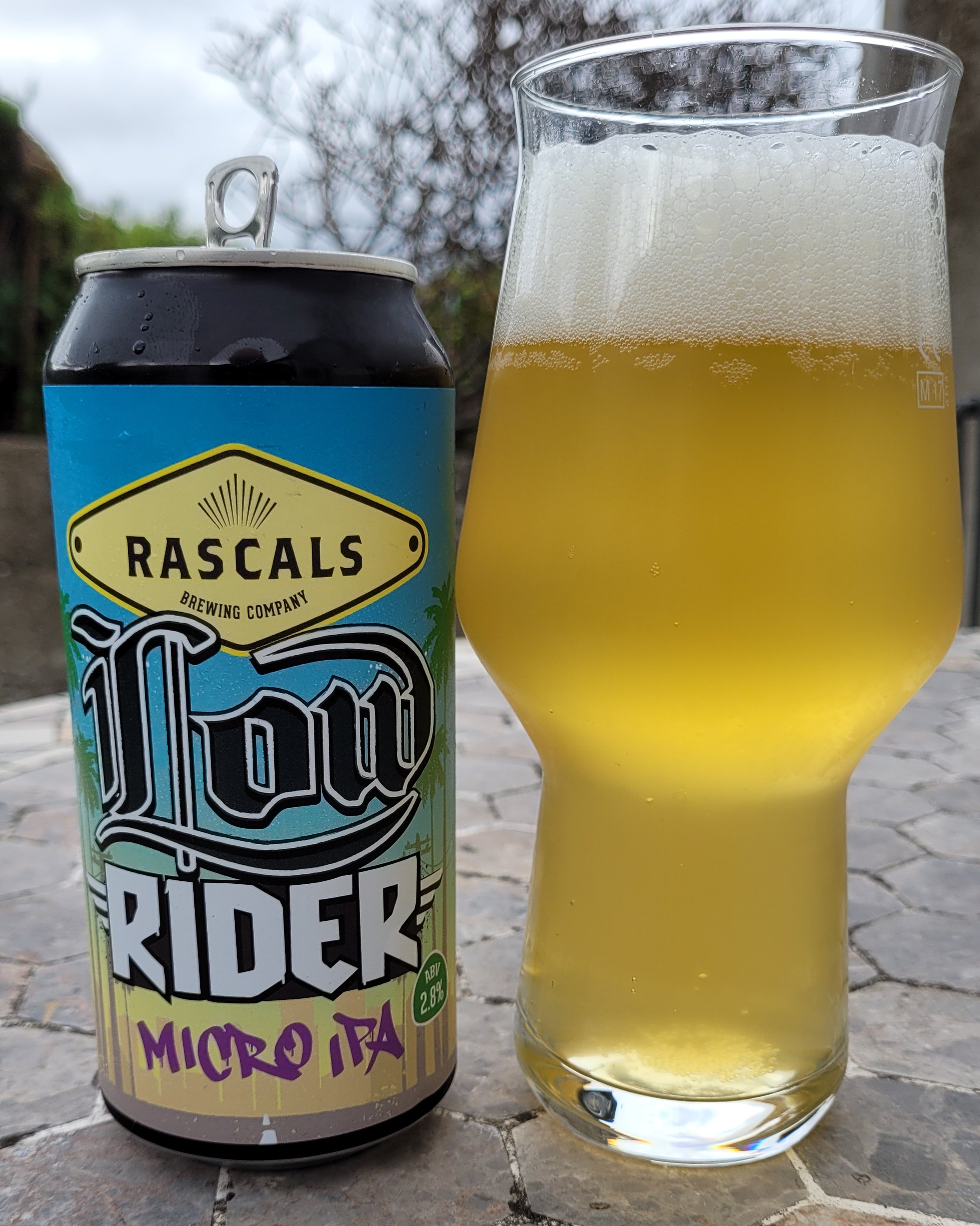
A postscript at home. Low Rider is a micro-IPA, a recent style whose merit I've yet to be fully convinced of. A graduate of the Rascals pilot programme, it's 2.8% ABV yet cost a substantial four euro twenty-five for a can. Yeah, yeah: inflation and that, but still. It had better be good. It's very pale in the glass though smells fresh and full-on, bursting with lime and assorted stonefruit. Clever use of oats boosts the mouthfeel so it doesn't feel any way watery, often a fatal flaw in beers like this. That said, the low strength does mean the flavour is a little muted and lacks a proper big finish. It's good while it lasts, however: west-coast grapefruit bitterness matched against juicier tropical notes. This is micro IPA done very well, though I'm still unconvinced about the price tag. It would be a short session on such spendy fare.

Rascals was stop one on a revisit of Dublin's prolific drink-in breweries. The series will continue shortly.

14 July 2021

Barrowside trilogy

Carlow Brewing has undertaken a bit of a refresh regarding its range and branding. I'm not sure where it's going and which if any of the existing beers are about to vanish, but I do know we now have Leann Folláin in 440ml cans and three new IPAs.

The first is very much a trend-chaser, though not a trend that Irish microbrewers have made much of: the slimmers' beer, for want of a better term. O'Hara's Lo-Cal Session IPA comes in 330ml cans, normally to be found in four-packs for €10. The can doesn't tell me how many calories are in it, which strikes me as an unusual move, though I can say it's 4% ABV. In the glass it's a pale lemon-yellow with a little haze and a freshly sharp and citric aroma. I'm getting vibes of modern northern English bitter, like Marble's Pint. There's a soft texture and an abundance of body so, like a good bitter, it doesn't taste compromised by the strength. The flavour has plenty of legs too: lemon candy, fresh spinach, oily pine and even some naughty dank resins on the finish. This is very jolly indeed and entirely suited to the four-pack format. Don't let the diet-oriented handle fool you: it's the whole package for a session IPA.

I'm not sure in which order to take the other pair. Normally I'd drink in ascending order of ABV, but the weaker here is badged as a West Coast IPA so I'm going to begin on the hefty 6.8% ABV Hazy IPA. With 51st State back in 2017, Carlow was among the first Irish breweries to present a commercial beer in the New England fashion, and they still haven't got the colour right. While most everyone else has the knack of yellow emulsions, this one is amber, and translucent rather than opaque. The label doesn't lie, though: "Juicy - Tropical - Stone Fruit" it promises and all three elements are right there in the aroma, a concentrated mix of passionfruit, guava and mango. There's a brief stumble in the foretaste where it turns savoury, opening on a dry rasp of caraway seed. Luckily the soothing tropical fruit is there behind it, here joined by a slightly citrus edge of tangerine, and a heaping helping of gullet-warming alcohol. Anyone coming to this expecting a hazy IPA like what the cool breweries make, and charge seven quid for, is in for a let-down everywhere but their wallet (this was €3). On its own terms, though, it's fine and actually rather enjoyable. Especially when that booze kicks in.

West Coast IPA should be much more in the wheelhouse of this mid-'90s veteran. It's the same sunset colour, though completely transparent, of course. The aroma was reticent, but there's pine and dank deep in there, so it gets a pass. On tasting it's surprisingly -- disturbingly -- similar to the Hazy one: the same savoury kick and boozy burn. The fruit is missing, of course, but the texture is still quite big and a little syrupy. There's none of the clean dryness I like in this style, and it's missing the fresh hop zing too, tasting rather sluggish and sweaty. Again it's OK, but it needs either a lighter body or much more generous hopping, I think. Full points for not being hazy, I guess, but as a West Coast IPA it leaves me wanting.

Who would have thought that the low-calorie offering would be the stand-out, but here it is. Dirty great pints probably aren't part of the plan, given the branding, but I would very happily indulge in some in due course.

12 June 2020

Surprise Vocation

My little local Tesco serves me well for the basics. Emergency Manislav and 4-for-€10 Leann Folláin and I consider my needs met. It was very surprising, then, to find a couple of high-end Yorkshire IPAs warming themselves on the ambient shelves, both canned less than a month previous. It wasn't beer shopping, it was a rescue mission.

First up, a splash of summer colour on a collaboration can between Vocation and Marble. Hop, Skip & Juice "hazy pale ale" nails its style credentials to the mast. If you don't get full New England vibes from this you deserve a refund, is the implication. It looks correct: the lemon-curd yellow of such beers, regardless of their strength -- this one a modest 5.7% ABV. It smells of custard vanilla first, backed by a sharper mix of lime jelly and fresh garlic. Again, bang in the centre of those inexplicable style parameters. The flavour, let it be noted, is not a mess. It's certainly dessertish: that mix of sweetness and lemon giving it an overarching meringue pie effect, with the garlic entering the picture as a savoury twang on the end; a two-course meal in reverse. But it's light, undemanding and fluffily textured, with none of the unpleasant extreme aspects that beers like this show too often. I wouldn't go so far as to call it "juicy", though. There's too much fuzz on the tongue for that. I guess it's a supermarket take on New England pale ale, and if that means it's balanced and accessible then I will absolutely take that, and commend it to you.

The ABV goes up to 7.2% for Love & Hate, badged as a New England IPA and following Vocation's standard branding and binomial nomenclature. Still hazy yellow, though it does look denser and more opaque than the previous. Here the garlic dominates the aroma and there's a worrying heat in the nostrils too. Is this the style reverting to its usual naughty ways? Yes. Yes it it. A rub of raw garlic across the palate, a scorch of hard alcohol and then a spike of dreggy yeast bite in the finish. This is both extreme and entirely normal for modern IPA fashion, and I despair for anyone who considers this a good beer or somehow progress. I've had worse, for sure, but here's a deliberately poor and unfinished-tasting beer getting into Tesco Express, where innocent civilians might find it. Hopefully the €4.40 price tag will keep them away when Manislav, Leann Folláin and Francis' Big Bangin' IPA are all on the same shelf and better value in every sense. Not forgetting the Hop, Skip & Juice too. Let's pray that punters are drawn to the colourful can first.

Moaning about fashion aside, a shout-out to the Tesco operative who decided that my neighbourhood store was worthy of these. There's a certain optimism -- especially when commerce is so heavily emphasising The Essentials -- in taking a chance on high-risk beer trends. Throw us another couple of randomers and I'll sure as hell buy them.

18 April 2018

Doing the rounds

Seems I now have two kinds of Irish beer round-ups to do every few weeks: the regular one and the Dublin brewpubs dispatch. We'll start this one at Open Gate.

I've said multiple times that lager is the Diageo microbrewery's principal strong point and I'm always pleased to see a new one. Open Gate Vienna Lager came my way on a visit to the bar last month. And it's absolutely proper in every respect: clear copper coloured, with a sweet-yet-crisp dark biscuit grain character, overlaid with green celery noble hop flavours which build pleasingly to a grassy bite in the finish. The carbonation level is quite high but the body is so clean that it gets away with it, scrubbing the palate without scouring it. At 5.5% ABV it's maybe a bit too full-on to be a true session lager, but a couple of pints is just the ticket.

Open Gate IPAs I have been less on board with. I missed the prequel to today's one, No Limits. This is called Double the Limits, 7.2% ABV, and in a New England kind of style. For all that, it's a clear lager-yellow colour. The texture is properly thick, however, and this helps feed a strong resinous hop character, leafy at first, before easing off to gentler lemon and lime notes. There's a certain cheesy funk in the aroma, and this side gives a mildly sour edge to the flavour which is quite out of keeping with the rest. Overall it's not bad; the flavour does manage to hang together coherently, the mouthfeel is lovely and fluffy and the big strength is well hidden. It's still not a great IPA though, whether double, New England, or however else you slice it.

Eastbound and down, to Urban Brewing. Last month I mentioned that JT from Gipsy Hill had done a collaboration beer here, and lo it arrived on the taps, the cheerily-titled Spring Break, a sour saison of 5.3% ABV with peach and apricot. It's a sunny shade of pale yellow and smells like a fruit sponge. The peach juice leaps out of the flavour first thing, and just when I thought it was going to build to a cloying sugariness, the tartness sweeps in and cuts it off deftly. The finish is merely mildly fruity, showing the melon rinds often found in unadorned saisons, plus a satisfying spark of jasmine perfume. The fruit element does come on a little strong in it, though is entirely in keeping with the beer's mission to be fun and carefree. I liked that it was tempered with the more serious soured and saison sides and would perhaps have preferred more from this. As is, though, it's a great offering.

Irish Altbier seems to be having something of a moment right now, and here was Alt Bier by Urban Brewing. There wasn't much going on in this, which I guess is perfectly on-point for the style, especially the more industrial big-name variants. It's the appropriate rusty colour and tastes dry and crisp. It took me a while to find anything else. A late-rising bitterness was the first distinguishing feature, followed by softer toffee malt as it warmed. Both of these are slight and not terribly distinguished. I was underwhelmed but unoffended by the whole thing.

Not long after, the venue played host to the National Homebrew Club's national championship. I took a quick break from judging there to sample a new offering just arrived on tap: Pan Am, an IPA with added grapefruit and yerba mate. It's a murky red-brown colour and, presumably because of the mate, is absolutely roaring with phenolic smokiness, tasting very similar to a strong cup of lapsang souchong. A tiny spark of citrus begins it, but followed swiftly by a long blast of stale smoke and old rubber, finishing dry and harsh. A noble experiment perhaps, but one that very much didn't suit me. I wouldn't be able to swear that the taste wasn't down to an infection of some sort.

I couldn't leave this post on that bum note, so thankfully was rescued by the next release: Bière de Table. This is broadly a saison, though is stronger than a typical bière de table at 4.9% ABV. It has the proper look, however: a pale and hazy yellow. And it definitely has the flavour, presenting beautiful perfume and spices right from the start. I got jasmine, lavender and incense all the way through, adding a slightly sticky peach nectar to the picture late on, before the long herbal finish. Its farmhouse credentials are present and correct and all the features gel together well. I genuinely got a vibe of Bermondsey from this; the nearest you'll find to The Kernel's version of the style in these parts.

I don't have a new one from JW Sweetman for this round but I'll let Kildare Brewing step in as a surrogate. Late last year, Sweetman ran a homebrew competition and the winner was Brian McSorley's stout Black Ó Lantern. Kildare subsequently brewed it up and sent a keg (the keg, I believe) to JW Sweetman where I got hold of a pint. This is Irish dry stout writ large: a huge dry and bitter hit up front, all black toast and sharply metallic hops. And yet it's not at all harsh, carried by a big and thick treacle base. That treacle brings a certain amount of sweetness into the flavour late on, and then the burnt roast comes back in the finish. It's an absolute beaut and up with the best of the genre, like Wrasslers and Leann Folláin. A repeat brew would be no harm at all.

I'm sure I'm already far behind on what these breweries have released more recently. If you want to find out what they have now it's best to just call in.

09 December 2016

Trouble and Hope

The brewery names sound good together, and they do have a brewer in common, but otherwise this set is unrelated, demonstrating perhaps nothing more than the diversity of Irish beer these days.

Trouble's Gung-Ho I found on draught in The Brew Dock last month. It was badged as a hopfenweisse, though this style councillor regards it as much more of a white IPA: it hosts a punch-up between spicy yeast flavours and bitter hops, resulting in a jarring soapy tangle of tastes that never settles down. It's a bit of a shame because, taken separately, the beer's different elements are lovely: there's a luscious soft wheatiness, a juicy peach aroma, and an invigorating fresh green bitterness, but there's no harmony and the drinking experience suffers as a result. Weissbier of any stripe should be smooth, and this is far too rough and pointy to fit into the genre.

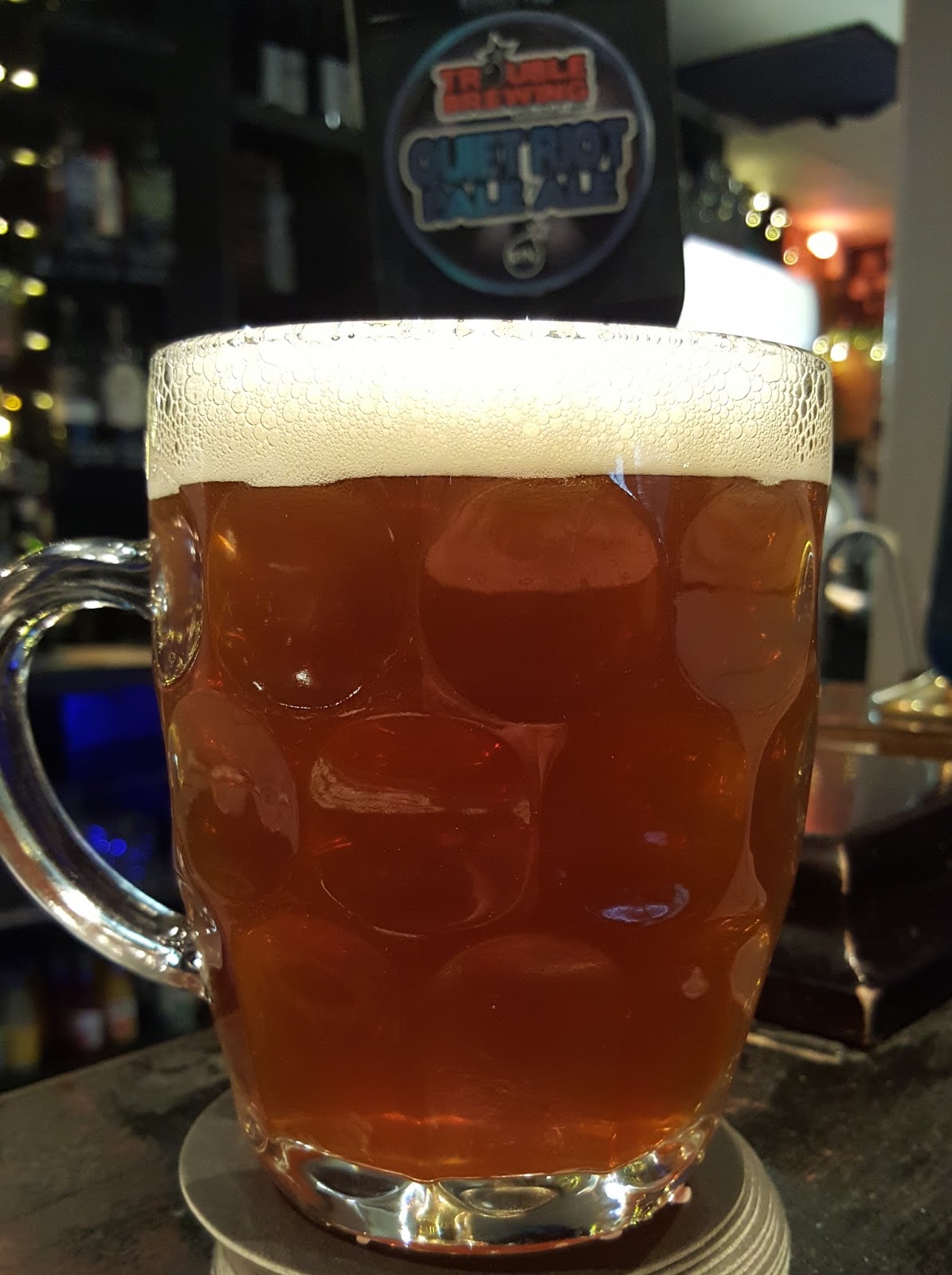
A few weeks later I found another recent Trouble special, Quiet Riot, installed on a cask engine at The Black Sheep. It's described on the badge as a pale ale and is bright orange with a slight murk, so I was expecting new world grapefruit and whatnot, but it's actually quite British-tasting, for reasons more than the dispense method, I think. There's a sweet jaffa aroma which shades toward Terry's Chocolate Orange: it has that sort of concentrated orangey oiliness. Then it tastes massively tannic, with a palate-scouring dryness worthy of the brownest of brown bitters. Behind this there's a satsuma sweetness, going perhaps far enough to resemble candied orange peel, while the finish brings in a big old fashioned hop bitterness given extra punch by the dryness. Unfortunately this is almost ruined by a poopy Brett off-flavour which I suspect is not part of the act and relates more to the cask having been tapped a whole week previously. Ignoring that element, what we have here is a pretty solid bittersweet English bitter, one that doesn't taste its strength.

Crossing over to Hope, Peach & Blueberry Sour is the third in their Limited Edition series. The previous two were among the best beers I've tasted all year, so anticipation was obviously high. It's also the second sour co-production between Hope, YellowBelly and Shane Smith, and the first of those (YellowBelly's Castaway) was also magnificent. Quite the pedigree, all in all.

It blushed out of the bottle, a cheery, rosy pink, forming only the briefest of foam tops. The aroma is a dessertish mix of fruit pie and jelly. The latter was very much to the fore when I took the first sip and got a hit of those sugar-coated sour jelly sweets. As well as the sour kick, there's a similar sort of indistinct fruit flavour. I would never be able to pick actual peaches and blueberries out of this, and it really lacks the lusciousness of Castaway's passionfruit, sacrificing it for a bigger tart hit. It's a decently tangy number, refreshing and drinkable, but nothing special this time.

And a final beer which I'm wedging in following the Christmas Craft Fair at the Teeling Distillery on Saturday last. Hope were pouring and I had the opportunity to try Limited Edition number four, an Export Stout. It's a real return to form after the blip of no. 3: thick and sweet the way a 7.5% ABV stout should be, tasting first of treacle and chocolate but then balancing it with a serious old-world vegetal bitterness. While those two elements were see-sawing on my palate I caught just a glimpse of a lighter, more delicate, meadow flower perfume, a whisper of lavender in the otherwise dark and stormy big-stout flavours. It's beautifully done -- a proper stout-drinker's stout -- and one to rank alongside Leann Folláin and Guinness Foreign Extra, for as long as it lasts. Des from Hope confirmed that limited means limited with this lot, though also that a new IPA, lighter than Handsome Jack, is on the cards for the new year. Can't wait.

28 December 2015

Next year's beers

Chef Kevin Dundon and Head Brewer Kieran Bird
At the beginning of November I wrote of being charmed by the King's Bay beers from Arthurstown Brewing Company. The brewery's official launch happened a few weeks later with sequential events in Wexford and Dublin hosted by the brewery's co-owner and frontman Kevin Dundon.

I learned that the King's Bay brand was created specifically for SuperValu and represents a slightly toned-down version of the Arthurstown recipes, intended for mass appeal. This was my first time tasting the beers as the brewer intended, alongside a preview of two that are still in development. The event took place in Tap House in Ranelagh, there were canapés, there was an a cappella choir, and there was also:

Dunbrody Red Ale is yet another standard Irish red. It's clear but still manages to look a little dirty and tastes of caramel in the middle, then finishes sharply dry. It's decent, though to be brutally honest I think I preferred the King's Bay Red to it -- they're both the same strength at 4.7% ABV. One for Irish red fans only, I think.

Also at the same strength is Dunbrody Pale Ale and this has a lot more to say for itself. Though the texture is a little thin and watery there's a lovely big hit of hop resins right in your face from the first sip. Not much else, mind, but that doesn't matter: there's just enough of a malt base to counteract any possible harshness and I have no objection to a one-dimensional hoppy beer as long as it tastes good. This does.

Still under starters orders and not yet on general release is Dunbrody IPA. I think the disparaging comments about this from the Arthurstown men were a little unfair. It's maybe a little lighter of body and more attenuated than many like their IPAs to be, but I thought this worked in its favour. It opens with a refreshing lemony spritz which shades a little towards bath-bomb after a few seconds. But the hops keep on rolling, providing a dank buzz which leaves a lingering resinous quality. The ABV is a satisfactory 5.5% and I don't for a second miss the toffee or thickness that it might be tempting to add to the recipe. Maybe a little more malt to bounce the hops off, but please don't ruin the good points, guys.

In my piece about King's Bay, I suggested that the range could do with a strong and dark dessert beer. Dunbrody Stout isn't quite that, but is perhaps the next best thing. While only 5.4% ABV, it's very full-bodied and smoothly textured. The flavours are all luxuriously dark and sweet ones: treacle, molasses and a tang of high-quality high-cocoa dark chocolate. Perhaps the thing I like most about it is how different it is to other Irish stouts. Leann Folláin may be all things to all drinkers, but even it doesn't have the same dessertishness as this. And pleasingly it still works by the pint. Paired with a warm chocolate pudding and some quality vanilla ice cream: mwah!

This preview suggests they know what they're doing beerwise at Dunbrody House, even if they are sticking to safe and accessible styles to begin with. I look forward to seeing what else 2016 brings from them.

26 November 2015

A few days in beertown

I left you last time in Moeder Lambic Fontainas, Brussels's ticker heaven. The other beer I had there before moving on to the cask Cantillon lambic, was L'Amer des Moeders, brewed for the house by Jandrain-Jandrenouille. It's a golden ale of an approachable 5% ABV, pale and slightly hazy with a sugary perfumed nose. This resolves on tasting into a weighty Belgian blonde with spicy jasmine up front and quite a dry finish. It's good, as pretty much everything the brewery produces is, though it's also a little severe, especially if it's intended for repeat purchase.

There's a new geek bar in town next to Centraal station: the first Belgian outpost of the BrewDog chain. It occupies a cavernous space, with oddly less seating than I'd have expected. There are also signs that this is a licensed franchise rather than part of the main operation as the staff don't seem to have the precision customer service expertise that's a hallmark of the UK branches. The menu is a mix of the core BrewDog range and a well chosen selection of mostly unusual Belgian guests. To wit:

Monkey Monk is a new Belgium-based brewing operation founded by Finnish ex-pats. The beer I had was a 6.5% ABV IPA called API and it's all rather simple and tasty, with that orangey hard candy taste common to many Belgian and Belgian-style IPAs, plus a dusting of light spices. Straightforward, no gimmicks; clean and well-made.

I followed it with Mont des Cats, a newish trappist brand, brewed under licence at Chimay. It's 7.6% ABV, a pale orange-brown colour, and smells enticingly of rum, rasins and bananas. The flavour is very much that of a strong dark trappist, with more raisins and a great deal of crusty brown bread, though the texture isn't as heavy despite the substantial strength. I kept expecting some tripel-style spicing, but that doesn't feature. Decent stuff and a pleasant change away from your Chimays and Westmalles while staying broadly within the genre.

That's all there was time for before dinner, hosted by Brussels's most renowned cuisine à la bière establishment, Restobières. Eccentric chef-patron Alain kept thrusting bottles of his house beer at us: ForMi Diable, a blonde ale complete with extensive punning ant cartoons on the label. The use of coriander and orange peel at 6.5% ABV make it something like a souped-up witbier, though the savoury herbal effect is more reminiscent of clean Belgian blondes like Duvel and makes it a better food beer. Which is the point, I guess. Anyway, a nice dinnertime conversation beer, though I'm still none the wiser about why the ants.

Also being passed around was a limited quantity of 2009 De Cam Framboise. I'm new to this gueuze brand, but have always enjoyed it so far. This red one is 6% ABV and very funky: lots of brett, traces of vinegar and just a tiny wisp of residual raspberry fruit. The most distinguishing feature was the sharp acidity, making it pure heartburn in a bottle. Fun to try, but a sip is plenty for my unrefined tastes.

For afters, a trip around the corner to Pin Pon, which I mentioned on Monday. As well as the house beer, I also had a go of St Feuillien Grisette Fruit des Bois, much to the bemusement of my companions. And the bar staff, actually. We're used to grisette as very much a craft style -- so craft that I don't think anyone in Ireland has made one yet -- but I suppose in Belgium this light saison still carries the less romantic associations of its industrial past. And especially when a load of purple syrup is dumped into the vat. The end result is 3.5%, bright pink and very sweet. The flavour is that of a forest fruit yoghurt, all fruit gunk and not much beer behind it, just a kind of vague stale mustiness. I'd be interested in trying the naked version of this, but it scratched my sweet fruit beer itch for a while.

A pub crawl on a different evening began with dinner in La Lombard, washed down with Petrus Aged Pale, a beer which, from what I've read lately, did rather well out of its sponsorship at the 2015 European Beer Bloggers' Conference. This is a whopping 7.3% ABV and features an odd aroma of candycanes and vinegar. It falls somewhere on the spectrum between proper Belgian sour beer and the high-volume industrial gueuzes, a properly bitter tartness sits next to quite a heavy sugariness. A simple flavour, with no woody or bacterial complexity, it's accessible and drinkable, despite the strength. And the good news is that importation to Ireland is imminent.

Dessert was Troubadour Imperial Stout. A little disappointing, this. I was expecting bigger and better but instead I got something which called ancient memories of chocolate-flavoured Ready Brek to mind: that fine sawdust wheatiness and sweet milk chocolate. A metallic hop kick in the finish and a light pepperiness adds a modicum of complexity, but that's your lot: just because something is from one of Belgium's best brewers and is 9% ABV doesn't mean it will alter your perception completely.

Guest photobomb by Tim Webb
After a quick stop in A La Bécasse and a pair of big jugs, the evening wound up in Toone and my nightcap was 3 Fonteinen Oude Kriek. This chap is only 5% ABV but very dense with it, a dramatic dark blood-red colour. I reckon the thickness helps offset the sourness because this is quite gentle in that respect, taking away the harsh acidity and leaving a pleasant spiciness. No fruit sweetness has survived the process and the flavour is more like tart blackcurrant than cherries to my mind. I can't remember the last time I enjoyed a kriek this much.

The last event of the trip was a reception the EBCU held for politicians and the drinks industry, in celebration of the group's 25th birthday. Member organisations had shipped in beer from their homes so there was a veritable buffet of varied European beers -- special thanks at this point to Carlow Brewing for providing Beoir's contribution to the party. I was only around for the set-up of the event so had time to sample just two of the beers on offer. One was Visioen, an 8% ABV stout from Dutch brewer 7de Hemel. It's a perfectly classical example of a strong stout: roasty and creamy at first and finishing with an assertive dry bite. The other, also a stout, was East London's Quadrant. This includes oatmeal and gets the benefit of its smoothing effect. But there's plenty of roast too and a certain sourness as well. Very drinkable and it would have been nice to compare both of these to Leann Folláin, which I'm told was very popular on the night.

But I had to make my excuses and depart, shoplifting as much as I could carry from behind the bar. Posts about my ill-gotten gains will follow in due course.