02 October 2023

Brace for the nonsense

Not for the first time, Melissa Cole said it best: "Are you here for the nonsense?" The nonsense in question is the Belgian Beer Weekend, a festival of sorts which takes over Grand Place in Brussels on the first weekend of every September. I had never been, and have Carey to thank for putting it into my 2023 schedule.

It is not as other beer festivals. There is, and I don't think this gets mentioned enough, nowhere to sit. Standing, perching, shuffling is the way of it. The payment system is a convoluted one, whereby a card is issued, for free, at the entrance, which needs to be topped up with credit by phone. Said credit is for buying beers but, this being Belgium, each exhibitor has their own glass on which you pay a deposit, refundable when you bring it back: perfect for a Bavarian quaffing fest; an absolute pain for a small-measure Belgian sipping one. Still, I bravely put up with it for several hours over two days, and here's what I sipped.

Swinkels was using the occasion to launch yet another Rodenbach brand extension: Rodenbach Evolved. I'm a huge fan of basic, unevolved, Rodenbach Classic, and I'm guessing all the variants are made with the likes of me in mind, but I've never found one I prefer over the original. And so it is with Evolved, which started out as ordinary Grand Cru and has been aged for ten years. The first and most obvious difference is to the texture: it's very thick and chewy; bready and spiced, like a hot cross bun. Think of it as an after-dinner sort of Rodenbach. Normally, Grand Cru is too vinegary for me, so at least they've knocked that out of it. Indeed the sourness is so minimal that I found myself missing it. The spritzy happy medium between Evolved and Grand Cru is, of course, Rodenbach Classic.

Staying with the sour, Lindemans launched the latest of their fruited lambics. It never occurred to me that Tarot Noir, at a grown-up 8% ABV, would be kin to their various artificially flavoured sugar bombs, but unfortunately it is. There's no sourness, just lots and lots of tooth-rotting pink-tasting candy. "Forest fruit" is the official description; blackberries, blueberries and black elderberries are the touted varieties; meh, next, is the review.

Sweetening up their act more successfully was Duchesse de Bourgogne with a Cherry Chocolate version I hadn't seen before. This retains the richness and sour poke of the original, but adds a complementary sourness from the cherries: nothing sugary or syrupy about it. It's not a kriek, being too warm and dark, but it's an interestingly different twist in the same direction. The chocolate side is minimal, barely perceptible, and I can't help thinking that's a good thing. Adding flavourings without losing sight of the classic beer underneath must be tough to do, but this one manages it in a pleasingly no-nonsense way.

If it's nonsense you want, of course, there's no need to go past the Huyghe stall, which was pouring a wide range of Floris flavoured wheat beers, plus the Mongozo range, served in a half coconut, as is correct. I have been intrigued by the existence of Floris Cactus for decades, and here was my chance to try it at last. It certainly provides some green for your money, being a brightly lurid bubblebath colour. The flavour resembles nothing so much as a Fat Frog ice lolly and therefore, presumably, the alcopop named after it. It's a sweet lime candy effect set on a soft texture; sweet but not cloying, but very silly and unbeerlike. I have a soft spot for it. I discovered Belgian beer through the likes of this so I'm never too angry at them for pulling daft shapes.

On a more serious note, Huyghe was also pouring Deliria, a strong blonde ale they originally produced for International Women's Day. At 8.5% ABV it appears to be pitching at Duvel's end of the market, which is a perfectly worthy target. It carries the same sort of lagery dryness with sparks of herbs and pepper up front and a little peach and mango arriving late, carried by the alcohol heat. It doesn't quite have the easy-going poise of Duvel -- few beers do -- but presents a decent take on the same angle.

Multinational-owned Grimbergen is a brewery I've come to associate with overly-sweet beers in standard Belgian abbey styles, so was very intrigued to see Magnum Opus brut beer. It turned out to be a very clear pale yellow and 8% ABV. The wine yeast has certainly cleared all the sugar out, and the result is extremely dry. There's a hint of grapefruit peel which I'm guessing is down to whatever hops they used. The aim seems to have been to create something crisp like Champagne, but it hasn't really worked and lacks the subtle complexities -- pale toast and white grape -- that I would expect to find in something like this.

Though I knew that Achel had lost its trappist designation, I didn't know it had changed its blonde ale. I wrote about the 8% ABV Achel Blond way back in 2007. In 2016, it seems they changed this to a 9.5% ABV beast called Achel Superior Blond. I gave this a go when I saw it. Though it has a very clean white sugar base, there's a fun herbal complexity to the flavour, giving me aniseed and rosemary in particular. That makes it seem a bit like a tripel, mixing the savoury and sweet aspects, though drier and much more like a standard, but very good, Belgian blonde ale. I have tended not to enjoy Achel's beers in general but this one had me thinking they're worth a revisit.

Vesper Tripel, by Brouwerij Cornelissen, came my way early on. This one is 9% ABV and a perfect clear golden. The flavour is intensely bitter, all raw green vegetables and wax. That certainly gives it character, but I'm not sure it's one I appreciate. While tripel may not be supposed to be easy drinking, I found this example to be too much work to be enjoyable.

I spotted Red Flo advertised on one of the vans on the festival periphery, and made a point of buying one just because the name is so silly. It's not even red, being a straight tripel from the brewery Flobecq. Orange-amber in colour, the aroma goes all-out for bready malt while the flavour is rough and grainy with an acrid, tacked-on, bitterness. This is not a good tripel, lacking any warming smoothness or invigorating spices. While far from bad, its big loud flavours make the wrong noises.

Conversely, VBDCK Brewery nailed its target style with Kerel Bière de Garde. This one is appropriately dark orange and as crisp as you like, showing just a tiny pinch of citric bitterness. I got elements of straw, melba toast and wheat crackers, plus a certain soft richness, like golden syrup, for balance. Bières de garde are sufficiently rare that I'll always choose one when given the option. While this one offers little by way of complexities, it still does the basics very well.

Finally for today, a shot of whisky, in the form of Cuveée Clarisse Whisky Infused from Brouwerij Wilderen. The base beer is a 9.2% ABV dark ale, and the bourbon barrel boosts that to 10.2%. It's a murky dark red in the glass, giving off highly unsubtle sweet whisky liqueur flavours in the foretaste, with vanilla dominating. There's also a burnt brown sugar edge, creating a kind of crème brûlée effect. Surprisingly, the finish is quick and it's very light-bodied and easy-drinking too, which something of this strength shouldn't be. Overall it's decent and unfussy, which is a bit of a failure from a beer that ought to be a flavour powerhouse.

That wasn't the only traditional Belgian style getting the bourbon treatment at the festival. See tomorrow's post for more.


29 September 2023

A sliding scale

With its abstract art, sweet fruit beers, pastry stouts and endless IPAs, Lough Gill has grown into a brewery unashamed to chase international beer trends. Well, there has to be at least one per country, like an airline or a bar with a Frank Zappa quote on the menu. Here are three examples of their recent output.

First up is You're Not Welcome, 5.3% ABV and brewed with mango and blueberry, but looking the greyish pink of blended strawberries, and smelling similar: sweet but with a tartly acidic edge. I was hoping it might be properly sour to taste but the lactose puts paid to that from the first sip. We move from freshly mulched strawberries to cheap raspberry ripple ice cream: sugar, artificial vanilla flavouring and pink fruit goo. It's a long way from any real fruit, never mind the fancy ones named. There is at least enough of a tang on the finish that it doesn't get sickly, and I think there's a welcome bite of hop bitterness too. That said, with this flavour profile, I probably would have preferred it to be full-on viscous soup. As is, it tastes like an earnest attempt at a serious fruit beer which turned out a bit silly. There are worse complaints to have, I guess.

Punishment is one of several things I'm a glutton for, so cracked straight on with an even stronger version of something similar. Wound Runner is, most importantly, 7.2% ABV. At least it looks, broadly, like a real beer, being a hazy orange colour. No pigment is provided by the peach, pineapple and passionfruit it's brewed with. Passionfruit, of course, is the up and down of the aroma, giving it a crisp and cold palate-cleansing sorbet effect. It's definitely cleaner and sharper than the previous, with no sign of all the extra booze. The lactose is sufficiently understated to let it taste properly tropical, and less like a 1980s budget dessert. It was lashing rain outside when I drank it and it provided a welcome beam of warm sunlight. While it's none of your fancy mixed-fermentation fruit beer, it's as good as the basic lactose-based model gets.

And then a hazy IPA to finish. Blue Blue Sky is hopped with Cashmere and two names I don't recognise: Luminosa and Pacific Sunrise. The latter is a Kiwi, and boy does this beer smell like New Zealand product, all high-octane kerosene and tangy white grape skin. I didn't think the world needed a more intense version of Nelson Sauvin but it may have got one. The flavour has that fossil-fuel oily thing, yet also manages to add juicy guava and apricot plus a very American pine-resin dankness. For me, those three elements are quite separate, yet meld into each other in a completely harmonious way. It's a hoptical illusion and I love it. I think the key here is freshness: I bought it and drank it within a couple of weeks of canning, and everything about it is brighter and more colourful as a result. I'm sure the sizeable 6.3% ABV is a factor in how intense the hopping is, and yet it drinks like a much lighter beer. Everything here is just as it should be, and there's no room for even a sniff of an off flavour. When it comes to hazy IPA, it takes a lot to impress me, and Lough Gill has done it with this. At the end of the glass I felt like giving it a standing ovation.

The fruit beers are par for the course, and fine for the fans. That IPA, however, should be drank by everyone. It's on tap at UnderDog this week, as it happens.

27 September 2023

Autumn is the new Spring

I didn't notice that Morning Dew was a spring seasonal when I picked it up from Blackrock Cellar. I see little enough WhiteField beer that I didn't even realise they had a seasonal series, but apparently they do.

It's a saison, purportedy in the French style, 6% ABV and utilising rye and spelt in the grist. Lesson one is don't pour it into a glass with any kind of headkeeper etching. I'm used to saison being bubbly but this took a full twenty minutes to pour satisfactorily. I'm guessing the French tend not to use half litre bottles for it. Once there, it's a hazy sunset colour, on the darker orange end of the saison spectrum.

Past the humongous all-angles head, there are very classic farmhouse brewing aromas of straw, dry grain and hard pears. The flavour leans into the fruity aspect, adding lychee, white peach and even a little pineapple. A very obvious alcohol heat intensifies this, and I think it's better consumed quite cold, which would also help with the foaming. The dry grain-and-hay side gets a little left out, showing up only briefly in the flavour.

If you don't mind the warmer, fruitier sort of saison, this one is for you. It delivers lots of Belgian-like esters but retains just enough crunch to taste like a proper saison rather than a golden ale. Personally I'd like a bit more of that dryness (and less fizz), but I would still be happy to see this coming back for another round next spring. Or autumn.

25 September 2023

Causes for celebration

It's still high summer in my notes backlog. Here's a few cans Rascals sent out over the last season.

I managed to find twenty minutes of al fresco beer drinking time and spent it with Pink Lemonade Sour. It's certainly pink, hibiscus doing what hibiscus does. It's hazy with that, and doesn't really form a head for any length of time, neither which is a surprise for this kind of beer. The aroma is that of a soft drink, promising some sort of flavoured processed sugar but being vague on the details. The body is quite light, as expected at 4% ABV, but it's not watery and it carries a decent amount of flavour complexity. It opens sweet, with the summery raspberry and cherry of hibiscus. When the sweetness fades, it becomes a crisp and refreshing job, akin to biting into a cold slice of watermelon. The bite grows into a full sour kick in the final stage, cleansing any of the initial sugar still drifting around. That's a slow-motion account of what happens, but really you can just drink this. And while it might appear to be pitched at those psychopaths who believe they don't like beer, it is very much a beer all the way through.

Celebrating 90 years of the Molloy's drinks business, The Craic Is 90 is 4.2% ABV, pale yellow and hazy, though the brewery doesn't assign it any style beyond "ale". To me, it's a very familiar American-style light pale ale, brimming with zesty lemon though never quite hitting full-throttle grapefruit. The base is thick enough to carry a decent amount of bitter acidity, and the whole thing brings a sense of high-end or homemade lemonade, perfect for relaxing sun-downers. It would theoretically work as a happy, social, party beer too, drinkable into the early hours, by people younger than me.

For the second in the brewery's IPA Outbreak series, a Session IPA of 4.4% ABV, brewed with Citra, Galaxy and Mosaic. It's almost clear too, only slightly foggy yellow in the glass. The Mosaic delivers in the aroma, making it smell deliciously melon-like -- honeydew and cantaloupe -- and very similar to the mighty Little Fawn, my session IPA archetype. The flavour continues that way, which is a bit of a one-note, but a note I like hearing. There's just enough bitterness to balance it, but nothing I would describe as Citra's doing, while the Galaxy almost seems to be asleep on the job. Where it falls down a little is the texture: while it was enjoyable for almost the whole first half, there's a wateriness which creeps in when it gets even slightly warm. It means that the lovely melons wear off faster than they should. I guess they've taken the "session" aspect seriously as it's very drinkable and leaves no aftertaste, but I think it would have benefited from the same sort of malt treatment as the previous beer.

You may need to do your own folkloric research on "Shemozzle": I can only say it's a frequently used word in southern GAA circles, though more for the innocent sort of on-pitch shoving and tugging that they do, rather than my native Ulster where conflict tends not to have cute and beer-appropriate labels applied. Anyway, this is a hazy IPA brewed in collaboration with Sudden Death when they were over for Rascals's festival back in May. It smells a bit hot, all of its 6.4% ABV and more. The savoury side of haze is very much to the fore -- onions, garlic, armpit sweat -- which is unfortunate. They seem to have gone for an accentuated bitterness but without the sharp and piney aspect of the west coast. I don't think the east coast lays any claim to the salty, vegetal bitterness on display here. It doesn't really work. Haze needs fruit, and this has none. It is at least sharp and clean, suggesting perhaps the influence of Sudden Death's German heritage. I'm not a fan, however: too much that is wrong with hazy IPA is on display here. On the slim off-chance that my opinions count for anything, there are lessons to be learned.

Light and simple: that's the way to go for summer beer. Save the sweaty haze for colder days.

22 September 2023

No funny stuff

Today's selection is from Sakiškių Alus, a Lithuanian brewery which makes lots of off-kilter beers. Each of this lot was chosen purely on the grounds of its perceived strangeness. It's as good a reason as any.

How do you even approach something called Sour New England Vanilla Marshmallow IPA? Cautiously, I guess. It's orange and only slightly hazy, so doesn't look like a New England IPA and therefore can't be trying too hard to pretend be one. The head disappears quickly. Sourness is the main feature, beginning with a tartly citric aroma which unfolds on tasting into a clean and zesty mandarin and satsuma spritz. This is lightly carbonated and extremely refreshing, seeming less than its 5.5% ABV. Any masochist who actually wanted vanilla or marshmallow from it will be disappointed, but maybe they'll enjoy that. I found a beer that hits the main points of sour IPA rather well, even if it doesn't offer much by way of complexity. I'm glad I choose it.

Something slightly more orthodox follows: Cherry Red, another IPA, also 5.5% ABV, this time with cherry. Our own Hopfully were collaborating brewers on this. It's not really red in the glass, more a brownish amber, and this time there's lots of fizz, piling up the head and slowing down the pour. The flavour is broadly sweet, but don't ask me how much that's down to crystal malt and how much is fruit syrup: neither is particularly distinctive. The flavour is plain at first, a rather dull red ale with no real hop punch or fruit flavour. There is an interesting spiciness, however, which I'm guessing is somehow derived from the cherry. It doesn't keep the beer from being quite boring, but at least it gives it some level of character. I guess I should be happy it's not a sugary mess, but I don't really see the point of it.

Throwing fruit and herbs into sour beer is much more commonplace. The combination Pomegranate Mint is a new one on me, however. The label also says it's lemony, though there's no lemon in it. It does contain chokeberries, though, because why not? This is another fizzy one, making the pour a bit messy. Underneath the white froth it's a dark orange shade, and quite murky with it. This time the ABV is 4.7% so the lightness is fully appropriate. I looked forward to an invigorating sharpness from the flavour but it turned out a bit dull and flabby. The mint is there, but it's more like chewing gum than the real thing, lacking piquancy. The sourness is also low key, and I couldn't detect any pomegranate. I will award it some credit for not tasting like toothpaste, but it's also not far off it. I think the concept is sound but the execution isn't great: everything should be brighter and fresher-tasting, even allowing for the ten months it had been in the can.

All that didn't inspire confidence when I moved to the Gose with Raspberries. This is the lightest of the lot; only 3.5% ABV. It's pretty good, though. Of course, it's not much like a real gose -- dumping some salt in doesn't change that -- and raspberries are not a natural substitute for coriander. But it's beautifully tart and refreshing. The fruit which gives it its lurid red colour tastes like more than basic raspberry, adding in notes of cherry and actual pomegranate. While it's sweet and juicy at its very core, that's surrounded by a thick layer of sourness, biting in the foretaste and pinching the jaw on the way out, leaving a clean mineral residue, which I guess means the salt is performing its function after all. I don't know if the brewery has other versions of this but I think the recipe could be a good fit for all sorts of other fruit.

Sometimes the crazy recipes work, and sometimes they don't. Guesswork based on the description is pointless.

20 September 2023

Farm boys

Thanks to the good offices of Craic Beer Community I got to visit Ballykilcavan during the summer. The Co. Laois brewery is more than just vessels and hoses, it's also a farm, a sustainability project and an ethos -- all the talk is very much walked here. They had just canned a new beer, Cobbler's Castle, which was handed out on arrival. I was too busy with the walking and the listening and the looking to take any notes, so decided I would revisit it as soon as I saw it in shops.

That took longer than expected and it was almost two months before I found it in the wild. It's a 4.8% ABV IPA boasting tropical fruit flavours. Maybe it had them two months previously but it seems to have drifted firmly towards the west coast since. The amber colour is one indicator of that, along with a rich seam of crystal malt giving it a caramel base. The hops on top are quite sharply citric in the grapefruit and lemon peel way. I was expecting this to build in intensity but, as befits the modest strength, it fades away decently quickly. This is session strength IPA in the way it used to be: that slightly resinous feel, familiar from the likes of Porterhouse Hop Head (an avatar of Brendan Dobbin's Yakima Grande), now out of fashion but still missed by the likes of me. It was nice to revisit before returning to the 2020s.

Here comes the haze, then. This is Clancy's Cans #12: Nelson Sauvin IPA, a little on the amber side again but decidedly cloudy. It smells fancy and tropical, all cantaloupe, guava and passionfruit: not casually so, but thick and ripe. The mouthfeel is weighty too, a little more than one might expect from 5.3% ABV. All of that runs the risk of it tasting too sweet, but luckily Nelson has our back. While the fruit is still very much present, there's a solid injection of the hop's flinty mineral bitterness to dry it out sufficiently to ensure balance and drinkability. It's no masterpiece of complexity but it's a good expression of Nelson and should keep its fans happy. I wouldn't have objected to a bit more, mind: it's a special edition, after all.

A very solid pair: par for the course with this brewery. It's well worth a visit if you happen to be down Laois way during the summer months. Details here.

18 September 2023

Boutique beers

I finally ran out of excuses and had to go to the Midlands Craft Beer Festival in Moate, Co. Westmeath. Veteran beer blogger turned industry mainstay Simon has been running this gig in his hometown since 2015. The line-up has changed over the years, but good beer and live music in a relaxed al fresco atmosphere has always been the offer. And it's only 90 minutes from Dublin. Why did it take me this long?

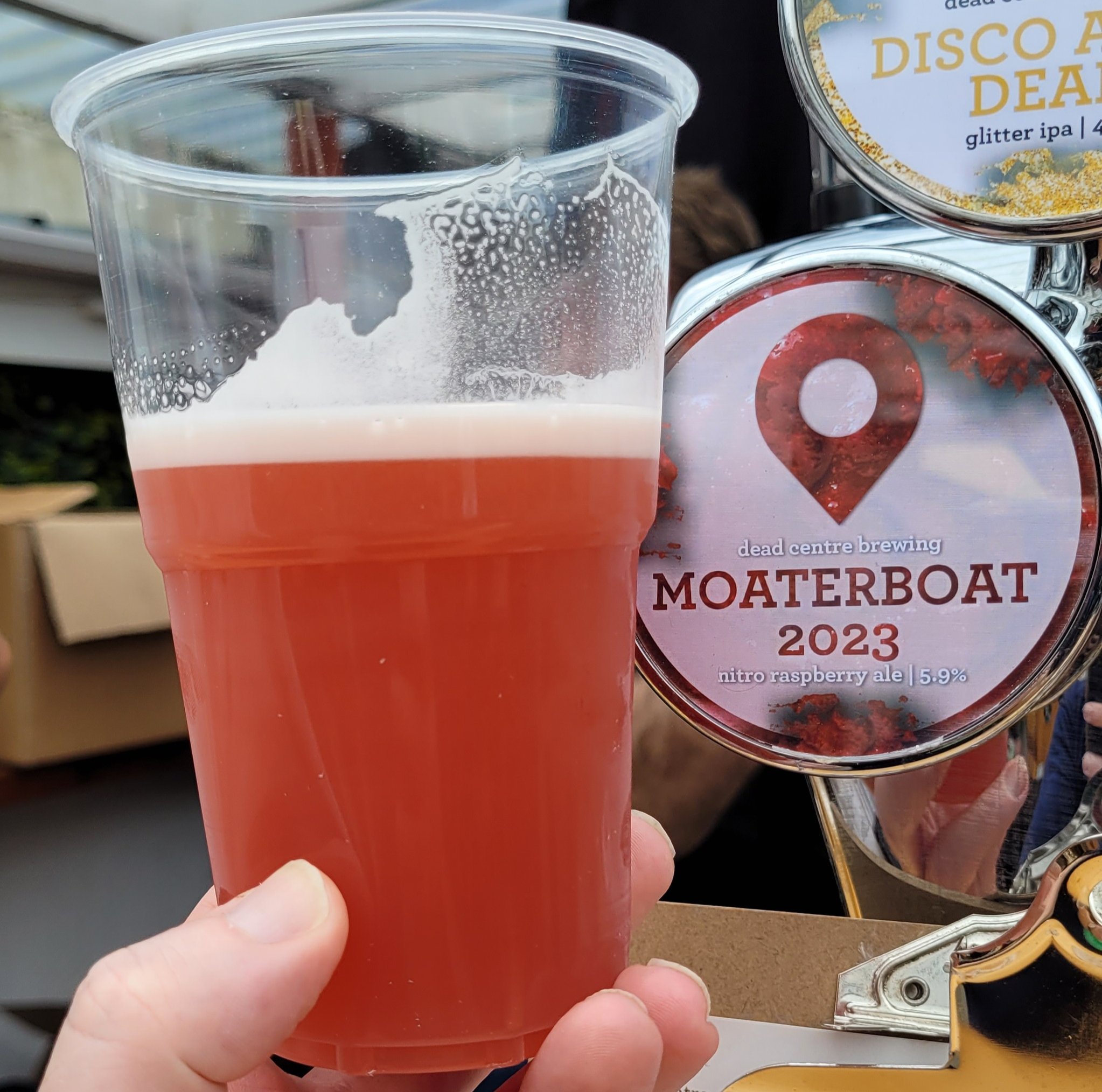
Ten companies were represented at the bars and I got round most of them in the five or so hours I was there. The beer that travelled the least distance came from Dead Centre in Athlone. They have a special which is made specifically for the event: Moaterboat. It's a bright pink, raspberry-infused ale of 5.9%, which is strong for this sort of thing. It's very casual drinking, offering simple dessertish fun in lieu of any complexity. Once I stopped looking for any, I enjoyed it. It's a bit like drinking a pavlova.

It seems that Moaterboat's persistent success has meant it spawned a variant for the 2023 event. Passionboat is lighter on its feet at 4.7% ABV, though tasted thicker and fruitier to me: I guess that's in the nature of passionfruit versus raspberries. There's a slightly metallic twang underneath, which I sometimes get from fruit concentrate in quantity. It's not too disturbing, however, and this is another simple and slightly daft beer, one which you have to appreciate on its own jocose level.

And the same can be said for Disco Ain't Dead. Dead Centre created this in 2018, at the height of the short-lived craze for glitter IPA, for it is one such. They're extremely rare in Ireland and this is the first one ever to come my way. I was excited! And then very disappointed when it completely failed to sparkle. You had one job! Since it provided no visual entertainment, I had to make do with tasting it. It's a fairly typical hazy IPA: 6% ABV and sweet, with almost ice-cream levels of vanilla, plus a burn of savoury garlic and a slight rubbery burntness in the finish. I doubt I would have picked up anything remarkable about it without knowing what it was. I will expect better from my next glitter IPA, whenever that appears.

Tagging along with Dead Centre was its client brewer The Format, dormant for several years as owner Mark tried his hand outside the beer business. Thankfully he's back now, and Loungin' was the first new Format beer since the beginning of 2020. It's a hazy session IPA given a fruitsome hop combination of Strata, El Dorado and Centennial. The vanilla was the first thing I noticed, but it's no one-note murk-bomb. There's a pinch of jaffa orange bitterness and then a surprise clove spicing late on. It's smooth and more thickly-textured than one would expect for 4.5% ABV. When he says session IPA he means it, and I would have liked to have spent some more time on this one.

The Midlands were further represented by Wide Street, down from Longford. They were pouring Cuvée Prestige from the tap, an arrangement which owner Seán regarded as sub-optimal. I never got a chance to go back and try the bottled version against it. In general, though, I wasn't overly keen. The proposition looks great: a Brett-fermented saison aged in Chardonnay barrels and with gooseberries. It definitely has a berry tartness, but I thought it went a little too far in this direction, the sour side shading into spirit vinegar territory. There's a heaviness here too; a sense of thick and sweet German white wine, which was a surprise. While this does hit lots of the correct flavour points for a mixed-fermentation saison, it's not in the upper echelons for me. One for ageing in that all-important bottle, perhaps.

Time for some more session IPA. Brehon Brewhouse brought Good Times, another 4.5%-er. It doesn't have all the bells and whistles of The Format's offering but it was still pretty good, mixing bright and fresh citric American hops with that typical New England base of smooth, sweet vanilla cream. Fun, easy-drinking, and very appropriately named; no further comment necessary.

Galway Bay are at this game as well. Their new session IPA is called The Good News, and the good news is that it, too, is 4.5% ABV. The visuals were a little off, it looking quite sickly in the glass, thin and yellow. The taste is spot on, however, thanks to what the brewery calls "a criminal amount" of Nelson Sauvin and Motueka. That gives it a delicious white grape juiciness, plus a mild dusting of coconut. This is set on a clean base, with none of the murky grittiness I thought I would get. It works as a down-the-hatch sessioner, if that's what the occasion demands. I liked savouring that classic New Zealand hop flavour, though.

The Bay had another new one for us as well, a Catharina sour, the Brazilian-style fruit beer that surprisingly few Irish breweries to date have tried their hands at. It's called Lagoma and is a collaboration with Rascals. Blood orange, guava and passionfruit give it the strong and unsubtle tropical hit which the style demands, at least initially. The fruit fades after a moment or two, and the finish is a little thin and plain. Normally these have a pulpy richness, delicious but not very beer-like. This one, while good, is more basic and approachable. It's fun in its own way, but doesn't offer much of an education in what makes Catharina sour distinctive.

Back to the IPA, and a cold one from Third Barrel, called Vulture Culture. This is 6% ABV and almost completely clear. The early hop flavours are a delightful juicy mix of stonefruit: apricot and peach in particular. A precision crispness in the texture helps accentuate this. But then it unfortunately reverts to type for cold IPA and delivers a rasp of raw white onion, one that becomes sharper and more pronounced as the beer warms. It's not ruined by any means, and this is a very decent interpretation of cold IPA. If only there were a way to expunge the onion, it could be perfect.

We finish on DOT's beers, beginning on another 6% ABV IPA. DOT has done a fair few like this, and here the distinguishing feature, which will do for a name, is Citra + Mosaic (edit: this may be the same beer they've been selling at other festivals as "Stage Left"). No haze here; it's clear and mostly quite clean. I detected a tiny rub of garlic but that's in second place behind a raft of cantaloupe and guava, the Mosaic doing exactly what's required of it. Yes, IPAs tasted of tropical fruit before anyone thought to make them hazy. Thanks to DOT for this reminder.

Dark beers were in short supply, but I get to finish on one from DOT, another of uncertain name. It's a version of the barley wine called Beastly and is a beast indeed at 17.8% ABV. The barrels in which it was subsequently aged previously held oloroso sherry and pot still whiskey. For quite some time, I'd say. This tastes mature, of old leather and marinaded beef, with more than a hint of the date and tamarind of brown sauce, and a peppercorn spicing to match. The texture and heat leave one in no doubt as to the strength. A sample on the way out the door is probably the best serving for it. I enjoyed it, but I don't think I would fancy a full measure of it.

And that's all I drank. Huge thanks, of course, to Simon for putting on a great show; to Don's Bar in Moate for hosting; and to all the brewers who brought beer. While it's quite possible that I was the last beer drinker in Dublin never to have made it along before, if there are more out there, it's well worth making a plan for next year.