Showing posts with label little fawn. Show all posts

06 July 2026

Round numbers

Another Monday, another blog post, another round-up of recent Irish pale ale. This one is the blog's 3000th entry. It's best not to think about what that means, and move right along with the reviews.

Spent bread beers were a bit of a thing a few years ago. Wicklow Wolf still has one in annual production and now Lough Gill has added one, getting their crusts from the O'Hehirs bakery chain. Oh! is a pale ale at 4.5% ABV and looks lager-like in the glass: a mostly clear yellow with lots of bubbles and a fine white head. The aroma is crisp and broadly citric but doesn't offer anything especially distinctive or noteworthy. There's a decently slick body -- almost chewy -- but while that would surely be an excellent base for launching some new-world hop fireworks, it's a bit dull on tasting. There's a slightly sweaty savoury aspect, a little bit lemon cookie with a touch of oaty flapjack. "Easy drinking" and "brewed for adventure" says the brewery. They can't have both. I found it rather dull. It's simple and clean, and has a pleasant substance which I'm guessing is the bread doing its work, but it needs a stronger hop charge. I know from other examples that this sort of beer doesn't have to be basic and compromised, so I don't know why Lough Gill has made this one so.

That was followed several weeks later by Hazy Sunshine, about the most on-the-nose name for a summer "tropical IPA". Nectaron, Wai-iti, Waimea and Mosaic are the hops, which certainly sounds like lots of potential for tropicality. The aroma offers a significant degree of fruit salad, but also a harder pith bitterness, suggesting that it won't be sunny the whole way through. It's a heavy affair, tasting denser than even 6.1% ABV might imply, and I found myself wishing I'd served it ice cold rather than the slightly higher setting of my beer fridge. The extra warmth allows a little bit of dry grit into the flavour, just beginning to edge in on the fruit effect from the hops. That bitterness I noticed in the aroma doesn't really materialise in the taste, and instead it's thick and gummy, loaded with concentrated pineapple and mango. A tarter juice and zest effect arrives in the finish, but that's as close to bitter as it gets. I would say it's harmless fun, but the alcohol heat really puts a dampener on any carefree summer vibes it may otherwise have had. This is a serious sort of sunshine. We've become unfortunately accustomed to that around here lately.

I don't get to feature Hopkins & Hopkins on here much: it's a brewery that tends to do only a few things, but does them well. One of its handful of regular outlets is Moss Lane on Pearse Street, where they're pouring a new H&H pale ale called Easy - East. It's a medium orange colour and was served pleasingly cold in the high heat of summer last week. Fresh and juicy mandarin kicks off the aroma and follows through to the flavour, where it's joined by a surprise peppercorn spice and a weighty citrus oil, like a Terry's Chocolate Orange, minus the chocolate. I was reminded in particular of the much-missed Purgatory from the somewhat-missed Franciscan Well brewery. This kind of clean and simple American-style pale ale is far from the bleeding edge of craft beer, and that makes it all the more worthwhile, especially when it's more than a lazy clone of the mainstream.

Over at The Porterhouse they had a rare new one under their own brand, brewed by The White Hag. Cruel Summer is a cold IPA, a style that seems to have gone out of fashion for no good reason. It's a light 4.6% ABV and a very pale yellow, gently hazed. And yet: the dank. It smells pungently weedy with a twist or two of coarse-ground pink peppercorn. The flavour opens on that, brightly and shockingly, but quickly calms down, introducing softer tropical juice and a more orthodox pithy American bitterness. It finishes in a clean and crisp lager fashion, meaning that despite the BIG hop taste, it would work as a session beer. I sometimes fear that I might be getting a bit bored of beer, that maybe they're all actually quite samey and not worth the effort I put in to finding new ones. This was a reminder, a stark one, that beer still has the power to impress and excite. If you're in the vicinity of The Porterhouse or Tapped this summer, do not miss.

From the around-for-ages-but-new-to-me file, Five Lamps IPA. The brand is a pox on Irish beer in general, wrapping itself in the Dublin flag while being brewed by C&C in Clonmel. But at the otherwise lovely Toner's pub, its IPA was the best of a very poor draught selection. It's a sizeable 5% ABV yet still manages to be quite thin and bland. The hops offer no more than a whisper of strawberry and an English metallic tang; and while it's malt-forward, that's not very pronounced either, being lightly caramelised with a bigger kick of dry tannin. It tastes cheap, which isn't terribly surprising since I'm led to believe the range was created to provide Dublin publicans with cheap beer, to compete with the heavily-promoted famous brands. My pint, of course, was not cheap, at €8. It's all about the margins, and this IPA is only marginally enjoyable, so that tracks.

In the same file we find another 5%-er, Rye River's Hazy Bangin' pale ale. This has allegedly been on sale in Tesco for yonks, just not any of the many Tescoes I visit on my travels around Dublin. Then Dunnes got it too and, hallelujah, I was able to buy it in the Stephen's Green Centre while picking up the still-brilliant Grafters brown ale. I don't know if the recipe has much in common with the archetypal Irish west-coast IPA, Big Bangin', of which it's a brand extension. It's certainly not in the west-coast style, what with the haze, and doesn't have the same brightness of hop. Instead there's a medium-sweet zestiness in both aroma and flavour, the former introducing a slightly sticky orange cordial note, while the taste includes some surprise coconut. It's good fun, but I wouldn't call it bangin', exactly. There's a strong caramel malt note which took me a while to place, realising eventually it's something you get from once-hoppy beer that's been sitting too long. My can was four months inside the printed best-before date so I had a reasonable expectation of freshness. I fear, however, this beer may be a delicate creature, not built for the neglect of warm supermarket shelves. As with the IPA the brewery makes for Lidl's Crafty Brewing range, I suspect one must be careful here about freshness. I will seek out a younger edition next time. This one was passable, but no more than that. Even Dunnes has better hopped-up options available. 

Brasserie Nautile visited Ireland in the spring, and included The White Hag on their itinerary, where they helped brew Salt & Stone, a West Coast IPA. This looks well, having the same pristine golden clarity as the brewery's excellent flagship, Little Fawn. It smells sharp, zesty and classically American, which is in its favour; the mere 5.6% ABV less so. I found it surprisingly soft, not bitter, its flavour more succulent stonefruit than punchy citrus. The peach and lychee subsides after a moment, leaving a sharper bite of fried onion and then, finally, a buzz of grapefruit and lime oil. It's not exactly full-on, delivering the IPA basics but nothing spectacular. That's in spite of, or possibly because of, a highly involved hop charge, featuring Columbus, Chinook, Centennial, Motueka and Simcoe. I reckon they've blurred into each other and there's nothing distinctive about the beer as a result. This is inoffensive and a bit anodyne. It certainly doesn't come across as one of those brave and wacky recipes that brewers like to devise when they get together. I enjoyed its simplicity,  but honestly I think I'd have preferred a Little Fawn from the supermarket. Sure, it's West Coast all the way, but that doesn't automatically make it a great beer.

I can't imagine what the prompt which created Curtain Twitcher's label said, nor can I believe that the horrific result was the best the AI could come up with for Third Barrel Brewing. Suffice it to say that the promise of Nelson Sauvin and Citra attracted me more than the "artwork" did. It's an IPA; hazy, though not billed as such, and quite a dense-looking shade of orange. The brewery knows how to use Nelson, and it's very prominent in the aroma: flinty sparks and squashy pineapple. A more subtle white grape and gooseberry takes over in the flavour, plus a weedy dankness and background note of fruit candy, which I'm guessing comes from the third hop, Lotus. There's lots of complexity, then, none of it especially novel, but if the basic formula works, why go changing it? Most importantly, nothing has gone wrong. Hazy it may be, but it's perfectly clean and lets the hops do all the talking. 6% ABV gives them a solid base to work from, the malt providing texture without interrupting the taste. Quality stuff, and recommended in particular to my follow enjoyers of Nelson Sauvin's mineral spice.

"A whole lot of New Zealand goodness" is the sum total of the description on DOT's Nectaron IPA. This is another kiwi-forward 6%-er, and hazy too, of course. The aroma is cool and crisp, hinting at peaches but their sharply perfumed skin rather than the sticky, juicy flesh. The flavour continues that theme, bringing a slightly jammy peach-preserve sweetness and matching it to dryer crisp pale grain. It's a heavy and viscous take on the tropical end of antipodean hopping. A bit of grass and some basil or thyme rubs up against the soft stonefruit. Overall, it's fine, but no great shakes. The hop flavour is a little muted, subdued, and not as full-on as I'd have liked it. DOT makes beers for Aldi and, for me, this one tasted more like that price bracket than the bigger number I paid for it in the independent trade. 

Grumbling further, I don't think I've ever enjoyed a beer badged as an "oat cream IPA". Corner Club by Galway Bay in collaboration with Swiss brewer Hoppy People is not specifically designated as such, but on the label the brewer boasts "we pushed oats and wheat to the max with this brew, creating the creamiest, juiciest IPA base possible," so I think I know what I'm dealing with. It certainly has the hazy custard appearance of the oat cream brigade. The aroma gives little away, but the presence of Nelson Sauvin is unmistakable, with a subtle waft of grape. On the flavour... there it is. Oat cream IPA always tastes like plasterboard: dry and rough, with an alkaline harshness. There's no juice, no cream, nothing soft, only harshness. I drank this back-to-back with Curtain Twitcher and it's amazing how a beer with similar specs as that -- 6.4% ABV here, with Citra and Riwaka accompanying the Nelson -- can result in something so different and so much less enjoyable. It's not massively offensive, but was rather bland once I got past the drywall rasp. The can art is good and the artist is named, so if you've ever drawn a correlation between that sort of thing, I don't think it works.

Galway Bay also takes us out with the strongest beer of the day: Disco Paradiso, another hazy affair, this one at 7.8% ABV. Sureshot of Manchester is the collaborating brewery, and they go to a lot of effort to explain the process that went into making it. Cold-steeped oats, whirlpool Nelson Sauvin and double dry-hopped with three further prestige varieties, one in HyperBoost® form. If this isn't silky juicy perfection then it's time to cancel the whole haze project. It's on the darker side of eggy yellow, with the greenish cast that very hoppy IPA sometimes takes on. Head formation is perfunctory and unenthusiastic. The aroma is a mix of saturated raw-hop vegetal notes and a friendlier kind of tropical buzz. There is a surprising amount of bitterness in the flavour, the Nelson in particular showing its old-world ancestry with a hard, almost waxy, grass bite. There's little room for tropical niceties underneath that, and it finishes bitter and resinous, albeit with a hint of lighter juice, lurking beneath the surface but largely overpowered and subdued. That's a pity. I appreciate that this is intended as a hop showcase, but it ends up unbalanced and rather harsh. The name and branding suggest a quirky and fun quality that's some distance from the rather serious bitter liquid.

Maybe the hot weather had me grumpy but, Porterhouse aside, there wasn't a lot to like here. If there's a theme, it's that a good dose of Nelson Sauvin can be a pale ale's saviour. Use more of that, just to be on the safe side.

16 February 2026

Fresh start

Here we go then. The new beers of 2026 start at the Rascals taproom at the beginning of February. Or rather, outside it. The bar and pizzeria in Inchicore was doing a roaring trade on bank holiday Sunday so I had to make do with a perch outside. That they're doing well in these straitened times gave me enough of a warm glow to offset the chill.

The long-running Pilot series is largely what we're about. Pilot #146: Belgian Dubbel is a little on the light side at just 6.8% ABV. It's pale too, more amber than the expected dark brown. First sip indicated that they've missed some targets here, and the gravity in particular. It's inappropriately thin, lacking malt weight and alcoholic warmth. The Belgian yeast did its job, however, delivering lots of esters, with red apple to the fore, followed by tannic raisin and sweet grape. It's a near miss. While not a bad beer, it offers so much of dubbel's fruity fun but without enough substance to make it properly enjoyable. But that's what pilot breweries are for. Hopefully somebody else noticed what went wrong and will fix it should they choose to scale up the recipe.

You wait forever for Dublin 8 to produce one pistachio stout then two come along at once. Open Gate's landed late last year, and here's Rascals with Pilot #148: Pistachio Stout. This is 6% ABV and quite light with it, plus I'm not sure there's any identifiable pistachio. Nuts, yes: there's a slightly earthy, peanut-butter effect, and a degree of hazelnut crunch, but with lots of vanilla too. Pistachio ice cream, maybe? I had hoped for a hefty, creamy stout, and this isn't that. But it's tasty. If you like your novelty beers low-key, and you should, this fits. It doesn't even need to be relegated to dessert, even if it's technically a smidge strong for session drinking.

Last up on draught was Bullseye Export, a supercharged version of the session-strength stout Rascals launched in 2024, boosting the ABV from 4% to 6.5%. Although that's only a tiny bit stronger than the previous beer, this one had the satisfying density that the other stout lacked -- and that's despite it being served carbonated rather than nitrogenated here. Its heady booze vapours added to the sense of something luxurious, and maybe a bit naughty. There's roast aplenty too, of the savoury, meaty sort. I was ready for a smack of old-world hop bitterness from the flavour, but it didn't go that way, unfortunately. In fact, it's quite sweet, giving further hazelnuts and lots of toffee and butterscotch. That turned it a bit cloying, and I think I dodged a bullet by not having nitro gloop to contend with as well. I'm sure it will have fans, but I'm not among them. It's not a bad beer and isn't offensive per se, just not how I prefer this kind of thing to be done.

Other commitments meant I didn't have time to finish with a glass of the new Mosaic IPA but I picked up a can before leaving. This is actually a 2025 release, having been around since August, apparently, but this the first time I've seen it. The Italian text on the can suggests it may be primarily for export. It was fresh, showing a packaging date of December and smelling magnificently of fresh fruit salad, which is exactly what I want when I see "MOSAIC" writ large on a can. The flavour follows logically from that, but intensifies it considerably. There's a powerfully punchy bitterness, more pith than flesh, finishing on a very west-coast rasp of pine acidity. In front of it, the pineapple and passionfruit are still there, albeit briefly. The bigness of the flavour is doubtless aided by its 6.3% ABV. It has a certain amount in common with that other Irish Mosaic showcase, Little Fawn, lacking that one's accessibility but making up for it in poke. It's clear and pale too, so is recommended to all the west coast revivalists out there. Since it seems to be in regular production, it would be nice if it were more available locally. We could do with a few more beers like this in circulation.

Is this the year my allegiances change from stout to IPA? That seems unlikely but it's still early days.

25 June 2025

Belfast bookends

Today's post is a short companion piece to Monday's run-through of the beers I drank at the Jubilate festival organised by Boundary Brewing last month.

Glider efficiency meant we were some minutes early for the gig, and fortunately the Boundary taproom across the yard from the venue was open and serving. It seemed appropriate to open my account for the day with the beer created to commemorate the event: Jubilate, brewed by Boundary in collaboration with nine festival participants from the island of Ireland. It's a pale ale of 4.5% ABV and hazy in the way that Boundary likes to make them; as do most of the other breweries involved, in fairness to them. Everyone must have brought a big sack of hops to the kettle because it is absolutely saturated in them, giving the beer a harsh and hot garlic character which I wasn't keen on. This clashes with another haze cliché: thick vanilla custard. There's a little orange juice lurking in the background, but I wouldn't classify the beer as juicy, the way the brewery does. It's bang on for the fashion, is absolutely the sort of thing that Boundary has a name for, and it will have fans for sure. For my part, I didn't think it was awful, but definitely isn't my kind of vibe. It's at least part of the reason that there weren't many IPAs in Monday's blog post: I reached my haze quota early.

We had a couple of hours between kicking out time after the early Saturday session and the train home from Belfast's shiny new Grand Central Station. It would have been rude not to drop in at The Crown while passing it, and we shared a snug with some Americans, upset that their stew arrived partially frozen. Pfft. Tourists. I had a pint of overly sweet English cask cider and an excellent one of Timothy Taylor Boltmaker, and on we went.

There was still time at the station. Time to exercise some morbid curiosity about the new BrewDog Belfast, situated on the mezzanine above the station concourse and about which I have yet to hear a good word said. It's a poky little space, all width and no depth (make your own BrewDog joke here) but it does serve White Hag's Little Fawn on draught, so can't be all bad.

Nothing so sensible for me, however. I spotted one potential tick among the BrewDog beers so opted for a pint of Wingman Tropical Storm. I quite liked the session IPA this is based on, and indeed found it to have a happy tropical flavour from the hops. Here, they've boosted the ABV to 7.2% and boosted the tropicals with mango and passionfruit extract. Or at least, they've tried to. The hop side gets utterly drowned out in a sticky confection of fake-tasting syrup. The sweetness is at that needle-bending end of the scale where it starts tasting hot and metallic. I will say the alcohol is well hidden, but it's hidden by something horrible. Still, I finished my pint and caught the train anyway. I doubt I'll be making BrewDog Belfast a regular stop on visits to the city, but I am glad that it's there and that it serves drinkable beer, something I'm increasingly glad of as the multinationals flex their muscles. Better this than somewhere pouring mass market rubbish.

The above is, of course, not representative of Belfast as a beer drinking city. (You can read some better recent experiences here, for example.) Boltmaker is already a magnificent beer, but it takes on an extra level of reverence in this sort of context.


21 March 2025

Hop and change

Today I'm catching up with my late winter beers from The White Hag, all in hop-forward styles, as is the brewery's wont.

The first is Swell, claiming to be no more than a classic American-style pale ale, but casually dropping that it's also brewed with "HyperBoost™", a science-fiction sounding name for Citra hop extract. It's not a shortcut, it's an enhancement, honest. The beer certainly looks classic: the beautiful rose-gold colour of pale ales from a more civilised age, and flawlessly clear, of course. We're back in the 21st century with the aroma, which is more juicy than bitter; suggesting soft peach and cantaloupe. In the flavour, the bitterness is quite restrained, emerging only in the late finish, alongside a slightly oily burn. Before that, things stay sunny and tropical, giving me mango, pineapple and more of that melon. In fact, it has a lot in common with the brewery's fab flagship Little Fawn, which is a surprise as it's both stronger, at 5.2% ABV, and darker too. Still, I'm absolutely not complaining -- this is lovely. Maybe lacking in the punch of good ol' APA, but with plenty of clean tropical fun to make up for it.

I expected that to be the better of this pair, because it's a red IPA next, and they rarely float my proverbial. The Fox is another clear one, which was more of a surprise than it should have been, and is a beautiful chestnut red. It doesn't smell dark, exuding lots of spicy, peppery hops, like sandalwood or incense. Even though it's a full 6.5% ABV, the flavour is more muted than I'd hoped for: still hop forward, though not in any assertive way. Red IPAs tend to be harsh and unbalanced, but this one is a little on the blander side. Resin is the primary flavour, accompanied by a mild summer fruit vibe: strawberry and raspberry. The spice in the aroma arrives late and is gritty and bitty, coating dark toasted grain crumbs. That's enjoyable, and I like how it keeps the malt's caramels in check. So, it's drinkable, and even somewhat fun, but still not entirely to my taste, turning a little astringent once the hop kick fades. Props for making a style that nobody else bothers with, however.

Finally, a shout-out to Brian who had cans of Baby Duck in his fridge when I called round to raid it a few weeks ago. Well, it was his birthday. This 4.8% ABV pale ale was brewed in collaboration with the P. Mac's pub chain, and has the first bit of haze we've seen today: a pale yellow translucency. That it's designed primarily for pub drinking is apparent from quite an understated flavour, low on bitterness and with very accessible peach and mango notes. Like the beer up top, it has a deal in common with Little Fawn, although it lacks the token hop bite of that one. There's no real follow-through in the flavour: one mouthful leads to the next and nothing builds as it goes. That approach has its place, but I would have liked a measure or two more complexity, starting with some proper bitterness. As is, it runs the risk of blandness.

It took a bit of work to be properly critical of these. The White Hag knows how to make clean and tasty hop-forward beers, and isn't shy about keeping new ones coming, it seems.

20 November 2024

Clock this

I'm used to Irish breweries having a long gestation, from the first announcement by some ballsy entrepreneur to actually being able to drink a pint they brewed can be a long stretch, and often the second part never actually happens. So I was agog at how fast things moved with Changing Times. The news that a consortium of prominent Dublin publicans had bought the old Kepak warehouse in Glasnevin and were planning to set up a brewery in it only landed last July. Since then we've seen Franciscan Well co-founder Shane Long and former Trouble and Hope brewer Mark Nixon become associated with the project, and now only four months later, there's actual beer pouring.

The consortium of owners includes The Palace pub in Temple Bar, and that's where I went on the day after the high-profile launch to try out the first two. Any excuse to visit such a fine establishment.

Daydreamer is the lager, described on the badge as "snappy". It's a very pubbable 4.2% ABV and arrived extremely cold, with a €7.60 tab -- priced on a par with other independent beers. There wasn't much to say about it at first: lots of fizz and a tiny amount of haze on the pale yellow body. Given a moment, there's a pleasant cracker crispness (snappiness? sure, why not), and a moment later brings some Germanic hopping. That adds a different sort of crispness: crunchy green vegetables. With the pint half empty and warmed a little, there's a threat of butteriness in the aroma but the flavour stays clean and dry. This has the basics of decent lager, and certainly isn't a clone of the cut-corner big brands. At the same time, however, it's no connoisseur's lager and only hints at the fun you can have with good pilsner, Helles or the like. If the mainstream lager drinkers aren't completely tied to the familiar labels, this offers an alternative of acceptable quality. I'm guessing that's what it's meant to do.

Launching alongside is the pale ale, After Hours. They've put "hazy" on the badge, but it's not really much cloudier than the lager. Sorry, hazebros: nothing for you here. It's 4.2% ABV again, which puts in a competitive space with Little Fawn, but it's nowhere near that quality. The aroma is broadly about American hops, with a certain amount of pine resin, though nothing overboard. The texture is thin, and fizz is again central, something much less acceptable in a pale ale than a lager. In the flavour, the hops make a valiant effort to be heard, but can't quite manage it sufficiently. There are token quantities of juice and dank with minimal bitterness, so it fits the hazy profile in the most basic way but, to me, comes across like an Ambush that's been run under the cold tap. It's not offensive, bad, or poorly made, but it tastes cheap and dumbed-down. This sort of beer was radical in Ireland a decade and more ago. These days, I think even mainstream pale ale drinkers will find it lacks character. I wouldn't be fully confident that it's a trade-up from fresh Hop House 13.

So... I don't really know who these beers are for. I can't see any drinkers of the big brands making the switch, when they've already turned down the pre-existing alternatives. And this goes even more for the third in the range, Clockwork stout, arriving soon. Equally, there's not much to attract the seasoned drinker of microbrewed beers. I see After Hours working as a distress purchase, but I think most of us would prefer a Little Fawn, Ambush, Scraggy Bay or Galway Hooker. It's disturbing to hear already of independent breweries' taplines being removed from pubs which are part of the brewery consortium.

A brand new brewery means lots of new potential, but I'm not seeing that realised to any great extent in the first two beers.

06 March 2024

Go fish

Lough Gill features regularly on these pages. It's a brewery which turns out a lot of product, and one which appears to have an eye on the US as its target market. As such, it tends to go big: high-strength IPAs, barrel-aged imperial stouts and smoothie-like "pastry sours" feature prominently. Today, however, it's a change of tack, with two rather more sessionable beers, both appearing on draught at UnderDog recently.

The first is Horizon, a pale ale at 4.7% ABV. It looks like the straightforward proposition it is: a mostly-clear pale amber with only the slightest cast of haze. They describe it as a "California IPA" without elaborating on what they mean by that. One might be expecting piney hops in the west coast style but it goes for gentler peach and melon instead, suggesting to me that Mosaic or its ilk have been employed. The texture is as light as the sessionable ABV suggests but comes with a heavy dose of fizz which I found slowed my drinking down. This is simple and decent stuff, and will hopefully find its way to being a permanent offering in places that don't already have the likes of Little Fawn, Ambush or Scraggy Bay on tap.

I neglected to take a photo of the other beer, which is a shame because it looked well in the Lough Gill Willibecher pint glass. Black Wave is a stout, nitrogenated and 4.2% ABV so very much made for pub drinking, and as far as I know that's the only way it's available. It performs the task well, without doing anything too unusual, for good or ill. For the most part the flavour is dry with a medium level of roast, enough to satisfy a regular drinker of such stouts without causing problems for those that are wary of it. There's a countermelody of milk chocolate which gives it a character of its own, and then a herbal echo, suggesting spearmint freshness to me. That sounds odd but it fits the rest of the profile seamlessly and is barely noticeable unless you look for it. I would say that getting a beer like this into pubs is a very hard sell and I wish the brewery luck with it.

This new turn towards more accessible beers is a welcome one, so long as it doesn't interfere with the regular production of fancy cans. Either or both of the above would be a welcome addition to the line-up in a pub seeking to give mainstream drinkers quality options from a small independent Irish brewery.

25 September 2023

Causes for celebration

It's still high summer in my notes backlog. Here's a few cans Rascals sent out over the last season.

I managed to find twenty minutes of al fresco beer drinking time and spent it with Pink Lemonade Sour. It's certainly pink, hibiscus doing what hibiscus does. It's hazy with that, and doesn't really form a head for any length of time, neither which is a surprise for this kind of beer. The aroma is that of a soft drink, promising some sort of flavoured processed sugar but being vague on the details. The body is quite light, as expected at 4% ABV, but it's not watery and it carries a decent amount of flavour complexity. It opens sweet, with the summery raspberry and cherry of hibiscus. When the sweetness fades, it becomes a crisp and refreshing job, akin to biting into a cold slice of watermelon. The bite grows into a full sour kick in the final stage, cleansing any of the initial sugar still drifting around. That's a slow-motion account of what happens, but really you can just drink this. And while it might appear to be pitched at those psychopaths who believe they don't like beer, it is very much a beer all the way through.

Celebrating 90 years of the Molloy's drinks business, The Craic Is 90 is 4.2% ABV, pale yellow and hazy, though the brewery doesn't assign it any style beyond "ale". To me, it's a very familiar American-style light pale ale, brimming with zesty lemon though never quite hitting full-throttle grapefruit. The base is thick enough to carry a decent amount of bitter acidity, and the whole thing brings a sense of high-end or homemade lemonade, perfect for relaxing sun-downers. It would theoretically work as a happy, social, party beer too, drinkable into the early hours, by people younger than me.

For the second in the brewery's IPA Outbreak series, a Session IPA of 4.4% ABV, brewed with Citra, Galaxy and Mosaic. It's almost clear too, only slightly foggy yellow in the glass. The Mosaic delivers in the aroma, making it smell deliciously melon-like -- honeydew and cantaloupe -- and very similar to the mighty Little Fawn, my session IPA archetype. The flavour continues that way, which is a bit of a one-note, but a note I like hearing. There's just enough bitterness to balance it, but nothing I would describe as Citra's doing, while the Galaxy almost seems to be asleep on the job. Where it falls down a little is the texture: while it was enjoyable for almost the whole first half, there's a wateriness which creeps in when it gets even slightly warm. It means that the lovely melons wear off faster than they should. I guess they've taken the "session" aspect seriously as it's very drinkable and leaves no aftertaste, but I think it would have benefited from the same sort of malt treatment as the previous beer.

You may need to do your own folkloric research on "Shemozzle": I can only say it's a frequently used word in southern GAA circles, though more for the innocent sort of on-pitch shoving and tugging that they do, rather than my native Ulster where conflict tends not to have cute and beer-appropriate labels applied. Anyway, this is a hazy IPA brewed in collaboration with Sudden Death when they were over for Rascals's festival back in May. It smells a bit hot, all of its 6.4% ABV and more. The savoury side of haze is very much to the fore -- onions, garlic, armpit sweat -- which is unfortunate. They seem to have gone for an accentuated bitterness but without the sharp and piney aspect of the west coast. I don't think the east coast lays any claim to the salty, vegetal bitterness on display here. It doesn't really work. Haze needs fruit, and this has none. It is at least sharp and clean, suggesting perhaps the influence of Sudden Death's German heritage. I'm not a fan, however: too much that is wrong with hazy IPA is on display here. On the slim off-chance that my opinions count for anything, there are lessons to be learned.

Light and simple: that's the way to go for summer beer. Save the sweaty haze for colder days.

07 August 2023

The Hag beckons

It's Hagstravaganza season again, with the fifth festival of the name taking place at the White Hag brewery this Saturday. To maximise my time drinking the guest beers, I made a point of going through all of the host's own new releases that I could get my paws on in advance.

"Blackcurrant-flavoured beers always taste like Ribena" was my thought going into Púca Blackcurrant, the latest in a long series of fruited mixed-fermentation sour beers from The White Hag. This one doesn't look like Ribena, however, being a pale hazy pink colour in the glass. They've included ginger with the berries, and that turns out to be the most distinctive part of the taste, complemented nicely by a serious and sharp tartness which is rare enough in "sour" fruit beers these days, so both literally and figuratively refreshing. Is there any fruit, though? A hint of berry, but it does get a bit lost with the overall tartness. Certainly there's no Ribena or anything else sugary. For me, this doesn't quite have the beatings of original lemon Púca, but it's not far off either. 

On to something rather hoppier next, with Dagda, a 4.8% ABV pale ale. It's pretty hazy, though not advertised as such; an eggy yellow colour with a fetching tall head of loose foam. I get a very modern, tropical-esque, aroma of pineapple, mango, nectarine and the like, achieved with a busy blend of Idaho 7, Citra, Cashmere and Motueka. The texture is New-England fuzzy, though light and cool, on foot of the low gravity. The flavour is softly spoken and stays on the fruit side, perhaps bittering-up the tropicals a little, to the level of peach skin, mandarin peel and candied lemon. There isn't a huge amount of either, really, and it's easy drinking. The massive demographic of Irish people who drink nothing but hazy IPAs will welcome this one which meets all their required points but in a schoolnight-compatible package.

The Answerer is apparently third in a series of fruited IPAs but I have no memory of what the previous ones were. Anyway, it's 5.8% ABV, a mostly-clear pale amber and infused with grapefruit. Well, grapefruit syrup, I suspect, because it smells very sweet and sticky, like sticky sweets. There is at least a solid poke of bitterness at the front of the flavour, one which hangs around drily on the palate, which is nice. The hopping -- Cascade, Simcoe, Mosaic and Idaho 7 -- emphasises the first two of those, adding a different kind of bitterness, all herbal and resinous, rather than anything tropical, finishing on a bite of alkaline minerals. The mouthfeel is full which helps those hop resins stay in the picture. Overall, it works rather well. The added ingredient adds something positive to the taste without lessening the extent to which it's still a proper, if slightly old-fashioned, American-style IPA. Even if it smells like a bag of Skittles.

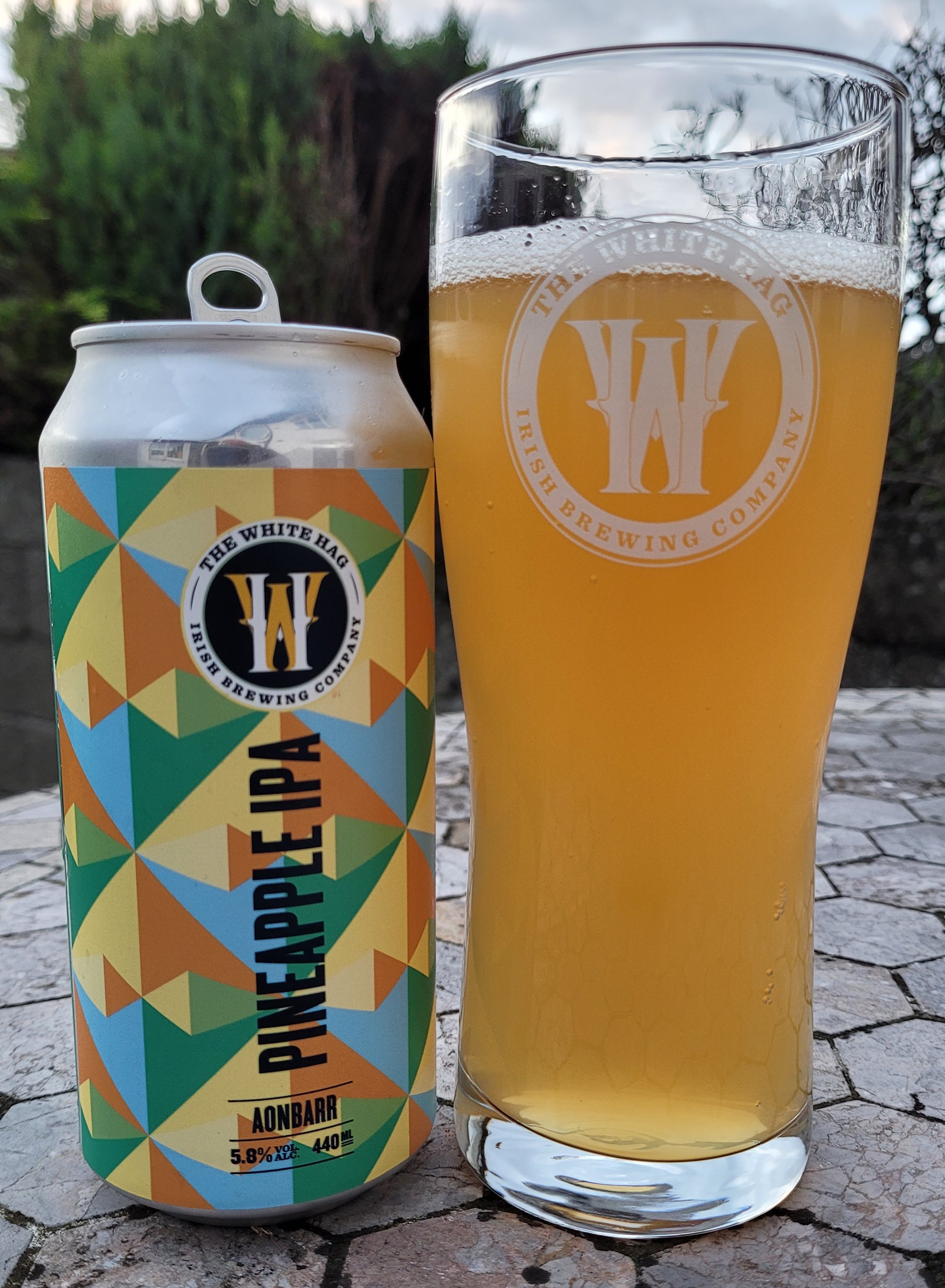
And then came number four: Aonbarr, with pineapple. While it's the same strength, it's a pale translucent yellow and very quickly loses its head, ending up looking more like a fruited sour ale than any kind of IPA. Initially it smells dry; crisp, bordering on papery. After that, again, there's a fruity side which could easily be either the hops -- just Idaho 7, El Dorado and Azacca this time -- or the tropical syrup. More Skittles, basically. There's a disturbing amount of fizz, which makes finding the flavour a bit tricky, but sure enough, there's the pineapple. Syrup being syrup, it's more like an ice pop or soluble vitamin than actual pineapple. There's a sticky, concentrated candy, element in the finish which adds nothing positive. As with the above, however, there's a decent IPA bitterness too, bringing an altogether more grown-up vibe.  It's not my kind of thing, though, and I'm not sure pineapple works as a complementary IPA flavour in the same way that grapefruit can, for obvious reasons.

Marking brews 1000 and 1001 at the nearly-nine-years-old brewery is a pair of light (7.5% ABV) double IPAs called Centennial Millennial. East Coast certainly looks and smells the part, exuding fresh mandarin juice from what appears to be a glass of orange juice. There's a fun and spicy nutmeg edge to this as well. Though the ABV is minimal for the style, it's densely bodied, and where I was expecting something as easy-drinking as orange juice, it requires a bit of pulling from the glass. Perhaps due to that density, it doesn't taste as bright as it smells. The juice turns to cordial; full of oranges but slightly claggy with it. A sweet stickiness begins proceedings, followed by a more savoury onion and garlic effect, about which there's a slightly dreggy, mucky vibe: not uncommon in beers like this, but most unwelcome. It's not awful: the aroma is great fun, and its happy fruitiness returns as the aftertaste. The middle needs cleaned up, however.

Centennial Millennial West Coast, then. It's clear and amber-coloured, so that's good, though lacking in aroma in general. I guessed this would be the sharper-hopped of the two but it was hard to get any flavour from it at all at first. Given a little time to warm, it becomes a kind of fruity-candy IPA: Skittles and Starburst, not grapefruit and pine. The bitterness level grows too, but never quite reaches what I would consider a proper west-coast grade. On the one hand it's clean and inoffensive; on the other it's a little insipid, and unworthy of being a celebration beer for a brewery milestone. A couple of years ago, any IPA in the west-coast style would have been regarded as a treat. With a steady revival in place, however, the standard is higher than this. Full nerd points for the use of the einstein "hat" tile on the labels of this pair, though.

And to finish, the traditional house beer of the festival: Hopstravaganza. The brewery seems to have invented a new style this time around, "Extra Pale IPA". What does that mean? Not much, I suspect. It's not particularly pale, being medium amber, and just a little bit hazed. 6.5% is a fairly middle-of-the-road ABV. There's a bit of promotional bumf on the can for Crosby Hops's CGX lupulin pellets, the Amarillo and Cashmere versions being used here. I can't say I can smell or taste any major difference they contribute. Still, the beer is very decent for all that, softly textured with a peachy/melony effect that I'm well used to from The White Hag, with a bonus poke of hard pithy bitterness. Not for the first time I'm comparing a new release to a beefed-up or toned-down version of Little Fawn, in this case the former. There's a fair whack of boozy heat lurking in the finish after the fruit, but the festival is for considered sipping of quality beers, so this will fit in perfectly.

Right so. See you in Ballymote. The usual drill.

09 November 2022

'80s bedspreads

They're a colourful pair, the new ones from Lineman. Always a brewery for flipping between the beer styles, these are both hop-forward but quite different.

The first is a 4.6% ABV session IPA called Group Therapy. It's pale and fairly hazy though isn't softly textured or vanilla flavoured. In fact it's rather dry, with the tell-tale pith and minerals of what I thought was Nelson Sauvin but the label tells me is an antipodean mix of Motueka, Galaxy and Topaz. Regardless, the effect is similar and delicious. Zesty citrus spritz in the aroma opens proceedings while the flavour matches its pithy bitterness with soft stonefruit. The texture is sessionably light and the finish quick, leaving only a gentle buzz of peach skin and flint. I have a preference for more of a tropical softness in my session IPA (by which I mean basically Little Fawn) but I have a lot of time for this approach too.

The ABV zips upwards next, to 8.2%, with a gasp of Oh My! It's a double IPA, and here's a bit of that New England energy, it being pillow soft and packing the juice in. Mosaic, Strata, Ekuanot and Cryo Pop are the guilty parties. As well as the pineapple and peach nectar, there's a decent kick of bitterness, though still in the pithy fruit mode, plus a bonus aniseed pop. There's very little fault to find here. It draws on the good aspects of both New England and the west coast -- soft and fruity but also properly bitter. It has me wondering why more double IPA brewers don't cram in this amount of complexity, given the scope granted by the strength.

As usual, Lineman is all about the quality here. Both beers are creative examples of their styles yet hit the essential points perfectly. As with Third Barrel on Monday, however, it must be nearly time for some more dark stuff. Just asking.

26 August 2022

Tiny maverick operator

Larkin's has done another rebrand and this time we're going with bespectacled anthropomorphic animals. OK then.

New in the line-up is a session IPA called Tiny. It's not all that tiny by these standards, an even 4% ABV. In the glass it's pale and lightly hazy, smelling pleasantly of fresh mango and mandarin. It follows that by being sweetly juicy on the palate with all the same fruits. A buzz of sherbety baking-soda minerality finishes it off. There's no real bitterness and quite an abrupt finish, but for what it is, it absolutely works. The base is as light as expected but by no means thin -- thanks again, oats. Writing that took half the glass and for the other I just enjoyed drinking it, for it is very much a drinking beer, one of unfussy good quality. Enjoy Little Fawn but would like it in bigger cans? Hello.

Despite the clarity, Tiny's label claimed it's "east coast" but the subsequent IPA in the series is definitely in the east coast style. This is Maverick, and Larkin's isn't the first Irish brewer to put a goose on the label of a beer called Maverick in a hilarious Top Gun call back. Theirs has a hat though. The beer is 5.3% ABV and properly murky. There's a decent amount of fruit in here, more citrus than tropical however, but there's also a nasty dry poppyseed savoury thing which overrides it. It's a full-bodied and warm, tasting like more than its 5.3% ABV. I perceive a very marked contrast between this and the previous one, in that it's just not as good, and I don't think that's solely because of my preferences -- the hops sing better in Tiny, and that can't be faked.

The next one is a re-brew. Operator was a Larkin's pilsner back in 2019. Now they've repurposed the name for something just called "lager", at 4.75% ABV because those louts need that second decimal place. Larkin's started out as a lager brewery so I expected this to be good, and it looks great: clear and golden and sparkling. The aroma is classically German -- bittersweet, herbal and grassy. The body is rounded and the flavour is peachy with red apple first before reverting back to the classic German attributes, all red cabbage, rocket and basil. Despite the apparent sparkle, the mouthfeel is smooth, making this another full-bodied one. As such, it exudes classy lager vibes -- a bigger character than a sub-5% strength would suggest, almost shading to the bock or Märzen zone -- but lovely smooth and flavourful drinking. If the brewery is going to go resurrecting old lager recipes I loudly request the Baltic porter next.

I wish Larkin's luck with its new look. It's striking and fun and all the things can art is supposed to be. That IPA ought to find its fanbase, it just isn't me today. The other two are much more what I'm after and I'd happily make them regulars if they stick around.

25 April 2022

Where you been?

It's almost three months since I last did a pale ale roundup, and with an even ten candidates in the backlog it's time to get a new one published. Here's what a selection of the busiest Irish brewers having been doing in this space.

The session begins, appropriately, with the latest from Kinnegar: Brewers At Play 22: Hazy Session IPA. There's a look of table beer about this one -- an anaemic yellow colour -- though it's the full 4.5% ABV so if anything on the strong side for the style. It smells sweet and chewy, channelling the fluffy candy vibes of big New England IPA, with a hint of pithy bitterness in the background. That pith, or maybe rind, is the main feature of the flavour, wasting no time in delivering a bitter happyslap to the palate. This settles after a second to a calmer meringue-pie tart sweetness with some interesting garlic and herb savoury notes. The finish brings us back to table beer with a dry and gritty rawness. There's a lot going on in this small package, and it won't be for everyone, but I think it works. They've clearly charged it heftily with an indecent amount of hops. 

Dublin airport's on-again off-again relationship with decent beer reached a new high point with the opening of Tap + Brew in Terminal 1 airside, a spacious bar where The White Hag is the principal beer supplier. Five of their beers are on tap, including an exclusive pale ale called Altitude. Though only 4.8% ABV it's quite weighty looking, a deep shade of amber. The flavour is a very straightforward mandarin-segment juiciness, finishing quickly and plainly with a carbonic bite. There are similarities with Little Fawn in the accessible fruitiness and the hops doing one thing and doing it well. Either is excellently suited as a gulp-and-go airport beer.

The O'Hara's Hop Adventure series, running since 2015, rumbles on. The latest variety getting the treatment is Talus. As usual it's 5% ABV and a pale golden in colour with a medium haze. It smells a little sickly: a hard-candy or cordial sort of sweetness. Worrying. Luckily the flavour is much cleaner, with a crisp fizz clearing away any sugar or resin excesses. The central character is delightfully pithy, the cordial calmed into more of a posh squash, tasting of real oranges and lemons. I think this shows off the hop very well, but perhaps more importantly it's wonderfully refreshing, arriving just in time for the warm weather.

Just like Hope's Summer Seasonal 2022. They've gone back to American pale ale like in 2020, except they've upped the ABV to 5.5% and cut the bitterness down to a paltry 17.6 IBUs. Behind the number there's a stated intent of making it juicy with El Dorado, Azacca and Idaho 7, with a bit of Citra because why not? The result is a darker amber than easy-going summer beer would normally be, and quite weightily textured. I didn't think it juicy as such, but it's very sweet, with dominant notes of strawberry and vanilla. It's almost cloying, though a mineral rasp in the finish offsets the sweetness a bit. Regardless, I'm not at all sure that this would be suitably refreshing on a hot day. It could substitute for an ice cream though, so there's that.

You'll Pay With Your Souls intones O Brother. No, I'll pay with my debit card: €5.25 for a 5.3% ABV Simcoe pale ale, which is a bit steep to be honest. It's a wan and hazy yellow and smells lightly lemony; pleasant, but not over-a-fiver pleasant. The flavour has some happier extra dimensions: dank resins, candied lemons, dill, rosemary and tumeric. That's a lot going on for a single-hopper. It's a bit of a time-tunnel beer, bringing me right back to when Simcoe was the cutting edge of hopping. I didn't like it then, finding it harsh and threatening. Now this old grizzled palate is much more able to deal, and it seems charming and retro. Retro really doesn't take long in the IPA world. On balance this is fun and enjoyable, and nowhere near as serious as the daft name implies.

Supermarket own-brand beers aren't known for getting the detail of higher-end styles right, but Dundalk Bay seems to have managed it with their new one for Aldi: Sailor Sam's Hazy IPA. It's the proper shade of pale custard yellow and smells of vanilla and garlic: not pleasant, but exactly what the €7-a-can mob do too. Fair play. The texture is a little thinner than the super-premium stuff, but then it is only 5.5% ABV. Flavourwise, the garlic is pervasive, laced with a slightly harsh butane note, though there's a happier tropical mango in the mix as well, plus the vanilla sweetness. All told it didn't really suit me: it's one of those beers that has everything I don't like about hazy IPA. But I respect the hustle, and somebody out there will appreciate it.

Next, as I hope will become a tradition for these posts, there's a black IPA. Lineman claims that Nagelbett is a "cold" BIPA, jumping on board the cold IPA bandwagon, although it's not actually cold fermented. Shenanigans! The description/confession is on the brewery website here. Photographing it in direct sunlight I discovered that it's more a dark brown than actual black. The tarry roast of good black IPA is present in the aroma, though I also get a definite sense of the dry burnt toast found in schwarzbier, so maybe the "cold" description isn't pure fakery after all. Against that, the texture is rich and creamy -- definitely more ale than lager -- while the flavour is subtle. Bitter dark chocolate smooshes into boiled veg. I waited for the fun peppery spice that normally arrives next, but it's missing, and with it goes one of the joys of black IPA. The finish is clean and quite quick, being another point where the "cold" epithet is earned, but this isn't black IPA as I like it. I'm especially concerned at how it's a substantial 6.4% ABV but doesn't have the depth, warmth or complexity that should come with it. It's fine, and new black IPA is always welcome. This one does get the basics right. However, the novelty factor that the brewery has aimed for didn't really pay off, I reckon.

Stronger still is Krush Groove, an IPA from Rascals, collaboratively brewed with Yeastie Boys. It's an IPA at 7% ABV, promising both New Zealand hops and tropical and citrus flavours. In the glass it's a medium hazy orange colour and smells of sweet cordial with an edge of harder diesel fumes, suggesting Nelson Sauvin is in the house. Both of those are present in the flavour, but on top of them is a hard bitterness, pithy and grassy, making it a clean-edged and uncompromising IPA. The words "west coast" spring to mind, but naww, this shouldn't be reduced to a sub-genre; this is what IPA once was, in its entirety, back when terminology mattered (2011). There's enough fruit fun on offer for this one to stay entertaining, but there's an old-fashioned roughness too, which doesn't pull punches and doesn't care if you enjoy it or not. I did.

"Oat cream IPA" continues to insist it's a thing, and the latest is Lough Gill's I'll Be Late, a powerful iteration at 7.2% ABV. It's pale for all that; an innocent sunny yellow emulsion. Citra, Galaxy and Idaho 7 are the hops, and I think it's the Fanta sweetness of Galaxy that I get most of in the aroma. Sweetness is a built-in feature, of course, and the lactose gives the flavour a definite milkshake stickiness without actually bulking out the body. The hop bitterness -- Citra in force -- clashes with this, the resins bringing an unwelcome second stickiness. I don't get it. The hopping here belongs in a clean and bright IPA and gains nothing from being rendered creamy. I'm all for innovation, but this has been tried before and it's not an improvement on the basics of IPA. Clean it up. Thank you.

We climb aboard the DIPA train, finally, with a new one from Third Barrel: And Dance The Blues. It's a mucky looking one, an unattractive earwax beige, with bonus points for a soupy unevenness of colour. The aroma is cleaner, though, with a strong and uncompromising vegetal, savoury bang of hops, all cabbage and pepper. You get more of that on tasting, in with some gritty, earthy murk notes. Yes: it's one of those, aimed at the more masochistic sort of haze purist. On the plus side, it conceals its 8% ABV well, so there's no nasty burn, a considerable compensation. Overall it's not my sort of thing though just like with Sailor Sam's above, I'm sure it will have fans, all of whom have tasted this sort of thing before and know what they like.

The rate at which new IPAs are being turned out by Irish brewers may indeed be slowing, but there's still plenty of choice on offer.