22 October 2018

Et bonjour!

I spent the first two weeks of September this year travelling through Quebec and Ontario, overnighting in Montréal, Ottawa and Toronto, and getting a bit of a sense of the beer situation there, in both the on and off trade. The next two weeks on this blog will be concerned with those surface scratchings.

Bar number one of the trip (excluding Dublin airport) was Station Ho.st, a slightly rustic-feeling pub to the north of Montréal city centre. This is the urban outlet of the Hopfenstark brewery and we stuck to their offerings.

Station 55 is where I started, the house saison. This arrived clean and clear looking, 6.5% ABV and a bright golden shade. There's a remarkable amount of citrus in it: a sharp Jif Lemon bitterness, and this is followed by a dry and waxy tartness, almost like one would find in a lambic. It's all very bold and invigorating, with only a small yeast bite at the end spoiling the party somewhat. Definitely an interesting sideways take on this very flexible style.

Next to it is Ostalgia Rousse, broadly an Altbier though perhaps a little pale for that. 5% ABV checks out, as does the biscuit and celery aroma. The flavour adds some chocolate into this mix but also retains and builds upon the hop bitterness. Like a true Alt it's balanced and full-flavoured though lacks their easy-going smoothness, pitching for that vegetal noble hop punch instead. It's fine though.

Herself followed that with its sibling Ostalgia Blonde, a Kölsch, of course. A tougher style to do well and they've definitely fluffed it here. It's very sweet, all candy and perfume right from the aroma. At the base of the flavour there's the husky dry grain of many a wonky Kölsch, and then that weird perfume thing sits atop it. They got the look and the texture right: it's clear and golden, soft and crisp; but everything else is wide of the mark.

It was sheer morbid curiosity that tempted me to try their cask bitter, Hooligan. This took an age to pour as it foamed furiously from the handpump, presumably via a totally unnecessary sparkler. I got the first of many, many short pours in Canada: foam is charged at the full liquid rate. Beneath that, it's a muddy brown-amber colour and rather warm. There's a high level of astringency, coupled with a wax bitterness similar to that found in the saison. I'd place this inside the bounds of the style but it's not a great example. Still, at least it wasn't infected or gone off, and represented an improvement on my last experience of North American cask.

Returning to Hopfenstark's Germanic efforts, the next one is a gose, called Pop Gose the World. This had a couple of good points, the main one being a gunpowder spicing as part of its tartness, and also a strong savoury herbal component which I'm guessing means a generous helping of coriander, something too-often left out of modern gose. Unfortunately, more prominent than any of these, was a stale and sweaty flavour likely produced by the salt in conjunction with raw-tasting grains. This hits the palate on the first sip and also forms the finish, undoing the good work of the subtler middle flavours.

The inevitable IPA is called Postcolonial. I wasn't keen on the appearance: a dark amber colour, and the toffee aroma with bathroom-cabinet overtones seemed to confirm that this wasn't going to be a bright and breezy hop experience. The flavour headed off in a different direction, however, and rather an enjoyable one. I got a fruity mix of ripe cherry and raspberry set on a base of spicy cedar and refreshing black tea. It's more like a bitter or, with 6.5% ABV, an English strong ale, and very decent. Possibly a touch soporific too as the energy reserves drained away at this point and we decided to turn in.

Luckily I had the foresight to stash a few cans from the local supermarket in the apartment fridge. It wasn't a great selection, the most promising part being a range of St-Ambroise beers by regional brewer McAuslan, covering a variety of styles. I got one of each and worked through them over the following days.

The first one I opened was St-Ambroise Oatmeal Stout. It's 5% ABV and poured a dense, dark black from the can, topped with a rich yellow foam. It smells sweet, of chocolate breakfast cereal and Nutella. The flavour mixes that Nutella vibe with a harsher, clangy metallic bitterness plus a touch of smoke for good measure. This throws all the stout flavours at the wall, resulting in an uncoordinated jangling assemblage, but it sort of works. None of the elements dominate, lending it all the excitement of a new-worlder (Cascade is in the hop mix), with the poise of an old fashioned full-on stout. Nicely done.

I wasn't expecting much of the next one: St-Ambroise Rousse, a red ale also at 5% ABV. It's fine, though, if not very exciting. A pale amber colour, it smells of toffee with a lick of boiled green veg. There's a metallic mineral foretaste and a slightly acrid bitter finish, the middle filled with that saccharine-sweet caramelised sugar. It's light enough to not get cloying, and I enjoyed the complexity. It certainly manages to hold the attention better than most red ales.

We bring the hops out to play with St-Ambroise Session IPA. The ABV drops down to 4.5% and it's a pale white-gold colour. It has a spicy and floral bitterness, showing jasmine up front, coupled with a bite of chalky lime. A seam of juicy fruit runs through this: cantaloupe and nectarine. All of it works quite well together. It's not as spritzy as these often are, offering an uncompromising bitter smack, but it's lively, invigorating and a treat for the senses.

St-Ambroise IPA looks every inch the North American IPA, being 6.2% ABV and a deep shade of orange. There's a classically Cascadian dry lemon-and-lime aroma, while the flavour is dry to the point of astringency. It begins on a powerfully grassy or leafy tang, followed by a rich oily resinous quality, both of which suggest a long and generous dry-hopping process. There's just about enough malt to balance it, and strangely that's what forms the finish: dark sticky toffee. While this big-hop, big-malt double act can be a little jarring at times, it's a full flavoured and assertive beer offering no half measures. Relax and let it do its thing.

Last of the set, as though it weren't already obvious, is St-Ambroise Double IPA. It's another clear orange job, and there's a lot of sticky alcohol heat. The hopping may have been raised a little but is still on the same bitter grassy lines as the IPA; the malt, however, has been boosted far beyond what's necessary, giving us warm toffee and mushy banana. At 8% ABV it's not even that strong. The clean bitterness of the previous beer has been stripped away and the resulting booze bomb is tough drinking: a double IPA brewed by someone who doesn't like the style and wants to punìsh those who do.

These are solid beers in traditional styles, for the most part, and only lose their way when they try and pull fancy tricks. There's more from McAuslan to come in a later post, but it's back to the pubs of Montréal next.

19 October 2018

Simply not cricket

We the drinking public were saved the horror of a year without the Irish Craft Beer Festival via the good offices of the Leinster Cricket Club in Rathmines. The event which had been hosted in the lavish surrounds of the RDS since 2011 was scaled back and placed in a big top tent on the lawn. The last-minute arrangements meant that the selection of beers and breweries to choose from was... let's say manageable. There was still a great atmosphere and a proper buzz about the gig.

My first port of call was to Rye River who were launching beer four in this year's limited edition series, a spruce-tip saison with the questionable title of Just the Tipple. You'll have to excuse the darkroom effect of photographing beer in a red tent on a sunny day. My first impression of this harkened back to the previous one in the series, the orange lager, because this too is hella orangey, in a cool, smooth and refreshing sort of way. The spruce arrives late, leaving a spiky pine residue in the finish. It's not the most complex saison ever, and is a little overclocked at 6.5% ABV, but it's enjoyable nonetheless.

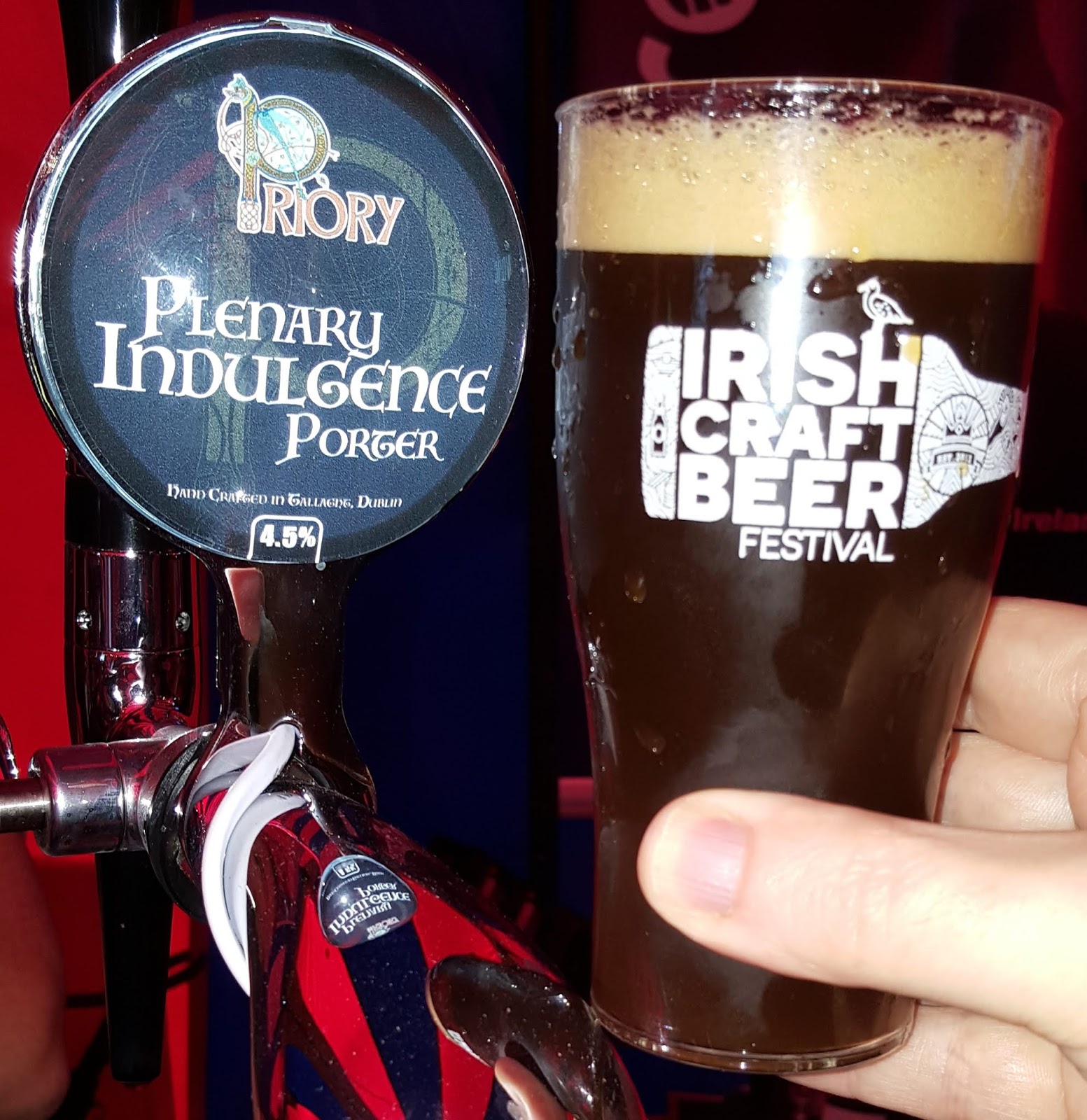
Local outfit Priory had brought along their fourth ever release, and the first that isn't an IPA. Plenary Indulgence is a porter of 4.5% ABV. There's generous dose of brown malt in here, along with the black and chocolate varieties, and that lends it a wonderful richness, beginning with an alluring coffee aroma, which extends into mocha and cappuccino in the taste. A crisp burnt-toast blackness finishes it on a dry note, balancing the sweetness nicely. As presented it was a little undercarbonated, being perhaps not quite ready for sale, but it'll have matured by the time you read this and is well worth checking out.

It was also beer number four for Bridewell Brewery, all the way over from Clifden. This is their Kölsch-style, and I was confused as to why they've done a second top-fermented yellow beer when their flagship is a top-fermented yellow beer. A helpful side-by-side cleared that up: Bridewell Blonde is in an English style with some Belgian trimmings, rich with honey and flowers. The new one is dry and crisp with some wholesome autumnal red apple and caramel. It's perhaps a little warm and fruity for true fidelity to the Kölsch profile, though the basics are definitely there.

O'Hara's was centre stage, of course, and new from them is 51st State Session IPA, a 4% ABV version of their 51st State New-England-ish IPA at 6%. If the original is quite distant from NEIPA (it is), this is even further out of sight. It's dry with a sharp bitter snap and a dank oiliness. I was reminded a lot of the standard O'Hara's IPA: that strong, almost harsh, hop kick. This one certainly packs in a lot for the modest strength.

Another vintage Irish microbrewery and another new IPA. Yippy is set to be the replacement for Hop Head after ten years of loyal service. It, too, is 5% ABV and it's very dry. There's a saliva-stripping chalk effect and a green asparagus savoury quality. I found it all a bit too severe and unbalanced. I will miss the richness of amber Hop Head when it goes.

That leaves just the token foreigners. Brewdog had a full bar at the event and went all out for stout. I began with their Small Batch Maple, a 7.5%-er. "Sweet" barely begins to describe it. The maple flavour is extremely real and extremely prominent, given an extra sugary caramelised edge. After the initial glucose explosion there's a richer toffee and brown banana sweetness, and a smoky complexity creeps in as it warms. It's not a subtle beer by any means but I enjoyed it.

Keeping it pastry but scaling up the alcohol, there's Mallow Mafia at 12% ABV. The nerve-jangling sugar is here joined by nerve-jangling coffee notes: concentrated ristretto at first, turning to warming and wintery Drambuie in the finish. The coffee also brings a strong enough roasted bitterness to hold the sticky sweetness in check. The marshmallow is present but not prominent, which is probably for the best. This imperial stout is all over the place like a clown car and it certainly entertained me.

The Carlow Brewing bar included offerings from the company's subsidiaries and imported ranges. My last one was Wild Beer's Funky Dory. This is a Brett-fermented pale ale, 5% ABV and pouring a bright gold colour with an aroma of white grape, turning to purest Champagne on tasting -- the same mix of luscious fruit and clean crisp toastiness. A peach and pineapple tang slips in behind this adding a wonderful complexity. It's perhaps a little thin, with the flavours crammed together instead of roaming free on the palate. I loved it, though: it's a beautiful example of what Brettanomyces can bring to a beer.

Naturally there was an Urban Brewing tap on the Carlow bar too but I didn't partake, having just been to the brewpub quite recently. Before this week of Irish beer posts ends, I'll lever those beers in here.

The name of Pilsner Vol. II implies that they've made one previously, though I must have missed it. This one is 4.7% and a perfectly clear shade of gold with a fine white mousse on top. A vinegar aroma set alarm bells ringing, however, and this proved an accurate warning. The main taste is the clean and sharp tang of white spirit vinegar. Around this there's a smooth and creamy texture and flavours of crusty bread and celery, all of which are hallmarks of truly great pils. That vinegar, though. Let's drop that from Vol. III please.

All the lagers come at once, it seems, and pouring alongside was Urban Brewing Oktoberfest. The deep orange colour had me expecting one of those horrible syrupy American versions of the style but it's actually pleasingly subtle, bringing light golden syrup, white pepper and crisp burnt caramel set on a perfectly autumnal chewy and warming body. There is a slightly nasty marker-pen phenol note in the very finish, but the good sides do more than enough to outweigh it, and the end result is as moreish as the style is meant to be. While not quite up there with the mighty Eight Degrees Märzen of 2012, it's not far off either.

Finally, it looks as though the big sack of lemon verbena that Urban acquired for its summer IPA is still not empty. The herb got another outing in a Lemon Verbena & Sage Saison. This is a murky yellow colour and a sizeable 6.4% ABV. A dry straw flavour forms the base, built upon by green oily sage and a floral meadow perfume with a green peppercorn spice in the finish. It's a fun combination, and while it may come across as a little medicinal, it's in the wholesome olde-worlde home-remedy sort of way. This is exactly how I like my saisons: bring that pepper every time.

And now it's back to building up a new backlog of Irish beer tasting notes. I'll post them once I've processed the beers I found on my summer holidays, coming up next.

18 October 2018

Not the Belgian Guinness you know

L-R: Wit, Saison, Dubbel, Tripel, Lambic & Stout
Well this was a surprise. Though maybe it shouldn't have been. Both Diageo and John Martin have been throwing shapes in the new and evolving world of beer that's grown up in the last decade or so, clinging to their respective inherited legacies while recognising that there's a new market of curious drinkers to be tapped. They were part of the furniture in European beer when they got together to create Guinness Special Export Stout, and I can't help wondering if the Martin people were a bit miffed when Diageo went solo with their own version of it -- Guinness Antwerpen -- a few years ago. All seems to have been forgiven as their second collaboration landed with much fanfare in mid-September.

It's a bit of a cheaty collaboration, though, being a blend rather than a de novo recipe. Diageo contributed their West Indies Porter while Martin, knowing where their geek cred rests, added their Timmerman's Oude Kriek to the mix. And a dash of Special Export was included too. The marketing whizzkids earned their fee by granting the finished product the name Lambic & Stout.

To celebrate, the Open Gate Brewery, where no part of the finished beer was produced, held a celebration of Belgian-style beers, most of which they had actually brewed themselves. I popped in to see how that went. The headline act, in its elegant long-stem glass, is 6% ABV and a red-amber colour, suggesting they haven't skimped on the lambic portion. Much like the more famous lambic/stout blend, Tilquin and Rulles's Stout Rullquin, it tastes exactly the sum of its parts, the elements separately discernible but not really melding together. You get cherry first, then stout, and then a mildly sour finish, adding up to a pleasant black forest gateau effect, but I'd still much rather drink the component parts, all of which are very decent beers, separately.

For their part, the Open Gate brewers had come up with six takes on Belgian styles, and I began with Open Gate Witbier. This was 4.5% ABV and gently lemony, but that's as far as the trueness to style went. It was also heavy with esters and thick of texture, lacking any of the refreshing zing that makes the style worthwhile. A solemn chewy biscuit character was no substitute for proper wit softness and spritz.

Open Gate Saison proved lightly sour at first, which was odd, but then piled in the white pepper and cedar wood spice, which is exactly how I like my saisons. There's a floral lavender side as well, bringing a touch of granny's bathroom to the whole thing, but it enhances rather than distracts from the main flavours. Again the texture is a bit thicker than expected, so while I'd say this doesn't taste like any recognisable Belgian saison, it's very nice indeed.

Beer three was Open Gate Dubbel, and again the style spec must have fallen down the back of the mash tun. It's only 6.5% ABV for a start, dark garnet rather than brown, and lacking any Belgian ester characteristics. Without them, the mix of chocolate, raisin and caramel makes it taste like a ruby porter, a particularly thin one with a burnt roast finish and some old-world bitterness. I enjoyed it on those terms, becoming less bothered about style specs as I went along.

Of course there couldn't be a dubbel without Open Gate Tripel, and at least the ABV was to-style at 8.3%. It's an amber colour and tastes pleasantly of honey and pepper, with a lovely warming buzz from the heat. If anything it's too clean, however, resulting in an unBelgian lack of depth: the initial pop from the flavours fades to nothing too quickly for something that ought to be a sipper. I found myself drinking it far too fast, though maybe that's a compliment.

L-R: Blonde, IPA
While everything so far had at least some redeeming features, I can't say much about the vapid Open Gate Belgian Blonde. It's lager-like in appearance but has no aroma to speak of and only an echo of honeydew melon and granola in the flavour. The watery finish is unforgivable at 6% ABV. It's unflawed but but boring, and set me wondering if there's a common thread here of beers fermented at too low a temperature.

If so, there was at least a style that suited this: Open Gate Belgian IPA. This began with a zingy hit of orange sherbet, lemon pith and floral violet. There's a spicy Belgian yeast character which threatens to turn it harsh but the clean hop notes manage to keep pace with it, and the resulting harmony of hop and yeast elements is exactly what makes Belgian IPA so enjoyable when done well. The end result is complex and quenching, sippable or quaffable depending on one's mood. Watch out for that 6% ABV, though.

It was fascinating to watch a brewery attempt to create a sequence of beers outside their normal comfort zone, and the results were interesting if not all great. These were a reminder, I guess, that this is still very much the experimental brewery for Diageo. A certain lack of polish is to be expected.

Thanks as always to Padraig and the Open Gate crew for their hospitality.

17 October 2018

Lidl goes shopping

Lidl unleashed a plethora of independent Irish beer in an autumn windfall of generosity last month. I picked up the ones I hadn't tried before, of course, including relative newcomer 59 South Pale Ale. It's brewed in Dublin at Select Batch but claims a pretend brewery at the foot of Mount Leinster in Co. Carlow on the label. It's a middling copper colour and a middling 4.8% ABV. A solid west coast bitterness opens the flavour: sharp pine and grapefruit; not exactly fresh and zingy but with plenty of punch. The aroma combines this with balancing toffee, but that dark malt doesn't get a look-in in the flavour, which is (pleasingly) all hop. The initial pine fades to wax then tails off, leaving a dank residue. Maybe it's the Carlow connection, but I'm reminded a lot of O'Hara's IPA here: it has the same sort of combination of heavy body and uncompromising acidity. I liked this solid pale ale much more than I thought I would and am all ears for the next 59 South release.

12 Acres had two new ones in the line-up. I began with Shepherd's Warning, a red-labelled (oh I get it now) IPA of 5% ABV. And there's a distinctly reddish tint to the beer too. The aroma is a wholesome mix of lemon and tannin like, well, lemon tea. I have a lot of time for a beer that smells refreshing. The flavour is blander, and sliding much more into red ale territory than IPA. I got a jammy kick of strawberry and some harsher green cabbage notes. After this it finishes quickly, abruptly so for a beer of its strength, leaving an odd wisp of caramel smoke in its wake. While perfectly drinkable it lacks character and is certainly putting on airs by calling itself an IPA. More hops please.

The other was Lazy Meadow, a lager I opened a few days later. It's a dark gold colour with a fun lemon spritz aroma. Lemon tea is again a feature, this time in the flavour, leaving it nicely thirst-quenching if a little flat. Though a mere 4% ABV, it has quite a big and chewy texture, and could easily pass as a pale ale more than a lager, which is a bit of a shame. It is clean and lacking in flaws, however, which can't be said of every budget Irish supermarket lager. I didn't take too long over it, and I don't think it's designed to be savoured anyway, but I enjoyed the time I spent with it.

It was great to see a nordie brewery represented at Lidl too. There were three releases from Hillstown, and my first to try was Douglas Top, another lager. Though only 4.1% ABV it's a rich dark golden hue and the aroma gets full marks: a classic pilsner mix of crisp green veg and soft sweet biscuit. Both of these elements get turned to an extreme in the flavour, in a way that wasn't to my taste. The hops are tinny and tangy; the malt musty and stale-tasting. I've certainly had real German lager that has tasted like this so I think the fault is entirely mine here, though the beer is a little flatter than it should be, technically speaking. Otherwise it's a cautious thumbs up, unless you have the same weird aversion to intensely German lagers that I do.

Long Mountain was an altogether smoother affair, being a wheat beer in a broadly weissbier style, though with a dab of witbier lemon in it too. The low carbonation works better here, giving it a full and silky texture for ease of drinking. In place of banana there's a gentler lychee fruit sweetness, and a piquancy that may be the yeast, or is possibly down to the surprise inclusion of rye, according to the label. The more subtle fruit and spice does fight a little with a level of alcoholic warmth which suggests more than the 5.3% ABV, so this isn't one of your light and refreshing weissbiers. It's not one for hammering through anyway.

The trilogy is completed by Mid Hill, an IPA, though a modest one at 4.5% ABV. It looked unattractive while pouring, as flat and pale as a half-litre of white wine. It is a little bit darker in the glass, with a skim of white foam which doesn't last long. The aroma offers fun mandarin and candy, followed by a harder metallic edge. Oddly, my first flavour impression is of chocolate, coupled with oily oranges, like a Terry's confection, or the orange creme sweets that tend to be the last ones left in the tin. And then there's that bitterness: a harsh buzz of green cabbage and zinc, rising late and forming a long and insistent finish. Coupled with further thinness and flatness, the flavour did not endear me to this beer. It's nearly a decent, vaguely American-style, pale ale, but it misses the mark on texture and fresh hop taste.

No stand-out bargains here, but a couple of decent and unfussy efforts. It seems kind of strange that Lidl's core beer range is of generally better quality than this handful of specials, though that's not a complaint.

16 October 2018

Labour of love

There was a rare opportunity to sample Land and Labour beers in Dublin at the Black Sheep last month. I missed it, but was along to scoop up the dregs a few days later.

First out, Assemblage, a wine-aged mixed fermentation ale of 5.4% ABV. The aroma squeals quality, offering up gently sappy oak with a hint of grape and a pinch of saltpetre. It was sweeter than expected, reminding me a little of faro: somewhere between that sweetened style and plain young lambic. The gentle sparkle certainly gives it the air of something you'd find on cask in the better class of Brussels boozer. The spicy sourness bursts on the palate with each mouthful, then fades quickly leaving an air of white wine. This is beautifully balanced, very drinkable, and difficult to believe it comes from an industrial estate in Ballybrit.

Seedling is next, a paler and brighter number the colour of burnished gold. There's a wine aroma here too, but sharper and flintier. The sourness is more intense on tasting, almost curdling, and it doesn't resemble any other soured saison I've encountered. The turned-milk effect lasts a bit too long in the finish, after the lemonade and Shloer aspects have faded out. Knowing nothing about how production of these sorts of beers works I have no constructive criticism to offer, only that I'd like more spice and more wood. Maybe longer than 18 months or barrel ageing is what I'm looking for, though 18 months sounds like it should be plenty.

Completing the set is DeNovo, a Brett IPA at 6.6% ABV. It's another fairly pale one, the lack of head making getting an impression of the aroma difficult, the eventual result being pineapple juice and lemon sherbet. The flavour, though, is a lovely mix of serious slurry-pit funk and bright candy-store tropical fruits: mango, pineapple again, and lychee, deriving from the Amarillo and Simcoe hops. It's quite a contrast, and takes a bit of getting used to. In between these two elements there's a resinous frankincense and cedar wood flavour. While it's certainly the boldest of the three, the texture is a little thin and the finish quicker than I'd like for an IPA, funked up or otherwise.

I think the mix of flavours found in Assemblage is more to my taste, but all three are genuinely world class, and you can taste the absence of shortcuts. That said, at €7.40 a glass, you would want to.

15 October 2018

Autumn leaves

Just time for a quick catch-up on some Irish beers from recent months, before the list grows too long again.

A snook is cocked at IPA fashion by the new one from Galway Bay, Clear Intentions. That said, they've gone all out for tropicality with the Opal Fruit power combo of Azacca, El Dorado and Mosaic. It's a mostly clear lager-yellow colour topped by a handsome and lasting pillow of white foam. Before getting to the candy you have to punch through a citrus bitterness that playfully punches back: lime chews and lemon cordial. Under that it's gooey and fruity, the 6.4% ABV combining with the slightly-too-warm temperature I served it at to lend it a heavy softness. When the Opal Fruits fade there's a darker liquorice bittering on the end, providing a longer, more serious, finish. A spring onion note creeps in as it warms further. This isn't in any way retro, tasting perfectly modern, just not of diesel and custard. It's a cuddly and cosy IPA, one whose bitterness you can happily settle into.

In addition to a new beer, Galway Bay also has a new bar: the pizza-centric Paddle & Peel on the former site of Beerhouse at the north end of Capel Street. They've done an extensive refurbishment but kept a very decent selection of their own and guest beers. I opted for the new one from Trouble, a take on the low-strength IPA craze that's been sweeping across Irish breweries in recent months, a 2.5%-er called Backstop. This presents a frankly shocking quantity of mango to the drinker, in both flavour and aroma. It's incredibly juicy, at least to begin with, before bringing peppery spices and a burst of citrus zest: all the good IPA features, basically, with next to no compromise. Yes it finishes a little quickly but the texture is not unduly thin. Great work by Trouble, and I'd happily see this replace their Graffiti here and there.

The first fruits of Eight Degrees's acquisition of Pernod Ricard came when the brewers raided the Jameson barrel store and came away with some casks to age a stout in. Phat Phantom is the result. I'm not sure I've ever had a barrel-aged stout at just 5.5% ABV: they're usually a fair bit stronger. I got a lot of crackling fizz when pouring, and detected a medium-strong sourness, suggesting that this one may have been still quite biochemically active, despite being only a few weeks in the bottle. The tang is pronounced enough to lend it a Flanders red vibe, and strip away the rich whiskey and chocolate warmth I was expecting. The oak is definitely present, in a slightly harsh and sappy way, and there's a dark plum and tamarind fruit flavour just peeking out from beneath it. But then the balsamic twang returns and insists on being centre of attention once more. I don't know if this is what the brewery intended it to be but it's most emphatically not the "Christmas pudding magic" promised on the label, and I hope the beer drinker won't end up suffering under Pernod Ricard's rush for Caskmates whiskey fodder.

Of a much better calibre was the same brewery's Hopsfume Brett IPA which I caught up with on a rare visit to the Bull & Castle. This is a bruising 8.3% ABV and a medium orange shade of murk. There's an exotic aroma of cedar and pineapple to draw you in, the first taste presenting a dry and musky perfume, turning to farmyard funk in the middle, with a pithy and waxy bitter finish. The alcohol, indiscernible at first, becomes more apparent as it warms, adding a Belgian note of boiled-sweet sugar, tilting the dial away from IPA towards tripel. This is a balanced and classy number, making great use of its assorted components to create a harmonious combination of flavours.

It was always going to be a tough act to follow, and the job fell to Third Circle's Neon Wilderness, another Brett IPA*, this time at just 5.6% ABV. Where's the funk? It appeared headless and dreggy, tasting of a chalky dryness with a vague lemon finish, but sorely lacking in character. I had a similar criticism for Third Circle's last outing with Brettanomyces, the Blue Sky saison back in spring. Whatever their wild yeast strategy currently is, it could do with a serious overhaul.

That was part of a trilogy of simultaneous releases from the Third Barrel collective. Stone Barrel's contribution was Mojo, a straight-up IPA at 6.1% ABV. This goes for an extreme oily bitterness straight out of the gate, though it all fades away quickly, leaving no hop afterburn. The more subtle notes are there: peach, lime and grapefruit, though also a yeasty burr that does no favours for the overall picture. It's OK and not fatally flawed, but Irish brewers are making much better hazy IPAs these days and this one doesn't measure up. Maybe it just needs time to clear.

As almost always seems to be the case, a beer released under the Third Barrel label trumps the others. No Sass! is badged as a session New England IPA. It's a hazy orange colour and tastes pithy and dank, lacking the soft vanilla and stone fruit one might expect from the designated style, but I really don't miss them. This is only 4.1% ABV and suffers a little from both thinness and yeast bite but the citrus zest and harder bitter finish compensates adequately for that, leaving you with a very decent and drinkable American-style pale ale.

Back at the Bull & Castle, I also caught up with a relatively new IPA from YellowBelly, a collaboration with Dutch brewer Big Belly and called Belly Dance. No ordinary IPA, this has been formulated to mimic the flavour of a pisco sour, via the addition of lime and grapes. It does it quite well too, having a strange sort of salty sourness and a soft soda texture. There's plenty of sharp citrus and even a vague dankness, so it's not all novelty and there's a decent IPA beneath the decorations. It's still a bit busy, overall, and I was getting tired of all the fruity, spicy fireworks by the end of a half pint.

An emergency hop transplant in my garden last winter meant I missed making a contribution to the third year of Rascals's Social Hops project. Maybe next year my plant will be up to producing cones. I caught up with the wet-hopped pale ale in Underdog, finding it a charming clear golden colour. There's a solidly bready base with a sweeter touch of almond and hazelnuts. The hops do make you work to find them, eventually revealing themselves as mild and meadowy dandelion and clover. There's a slightly sterner bitter finish with overtones of lemon, but that's about as hoppy as it gets. Overall it's a soft and refreshing pale ale in a bucolic English style and would make for a great introductory summer beer were the seasons the other way round.

White Hag had a bunch of new releases over the last few weeks. From the can I got Son of the Sea, described as a session NEIPA, being 3.8% ABV and a wan pale murky yellow. It smells pleasingly pithy: orange rind with a hint of vanilla and sorbet. The flavour doesn't quite live up to that promise, turning very watery very quickly: a rapid rush of yeasty spices and then nothing but an echo of sweet lemon-curd citrus and a mild coconut buzz. It's pretty basic and I can see how raising the alcohol base might improve it. This hits the general style points, lightly, but I don't see what it adds to the Irish beer environment: there are better low strength beers and better murky hop jobs. It's unnecessary.

At P. Mac's, meanwhile, there was a red ale brewed especially for the pub and given the name Aw Class! That's something of an exaggeration as this is very much a down-the-line version of the style. It does show the complexities of flavour that good Irish reds often have: hints of summer fruit, a certain spicy piquancy and a faint burnt roast, but it doesn't accentuate the modest malts and hops the way the really exceptional versions do. Still, it's not bland and only 4.6% ABV so could have been a lot worse. I can't see myself ordering another given the usual quality alternatives on offer from P. Mac's taps.

Up the street at Against the Grain I found White Hag's new oatmeal porter, a 5.2% ABV job called Cauldron of Plenty. It wasn't served on nitro (thankfully) but still arrived with a beautifully smooth and creamy texture. The flavour offers milk chocolate to start, then moves on to plump sweet raisins and tangy plums before reaching a crescendo with boozy rum and port. This is perfect comforting winter fare and I look forward to seeing more of it around as the nights draw in.

I hoped for something along similar lines when I saw JW Sweetman Mild land, and hightailed it straight to the Burgh Quay brewpub as soon as I could. I was surprised, then, to discover a pale red coloured beer on nitro, all gloopy with a sickly candy-sweet aroma. Sweet syrup forms the centre of the flavour, with an outlying nuttiness and a tang of spinach on the end. For all that, it's a bit insipid, and it's hard to locate those flavours amongst the gloop. Perhaps it would be better on cask. In the meantime, I'll take my milds dark, as usual, please.

Down on Millennium Walkway, the space that had been branch two of Pitt Bros barbecue has swiftly and with minimum redecoration become branch two of Mad Egg fried chicken. They've made the smart Beer-Nut-friendly move of having an exclusive (eggsclusive?) house beer, ensuring that I go in at least once. It's a 4.5% ABV pale ale called Mad Yolk, proudly wearing its Hope Brewery provenance on the label. This is a sweet and sticky beastie, packed with juicy Seville orange. Low fizz and next to no bitterness mean it would likely be a tough slog for drinking on its own, but placed next to the spice and stodge of a fried chicken sandwich it works rather well. I got a bit of a nostalgic buzz from the flavour, reminding me of Fanta in the 1980s, when it was lurid orange and had never had a real orange near it. If you can stand that level of sweetness in your pale ale, you'll be OK here.

Rascals has marked the change of seasons by giving us a new imperial stout, Straight Up, aged in bourbon barrels and a relatively modest 8.6% ABV. It looks like a bigger creature, pouring gloopily with a tall dark-tan head, and it certainly feels very thick on the palate. There's a lot of heat too: the bourbon is not subtle. Bags of vanilla, raw toasted oak and a sharp spirit burn. Only afterwards is there a gentler buzz of chocolate and coffee as the stout finally gets a word in. I was expecting a mellow and gentle beer but this is a bit rough and loud. I wonder if more time in the can would settle it?

Finally for today, a new release from Larkin's, their first since the Summer Session Saison back in July. Galaxy Quest is a session IPA with a dramatic name but a more prosaic ABV of 3.8%. It's a milky pale orange colour and tastes yeasty and creamy, lacking the expected hop impact. I found a lemon sharpness in the finish, and some notes of garlic, turned to aioli by the texture. More than anything, it tasted unfinished to me, like a longer maturation would have cleaned it up and allowed the hops more breathing space. It was quite a shock to experience this from a brewery that does clean and bright flavours so consistently well. I hope it's not the beginning of a trend.

That's it for this scattergun blast of recent Irish beers. I'll be turning a more focused gaze on one particular brewer's wares tomorrow.

*Well, sort of. I'm told WLP644 is the yeast used here, one which was thought to be a strain of Brettanomyces until genetic testing a few years ago revealed it to be regular Saccharomyces, albeit with very Brett-like characteristics.

12 October 2018

How's the weather?

Wild Weather Ales arrived unexpectedly into Ireland earlier this year like a sudden storm. The cans are striking, with their quirky names and kids'-comic artwork. I picked up a selection in O'Brien's in Blanchardstown when I was there for their festival.

First open is King St Pale, an "honest" pale ale at 4.2% ABV. True honesty would have meant a written warning it was going to gush all over my hand when I flipped the ringpull. It looks well: hazy but bright, and keeping its head after the initial rush. The aroma is a balanced mix of citrus: mandarins and lime, though with a savoury edge that made me wary going in for the sup. It's OK, though. Not as juicy as the aroma suggested, turning instead to the caraway side of hopping with some added oily dankness. It's a little watery too, finishing quickly on a mineral soda tang. Nevertheless, this is perfectly drinkable, and actively refreshing on that particular warm afternoon. A good starting point to build from.

Led Balloon was next, described as an American red ale. It's not very red. Perhaps it's the murk giving it more of a pale amber colour. There's a buzz of Irish red from the aroma: caramel and roast. It's no hop-dodger, however, and the flavour brings a spice more than a bitterness: green pepper and celeriac, but all hop-derived. It's not an exciting beer, and the "American" badge implies to me that the hopping would be more intense, but as a red ale it's very passable.

Back to the pale ales next, and Obscure 80s Reference. It didn't gush but I could tell from the tall pillar of foam it was thinking about it. The appearance is similar to the King St: a cheery opaque orange. Simcoe is the advertised hop yet it smells of caraway. Are we in for a replay here? There's a certain resin to the flavour, but not as much as you'd expect from something with Simcoe written in all caps on the label. The texture is light and what hop flavour it has fades out quickly. Even at 5% ABV, it should have more going on. This is a little tin of whatever.

From pale ale to IPA, and Storm in a Teacup, brewed with additional Earl Grey tea. It's a hazy deep orange colour with a busy fizz, foaming up at first, then keeping a thin but steady head. The aroma is a strange mix of sweet Seville oranges, harsh yeast and twangy zinc. Despite the fizz, it has a smooth texture, reflecting fully the 6% ABV. The flavour is out, though. A heavy dregginess dominates the picture, covering the hops, aided by thick treacley brown bread. As it warmed I even got a twang of vinegar. A tannic edge on the very end must be the tea, but it tastes like dry leaves rather than a steaming infusion. I've had problems with Earl Grey flavoured IPAs before, but not these sorts of problems. I'm convinced this is just a poorly made beer.

We conclude, appropriately, with End of Level Boss, the double IPA at 9.2% ABV. No overactive foam here; in fact it was difficult to get any head to form. I should have known by now to pour carefully, and shuddered when a concentrated gobbet of dregs followed the clear golden beer into the glass. The aroma offered the first hint of tropicality I've had from this supposedly hop-fronted lot: pure pineapple juice. The flavour isn't as sparkly, though the pineapple is there in the background. It's as thick as the strength implies, with a fairly intense alcohol heat. Most of all it's sticky, in a fruit juice sort of way but also a gummy lactose sort of way. This is a beer to be chomped through, and it lacks any balancing bitterness or major fruit complexity. Passable again, like the pale ales.

My takeaway from this whole thing is that, despite the shiny cans and the kidult branding, what we have here are your basic bottle-conditioned English microbrewed ales. You have to be careful how you pour them and there's nothing exceptional in the way they're designed. I suspect it's an inevitable consequence of the way British craft beer has developed in the last ten years, that brewers with no intention of making daring beers reckon that the artwork is enough. These aren't bad beers, but they look to me like they're intended to fool the drinker.