05 December 2022

Move fast and brew things

I made three trips to The Guinness Open Gate Brewery over the autumn, the first in September, taking further advantage of their new walk-ins policy.

My on-arrival sample was Open Gate Festbier, a little bit of a lightweight at 5.5% ABV. Still there's a richness to both the deep golden colour and the malt-driven aroma, smelling almost sticky with honey and treacle. The flavour continues in that vein, and while it stays in the Bavarian zone, there's a touch of those awful orange-coloured things the Americans call Oktoberfest beer. Here, the lower gravity comes to its aid and it finishes quickly before turning nasty. It's decent and characterful, representing the style adequately. I wasn't tempted into ordering a bigger measure however.

My first actual choice was Open Gate Smoked Porter. This looks properly Guinnessy: black with a cream-coloured head, and its 4.8% ABV offers a reminder that Guinness calling its 4.2% ABV flagship a "stout" is a bit silly. Anyway, the aroma shows the standard roast and mild sourness of regular Guinness, and the texture is similar too. I expected the smoke to jump out in the taste, but it's subtle to the point of non-existent. Instead, the dominant flavour is chocolate, and that's what echoes long in the aftertaste. There's a bit of a dry bite which could be the smoke, but if you like your smoked beers smokey, as I do, this isn't the one. Another candidate for the "passable" file. If they hadn't advertised the smoke I might have enjoyed it more.

Open Gate IPAs are rarely stellar so I wasn't expecting much from Hook Line & Sinker, a staff brewing competition winner. It's mostly clear and amber coloured, smelling faintly of orange peel. We're definitely on the west coast here (6.8% ABV, 70 IBUs) as the flavour proceeds to pine resin and good old fashioned grapefruit. As tends to happen with these -- and I blame the Guinness yeast for this -- the malt side mutes the hops somewhat; an attempt to bring balance to a style that doesn't suit it. So the brightly bitter citrus becomes prosaic marmalade, and the fresh pine shades to overconcentrated floor cleaner. That sounds worse than it is. Once again, this beer is fine, but it depressingly typical of Open Gate IPA. I wonder is this what the brewer intended it to be.

I left the most interesting-sounding one to the end: Jerk Spiced Brown Ale. This is the second time Open Gate has done one of these, but 2022's has been substantially beefed up from 2019's, to 8% ABV. It's just about possible to see through the very dark brown body and it's nitrogenated which probably holds the aroma back. The flavour, however, goes all in on those herbs and spices. I don't know what's in it but I get black peppercorns, nutmeg and cardamom on a perfect brown ale base of toffee and milk chocolate. My only issue with this one is that it doesn't taste anything like the ABV: it's light-bodied and even thirst-quenching in a way that beer of this strength shouldn't be. The nitrogen alone should have given it more body than it has. Go figure. Anyway, it's lovely but I'm not sure I'd want to drink it again out of fear of how quickly I could down it.

Early last month I was back, as Open Gate hosted a segment of the autumn 2022 European Beer Consumers Union meeting. On the flight this time was another new IPA, called Hoppy McHoppface. Again it's a very typical OGB IPA, presenting headless, dark and murky, and tasting sweet first, then resinous and finishing on a hard tacked-on bitterness. None of the elements meld together properly, nor is there any standout headline feature. The end result is a mulchy estery mess, the opposite of the bright cleanness which should be a hallmark of this sort of thing.

The brewery is trotting out a series of fruited beers fermented with Brettanomyces, and to the right of the pictured IPA there is one of those: Nitro Passion Fruit Brett. It's a very strange beast, starting on the clean tropical sorbet effect that I usually get from passionfruit, but continuing into a strange smoky spice, like there's chipotle peppers in it. That shouldn't work, and perhaps terms like "work" aren't appropriate for something like this. Let's go with weird-but-fun, which is what I like to see Open Gate doing.

A swift half before finishing: Nut's [sic] About Stout, described as a peanut stout with no peanuts. Happening across brewer Peter Simpson at the bar, he explained that it uses a distillate of peanut which provides the flavour but takes out the bit that kills people. Which is nice. The beer itself is another highly contrasting one, 5.8% ABV and a dry stout at its base. The peanut isn't oily but comes through as more of a dried peanut shell effect: husky and almost acrid. To balance things there's a big dollop of caramel in the middle, making the whole thing taste like a Snickers bar. If that's what you want from a stout, then here it is. Again, I enjoyed the silliness.

The brewery has begun a series of tutored tastings of new beers, running on one evening every month. I was invited along to the first one (thanks Reuben) and there were four new items on the roster.

I was particularly interested to see a California common, rare as they are. This one, Friends In Common, is on the strong side at 6.1% ABV. It uses that well to boost the flavour intensity, the clear red-gold beer beginning with a wholesome brown breadcrust foretaste before adding soft damp grass from what I'm guessing are Germanic hops. It's seasoned also with some black pepper spicing, giving it a slightly wild air, a little like a saison. All of this is set on a hefty smooth body and makes for satisfying drinking. Maybe there would be more California commons if they were all this tasty.

And while that was saison-like, it sat next to an actual saison called 'Tis The Saison. This is another strong one at 6% ABV, and allegedly brewed using crystal malt, though presumably not much of it because it's extremely pale, barely golden and totally clear. Not that it's bland: the saisonosity is dialled right up making it dry and very spicy, with a taste like the husk of a pink peppercorn, the Belgian yeast no doubt aided by the inclusion of rye in the grist to create the effect. Less welcome notes of banana and a touch of apple skin creep in as it warms, but it's still a very good effort overall.

There has to be another IPA, sadly, and the most interesting thing about African Haze is that it was collaboratively brewed by the team from the upcoming Guinness Open Gate Brewery in Nairobi. Still, it's just another one of those Open Gate IPAs where the hops are killed off by the yeast byproducts and the result is buttery esters reaching an almost cheese-like intensity. They say they made it more bitter than hazy IPA usually is, and that just makes it taste like there's a shot of lime cordial in it. Unimpressed, I moved on.

A lovely palate-cleansing tripel finishes us off. Just A Tripel is 10% ABV and a striking clear deep golden colour. The esters are a huge part of this, but more appropriate to a tripel than the above IPAs. There's lot of banana aroma, while the flavour is clove rock in particular. There's a little white pepper but nowhere near as much spice as I like in a tripel. The best feature is the booze, delivering as it does a pleasant warming fuzziness, perfect for a miserable evening in mid-November. Overall, it's fine, but not exactly high end, to my palate anyway.

With the Gin Botanical Lager being the highlight from the last session, maybe novelty beer is a particular Open Gate strong point. I'm on board with that.

02 December 2022

Fleeting Hopes

Three beers from Hope today, beginning with numbers 27 and 28 in their limited edition series.

The first is a style I'm sure they've tackled before: Munich Helles. It's a high-spec one too, amber rather than golden and a smidge over standard strength at 5.3% ABV. The extra gravity is apparent in the texture: it's thick almost to the point of being syrupy. Syrup is also what's served in the flavour, a much intensified version of the light spongecake that Helles usually shows. It doesn't dispense with lager pleasantries completely -- it's still nicely crisp despite the density -- but it's no casual easy-drinker either. 440ml was enough to chomp through.

28 is a Double Rye IPA and 8.5% ABV. It's a deep amber colour and smells fresh and spritzy, all clean west-coast grapefruit and pine. The flavour is clean too, but in a very different way, packed into a thick and sticky malt bomb. This is double IPA as it used to be, a decade or more ago, where doubling down on everything was the key, resulting in big and heavy bodies with accompanying chewy malt flavours while also packing in intensely citric and dank hops. In short, it's mostly subtle as a foghorn, though the rye adds its own thing, bringing a relatively understated grassy bite. If you're in the mood for something daftly 2010, then here's the entertainment. On its own merits it's rather fun and delivers everything it promises.

Roll forward a couple of months and deckchair guy is back, with this year's winter seasonal: Dublin Porter, a 6% ABV job using smoked malt. It's quite a dense black, with the requisite topping of ivory foam. There's a faint twang of phenols in the aroma, though nothing too severe. In the flavour that represents as a mild acridity, sharply dry to begin. It mellows quickly, however, rounding out into an almost creamy texture with notes of charred oak, burnt sugar, dark chocolate and well-done toast. It's nothing fancy but very nicely done. There's just enough weight for it to be satisfying and just enough smoke for it to be interesting. Neither of those elements interfere with the easy-going drinkability, however, and it still shows all the essential characteristics of daycent porter. A sequel is promised, and I look forward to it.

I don't know if Hope deliberately keeps track of the styles it puts out in limited runs and seeks to keep them varied, but if they do, it's appreciated.

30 November 2022

What's the catch?

I've long suspected that Omnipollo is more of an elaborate practical joke than a beer company. Today's offerings help prove my point. They're not kerr-azy concoctions of dessert and fruits; they're far weirder than that.

The first is a Mexican-style lager, clear glass longneck and all. Only the arty and uninformative label lets you know who's behind it. Luz has surprisingly good head retention for something presumably intended to be necked from the bottle. It still smells skunked though: a good recipe will only take you so far when the bottle is clear. That doesn't wreck the flavour however, and the beer is surprisingly tasty, with a gentle tropical fruit buzz on a full-bodied base, not too different from a pale ale. Which means I should probably fault it on stylistic grounds: it's not bland or corny the way mass-market Mexican lager is; nor amber and malt-forward in the Austro-Mexican fashion. They've played a trick on me but I don't mind at all.

What's as unlikely as Mexican lager? How about an alcohol-free beer? Konx is a pale ale, with a non-intoxicating 0.3% of alcohol. It is indeed very pale, a sickly yellow colour, hazy with a hint of green about it. They've been clever with the hops here, using a lemon/lime variety to help cover the inherent worty sweetness that these tend to have. The result still tastes like a soft drink -- posh lemonade in particular -- but the hops are real and add a certain sense of beeriness, as does the soft effervescent mouthfeel. As ever, I wouldn't consider swapping a real beer for this, but it's far from unpleasant with none of the usual non-alcoholic traps.

Buy your non-alcoholic beer and longneck Mexican-style lager from Omnipollo, is the lesson from these. I didn't think I'd be typing that today.

28 November 2022

Free range beers

Since the launch of the Farringtons Brewery I've been reporting on their output via the Post Card beers, which they produce under contract. Their own brands were confined to the restaurant where the brewery is located, or were until last August when a whole set got canned and sent out into the world. I bought one of each when I saw them in Molloy's.

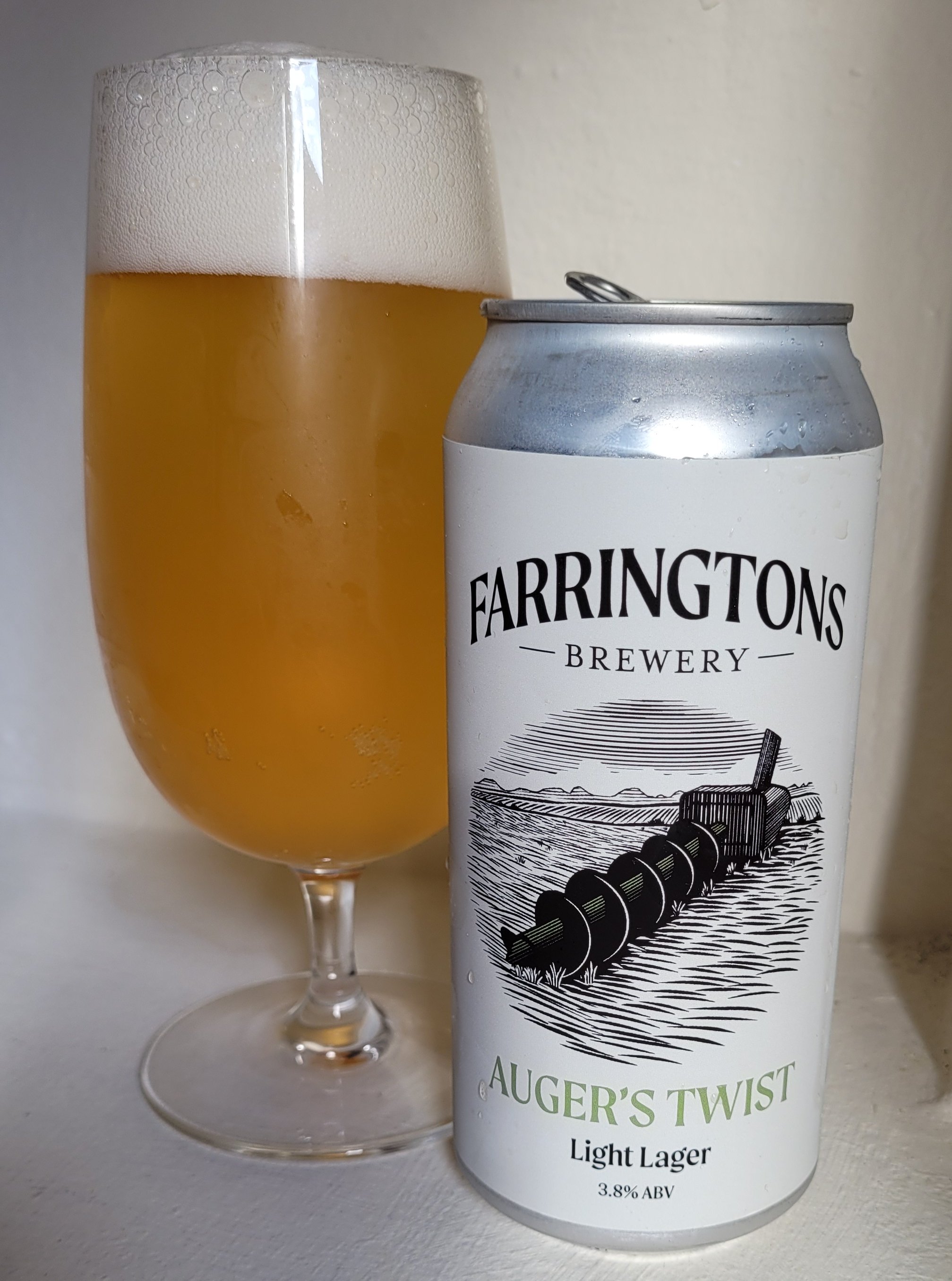
We start at Auger's Twist, described as a light lager and 3.8% ABV, making it an unusual choice for going out into the off-sales world. Regardless, it's a bright and happy gold with minimal aroma and restrained fizz. The flavour is the crispness of ready-salted crisps: no malt syrup, no hop veg, just a dry crunch of raw brown sugar with the faintest hint of bitterness. It's the sort of thing that's almost impossible to do on a small restaurant brewkit, so as a technical exercise it's phenomenal. As a beer to drink, it's not much above what the macros do and not really worth going out of your way for.

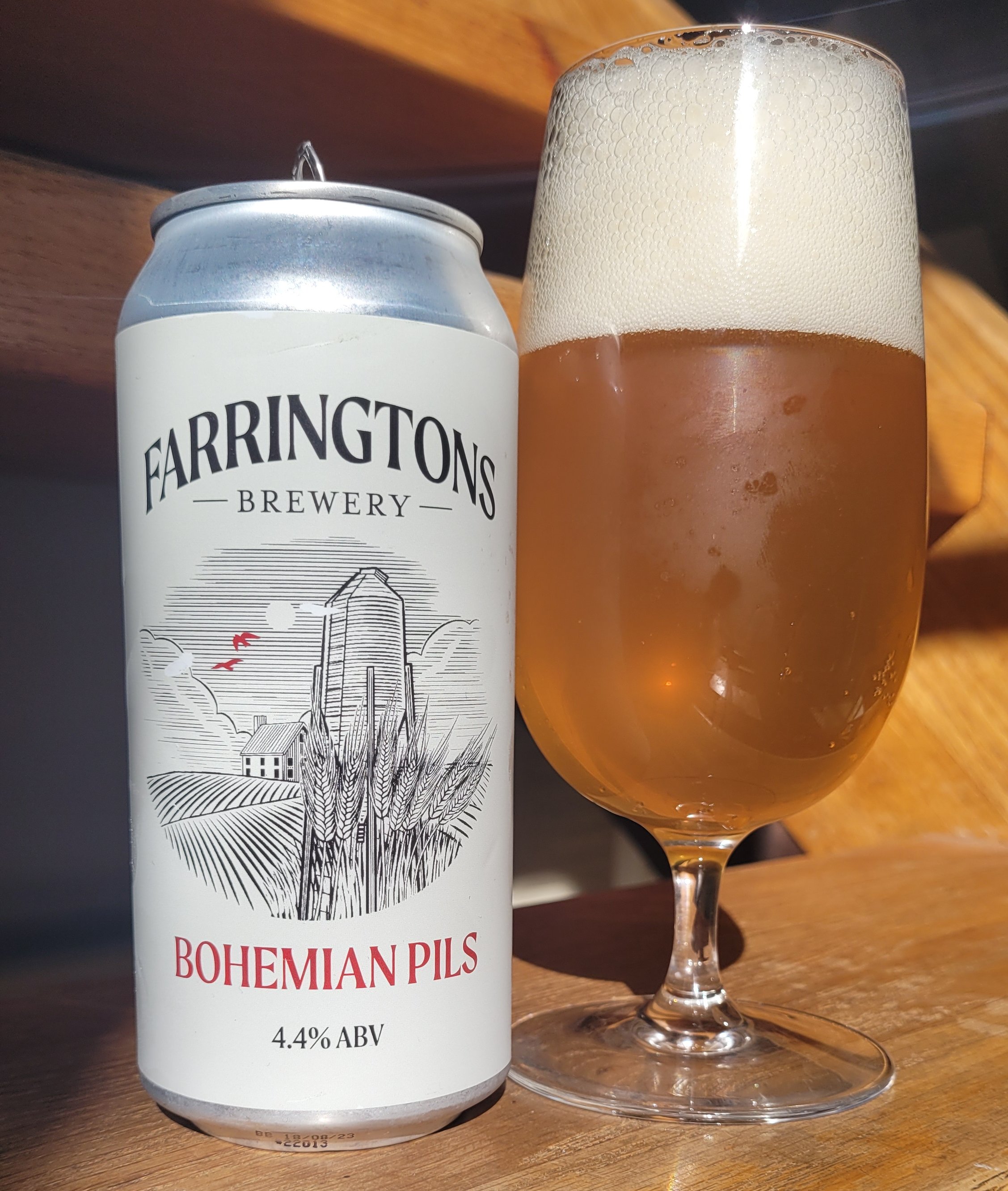
More is promised by, and expected from, Bohemian Pils. It's a bit low strength at 4.4% ABV, and a touch hazy. There's a happy waft of damp grass from the aroma while the flavour is a colourful mix of fruits and flowers, including lemon, lychee, lavender and honeysuckle -- not typical for a pils but still very enjoyable. A dry herbal bitterness in the finish pulls it back, stylistically. This is good stuff, even if the hop flavours are a little off-kilter. It still performs the role of a pilsner with aplomb.

I thought that was it for the lagers and I turned next to Dirty Snout, which I took to be an amber ale. This is plagued by the large floaty bits which murk up some of Post Card's beers, though don't seem to adversely affect the flavour. Otherwise, it's amber as advertised, a deep chestnut red. I began to realise something was up when I noticed it wasn't sweet or fruity as amber ale tends to be, but rather it has a dry roasted crispness, making it more akin to an Altbier than an amber ale. A check of the smallprint told me that it is an amber lager rather than an ale, and that makes perfect sense. As such it's another good example, bringing a lovely dark richness to a traditional German-style lager.

We enter the warm-fermented segment with Clever Plucker, described as a Session NEIPA. That means it's 4.5% ABV and palely hazy, like a witbier. It has plenty of New-England features, however, beginning with the juice-forward aroma. That leads on to a mix of orange flesh and vanilla in the foretaste, turning a little pithy later, but disappearing before it turns properly bitter. The abrupt finish is due to the light body and it feels a little watery as a result. Still, the flavours are on point while they last and it's very clean and sessionable so delivers everything it promises.

From there to the strongest of the set, a pale ale called Out on Bale, at 5% ABV. This one is a darker  colour and has a slightly savoury aroma. The flavour is rather plain, with just a mild tang of jaffa orange and a slightly nutty marzipan note. Although I'm sure it's going for bitter rather than sweet, it doesn't quite hit the mark there and the hopping falls a bit flat. That savoury thing reemerges as it warms, nutmeg and sandalwood, alongside a vague marmalade character. It's inoffensive, and entirely the kind of thing one might expect from a restaurant brewery. It's not up to the standards of the others.

That one blip aside, this is a very solid set. The can artwork looks great too. I've no idea if there'll be more from them or how active they'll be outside the home restaurant, but I'd certainly be up for trying more.

25 November 2022

Play on

The advent of Kinnegar's new taproom in Letterkenny sees a new series of taproom-only specials called Tap Room Only (TRO). They're available in a selection of pubs across the country, with Bonobo the designated Dublin outlet. First up is a very daring Smoked Pineapple Sour. It's 4.5% ABV and bright yellow, though with lots of floaty bits, presumably pineapple. The aroma is fresh and zesty with an air of the tropics, and there's plenty of real canned pineapple in the flavour, given an extra tang by the souring culture's tartness. It would have been lovely if they'd left it there. Unfortunately there's also the smoke. It's a stale burnt plastic and burnt kippers thing, present from the outset and all the way through to the aftertaste, so impossible to ignore. All praise for the idea, but the execution didn't work. This definitely shouldn't have left the taproom.

On the packaged front, they went super-traditional with a Märzen for their autumn seasonal. Leaf Kicker is 5.9% ABV and rather more amber than these tend to be in Germany. That gives it a density which makes the flavour slow to develop. It begins quite dry with a snap of cracker, gradually growing in biscuity richness to become a properly full malt-driven lager. The hops are toned down, which was a little disappointing but not really a problem. What you get is a rasp of spinach, celery and white pepper, fading to a broad metallic bitterness in the finish, balancing out the high malt level. It's decent fare, and although it's weightier than any Munich Oktoberfestbier, I could still happily drink it by the Maß.

The Brewers At Play series continued upwards to 26 with a raspberry-infused "farmhouse ale". It's very basic fare, tasting predominantly of candy-like raspberry-flavoured syrup. There's a certain dryness to the base, but no flavour complexity that I could describe as "farmhouse", where I'd be looking for rounded peachy esters, crisp straw or wild-yeast funk. If they're there, the syrup has buried them. In its defence this is only 3% ABV and very easy drinking. Perhaps it would have worked better at the height of summer rather than in an admittedly warm autumn.

We move on, yea even unto Brewers At Play 27: Black Lager. Your correspondent does enjoy a good Schwarzbier so was very pleased to see this land. 4.7% ABV is a nicely approachable strength, and it is indeed properly black, only showing as deep deep ruby when held to a light source. There's a mild caramel sweetness in the aroma but it's mostly dry on tasting: nicely roasty and fully lager-crisp. There's a certain Helles-like malt sweetness in the middle and a faint herbal liquorice complexity. Mostly, though, this is an easy-going drinking lager with no fancy twists. Without seeing the colour, I'm not sure I would even have picked out those dark-beer qualities at all. It's nice to see that being "At Play" doesn't have to mean doing silly things. I guess they save that for the TRO series these days. Coffee and seaweed stout is next there.

Maybe it's my fogey old palate, but on this showing Kinnegar looks to be doing a better job of traditional lager styles than fancy farmhouse fruit stuff at the moment.

23 November 2022

Turfed out

I'm sure I remember drinking a beer made from 100% peat malt before. I think it was at a beer festival in Copenhagen but searching through my notes on this blog -- which is what it's for -- I can't find it. Anyway, here's another, or possibly my first: Rex Attitude from Yeastie Boys. It's one of their New Zealand-brewed beers and I picked it up at Rascals HQ so I'm guessing it was shipped or muled over as part of the Krush Groove collaboration earlier this year.

Officially a golden ale, it's more of an orange amber colour, while 7% ABV suggests they did not skimp on the smoky malt. The aroma is not the explosion in a kipper factory that I feared, being pleasingly, wholesomely peaty, like walking into a picturesque highland village on a frosty winter's morn. The flavour has more of a poke. There's an almost lager-like base, clean and crisp, and presumably designed to give the special effects maximum impact. And impact they do: phenols on steroids, TCP on PCP, sod's law. Though it's light-bodied and doesn't feel anything like its strength, there's a concentrated liquid smoke essence thing going on, coating the palate and leaving no room for anything else. The label warns you, and then fully delivers on that threat.

I quite liked it. It's very silly, though I contend it's still drinkable and quite cleverly designed. One small bottle was plenty though, and there was no way I was going to drink anything else on the same evening. I commend this to anyone who has a high tolerance threshold for smoke flavours in beer, and issue a stern warning to those who do not.

21 November 2022

Waiting for GoDOT

Back in June, DOT Brew announced, grandly, the launch of a new core range of beers. I reviewed the first few when I got them and figured I would catch up with the stragglers -- amber ale and double IPA -- in a few weeks when they hit the shops. The DIPA followed close on their heels but I had to wait for the amber, and drink a few DOT one-offs while I did so. Now in late November I've started regarding Easy Amber as the Godot of Irish beer and I have a huge collection of tasting notes from some of what DOT put out over the last five months. Time to catch up. We might even get a different amber ale on the way through.

The one shoe that did drop is Alto, a double IPA at the de rigueur 8% ABV. It's not totally opaque, letting some orangey light through, which I appreciate. It smells quite sweet and syrupy, like a melted ice pop, though with hints of citric bitterness and lime in particular. The flavour continues in that sharply bitter direction, hitting up against a big malt sweetness that has nothing to do with the haze. I quite like this west-coast angle, even though it's plainly not what the beer is meant to be from the description. There's nothing silly going on here and as such it's exactly the sort of double IPA that one should put into regular production.

Among the special editions, then, first there was Got Fruit?, a sour ale with raspberry, cherry and peach. Although 4.4% ABV, it's very thin, with a knock-on effect on the flavour. You get a quick flash of the raspberry, a brush of cherry juice, and then it's done. The base beer behind it is at least actually sour, though it's in the grainy way, reminding me of Berliner Kindl Weisse. I suppose that's authenticity of a sort. I'm glad it's not thick or overly sweet, but I think a properly tart bite would have made it into something more interesting. But then I always think that.

DOT joined Lough Gill on the roster of small brewers who supply Aldi, a supermarket that could do with upping its game in the beer stakes. A pair of IPAs dubbed the "Spin Off Series" landed in early July and the Session IPA sat in my fridge for a further month. That gave the sediment plenty of time to settle to the bottom of the can and I even managed to keep most of it out of the glass. It's still pretty hazy though, while also thin-looking, visually agreeing with the 3.2% ABV. The aroma is bright and freshly lemony, suggesting carefree summer drinking, and while it's light-bodied this is definitely not unpleasantly thin nor harsh. The zesty zing continues in the flavour, joined by a touch of savoury garlic but mostly staying true to the lemon with even a little extra vanilla complexity rounding it out. As a summer session beer it's perfect: fully flavoured and decent value at under €2 the can. I'm much too late to recommend this as a summer barbecue crowd pleaser, but hopefully other people found that out by themselves, and stored it upright in the ice bucket.

That shipped alongside a 5.8% ABV IPA called Side Step. It looks New Englandy and smells, too, of ripe peaches and mangoes. The texture is rich and rounded, while the flavour puts the tropical fruit first, in a concentrated and slightly syrupy way. I say all this in a certain tone of surprise as we're promised rye in the ingredients and there's really not much rye character. There's a certain savoury side that could be classified as "grassy", from a distance if you squint, but it's no sharp and squeaky rye IPA. As long as you're ready for something tropical and mostly sweet, this is lovely. There's a heft, a heat and a density that makes it quite grown-up, aside from the fruit salad. It took me a good half of the can to figure out if I liked it, but it gets the seal of approval. Good choice, Aldi.

They came back for a second round of Spin Offs last week, and I'll start with Alpha Amber. Indeed, as well as the unfulfilled promise, DOT had an amber ale in the line-up early on but it's not a style we see much of. This one is 5% ABV and more a murky brown than red or amber. The aroma is on point, however, exuding smooth caramel laced with mild orange-peel citrus. So it's no US-hopped powerhouse, then, despite the presence of Columbus, Citra and Chinook. Instead the flavour offers quite a gentle blend of glacé cherries, fruitcake and tea. There is a sizeable dollop of dreggy grit hanging around in the finish as well, unfortunately. If you've got one on hand I'd suggest leaving it somewhere cold for a week or two to clean it up, as I did with the Session IPA. It's still good though, and I doubt that anyone who has missed amber ale will object to a bit of dreg here and there.

The companion piece is, like many a stout I'm sure, called Dark Side. They've added vanilla, and at a mere 4.2% ABV for the base beer, that strikes me as a brave move. It's a little pale too, the light shining redly through it. The aroma is properly stouty, however: a lovely waft of warming roast untroubled by the vanilla. So it goes with the taste, which is properly dry and actually refreshing. It is a little thin, and I genuinely couldn't decide whether that was a flaw or a drinkability enhancement. I had finished the beer before I figured it out so I guess that answers that question. I don't know that the vanilla is necessary but it's not overdone and doesn't get in the way. I approve, and at Aldi prices it's excellent value.

In March DOT did a barrel aged pilsner for Teeling and now it seems there's one for everybody in the audience as two more exclusives arrived in quick sequence in August. The first was another Redmonds collaboration, and it was Jimmy Redmond himself, apparently, who recommended the use of a Marsala barrel. So it goes. The result -- Barrel Aged Pilsner -- is 5% ABV. Immediate pilsner points get deducted for it being almost completely flat. That doesn't ruin it, but it would be better with a little sparkle to lift the flavour. Said flavour is delicious and really emphasises the fortified wine, tasting more of a mature pale sherry to me, but what would I know? There's ripe and juicy raisins and well as dry splintery oak, plus plenty of bone dry white wine. What with the flatness, it loses sight of the pilsner side completely, but honestly I forgot it was supposed to be there: a clean lager base is nothing other than a canvas on which all the fun wine barrel patterns and swirls are projected.

Literally the next day, Craft Central announced the arrival of their DOT Oak Conditioned Pilsner, at 5.5% ABV. It looks like an unfiltered kellerbier type job, orange and hazy. The aroma is proper unadorned pils, with lemon zest and dry grass on a dry cracker base. There's just a teeny hint of oaky vanilla and a touch of squashy grape, but otherwise it's crisp, clean and refreshing pilsner. It works! Squinting at the small print I see that this isn't barrel aged at all; they've merely left oak cubes bobbing in it for a while. That makes a big difference, letting the lager be a lager, and a very good one in the wholesome rustic style. I would even go so far as to say that the oak added something worthwhile. 

These two are two very different and opposite sides of the oak-and-pils equation. I would never have thought such creativity was possible in such a niche space, but there I go underestimating DOT again. When they came back to Teeling it was with yet another barrel aged pilsner.

This is called Joining the Dots, 5.2% ABV and hazy orange again. The barrels are of white wine origin, having been subsequently used for malt and grain whiskey. There's a lot of fruit in the aroma, mixing soft white grape with more piquant citrus peel, plus a sweet layer of oak. All of that comes through in the flavour, which is quite intense. I think the barrel side gets a bit cloying, adding a honey stickiness that's totally out of place in pils. This beer is complex, no doubt, but it comes at the expense of subtlety. Again it's interesting to see yet another direction in which barrel-aged pils can go, though I'd prefer less influence from the particular barrels DOT has chosen here.

More double IPA? Go on then. Ah-Ah-Oh is full-on New England: totally opaque and almost glowing with opalescence. No juice in the aroma, though, and it smells quite dry and grainy. Still the body is properly big and fluffy as befits 8.2% ABV. But just like the aroma is understated, the flavour is seriously understated, with only a vague orange peel and red cabbage character. Citra, Strata and Centennial are not normally this reticent. On the plus side, while searching the flavour for hops I found a nice spicy side: nutmeg and black pepper, if you look hard enough. Overall, though, this isn't great. I wanted big flavour from a strong IPA and for whatever reason that's not on offer here. I'm sure the name wasn't meant to express an anticlimax but that's what I got.

As everyone who matters knows, Dublin's top beer bar UnderDog has re-opened at The Legal Eagle. You will once again be seeing lots of its TeKu glasses on these pages in the future. On opening night they were pouring DOT's Coffee Milk Stout, an 8.2% ABV job that's absolutely loaded with essence of coffee, to the point where it tastes more like a Tia Maria than a stout. The milk side isn't shy either, adding a sweet softness that brilliantly offsets the coffee's jangling bitterness. It doesn't happen often, but big silly stouts can be classy and balanced as well, and this is one of those.

We go big to finish, with a 12% ABV stout. I was particularly interested in Imperial Stout Potstill as I'm a fan of pot still whiskey, although I haven't tried Teeling's, which presumably supplied the barrels here. It's a uniform black colour with a skim of cappuccino froth on top. As with the pils above, there's an unsubtle early contribution from the wood: a strongly oaky aroma, though laced with chocolate. The flavour is very nicely integrated, however, seamlessly blending dark chocolate and espresso stout characteristics with sweeter honeycomb and fine vanilla cream. It's marvellously smooth with very little alcohol heat and very easy drinking as a result. The barrel does a great job of adding a certain enhancement without going overboard. Much as I like pot still whiskey, I'm glad this beer didn't wind up tasting directly of it. Instead it's an easy-going sipper with all the great things about imperial stout, and more.

That's... probably enough DOT for now. If the core-range amber ever does show up, I'll be sure to let you know.