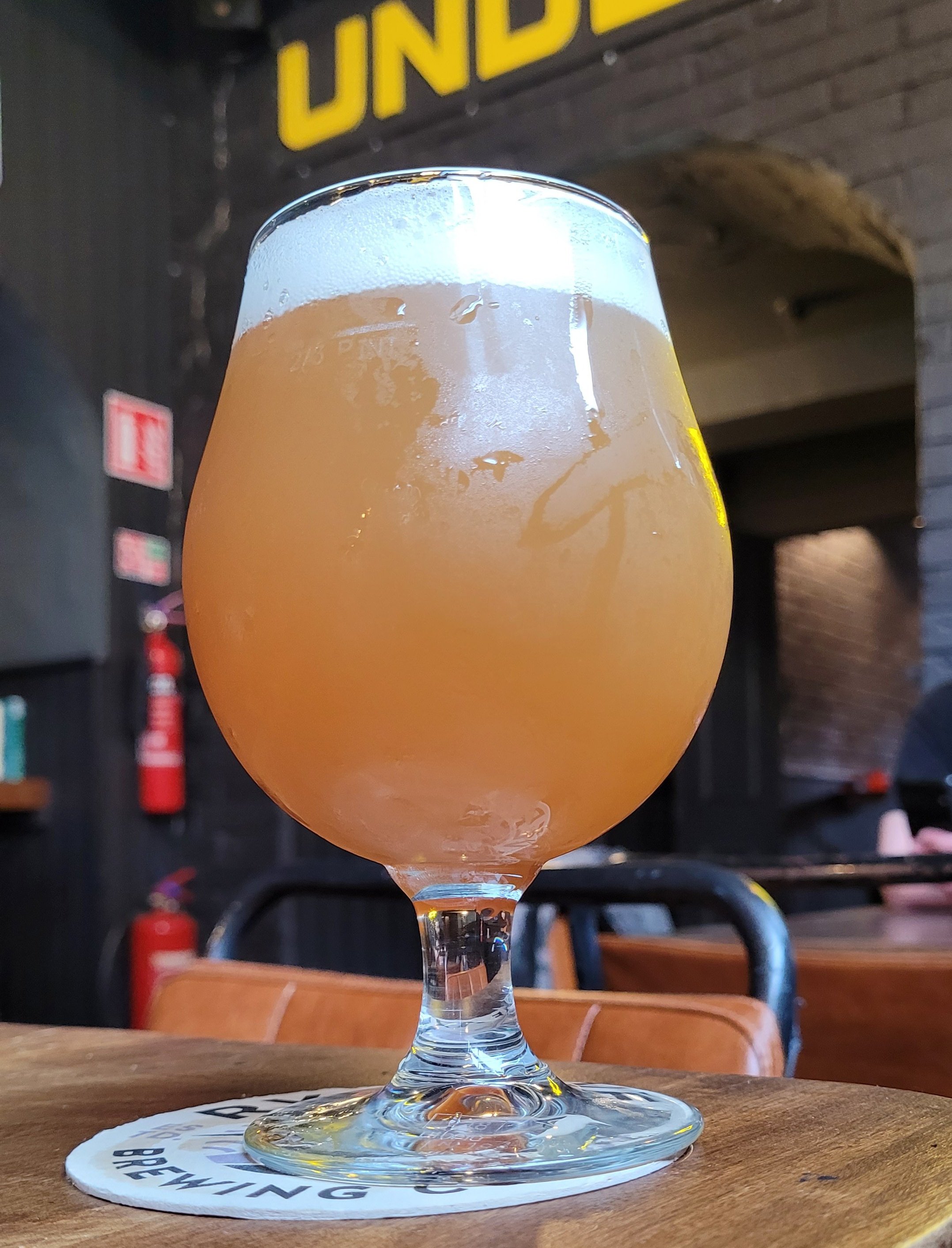
Having been cancelled by that virus thingy back in 2020, Boundary Brewing's Jubilate festival finally came to life at the end of May. The venue was a spacious floor of a former linen mill, just opposite the brewery and its taproom in east Belfast. 20 guest brewers from Ireland and the UK showed up, each pouring two beers at a time.

Without any particular strategy in mind, I began with
Ultimate Thunder, a 4.9% ABV New Zealand-hopped pale ale, produced by Northern Monk with collaborative input from Amity and Elusive. The hop bill is an involved one, and I'll leave you to look up the details yourself. I didn't find it especially characterful, however, seeming to offer nothing more than the basics of New Zealand hops' Germanic origins: a weedpatch of nettle, dandelion and dry grass clippings. It's nicely clear and clean, channelling the pale lager styles which such hops were originally bred for, and there's a beautiful creamy texture of the sort found in the best pilsners. Despite this, the finish is abrupt with no aftertaste to speak of. I enjoyed it to an extent but had expected more from it.
Beside it here is
Exemplify, a coffee stout from Belfast client brewer Tilt & Pour. Though only 4.5% ABV, it's weighty and sweet, presenting like the unloved coffee-cream item in a milk chocolate assortment. After the initial sugar rush, the roast reasserts itself and it tends towards acrid and burnt from the middle to the finish. They certainly didn't skimp on the coffee: this has at least two very real coffee aspects going on. I found it a bit too busy for my liking, not enjoying the clash of the rough and the sugary. If you like your coffee beer with
all the coffee, however, it might just be your cup of tea.

While we're on novelty stouts, I had high hopes for
Sigaro, currently being touted around the festival circuit by Galway Bay, and made in collaboration with Italian brewer Hilltop. The name derives from the inclusion of tobacco in the recipe, which I don't think I've encountered before, but seems like a suitably complementary adjunct for a stout. There's rather more normal cacao as well. Alas, I have no idea where the tobacco went, or what contribution it made, because I couldn't taste it. Nor the chocolate either, frankly. This 5.6%-er turned out to be another confectionary-like effort, smelling warm and creamy, like an Irish coffee, and with a roasted coffee dryness at the centre of the flavour, more subtle than in the Tilt & Pour one. No gimmicks, no fireworks, just a well-made classic drinking stout, properly balanced and making good use of nitrogenation to smooth it out. Have your cigar on the side.
Our hosts had set up their own bar separately from the guests, and my first from here was a lime and coconut gose, given a typically Boundary name of
Just Had To Teach Myself Calculation Logic. Although it's a light 4.5% ABV, this has a beautifully smooth texture and does an excellent job of showing off its headline ingredients. The big coconut flavour comes with an attendant creaminess, while the lime is subtly tangy, taking a background role along with the salinity. It's dessertish without turning overly sweet, and while very much a novelty beer, the classic elements of gose are still present and form the visible framework onto which the novel aspects are affixed. It's gulpable, refreshing, and only a little bit silly. Perfect summer fare.

The festival selection, though satisfactory, was lacking in high-end geek-bait, which was a little disappointing. Land & Labour's presence helped, and there was also The Kernel, from whom I tried
Bière de Saison Apricot. First impressions weren't much, the beer looking innocent and yellow, with a simplistic stonefruit-flesh aroma. It hit the geek buttons with its flavour, however: a lambic-like soured peppery spice and lots Brettanomyces-derived funk, resembling a young and frisky blue cheese. The name is typical Kernel understatement: it puts in a performance which is much more impressive than those four simple words convey.

Back to the locals, and Beer Hut was up next, with
Master Blaster, a session IPA. This is a hazy one, and very pale yellow with it, 4% ABV and brewed with Centennial and Simcoe. I wasn't a fan of the butane and banana aroma, something better suited to a weissbier than an IPA. The flavour was a big improvement on this, thankfully, beginning with the zingy and sparking bitterness: grapefruit and lime rind, giving way to a more resinous forest pine. It's a little on the thin side, but avoids turning harsh, as so often happens when light beers are given big hops. The malt base is clean and dry, with a snap of water biscuit. This gives you big beer energy in a small package, which I guess is the point of session IPA, but it's seldom done so well as it is here.

Whiplash pulled a daring move with its choice of beers: maybe people would be bored with all the saturated IPAs and novelty stouts; maybe they'll want something to hit reset. So they brought their recent non-alcoholic IPA and their brand new shandy:
Body Radler. As the name suggests, this is Body Riddle pale ale, diluted back to 2.5% ABV with lemonade. And it seems to be quite a high-end lemonade, being cloudy and with a fresh zesty tang. Unfortunately, the beer side gets totally buried under the sugar, so while it's far from unpleasant, you may as well be drinking the lemonade neat. I don't really see what purpose is served by the beer, because it doesn't taste or feel like a grown-up drink at all.

I rarely see them in the wild, but Kinnegar's "Tap Room Only" series has now reached
TRO 12: Smoked Lime Sour. I was a little apprehensive, though there was no chance of me passing this one by. I was hoping for something along the lines of a tropical barbecue, but no. The aroma is barely there, while the flavour chases it with a honking, clunking fishy twang with an unpleasant chemical burntness. It's not the first smoked beer in which I've encountered this kippers-and-plastic effect, and I have to wonder who out there is OK with it. That said, the harshness settles after a moment or two and the whole beer becomes smoother and gentler, showing sweet lime candy, pineapple and honeydew melon, before finishing on a note of cold ashtray. It doesn't work. There is nothing complementary about how the citrus and the smoke interact with each other, and the latter would have been better left out. A worthy experiment, perhaps, but not one to repeat.
Beside it is a cleansing imperial stout from the Boundary bar, the last remnants of one from a few years ago called
Like Putting on a Wee Jumper: 10.4% ABV and aged in an Islay cask for a swift four weeks, then cut with another stout. That cautiousness means it's only slightly smoky, which was a relief after the beer beside it. Instead, there's a beautiful spiced wine or vermouth character, mixing in with coffee and toast. The name is extremely apt: it's wintery and comforting, without turning hot or cloying. There's a good dryness to the toasty roast, lending it almost a crispness and ensuring it remains drinkable. There was no way back from here: stout time had begun.

Left Handed Giant's
Deeper Water was a mere lightweight at just 4.5% ABV, served with a huge wodge of nitrogenated foam. The aroma is attractively chocolate-like, but it turns oddly savoury on tasting, with a strong umami note, hinting at autolysis, even though it's not the kind of strong and old beer which I'd have thought might be susceptible to that. While it's not bad, it left me a little confused as to what was going on here.

While the Rascals pilot brewery is relatively accessible to me at home, I had to come to Belfast to try
Pilot #135, a big imperial stout of 10.3% ABV, which isn't usually their style, but I'll take it regardless. The lack of aroma was a bit of a let-down, giving me nothing but a worryingly harsh heat. The flavour is mellower, thankfully, offering a nutty cola effect, with a wintery cinnamon spice note. I'd be happy if they decided to make this a regular beer -- it would be most welcome in their generally quite light core range. But as a one-off, it lacked a bit of character. I felt it needed more of a richness to make use of the alcohol. Cake it up, please.

That beer's prospects weren't helped by it coming right next to the magnificent
Vienna Imperial Stout from Kirkstall. The name derives from the base malt used, one which has given it a superb rich and velvety smoothness. This 10.2% ABV version has been aged in Irish whiskey and bourbon barrels, and the honey effect of the former arrives late in the flavour, complementing the sumptuous milk chocolate which forms the early part. It's one of those beers which is difficult to pick apart because it all dovetails so neatly together and you can't see the joins. It was a tough decision, but eventually I had to set down my pen, sit back and simply marvel.

That was it for the draught, but some packaged beer was circulating the room, via the good offices of
Simon. Oldest stout of the day was Cloudwater's
Hibernate, 11.2% ABV and bottled over a decade ago. This showed the classic pipe tobacco and old leather of very agéd stout, though there was a surprisingly fresh seam of coffee running through it as well. Predictable, but not overwhelming, soy-sauce umami crept in towards the end, and a fun aftershave spice finished it off. Beer this old often presents a trade-off of mature deliciousness against wonky flaws, but overall, this was worth drinking, and had escaped any unpleasant oxidation or souring. I'm not sure I would have left it much longer, though: get your Gyle 123 open, if you're holding.

And finally, half its age:
Intergalactic, a whiskey-aged salted caramel stout, aged until five years ago in a whiskey barrel. This was the day's strongest, at 12.5% ABV and I'm not sure that the super high gravity served it well, because it came out smelling unpleasantly of hot mushy bananas. The flavour tempered this with some classic coffee and cocoa, and presumably the caramel element was a contributor to that. A small sample of this was plenty for me. Maybe it could have done with another five or so years in the can.
Anyway, that's where it all wrapped up. It was a well-run festival in an excellent space with plenty of interesting beers. Particular thanks to all the brewers who brought stout, something that's not always a given for a summer gig. I'm not quite done with this trip to Belfast yet, however: pre- and post-festival beers will follow
next.



 In the interests of balance for what follows, I did buy one IPA from the range of Dois Corvos beers which arrived in Dublin from Lisbon recently. There were numerous options but I picked Funchal Drift, the New England-style one made with Citra and Motueka. That sounded interesting, though the unappetising pale yellowish green emulsion it poured as, less so. A worrying kick of vanilla and plasterboard manifests in the aroma, alongside an assertive lime bitterness. Hello Citra. From the foretaste I got an initial waft of that chalky mineral effect I smelt, followed by hot yeasty dregs and vegetal leaf bitterness. At least a part of this is down to the Motueka, adding a eucalyptus medicinal effect which dovetails neatly with the grit and the murk, but not in a good way. The Citra fails to come to the rescue; where there might be a zesty citric finish, it's only smoke and burnt plastic. Any dessertish custard softness has been thoroughly drowned out. I took a gamble and I lost. This beer presents a catalogue of reasons for calling the whole haze phase to a halt sooner rather than later.
 Ugh. With that out of my system it was time to move on to the stuff which attracted me more. I began on Café Racer, which is as good a name for a coffee stout as any. Funny, it doesn't smell of coffee. It smells, and bear with me, of the things that coffee smells of. Toast, hazelnuts, tar and tobacco. I didn't say good coffee. It is intriguing though. The body is surprisingly light and fizzy, and the flavour primarily dry. 5.4% ABV means it shouldn't necessarily be a big and creamy fellow, but I was still surprised by how gassy the whole thing is. Nuts are at the centre of the flavour, with a bit of the aroma's hazelnut and even more dry peanut shell. A certain amount of dark chocolate surrounds that, though oddly no coffee. A tang of burnt salt is all the finish offers. I really wanted to like this, but it's all harsh and pointy; neither refreshing nor comforting. It doesn't smell like good coffee and it doesn't taste like good coffee stout. Maybe I should have expected that.
  Our last last best hope is Magnetic Poles, a Baltic porter with tonka beans. Normally I'm very much not in favour of microbreweries adding their own kooky twist on classic European lager styles, but I was so desperate for something good at this stage that I was determined to give it a fair shake. It's 8% ABV and densely dark brown with a tobacco-stain head. The aroma is oddly sour, of old sherry and cherry liqueur. It doesn't say it's barrel aged but I might believe it is. The cherry note continues in the flavour, even sharper, and joined by an oily tobacco leaf effect, classy dark chocolate, rosewater and Christmas cookies. It's the first beer that almost manages to put tonka in its place, turning it into a surface-level seasoning instead of the beer's whole deal, though the dusting of cinnamon is a dead giveaway of what's going on. It works beautifully, however. Strong tonka-laden stouts tend to be stickily sweet, but by adding the lager dimension this one retains a level of crispness which makes it far more drinkable than one might expect given the strength and other specs, which is of course the Baltic porter way and why we love the style. Never before have I encountered a beer that managed to put manners on tonka's busy confectionary, but if one style was going to do it, it would be this one. Baltic porter purists need not apply, but I found it a perfect melding of old fashioned meticulous decency and frivolous craft creativity. Fight me.