Showing posts with label hazy little thing. Show all posts

13 March 2026

Little by little

Looks like it's time for me to get my Little Thing out again. The latest in Sierra Nevada's seemingly endless variations on its signature hazy IPA is Citra Little Thing. As usual, the can is most uninformative, beyond the ABV of 7.5%, but the brewery website tells me it's not a single-hopper, the Citra joined by Simcoe.

It's reasonably hazy, though not the full-on beaten-egg emulsion you get from the more extreme practitioners of the art. It smells reasonably juicy, though with more of a fruit candy vibe than actual juice: Skittles, Starburst, that kind of thing. For all the alcohol, the flavour is quite muted, I thought, and there's none of the hop vibrancy I had been expecting. You could argue that Citra is famously bitter so might disappear in an IPA designed to be sweet, but you'd be wrong. Plenty of breweries use Citra for this purpose to excellent effect. This seems like a big industrialised brewery low-balling the hops for budgetary reasons. For shame, SN!

That said, it's not a bad beer by any means. There's a pleasant light zesty kick and some deeper, slicker resins in the finish. It's extremely easy to drink. The problem is, I didn't come to a 7.5% ABV American IPA for easy drinking. While I recognise that west-coast punch isn't part of the offer, the absence of juice and fruity hop fun is a major black mark. Maybe I can't complain when I only paid €2.50 in SuperValu, but I'm complaining anyway.

It strikes me that naming hop varieties is a means to extending this series even further. Citra was a reasonable place to start, but I hope the next ones will be more interesting.

Meanwhile, the change of season brought out Sierra Nevada's Springfest IPA. This looks light and breezy, being a pale gold and perfectly clear. It's a full 6% ABV, however, and has the malt substance to back that up. On top of that are the hops, and it's very much in the Sierra Nevada style, which is to say old-fashioned but delicious. The varieties used are Centennial, Citra and CTZ, and they give it quite an intense lemon flavour, concentrated like meringue pie filling, and with a raw rind bitterness on the finish.

All of that makes it invigorating rather than refreshing; while it may be presented in easy-going sessionable terms, I'm not sure it would work as such. There's a fair bit in common here with the brewery's flagship pale ale, although the lack of any dark malt component makes it something different. Both beers share balance, drinkability and an assertively punchy hop-resin taste. Exactly what I'm after from Sierra Nevada, for the most part.

Finally, a pils, of all things. The name, PILS, sets down a marker that this will be definitive and no-nonsense, and I'm very much of the opinion that that's how pilsner should be done. I've not seen it in cans, but Tapped had it, er, tapped, in late February. Full marks for another flawless gold colour and long-lasting fine foam, although the latter could stand to have been a bit thicker: I blame the made-for-UK imperial pint glass for that. There's a suspicious fruit quality in the aroma; not unpleasant, but not pils-appropriate, suggesting modern craft's peach and apricot rather than herbal greenness. Sure enough, that proved to be the centre of the flavour as well, which had me running to the brewery website for a hop-related explanation.

Here I found the beer described as "Pilsner as it should be," and also that it's made "with an innovative twist." You can't have it both ways, lads, unless you think the Czechs have been doing it wrong. I couldn't find a hop listing among the marketing guff, but they do say it should taste of "citrus and tangerine", which is a long way from pilsner as it should be, in this critic's opinion. I give them credit for the beer's texture: the carbonation delivers optimal crispness and the body has the weighty, creamy density of the very best pilsner (*cough* Keesman *cough*), but these are also features of good pale ale, and that's what this tastes like.

I'm whining a lot here, so I should add at this point that it's a beautiful beer: tasty and subtle; supremely sessionable at 4.7% ABV, though only for plutocrats at €8.70 the pint. My only real bug is dressing it up as though it's an authentic expression of Europe's lager-brewing tradition. Maybe that flies for beer drinkers in California or North Carolina, but it doesn't here. Of all the breweries in the US, Sierra Nevada is the one with least need to pretend to be something other than itself.

07 November 2025

Periscope creep

Oh they are a capricious lot, the beer gods. Just after I complained about unnecessary extensions to the Sierra Nevada Torpedo brand, two new ones arrived into view. I must make the requisite sacrifice by drinking them.

But first, another inevitable extension. I swear the well of inspiration for the Little Thing series is running dry. I mean, Hoppy Little Thing? What's next? Fizzy Little Thing? Liquid Little Thing? Beery Little Thing? Hoppy is 5% ABV and a pale sort of yellow haze. It doesn't smell especially hoppy, just a vaguely zesty lime effect. The carbonation is faint, and that helps accentuate the New England softness. The flavour is hoppy, I guess, but it's quite plain: similar lime to the aroma, some lemon candy, a brush of onion, and then a vanilla sweetness which isn't hop-related at all. I don't get the point of this. It's like a watered-down version of the 6.7% ABV original. Was anyone asking for an extremely basic hazy IPA in 2025? Sierra Nevada thought they were.

Time next to ready the Torpedoes, and first up is Phantom Torpedo at a spectrally diaphanous 6% ABV. They have no convincing explanation for the name, but do tell us it's brewed with Vic Secret, Azacca and Magnum. It's a sort of grey-ish orange, which is unattractive, and translucently hazy with it. The aroma is pithy and bitter, all very classically Californian. Vic Secret's aniseed waits for the flavour to appear, where it's right in the foretaste, all very herbal with less of its usual bitterness. Oily jaffa orange follows, briefly, before an understated resinous finish, coating the palate without turning aggressive. I guess it's an echo or a ghost of regular Torpedo. Did anyone ask for a Torpedo that was less Torpedo-y? While I enjoyed it, it does feel like the flavour is building up to a kick that never gets delivered. Vic Secret has such a bold and distinctive flavour, ideal for this kind of IPA, it's a shame to see it low-balled like this. Good but with lots of room for improvement, is my take.

We're out the other side with Electric Torpedo, very slightly stronger than the original, at 7.5% ABV. The brewery has opted not to tell us what the hops here are, only that it's a blend. Once again it's a hazy orange, but looking rather less grey than the previous. I get marmalade from the aroma, with lots of oily orange and lime rind. Its flavour is altogether less processed, with zinging fresh citrus for days. I guess it's the gravity which allows that, and yet there's no boozy heat nor sugary malt to get in the way of the hops. This has a lot of Torpedo's aggressive charm, but I think has a subtler side too, leaning less on the harsh resins and allowing more of the fruit to come through. It's so clean and easy to drink that a 12oz bottle didn't feel like enough, despite that significant strength. "Electric" is perhaps an overstatement, but it's very lively and stimulating, and thoroughly enjoyable. If we hadn't all got sidetracked into the haze, this could have been what IPA evolved into, and we would all be the better for it.

OK, these departures into alternative-universe Torpedoes I do understand. If the brand-extension conceit is what it takes to put more tasty west-coast IPAs on the market, then I'm all in favour. Consider the series to be an answer to the prayers of all those rheumy-eyed old hopheads, hankering after one last hit of pine in a world of vanilla and garlic sludge. Who could deny them?

08 August 2025

Unnecessary extensions

Did Sierra Nevada need to add a Peachy Little Thing to its already extensive range of hazy IPAs? No it did not. But, as always, I am obliged to drink and tell you about it. To give it a properly fair shake, I opened it on a warm afternoon, on the assumption that this is a more frivolous and summery kind of beer, although the 7% ABV means it comes with some serious heft. It's mostly opaque and the bright orange of a diluted squash. The peach... substance... is very apparent from the aroma, adding a strong and artificial sweet-smelling perfume. Who remembers Magic Hat No. 9? I didn't, until I took a sniff of this. The mouthfeel is beautifully soft, making good use of that high gravity to give it a deliciously chewy texture. And though they claim it's an IPA, there is precious little sign of any hops. Instead, that concentrated peach essence rides roughshod over everything else, unsubtle and overly sweet. I guess it works in a complementary way with the pillowy texture, but it doesn't create a pleasant beer; this barely tastes like a beer at all. I will credit that it could have ended up a syrupy mess, and instead it's simply syrupy in a straightforward, one-flavour, fashion. I don't see the point.

My local SuperValu occasionally gets shipments of expiring stock from local distributor Grand Cru, so you'll need to ignore the "fresh" aspect of this Cryo Fresh Torpedo, the bottle being a bit over a year old by the time I got to it. One again, it's a 7% ABV IPA, though this one is an altogether warmer-looking amber shade, and mostly clear with it. The aroma has survived well, and still has the classic Torpedo pine sharpness. Surprisingly, the bitterness doesn't dominate the flavour. It still tastes plenty fresh, though, with zesty orange juice and thick-shred marmalade. Only in the finish is there a drier and bitterer lime rind effect. It's all quite subtle too, lacking any punchy extremes, with neither harshness nor heat. Despite all the technical hop wizardry, this is a decent, accessible and enjoyable IPA, very much in the West Coast fashion, but not overdoing it. My only quibble is that overdoing it is basic Torpedo's main feature, and I'm a fan of its resinous severity, none of which is on display here. For €2.60, I got a very good bottle of beer, though I still think I would trade up to a fresh bottle of OG Torpedo.

Torpedo and Hazy Little Thing are very good beers in their own right, and I'm a fan of both. These attempts at using established customer good will are, I think, misguided. Not everyone will come in on the ground floor, and I hate to think that anyone would eschew the originals having tried and disliked these cash-in variants.

12 June 2024

The Thing from outer space

Is it a drugs reference? I don't get the reason for the latest in Sierra Nevada's Little Thing series of beers being called Cosmic Little Thing. Is it, like, "woah, cosmic, maaan"? I don't know. On the front of the pint can we are promised "an interstellar wave of tropical flavor". Uh-oh

For once, the promise is kept. The aroma doesn't give us much tropicality, just a pithy, zesty, citrus tang. The flavour, however, raids the sweetshop for everything flavoured as pineapple, passionfruit, mango and guava. It's not real fruit and there's no juiciness, going instead for candy chews or jellies: perfumed, chemical, and extremely sweet to the point of turning bitter. There's a little bonus complexity too; some sharper resins and a welcome peppery spice.

Doubtless the 8% ABV helps provide a generous platform for all the hop goings-on. It's a full-bodied double IPA, with the fun pillowy texture typical of hazy IPAs. Despite its general bigness, it's not boozy and slips back a little too easily, perhaps. I level no criticism at the very tall boy packaging format.

This is a good ramping-up of the things that make the flagship Hazy Little Thing IPA a good beer, while incorporating features from the Big Little Thing west-coast double IPA. I still don't know what makes it "cosmic", but it's a nice little big thing.

19 January 2024

Les étrangers

Am I a bad beer tourist for going to France and being interested in beers from abroad instead of doggedly sticking to documenting the local scene? Yes, probably, but there's nothing you can do about that. Today's beers are ones I bought in Bordeaux but which got there from elsewhere.

First up is a couple of Brooklyn Brewery beers, brewed by their partner Carlsberg Sweden, beginning with The Stonewall Inn, a session IPA. At only 4.6% ABV it walks the walk for an American recipe, undoubtedly in a straight line. It's a clear golden colour and smells nicely peachy, though not madly different from the brewery's flagship floral lager. It's definitely not a lager, however: the mouthfeel is weighty and thick, while the hops move along from the colourful soft fruit to a more serious dank quality; funky and vegetal, lacking an uplifting tang of citrus typical in an American IPA. I found it a little shocking at first, but warmed to it by the half way point. The flavour is largely Citra's doing, I read, and I think this may be primarily pitched at the Citra fanatic. I made my peace with it eventually, but it would be a challenging sort of session with all the boiled cabbage notes in evidence.

Pulp Art is another European contract job, this time a hazy IPA and 6% ABV. There's a similar fruity character to the aroma, and it suggests that more of the same resins are to come. Luckily it reverts to style on tasting with a big hit of, yes, pulpy orange: a mix of sweet juice and bitter pith. The pithiness even introduces a slight coconut note, making me think of Sorachi Ace, a hop that Brooklyn was responsible for popularising in the craft beer world. It is, however, an all-American superteam of Strata, Simcoe, and Citra again. I guess Strata is on juice-mongering duties here. Anyway, it works really well. A bit like with Sierra Nevada's Hazy Little Thing, an established player has taken the new fashion, put their own stamp on it, and created something very tasty in the process.

Given its long trading ties with Britain, it shouldn't be surprising that Bordeaux has plentiful English-style pubs. I first stopped by The Starfish, which has a sizeable range from Brewpoint, the pseudo-craft label of Bedford's Eagle brewery which used to be Charles Wells, including a bitter on cask.

I did check that other people were drinking John Bull English Ale (possibly previously called "Johnny English"), and they were. They must have come away with a poor impression of cask bitter, however, because my pint was thin and vinegary. There's a slight hint of raspberry about it, but the rest is a way over-attenuated mess, too cold, too fizzy and with an utterly inappropriate sourness. 5.3% ABV should have provided something of a safety net against such things, but not enough, it seems. Usually, I'd try to find the redeeming features; the beer the brewery meant me to have. I'm at a loss with this, however. Drop me a comment if you know how it's meant to taste.

To follow, Ink Well, an oatmeal stout. It was served on nitro but has plenty of flavour, opening on slightly-sweetened filter coffee and building on the sweetness with rosewater and milk chocolate. A bitter counter-melody plays next to this, adding liquorice laces and crisp green cabbage leaf. There isn't much else that a 5.2% ABV stout needs to do. I was very impressed, especially after the John Bull fiasco.

Brewpoint also has the beer concession at another pub in town, The Charles Dickens, down by the river. Here I went for Hop & Heart, their recent take on New England IPA. It's no such thing, of course, and although it hits the gravity full square at 6.2% ABV, is an easy-drinking and refreshing orangeade style number. There's a sherbet-like spritz, a mild kick of Orangina pith, and then a very quick finish, reflecting the almost watery texture. So as far away from proper New England as, well, Bedford is, but it works: a clean and super-suppable, Skittles and Starburst, simple delight.

Yet another Wells pub is The Houses of Parliament. Here I had a half of the 9% ABV Scotch ale, Hop Scotch. This one is a clear garnet colour and was tricky to get the measure of at first, since it was poured extremely cold. Given a few minutes to acclimatise, however, it reveals itself as a very good exemplar of the style, built on a firm foundation of creamy Highland toffee, adding a red liquorice complexity, with a lacing of burnt caramel and a spritz of raspberry tartness. It doesn't taste as powerful as the ABV implies, which may be in part down to the temperature, but I'm sure the excellent balance plays a role too. A half on a damp winter afternoon was just the ticket, recalling similar encounters with The Porterhouse's late lamented Brainblásta, and a reminder why it's a terribly civilised idea to have something like this on any brewery's roster of regulars.

They had a stout I hadn't seen in the other branches, called Genesis. It's served on nitro and is the GB Guinness strength of 4.1% ABV, so it's pretty clear what market they're aiming for. Again, my pint needed a bit of time to warm up to get anything from it, so at least that bit's accurate. Even then there's not much: a broad toasty, bready characteristic, and possibly even a touch of Big G's lactic sourness, but I'm reaching here. It's a very plain, roast-led, low-strength stout and isn't meant to do anything other than save the chain from having to pay money to Diageo. Job done. "A Guinness for people who don't even like Guinness," observed the wife.

For herself, a bock, called Crafty Seadog, a whopper at 8.5% ABV. It smelled a little sour and vinegary, which was off-putting. In the flavour that tartness becomes a fruity balsamic and raspberry effect, which is interesting but not so bock-like. I think I would have struggled through a half litre of this. Luckily my wife is made of sterner stuff. It's no Duvel, I'll tell you that much.

Acquitaine has historic links to the Basque country too, somewhat represented by the fair amount of Basque beer on sale in Bordeaux. I picked up a couple from Laugar, where I suspect the brewers or branding people have a bit of a thing for the heavy metal music.

Funeralopolis is an actual tie-in to the "doom metal classic" of the same name, by Electric Wizard. No, me neither. It's an imperial stout of 10% ABV, with added coffee, tonka beans and lactose. Tonka doesn't dominate the aroma for once, and there's a nice mix of roasts here: the coffee and the heavy dark grain. You have to wait for the flavour to get the tonka, and it's right there in the foretaste, the signature Christmas-cookie spice. It's fairly sweet in general, in a most non-metal way, the coffee giving it an overall tiramisu vibe, including a dash of vanilla. The alcohol heat is kept well in check and the finish is surprisingly quick, leaving no aftertaste. Its mouthfeel is quite light, with plenty of fizz and zero gloop. All-in-all it's a cuddly, playful little thing, which I very much doubt was the intention, but I'll go with it.

The devil music theme continues with Midnight Harvest, another imperial stout, this time with smoked cocoa, which is a new ingredient on me. It's 10% ABV again, and again we get some lactose to take any edges off. It smells broadly chocolatey, but not particularly strongly. The flavour has a little more to say, and it's mostly chocolate. I guess it's the lactose's fault that it's very much basic milk chocolate rather than anything fancier. There's a tiny whiff of smoke in the finish, resembling what you get when chipotle or paprika features in beer -- a slightly chemically, plastic, twang. It doesn't ruin it but doesn't really add anything positive either. For all the camp drama of the label, it's a fairly plain chocolate milk stout, decent but unexciting. Rock out with your choc out.

And there we sign off from 2024's first trip. Bordeaux isn't all about the beer by any means, but there's plenty of good stuff, should you want it.

08 January 2024

Little and large

We had a jolly time of it one Thursday night in early December. Sierra Nevada's co-founder, Steve Grossman, was in town, prompting a night of revelry and €5 pints at UnderDog.

One of such was Oktoberfest, last year's vintage having been brewed in collaboration with Kehrwieder of Hamburg. As such, then, there's a northern influence, meaning less Bavarian softness and more of a hop bite. Not that there isn't a huge malt component: this is very bready, with an overall chewy and wholesome feel. The hops manifest as a selection of leafy vegetables, particularly celery, spinach and rocket. While it's very definitely a Festbier, it does shade into pale bock to an extent, with all that noble hop character. A little unwelcome caramel emerges as it warms, so I was glad to be dealing with only a pint rather than a litre. It still absolutely hit the mark, however, providing just what an Oktoberfest beer ought to, in a way that non-Bavarian breweries rarely get just right.

Later, a special bottle of Brux was opened. This is a collaboration with fellow Californian brewing legends Russian River and is a "domesticated" wild ale. From the name it's apparent that Brettanomyces is its signature feature. I thought it was quite understated, which is unusual because Russian River in particular likes to go properly wild with its wild beers. Here, I got an aroma of subtle rosemary and basil, followed by a flavour of Sauternes grape and breadcrust. An extra perfume and resin effect emerges as it warms, alongside a lightly earthy mushroom funk. It's good, I guess, but it's not as fun and interesting as the best of these, holding back on going full-tilt with the Brett. I enjoyed it, for free, but would have resented paying top dollar for a beer that doesn't offer as much as it promises.

We leave the pub and head home with cans now. The ...Little Thing series has been rolling along busily since it began, occasionally producing worthy successors to Hazy Little Thing, but mostly not. The next is at some remove from hazy IPA, being a pilsner called, of course, Crisp Little Thing. It's described on the can as an "easy drinking lager", which tends to be brewer-speak for bland. 4.7% ABV is certainly lower than typical for Sierra Nevada. Still, it looks well, being an enticing limpid gold in the glass, if a little lacking in head. It is crisp, so full marks there, but it's not plain or watery. There's a surprise stonefruit taste -- peach and apricot, with some bonus tropical lychee -- therefore it's certainly not a typical German-style lager like the Oktoberfest. This is definitely American, in a good and very Sierra Nevada sort of way. The fruity side does come at the expense of crispness, and it lacks that dry thirst-quenching power that the name suggests it should have. I'm not complaining, though. Rounded, fruity, uncrisp lagers are still absolutely OK with me when they're this well done.

They're going to run out of "cool" beer words soon, aren't they? With Crisp covered, the inevitable next step is Dank Little Thing. If you fancy some background reading, Stan has opinions. So, the brewery is going all-in on the stoner culture with their marketing here. I'm not sure that they walk the walk, however. Yes, the aroma does have a hard resinous edge, buoyed up by the heat from 7.5% ABV, which gives it a certain front-door-of-Amsterdam-Centraal effect -- weed smoke, not sticky buds. Any similarity ends there, however. The taste is centred on tropical fruits typical of hazy IPA, suggesting pineapple and mango in particular, set on a weighty base with the sweetness of orange-flavoured hard candy. The fruit is quickly overtaken by a sterner herbal bitterness, one which isn't beyond what bittering hops can do, but from the publicity material, and the phrase "ale with natural flavors" on the can, signifies the addition of terpenes. Black's of Kinsale went through a phase of doing this, in four of their beers from 2019, then stopped. It doesn't make the beer taste like weed and I doubt it'll get any stoners on board. Dankness works better when it's a side effect of high quality hops, rather than this sort of novelty contrivance. The overall picture is fine, but it does taste like a sweet and hazy IPA that's been bittered up in a way which does nothing to improve it. We go back to my contention that the original Hazy Little Thing is very hard to better.

Still, it's good that Sierra Nevada is still turning out interesting beers for this blog to cover. That's appreciated. I've often said that IPA is their strength, and a lane that they're best to stay in, but maybe there's room for more lagers too. They certainly appear to have developed skills in that direction.

06 September 2023

Get up offa that thing!

I make this -- Tropical Little Thing -- the seventh Sierra Nevada "Little Thing" beer to come my way. It does at least share a few attributes in common with the original and, arguably, best Hazy Little Thing: it's an IPA and has a similar ABV at 7%. What makes it tropical? The can doesn't say, while the brewery simply suggests it should taste of mango, papaya and passionfruit, without suggesting any of them have been added. Has it all been done with Amarillo, Cascade, El Dorado, Sabro and Sultana hops? That seems ambitious.

It's certainly hazy; almost completely opaque, and a glowing weissbier gold rather than the more typically modern beaten-egg yellow. The aroma does indeed suggest tropical fruit, although not a whole lot of it. This smells interesting: sweet, but calm and balanced too. There's a lot of heft to the body; a filling, almost warming, density. Carried on that is the hop-dominated flavour, and there's no sign of any fruit additives. Of the five named varieties, I hear Sabro the loudest, with its sharp pithiness. That's complemented by a gentler mandarin zest, and maybe a little pineapple and mango arriving late, but I wouldn't say it's the main feature. For such a heavy beer, the finish is very quick, and I would have liked the hops to hang around longer, doing more.

In general, though, it's pretty good. It doesn't quite deliver on the description given, but take it as a standard American hazy IPA from a large brewery and it's perfectly satisfactory. Anyone trying to decide between this and the similarly-described Juicy Little Thing should definitely pick this.

And the Little Things keep coming. Look out for Crisp Little Thing next, if and when it arrives here.

26 April 2023

Bandwagons west

Did we really need another extension to Sierra Nevada's "Little Thing" series? Especially since this one is called Juicy Little Thing: wasn't juiciness the whole point of the original, and still best, Hazy Little Thing? As we all know by now, yeast technology has moved on, hop optimisation is the name of the biochemical game these days, and Sierra Nevada has no intention of being left behind.

The beer is 6.5% ABV, so only subtly different from the original's strength. It positively glows in the glass, a radiant tropical-sunset orange. For all the haze and purported juice there's not much of an aroma, and what's there is on the savoury side. The flavour is very dull. It had been in the can for a little over two months, which shouldn't be enough to kill hop subtlety altogether so I can only conclude there wasn't much to start with. In place of juice I found a sickly orange cordial, dried onion and a sort of stale plasticky twang, like you might find in a cheap and nasty German lager. It's very disappointing but is at least in keeping with most of the other secondary Little Things by being not worth drinking. One can rarely fault Sierra Nevada's consistency.

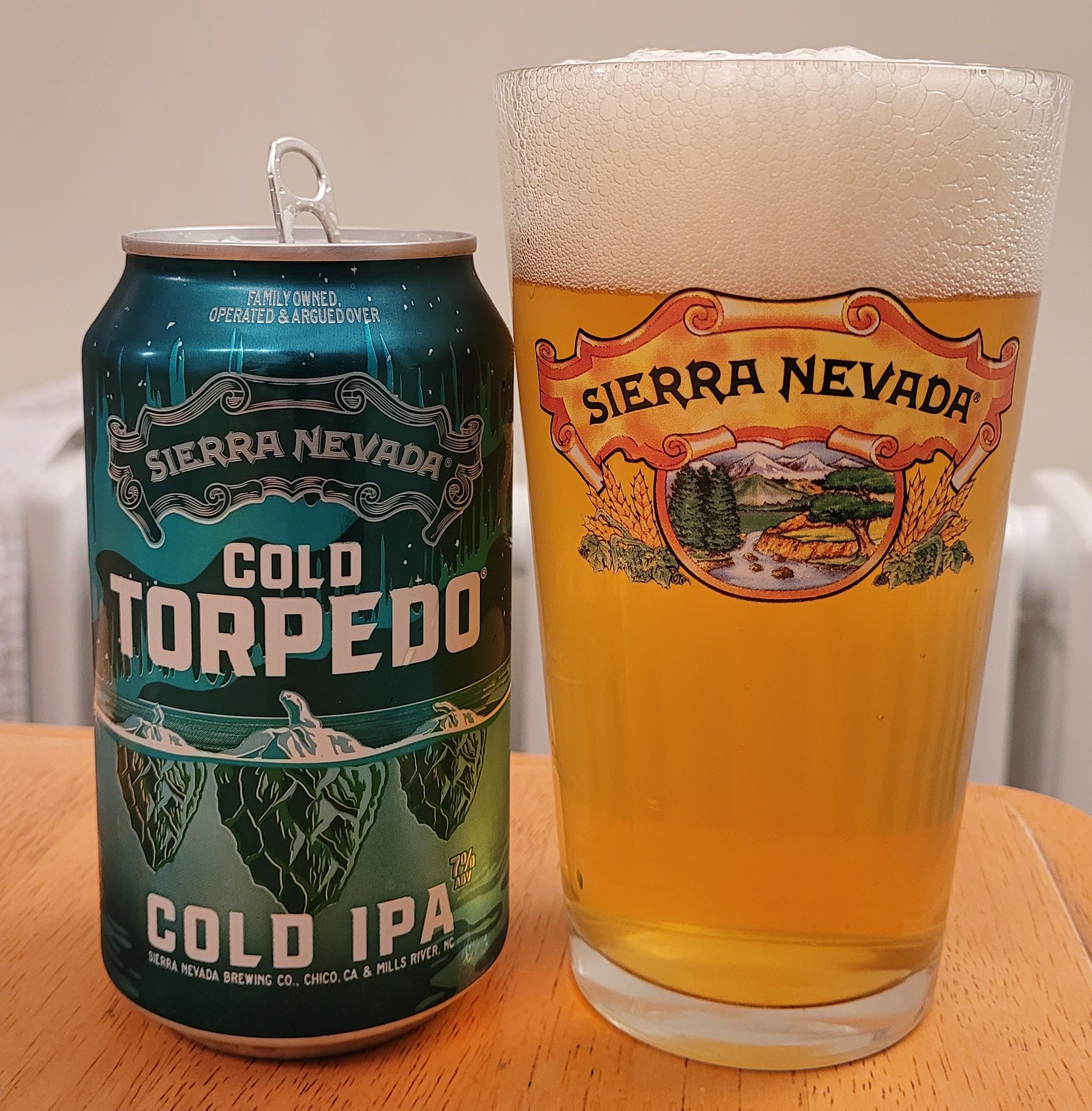
Another unfathomably fashionable IPA sub-style is cold IPA, and the brewery has given their fabulous Torpedo the lager yeast treatment to create Cold Torpedo. "Ultra-crisp and clean for peak drinkability" goes the blurb. Drinkability is not what I come to resin-bomb Torpedo for, so I was wary. Is this another ill-advised and unnecessary brand extension? I'm going to say "no". It is undoubtedly lighter than real Torpedo, and paler too, but the high-octane hop explosion is retained, and a certain amount of crispness suits it. It's still bitter and resinous, but without the weighty malt backing you get more of the fruity side: pith and zest, not just the oils. Lime and grapefruit gives way to apricot and cantaloupe. It's still a powerhouse, but on a more advanced and complex level. It makes for an interesting companion piece to Torpedo, which is what brand extensions ought to be.

Still, if Sierra Nevada are going to insist on chasing passé IPA trends, how about throwing us a black one now and again?

15 June 2022

Defcon FUN

I missed this one the first time it arrived on these shores, but it's back, in an even larger pint-can format. The strapline on Sierra Nevada's Atomic Torpedo is "Juicy West Coast DIPA", a phrase designed to mess with the head of anyone just getting into the myriad variations of contemporary IPA. Ah well.

It's 8.2% ABV and looks much like standard Torpedo -- a medium amber colour. It has a very similar resinous aroma as well. The flavour is where it changes. Where Torpedo transforms that resinous smell into a tongue-scorching resinous bitterness, this one is sweet and floral. I guess this is what they mean by "juicy" but it's not juicy, it's sweet. The resin is still there, but the bitterness is very muted, hiding behind meadowy violet and honeysuckle, with a side order of red onion relish.

What's most impressive is how well hidden the alcohol is: it does not taste like the strength. But at the same time it's not an improvement on regular Torpedo; perhaps they shouldn't have used the name. Torpedo is heavy and bitter, which is what makes it worthwhile and it's not a formula I'd recommend messing with.

For something considerably more easy-going, here's another in the endless ... Little Thing sequence of brand extensions. Sunny Little Thing is a wheat ale, doubtless designed to be thirst-quenching and accessible, though it is the full 5% ABV. Citrus flavourings are mentioned but not in detail; so is this one of those American takes on witbier that doesn't like using the word?

On tasting: not really. Those fruit flavourings aren't an afterthought or a garnish, they're the main act. From the first sip this tastes like fizzy orange squash, with an attendant weighty sweetness. The wheat should soften the texture and perhaps also dry it out, but dryness is not a feature. There is still a vestige of hops in the background, meaning it just about still tastes like a beer, but for the most part I wasn't impressed. The taste here has a good deal in common with the German and Austrian radlers for which I have a lot of time, but because it's stronger and denser it lacks their ability to casually refresh.

Perhaps I shouldn't be surprised that beers as excellent as Torpedo and Hazy Little Thing are used as bait by the brewery, to get fans to buy new beers with similar names. It's just a shame they seem nearly impossible to improve upon.

07 August 2020

Dancing to the beat

Remember brut IPA? The sub-style's brief moment in the sun a couple of years ago has left one survivor in the off licences of Dublin: Ska Brewing's Moral Panic. It has been around more or less since the craze began, and since it's still around and stocked freshly, I thought it was about time I gave it a go.

The pour gives us something pale yellow and hazy -- looking very summery in the sunshine -- and the flavour is a spritzy sea-breeze of salt and lemons. I was surprised to find it quite sweet: the lemons are candied, and a little syrupy. The brut-ishness comes in the texture, a watery hollowness that makes it very easy to drink but I think is preventing the taste from being as assertive as it could be. There's a certain tangy minerality in the background, though not as much as I was hoping for. This looks like a witbier, tastes a bit like a witbier, and can be put to similar sorts of duties, as an outdoor summer refresher, albeit slightly on the strong side for that, at 5.75% ABV. Still, don't expect any style-shaking peculiarities.

For something more up-to-the-minute and down-with-the-kids, here's a hazy IPA called The Hazy IPA. As always when a biggish American brewer puts one of these out in sufficient quantity for it to reach here, I have Sierra Nevada's Hazy Little Thing in mind. A tough contest.

This one is 6.5% ABV and is indeed hazy: a juicy-looking pale orange. The aroma is an enticing cross between orangeade and citrus sorbet. It tastes more serious, however. There's a little garlic or spring onion and a definite booze heat, sending double IPA vibes, punching well above its weight. The juicy citrus side -- satsuma, tangerine -- runs in parallel with this, a separate sweet counterpoint to the allium acidity. An earthy yeast bite finishes it off, adding nothing positive. They have managed to get the distinctive features of hazy IPA into this one. If the style is really your thing and not an affectation, then having a cheap and accessible mass market version should be a cause for celebration. Me, I'd take Sierra's answer over this any day. The rough edges that Ska has left here don't suit me.

A late addition to the set is The Aggrolite, a "lo-cal" session IPA, I guess for the benefit of those unconvinced by Ska's move into the hard seltzer realm. 4.2% ABV is comedically low for an American beer, and there's a thinness to the texture which over there they would likely expect from something this ridiculously compromised. For us, where it's perfectly normal, that's less acceptable. It smells like an old-school American IPA with a heavy dose of toffee-like crystal malt studded with jaffa-pith hops. That doesn't gel at all well with the mouthfeel; in fact it's completely out of keeping with the rest of the profile. It was quite a surprise to find it deliciously juicy and modern tasting, coming across like real mandarin flesh, the sensation just as you bite into a segment and the juice runs out. There's a faint aspirin or chalk twang in the finish but that juice comes back in the aftertaste. Once I learned to stop smelling it, I really enjoyed this. It's clear and clean too, another beer that shows murk is not required for juicy freshness. Lessons!

09 December 2019

Radical move

The distribution arm of Carlow Brewing Company, Radical Drinks, has added a couple of high-profile American breweries to its line-up, including Firestone Walker. Back in October they held an event at Urban Brewing to celebrate the visit of head brewer Matt Brynildson and it was a chance to taste a few of the FW beers I'd never had before.

That began with Luponic Distortion, specifically number 13 in this ever-evolving series of IPAs. Unlucky for me? No! They don't disclose what combination of hops go into each version but I'm guessing Sorachi Ace or something very similar plays a big part in this because here comes the coconut! When that fades there's a softer melon buzz, set on a body that's smooth and quite weighty for just 5.9% ABV: chicken feed as Californian IPAs go. There's even a little malt stickiness to balance the punchy hops. It's not a world-beater but it is a very decent, no-messing, American IPA.

Fashion caught up with us immediately afterwards, in the form of Mind Haze, the hazy IPA that has to be in everyone's portfolio. They've nailed the texture here: it's beautifully soft and fluffy. The flavour is quite muted, however. I got gentle wafts of peach, orange sorbet, and mild vanilla. The fruit builds a little as it goes, though forms nothing more intense than a mandarin orange by the end. Comparisons with Sierra Nevada's all-conquering Hazy Little Thing are inevitable, and I definitely don't consider Mind Haze to have the beatings of it. Maybe Luponic's aggressive hops spoiled me for it in advance.

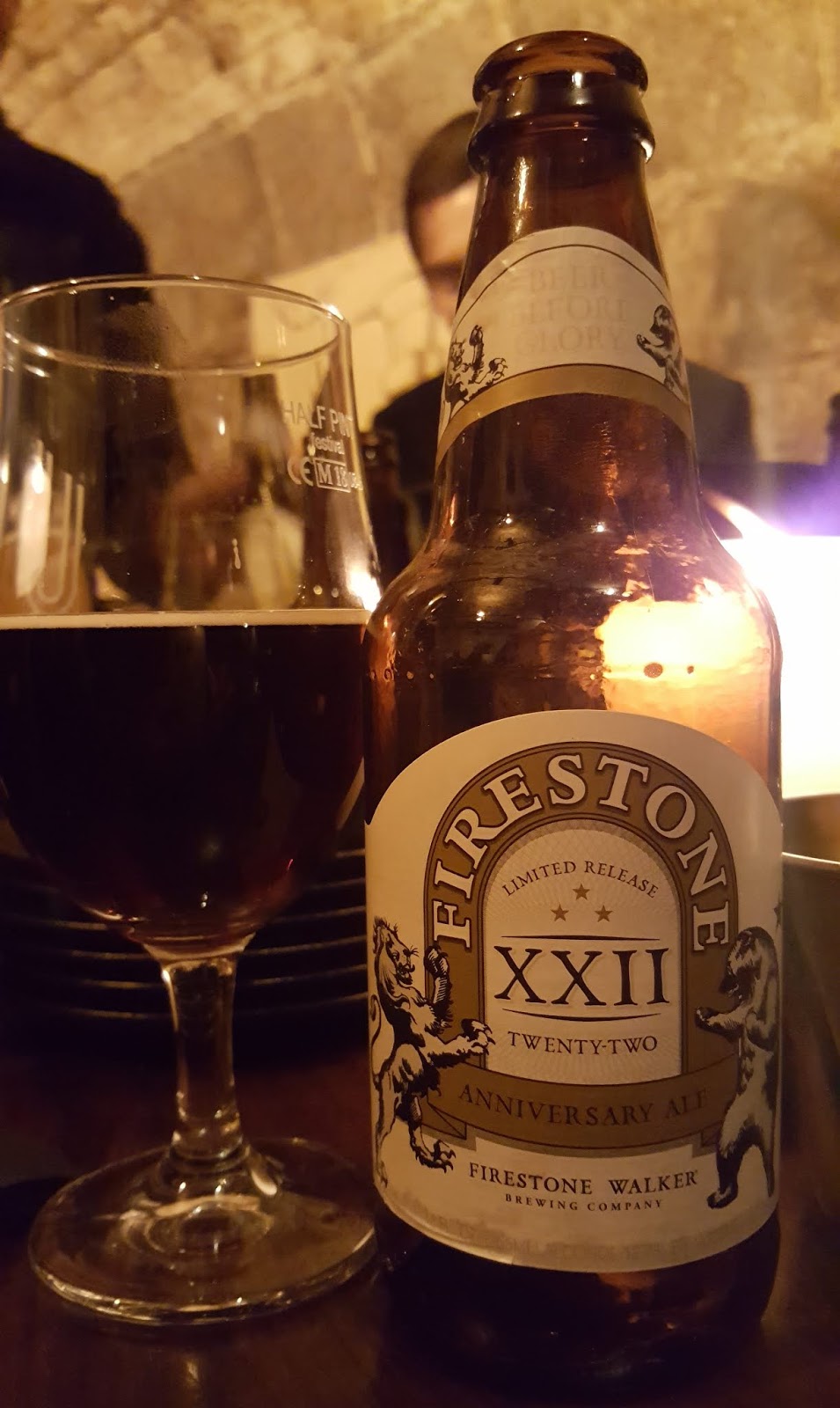
The evening's wow factor was brought by a beer that I don't think is part of the import portfolio: Firestone Walker XXII. This is the annual release of brown ale devised by the winemakers whose farms surround the brewery. My history with it goes back a decade, to the bottle of XII that Chris brought to the 2009 Franciscan Well Easter Beer Festival. This year it's 12.7% ABV. The caramel and coffee of the brown ale are still there, providing a baseline richness. It's then overlaid with an oaky Shiraz spice, floral Oloroso and herbal hippocras. A smooth alcohol heat turns the whole concoction into a glass of winter warmth. The barrel-ageing expertise is very apparent here.

While I was there, of course I tried what was new from Urban Brewing itself. These are long gone from the taps by now, but for the record:
Urban Grapefruit IPA is 6.2% ABV and arrived a clear golden colour. The aroma was a little off-putting, with a harsh sweaty character pervading. It tasted much better, thankfully. High carbonation and lots of real fruit give it an orangeade feel -- the traditional sort made from actual oranges. A sharp tang of pure grapefruit brings this to a crescendo in the finish. But before that there are hops too: nothing distinctive, but bringing a different kind of bitterness to the picture. I'm not normally a fan of these, but this was decent.

I wasn't sure what to expect from Urban Kveik IPA, not because of the farmhouse yeast, but because this was a mere 3.1% ABV. It's another clear one, and this time the aroma left me thinking of appleade. The texture of this was beautifully soft and silky while the flavour, though not massively complex, showed deliciously juicy nectarine and apricot. For the strength, it was a superbly satisfying beer and unlike anything else I've encountered. More beer of this density at this strength would be very welcome.

By way of postscript, brand new to the Radical Drinks range is a selection from New Belgium. These arrived shortly before news of the Colorado brewery's prospective takeover broke. It's just a handful out of the core range, and I was a bit excited as it's the biggest American craft brewer who had hitherto not been distributed in Ireland. The only packaged one new to me was Citradelic. This is a pale ale of 6% ABV, brewed with tangerine, orange and orange peel. It's a perfectly clear orange-amber colour in the glass. The carbonation is high but the flavour disappointingly muted. The two may be related. A dry crispbread effect is the first thing I taste, then there's a perfume waft -- not so much citrus as a concentrated floral quality. It tastes quite artificial. Fortunately it fades quickly and the best feature arrives: an aftertaste showing a buzz of real juicy tangerine, with an angry kick of bitter hops on the side. As with my first Fat Tire a few years back, I thought this would be better.

On draught we also get Voodoo Ranger Juicy Haze IPA. I thought I'd missed this on the initial release so was pleased when it showed up on the bar at The TapHouse. I was less pleased to find there's no juice, though it is at least hazy. Its taste is all savoury seeds -- sesame, poppy, caraway -- with a mild touch of vanilla. The texture is thick and cloying but not sweet, with lots of boozy heat from 7.5% ABV. This can't have been in the country more than a few months but it tastes stale. I'm blaming the recipe. Regardless, I got no brightness or freshness from my glassful, and this is absolutely not what one would expect from a beer calling itself juicy and shipped from Colorado. Dull, blunt and deeply disappointing.

Thanks to the folks at Carlow Brewing and subsidiaries, and Firestone Walker, for the hospitality. Among other things, I hope the production of more interesting beers at New Belgium lasts long enough for some to be exported in this direction.

08 April 2019

Brutal winter, cruel summer

A raft of new beers from the ever so industrious Sierra Nevada today.

It was still winter, just about, when I opened the Winter Warmer lager. This is a  potentially warming 6.7% ABV and a very dark red-brown colour. Not much head formed on pouring, and that dissolved to nothing in a couple of minutes, leaving it millpond flat. The flavour is typical of mid-European dark lager, big on liquorice and caramel, with lots of burntness too. There's a surprising lighter fruit side as well, bringing a squeeze of sweet cherry and blueberry. What it lacks is warmth. Though it has the same sticky dark malt of any dunkels or tmavý, the alcohol doesn't really push through. It's fine but unexciting.

"Spring seasonal" it says on the label of Sierra Nevada Brut IPA. Also that it was packaged on 17th December. Go figure. From the bottle it's a pure and clear pale gold. The aroma is quite sickly: a gastric acidity that made me slightly apprehensive. Thankfully there's none of that on tasting, just a lemon sherbet flavour, and not much else, really. It's surprisingly sweet for something that's apparently had all the sugar fermented out of it, a definite hard-candy effect. There's a certain tongue-shrivelling dry smack, but nothing dramatic. It feels a bit efforty, overall: an attempt to get down with what the kids are drinking that doesn't bring the Sierra Nevada finesse in the same way Hazy Little Thing did.

Back to lager again for the next one. Sierraveza is Mexican-style, tapping into that craft market for macro clones. It looks more like a Corona than a Negra Modelo: a pale limpid yellow with poor head retention. It also somehow tasted skunked, and given the brewery's attention to detail I can't help thinking that might be deliberate. There's a touch of Germanic heritage next -- some slightly harsh ryegrass noble hops and soft, sticky, candyfloss malt. It doesn't taste like a quality beer, and yes I know that's probably the point, but I also don't know why Sierra Nevada is elbowing in on Corona's territory. Their brand is cheapened by it and the drinker gets nothing worthwhile out of the arrangement.

Beer four is for charidee: Resilience, an open source IPA produced by multiple American breweries to aid relief from the 2018 Butte County wildfires. It's a dark orange job, the aroma redolent with toffee and caramel. The texture is smooth and the flavour dry at first, with a strong-tea astringency. Behind that are the fresh and fruity hops, bringing mouthwatering orange peel and spiky, earthy resins. It's another of those '90s style IPAs that I keep calling out when I see them but there's a new one every week or so. It won't be for everyone, tastewise, but I liked the complete eschewing of fashion in aid of a good cause.

Overall, not the brewery's best work, this lot. At least we can be assured there'll be something else from them along soon.

20 April 2018

Hi Sierra!

There was a veritable cascade of new Sierra Nevada beers in mid-March. It took me a while to pick my way through.

From the 4-Way IPA pack, we begin with No Middle Ground, claiming to be a fruity-hopped IPA with added cold-brewed coffee. It doesn't look great: a sickly, murky, orange-ochre. The aroma gives a sweaty stale coffee effect plus harsher more acidic hop bittering. Could the flavour save it? A little. The coffee turns fresher and the hops calm down, but neither really excels. That it was a November release suddenly makes sense as it's quite warming, plenty strong at 6.9% ABV, showing a thick toffee malt base, and then with the added creamy, oily coffee. That finishes quickly, however, and there's only a very mild twang of citrus after it. This isn't the crazy brew I expected it to be, but it's not terribly interesting either. I've tasted much more enjoyable coffee IPAs, and they usually throw balance to the wind and pump everything up more powerfully than Sierra Nevada has. Consider it a beginner's version of the style.

The other is Know Good IPA, one which claims no gimmicks or special features, just perfect straightforward US IPA flavours. It's 6.2% ABV, clear pale gold and has a gentle stonefruit aroma, showing apricot and plum. There's a quick bitter kick in the foretaste, chalk and grapefruit, but it fades quickly leaving a candy sweetness behind. Like the previous beer it lacks distinguishing features. Yes, it's balanced, and pleasant, and even moreish, but where is the Sierra Nevada razzle-dazzle, the one that made their Pale Ale so talked-about? I'd definitely swap it for a Torpedo.

Hop Bullet double IPA isn't part of the set, and though there's no packaged-on or best-before date, it's marked as a spring seasonal so I'm guessing it's fresher than the previous two. It pours an innocent clear pale orange and smells sweet and sugary. The flavour continues that theme, but adds a gentle spritz of orange zest too, finishing on a drier lemon bitterness. It's still quite light and plain, which is not what one expects from a Sierra Nevada DIPA, especially one with such an openly aggressive name, and 8% ABV too. It's a bit of a damp squib. Looking for answers on the label, it turns out the science part is the use of lupulin dust. Call me old fashioned but I think I prefer my US IPAs brewed with hops.

We're a long way from the finish and there has been no wow factor as yet, which is frankly astonishing. We move next into a quartet of beers using experimental hops. They don't have names yet, and we're not even given their code numbers. I can't help feeling I'm paying money to do the brewery's and grower's product development for them.

First out is Experimental Hop Pilsner, pale yellow at 5.5% ABV. I'm not at all sure that pilsner, of all styles, lends itself to experimentation. I'm happy with Saaz, thanks. This one smells properly grassy, with a touch of bread or cake, like a classic Czech version. The carbonation is low and the flavour offers that fresh-mown grass accompanied by a lemon-rind sharpness. There's plenty of light lager malt to buoy that up, and it does taste like a proper pils. But there's that lack of oomph again. It's not particularly hop-forward and doesn't offer much of a twist on the basics.

Experimental Hop Session IPA brings the ABV down a notch to 4.6%. It looks similar to the pils: just as pale with a little more haze. The aroma is mild but what's there is worryingly plasticky. The flavour, however, is massive coconut, almost exactly like Sorachi Ace but without the token orange pith. At least this one is easy to describe, and to be honest I'm glad to have something to hang on to. It is a little watery, though, and I'd never have described it as a session IPA without prompting: this hop, like Sorachi, will just make everything taste like itself and nothing else. At least we know that they're not using the same hops all the way through. Time to ramp up the strength.

The IPA was the best of last year's Fresh Hop set, so I was similarly optimistic this time round for Experimental Hop IPA. The aroma is an odd mix of the floral and citrus, like grapefruit handsoap. My optimism wilted a little. The flavour is bolder, but its first offering is a harshly savoury Mosaic-gone-wrong whack of caraway seeds. Behind it is a very strong sweet and oily blend of chocolate and orange oils: experimental in the hallucinogenic sense. There's even a slight curl of sweet and savoury smoke. The thick texture rescues it from too much weirdness, and there's a chompable chewy character, getting full value from its 6.7% ABV. The comedown is a far more normal punchy grapefruit finish. This was definitely the most interesting of the set so far. Would they double down for the double?

Experimental Hop Double IPA is an even 8% ABV and a pale copper colour. I wonder are the hops the same as in the session IPA because there's that coconut again, though sharp and spicy rather than rich and oily. It's properly heavy without turning hot, cementing the hop kick in a solid malt base. That said, I expected more complexity in a beer with this sort of poke. It's all rather one dimensional, bringing us back to the decent-but-unexciting earlier beers in the series.

Obviously nobody wants an experimental beer that tastes terrible. This lot, however, could have done with being a little more out-there.

The special bonus round is Braupakt, not actually a Sierra Nevada beer at all but brewed at their Bavarian collaborators' place in Weihenstephan. Broadly, it's a weissbier, though a big lad at 6% ABV. It's a murky and boorish creature, topped with a thick and awkward pillar of foam, though one which fades quickly. The aroma is a little harsh, blending banana with the strongly artificial citrus of toilet duck. Its flavour is a little cleaner, offering more crusty bread than fruity esters. The hops are mixing it in there, but as a thumping California bitterness rather than any depth of hop flavour. There are echoes of Schneider and Brooklyn's magnificent Hopfen Weisse, but only echoes: it falls a long way short. As a beer, overall, it's only OK, showing the features of its dual aspect but never managing to blend them into a greater whole.

Not much impact in this lot. I can't imagine any of these beers will be cited as life-changing the way Sierra Nevada Pale Ale frequently is. But there was one final shot at redemption, landing just a couple of weeks ago. Hazy Little Thing is Sierra's take on New England IPA, which in and of itself is fascinating. The style gets brickbats for being brewed in a slipshod fashion. How would it fare at the hands of a large brewer as experienced and fastidious as this?

It's certainly not as murky as a typical NEIPA, cloudy and translucent rather than soupy opaque. There's plenty of juice in the aroma: sweet cantaloupe and mango, with an underlying grassy spice. The texture is remarkably light for 6.7% ABV, with none of the milkshake gumminess I associate with the style, and don't miss in the slightest. The spicy bitterness is to the fore of the flavour, as well as a zesty citrus. There's not so much room for the juice here, the finish offering little more than a sharp metallic tang. It's still very tasty, and very easy to drink: I polished my can off in short order and was ready for another straight afterwards. This won't replace the murkbomb du jour in any haze-chaser's affection, but it's a damn fine beer and that's all that matters.