Showing posts with label galway hooker. Show all posts

20 November 2024

Clock this

I'm used to Irish breweries having a long gestation, from the first announcement by some ballsy entrepreneur to actually being able to drink a pint they brewed can be a long stretch, and often the second part never actually happens. So I was agog at how fast things moved with Changing Times. The news that a consortium of prominent Dublin publicans had bought the old Kepak warehouse in Glasnevin and were planning to set up a brewery in it only landed last July. Since then we've seen Franciscan Well co-founder Shane Long and former Trouble and Hope brewer Mark Nixon become associated with the project, and now only four months later, there's actual beer pouring.

The consortium of owners includes The Palace pub in Temple Bar, and that's where I went on the day after the high-profile launch to try out the first two. Any excuse to visit such a fine establishment.

Daydreamer is the lager, described on the badge as "snappy". It's a very pubbable 4.2% ABV and arrived extremely cold, with a €7.60 tab -- priced on a par with other independent beers. There wasn't much to say about it at first: lots of fizz and a tiny amount of haze on the pale yellow body. Given a moment, there's a pleasant cracker crispness (snappiness? sure, why not), and a moment later brings some Germanic hopping. That adds a different sort of crispness: crunchy green vegetables. With the pint half empty and warmed a little, there's a threat of butteriness in the aroma but the flavour stays clean and dry. This has the basics of decent lager, and certainly isn't a clone of the cut-corner big brands. At the same time, however, it's no connoisseur's lager and only hints at the fun you can have with good pilsner, Helles or the like. If the mainstream lager drinkers aren't completely tied to the familiar labels, this offers an alternative of acceptable quality. I'm guessing that's what it's meant to do.

Launching alongside is the pale ale, After Hours. They've put "hazy" on the badge, but it's not really much cloudier than the lager. Sorry, hazebros: nothing for you here. It's 4.2% ABV again, which puts in a competitive space with Little Fawn, but it's nowhere near that quality. The aroma is broadly about American hops, with a certain amount of pine resin, though nothing overboard. The texture is thin, and fizz is again central, something much less acceptable in a pale ale than a lager. In the flavour, the hops make a valiant effort to be heard, but can't quite manage it sufficiently. There are token quantities of juice and dank with minimal bitterness, so it fits the hazy profile in the most basic way but, to me, comes across like an Ambush that's been run under the cold tap. It's not offensive, bad, or poorly made, but it tastes cheap and dumbed-down. This sort of beer was radical in Ireland a decade and more ago. These days, I think even mainstream pale ale drinkers will find it lacks character. I wouldn't be fully confident that it's a trade-up from fresh Hop House 13.

So... I don't really know who these beers are for. I can't see any drinkers of the big brands making the switch, when they've already turned down the pre-existing alternatives. And this goes even more for the third in the range, Clockwork stout, arriving soon. Equally, there's not much to attract the seasoned drinker of microbrewed beers. I see After Hours working as a distress purchase, but I think most of us would prefer a Little Fawn, Ambush, Scraggy Bay or Galway Hooker. It's disturbing to hear already of independent breweries' taplines being removed from pubs which are part of the brewery consortium.

A brand new brewery means lots of new potential, but I'm not seeing that realised to any great extent in the first two beers.

19 September 2022

Clearance ale

I'm off on holidays for the next while, which meant doing a bit of fridge and notebook clearing before I went. Here's most of a summer's worth of randomly assorted Irish pale ales and IPAs.

Nasc was a traditional music festival held back in May at which Four Provinces had a beer of the same name. It subsequently showed up on draught in their pub which is where I found it. This is a pale ale of 4.5% ABV, amber coloured and decently weighty for the strength. Fresh American hops, and I'm thinking Cascade in particular, give it an intensely perfumey resinous character, reminding me a lot of Galway Hooker's now-iconic pale ale. It's every bit as sessionable as that one, cool and sinkable but with a long lasting bitter finish. I can see this being perfect for a festival, refreshing and unfussy but also packed with flavour. Only the slightly overdone carbonation would give me pause before going back to the bar for another.

Kinnegar has taken on one of my favourite beer styles, the sour IPA, with Brewers At Play 25. It's a modest 4.9% ABV and a lovely crystal-clear pale gold in the glass. The aroma suggests mandarin segments with a little zest while the flavour opens on a clean and refreshing tartness, with a kind of ascorbic minerality scouring the palate slightly. The vitamin C character continues into the finish with the return of the sweetly citric notes from the aroma. It works well, and I particularly enjoyed the way it emphasised the sourness over the hops. It's nice not to be complaining about breweries using the word "sour" on things that aren't.

I haven't seen beer from Tyrone's Baronscourt Brewing down in these parts before, or indeed at all, but Aldi had one in stock, a pale ale called Not A Flying Duck. It's a Lucozade amber colour and smells sweetly of sherbet and marmalade, very much in the English style. The label says it's slightly hazy with tropical aromas and it's neither, so let's draw a veil over that. I do believe them when they say it's dry hopped with Citra and Simcoe, so I guess it's the weighty roasted malt that covers them up in an effect that used to be called "balance" when such things mattered. The end result here is a traditional, retro, broadly American-style pale ale, with the clean tannins of a British bitter. It's been a while since I've tasted anything like it and it was fun to revisit.

Perhaps someone at Aldi likes a bitter because there's a new commission from Lough Gill as well, in the ESB style, called Watt. It's amber too and piles in the tannins. No pretence at tropical or American hops here: the flavour is very earthy and English. Lighter notes are thin on the ground but I detect a certain amount of summer fruit, some mild strawberry or cherry. Overall, though, it's a bitter bitter -- dry and attenuated, with even the malt seeming muted for 5% ABV. I got through it OK, but I didn't smile much.

For something fiercely modern, here's Hopfully in collaboration with Bullhouse, haze enthusiasts both, with a pale ale called Upstairs. The aroma is a little lacking in this, smelling delicately of sherbet and zest rather than anything brasher. The flavour too lacks hop impact. There's a pleasant lemon-sorbet bite and none of the vanilla sweetness nor garlic oiliness that often comes with these. But there's not a whole lot else. I find myself a little disappointed that it's not awful the way hazy hoppy things sometimes are, but neither is it one of the good ones. One-off collaborations tend to be on the extreme end of the spectrum, because why not, but this doesn't taste like two breweries who do this sort of thing as a matter of course trying to impress each other. If hazy pale ale were a shrug...

Lough Gill travel on the same lines with New Journey, a self-styled "DDH juicy IPA" of 5.7% ABV. No skimping on the haze here either: it's a bright eggy yellow, as I've come to think they all should be. Juice is promised and juice is delivered, from the noseful of freshly-squeezed you get from the aroma to the more intense lemon and lime of the foretaste, leading on to brief but pleasant mango and pineapple in the finish. Full-spectrum juice, this. Alas, that's not all and there's an element of dry and savoury grit which harshens the zing and roughens the zest. It may seem unreasonable to request a clean-tasting can of murk but I know it's possible so I'm keeping to my standards. As is, this is only OK. I don't know exactly where the polish is needed but it could do with some buffing up to really sparkle. Nice try, though. It had me for a moment.

Dublin contract brewer Fat Walrus has invented the "space IPA" style, for reasons of their own. Maybe it's the addition of Galaxy hops which make it so, but it's the reason it's called Galaxy Shmalaxy. It's a heady fellow, taking an age to pour and finishing with an impressive foamy bouffant over a translucent pale orange body. It follows that it's highly carbonated and that interferes a little with the foretaste. When the carbon dioxide subsides there's a lovely bittersweet twist of mandarin peel or orange liqueur, in classy cocktail kind of way. That fades to a dry bitterness which makes for an interesting contrast with a big fluffy mouthfeel, the sort of thing that usually comes with juicy tropical New England-style IPAs, and this isn't one of those. Yet it's no palate-scorching west coast creature either. Instead, it's a balanced presentation of Galaxy at its orangey best. Lovely. If that's space IPA, I look forward to the next one.

Hasn't O Brother run out of ways to make IPA at this stage? I haven't been keeping count but they've got through a lot. The newest is called Social Proof, Amarillo and Mosaic, 6.5% ABV and with a spritz of mandarin in the aroma. Nice. It's not exactly New England style but the mouthfeel is certainly smooth and soft, which is in its favour. No vanilla or garlic in the flavour, thankfully, and instead it has a lightly bitter meringue-pie filling character, finishing swiftly and neatly on citrus peel. It's an understated and unfussy sort of IPA, and I liked that about it. There's a lot to be said for not trying anything fancy.

The dadrock lyrics are in endless supply at Third Barrel, with the next being a double IPA called Coming Through In Waves. Hopwise they've thrown everything at it -- Mosaic, Sabro, Cryo Pop and HBC 630 -- though the strength is modest for the style at 7.8% ABV. It's extremely hazy, the colour of beaten egg with a gritty texture. The flavour has a certain amount of tropical fruit but it's in the ha'penny place next to a big garlic and spring onion twang, as well as a booziness that shows the strength as perhaps not so modest after all. It's not a great example of the style and I think the hopping may have been overambitious. Less garlic, more guava, please.

That's it for now. There was still plenty of beer in the fridge when I left but it'll have to wait until the autumn nights are drawing in before I get to it.

28 April 2018

Unshore

This blog turns 13 today, and anyone who has been reading it for a while will doubtless have noticed that I write more about Diageo beers than I used to. The reason, of course, is that there are simply more of them these days, since the Open Gate Brewery came on stream. For the record, I have always sought out and written about anything the multinational has released locally: you'll find reviews of The Brewhouse Series from 2005/6, Guinness Black Lager from 2010, Smithwick's Pale Ale from 2011, and so on. Hell, I've even taken notes on Harp. It's easy to think that The Brewers Project and Open Gate represented a turnaround in how the company sees the market, but of course they weren't, merely an extension into another segment of it.

And so it is that the latest Diageo release, Rockshore, is pitched at a whole different audience. It was developed at Open Gate Brewery, just like all Diageo's beers, but it doesn't bear its name, nor even that of Guinness. It's a 4% ABV lager of unspecified style. I haven't yet seen it for individual sale in the off trade -- eight cans or six bottles seem to be the only options. A pint it was, so, at the airport. "Best served ice cold" said the branded glass, and the bar definitely tried to optimise my experience, nearly giving me frostbite in the process. That produced a sensation very similar to the Coors Light experiment I ran a few years back: the beer is thick; syrupy and sweet. The first hit of flavour was ripe red apples, a lot like a sugary alcopoppish cider. That does fade quickly, but there's absolutely nothing behind it, for good or ill.

In its favour, it's not watery, it's not harshly carbonated and it does taste of something. In the minus column what it tastes of is not beer, isn't pleasant, and the thickness strips it of refreshment power, which I'd have thought would be one of the aims.

Two thirds of the way down my pint I discovered I had grown accustomed to the apples, and by the end I could see how someone would be happy to drink another straight afterwards. Not me though. Not when there's Galway Hooker on the bar and 40 minutes before my flight is called.

04 July 2016

Don't mention the war

It's come up before how Irish supermarkets are currently using beer as one of the weapons in their endless struggle for dominance over each other. This is a good thing, in my opinion. Even aside from the well-priced quality beer available, it's also a sign that the average shopper is getting more choosy about their beer. I've long said that beer is following where wine and coffee have already been: from a poorly served commodity to something that requires more than token planning by any retailer intending to sell it, and all driven, shaped, by consumer sentiment.

German rivals Aldi and Lidl both held drinks tasting events for their summer ranges in Dublin. Both leaned heavily on the wine side, of course, but there was beer too, and a chance to get a bit of a snapshot of how they see that market segment.

Aldi's event was in the classy surrounds of the Cliff Townhouse on St. Stephen's Green, the doors of the first floor veranda thrown open to the early summer evening breeze. Aldi has an established working relationship with Carlow Brewing and Station Works and it was more of the fruits of that which were on the table.

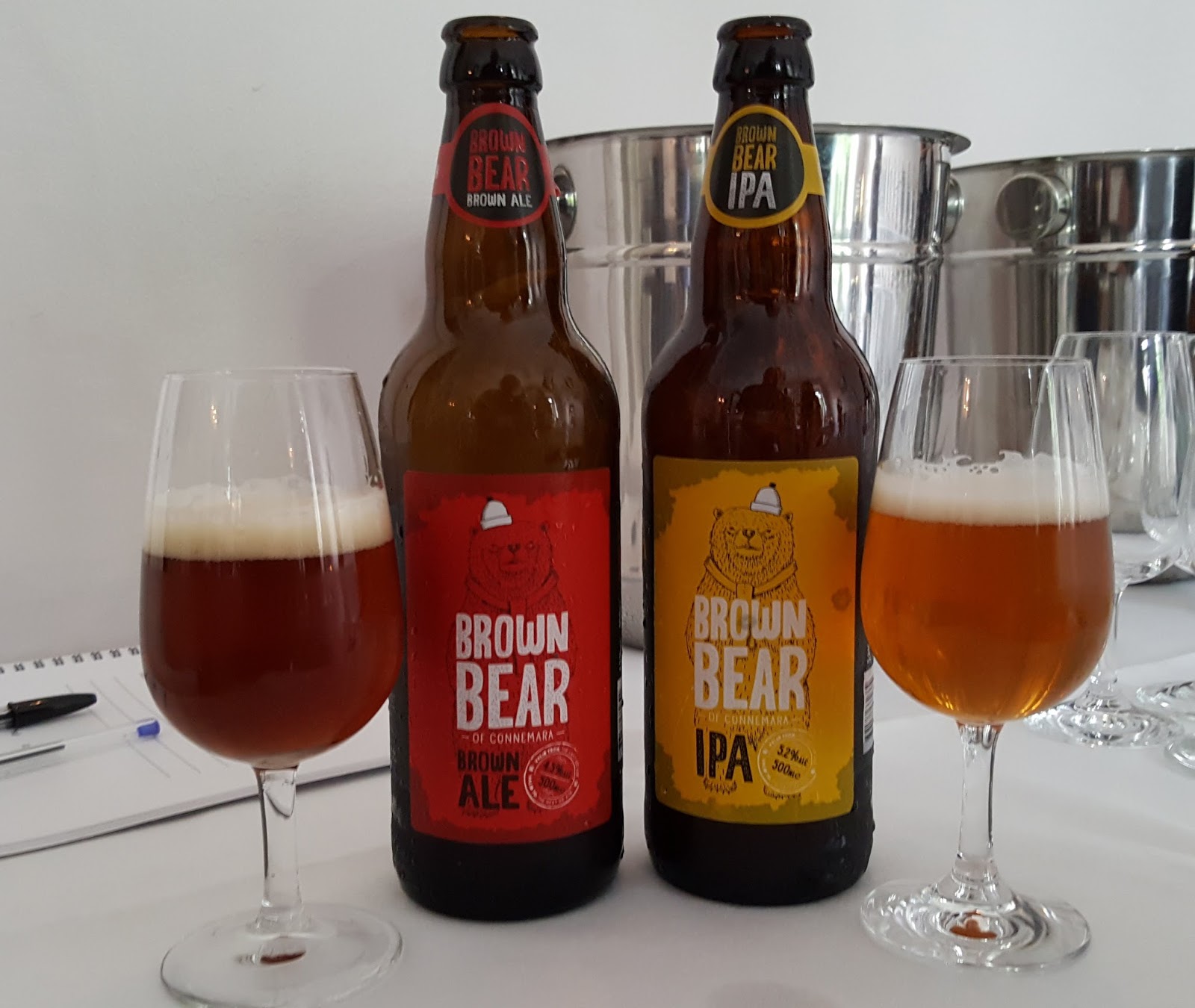
"Brown Bear of Connemara" is the rather odd name they've chosen for the latest set of Newry-brewed Station Works beers. Brown Bear of Connemara Brown Ale is 4.5% ABV, a tan amber colour and has quite a pleasant, on-style, toffee aroma. The body is light but the flavour, while complex, just isn't very nice. A sour-ish sweaty tang is the opener, then a kind of HP Sauce savoury thing, with date and tamarind fruit, finishing off with a slightly harsh and acidic hop burn. It is, of course, delightful to have a budget brown ale that isn't a sticky mess of caramel and butterscotch, but this swings just a little too far in the opposite direction.

Brown Bear of Connemara IPA is a deep gold colour, almost amber, and smells autumnally of moist musty apples and dry dusty crepe paper. There's less going on in the flavour, though it's all generally good -- a simple balance between citrus hops and lightly toffeeish crystal malt giving a sort of red ale/pale ale hybrid effect familiar to drinkers of Galway Hooker. Drinkers of IPA will probably bemoan the lack of hops in this one but I was just happy that it's not completely awful, in contrast to what I was expecting.

The O'Shea's range produced for Aldi by Carlow has seen an expansion by two, along with some down-wif-da-kidz new livery. O'Shea's Session Pale Ale has clearly been cut from the same cloth as O'Hara's 'OPsession as it's a similar brownish colour and has a similar rough dryness to the flavour. You get a little hint of grapefruit on the nose and the finish has a fairly harsh acidity that is definitely hop-derived, but just like its twin it fails to deliver what the style is supposed to provide: freshness and brightness.

The other newbie is O'Shea's Wheat Beer, 4.3% ABV and claiming Belgian influence though it's totally clear and I see no mention of any ingredients beyond malt and hops. It does smell spicy, however, which I suspect is the yeast at work, and the same goes for the slightly estery, buttery character as well. On tasting, the wheat cereal grains come forward in a big way leaving you with a mouthful of buttered toast. After this, the flavour just kind of wanders off mumbling to itself: vague herbs, a dry mustiness, a whisper of soft lychee, but nothing that really stands out. Inoffensive but lacking in character is my verdict.

Choice is a good thing, but the O'Shea's range has much better beers in it than either of these.

We'll stick with Carlow Brewing for the moment when we cross over the battle lines to a Lidl tasting event. Their marketeers took the rooftop lounge in the Radisson on Golden Lane and the spread was pleasingly beer-forward. Rather than pushing their own-label stuff, Lidl put the emphasis on more familiar brands that they've started stocking, including a couple of beers each by Rye River, Trouble and Carlow Brewing's own O'Hara's marque.

O'Hara's Irish Lager is a beer I haven't tried since its infancy as O'Hara's Helles back in 2013. I think it has improved since then, still assertively bitter but lighter textured and easier to drink. Only a slight plasticky burr spoils it for me.

The Shepherd Neame range that Lidl has always carried has been expanded, and a new one for me was Burns Ale. Apparently this is in a Scottish style but it tastes like lots and lots of other Shepherd Neame beers, with that stale orange peel effect. Though a mere 3.8% ABV it seems a lot heavier and has a sweaty, musty, burlap-sack flavour, plus a vomity metallic sharpness. Grim stuff, perhaps best suited to the dour presbyterian mindset.

Everything else new to me was Belgian. Lidl has taken on several beers from the Du Bocq brewery, including Corsendonk Pater (under its American name of "Corsendonk Abbey Brown Ale", for some reason) and this Gauloise range.

Gauloise Blonde is a decent go at the style with some light and clean melony fruit esters, a sharp bitter bite at the back of the throat and then a neat quick finish. One could accuse it of being boring but the well-hidden 6.3% ABV is its own sort of entertainment.

The ABV drops back to 5.5% for Gauloise Ambrée and, while definitely darker, this could pass as a blonde in a different range. I couldn't detect anything I'd describe as "Belgian" in the flavour profile; there's just a vague light biscuit thing. Simple, a little dull, but inoffensive, in short.

Gauloise Dubbel, is truer to style, though only 6.5% ABV, which seems rather low for a dubbel in my estimation. Again it's a simply made beer, making the right sort of raisin noises to pass as a dubbel but definitely too light, and with an off-kilter sherbet note that doesn't really belong but does no harm. There are better dubbels out there, but probably not in your local Irish Lidl.

Certainly if Petrus Dubbel Bruin by Bavik is anything to go by. This is 6.5% ABV again so maybe that's just how they make them now. For Lidl, anyway. It's a dirty beast, saccharine sweet with oodles of brown sugar and burnt caramel thrown in. Best stick to the Gauloise, if you're making a choice.

"Mediocre at best" is my bottom line on this whole shebang. Both Lidl and Aldi, have much better beers in their ranges than most of this lot. Full marks for constantly expanding the offer but I'd prefer a higher degree of pickiness over what gets stocked.

02 February 2015

The West...

A couple of weeks ago I took up the invitation from Aidan of Galway Hooker to visit the new brewery site in Oranmore with a group of fellow Beoir members. It's a hell of a set-up, all shiny and automated in a space that's more like an aircraft hangar than a typical Irish microbrewery, and certainly a long way from the cramped block-built shed where the brewery started in 2006. There's even a cosy tasting room on site where I got the chance to taste Galway Hooker Dark Lager for the first time.

This follows the Pale Ale and Stout to be the third permanent Galway Hooker beer and, for the moment at least, exists only in bottled form. I think I was expecting something black and schwarzbier-ish so was surprised to find it's much more on the Vienna or Alt side of the house: copper coloured -- not dissimilar to the Pale Ale, in fact -- and with a light, clean crunchy grain backbone overlayed with subtly green German hops adding notes of fresh rocket and raw spinach leaves. All very approachable, and sessionable too at just 4.3% ABV.

Another brewery on the grow is Beoir Chorca Duibhne in west Kerry who upgraded last autumn from their toytown half-hectolitre kit to a grown-up 5 barrel job. We've certainly been seeing the fruits of the expansion here in Dublin in recent months, with a sequence of bottled seasonals and beers on keg for the first time.

The latest of the latter was simply titled Dark Winter Ale and is a blend of Carraig Dubh porter and Cúl Dorcha dark ale with a finished strength of 5.7% ABV. Its appearance is true to its porter roots: brown-black with a creamy head. Yet the first thing I thought of on drinking it was pilsner and I suspect that's the German hops from Cúl Dorcha at work. Of course it's still malt-forward, but it's a particularly lagery crisp, wholegrain biscuit sort of malt. The hopping behind it shows lots of cut grass. Only when it warmed did I start getting hints of chocolate from the foundation porter but the sharp hop acidity still dominated. It's all just a bit too severe for my liking and I think I prefer drinking both beers separately.

This was in 57 The Headline which had another new western beer on tap just after New Year: Black Donkey's Belgian American Amber Ale, the first from the Roscommon brewery's pilot kit to hit the market. I won't sugarcoat my words here: I did not like this beer one little bit. It's massively musty, with the sort of dry rot stank you get in the less fancy charity furniture shops. Is it an oxidation effect? Might the grain have just been off? Is it something about the way the ingredients are combined? I don't know. But it didn't taste Belgian to me, and certainly not American. It's too dry for either and the only trace of fruitiness I could find was a tiny hint of red berry right on the finish. I'm all for playing with ingredients and styles but I wouldn't have been happy with a beer like this going out under my brand, though Richard the brewer tells me he got lots of positive feedback on it. Did anyone else out there try it?

Edited June 2015: This beer has since been relaunched under the name Buck-It. A change in the yeast seems to have fixed the perceived flavour issues.

A bit of a hop kick to go out on. Marcus from Reel Deel gave me this sample bottle of his second beer, Jack the Lad, at a do in 57 organised by his distributor, Vanguard. It's a 4.5% ABV IPA, a darkish clear gold colour and smelling pleasantly perfumed, with fabric softener and lemon cordial notes. The first sip delivered a big and pleasing dose of citrus hops but I think my palate adjusted almost immediately and subsequent mouthfuls were more muted. It's still hop-driven, showing sharp grapefruit and lime in particular, but there's a soft cake-and-candyfloss base behind it. Much like good ol' Galway Hooker Pale Ale, this is an easy drinker with plenty of hop complexity to hold your interest too. The suggested Irish cheese match on the label is a nice touch as well.

So that's some of what they're up to out west. The next post looks at a handful of new beers from points east of the Shannon.

12 December 2013

The wild geese

As the Irish beer market continues to grow, it's inevitable that contract brewing forms a big part of it. Of the Irish breweries who facilitate other brands, Eight Degrees in Co. Cork and Hilden in Co. Antrim are probably the most prolific. A few brands have opted to look outside Ireland altogether, either for reasons of cost and convenience or to avail of the expertise abroad. I'm looking at two of those today.

Brown Paper Bag Project have been going a couple of years now and Trinity is their fourth beer, and the third to be brewed in Belgium. The 75cl bottle badges it a tripel, and it's appropriately strong and golden, though rather brighter and clearer than most tripels I've met, with lower carbonation: all points in its favour. The aroma is more about fresh tropical fruits than yeasty spices and it tastes distinctly of pineapple juice. There's almost none of the complex earthy murk one often finds in tripels, nor the alcoholic heat, nor the golden syrup sweetness. Only a hint of cereals, hop bitterness and a very light spiciness in the finish hints at the style. As a frivolous, fun, cartoon version of a tripel I loved it. It's the sort of thing that would set Brouwer Van Klomp's teeth on edge, however.

One of the newest brands around is Stone Barrel, based in Dublin though the first batch of the first beer was brewed in the UK. It's called Boom and is badged as a "session IPA". It's not just the modest 5% ABV which backs up this designation: the carbonation is low, adding to the drinkability, and the flavours are a little muted too. The brewers were somewhat disappointed in how it came out, wanting more late-hop impact from the Simcoe, but it's perfectly decent as-is: there's a kind of herbal green flavour in the middle, backed by light biscuit malt. On the Irish hoppy beer scale it falls somewhere north of Galway Hooker but beneath O'Hara's IPA. It's a good first effort and I'm looking forward to seeing what they come up with next. Anything that gets more hops onto the Irish beer market is all right by me.

29 December 2011

Thorn on my side

Inevitable, really. Only a year ago I passive-aggressively ask the trade where the Thornbridge stuff is, and now there's more of it coming in than I can keep up with. So, this is a clearance of some stuff that's been sitting in my fridge for too long, plus some more recent acquisitions, all from the über-classy Derbyshire brewery.

I didn't get Kölsch until I went to Cologne. From the bottle and keg it had always just tasted like a dry pilsner to me, and a very plain one at that. What's the fuss about? That changed when I got to drink it closer to the source. The smoothness offered by the version served from wooden barrels in the better Cologne pubs adds a vital dimension to the Kölsch experience you just don't get any other way. So I was intrigued and more than a little suspicious when I got hold of Thornbridge's bottled take on the style. Would bottle-conditioning make that all-important difference?

Tzara pours a clear limpid gold. I was careful to avoid any sediment, but really there was very little to be found. The mittelfrüh hops are very apparent in the aroma: the heady fermented grassiness of warm silage. The flavour is sweeter, though, making the most of the carapils malt to balance the green flavours with a bit of residual sweetness. And most importantly of all, the carbonation is light. Not cask-smooth, but far from being pale yellow burp-water. I think they've done a good job here, and are showing the joy of Kölsch much better than, say, bottled Früh does.

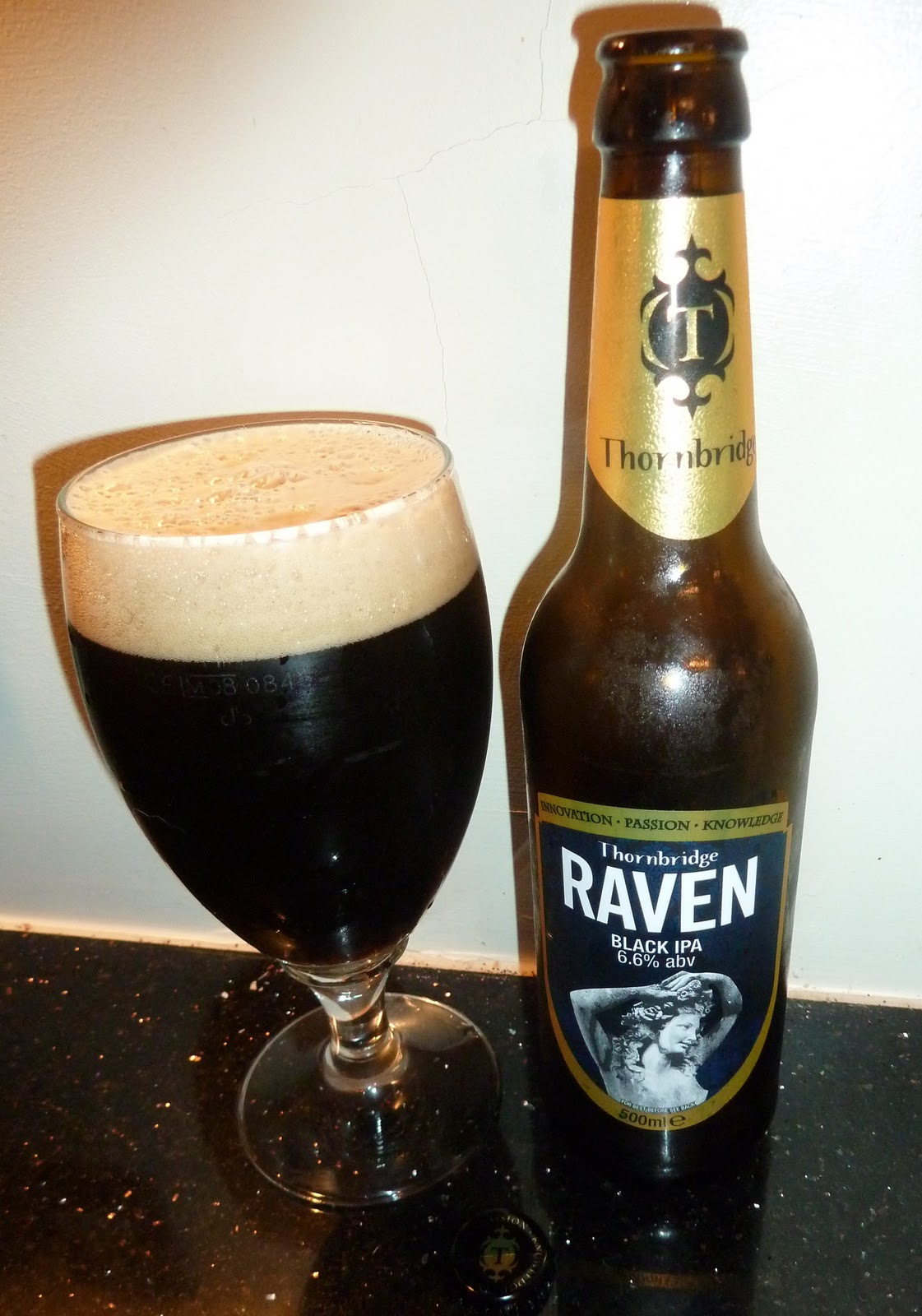
Raven, Thornbridge's black IPA, doesn't mess about. From the opaque black-brown body comes a bolt of pithy aroma preparing the way for intense bitterness on tasting. Dominating the proceedings is flinty Nelson Sauvin in its dry, less fruity, incarnation. I get a lot of the harshness I associate with Sorachi Ace in large quantities but none of the fruity peachy fun that I feel the Centennial ought to be supplying.

The wife really enjoyed it, and got a good roasted dark ale flavour from it. I couldn't detect that under the citric punch: it's another one of those black IPAs I would swear is pale when drinking with my eyes closed. There's no doubt Raven is complex and interesting, but I just feel a bit abused by it. Too much of a workout for my weak and feeble palate.

Next up, Versa, the puntastic weissbier. It comes out a lovely, almost red, shade of gold and only slightly hazy given the style. At 5% ABV it's on the weak side, and offers very little other than wateriness on the nose. What it loses in welly, however, it gains in drinkability. No overpowering banana esters or other heavy flavours. Instead it's mildly zesty with an easy-going sherbet effervesence rather than full-on fizz.

I'm sure it's a perfect summer refresher but I've no objection to it in the depths of winter either.

For the proper chilly evening sipper I've reserved a bottle of Bracia, Thornbridge's super-limited strong dark ale brewed from a whole host of malts, including brown and peated; a plethora of hops including Sorachi Ace and Pioneer; and with a bonus addition of Italian chestnut honey. It's a beer to take very seriously indeed.

It pours slowly and unctuously, lazily forming a dark tan head. The aroma is odd: lots of roast, but the dryness is sweetened by a floral character which I'm guessing comes from the honey.

It tastes weird. Intense perfume pervades the whole thing and makes it hard to get at the beeriness beneath. I can just about detect the peat, and the roast barley is present on the finish. There's possibly a bit of chocolate buried in there too, but overall it's quite difficult to take. Still, I suppose when it's €10 for half a litre you don't want to be charging through it. I'm not at all sure I'd buy another bottle, and the price is only part of the reason.

And that concludes the beer reviews for 2011. All that remains for this the last post of the year is the handing out of...
The Golden Pint Awards 2011

Looking back on the 2010 awards (2009 is here), I think I can safely say I achieved my ambition for 2011: to travel. 12 countries and 4 of them new to me is a personal best. And the beer scene in Ireland has moved on quite a ways in the past year. I'm excited at the thought of similar progress over the next 12 months. Anyway, here's how it's all panned out:

Best Irish Draught Beer: Metalman Windjammer
A brewery that was no more than a logo this time last year stormed out of the blocks with a kickass flagship ale and this stunning summer seasonal. All kiwi hops made it a pineapple and mango flavour grenade. I'm limiting the award to the cask version, however. It all fell a bit flat when filtered and kegged. Caskless Irish pubs: start your engines.

Best Irish Bottled or Canned Beer: Knockmealdown Porter
Lots of Irish beers made an appearance in bottles this year, including old favourites such as Trouble Dark Arts and Galway Hooker. I give the prize to another brand new brewery for 2011, however: Eight Degrees and their hefty-yet-drinkable porter Knockmealdown, though Franciscan Well's Shandon Century was a close second.

Best Overseas Draught Beer: Wild Esra on Cherries
Even at a festival where imperial stouts, barrel-aged rarities, sour one-offs and weird fruit beers abounded this one from De Molen had enough character to stop me and make me pay attention. It's the whole picture. The world of beer geekery in a single glass.

Best Overseas Bottled or Canned Beer: Great Divide Smoked Baltic Porter
They say Great Divide ain't gonna be exporting no more. I'm willing to donate one of the last bottles of this in the country to a local brewery for cloning purposes.

Best Overall Beer: Wild Esra on Cherries
No question. It's not a drink-all-year sessioner. It's an unforgiveably room-dividing one-off of the sort that shouldn't get awards from people who aren't insufferable rarity-chasing spoogebeerians. But it's just too damned tasty not to take the prize.

Best Pumpclip or Label: De La Senne Equinox
The wife spent a fair few days in Brussels on business this year, which meant a Belgian beer bonanza for me. Ordering by remote control can be a dangerous game but I've never had a problem in saying "Just anything by De La Senne. You'll know them by the labels." From a brewery with a wonderful eye for design, brooding Equinox is one of my favourites.

Best Irish Brewery: Metalman
You want to know what I think is missing from Irish beer? Bravery. With just a few exceptions, mostly from the established companies, we're still stuck in the Stout-Lager-Red Ale Beermuda Triangle of traditional Irish styles, only now we have a hoppy-but-sessionable pale ale thrown in too. Metalman, while sticking to a solidly reliable pale ale to make a name for themselves, haven't been afraid to play around with other ideas for the limited editions. So we had the antipodean-hopped not-quite-amber ale mentioned above for one, and second up was a peppered witbier made with saison yeast: Alternator. Beer is all about diversity and Metalman get this gong for giving us that from the very start.

More of this sort of thing, please, Gráinne and Tim.

Best Overseas Brewery: 1516
Back to the very top of the year for this one, and one of the highlights of my trip to Vienna. Breaking the lagerland mould with hoppy pale ales and plenty more besides. Bravery and diversity once again.

Pub/Bar of the Year: Bowe's Lounge
I haven't ventured too far from my usual local haunts in 2011: The Bull & Castle, Against the Grain, The Porterhouse, L. Mulligan. Grocer: chances are, that's where you'll find me. But we've seen an interesting development in Dublin pubdom this year. An increasing number of "normal" pubs -- some of them guidebook classics -- have started stocking beers from the independents. The bright green light on the O'Hara's IPA keg font is the most welcoming sight in any Dublin pub. It says "Yes, you can stay here for a drink".

The Palace on Fleet Street has long been ahead of this curve, but this was the year they went cask and got a Dungarvan beer engine installed. The Long Hall now has Hooker; there's Carlow bottled and draught beers in The Church on Mary Street. But one of the most enjoyable evenings I had all year was the Sunday night session in Bowe's Lounge. O'Hara's IPA on tap, Fuller's ESB bottled, and a casual yet wonderful trad session in the corner.

Bowe's is a decent, untouristy, unpretentious boozer that happens to take its beer a bit more seriously than most. We need dozens more like it in this town.

Beer Festival of the Year: Borefts
I think the local highlight was Bloom in Phoenix Park back in June, but the geektastic Borefts festival at De Molen in September was something else entirely.

World-beating beers aside, it was the most enjoyable drinking session I had all year. Thanks to Derek, Ron, Lexie, Mike, Chris, Dom, Evin, Menno and Her Outdoors for making it so.

Supermarket of the Year: No-one
Looking back, I realised I've bought next to no beer in the supermarket this year. None of the offers have really caught my eye. The only one giving us any decent amount of diversity is Marks & Spencer, and their stuff is just too expensive for what it is. I've been pleased to see off licence chain O'Brien's really raise their game beerwise this year, with Carlow, Dungarvan and Eight Degrees all now in stock. But really, only the independents have been meeting my needs in 2011.

Independent Retailer of the Year: The Beer Club
Partly because it's headquartered on my doorstep, but mainly because manager Stephen has shown an incredible enthusiasm for the whole speciality beer segment. It has been a delight to deliver the tasting sessions in the basement (and if you were at one of them over the past few months -- thanks for being such a great crowd) and even more of a delight to be at the sessions where other people did the talking. I'm looking forward to more of those in the New Year.

And extras like this aside, I love that I can just nip around the corner to buy beers I've never had before. I never thought I'd see the day.

Best Beer Book or Magazine: The Oxford Companion To Beer
Simply for existing, and being a huge sign of beer's growing stature in the culinary world. The errors and ommissions, while they should never have happened, provide a new opportunity to help right the historical wrongs that have been done to beer. As such, The Oxford Companion to Beer is the antigen in the beer writing system, and Alan's wiki shows a healthy immune system.

Best Beer Blog or Website: DrinkStore
Yes, it's a shop that sells beer online, but I'm giving it this award for its role as a  reference source. New beer comes and goes on the Irish market quite quickly, and not everything gets reported by drinkers in the field or the responsible retailers like Bradley's in Cork and Jay at Hollands of Bray. When I'm wondering where my next blog post is going to come from, DrinkStore's beer section is where I look first. Where did I find out that, at last, Ireland had Thornbridge? DrinkStore's website.

Best Beer Twitterer: BoakandBailey
One of the best things about their blog is the way it acts as a sort of clearing house for informed and mature commentary on all things beery. Their long overdue arrival to Twitter has extended that to the microblogging world and we get wonderful links and observations that we would otherwise miss. They get this award despite the unfair tweeting advantage of having four thumbs.

A dishonorable mention, of course, goes to SimonHJohnson. If you're into beer, on Twitter, and not following him, you're doing it wrong.

Best Online Brewery Presence: Eight Degrees
Dungarvan got the gong last year for sheer busyness. This year, for the same reason, it goes to Eight Degrees (not that Dungarvan have slowed down or shut up or anything). Great outgoing support for the local businesses that stock their beers, and by extension great support for the customers who want to find and drink it. Howling Gale on draught is a rare beast: it's great when Scott and Cam give us the coordinates to find it.

Food and Beer Pairing of the Year: Cheese, generally
I'm no wiser about the principles of beer and cheese matching than I was in January, despite the government dedicating an entire long weekend to teaching me. However, I've had an enormous amount of fun this year just picking random cheeses and beers and seeing what happens when they're put in close proximity. I'll be doing lots more of this in 2012.

In 2012 I’d Most Like To: Try going pro
I've had fun this year trying my hand at the whole public speaking malarky. Together with Stephen at The Beer Club I've discovered that there are people out there willing to give up their evenings to be talked at by me about beer (previously it was just a question of picking the bar stool next to me) and having a receptive audience and a bit of back-and-forth is very rewarding. So, more of that for 2012, until I decide I hate it and don't want to do it any more.

Which leads effortlessly into a shameless plug for the gigs I'm doing at The Carlyle Institute starting in January. Two hours; six beers; small classes; lots of cheery-beery banter and only limited quantities of awful puns.

Open Category: Most Exciting Beer City
By all accounts London has really got it going on at the moment. But I wasn't there in 2011 so can't comment. My award goes to Prague for its ale revolution sitting atop a well-deserved reputation for kick-ass lagers. Well worth a weekend if you're anywhere in the vicinity.

I wouldn't say no to a return to Vienna or Amsterdam, mind. It has been a good year.


But here endeth 2011. I'm off to the beer fridge to begin putting 2012 into some sort of drinking order.

12 September 2011

Diageo with a human face

It's a rite of passage for the Irish beer drinker to be able to reminisce on a failed Guinness brand extension. You're not fit for a bar stool if you can't bore innocent people senseless about your memories of Breó, or the St James's Gate series, or the Brewhouse series, or (the holy grail of failed Guinnesses) Guinness Light.

I've tasted most of these (yawn, yeah, whatever, grandad) and in several cases they weren't bad beers: they just weren't ready for that time and place. Diageo are currently pushing out a new brand extension -- this time to the venerable Smithwick's marque -- and, in the opinion of this amateur market analyst, it's in a much better position.

Smithwick's Pale Ale is a very pale -- blonde, really -- beer being launched on keg and in half-litre bottles around the country this month. It's 4.5% ABV and has been late hopped, including dry-hopping, with Amarillo. And it shows. While light of texture to the point of wateriness and a little on the gassy side, at least from the keg, there's no mistaking the flavour of proper hops: a sweet and juicy peachiness is given an empty stage to sing its heart out.

Cleary, a lot of thought has gone into this product, and it owes its existence to more than Diageo's general revitalising of the Smithwick's brand and the flatlining of mainstream beer sales in the developed world (though I don't doubt both those things had a lot to do with it). Why, of all things, a hop-forward pale ale?

Five years ago such things didn't exist here. Microbreweries made red ales, and lagers, and stouts and wheat beers. Then Galway Hooker came along and changed the parameters, eschewing the mainstays of Irish beer and going for high doses of Saaz and Cascades. Established craft breweries followed them and the hoppy pale ale is now in the repertoire of most of the nation's micros. It's an accessible style of beer and just different enough from the other taps on the bar to make it worth investigating. But most importantly it just tastes nice. You don't need a slick brand identity to shift this stuff, nor countless centuries of brewing heritage, nor suggestions of sophistication or the exotic. It's the sort of beer grown-ups like to drink and it stands on flavour alone.

There are apparently several more to come in this Smithwick's series, but I reckon they've started in a safe and sensible place, and my perspective on the beer offerings in the Typical Irish Pub is certainly brightened by its existence.

However, I also think there's a darker lesson for Ireland's independents. Medium-strength hoppy keg ales are done. Diageo make one now, and unless you can play the local card or have some other unique selling point I imagine it's going to be a much harder thing to flog. Time to make something else.

07 July 2011

I know why the lizard croaks

All of a sudden it seems like there's loads happening on the Irish beer scene. For one thing, Franciscan Well have a new seasonal out which I caught up with in the Bull & Castle recently.

Croaking Lizard is a brown ale of the murky reddish variety. Where one might expect a certain sweetness, this is incredibly dry with lots of roasted grain, almost akin to a stout or schwarzbier, in fact. At the end there's a little kick of vegetal hop bitterness. But no coffee, no caramel: none of the flavours I'd consider important in a brown ale. I did have a second one, just to get my head around it, but I don't think it's for me, really. If you're looking for something light, crisp and quite fizzy, however, this could be the dark beer you're after.

Meanwhile, the most hotly-anticipated new arrival finally made its debut at the end of June, with the appearance of Galway Hooker in bottles. I'm actually a little surprised by how hotly-anticipated it still was. Irish drinkers have been clamouring for bottled Hooker since the time (up to a mere three or four years ago) when it was the only Irish beer in permanent production and distributed widely that had any kind of hop character to it. Since then we've been able to take home Porterhouse Hop Head and O'Hara's IPA, yet still the cry has been "We Want Hooker". Now that I've had a bottle -- a half-litre resplendent in its county colours -- I think I can see why the attraction is still there. Though lacking the punch of Hop Head and the strength of O'Hara's, it's doing its own thing: very sessionable at 4.3% ABV yet rounded out with a crystal malt sweetness that the others haven't matched. For me, the real bonus has been a whole glassful at cellar temperature. The anticipation of a dry-hopped cask version is almost unbearable.

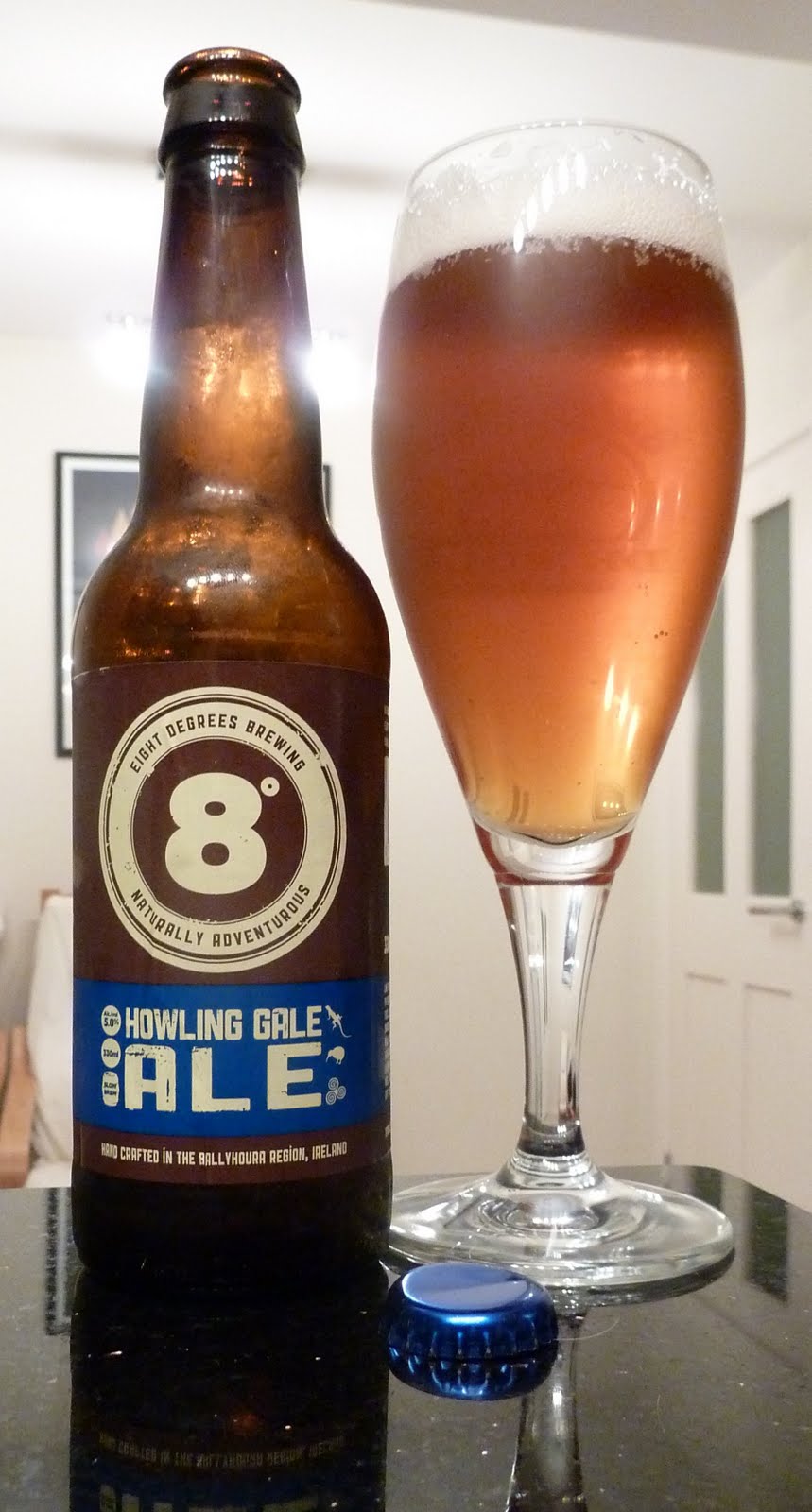
Also fresh off the bottling line is Eight Degrees's Howling Gale. Bottle conditioning in 33cls makes this an even more complex affair, with a bit of yeasty grittiness in with the intense hop bitterness, plus some sweet biscuit malt just peeping through at the end. The guys say the second batch was done with an adjusted hop schedule so I'm looking forward to comparing the two, pathetic geek that I am. In the meantime, keep inspecting the fridges for Howling Gale. The second in the Eight Degrees series -- Sunburnt Red -- should making an appearance soon too. (Oh, today, as it happened. Now on tap at L. Mulligan Grocer.)

And finally a whole new brewery has brought its wares to Dublin. BrewEyed is based in Co. Offaly and met the public at the Brewers on the Bay festival in Galway last April. I happened across BrewEyed Lager when out for a few leisurely Sunday beers in The Village on Wexford Street a couple of weeks ago. This is their first release and as such I wasn't expecting much from it. The tang of cider in the aroma immediately put me on guard for a poorly constructed lager. But beyond it I found a remarkably well-made pilsner. There's a decent amount of sweet candyfloss malt forming the base, and then some lovely grassy Czech hop notes, including a touch of asparagus, rounding it out. Maybe there's a slight oxidised note in there too: another flaw one can expect to find in a first-run beer. But overall a promising start and I look forward to trying the blonde ale when and if that appears in these parts.

06 June 2011

Days of beer and roses

The Irish summer made a fleeting appearance late last week, coinciding with the opening of Bloom in the Park, a garden festival organised by Bord Bia, the state food promotion agency. Bord Bia are long-standing friends of the independent beer movement in Ireland, having organised the SeptemberFest extravaganza in 2008 and 2009. Last year it was incorporated into Bloom with the creation of the Bloom Inn tent. This year saw the Bloom Inn return, in a larger double-dome form as part of an artisan food village which included pigs-on-spit, Murphy's amazing ice cream, pies, cheese and all the other wonderful foodie delights of which this country has every right to be proud. I spent Friday afternoon dodging the rays and beering and pigging my way round.

Nine of the country's craft breweries were represented at the Bloom Inn, with a mix of their core beers and some specials and seasonals. Unsurprisingly on such a scorcher, the highlight for me was an ice-cold lager. When I visited the revamped Messrs Maguire brewery back in January I remarked on the excellent unfiltered Haus lager, served from the conditioning tank. It stayed there for a while as Mel wrestled with filtering hardware. I'm delighted to say that she eventually gave up and the Haus now in commercial circulation is unfiltered, and really quite wonderful. Amber and only slightly hazy, it's crisp, full-bodied and ever-so-slightly sweet with a light hand on the carbonation. Irish lager is rarely so good.

Galway Hooker was another star of the day: Ronan had the inline chiller turned up to 11 and the pale ale was pouring beautifully. For once I wasn't complaining about the ubiquitousness of hoppy keg ales in Irish brewing as it was just the day for them, with 8 Degrees Howling Gale, Trouble Ór, O'Hara's IPA, Porterhouse Hop Head and Metalman Pale Ale all just the ticket. At the cask-only Dungarvan Brewing stand there wasn't much action between the two stouts, but Helvick Gold was wonderfully cool, refreshing and full-flavoured. While I was overjoyed to find Metalman Windjammer on cask again, it was let down by a too-high serving temperature, but fortunately it was also on keg: the right dispense method for the weather, especially since the keg edition retains a lot of the cask's delicious tropical fruit flavours.

Just one brand new tick for me, from the always-inventive White Gypsy. Bruin is billed as a "Belgian Brown Ale", which had me thinking of tart Flemish red style flavours, but it's quite different. I guess the best way to describe it is a light dubbel: it's a rich chestnut brown, smooth and incredibly fruity, packed with the banana flavours closely associated with Belgian yeast working at high temperatures. There's lots of filling malt sweetness too, hinting at raisins and chocolate. The cask dispense added to the smoothness but it was still a bit of effort to drink it. Even though there was a cooler in action it was just a bit warm for the day that was in it. A beer to save for a rainy day, perhaps.

Today is the final one of Bloom 2011, with the curtains coming down on the beer tents at 6pm this evening. If you're anywhere in the vicinity of the Phoenix Park, go.

Hearty congratulations are due to Bord Bia for putting on a superb show, very well organised and great fun to attend. And a big thanks both from Beoir and me personally for providing this platform for Irish craft beer to show off to a crowd which otherwise might never notice its existence. Here's hoping for many more years of the Bloom Inn.

28 March 2011

New tack

It's Porterhouse Independent Irish Beer and Whiskey Festival time once again. And, also once again, they've re-jigged the way they're doing it. Instead of splitting the line-up across several bars, they've asked each one of Ireland's micros to supply just one beer and all of the 14 submissions are available across the estate including (apparently) London and New York. I called in to the Temple Bar branch on Wednesday last for the results of their annual, blind-tasted, competition of the festival exhibits. Just one overall gong this year, plus two runners up. And all worthy recipients too: first prize to Mel Camire for the fabulous Messrs Maguire Brown Ale, second to Franciscan Well's excellent Purgatory, and bronze medal for the newest arrival Metalman -- one hell of an achievement given the seasoned competitors they were up against. Metalman Pale Ale is now officially superior to O'Hara's Stout, Galway Hooker and Wrasslers XXXX. Tremble in your wellies, established brewers.

The Porterhouse's ever-generous hospitality gave us Beoir members the chance to do some comparisons of our own from among the festival listings. There was just the one new beer to me: White Island Wheaten Ale from yet another newcomer to Irish brewing: Fermanagh's Inishmacsaint. I already tried their lager (here) and was impressed, though perhaps more by the technical prowess than the taste of the beer. I reckoned the wheat beer would be more interesting. And it is, no doubt, just perhaps not in the way I'd anticipated.

As it happened I was surrounded by brewers when I brought the bottle back from the bar and offered it round. Every one of them recoiled in horror at the smell and screwed up their faces at the taste. I'm pretty sure this is wheat beer as no-one but the Good Lord intended it. It pours clear and starts with some fairly serious vinegar on the nose. The texture is highly attenuated, thinned out and barely discernible as a wheat beer at all while the taste is both sharp and sour with a major lactic sour-milk tang on the finish. I'm no Quincy, but I would guess that something in the lactobacillus line got in here and had its wicked way with the fermentables.

And yet, perhaps because I'm not a proper brewer, I thought it still had something going for it. Other non-brewers in the company thought so too. The thinness and sharpness is at least clean, with an interesting bite. Could it be that what we have here is a new lambic appellation? No, probably not. I would guess that if Gordon gets the right sort of feedback he'll have this cleaned up and tasting properly Bavarian in no time.

More's the pity, perhaps. It wasn't that long ago that brown or hoppy ales wouldn't have stood a chance in an Irish beer competition. Why not give the sour side a fair crack of the whip?

The Porterhouse Independent Irish Beer and Whiskey Festival runs until Sunday 3rd April.

04 March 2011

Whatever you're having yourself

Session logoA particularly awkward Session topic for me this month. Stan Hieronymus has set it up, picking "regular beer" as the theme. Now, it's not that I'm short of regular beer: the variety of quality everyday beers in Dublin has increased enormously over the past year and I genuinely need to think about what I'm in the mood for when going for a pint in my regular haunts. And therein lies the problem from a blogging point of view: most of the beers in question are so new I've probably written about them recently already: the likes of Trouble Ór, Helvick Gold and O'Hara's IPA. Between these and Galway Hooker we are living in a golden age of golden hoppy Irish draught ale, and I couldn't be happier.

So, if I'm not going to bore you with re-runs of my regular pub beers I'll have to go home and see what's in the fridge. As well as the fodder for this blog, there are still quite a few other commercial beers that I like to buy regularly. I rarely pick up more than three or four bottles of these at a time: the lack of a car means that beer-by-the-case isn't really an option for me. For everyday stock-in-trade home drinking, I rely more on the beer I've made myself.

You won't find me writing much about my brewing on this blog. I've been dabbling for the last two years, playing about with dry malt extract and dry yeast and have been generally quite pleased with my efforts, despite the limitations inherent in my system. Experimenting with hop varieties and specialty grains is fun, but I've also gradually developed a shortlist of recipes that have become my regular beers.

About every second or third batch, for instance, is a 5-point-something % ABV pale ale, generously dry-hopped with citric US varieties. It's still very much a work in progress, and quite possibly always will be, given the range of hops available and the different ways of combining them. But if I ever do get my Cascade, Centennial and Amarillo lined up just right I may well just leave the recipe alone. I tested the current incarnation earlier this week, just nineteen days after it went in the bottle. Hopwise it's all Cascade which is giving some lovely spicy, pithy flavours, but I think it still needs to settle down a bit. I've also, experimentally, switched yeast to Nottingham rather than the usual US-05, following a price hike in the latter. My regular supplier (www.thehomebrewcompany.ie) has since brought the price back down and I reckon I'll be swapping back to US-05 as I'm not sure Nottingham is as neutral as I'd like.

More recently, I've become a slave to brown malt, having done a couple of batches of porter which lays it on thick (a kilo, steeped, in about 23L of wort, with just a little black malt for balance) giving a wonderful milky coffee flavour. I keep the ABV low, not much over 4%, which not only produces more beer out of a 3kg bag of malt extract, but also leaves the beer light enough to throw back. As an end-of-the-working-day session beer it's just about perfect.

That's it for this break in your normally scheduled blogging. If you'd like more brewing commentary in with your beer reviews, may I recommend my friends and compatriots Reuben and Mark. And of course the obligatory plug for Beoir: Ireland's organisation for drinkers and brewers, a community populated by both the serious amateur brewers and those like me whose main interest is having a convenient supply of quality everyday (tax free) beer.

04 February 2011

That's gas

Session logoThe Session rolls round again and once more I am permitted to digress momentarily from my usual straight-laced beer reviews and propound one of my half-baked general theories on beer at large. Reluctant Scooper has picked the topic: nothing more controversial than Cask, Keg, Can or Bottle. Nothing anyone, particularly in the UK, could possibly get heated about, then. With that in mind, allow me to tell you how it is.

Cask beer is still very much a novelty in Dublin, even though I now need to employ the fingers of both my hands to count the pubs where it's readily available. Between these places and the growing festival circuit, there's plenty of opportunity to compare keg, bottled and cask versions of the same beer. (I'm not going to touch the bottle-conditioned vs. force-carbonated-bottle issue as I think it's usually more of a marketing sideshow than a real taste issue). I think, after much deliberation, I've come up with a grand theory of How Cask Beer Is Different From Keg Beer. Here goes:

Cask blends, keg separates. That is, in a keg beer you get each element of the flavour served to you by the carbon dioxide separately: here's some hops, now here's some malt, now here's some yeast esters. With the calmer gas of cask, all of this gets mixed in together and you get a smoother and altogether more holistic experience: your pint is doing one thing. It may be a very impressive balancing act, but it's still just one thing.

The problem with keg is that flaws stand out a mile. They jump out of the glass and have a whole platform to themselves from which they can wreak havoc with your drinking enjoyment. That little bit of oxidation? Those funky off-notes the yeast threw? The watery absence of any proper flavour? There they are, large as life.

Cask will shut them up. But, of course, carbon dioxide doesn't know the difference between a flaw and a subtlety, and cask serve can very easily bury delicate flavour elements, especially in stronger beers. If you want to make the hops shine in a cask beer you need to dry hop it or risk their being shouted down by the malt.

By way of evidence I present three Irish beers I've had the pleasure of in cask and force-carbonated form. Clotworthy Dobbin is the one I usually cite in evidence because the difference is so startling. Bottled and kegged Clotworthy is a work of incredible balance: chocolate raisins from the malt are given a spicy green twist by the American finishing hops. A mouthful goes maltmaltmaltmaltHOPS! On cask, the hops just vanish and you're left with a big heavy, but rather dull and monotonous, MALT.MALT.MALT.

Galway Hooker is less understated with its hops: Saaz and Cascade bounce around in a zingy grassy fizz-driven flavour bomb. Take away the fizz, however, and it's like a balloon from last year's birthday: sad and shrivelled with just flat, sharp vegetable flavours on water. We've not seen cask Hooker for a while now, though the rumour mill has it that a dry-hopped version may be on the way and that should do it the world of good.

Finally the first edition of O'Hara's Leann Folláin. The bottled version had a jarring oaky sort of tang apparently caused by the yeast. It wasn't meant to be there (and, happily, it's absent from the version now on sale) and it really spoiled the party in what should have been a great extra stout. I couldn't believe, when Leann Folláin showed up on cask in the Bull & Castle, that there was no sign of the off flavour: all was happy, stouty, normal chocolate malt and roast barley, and absolutely delicious to boot. The difference between the two was truly amazing. Cask blend effect to the rescue!

So there you have it. Some beers suit cask better than keg, and some the reverse. It just depends on the beer. Brewers generally will have one or other in mind when they assemble the recipe so it's not surprising that a beer brewed for keg is sometimes lacking on cask, and vice versa. In the UK, the cask and keg or bottle versions of supposedly the same beer are often brewed to different recipes, sometimes even in different breweries.

Enough controversy for one post? Nah. I'm just getting warmed up. Can we do black IPA next? Much electronic ink has been spilled in debating the ins and outs of this recent addition to the beer classification firmament. Is it a whole separate thing? Is it just hoppy porter? And are any of the other names more suitable than the oxymoronic "Black India Pale Ale"? I happen to have one in front of me, kindly gifted by Oblivious, but I'm not going to delve into any of the taxonomic issues. It's not like I'm organising a competition.

More relevant to the topic at hand is the dispense method: this is the first craft-beer-in-a-can that has crossed my path. The brewery, 21st Amendment of San Francisco, has pioneered the practice, and breweries all over are following suit. And it's yet another thing that some beer commentators get highly vexed over. Just as there are some who believe -- despite the logical absurdity of the position -- that cask beer in prime condition simply cannot be bettered, there are those who believe that good beer cannot come in cans. Daft absolutist statements are perhaps best treated with a nod, a smile and another pull on your pint. It's better not to engage. So, without any prejudices on style or dispense, how is 21st Amendment Back in Black?

Rather than pure black, it's more of a dark but translucent ruby red in the glass. The aroma is striking: brewery-fresh grapefruit. Not at all boozy despite a considerable 6.8% ABV, no acid harshness: just citric hops in perfect balance. The head is tight and lasting and the texture light. On tasting it's definitely an IPA. Maybe not an especially hoppy one -- the taste doesn't deliver the full-on experience promised by the nose -- but it's gently fruity and very drinkable. As to the dark malts, they add a token dusting of dry roast and chocolate, but nothing that would make anyone call this beer a porter. Drink it with your eyes closed and you'd be hard pressed to tell it's black. An all-round decent US IPA that just happens to be darker than most.

But would you know it didn't come from a bottle? No. It tastes much fresher than a lot of American hoppy beer we get, but then it was imported by Oblivious directly. From the drinker's perspective I see absolutely no downside to quality beer being packaged in cans.

As with any method of dispense: if it tastes good, do it.