Showing posts with label pliny the elder. Show all posts

28 April 2025

It was twenty years ago today

In February 2005, Russian River launched the world's first triple IPA, Pliny the Younger. A few months later, on 28th April, I stopped putting things off and published the first post on my new beer blog. The two of us have not met previously, but here we are at last, on the 20th anniversary of me getting this thing moving.

I can't remember the last time I saw a clear triple IPA, but it's quite the thrill: the promise of a strong, clean, upright and muscular experience; a beer six-pack of a different sort altogether. The aroma is pure West Coast, but not in an especially intense way, just nice sparks of grapefruit zest on a clean malt base which calls to mind strong pale lager. Flavourwise, it's not hugely different to how I remember its double IPA antecedent, Pliny the Elder, tasting: an orderly array of classic American IPA characteristics, including grapefruit, pine, orange peel and a touch of spicy, herby, cannabis. The extra strength does make a contribution to all this, though, preventing any harsh IBU-chasing bitterness by adding a slightly syrupy residual-sugar effect. Despite it, the heat intensity is restrained and I wouldn't have guessed an ABV as high as 10.25%. This is drinkable rocket fuel.

Overall, it's a jolly decent beer. I get how, two decades ago, it would have been eye-poppingly amazing. At the time, I was only just discovering what Sierra Nevada Pale Ale does, and there wasn't a single commercial brewer in this country using Cascade hops, never mind anything more intense. But triple IPA made its way here eventually: half way between 2005 and now, Trouble Brewing released Ireland's first, and it wasn't markedly different to what I have in front of me. Since then, American IPA went tragically off course [insert politics joke here], and there are now any number of hot messes claiming to be worthy triple IPA, so the amazement factor is now back, except in retro mode: this is great because hardly anyone makes IPA like it, or as good, any more.

We're just two twenty-year-olds, having fun together, not caring that the rest of the world has moved on. A big thanks to Paul for gifting me the bottle.

07 April 2017

Changing tides

Session logo"Imports" is our designated topic for The Session this month, set by our taskmaster Christopher at I Think About Beer. He asks a very specific question of us non-American participants: "How are American beers (imported into YOUR country) viewed? What is their place in your market?" and I think now is a particularly interesting time to answer it.

When I started taking a serious interest in beer, the speciality and niche end of the market in Ireland consisted almost entirely of British and Belgian imports. You'd get a few central and eastern European lagers and wheat beers bundled in with them, but Britain and Belgium was where it was at, on the off licence shelves, in the pub fridges and the tiny handful of online outlets.

I reviewed my first American beer, Sierra Nevada Pale Ale, in my fifth ever post in 2005. It didn't revolutionise my outlook on beer. Neither did the second, Samuel Adams Boston Lager, over a year later. It wasn't really until 2007 and the point where I joined in with Dublin's nascent beer geek and homebrew community that the significance of American beer came to my consciousness, and that centred on one beer: Goose Island IPA.

Goose Island was, by all accounts, the last word in hoppiness. It was strictly not to be touched until the end of a session as it would obliterate the palate and render all subsequent beers tasteless. From then on American beers, and American hops, were the focus of the beer discourse. There were more Sierra Nevadas to be consumed, including their since-retired IPA; there was Brooklyn, Anchor and Rogue for the non-lovers of hops, and Harpoon, Flying Dog and Great Divide for the growing number of drinkers who looked first for the letters "IPA" on the label.

And then the deluge. Younger importers began putting the American selection front and centre in their ranges, and draught American beers started to arrive. This was also just as the independent Irish scene began its first serious growth spurt and I noted with amusement when one distributor who had built an empire on sturdy traditional Belgian and English ales took one token brewery from each of America and Ireland: by 2012 you looked silly without them.

Availability has waxed and waned over the years. Great Divide and Dogfish Head were both missed when they stopped being available, but life went on. Things seem to be on a bit of an upswing at the moment, largely led by Grand Cru Beers who push their Californian and Coloradan brands heavily. It was Grand Cru who took the decision to drop Goose Island IPA from their portfolio, citing a decline in quality and tanking brand equity as the reason. Happily they still carry Founder's All Day IPA which I consider to be a perfectly adequate replacement.

While there always seems to be new American beer to try, there's also less reason to. That hoppy kick which was once the sole preserve of US imports can now be found in abundance in Irish and British beer. I'm not sure why anyone who fixates on freshness would even bother with something that's travelled across the Atlantic, refrigerated containers notwithstanding.

Maybe the imported Americans don't generate the same buzz as they used to, but the hand-transported rarities still do. Even non-whaley commodities like Pliny the Elder get reverentially Instagrammed when someone brings one back. I'm making my own contribution to the buzz around American suitcase beer with this bottle of Captain Lawrence Frost Monster imperial stout which I acquired in New York last September and which spent the winter in my attic. It was quite elderly when I got to it, bottled in late 2015 according to the printing on the neck. No ABV is stated but research tells me it's a stonking 12%.

It smells... rich. There's a decadent chocolate truffle sweetness in an aroma that whispers words like "luxury", "sumptuous" and "calorific". While the chocolate continues in the flavour, there's also a big bitter green hop whack, strangely fresh for a beer that's been sitting, sequentially, on a shelf in lower Manhattan and a floor in west Dublin. The silky truffle and the twangy veg perform a duet all the way down, with the chocolate a little bit louder but still balanced nicely. The alcohol provides percussion: a strong hot back beat, keeping the whole performance grounded, never losing sight of the fact that Big Strong Stout is what this one is all about. It's a superb rendition, exactly what is demanded of a beast of a beer like this.

One of my grievances with modern beer hype is that so much gets left behind, and for no good reason. I had never heard of this beer before I bought it, yet it's absolutely world class. For anyone considering standing in line outside an American brewery in the hope of bagging something special to show off with back home, check the local liquor store first: there might be something there that'll save you an hour or two.

30 August 2010

"Trust me, I'm a brewer"

We all, I'm sure, have our own little pre-conceived notions about beer, beer drinking and beer quality. There are brewing practices, ingredients, dispense methods that we will trust implicitly or decry the evils of, even if our views are not shared by everyone else. It's all part of the wonderful complexity and diversity of beer and beer culture. Statements beginning "Everybody knows..." are rare among the cultured zythophiles.

I can trace one of my beer scruples to the bottle of Pliny the Elder that Chris brought me a while back. The label stresses, multiple times in multiple ways, that it's a beer for drinking fresh and should in no circumstances be aged. Since the flavour profile is built around fresh hop flavours, that's understandable: it's something I've noticed in dry-hopped beers I've made myself, that after a couple of months the fresh and fruity hops zing starts to fade and, eventually, disappear leaving just the bitterness behind.

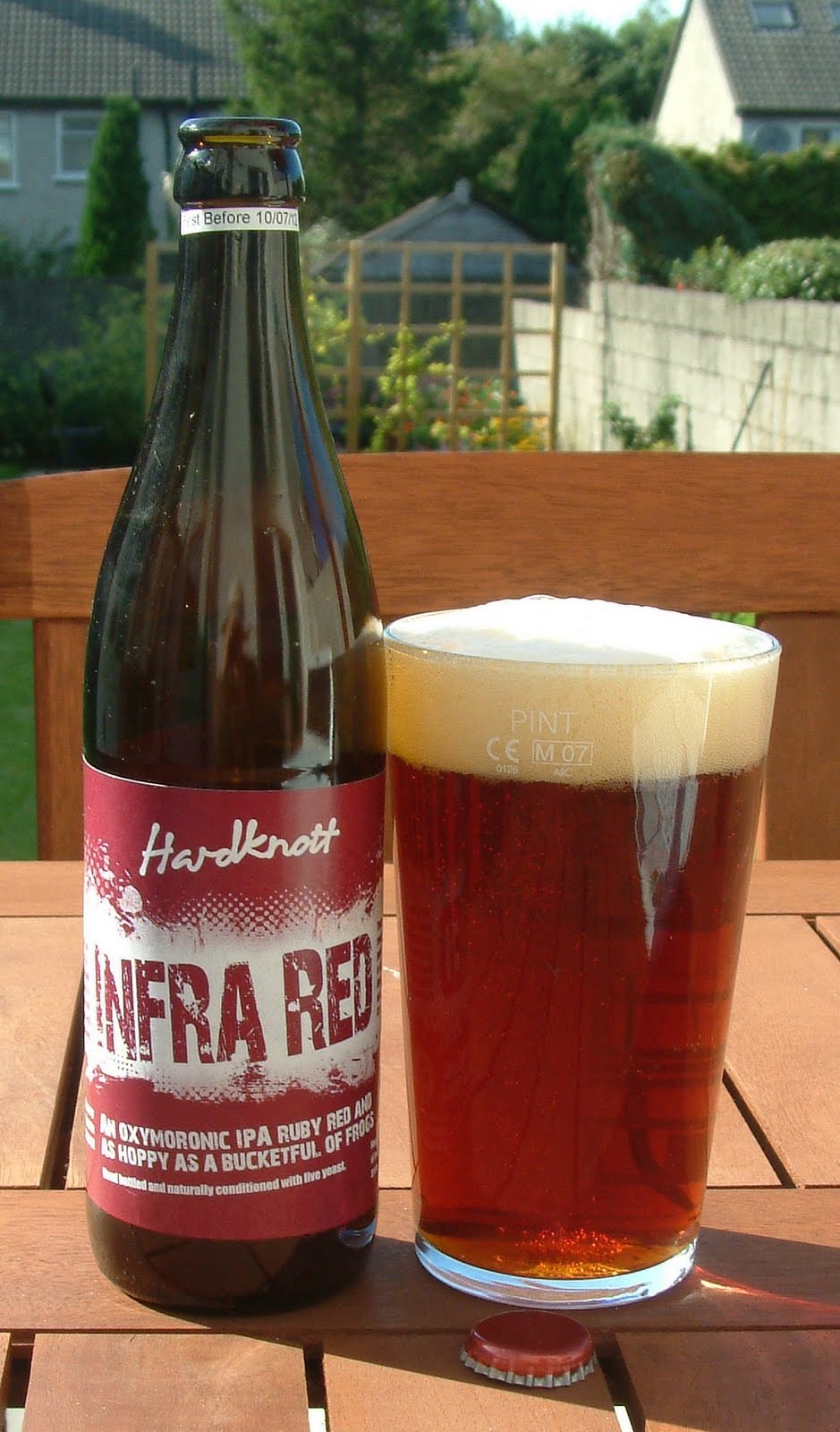
So I was a little conflicted when Hardknott Dave gave me a bottle of Infra Red. Like the Granite and Æther Blæc he also generously proffered, the label suggests that it's most likely to keep improving after the best-before is past. But unlike a barley wine or imperial stout, dry-hopped IPAs -- of which Infra Red is one -- depend on the delicate young hop oils to define themselves and give you the proper hop buzz you're after.

So what to do? This is my one bottle and I'm not likely to see another in the foreseeable future. Take the brewer's word for it or trust my instinct? The latter prevailed: Granite and Æther Blæc have been consigned to the darkest corner of the cellar; but Infra Red I drank.

It's a big ol' bugger, easy to pour slowly, leaving the sediment behind and giving a lovely clear dark amber body topped by a healthy layer of froth which lasts all the way to the end. And I could smell the dry hops at arm's length. On first sip the heavy body fools you into thinking this is going to be a malt-driven beer, but instead of a toffee follow-up there's a smack of those fresh and zingy grapefruit hop flavours. It's very brief, though, and the aftertaste is altogether more firmly bitter in a way I'd associate with English hops more than American. It lasts for ages too, thanks to the tongue-coating texture, and doesn't turn harsh as it fades. Maybe a teensy bit metallic, but I think that's just something to which I'm especially sensitive.

Did I make the right decision? Yes, I think so. This beer is definitely robust enough to survive a long time in storage, and it will undoubtedly change radically during this. But that brief flash of fresh hops will vanish and I wouldn't be at all sure it'll be replaced by anything as tasty.

My recommendation on Infra Red is drink 'em if you got 'em. Anyone who likes their beer big and bitter should be all over this. Trust me on that.

21 May 2009

Hop much?

The hopheads are taking over. Dublin's quality beer off licences are bursting with isohumulones these days, between the new-style hopped-up Belgians, some bitter delights from across the Irish Sea, and of course those crazy Americans and their IBU fixation.

Amid much rí rá agus ruaile buaile, Sierra Nevada Torpedo hit Dublin recently, and I secured one to bring home and dispose of safely. Everyone who'd already tried it warned me that it wasn't some hop-monster as the name might suggest; that this 7.2% ABV IPA is actually quite balanced. I'm not sure I'd agree with them. What's very true, however, is that it's gorgeous.

The aroma is zesty and clean -- none of your big boozy vapours here -- while the flavour is binary: it rocks between sweet marmalade and very slightly harsh, resinous piney hops, which just pitch over into lemon washing-up liquid right at the end. There's a solid, and actually quite sticky malt base to it. So why, in the name of sanity, is this hyperactive flavour orgy so damned easy to drink? It took herculean restraint to hold myself back from draining the glass before I could string any kind of verbal impression together. It's that tasty.

I'm not a hophead as such, nor am I attuned to the very finer points of hop appreciation, and that's why I will quite blithely announce that Torpedo is every bit as enjoyable as Pliny the Elder.

Next, I raised my hoppy game further by following up with Victory Hop Wallop, stronger at 8.5% ABV and paler -- just at the point where yellow becomes orange. And yet despite the higher strength it lacks the malt profile of Torpedo and is actually quite thin. But bitter? Oh my yes. Bitter as the day is long. Fell out of the bitter tree and hit every branch on the way down. Not harsh, or any way difficult, just very very charmlessly bitter. Of fruit, you get a chaste peck from a sugary mandarin orange at the start of each taste, before Dame Bitter comes round to claim her due. It's not that it's unpleasant, it's just not very enjoyable, in complete contrast to its tamer stablemate HopDevil.

Proceed with caution, is the message to those wielding the hopsack, I guess.

27 April 2009

Adding insult to hot ash

You have to feel sorry for poor old Gaius Plinius Secundus. Being buried alive in several tonnes of burning hot ash following the eruption of Vesuvius was probably bad enough, but the indignity of having one's name mispronounced on a regular basis must be far worse. For the record, the American Heritage Dictionary will tell you how to say it here.

Pliny the Elder is one of two from Russian River in northern California which were a gift from TheBeerGeek crew, and is a particular favourite of Chris's. I can see why. It's a strong IPA, and pours a pale marmalade colour with a light, even haze through it. Bitter? Oh yes, in a big acidic way. And yet it's not difficult or corrosive like some super-hoppy beers can be. Oranges dominate the flavour, in that oily way which reminds me of a Terry's Chocolate Orange minus the chocolate. I didn't get any grapefruit character until the first burp, which produced a taste sensation similar to chewing grapefruit rind. The label exhorts the drinker to consume it cold, and I think it might have been even more enjoyable if I'd been drinking it below 12°C, but it's a damn fine beer however you look at it. I've had bitterer; I've had hoppier; I've had stronger. But what we have here is what passes for balance among west-coast hop-bombs. And it works.

Second up is the marginally more sessionable (6% ABV) Blind Pig IPA. Here the fresh and zesty grapefruit flavours are right at the front. There's not a trace of harshness: instead it's soft and juicy, with hints of honeydew melon. The malt is just about detectable at the base, but it doesn't add much by way of warmth or weight. Instead, we get an easy-going well-balanced IPA which is all the more enjoyable for coming in a half litre bottle.

I've been listening to Chris raving about Russian River for a while now, and having tried two of their beers I can definitely say that the hype is worth believing.