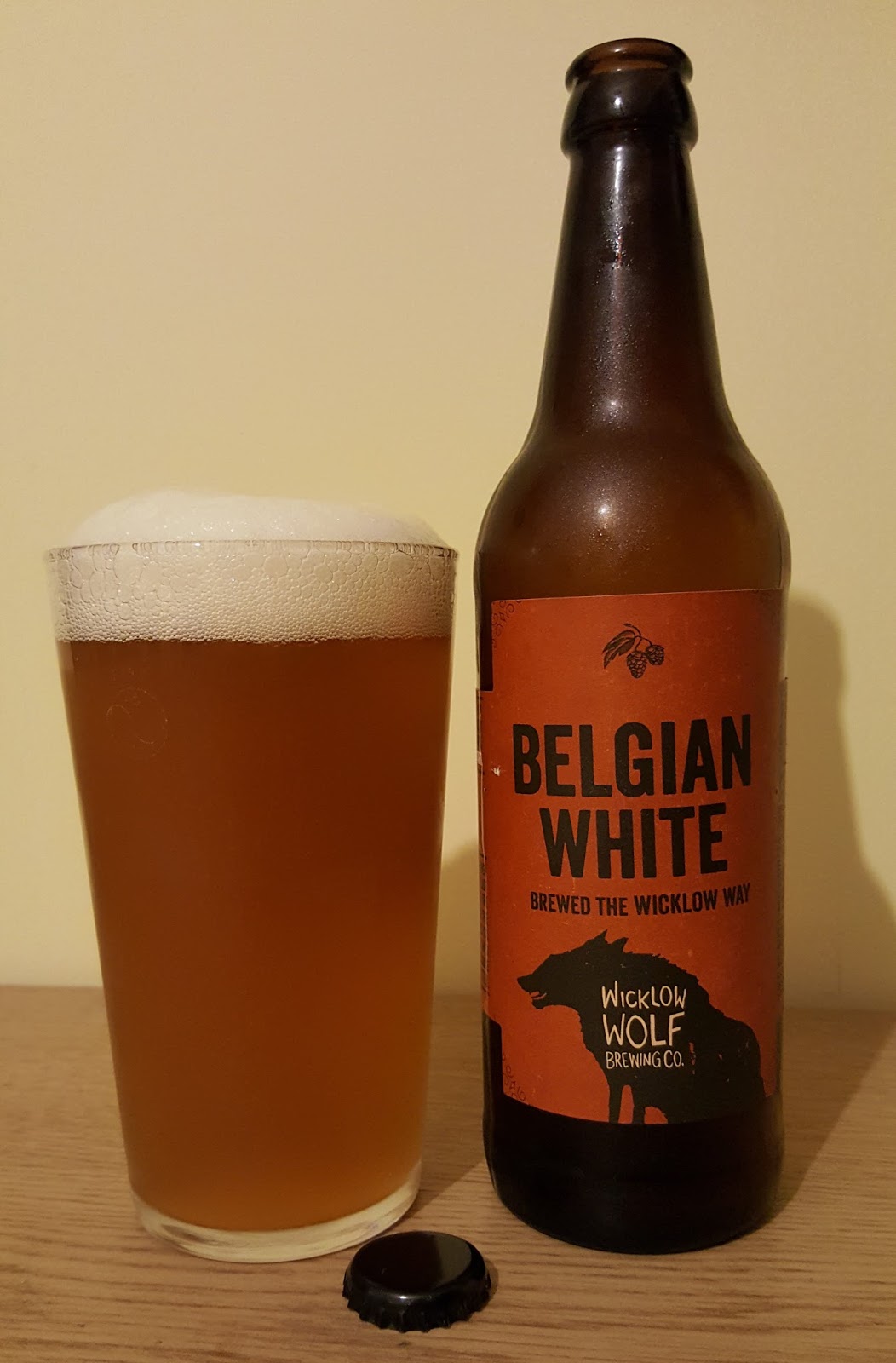


 There were no half measures in the relaunch that Wicklow Wolf just undertook. It centred around the big and shiny new brewery in Newtownmountkennedy, but also included a brand refresh, a format switch from bottles to cans, and a raft of new beers. Sessioners Elevation and Eden survived the update, while Arcadia has been rejigged from warm-fermenting blonde to fully fledged lager. The IPA, porter and red, however, have been completely replaced, and in this post I'm looking at the new starting line-up, plus a few specials.
 Wildfire is the brewery's new take on red ale, or possibly amber, given that it's officially "hoppy". It's quite a dark take, showing only faint red tints through the garnet. This is replacing their Sorachi Red and I get a definite bang of pithy coconut Sorachi Ace right in the middle of the flavour. Around it it's a bit thin, the texture watery and the flavour sharp. The malt side of the equation is understated: no toffee or caramel here; not much more substance than you'd find in a cup of strong tea. This feels tokenistic: we have to have a red; let's do Smithwicks with a more interesting hop. It'll float many a boat I'm sure, but not mine.
 The centrepiece IPA is named after another extinct creature: Mammoth. Wicklow Wolf's distant roots are in Colorado, hence their launch with their original 6.3% ABV IPA. That's crazy strong for an Irish IPA so here they've brought it down to... 6.2%. It's not that different, really: a big hit of grapefruit and orange pith; a malt weight which exists solely to propel the hops. There's a slight metallic tang, but setting that aside it's very clean, delivering the hard 'n' hoppy flavours any '90s kid will lap up. With modern IPA splintering into a million variants, not all of them worth drinking, it's good that there's still a bitter hoppy core present and visible.
 It doesn't really make sense to think of Apex as a replacement for Black Perle Porter, but it is the only black beer in the line-up. It's an oatmeal stout at a big 6.5% ABV and plays up to that from the moment the can opens. The pitch-black beer pours out thickly and slowly, forming lots of nicotine-coloured foam. It smells like a turf fire on a cold night: acrid yet somehow comforting, a mix of bitter herbs and burnt toast. The bitterness is intense from the first sip, giving it an almost grassy kick. When this fades there's strong coffee, a tang of tobacco and a light spritz of rosewater. These are all classic, stouty, stout flavours, not quite balanced but skewed towards a very grown-up bitterness. I really enjoyed the effect, and would quite happily have everything ramped up a level or two higher, but I know that wouldn't be to everyone's taste. Recently I wrote how much I enjoyed the straightforward stylings of Lineman's Astral Grains, well here's another very much in that vein.
 The sequence hits the crescendo with Pointy Shoes, a bourbon barrel imperial stout. I only just noticed that the branding is still the old one. Well, if you're going to go out, go out on 12.5% ABV. Despite the strength it's very easy going, light on the alcohol warmth and with elements of coffee, coconut, vanilla and churro sauce. With my imperial stout scorecard out I'd say it lacks bitterness, the sort found in Apex, but as a smoothed out barrel-aged take it's up there with the best.
 Berliner weisse next, and I think Vice Vice Baby may be the first I tried from the new brewery, back in early October. It's strangely clear for the style: another pure gold glassful. It's not any way sour either. I get a dry wholegrain crispness but that's as close to the style as it comes. There's a briny, sweaty musk and a bizarre sugarpill sweetness. I imagine this is what you'd end up with if you forgot to add the souring culture to a straight-up Berliner weisse, though I'm sure that's not what happened. The end result is a clean and thin beer, screaming out for a tartness which it just hasn't been given.
 I was privileged to have visited the Wicklow Wolf hop farm back in the summer. They've been turning out the Locavore series from there this last few years: an annual all-Irish beer (or two) in a spread of styles. Saisons, blondes and pale ales have all lent themselves to the muted tones of Irish-grown hops, but this year they've gone dark: Locavore 2019 is badged as a dry Irish stout. Well, it is and it isn't. For one thing the ABV is up at 5.5%. For another, the flavour is beautifully complex, bringing rosewater, cocoa, tar and pipe tobacco. It's a lot more complex than the norm. I find it hard to believe that the hop character here was grown in Leinster but it really forms a centrepiece to this. We're far from everyone else's idea of Irish stout: this is closer to the top end of London porter. Maybe it's time we reclaimed it.
 Last of the string is Dawn of the Red, an imperial red ale aged in bourbon barrels. It comes out at 9.4% ABV and smelling all of that: big on the oak, coconut and red liquorice ropes. The texture is heavy and that's fully part of what it does; the oak vanillins spread quickly to the back of the mouth from the first sip onwards. Though the wood is sharp, verging on harsh, there's a smooth and balanced aspect, brought by the malt. A lot of work has gone in to making this beer taste like this. I like the end result: all the malt and all those bourbon barrels. If super-strong barrel aged red is your schtick, here's 440ml of it.
Do one thing and do it well is very much not the Wicklow Wolf motto, if these early offerings are anything to go by. In particular, the brewery seems to have found a new knack for stout. Long may that continue.