

 My beer bucket list is, was, a short one. Bamberg came off it in 2014; Portland last year; and the Toer de Gueze back in May. The only other item is one that had been on the list since the very beginning, so long that I regularly forgot about it for long spells, though never quite lost interest in it completely. The Poperinge Hop Festival happens once every three years, in the heart of the West Flanders hop-growing region. It's a celebration of the harvest on which the area's fortune was traditionally made and which, judging from the fields surrounding the town, is still part of the economy. The 2014 iteration was covered excellently on Belgian Smaak in this post, and it seems that the festival doesn't change; everything was pretty much the same when I arrived for 2017's outing.
 It's not a beer festival as such. Various events are spread over the weekend including the marching band tattoo, the election of the Hop Queen and all culminating in a three-hour parade on the Sunday, describing every aspect of hop growing culture in flamboyant, and often quite confusing detail. The friends and enemies of the hop plant was a highlight, with its children dressed as weevils and a lady in grey lycra interpretively pole-dancing wind burn. It's not the sort of thing you see every day. All festivities are overseen by Popernicus, the spaced out ladybird mascot and ambassador.
 At the top of the town is the feesttent, a vast Oktoberfest-style marquee where the only beer on sale is Jupiler. One of those Grampa-Simpson-in-the-burlesque-house turnabout moments. Down in the main square of Poperinge, however, the open space is occupied with Lekker Westhoeks, a celebration of local food and drink with stalls selling cheese, sausage, chocolate, ice cream, and of course beer. The beer stall is the biggest, listing 32 Flemish beers, with generous samples from the bottle going at €2.50 a throw. That's a reasonable price for the Westvleteren 12 that topped the list, but what else did they have?
 I opened my account with Hop Hanker, from client brewer Homo Beerectus. It's a single-hop IPA made with locally grown Sorachi Ace. And it turns out that Belgian Sorachi is just as effective as Sorachi from anywhere else: this is massively pithy, the citrus peel effect buoyed up on a chunky Belgian texture. It's hard to believe that something this substantial is just 5.5% ABV, but it is. There's not a whole else going on beyond the orangey hops, but it does its one thing well and when it's only a sample that's not a problem.
Beside it stands another IPA: All Inclusive by De Plukker. This one has a bit more Belgian welly at 8% ABV and piles on the sugar and yeast resulting in big floaty bits and a sweet aroma that turns to a saccharine bitter tang on tasting. What's missing is any discernible hop flavour, making for a very disappointing overall picture, especially given the name. And at a hop festival too!
 I couldn't resist giving Troubadour Magma Hop Twist a go, the basic Magma double IPA being an all-time favourite of mine. "Hop Twist" is an annual series of variations, and in 2017 they seem to have just scaled everything back. The ABV is down to 7% and the bright colourful hops that are Magma's calling card are very muted too. The aroma is a slightly soapy citrus and herb thing, while the flavour is clean but a little dull: a dash of mint being the most distinctive feature. It's fine, but really doesn't deserve that association with Magma.
The other beer in the picture was chosen solely for the alphabet soup of a name: Gemeldorp Verpleegster. It means "nurse", apparently. It's a golden ale of 6.5% ABV with added honey and herbs. There's not much else to say about it, however. It's cleanly flavoured to the point where I'd be prepared to believe it's a lager, and has a decent refreshing waxy bitterness. But that's as exciting as it gets.
 Something strong and sippable was required for parade-watching on Sunday afternoon, and that was Den Twaalfth by 't Gaverhopke, whose name is also its ABV and recommended serving temperature. This is jet black and completely flat, tasting sweetly and boozily of rum and raisin. It still manages to stay light of body, however, which does wonders for its drinkability. It's one I would have liked to have taken a closer look at, but needs must.
 Back at the stalls, De Ranke Simplex was next, the brewery's sort-of pils. It's a pale hazy yellow colour and opens on a zesty note, the bitterness growing to eventually become waxy and a little harsh. A lighter jasmine spice is present in the background, but the dominant feature is a big honking gritty yeast flavour that it would be much better off without. There's a decent beer under there somewhere.
The other beer this time is Gloriaan Tripel, a strangely dark amber version of the style. At 8.9% ABV it's not a total alcohol bomb, but it seems like one, with pear on the nose and a stronger acetone flavour, coupled with bitter aniseed. Too hot and heavy for my liking, with no spices or herbal finesse. Is it me or are decent clean tripels becoming rarer in Belgium?
 One for the road was Stoute Pitte, a weighty 8%-er by Pater Pitte. In the Belgian style it's sweet, but there's a lot going on with that: caramel and liquorice to begin, turning to prune and warm Christmas pudding at the end. There's enough bitterness to keep it from cloying as well. A great one to end the festival on.
I'm told Lekker Westhoeks happens annually, so there's no need to wait until 2020 if this bit takes your fancy. I expect you won't get to see Popernicus, though. The Hop Museum is well worth a visit, if hop information isn't available in parade form.
 We were staying in Ypres for the weekend, which should have been a ten minute jaunt on the train. Unfortunately, Belgian Rail chose this weekend to close the line for engineering works so it was a less-reliable bus replacement service instead. On the plus side, Poperinge station has a nice little bar attached, Flou's, and we awaited our bus there. The area seems to have resisted the domination of national lager brands and most pubs bore the livery of older local marques such as SAS and Bavik which I've never seen elsewhere. Flou's is a Bavik house. Unsurprisingly, Bavik Super Pils is not great. There's the standard cooked corn flavour of eurolager though with more of a hop kick than might be expected. I found it a bit severe overall, something its brewers probably regard as character.
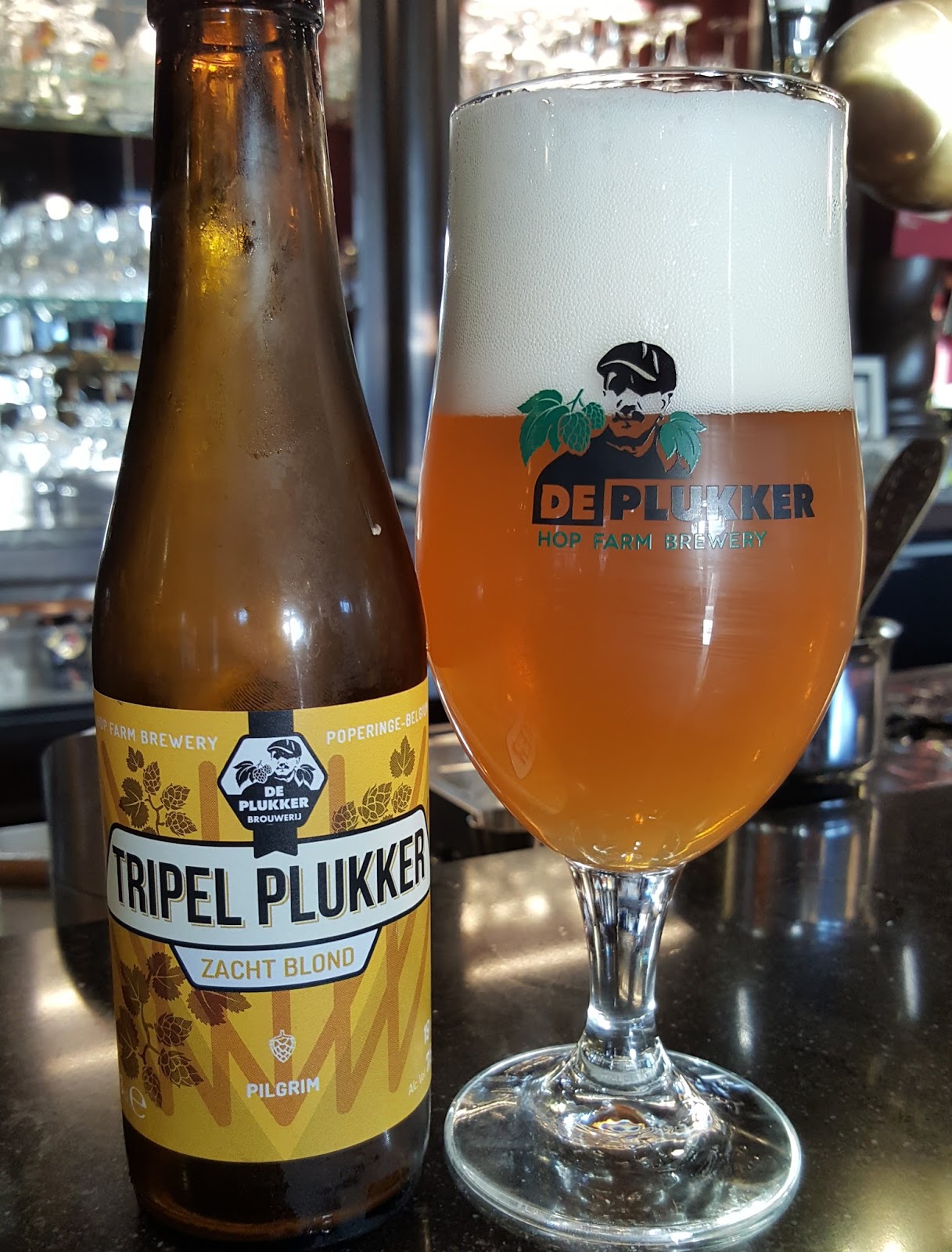 From the bottled selection, herself went with another by De Plukker, mentioned above. I had heard that Tripel Plukker is their best, but it really didn't taste it to me. It pours with lots of unattractive suspended bits through it. The aroma is a headache-inducing mix of phenols and higher alcohols while the taste is savoury: caraway and diesel, all set on a greasy, sickly body. There is some peach fruit buried deep within it, almost completely out of reach. Maybe I got a bad bottle, but either way this was not a good beer.
There is one brewery in the town of Ypres: Kazematten, established in 2014. I had the first of theirs at the festival: Tremist, a saison. It's quite a plain one with banana laid on thick and just a little pepper in the dry finish. I felt there should be more going on at 6.7% ABV.
 The flagship brand at Kazematten is The Wipers Times and I got hold of a bottle of 12 in a local shop. It's a 6.2% ABV blonde ale, smelling enticingly of honey and peach nectar while tasting principally of vanilla custard. A stimulating fizz keeps it clean and overall it's a cut above your standard Belgian blonde.
 Grotten Santé gave me pause when I saw it. The branding is very similar to St. Bernardus's Grottenbier, the dark ale designed for them by Pierre Celis when he was on the payroll. St. Bernardus is only around the corner in Watou as well, so it's not like they won't see it. Only when I sat down to write about it did I discover that Kazematten is a subsidiary of St. Bernardus, and that this beer is actually a slightly tweaked version of it. The casements of Ypres provide a cave-ageing facility that Bernardus don't have at headquarters.
For all that, the beer is another plain and simple one: dark red-brown, 6.5% ABV and quite dry with just a dusting of cinnamon across it. It's nice to have a dark beer that doesn't try to burn you with booze or smother you with banana so it's probably quite a welcome addition to the scene. Not really one to write home about, however.
On Monday morning, with the trains back online, we packed up and headed on our way. Ypres and Poperinge were just one stage of a week long jaunt across the Low Countries. Next stop: Bruges!


