Showing posts with label windjammer. Show all posts

31 August 2020

Autumn beckons

A change of season is upon us, and as we bid farewell to this strange sad summer, let's have a few beers.

Hey, remember Neomexicanus? Most of my experience with the semi-feral American hop came via St Mel's never-repeated experiment with it back in 2015. Now Rye River has decided to take it on with the latest in its Limited Edition Series: The Dropper. Tamed Neomexicanus variety Sabro has been used, as well as the newly-named crossbreed Talus (still only "HBC 692" when the label went to print). The beer is an American-style pale ale of 5.4% ABV, hazed with London Fog yeast to a translucent yellow-orange. The aroma is pithy: an instant reminder that Sabro, for me, has a lot in common with Sorachi Ace. There's a beautiful switcheroo on tasting, however. Where I was expecting bitter, and possibly plasticky, there's a gorgeous juice tang which is a little bit tangerine and a big bit grapefruit. It's invigorating without being harsh; refreshing without being thin; complex without being awkward. In short, it's a near-perfect pale ale, reminding me somewhat of the best pale English bitters with its soft drinkability, though obviously far too strong for that sort of thing. The brewery has pitched this as a daring feat of radical hopping but the result is pure and unfussy quality quaffing.

Maui Wowie is the latest terpene-infused "high PA" from Black's of Kinsale. It's a medium orange colour with what passes for a mild dose of haze these days. The aroma is fun and spritzy, a playful squirt of grapefruit juice in your eye as you're peeling. There's a similar fun sharpness in the flavour: satsuma pith and mandarin peel. Next to it there's a savoury side which the brewery is describing as pepper but to me it lacks piquancy, tasting more like cedar wood or balsam resin. The whole thing is certainly unusual, and in a good way. A full 5% ABV, it manages to stay refreshing and sinkable, though it's worth pausing to explore complexities you don't find in everyday IPA. This isn't for everyone but I fully regard "different" as a positive selling point at the moment.

It's been a while since Beoir Chorca Duibhne has featured on these pages, but my eye was caught by a new one from them in Redmonds because they've upgraded their usual stark labels for a picture of the local coastline. It's an Antipodean Ale, owing to the use of Galaxy for dry hopping, and a sturdy 6% ABV. In the glass it's amber coloured with an off-white head, though the aroma is all about the Munich malt richness rather than hops of any provenance. And it's far from a hop bomb on tasting, to the point of barely qualifying as IPA. Gingerbread, hibiscus tea, cherry bakewells and barm brack all feature. We are definitely in afternoon-tea territory. Very civilised. If this was an attempt at going all modern, BCD has failed. But it's a lovely, warming, flavoursome and traditionally-styled beer.

Dinner at 57 The Headline gave me the chance to try Popsicle, the latest from Hopfully. It's a session IPA of 4.5% ABV and very densely murky. The flavour opens on a note of fluffy peach and follows through to coconut, with some slight garlicky vapours drifting in at the finish, along with the chalky dryness I often find in these. It's quite a simple take on the New England IPA genre and offers nothing I haven't tasted before, but it's tasty and enjoyable, making good use of its modest specifications.

Had this been a normal kinda summer I would have drank this new Two Sides beer on tap at 57 The Headline or Brickyard, for whom it was brewed by Third Barrel, but it's a Different Kinda Summer, so it's a can at home. A pale ale at a pub-worthy 4.3% ABV, it's a similar pale and hazy yellow to Two Sides's previous summer banger, Two Yards. The aroma, too, is equal parts juicy and dank in a very enticing way. They queue up in the flavour, being bitter, herbal and dank first -- hello Simcoe -- and then fading out on vanilla and orange ice pops. It's a lovely combination, showing two of the US hop world's most delicious facets. There's a bill to be paid for that strength, though, and it is a little thin which offsets the hop impact somewhat. The plus side of that is sessionability: you could definitely down several pints of this without getting bored or overwhelmed. The draft version is available in both pubs (with food) if you want to try it as it was intended, but can is no hardship.

Next up, guess what: New England IPA. Whatever their individual merits there sure are a lot of these. Anyway, Devils Chimney is the exciting name, brewed by Lough Gill to 7% ABV. It's an orangey colour and quite thick set, something that matches the heavy orange-cordial flavour. That initial sugary twang fades quickly and is replaced by a slightly nasty plastic acridity. There's a little wax or pith bitterness too, which is more acceptable but still contributes to the harshness. I can see why brewers of this sort of thing go for the soft vanilla sweetness: something like that would really help this beer out. This is quite a rough, angular take on New England, drawing in elements from the sharper west coast style, but not to the extent that it improves things. It doesn't taste like everyone else's NEIPA, so there's that. Difference, again, is to the good.

Galway Hooker is having no truck with any of this and put "West Coast IPA" in block capitals on the front of the second in their Seafarer Series. To underline that, it's called Citrus. Hit me with those beta acids! Although this is the appropriate shade of amber, it's not pleasingly clear, looking quite soupy in the glass and topped with lots of busy froth. The aroma is fresh and, well, citric, with notes of pine and lime, though also a slightly juicy tone as well. They just can't help themselves, can they? Thankfully there's no soppy juiciness in the flavour. It's well balanced between sharp, dry hops and crunchy caramel malt. There's some rye in the grain bill which probably helps contribute to that sharpness. That said, it's not severe, or even especially bitter, and the lime's edge is softened by a floral perfume effect. An oily weediness rounds out the flavour. The murk has given it a soft texture, one that suggests the east coast much more than the west to me. Only when I'd finished it did I notice on the can that lemon juice, lime juice and orange peel were added ingredients. I'm not sure they brought anything that couldn't be done with hops. So this isn't a pure antidote to New England IPA but is very decent and unfussy drinking.

Also heading for the West Coast, because I guess Irish IPA is now a rap war by proxy, is Third Circle with their all-Centennial Centurion. We go up to 6% ABV here and get an extra punch for our trouble. Here is the no-nonsense dry and sharp heavyweight I was expecting: a grapefruit wrapped in crepe paper covered in balsa wood. There's pine aplenty, rolling oily late into the finish. It's almost a clear red-gold, though not quite, but without any trace of softness, roundness or any gentle caresses. That said, it doesn't go to extremes: no alcohol heat or hop-resin burn. This is clean and old-fashioned fun; a proper palate scrubber and a pleasing throwback to the old days when IPAs treated you cruelly and didn't call for days after. You have to be into that to like this, and while I'm glad there are options in the IPA sphere, I'm extremely happy to get one of these now and again. West coast done proper.

From the same brewery, the next under the Crafty Bear brand is a red IPA called Bimbos. Why? I don't know. It's an "Imperal Red" according to the label, and 8% ABV. I liked its clear deep amber hue and expected warming barley wine vibes from it. The aroma presents more of a modern hop fruitiness, backed by a promise of rich roasted malt. An odd mix comes through from the flavour, all of it at once. I found myself having to mentally slow the process down to pick it apart. Loudest is red liquorice ropes, candy-sweet with a mild herbal bitterness. Tangy strawberry jam runs alongside, then more traditional hop bitterness: crunchy red cabbage and sticky pine. Wafting over the top is a peppery spice, helping dry out any sugary excesses. The end result is rather good. It reaches the parts you might usually call on a barley wine for, being warming, complex an satisfying to sip, but it's also hop-forward and punchy. A best-of-both-worlds job, despite the poorly-chosen name.

Mind you, that pales in comparison next to Treaty City's decision to call their new one "Limited Bitch". Eww. This is also red, an IPA of 5.5% ABV and hopped with Summit, a bit like Metalman classic Windjammer. The aroma is earthy and savoury, not what one would expect from an IPA, even a red one. There's a little bitterness in the flavour, punchy in the foretaste but fading quickly. Then there's a burnt-caramel edge, some dry tannins and the thick toffee of a typical red ale. This doesn't have much going for it, its best feature being the full texture, so at least it feels like a good red ale even if it doesn't necessarily taste like one, and very little like an IPA.

Wide Street's first go at a mixed-fermentation lager didn't impress me much, but they've made another attempt, with one called Diversion. It's a bit of a beast at 6.4% ABV, hazy and yellow, and smelling sharply sour in a Pajottenland stylee. Sure enough there's a lot of sourness and a lot of funk in the aroma: vinegar time in the farmyard. The texture is thick and gummy in the way that Brett does but lager doesn't. A hint of peach and apricot peeps through the powerful acidity. This certainly doesn't fall into the trap of being neither one thing or another: it's unashamedly sour and funky. It took a bit of getting used to but I was into it by the end. Maybe a little more of that Bretty funk would have helped balance the extreme tartness better, but that's a minor quibble. Spare a thought for anyone who didn't read past the word "Lager" on the label.

I needed a comedown from such giddy heights of sourness so it was back to Lough Gill for their Wild Irish Gose. This has been out for ages and I was convinced I'd had it under a different name and branding. But nothing in previous blog posts matches the spec, so here we go. It's an unassuming 4% ABV and a perfect limpid gold. A lemon spritz is the opener and it doesn't get more sour than that, even when the briny salt follows it on stage. Coriander isn't listed as an ingredient but there's a definite herbal complexity in there. Despite the strength it has a full texture as well as plenty of cleansing bubbles. This isn't an exciting beer, but is enjoyable in an understated way. Just what I was after.

As is obvious from the above, properly dark beers are thin on the ground this weather, so I had to turn to a very unseasonal "hot cross bun pastry stout" from Dead Centre: Four Quarters. 6.8% ABV, it gloops out into the glass, oily and dense, briefly forming a dark brown head which quickly crackles away. Apart from a small cinnamon spice element, there's not much novelty about the aroma but plenty of rich and tarry stout-roast. The flavour is very strange, and not what I was expecting. For one thing it's quite dry, with a harsh zinc-ish twang in the foretaste. In the centre, a heavy dollop of marmalade, suddenly calling witbier to mind. It turns out that orange peel is an ingredient, so that explains that. As is cinnamon but it's a lot less prominent in the flavour than the aroma, coming across in a slightly medicinal/mouthwash way. There are raisins too, which I couldn't taste, and as an insurance policy to guarantee the hot cross bun effect, the ingredients also include actual hot cross buns. Isn't that cheating? All in all, this is a near miss. Pastry stouts must be heavy, thick and sweet, and the dry metallic side on display here prevents that. In the absence of other stouts it will do, and it's an idea that's worth trying again, but filling out the body is the first thing I'd address.

As the nights begin to draw in I'm hoping that dark beers will be easier to find for the next one of these round-ups.

08 October 2014

Hops in the house

It goes without saying that there were pale ales aplenty at the Irish Craft Beer and Cider and Whiskey and Whatever You're Having Yourself Festival at the RDS last month. It's still the backbone of the Irish craft beer market and even firms with plenty of pale 'n' hoppy in the portfolio already were showing up with additional ones.

Mountain Man's Crazy Horse is their third beer and the third pale ale, this time a "San Diego IPA" at 7.5% ABV. It's certainly a reminder of how American IPAs came to world prominence: that massive citrus balanced against a huge and chewy caramel malt base. It tastes almost old-fashioned now, given the choice of ingredients generally available to small-scale brewers: charmingly retro, perhaps.  It should still turn a few heads down Ballyvourney way.

And staying in Ballyvourney, I got my first proper taste of 9 White Deer Stag Bán pale ale. It's a magnificent refresher, bursting with pilsnerish grass notes plus mild lemony zest, all set on a dry and crisp hazy pale body. A beautifully put-together 4.5% ABV session beer. Stone Barrel are in similar territory with their new seasonal Day Trippin', though ramping the alcohol and the malt character a little higher, and turning up the bitterness too, to give it an invigorating sharp bite.

Trouble Brewing's latest IPA is called Chasing the Dragon: 8% ABV and very big on the golden syrup and oaty biscuit malt flavours. There's a decent bit of grapefruit and lemon pith from the hops, but they're more a seasoning than the core of the flavour. Lower strength, but similarly biscuity, was Black's of Kinsale's Rocketship IPA. This one's 100% Galaxy hops and shows a little of the mandarin juice and jaffa zest I associate most with the variety but it's sandwiched between lots of sweet grain, conjuring up the Jacob's Club Orange bars of my childhood.

Two festival specials were on offer from Bo Bristle: a 7% ABV Imperial Red, crisp with lots of melanoidin malt for a rich cleanness of flavour, enhanced by a gorgeous fresh and grassy hop aroma. The 7.7% ABV Double IPA was a single-hop Citra effort, remarkably light and drinkable at that strength.

Metalman used the festival to garner feedback on a couple of possible recipes for their upcoming canned range. Can Prototype #1 was the only one I got to try: a 5.6% ABV amber ale, with its roots in regular seasonal Windjammer, but utilising American rather than New Zealand hops. It's decent but unspectacular: some lovely chocolate notes but no hop fireworks. I found myself surprised to be enjoying Rubus more, a raspberry-infused blonde ale which manages to taste powerfully of the fruit without being either too tart or too sweet.

Finally for now, I didn't get much of a chance to explore the Canadian beers on offer, but did manage a slurp each of Side Launch Pale Ale and Great Lakes Canuck Pale Ale, both just under the 5.5% ABV mark, both hazy and somewhere on the yellow-gold colour spectrum. The Side Launch is lemony and tannic so wins on refreshment power, though I found the Canuck more interesting: piling spices and grass on a sauvignon dryness. I'd be perfectly happy with either, mind.

Just a bit of mopping up to do before we leave the RDS for another year.

12 April 2012

Full of Easter promise

It was all a bit compact-and-bijou at The Franciscan Well for the Easter Festival this year. The rambling village of brewery bars that in recent years threatened to take over the yard completely if left unchecked was pruned back somewhat for 2012. No representation from regulars Hilden and Barrelhead, while Beoir Chorca Duibhne, Messrs Maguire and the hosts were relegated to taps on the main pub bar inside. It did leave the space less cramped than last year, and of course there was still plenty of beer choice.

But before I get on to that, a few words about one of the absentees. I caught up with Messrs Maguire Olympic Gold in its home pub in Dublin last week. This new seasonal is certainly, well, gold: a darkish shade thereof, shading to amber. Though billed as a golden ale it's very highly attenuated and feels quite lagerlike, its dominant crispness given extra bite from the strong carbonation. The only nod towards aledom that I detected is a slight bubblegum aftertaste, but it's nearly not there. It would be a decent if unexciting summer refresher were it not for a rising disinfectant tang which started small but built quite quickly as I chugged my pint.

Right, back to Cork then. It goes without saying that as well as fewer breweries than usual, there were no newcomers either. A shame, since I'm aware of at least a couple of new operations on the way, including a second brewpub in Cork city itself. Still, these things can't be rushed.

We'd met Scott from Eight Degrees in the nearby Bierhalle just before showtime, where we both tore into the fantastic full Irish they serve. Eight Degrees were launching their new Barefoot pilsner. It's not yet bottled so arrived to Franciscan Well straight from the lagering tanks, unfiltered and not quite fully carbed. And lovely it was too, displaying that wonderful soft biscuit sweetness one gets in good pils, balanced by an almost metallic tang from the hops. It could possibly do with more pronounced hopping, but maybe we'll get that with the fizz.

The people who didn't have a lager, shockingly, was the UCC pilot brewery. Though they abandoned cold-fermentation they didn't abandon their teutonic stylings completely. Moritz was billed as a pale ale but the description of it fell back into the German vernacular with mention of a Kölsch influence on the recipe. It was certainly the correct shade of wan yellow and had a decent crispness to it, but also a jarring slap of butterscotch too which made it tough drinking after the first few seconds. Describing this as "honey" in the tasting notes was a game effort, but didn't leave me any better disposed towards it.

Moritz's brother beer Max was a down-home weiss and it showed that the brewers were on much more familiar ground with this style. A biggish 5.8% ABV but slipping down easily, fresh and fruity with sinus-clearing clove flavours. You could have mistaken it for Schneider Weisse were it not for the golden colour.

In Dublin we tend to think of Galway Hooker as a bit of a one-trick pale ale pony, though it is a fine trick and performed well. Over on the left-hand coast, however, there are a couple more strings to Aidan and Ronan's brewing bow. An earlier experiment with the dunkel weiss style appears to have been regularised into Opus II. This came from the cask at The Franciscan Well and presented as a murky muddy dark brown affair. The weissbier sweetness was transformed into milk chocolate, rendered extra smooth by cask conditioning. A pleasant dash of dry roast hits the back of the palate and is followed by a totally unexpected bitter kick from the hops. I'm not sure how sessionable this would be, but as the first dark beer of the day a half was very welcome.

Also on the Hooker bar was Nectar, an amber ale brewed as the house beer for Tigh Neachtain in Galway City. Allegedly influenced by Samuel Adams Boston Lager, I thought of it more as a dark Hooker. Yes there's a toffee hit up front, but it's followed by a very clear and quite assertive hop tang. The two combine beautifully. While not as full-on as the best American amber ale I was very happy with this and would love to see it given a wider distribution. It will certainly get me through the doors of Neachtain's next time I'm in Galway.

Home brew champion Mark was cutting a fatherly figure by the Trouble Brewing bar when I arrived in, doting on his winning recipe for Spelt Saison. I had a taste of the homemade version when the competition was being judged and Paul at Trouble has got the scaling-up pretty much bang on. The light sour bite is there, created by the tandem action of greedy saison yeast plus a whack of real grapefruit. Generous hopping removes any claims that could be made for fidelity to the saison style, but I don't imagine anyone who drank it cared. There's a little bit of grainy warmth in the background and I can't help thinking this summer refresher would be better with keg carbonation to lift it. Either way, I've never tasted anything like it from an Irish brewery and it proves how vital it is to take homebrew recipes and produce them on a commercial scale. Vital.

Across the way we had something new quirky and fun from Team Metalman. Chameleon is, at the basic level, a light and summery blonde ale, though packing a well-hidden wallop of 5% ABV. The unique selling point, and reason for the name, is that the casks have each had something extra added to them. On Saturday afternoon Chameleon Pacifica was pouring, one that had a gorgeous Opal Fruit juiciness from the New Zealand hops. It was next to the 2012 edition of Windjammer, darker than last year's and similarily Kiwitastic, but with some bonus light caramel. Tragically I missed smoked chilli Chameleon and hope it'll come my way at some point.

I was starting to get antsy with the thought of sinking a cool pint of Dungarvan Comeragh Challenger at this stage, but there was one last tick to be ticked. And I'm glad I didn't miss it. White Gypsy was serving, among others, Red Oak, a 4% ABV blend of two malt-forward dark styles -- Irish red ale and Belgian-style bruin -- which was then dry-hopped. What? Why would you...? Oh. Oh wow. The result is a lightly astringent fruity quencher, brimming with delicious tannins. Irish red meets English mild, with all the complex flavour and extreme drinkability of the latter. A beauty of a beer and not to be missed. But I didn't follow my half with a pint. The Challenger had dibs first.

And so it was back home on the 8.30 train, with some Eight Degrees bottles Reuben had managed to charm out of Scott. Much appreciated, both.

Sometimes the explosion of beer specialist pubs in Dublin (another one opened on Amiens Street yesterday) makes me question the need to travel to out-of-town festivals for beer in the first place. But even with a limited showing, the Franciscan Well Easter Festival offers a reminder that there's no substitute for a yard full of brewers and their wares.

29 December 2011

Thorn on my side

Inevitable, really. Only a year ago I passive-aggressively ask the trade where the Thornbridge stuff is, and now there's more of it coming in than I can keep up with. So, this is a clearance of some stuff that's been sitting in my fridge for too long, plus some more recent acquisitions, all from the über-classy Derbyshire brewery.

I didn't get Kölsch until I went to Cologne. From the bottle and keg it had always just tasted like a dry pilsner to me, and a very plain one at that. What's the fuss about? That changed when I got to drink it closer to the source. The smoothness offered by the version served from wooden barrels in the better Cologne pubs adds a vital dimension to the Kölsch experience you just don't get any other way. So I was intrigued and more than a little suspicious when I got hold of Thornbridge's bottled take on the style. Would bottle-conditioning make that all-important difference?

Tzara pours a clear limpid gold. I was careful to avoid any sediment, but really there was very little to be found. The mittelfrüh hops are very apparent in the aroma: the heady fermented grassiness of warm silage. The flavour is sweeter, though, making the most of the carapils malt to balance the green flavours with a bit of residual sweetness. And most importantly of all, the carbonation is light. Not cask-smooth, but far from being pale yellow burp-water. I think they've done a good job here, and are showing the joy of Kölsch much better than, say, bottled Früh does.

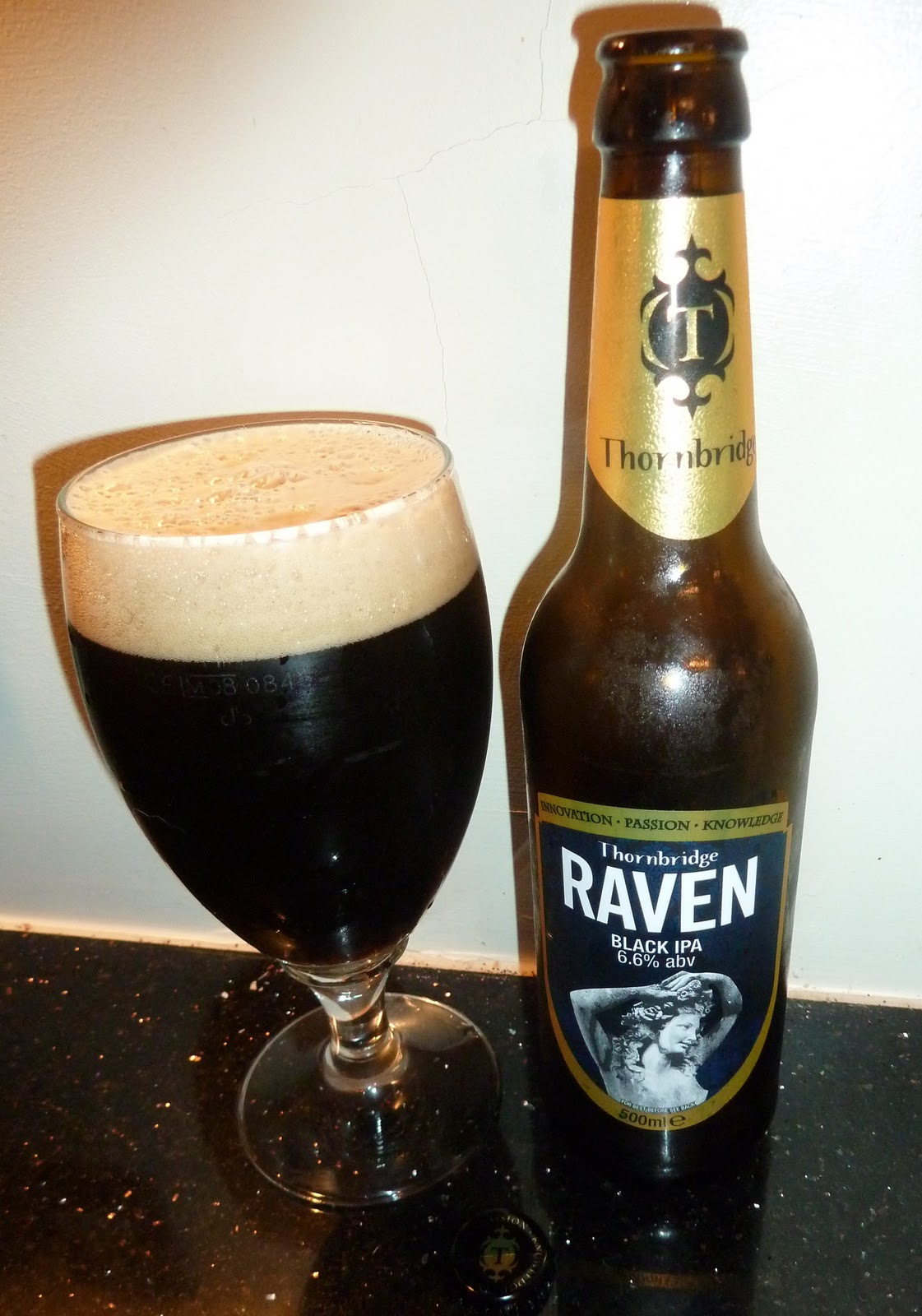
Raven, Thornbridge's black IPA, doesn't mess about. From the opaque black-brown body comes a bolt of pithy aroma preparing the way for intense bitterness on tasting. Dominating the proceedings is flinty Nelson Sauvin in its dry, less fruity, incarnation. I get a lot of the harshness I associate with Sorachi Ace in large quantities but none of the fruity peachy fun that I feel the Centennial ought to be supplying.

The wife really enjoyed it, and got a good roasted dark ale flavour from it. I couldn't detect that under the citric punch: it's another one of those black IPAs I would swear is pale when drinking with my eyes closed. There's no doubt Raven is complex and interesting, but I just feel a bit abused by it. Too much of a workout for my weak and feeble palate.

Next up, Versa, the puntastic weissbier. It comes out a lovely, almost red, shade of gold and only slightly hazy given the style. At 5% ABV it's on the weak side, and offers very little other than wateriness on the nose. What it loses in welly, however, it gains in drinkability. No overpowering banana esters or other heavy flavours. Instead it's mildly zesty with an easy-going sherbet effervesence rather than full-on fizz.

I'm sure it's a perfect summer refresher but I've no objection to it in the depths of winter either.

For the proper chilly evening sipper I've reserved a bottle of Bracia, Thornbridge's super-limited strong dark ale brewed from a whole host of malts, including brown and peated; a plethora of hops including Sorachi Ace and Pioneer; and with a bonus addition of Italian chestnut honey. It's a beer to take very seriously indeed.

It pours slowly and unctuously, lazily forming a dark tan head. The aroma is odd: lots of roast, but the dryness is sweetened by a floral character which I'm guessing comes from the honey.

It tastes weird. Intense perfume pervades the whole thing and makes it hard to get at the beeriness beneath. I can just about detect the peat, and the roast barley is present on the finish. There's possibly a bit of chocolate buried in there too, but overall it's quite difficult to take. Still, I suppose when it's €10 for half a litre you don't want to be charging through it. I'm not at all sure I'd buy another bottle, and the price is only part of the reason.

And that concludes the beer reviews for 2011. All that remains for this the last post of the year is the handing out of...
The Golden Pint Awards 2011

Looking back on the 2010 awards (2009 is here), I think I can safely say I achieved my ambition for 2011: to travel. 12 countries and 4 of them new to me is a personal best. And the beer scene in Ireland has moved on quite a ways in the past year. I'm excited at the thought of similar progress over the next 12 months. Anyway, here's how it's all panned out:

Best Irish Draught Beer: Metalman Windjammer
A brewery that was no more than a logo this time last year stormed out of the blocks with a kickass flagship ale and this stunning summer seasonal. All kiwi hops made it a pineapple and mango flavour grenade. I'm limiting the award to the cask version, however. It all fell a bit flat when filtered and kegged. Caskless Irish pubs: start your engines.

Best Irish Bottled or Canned Beer: Knockmealdown Porter
Lots of Irish beers made an appearance in bottles this year, including old favourites such as Trouble Dark Arts and Galway Hooker. I give the prize to another brand new brewery for 2011, however: Eight Degrees and their hefty-yet-drinkable porter Knockmealdown, though Franciscan Well's Shandon Century was a close second.

Best Overseas Draught Beer: Wild Esra on Cherries
Even at a festival where imperial stouts, barrel-aged rarities, sour one-offs and weird fruit beers abounded this one from De Molen had enough character to stop me and make me pay attention. It's the whole picture. The world of beer geekery in a single glass.

Best Overseas Bottled or Canned Beer: Great Divide Smoked Baltic Porter
They say Great Divide ain't gonna be exporting no more. I'm willing to donate one of the last bottles of this in the country to a local brewery for cloning purposes.

Best Overall Beer: Wild Esra on Cherries
No question. It's not a drink-all-year sessioner. It's an unforgiveably room-dividing one-off of the sort that shouldn't get awards from people who aren't insufferable rarity-chasing spoogebeerians. But it's just too damned tasty not to take the prize.

Best Pumpclip or Label: De La Senne Equinox
The wife spent a fair few days in Brussels on business this year, which meant a Belgian beer bonanza for me. Ordering by remote control can be a dangerous game but I've never had a problem in saying "Just anything by De La Senne. You'll know them by the labels." From a brewery with a wonderful eye for design, brooding Equinox is one of my favourites.

Best Irish Brewery: Metalman
You want to know what I think is missing from Irish beer? Bravery. With just a few exceptions, mostly from the established companies, we're still stuck in the Stout-Lager-Red Ale Beermuda Triangle of traditional Irish styles, only now we have a hoppy-but-sessionable pale ale thrown in too. Metalman, while sticking to a solidly reliable pale ale to make a name for themselves, haven't been afraid to play around with other ideas for the limited editions. So we had the antipodean-hopped not-quite-amber ale mentioned above for one, and second up was a peppered witbier made with saison yeast: Alternator. Beer is all about diversity and Metalman get this gong for giving us that from the very start.

More of this sort of thing, please, Gráinne and Tim.

Best Overseas Brewery: 1516
Back to the very top of the year for this one, and one of the highlights of my trip to Vienna. Breaking the lagerland mould with hoppy pale ales and plenty more besides. Bravery and diversity once again.

Pub/Bar of the Year: Bowe's Lounge
I haven't ventured too far from my usual local haunts in 2011: The Bull & Castle, Against the Grain, The Porterhouse, L. Mulligan. Grocer: chances are, that's where you'll find me. But we've seen an interesting development in Dublin pubdom this year. An increasing number of "normal" pubs -- some of them guidebook classics -- have started stocking beers from the independents. The bright green light on the O'Hara's IPA keg font is the most welcoming sight in any Dublin pub. It says "Yes, you can stay here for a drink".

The Palace on Fleet Street has long been ahead of this curve, but this was the year they went cask and got a Dungarvan beer engine installed. The Long Hall now has Hooker; there's Carlow bottled and draught beers in The Church on Mary Street. But one of the most enjoyable evenings I had all year was the Sunday night session in Bowe's Lounge. O'Hara's IPA on tap, Fuller's ESB bottled, and a casual yet wonderful trad session in the corner.

Bowe's is a decent, untouristy, unpretentious boozer that happens to take its beer a bit more seriously than most. We need dozens more like it in this town.

Beer Festival of the Year: Borefts
I think the local highlight was Bloom in Phoenix Park back in June, but the geektastic Borefts festival at De Molen in September was something else entirely.

World-beating beers aside, it was the most enjoyable drinking session I had all year. Thanks to Derek, Ron, Lexie, Mike, Chris, Dom, Evin, Menno and Her Outdoors for making it so.

Supermarket of the Year: No-one
Looking back, I realised I've bought next to no beer in the supermarket this year. None of the offers have really caught my eye. The only one giving us any decent amount of diversity is Marks & Spencer, and their stuff is just too expensive for what it is. I've been pleased to see off licence chain O'Brien's really raise their game beerwise this year, with Carlow, Dungarvan and Eight Degrees all now in stock. But really, only the independents have been meeting my needs in 2011.

Independent Retailer of the Year: The Beer Club
Partly because it's headquartered on my doorstep, but mainly because manager Stephen has shown an incredible enthusiasm for the whole speciality beer segment. It has been a delight to deliver the tasting sessions in the basement (and if you were at one of them over the past few months -- thanks for being such a great crowd) and even more of a delight to be at the sessions where other people did the talking. I'm looking forward to more of those in the New Year.

And extras like this aside, I love that I can just nip around the corner to buy beers I've never had before. I never thought I'd see the day.

Best Beer Book or Magazine: The Oxford Companion To Beer
Simply for existing, and being a huge sign of beer's growing stature in the culinary world. The errors and ommissions, while they should never have happened, provide a new opportunity to help right the historical wrongs that have been done to beer. As such, The Oxford Companion to Beer is the antigen in the beer writing system, and Alan's wiki shows a healthy immune system.

Best Beer Blog or Website: DrinkStore
Yes, it's a shop that sells beer online, but I'm giving it this award for its role as a  reference source. New beer comes and goes on the Irish market quite quickly, and not everything gets reported by drinkers in the field or the responsible retailers like Bradley's in Cork and Jay at Hollands of Bray. When I'm wondering where my next blog post is going to come from, DrinkStore's beer section is where I look first. Where did I find out that, at last, Ireland had Thornbridge? DrinkStore's website.

Best Beer Twitterer: BoakandBailey
One of the best things about their blog is the way it acts as a sort of clearing house for informed and mature commentary on all things beery. Their long overdue arrival to Twitter has extended that to the microblogging world and we get wonderful links and observations that we would otherwise miss. They get this award despite the unfair tweeting advantage of having four thumbs.

A dishonorable mention, of course, goes to SimonHJohnson. If you're into beer, on Twitter, and not following him, you're doing it wrong.

Best Online Brewery Presence: Eight Degrees
Dungarvan got the gong last year for sheer busyness. This year, for the same reason, it goes to Eight Degrees (not that Dungarvan have slowed down or shut up or anything). Great outgoing support for the local businesses that stock their beers, and by extension great support for the customers who want to find and drink it. Howling Gale on draught is a rare beast: it's great when Scott and Cam give us the coordinates to find it.

Food and Beer Pairing of the Year: Cheese, generally
I'm no wiser about the principles of beer and cheese matching than I was in January, despite the government dedicating an entire long weekend to teaching me. However, I've had an enormous amount of fun this year just picking random cheeses and beers and seeing what happens when they're put in close proximity. I'll be doing lots more of this in 2012.

In 2012 I’d Most Like To: Try going pro
I've had fun this year trying my hand at the whole public speaking malarky. Together with Stephen at The Beer Club I've discovered that there are people out there willing to give up their evenings to be talked at by me about beer (previously it was just a question of picking the bar stool next to me) and having a receptive audience and a bit of back-and-forth is very rewarding. So, more of that for 2012, until I decide I hate it and don't want to do it any more.

Which leads effortlessly into a shameless plug for the gigs I'm doing at The Carlyle Institute starting in January. Two hours; six beers; small classes; lots of cheery-beery banter and only limited quantities of awful puns.

Open Category: Most Exciting Beer City
By all accounts London has really got it going on at the moment. But I wasn't there in 2011 so can't comment. My award goes to Prague for its ale revolution sitting atop a well-deserved reputation for kick-ass lagers. Well worth a weekend if you're anywhere in the vicinity.

I wouldn't say no to a return to Vienna or Amsterdam, mind. It has been a good year.


But here endeth 2011. I'm off to the beer fridge to begin putting 2012 into some sort of drinking order.

06 June 2011

Days of beer and roses

The Irish summer made a fleeting appearance late last week, coinciding with the opening of Bloom in the Park, a garden festival organised by Bord Bia, the state food promotion agency. Bord Bia are long-standing friends of the independent beer movement in Ireland, having organised the SeptemberFest extravaganza in 2008 and 2009. Last year it was incorporated into Bloom with the creation of the Bloom Inn tent. This year saw the Bloom Inn return, in a larger double-dome form as part of an artisan food village which included pigs-on-spit, Murphy's amazing ice cream, pies, cheese and all the other wonderful foodie delights of which this country has every right to be proud. I spent Friday afternoon dodging the rays and beering and pigging my way round.

Nine of the country's craft breweries were represented at the Bloom Inn, with a mix of their core beers and some specials and seasonals. Unsurprisingly on such a scorcher, the highlight for me was an ice-cold lager. When I visited the revamped Messrs Maguire brewery back in January I remarked on the excellent unfiltered Haus lager, served from the conditioning tank. It stayed there for a while as Mel wrestled with filtering hardware. I'm delighted to say that she eventually gave up and the Haus now in commercial circulation is unfiltered, and really quite wonderful. Amber and only slightly hazy, it's crisp, full-bodied and ever-so-slightly sweet with a light hand on the carbonation. Irish lager is rarely so good.

Galway Hooker was another star of the day: Ronan had the inline chiller turned up to 11 and the pale ale was pouring beautifully. For once I wasn't complaining about the ubiquitousness of hoppy keg ales in Irish brewing as it was just the day for them, with 8 Degrees Howling Gale, Trouble Ór, O'Hara's IPA, Porterhouse Hop Head and Metalman Pale Ale all just the ticket. At the cask-only Dungarvan Brewing stand there wasn't much action between the two stouts, but Helvick Gold was wonderfully cool, refreshing and full-flavoured. While I was overjoyed to find Metalman Windjammer on cask again, it was let down by a too-high serving temperature, but fortunately it was also on keg: the right dispense method for the weather, especially since the keg edition retains a lot of the cask's delicious tropical fruit flavours.

Just one brand new tick for me, from the always-inventive White Gypsy. Bruin is billed as a "Belgian Brown Ale", which had me thinking of tart Flemish red style flavours, but it's quite different. I guess the best way to describe it is a light dubbel: it's a rich chestnut brown, smooth and incredibly fruity, packed with the banana flavours closely associated with Belgian yeast working at high temperatures. There's lots of filling malt sweetness too, hinting at raisins and chocolate. The cask dispense added to the smoothness but it was still a bit of effort to drink it. Even though there was a cooler in action it was just a bit warm for the day that was in it. A beer to save for a rainy day, perhaps.

Today is the final one of Bloom 2011, with the curtains coming down on the beer tents at 6pm this evening. If you're anywhere in the vicinity of the Phoenix Park, go.

Hearty congratulations are due to Bord Bia for putting on a superb show, very well organised and great fun to attend. And a big thanks both from Beoir and me personally for providing this platform for Irish craft beer to show off to a crowd which otherwise might never notice its existence. Here's hoping for many more years of the Bloom Inn.

25 April 2011

All 'Well and good

Easter weekend once again brings the centrepiece of the Irish beer calendar at the Franciscan Well in Cork. This year, the Easter Festival featured 13 guest breweries from around Ireland, including newcomers 8 Degrees, based in nearby Mitchelstown.

The company is the result of a trans-Tasman détente between Aussie Cam (right) and Kiwi Scott, playfully branded and with big plans for its entry into the market proper. The primary product will be 33cl bottles of three different beers, most likely sold by the six-pack. It's not a standard method of beer delivery for Ireland and it'll be interesting to see how it pans out. There will also be draught, and the first to arrive on tap is Howling Gale, a blonde ale hopped up on Chinook, Centennial and Amarillo. Aren't there a bazillion craft beers like this in Ireland already? Well, yes and no. At 5% ABV, Howling Gale is weightier than most, with a full wheaty body, despite the absence of wheat. It's arguable how well it'll work as a sessioner, given those extra few strength points above most by-the-pint beers, but I can see it performing in the 33cls as long as they get the pricing right. Its other distinguishing feature is the lack of filtering. Only the finest of haze is visible and it more than pays its way with the extra citrus flavours being delivered. Howling Gale is a promising start for the new brewery, and its unusual vital statistics could well be the beginning of a new spin on the craft beer revolution in these parts.

While I'm banging on about filtering, a word on Galaxy Pale Ale, brewed by Trouble as the grand prize in their Trouble Maker competition last year, the winning recipe provided by Rossa O'Neill. You can read his account of his day at the brewery here. I liked the finished product, honest I did: a gorgeous shade of garnet, super-light cask-like carbonation, a firm bitterness and a subtle biscuity follow-up. But I couldn't help feeling there should be more to it, that a fruit and citrus contribution from the hops should be at the centre of the flavour but has been stripped out by the evil filter. No amount of limpid sparkling beauty can make up for a beer that has been gutted like this. If the flavour is bold enough to cover any yeasty tang -- as is the case with most any of these US-style Irish pale ales -- I don't see why the beer can't be cloudy. Rant over; comments welcome.

A smooth and calming glass of stout next, and my first try of Dungarvan's special edition Coffee and Oatmeal Stout. Cormac tells me the recipe is very different from Black Rock, but I couldn't help but notice the similarities, a function of cask's tendency to smooth out distinctive flavours, I reckon. Anyway, it's a rock-solid stout, well-balanced between roasted dryness and plummy fruit esters. I couldn't say I was able to pick out the coffee, but I'm guessing the dry aspects of it were down to this in some measure.

I had a good natter with Seamus and Liam from the ever-expanding Carlow Brewing Company. Liam has begun a series of smoked beers in half-batch runs, and the first example was on their bar at the weekend. O'Hara's Smoked Ale No. 1 is a reddish-brown bitter, with chocolate malt in the ascendant plus hints of raisins. The smoke infuses this with a subtle kippery tang. A few fellow-drinkers were hard pressed to identify this as smoke but it was familiar to me from my own experiments with rauchmalz. Liam was a little disappointed that it didn't come out smokier, expecting more of a bang for the substantial bucks the brewery spent on the speciality grain. The frustration looks like it may well lead to some messing about with peated malt later in the series: then we'll be talking serious smoke. Can't wait.

After many years of sharing a bar, Messrs Maguire were totally separate from former host White Gypsy at this year's festival, serving two beers that Melissa brewed in Dublin herself, plus the sublime leftovers of Barrelhead's Franciscan Well-brewed Pale Ale: eight months old and tasting fabulous, like Harvey's Best on steroids. Meanwhile, White Gypsy was twinned with its new protégé Metalman, making their first appearance at the Easter Festival with their second beer: Windjammer, on cask. Three different New Zealand hops have gone into this (Pacifica, Southern Cross and Nelson Sauvin) and the result is a punchily bitter pale ale which calms down quickly, presenting the palate with a basket of pineapples, mangoes and nectarines. I only had a half, but I want more. Once the palate has adjusted to the bitterness, I'd say the second pint is a marvel. Hopefully I won't have to wait too long to find out.

My final bit of scooping was at the UCC Pilot Brewery bar, once again giving it the whole Teutonic thing, with pretzels, dirndls and Tyrolean hats. Inevitably, the beers were a lager and a weizen, though it doesn't look like much work has gone into the names: Traditional Bavarian Beer (an alleged Oktoberfestbier) and Fruity Wheat Beer. The latter really doesn't look like much on coming out of the tap: murky brown and headless, but as I may have said before, how a beer looks doesn't matter. There's a lovely spice to it alongside the bananas, putting it in the same general end of the weizen spectrum as Schneider-Weisse and that's definitely a good thing. A bit more condition would have lifted these great flavours a bit more, however. The lager was another fruity one: miles and miles from any helles or Oktoberfestbier I've tasted, other than those you sometimes find in wonky brewpubs. Still tasty, though, and clean enough to stay drinkable and refreshing.

Trade had been brisk from the moment the doors opened and the festival yard was jammed by 8pm when I left for my train. It would have been nice to go back and spend another leisurely afternoon pinting my way round the plethora of summery beers I'd been sampling, but that'll have to wait until someone (anyone?) more local to me starts running a great event like this. In the meantime, thanks as usual goes to the Franciscan Well team and the 13 visiting breweries for making it all happen.