06 April 2008

A bullet dodged

Cheers to Thom of Black Cat Brewery fame for spotting that Samuel Adams Winter Lager was being sold in the Bull & Castle last night, and for buying me a bottle.

I had previously complained that Redmond's were selling it by the six-pack only, and that I wasn't prepared to shell out that much money for that much of it. Since I wrote that, I got talking to the management in Redmond's who said that American beer by the six-pack is definitely the way forward and that people will buy a cardboard basket of US imports for nearly €13 who wouldn't buy single bottles of it. I can only count my lucky stars that the Holiday Porter is not being supplied in such baskets, because Redmond's would have no qualms at all about flogging it exclusively in this form. Mind you, it'd be worth it, but I wouldn't know that unless I'd already been able to buy a single bottle.

I'm horrified by the whole development and hope it's a passing fad rather than a permanent fixture, especially now that I've had the Winter Lager and hated it. It's very similar to Boston Brewing's excreable Octoberfest beer: oversweet, heavy and cloying with an unpleasant maize-like character.

Words cannot express my relief at not being stuck with five more bottles of this rubbish. Thanks again, Thom.

04 April 2008

Beer hunting with my mate

Darkness had fallen rapidly some time earlier but the insane traffic and hordes of people showed no sign of abating. We had been circling the busy square, with its mad tangle of flyovers and irrelevant traffic control measures, for about forty-five minutes, having spent the previous hour walking up here over thronged pavements and crossing some of the most dangerous junctions I've ever encountered. My only guide was a small scrap of paper where I'd scribbled an address. But Cairo doesn't really do addresses, which is why it took so long for me to finally admit that the brewpub just off Ramses Square didn't exist.

I turned to her and said "We passed a hotel just down that way. Fancy a pint?"

It wasn't until much later that I realised how lucky I am, from a beer-and-travel point of view, to have married the woman I did. Which is why I'm nominating Mrs Beer Nut as my beerpal for this month's Session. Beer-drinking friends often refer to having been issued a "pass" to attend events. I never have. I normally bring my pass-issuing authority with me.

Admittedly, our first date was a tour of the Dublin Brewing Company which she had organised, so that should have been an indicator of how things would go from there. She is inordinately tolerant of going the extra mile (or two, or three) with me for the pub that's "meant to be really good, according to a web site I read". As well as chasing a non-existent brewery through nighttime Cairo, this has meant getting utterly lost on Waiheke Island in New Zealand, crossing the ring of steel set up for the World Bank meeting in Singapore to get to the Paulaner Bräuhaus on the other side, and making the out-of-the-way train journeys which brought us to obscure microbreweries in Moss, Bodegraven, Leuven and Hilden. This is not to mention the endless sleeve tugging by which I've led her to brewpubs in otherwise dull parts of Paris, Vienna, St Petersburg, Seoul, Athens, Sydney, Lisbon etc etc. She was even amused to be literally the only woman on our packed flight home from Oktoberfest. Beer tourism is now an intrinsic part of our travel arrangements, where possible, and amazingly she doesn't seem to mind this.

Nor does she mind sharing once we've reached our destination. I'll normally give her first call on ordering interesting new beers, but there's usually quite a bit of give and take on how to divide the menu out between us. Having the extra palate is invaluable for blogging purposes as well -- she'll spot the grapefruit, or the tobacco, or the sherbet long before I will. I'm not running a formal two-hander, but let it be here noted that's there's almost always someone else's observation included with mine on this blog.

Oh, and she also has a tendency to attract pub cats, particularly in the low countries. She's pictured here with one of the residents of Toone in Brussels.

I hope, then, that it's not too on-the-nose for me to have picked Boon's Mariage Parfait as my beer for this post. Through the green glass, skeins of sediment can be seen drifting lazily through the beer, though none is deposited on the bottom of the bottled even though it has been sitting still for a couple of months.

 It delivers all the varying characteristics of the lambic style all at once on the first sip. The sour bitterness, the matured candy, the grainy malt: all there in a big way and all making themselves felt immediately. The only thing it lacks is that astringent nitre brickiness one gets from the like of Oude Geuze Boon. Instead, this is a smoother creature, with all such edges knocked off. There's nothing about balance in the lambic job description, but this one manages to pull it off.

 All-in-all it makes me want to be in Belgium. With the wife, of course.

02 April 2008

Weisse principles

The clocks have gone forward and I've been arriving home this past couple of evenings not feeling the need to stand in front of an open fire with a snifter of barleywine. With the temperature in double figures I reckoned it was time to break out the Ayinger wheat beers I've been sitting on for the past few weeks.

I had actually meant to drink them at the weekend, but when I pulled them from their lying down position in the fridge there was a decent-sized beach of sediment running the length of each bottle, so I've been leaving them upright for the past couple of days.

The labels stumped me once again, and I still haven't checked what the technical difference between an Ur-Weisse and a Bräu-Weisse is. As usual with German beer the important information is in small print, so I read on the neck label that the Ur is a dunkels hefe weizenbier, and the Bräu the same in helles. Hidden on the main label is their respective strengths of 5.8% and 5.1% ABV.

My extremely limited German vocabulary tells me that "ur-" has the same meaning as the prefix "proto-" in English, so perhaps I'll do this in chronological order.

The first thing that struck me about Ayinger Ur-Weisse is that it's not very dunkels at all. I had been hoping for something along the brown-red lines of good old Schneider, but instead it's really rather orange. The flavour is understated by the usual standards of the style: lots of fruit there, of course, but it doesn't linger. There's a quick hit of wheaty-graininess, a touch of bitter fruit followed swiftly by a sweet banana finish, and then it's time for the next sip. It's a very easy beer to lash through which, considering its strength, is not such a good thing.

Perhaps unsurprisingly, Ayinger Bräu-Weisse is also paler than its contemporaries: a thin-looking light yellow. The banana flavour doesn't muck about here, and arrives full on the nose as soon as the bottle is opened. It carries on through the taste, but not in any kind of heavy or cloying way. Instead, there's a very unusual dry edge to this weissbier which serves to make it extra refreshing. Like the Ur-Weisse, it's an uncomplicated beer, though it's one which I think works rather better than its darker brother. Both create a direct line in my memory back to beers I've drunk while in Germany. I love it when beers do that.

I reckon I'll be returning to Ayinger Bräu-Weisse when proper summer arrives. If proper summer arrives, of course.

31 March 2008

Last refuge of the scoundrel

I like to know where my beer comes from. It makes no difference to how it tastes, but it adds to the educational experience of drinking beers from around the world: this is how it's done in that place. I'm slightly bemused, then, by the label on my bottle of William Wallace Ale from the Traditional Scottish Ales company, dedicated to the eponymous Scottish nobleman, and offering us a place of origin no more precise than "Scotland" and then a postcode. I can only speculate as to why they'd prefer people didn't know it's made just outside Falkirk (I assume, unless it's contract brewed elsewhere), but there you have it. Nothing like pride in where you come from...

William Wallace is in the 80/- style, though bears little resemblance to the kegged heavies I drank while living in Scotland some years ago. It has the characteristic lovely dark red colour, but is quite lightly carbonated making for a full-bodied yet easily drinkable texture. The taste is dominated by big sweet caramel flavours with just a hint of a tang from the hops. Fairly simple, quaffable and satisfying.

And from a genuine Scot, to a fake one. Martin's of Belgium have been churning out their "Scotch ales" under the Gordon label for years, and I'm not adverse to those I've tried over in the low countries, even if it has been quite a while since my last one. Until it arrived in Ireland recently, I had never seen Gordon Finest Gold before: a 10% ABV monster in an innocent green bottle with the only twist-off cap I've ever seen on a European beer.

It pours a red gold colour and is another beer lacking much by way of carbonation: a spotty, uneven thin white skim sits on the surface for the duration. Definite waft of malt on the nose. That pale sugary malt comes through in the flavour in a big way: this is powerfully sweet to the point of sickliness and really quite difficult to drink. With most of the Gordon range you get a similar strength but it comes with dark and smoky caramel flavours to create an enjoyable sipping experience. This beer is just plain hard work for not much reward.

And, though up-front about its tartan fakery, it won't even tell us where it comes from either: "Brewed in Benelux" is far as it goes. Can't seem to find that place on a map.

27 March 2008

Lights by name

It's bilingual puns again today, I'm afraid. Sorry.

Solas is a bar on Wexford Street in central Dublin. It's a very up-market modern sort of place, big into its cocktails and achingly hip soundtrack. In short, it's the sort of fashion-victim lounge I generally avoid like the proverbial. Oddly, however, it has a very slightly better-than-average beer selection, though leaning towards the wit-and-weiss school of daring, with just a couple of Chimays representing decent ale. Bizarrely there's a Bass tap, something normally only found in slightly ropy suburban drinking dens and those frequented by even ropier Taoisigh. But I digress.

The first tap in the row dispenses a house beer called Solas Lite. "Solas" is Irish for "light" in the illumination sense, so somebody probably thought this was hilarious. Anyway, I have no idea who makes it or what it's doing there. The staff were as bemused by the whole thing as I was. What they could tell me is that it's a yellow lager, it's very low strength (3.6% ABV) and it's dirt cheap: €3.60 a pint. Cheap unbranded beer is not something one readily associates with this sort of bar. In fact none of those three words really fit in with the stoli-and-prada brigade. Nevertheless, the proprietors are proud enough of this to have had custom glassware made -- the engraving just visible against a black background (right).

Unsurprisingly, the intrigue around Solas Lite is far more interesting than the beer. It's bog-standard pale and gassy as hell. The flavour, such as it is, is dry and there's a touch of diacetyl which suggests to me that it may actually have been made by a human rather than a machine.

Being upmarket, Solas doesn't have a Bud tap, but this is pretty close. The colour and strength are wrong for it to be a simple rebadge, however. And yet an owner who has specially commissioned a beer and accessories is seemingly not enough of a beer enthusiast to have ordered something interesting. And yet it's been around too long for it simply to be a disguised batch of something else that didn't turn out as expected. None of it adds up, and I doubt I'll ever get to the bottom of it unless someone out there knows.

Anyway, here presenting Solas Lite: probably the dullest enigma in the beeriverse.

23 March 2008

Munster mash bash

The Irish beer calendar is a short one and mostly concentrated in the latter half of year, with Hilden in August, the GIBF in October and CAMRA NI's Belfast festival in November. The main event, however, is the first of the year and happens on Easter Saturday and Sunday at the Franciscan Well brewpub in Cork. This is where the nation's craft brewers gather to sell their wares side-by-side and meet the drinking public. This year there were stalls from Hilden, Hooker, Carlow, White Gypsy, the University College Cork Pilot Brewery and the 'Well itself. Whitewater had just sent some bottles along, and The Porterhouse phoned in a keg of their Oyster Stout but left it to the hosts to serve it. Unfortunately there was a supply problem with the new Dingle brewing company (Beoir Chorca Dhuibhne) so I didn't get to try their beers.

For the second year, the Irish Craft Brewer contingent among the festival-goers used the opportunity to award prizes to the best beers available, and this year the top gong went to a cask version of the Franciscan Well's Purgatory pale ale. I had it in its kegged incarnation last year, and quite liked it. On cask, however, I was blown away. It was superbly balanced with big mandarin fruit flavours sitting comfortably next to a sherbety hoppy bite, all attached to a full smooth body. A deserving winner and hopefully we'll get to see more of this.

A runner-up award went to Messrs Maguire Imperial, which I have already raved about at length. The MM brewer is about to launch his own range of bottled beers under his new White Gypsy brand. He says that, the market for Irish craft beer being what it is, most of this will go straight to export. It's a shame, but I'm depending on the usual suspects in the retail drinks trade to get hold of at least a few cases of these for the locals. This stand was also selling MM Best, a beer which does the festival circuit in the UK and beyond, but is rarely seen in Ireland. The pub where it's made used to have a regular cask ale (called Pale, if I recall correctly) but it, and its beer engine, disappeared some years ago. Best is a light-bodied golden session ale with a slightly astringent bitterness. All of the cask beers were being served through sparklers and I used this one to decide my opinion in The Great Sparkler Debate. Having tasted it with and without the plastic tap attachment (picture, right), I confess to not being able to ascertain much difference.

Third place went to last year's champion Galway Hooker. As the only winning beer produced on a year-round basis, Hooker clings to its premier position in the pantheon of Irish craft beers. Still daring and still fresh even after a couple of years on the market. As I mentioned on Friday, their Irish Coffee Porter was made for this event and it was available in both keg and cask varieties. I didn't try the kegged one to see how it worked with the right gas mix, but the cask one was definitely a different beer to the one I was drinking in the Bull & Castle. The foamy head carried all the coffee essence that I thought was missing from the keg version last week. Fuller, smoother, and altogether more flavoursome. It could be that there's some truth to this notion of cask beer being somehow better than keg...

Another cask beer walked off with the prestigious Beer of the Festival award, decided by popular acclaim rather than any formal voting procedure. This was Carlow's Druid's Brew, made especially for the Easter festival each year and modelled here by the lovely Cormac. It's a powerfully bitter stout with a real back-of-tongue dry tanginess in addition to bags of full-on stout roastiness. Its texture is fascinating, being very similar to the sort of creamy smoothness you get with nitrogenation. This, I guess, is the effect the Guinness scientists were going for when they developed nitro beer back in the '50s.
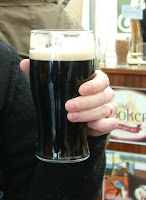
UCC's Pilot Brewery had two beers on (though not when this picture was taken). Frithjofs is a lager which looks for all the world like a Belgian witbier: cloudy and pale yellow-green. It has you thinking of lemons before even taking a sip. In reality it's not really lemony, but it does have a tangy fruitiness to it, to my mind more like a light German weiss than anything else. It's also quite dry and crisp and probably works well as a summer refresher. The other tap (eventually) dispensed UCCinator, a dark bock, though a bit light-bodied to count as a doppelbock, despite the name. It has quite an overpowering sweet-and-sour character, reminding me more than anything of boiled sweets. At 7.4% ABV it's probably just as well I couldn't drink much of it.
As well as their own beers and the festival visitors, the 'Well also had a small range of Belgian beers on tap in the upstairs bar. I tried the Barbar Winter Bok, a deeply dark brown lager brimming with sweet sweet fruity flavours and concentrated essence of banana. Another one not to be taken lightly, but good in its own sweet way.

The Festival continues today but I'm back in Dublin, my cup having truly runnéd over with Irish craft goodness. The buzz among the brewers mentioned the possibility of a Dublin beer festival along similar lines. Going to a beer festival then home to sleep in my own bed would certainly be a pleasant novelty.
21 March 2008

Sneaky taste

Today is one of Ireland's national prohibition days, when no alcohol may be sold and all the pubs shut. Christmas is the other one. In general, the Thursday before Good Friday is one of the busiest drink-buying days of the year, with booze flying off the supermarket shelves like it was about to be banned permanently.

So I was expecting The Bull & Castle to be jam-packed yesterday evening, but it wasn't too crowded. What brought me there was the unveiling of the second beer from the Galway Hooker lads: a seasonal (I assume) brewed especially for the Franciscan Well Easter Beer Festival which kicks off tomorrow in Cork.

They've called it Irish Coffee Porter and it's a very odd creature. For who-knows-what reason, they've decided to serve it nitrogenated, but due to a gas snafu at the pub and the removal of the holey disc thing the beer is supposed to run through, it came out sort-of nitrogenated with a big foamy head that quickly shrank down to a thin skim. The mouthfeel was good, though. Properly prickly and none of that nitro smoothness. It was way too cold though, and I needed to sit with my hands around my pint to bring it to a temperature where any flavour could be detected.

I don't believe in quibbling over nomenclature or beer style semantics, but this isn't a porter. It's a remarkably pale shade of red, only just darker than your typical Irish red ale. The aroma is great, though promising chocolate more than coffee. The flavours are complex but understated, with nothing really bold or attention-grabbing. Again there's chocolate malt to begin with and a sweetness that reminds me of The Porterhouse's Chocolate Truffle Stout which was particularly sweet this year. The slight coffee notes arrive later and there's a hazelnutty finish.

At 5.5% ABV it's not a quaffer, but it does slip down very easily and pleasantly. However, after a couple of pints of understated chocolate and coffee notes my tastebuds welcomed the full-on flavour assault of a regular Galway Hooker.

I'm not a believer in the trite adage about doing one thing and doing it well, and I certainly welcome more Irish craft beer to the market, even if it's only a special edition. However, this recipe needs some beefing-up if it's to become a classic like its stablemate.