15 July 2016

Fail ale trail

They brew 'em strong at Nébuleuse in western Switzerland. I had three of their bottles in stock and deciding a drinking order was complicated by all of them claiming some palate-pounding heft. In the end I let hops call the shots so began with their saison.

Namur Express is no lightweight, however. 7% ABV and pouring the dark gold of apple juice. In defiance of the brewery's name, I managed to keep the lees out of the glass so perhaps that's why there wasn't much of a saison character to the aroma, just the hot esters you might find in a super strength tramps' lager. There's not much happening in the flavour either, to be honest. It could be that first impression of the colour, but I get apples again in the taste: grainy red ones. There's a bit of syrupy candy, and a thick texture to go with that, but none of what makes saison a distinctive style. While not flawed in any specific way, if you'd told me this was an industrial Belgian blonde I'd have nodded along and spent the time I was drinking it thinking about what's up next. Not an auspicious start.

What was up next was Shaddock, a "strong bitter". Strong, here, means 6% ABV. While the marketing speaks mostly of its malt pedigree, the hops are Chinook and there's added bonus grapefruit so citrus was expected. It wasn't found in the aroma: it doesn't smell of anything much, in fact. It looks like a brown bitter, though, the dark amber of strong black tea. And again, that appearance is affecting how it tastes, because the first flavour I get is the heavy tannins of over-stewed tea. It's not pleasant. Rather than adding zest, the hops and grapefruit produce an unpleasant soapy effect, so the last thing you need is the dry, stale, sweaty finish that follows it and the growing bilious acidity which creeps in as it warms. This is a disaster of a recipe, like Bombardier's even-more-evil twin.

So high hopes, then, when facing into Embuscade. While the others were reluctant to form a head on pouring there's no such shyness here. An awkward amount of foam had to be dealt with as I poured slowly, trying to keep the yeast dregs out of the glass. "Ambush" is an American-style IPA of 6.5% ABV and a wholesome, clear, west-coast gold. It definitely smells of citrus, which is in its favour, though it's a candy lemon-sherbet effect which suggests the hops are not going to have everything their own way. Sure enough, on tasting, the hops are damn near undetectable. There's a raw sweetness that tastes to me like dry malt extract, followed by an almost smoky savoury quality which could be yeast autolysis but either way is very out of place, accompanied by an unwelcome metallic aspirin tang. An acrid squirt of Jif lemon in the finish is all the hops get to say, and I don't blame them for being angry. I'm angry too.

It may be that Nébuleuse (est. 2014) is on a journey towards making good beer and these are just juvenilia -- baby steps on the way to proper brewing. But I'm slightly amazed that they're letting them out of the brewery. Clearly, the aim is to make beer as good as brewers do it in Belgium, Britain and the US, but on this showing they have a long way to go to get there.

13 July 2016

Wheat punch

Earlier this summer we had the first beer commissioned by one of the big off licence chains from an Irish micro in the form of the Molloy's/Rascal's All Night Long. It was followed closely by the O'Brien's chain releasing its own, via O Brother: an "American wheat IPA" which they've given the rather clumsy name of Who What Wheat Where. These collaborations are a good idea because they encourage people like me into chain stores where I wouldn't normally look for beer, but in this case I didn't have to because O'Brien's shipped me a couple of free bottles.

It's 5.5% ABV and brewed with seven different headliner American hops, including Simcoe, Columbus and Chinook. You can read about its creation on the O'Brien's site here. I was a little apprehensive when I opened the bottle and noticed a lot of dried yeasty gunk gathered about the neck. Thankfully, however, I had left it standing in the fridge for a couple of weeks beforehand, so I don't think this interfered with the end product. It pours a rather unattractive greyish orange with a loose head that subsides a little too quickly.

The aroma was much more encouraging: a fresh hit of classically American grapefruit and pine. On tasting the bitterness dominates, as I often find with O Brother's beers, and in this one you need to deal with a green leafy edge before you get to the fun stuff, an element which suggests it might have been dry-hopped for a little too long. There's a pleasant juiciness at the centre, a sunny tangerine quality that uses the wheaty body to emphasise itself and sit on the palate for longer than expected. I'd have liked more of this and less of the sharp bitterness.

Overall not a bad effort. It deftly avoids the soapiness that white IPAs of this sort often exhibit. With a little fine tuning it could be superb though I don't know if there are plans to brew it again.

11 July 2016

Left in the dark

Trying to keep up with what Ireland's breweries are turning out has become exhausting. Poor me, etc. I did a bit of a fridge clear-out at the weekend, getting to grips with some of the dark beers that had accumulated in there.

First up, Fierce Mild, a mild (obviously) from YellowBelly and with an impressively low ABV of 3.1%. It poured out disappointingly flat with only the thinnest layer of bubbles forming, temporarily, on the cola-brown body. And sure enough there's barely a whisper of condition to it. Nobody wants their mild to be a fizzbomb, least of all me, but this has unfortunately veered much too far the other way. It's doubly a shame because the beer tastes great: a rich and smooth chocolate flavour is the centrepiece with a black cherry fruit complexity and an edge of gentle roast. While light and very easy drinking it's also decently full bodied without a trace of wateriness. But it's just not enjoyable because it's flat. I feel gypped.

Onwards anyway, and Kangaroo Jack is YellowBelly's foreign extra stout, though a modest one at just 6.5% ABV. I thought I was on for another carbonation disaster as it poured out thickly and flat, but a stable head did form and there's an appropriate prickly fizz. One sip is enough to serve as reminder that stout, traditionally, was a very heavily hopped beer, and export stout even moreso. This, presumably as a nod to its Australian collaborators Woolshed Brewery, uses Southern Cross hops which give it a big, greenly bitter, flavour, mostly grass and crunchy fresh cabbage, though laced with pithy grapefruit as well. Looking past this there's a chewy caramel sweetness at the centre, the malt delivering a massively full texture as well as the flavour, and then there's just a mild dryness creeping in at the finish. But really this beer is all about the hops, and gloriously so.

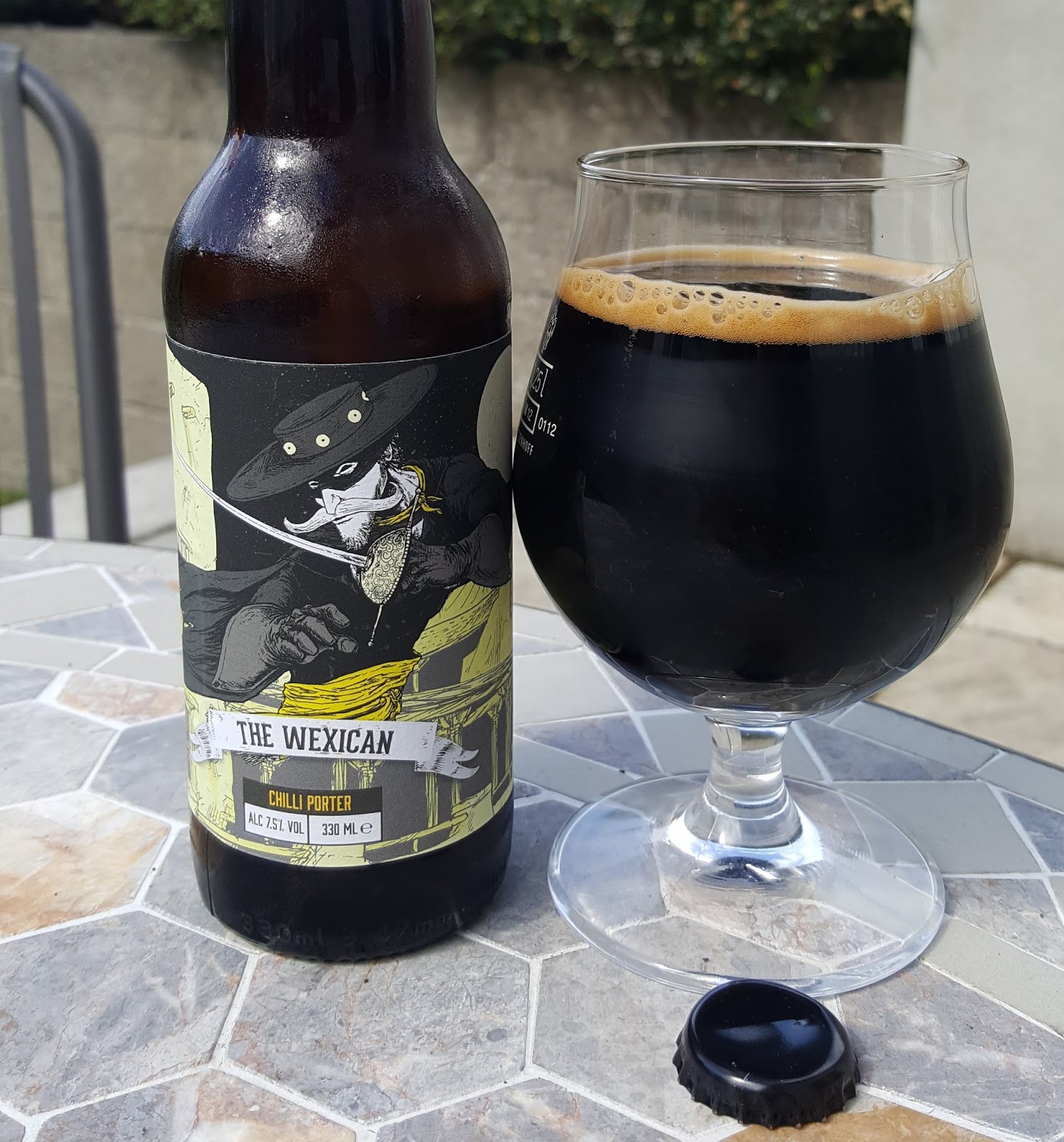
I was given a health warning about The Wexican by Richard in DrinkStore. The chilli levels were too high for him; no such thing for me: bring it on. It's another dense one, pouring inky black and again no head and only tokenistic carbonation. It has the dry acidic bitterness of super high cocoa dark chocolate and a savoury Bovril note that suggests the possibility of autolysis. The chilli, frankly, is barely there: just a light scorch on the palate and a warmth in the belly, but disappointingly no chilli flavour. This is a rather severe beer. Though 7.5% ABV it lacks the comforting depth and roundness of Kangaroo Jack while retaining a gut-coating stickiness. It's a hard one to love.

We'll stay in Wexford and switch breweries for the last beer: Ejector Seat a "turf smoked stout" from the Clever Man range by Drew Fox Brewing, and the first of their beers I've tried. It's an approachable 4.5% ABV, though appears quite dense: an opaque black with a beige head. The label promises the full-on effect of a turf fire, but I don't think I'd go that far, there's just a gentle peaty greasiness in both the aroma and the flavour. The stout behind it is a pretty basic one with a middling amount of roast, some cocoa, and higher than average bitterness for a pleasing old-fashioned effect. The smoke seasoning adds even further to its quaint charm, as does the thick, slick mouthfeel. Not a world-beater but a solid and interesting beer.

Three dark and heavy beers in a row meant that I needed to pull a palate-cleanser from the fridge next, but that'll have to wait for another post.

08 July 2016

Random cask

A recent bicycle trip homewards along the south coast  of Dublin Bay brought me past the two JD Wetherspoons situated there, both at convenient points for stopping off to rest the legs a bit before the final push. Stopping for a pint or three was only common sense.

Just one new beer for me on the taps at The Forty Foot in Dún Laoghaire: Cairngorm Black Gold. Thirsty on a warm afternoon I wasn't really in the mood for a dark beer but I went with it anyway and grabbed one of the last remaining tables on the upper terrace. One sip dispelled any doubt that this was the beer to choose: the texture is wonderfully light and smooth lending it enormous refreshment power. Then there's all the lovely complexities typical of dark cask ale: dry cocoa, sweet blackcurrant and then, as it warms, touches of salty caramel and butterscotch. I took my time over it, enjoyed it thoroughly, and headed on to Blackrock in a good mood.

Looking for something with more of a sunshine-in-a-glass quality when I got the The Three Tun Tavern (two years old today!) I opted for Gravitas by Vale Brewery in Buckinghamshire. It certainly looks the part: clear and cool and bright pale gold. But alas it's just too heavy to do the job required of it. The mouthfeel is sticky and the flavour a sickly, overly-floral perfume thing, with a surprising amount of alcohol heat for just 4.8% ABV. There is a little bit of nuance which comes into play after the first few mouthfuls: melted tropical fruit ice lolly and a sharp but fun lemon bitterness, but they're not enough to make the beer fully beer-garden compatible.

It was May so I felt obliged to do my bit for international mild month by drinking a valedictorian pint of same, since the management had been good enough to put one on. Mary's Ruby Mild was the name, from another home counties brewery, Nethergate. It didn't look the best when I got it: ruby, yes, but with a suspicious brownish haze through it. It didn't taste clean either, having a salty putty earthiness over the top of crunchy cereal and sweet strawberry. The heavier sort of Irish red ale is what it reminded me of and it certainly did not offer the light quaffability that I'm after in a mild, especially outside on a late spring day. Perhaps I was unlucky and got the tail end of the cask: I don't think I've had a single complaint or concern over the way cask beer is handled in either of these pubs and if this was a bad one then it's a rarity.

To be honest, I wasn't expecting to find as many different British cask ales on tap in these pubs as I did, and it was a pleasant surprise even if only one out of three was any good. I might have better luck the next time I'm pedalling through.

06 July 2016

Hear me growl

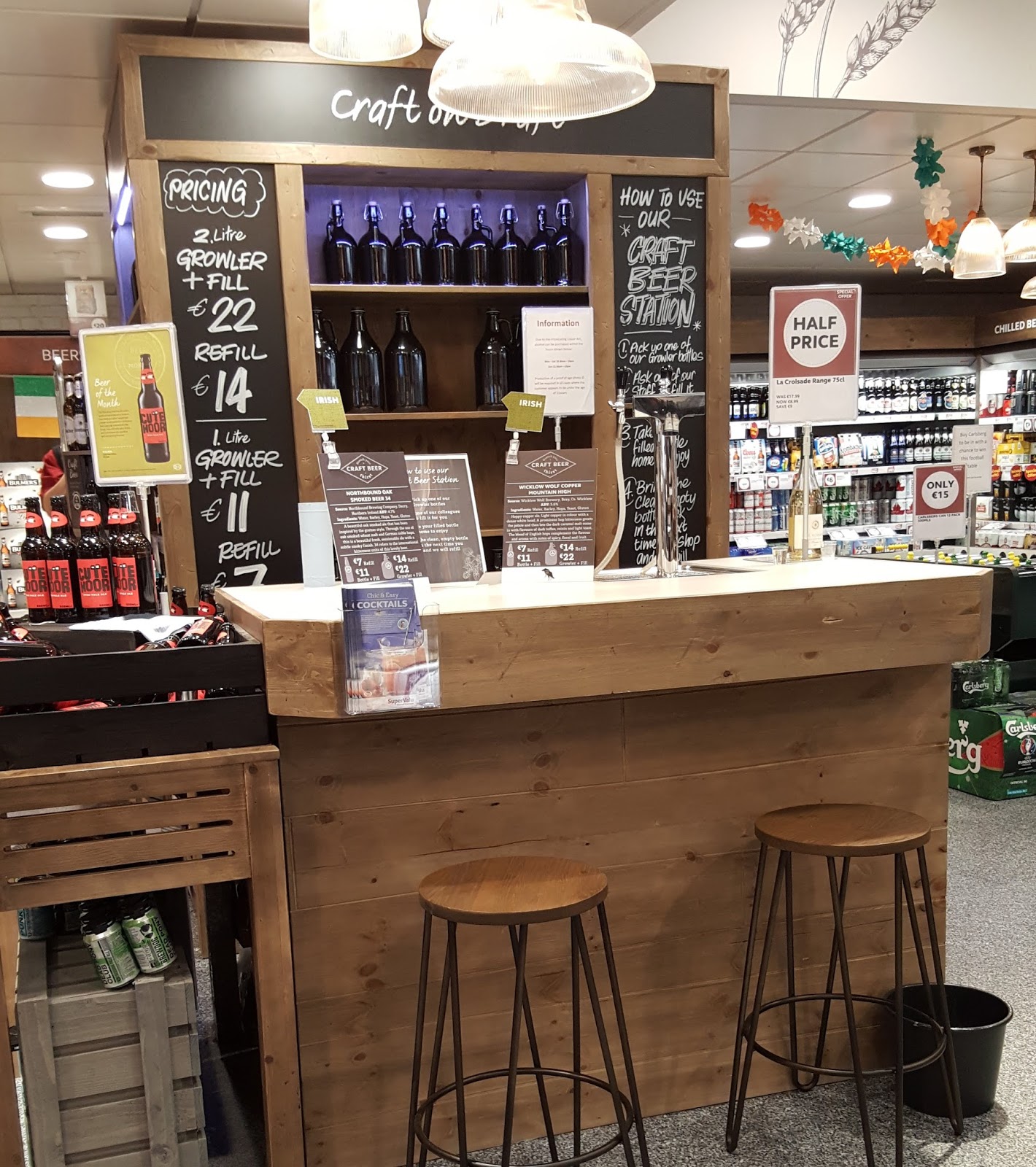
So my local supermarket got a growler station in. It's mounted on an island bar in the off licence section and features two taps of microbrewed Irish beer, one permanent (so far), the other rotating. Growlers are available in one litre and two litre sizes, priced at €11 and €22 for the vessel and its first fill, with the beer costing €7 and €14 thereafter. It's spendy for supermarket beer, no doubt. But then they sent out a voucher to local loyalty card holders offering a large growler with the beer of one's choice for a tenner. Cleverly, the permanent beer is exclusive to the growler circuit, so I was in.

The serving experience was, to put it simply, poor. For one thing they aren't using metric growlers: my 2L one is lined at 64 US-ounce (1.9L) and wasn't filled near the line, the top of the neck containing just foam. I didn't get to see it poured but when it was produced for me from behind the counter it was still cold so I was happy that it had been filled recently. But because the cap hadn't been screwed on tight it leaked on the way home and the extra head space meant that by the time I got round to drinking it a couple of days later it had lost pretty much all of the fizz. My general growler-scepticism is hereby reinforced. But how was the beer?

Wicklow Wolf Copper Mountain High is, as the name suggests, an amber red colour and has a bit of welly at 5.6% ABV. Though almost devoid of condition when I poured it, there was plenty of complexity to be found in the flavour. First impression was of an English bitter: a plummy dark fruit centre surrounded by a dry, sharply tannic, quality which scores the palate at the outset and sands it down in the finish. And amongst all the serious beeriness there's a fun strawberry flavour as well, a sweet tang that does wonders to aid the drinkability, and then a tiny pinch of burnt roast to re-balance matters.

I had no problem getting through three-and-a-bit pints of this in a single sitting. And I honestly think the flatness helped accentuate its English stylings: it was still superbly refreshing even with no more than an effete prickle to it. Copper Mountain High would be a go-er on cask, but sadly the brewery doesn't do cask. I guess a badly-poured growler is the next best thing.

04 July 2016

Don't mention the war

It's come up before how Irish supermarkets are currently using beer as one of the weapons in their endless struggle for dominance over each other. This is a good thing, in my opinion. Even aside from the well-priced quality beer available, it's also a sign that the average shopper is getting more choosy about their beer. I've long said that beer is following where wine and coffee have already been: from a poorly served commodity to something that requires more than token planning by any retailer intending to sell it, and all driven, shaped, by consumer sentiment.

German rivals Aldi and Lidl both held drinks tasting events for their summer ranges in Dublin. Both leaned heavily on the wine side, of course, but there was beer too, and a chance to get a bit of a snapshot of how they see that market segment.

Aldi's event was in the classy surrounds of the Cliff Townhouse on St. Stephen's Green, the doors of the first floor veranda thrown open to the early summer evening breeze. Aldi has an established working relationship with Carlow Brewing and Station Works and it was more of the fruits of that which were on the table.

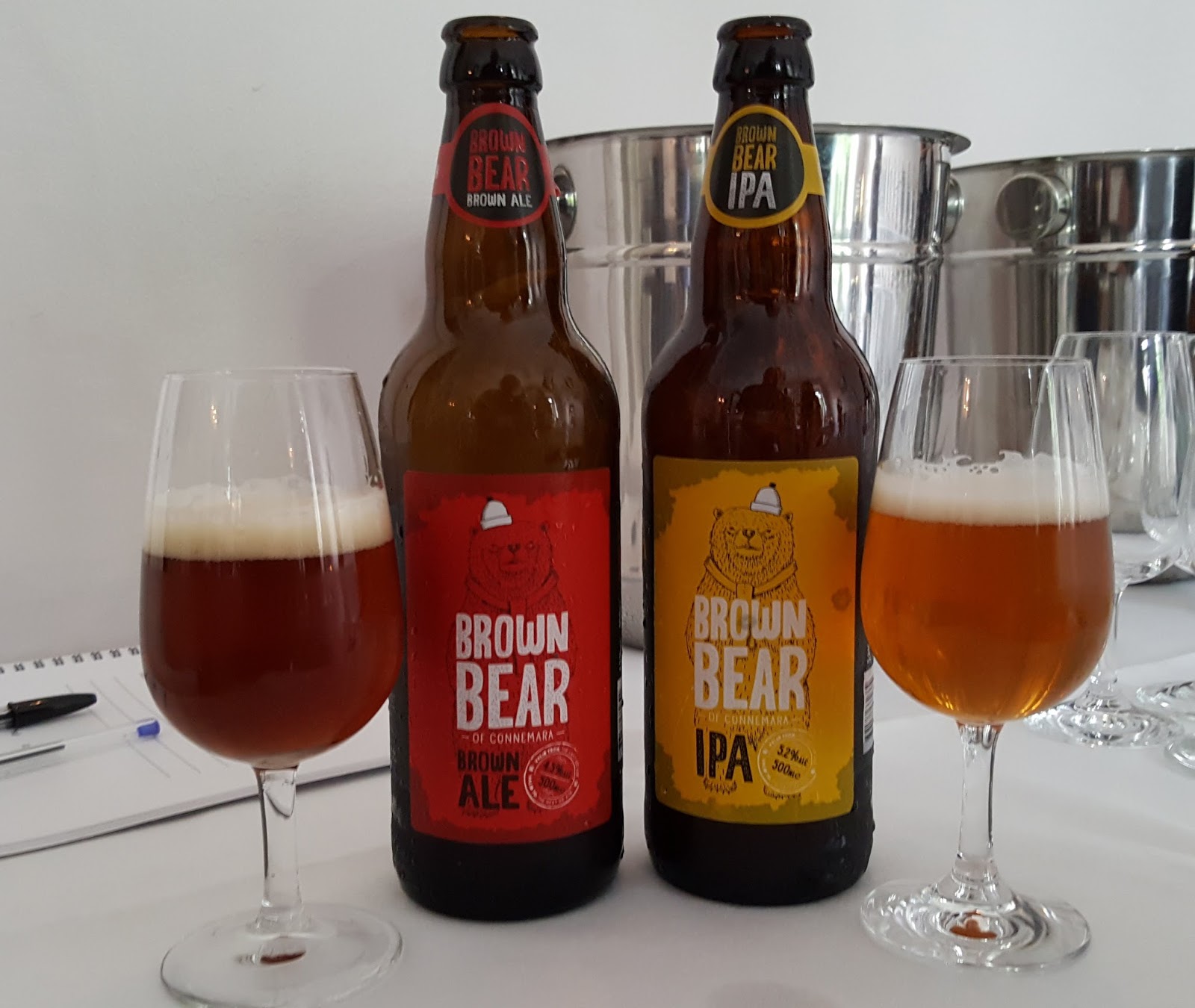
"Brown Bear of Connemara" is the rather odd name they've chosen for the latest set of Newry-brewed Station Works beers. Brown Bear of Connemara Brown Ale is 4.5% ABV, a tan amber colour and has quite a pleasant, on-style, toffee aroma. The body is light but the flavour, while complex, just isn't very nice. A sour-ish sweaty tang is the opener, then a kind of HP Sauce savoury thing, with date and tamarind fruit, finishing off with a slightly harsh and acidic hop burn. It is, of course, delightful to have a budget brown ale that isn't a sticky mess of caramel and butterscotch, but this swings just a little too far in the opposite direction.

Brown Bear of Connemara IPA is a deep gold colour, almost amber, and smells autumnally of moist musty apples and dry dusty crepe paper. There's less going on in the flavour, though it's all generally good -- a simple balance between citrus hops and lightly toffeeish crystal malt giving a sort of red ale/pale ale hybrid effect familiar to drinkers of Galway Hooker. Drinkers of IPA will probably bemoan the lack of hops in this one but I was just happy that it's not completely awful, in contrast to what I was expecting.

The O'Shea's range produced for Aldi by Carlow has seen an expansion by two, along with some down-wif-da-kidz new livery. O'Shea's Session Pale Ale has clearly been cut from the same cloth as O'Hara's 'OPsession as it's a similar brownish colour and has a similar rough dryness to the flavour. You get a little hint of grapefruit on the nose and the finish has a fairly harsh acidity that is definitely hop-derived, but just like its twin it fails to deliver what the style is supposed to provide: freshness and brightness.

The other newbie is O'Shea's Wheat Beer, 4.3% ABV and claiming Belgian influence though it's totally clear and I see no mention of any ingredients beyond malt and hops. It does smell spicy, however, which I suspect is the yeast at work, and the same goes for the slightly estery, buttery character as well. On tasting, the wheat cereal grains come forward in a big way leaving you with a mouthful of buttered toast. After this, the flavour just kind of wanders off mumbling to itself: vague herbs, a dry mustiness, a whisper of soft lychee, but nothing that really stands out. Inoffensive but lacking in character is my verdict.

Choice is a good thing, but the O'Shea's range has much better beers in it than either of these.

We'll stick with Carlow Brewing for the moment when we cross over the battle lines to a Lidl tasting event. Their marketeers took the rooftop lounge in the Radisson on Golden Lane and the spread was pleasingly beer-forward. Rather than pushing their own-label stuff, Lidl put the emphasis on more familiar brands that they've started stocking, including a couple of beers each by Rye River, Trouble and Carlow Brewing's own O'Hara's marque.

O'Hara's Irish Lager is a beer I haven't tried since its infancy as O'Hara's Helles back in 2013. I think it has improved since then, still assertively bitter but lighter textured and easier to drink. Only a slight plasticky burr spoils it for me.

The Shepherd Neame range that Lidl has always carried has been expanded, and a new one for me was Burns Ale. Apparently this is in a Scottish style but it tastes like lots and lots of other Shepherd Neame beers, with that stale orange peel effect. Though a mere 3.8% ABV it seems a lot heavier and has a sweaty, musty, burlap-sack flavour, plus a vomity metallic sharpness. Grim stuff, perhaps best suited to the dour presbyterian mindset.

Everything else new to me was Belgian. Lidl has taken on several beers from the Du Bocq brewery, including Corsendonk Pater (under its American name of "Corsendonk Abbey Brown Ale", for some reason) and this Gauloise range.

Gauloise Blonde is a decent go at the style with some light and clean melony fruit esters, a sharp bitter bite at the back of the throat and then a neat quick finish. One could accuse it of being boring but the well-hidden 6.3% ABV is its own sort of entertainment.

The ABV drops back to 5.5% for Gauloise Ambrée and, while definitely darker, this could pass as a blonde in a different range. I couldn't detect anything I'd describe as "Belgian" in the flavour profile; there's just a vague light biscuit thing. Simple, a little dull, but inoffensive, in short.

Gauloise Dubbel, is truer to style, though only 6.5% ABV, which seems rather low for a dubbel in my estimation. Again it's a simply made beer, making the right sort of raisin noises to pass as a dubbel but definitely too light, and with an off-kilter sherbet note that doesn't really belong but does no harm. There are better dubbels out there, but probably not in your local Irish Lidl.

Certainly if Petrus Dubbel Bruin by Bavik is anything to go by. This is 6.5% ABV again so maybe that's just how they make them now. For Lidl, anyway. It's a dirty beast, saccharine sweet with oodles of brown sugar and burnt caramel thrown in. Best stick to the Gauloise, if you're making a choice.

"Mediocre at best" is my bottom line on this whole shebang. Both Lidl and Aldi, have much better beers in their ranges than most of this lot. Full marks for constantly expanding the offer but I'd prefer a higher degree of pickiness over what gets stocked.
01 July 2016

Sunday mass

Session logo
Go to the Inn on any Friday night
And listen to them while they're getting tight
At the expense of him who stands them drinks,
The Mass-Observer with the Hillman Minx.
-- John Betjeman, The Dear Old Village (1954)
I don't have a Hillman Minx, or money to buy pints for the locals. Just a notepad and a set of instructions from this month's Session taskmasters Boak and Bailey. And I figured Friday night would be a terrible time to do this anywhere but a brightly-lit suburban pub where there's probably nothing I want to drink. Hell with that.

Early doors on a Sunday is the best time to be in the pub, for any number of reasons. On this particular Sunday I crossed town to visit WJ Kavanagh's, partly out of guilt because I hadn't been to this fine establishment in far too long, and it was also promising some new beers.

It was around 1pm when I walked in and my first shout was Summer Days, a new Session IPA from Eight Degrees and one which immediately invites parallels with their excellent Grand Stretch from last year. This one is paler, for one thing, hazy too and with a certain amount of yeast fluff in the taste, I thought. Otherwise, however, there's a big tangerine centre, edged with biting grapefruit. After a longish cycle on a warm day it was fantastically refreshing when cold but does take a turn for the watery as it warms. I don't think it's as good as Grand Stretch and it's mainly the big bitterness that wasn't to my taste. Though the €6 price tag also went a long way to reduce its sessionability.

With that done, it was down to work.

  • How many people are drinking?
A rough count of the chairs suggested that Kavanagh's seats about 150: it's not a small place and, as is often the case with Dublin pubs, is made up of several premises knocked together over the years -- an inevitable side-effect of the fixed number of pub licences. For a publican in search of more trade, expanding your bar is much more cost effective than opening a new one.

However, all the tables were empty when I arrived and there was just one other punter at the bar -- hi Deb! In total, 15 souls were present during the course of the study. A group of three mature visitors to Dublin had a rendez-vous with a local friend who was their guide for the day. They were in for food and a couple of drinks before going off to do some tourism.

Next in were a young couple and their baby in a pram, meeting up with two childless friends of the same age. The atmosphere at their table had the feel of a regular Sunday catch-up. 

Shortly after they settled in, two well-to-do early-middle-age Dubs sauntered in in fancy hiking gear, designer sunglasses perched on their crowns. They had plainly never been here before and needed to know if food was available before they took to a table to peruse the menus over pints of water.

Of the same age and social class were an American couple who came in next and sat along the bar from me, but only after himself had given the taps a thorough inspection. "Oh wow! Cask!" It was almost time for them to go home to San Francisco and this was the first cask beer they'd seen in Ireland. He was definitely staying for some of that. 

Last of my subjects was an elderly gentleman wrapped up in a raincoat and walking with a stick. He seemed to be known to the staff and I wouldn't have been at all surprised if he had been drinking there since before it was a specialist beer pub.

And there was also your correspondent, representing the lone ticker demographic. Speaking of which, time for another pint.

Alligator IPA is new from Trouble Brewing. Appropriately for the name it's swampy in appearance -- a dark amber -- and with a heavy 5.7% ABV that is definitely borne out in the taste. There's a dense and warming caramel followed by a harshly bitter spiciness, but in front of all of this is that yeast: this alligator has a seriously unpleasant bite which makes it very difficult to concentrate on anything else. Cleaned up you'd have a good robust amber ale; as-is it just doesn't hold up well.

To answer the second part of the first question, ten of the fifteen people in the pub are actually drinking, though disappointingly little of it was beer.

  • Which beers are on tap, and which are people actually drinking?
Positioned at the bar I was able to conduct a full census of the 23 working taps (one was out of action):
17 were from independent Irish breweries, 5 quality imports, plus Guinness.
21 of the taps were hooked up to kegs and then there were two cask handpulls -- one pouring Irish and the other an import.
The styles broke down as 4 IPAs, 4 pale ales, 4 red/amber ales, 3 stout/porters, 2 ciders, 2 lagers, 2 wheat beers then one each of saison and sour beer.

The table of four with the pram stuck to water the whole time. They left as soon as they'd finished their food. Our American cask enthusiast had the cask Irish red while his companion took the English cider on cask next to it. The group of older friends bought mixed rounds of red ale and shandy. Having finished their initial pints of water, the well-to-do couple opted for a bottle of prosecco while the elderly gent, purely to remove any sense of plausibility from my observations, partook of a single glass of rosé wine. And two pints of IPA (so far) for the beer geek.

I was a little surprised at the representation of red beers in the line-up. Sure who drinks red nowadays? But the anecdotal evidence here would strongly suggest that red ale has not yet had its day.

  • What are they eating?
Everyone except the two lone men did have food. The Kavanagh's menu is big on pub classics and that's what I saw being handed out: wings, a burger, steak sandwiches, fish and chips and several salads. On Sunday the menu is enhanced by a roast dinner for €15 but there didn't seem to be any takers.

  • How are they passing the time?
Not much to report here. They talked to each other. You might have thought that Sunday afternoon is a good time for newspapers, crosswords or board games in the pub, but not this place. As far as I could see, board games are not supplied at Kavanagh's.

  • What are the topics of conversation?
Sitting at the bar while most everyone else was scattered around meant I didn't overhear much. From the three visitors and their local friend there was much boisterous laughter, and Team Pram was also excited, handing around photos on phones. I got more detail from the Americans along the bar and it was very much The Sort Of Things You Talk About On Holiday, taking conversational cues from the surroundings including the food options and, with Euro 2016 in the early stages, the comparative rules of ball games.

  • How is the pub decorated?
WJ Kavanagh's has always seemed to have a bit of an incongruous Tex-Mex theme to me, probably traceable back to several owners ago. There are some stucco'd walls and exposed hardwood joists for that hacienda look. But turn another way and you'll find Brooklynesque bare brick and elsewhere upmarket Farrow-and-Ball style flock wallpaper. Eclectic covers it, I think. This is mostly adorned with breweriana -- signs advertising the cutting edge brands of fifteen years ago like Samuel Adams and Delirium Tremens, as well as hipper ones such as BrewDog and Naparbier. A single vintage metal tobacco ad clings to one corner, in perpetual fear of the screwdriver.

  • How many TVs are there and what are they showing?
Surprisingly for a large pub just around the corner from Croke Park there are only two, modestly sized, TVs. Both are showing the football, to the interest of nobody much. 

  • Are there pot plants, parrots, spittoons?
Short answer: no. But it's interesting how it has been kitted out, and I'm sure this is one of those features that are common to urban pubs but rarely noticed: everything is subtly nailed down and secured; nothing is hanging loose to be idly torn or knocked onto the floor. The pub doesn't look at all sparse, but if you wanted to trash the place you'd find it tough to gather materials for doing so.

  • How many smokers are there? And vapers?
Only one: our rosé-drinking buddy went out to the small smoking terrace for a cigarette.

  • Is there a dartboard, pool table or quiz machine, and are they in use?
No on all of these. Plenty of pubs have pool tables but I don't think I've ever seen a dartboard in Dublin, and certainly not in the city centre. Gambling machines are mercifully illegal.
***
I deemed the study to be completed at 3.30pm and ordered a third pint to celebrate: the Irish red on cask.

Rouge is the name, from White Gypsy brewery. Presumably it's a relative of, or a twist upon, their usual red ale Ruby. It arrived a perfect clear copper colour, unsparklered so filled pleasingly to the brim. And while the badge may say Irish red, this is most definitely an English-style brown bitter, and a bloody good one at that. It is incredibly tannic: throat-closingly dry and scouring the mouth clean of moisture. A green herbal leaf effect adds a bitterness which enhances the similarity to builder-strength stewed black tea. My pint could have been cooler, and with a touch more condition, but it was highly enjoyable in its one-dimensional way.

As I marvelled at this, four inner city Dublin yoofs sauntered in, clad in their uniform grey tracksuits. While certainly local, I suspect they were also new to the pub because the selection of taps flummoxed them. Having strolled the length of the bar, exchanged confused looks, and turned on the heels of the their Adidas, they made for the door. "Do yiz do cocktails?" said one incredulously over his shoulder, as a disparaging remark rather than a question. And then, as the door swept closed behind him, "I love the origami."

A malapropism? Or is origami the latest front in the class war? Somebody should do a study.