Showing posts with label guinness. Show all posts

20 July 2026

Where they do things differently

The Glider is a modern marvel. Belfast's metro-like bus-with-notions runs transversely across the city, from west to east, passing plenty of the city's beer destinations on the way. A new curiosity has arrived at the eastern G1 terminus in Dundonald. As has been reported far and wide, Lidl NI has chosen to open a fully-operational pub in the same building as their supermarket, to subvert local licensing restrictions. I went up to have a look.

Knowing, presumably, how much of a curiosity The Middle Ale would be, and the potential for positive publicity, the chain has gone to more effort than it strictly needed to. Although there's nothing distinctive about the exterior, the inside has been designed to a definite theme, based on the old-fashioned Irish pub-grocer, as befits a kind of modern day equivalent. The shelves are lined with decorative versions of Lidl food and homewares, not to advertise them seriously, but to fit the theme. With that goes shiplap-style painted-wood walls and ceiling, lighting in the style of early electrification, and even little vestigial drawers behind the counter, as though for storing loose produce. That it's all garishly coloured in the company's red, yellow and blue, rather than more realistic earthy ochre or olive green, takes away from the effect and reminds one that it's all a bit of set dressing. But it's fun, like drinking in the on-stage pub from a pantomime.

The drinks offer... well, they've made a bit of an effort. For the most part, the draught options are what you might expect to find in a mainstream Norn Irish pub with a tie to C&C: Tennent's, Heverlee, Bulmer's, Bud Light, Guinness and the one surprise, Estrella Damm. When I lived in the province, such a basic array would absolutely have included C&C-brewed keg Bass as well, and it was a little jarring to see it's not part of what's plainly an out-of-the-box factory-settings beer line-up. I bet the marketing wunderkind who came up with "The Middle Ale" didn't think to ask if the pub would sell any ale. It doesn't.

While you can buy Lidl-brand wine and spirits behind the bar, the logistics of doing the same for draught beer would have been impractical. This is where the effort shows, though: an additional beer tap is badged as the own-brand Crafty Brewing Lager, and while I strongly suspect it's hooked up to a keg of Rye River's Bidin' Time, I also have my suspicions about whether or not those are two different beers in any meaningful way.

None of this was getting me any new ticks, however. I had to turn to the bottle options for that. Now, you know I love a bit of knock-off branding from the German discounters. I had never taken a punt on either of the main rivals' Corona clones, because they're only in six-packs and that's too much commitment to a beer that's likely undrinkable. At The Middle Ale, however, they'll do you a single of Camaro, and even shove a wedge of lime in it.

I understand that the lightstrike-proof hop substitute that big-brand clear-glass lagers are made from is quite expensive. That it's not in use here is painfully obvious, even sniffing through the tiny aperture of a longneck. The pub hasn't been open long but this was still skunked from its time in the glass-fronted fridge. That's present in the flavour too, but is far from the worst thing about it. There's a horrific cooked-sweetcorn savoury quality, turning to popcorn husk in the finish. The little jet of real lime from the wedge does genuinely help by masking some of the awfulness, but it's a bad time from start to finish. The mainstream versions of this type of beer are mostly very bland and treated a little unfairly in the discourse; the Lidl one, however, tastes as bad as all the jokes about them say they do.

A better drinks offer might have had me spending a little more time there, soaking in the Disney-does-country-grocer ambiance, but nothing took my fancy. Back on the Glider, then.

I didn't have any to-do list beyond that, although I'd never had a pint in the downstairs bar of The Ulster Sports Club, so decided to fix that next. It was quiet and cool in there, and downstairs was the only option as the Out of Office brewery taproom on the upper floor hadn't opened yet. I had a pint of their session IPA: Pencil Pusher.

This is a modest 4% ABV and pale yellow with a light but definite haze. The flavour is crisp at first: plain and a little grainy, before the hops kick in, bringing a fresh and pithy citric bitterness. It took a moment for anything else to appear, beyond the initial grapefruit, and that's a sweeter and slightly sticky stewed peach effect. It remains zippy and refreshing, however, and well-chosen as a regular on the more mainstream downstairs bar. There's little to dislike about it.

All roads lead to The Sunflower, and it was busy in the sunny beer garden, though a little quieter indoors, before the Friday after-work crowd fully descended. Galway Bay makes the house beer here: Sunny Lager. It's pretty unchallenging fare, though well made. It's a crystal-clear golden colour, looking like lager perfection, and is softly textured, the body full for something only 4.3% ABV and likely brewed to a price point. Where I cynically expected it to be bland, the flavour has a colourful floral quality, tasting of summer meadows and tasteful bouquets. Maybe the appropriate weather we had enhanced my impression of it, and it wouldn't be as engaging on a dismal grey afternoon. Quality is quality, however, and I would come back to this.

On the guest cask was El Dorado, a pale ale from Manchester brewery ShinDigger. They had it served nicely cold, which was appreciated. This is another pale and clear one, and has much in common with the lager, being plain and decent, with a subtle hop flavour. Here, that's a light zing of orange and grapefruit, though without any proper bitter kick. It's hard to dislike, but I had turned to the cask in search of complexity, and attracted by the name of the beer being the name of a hop. There's an element of false pretences about it: it's far from the hop showcase one might think it would be.

And with that it was back home to Dublin. I didn't get any proper exploring of Belfast done but felt I did the city's beer scene a little bit of justice. Whether it's worth gliding out to Dundonald to see how Lidl does a pub isn't for me to say. Don't go for the beer offer is all I have to add to the conversation.


29 December 2025

The Christmas menu

I hadn't noticed before that Wetherspoon publishes a quarterly leaflet of its upcoming seasonal rotational beers. Maybe it's a new practice, but it's great for us tickers. In the run-up to Christmas, I did some hunting around the Dublin branches for the late 2025 offerings.

That started with the appropriate Winter Draws On, by Brewsters. It's only 4% ABV and promises citrus and spice, so is one of those English winter ales. Still, it looks cosy with its warm copper glow. The citrus manifests as dried peel, like fruitcake mix without any of the actual cake. Complementing the lightly fruity bitterness is a tea-like dryness, adding a refreshment quality that isn't very seasonal but is very pleasant. This is a clean, characterful and well-balanced session beer, exactly the sort of thing that I associate with Brewsters. Your cockles won't be warmed but your thirst will be slaked.

A rare visit to The South Strand brought me Evil Elf by Rudgate. I would be quite willing to bet that this golden ale appears under a different name during the summer, because it has a very sunny disposition. Zesty, and slightly oily, lemon forms the aroma and continues in the foretaste. It's not bitter, however, tasting more like lemon candy than actual citrus fruit. The sweet side grows gradually, adding notes of honey and golden syrup. It verges on sticky but its modest 4% ABV keeps it on the right side of drinkable. This is solidly made and devoid of seasonal daftness. There's no way any sensible brewery would only roll out such a straightforwardly enjoyable recipe at Christmas.

Advent Ale is from Titanic, the brewery abandoning its sinking ship theme for the season of goodwill. This 4.6%-er is a medium gold in the glass and smells sweetly spicy, hinting at clove and nutmeg. Those spicy oils are present in the flavour but pleasingly low-balled, hinting at their presence but not the beer's whole thing. Unfortunately, the beer doesn't have a whole thing, its base tasting to me like a rather plain blonde ale: honey-sweet, gently floral, but otherwise nondescript. I guess Christmas beer doesn't have to be dark and strong, though at the same time I don't really get the point of doing them pale and light, except there's presumably a market for them. File this inoffensive chap with the other cod-seasonals, made for spring rugby and... actually, is that the only other time English breweries make lacklustre tie-in beers? Answers in the comments.

So far, so sessionable, but where are those big winter warmers? Otter's Otter Claus brings us all the way up to 5% ABV and is a wholesome-looking dark amber colour. Alas, it doesn't go anywhere special in the flavour, being the same as any number of malt forward, medium-dark, strong bitters. To wit, there's toffee, black tea, burnt caramel and a token measure of orange peel and meadow flowers from distinctly English hops. It reminds me a bit of Wetherspoon staple Abbot Ale but is much more enjoyable; lighter on the caramel and more drinkable as a result. It left me feeling a bit stiffed on Christmas vibes, but it's a decent beer. While it may be a brown bitter, I don't think it can be accused of being twiggy or boring. For €2.60 the pint, I have little to complain about here.

It's not all red suits and reindeer in the seasonal offerings. I also had my second encounter with the Bateman's sub-brand Salem, and their Dark Fruits porter. It's actually surprising that more cask breweries aren't taking a pop at Titanic's Plum Porter market share. I didn't get to try them side by side, but I deem this a worthy adversary. The berries are very prominent in the flavour, a jammy damson and cherry effect with just the right amount of restraint on the sweet side and a mild blackcurrant tartness. In proper Titanic style, the base is velvety smooth with oodles of creamy milk chocolate. The depth and roundness of its texture is especially impressive, given it's only 4.6% ABV. Mouthfeel for days. My one pint wasn't long being sunk, and while I'm not sure that a second would have been as enjoyable, in other circumstances I would have been quite prepared to try it. Quality stuff, this, and I say that as a fruit porter sceptic.

Ramping up the strength and the blackness, next is Hammerhead Stout by Nottinghamshire brewery Milestone. This is a very full 5.6% ABV and promises "a bite" on the clip. It arrived looking handsome: fully black with a thick pillow of foam and a dome of loose bubbles over the top. It's exactly the appearance Draught Guinness was invented to reproduce but never will. The aroma, however, is in the Guinness zone, being rather vague, just toasted grain and a mild metallic bittering. From that, the flavour was a surprise, opening up a ribbon-wrapped box of milk chocolates, adding a light smattering of latte coffee, butterscotch and vanilla, with a subtle dry charcoal note on the end for balance. I was impressed by the contrast between aroma and flavour: it smells almost acrid but is smooth and sumptuous to drink. While not exactly complex, it's perfectly balanced and wonderfully drinkable. In a less festive mood I might be inclined to complain that the ABV is excessive, but I'm willing to let that go because I'm sure the heft is a major part of its classy, understated gameplan. For me, this hit the same spots as Irish stout classics Leann Folláin and Nocturne, with bonus cask silk. At time of drinking I had recently finished reading Martyn Cornell's epic history of porter, and this beer fitted the hyperbolic descriptions that 18th and 19th century writers used when describing good product. I hope this isn't just a Christmas beer. It belongs on the bar year-round.

In summary, I think the breweries could have done better here. Light and pale just doesn't do it for me at midwinter. I was very glad to find at least some level of darkness in the selection. It would have been a wash-out without them.

03 September 2025

Special import stout

Foreign interpretations of Irish beer styles, and stout in particular, is something of a research interest of mine. They're not often sold in Ireland, for perhaps obvious reasons, so I was drawn to O'Ness by Prague brewery Sibeeria as much for its novelty value as anything else.

Not that there's anything particularly novel about a 4% ABV stout, packaged carbonated in its half-litre can. That results in a lovely pure-black pint with a wholesome tan-coloured stack of froth on top. The aroma is lightly roasty, with a Guinness-like tang as well, hinting at blackberry and plum. I noticed it poured quite thickly, and indeed the texture is remarkably heavy, making it feel like a much stronger beer.

And that's true of the flavour as well. It's primarily a bitter beer, with the dark fruit element meeting a quite severe herbal sharpness; an apothecary shop of aniseed, thyme, yarrow and bay leaf. There's a dusting of very dark cocoa powder and a sticky tang of molasses, but without any of the sweetness. A dry roasted finish skirts acridity but stays manageably drinkable. It's quite a workout for the palate, but everything hangs together extremely well.

Drinkers used to the sweet dark beers of Czechia, or indeed the creamy blandness of Guinness, will get a surprise from this one. No punches are pulled and it exhibits the assertive grown-up bitterness of an export-strength stout at a barely credible low ABV. I found it impossible to drink fast, and enjoyed lingering over it. There really aren't many Irish brewers making session-strength stout as flavourful as this. If, like me, you're still mourning the death of Wrassler's XXXX, here's a worthy substitute.

17 January 2025

Arthur's Last Christmas

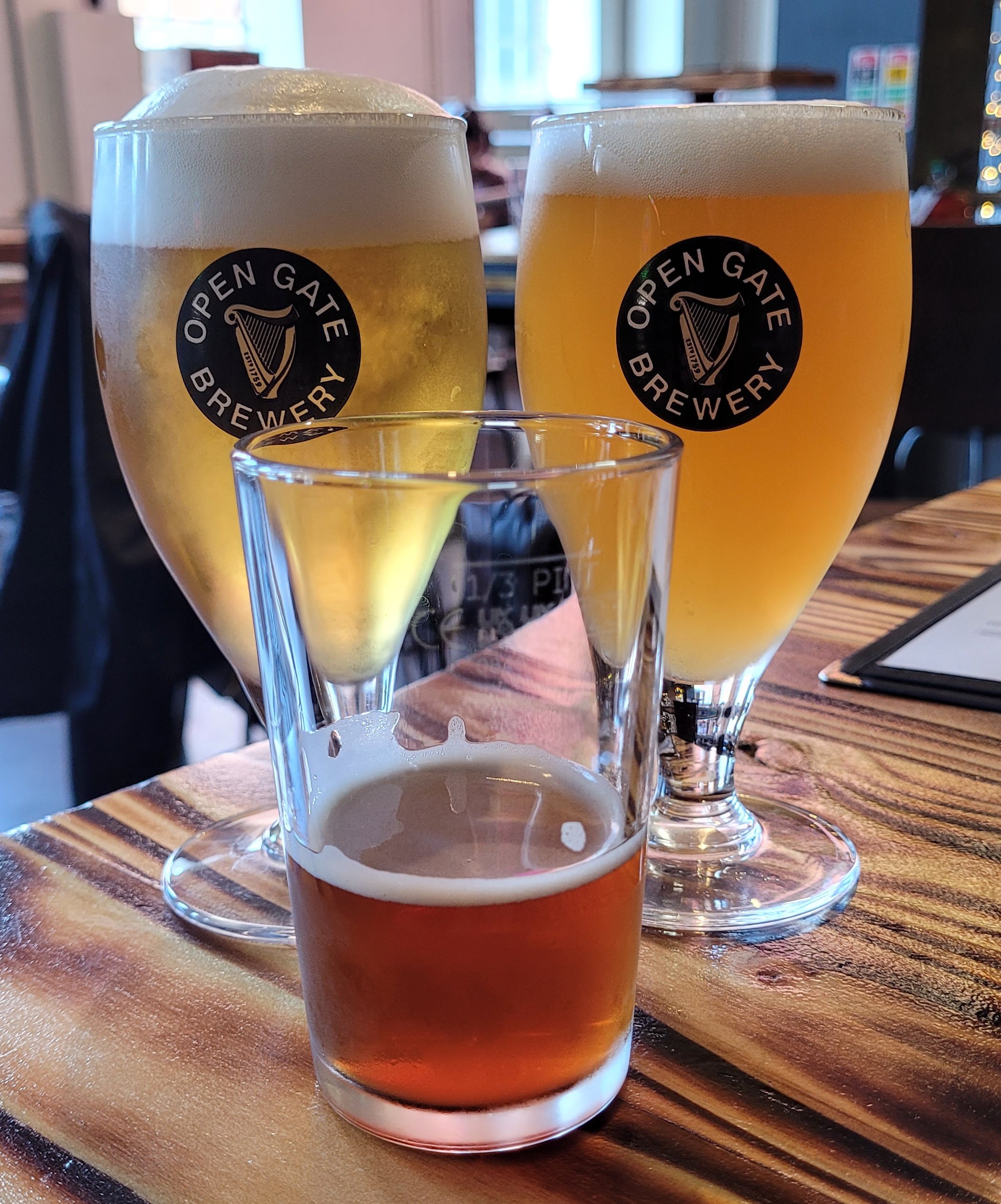
Just before the Christmas holiday I dropped in to the Open Gate Brewery to see what the Guinness crew were offering for the season.

Paddle one began on a Chocolate Milk Stout, the sort of thing Guinness has produced from time to time but rarely to any great aplomb. This one is fine, but unremarkable. It has all the creamy Guinness texture but a little too much of the signature Guinness bitterness. I could barely taste the powdered chocolate behind this, nor did I get any of the vanilla effect which often results from lactose. Overall, it's maybe a smidge denser and sweeter than Draught Guinness, but little more different than that.

The next one gives this post its title: Arthur's Last Ale. The claim is that it's a recreation of the last batch of ale brewed by Guinness before it became an all-porter brewery in the late 18th century. My "beer specialist" server couldn't tell me what it's made from, but it's a dark garnet colour, so I'm guessing some combination of roasted malts is involved. The aroma gives little away but the flavour leaps in with Scotch-ale levels of sticky toffee. It's only 5% ABV but feels more, almost like a barley wine. The flavour finishes with a bite of burnt caramel. A very slight leafy green tang is all that the hops, presumably English, have to say. As historical recreation beers go, it's accessible and pleasant. I don't get the point of putting something like this out as a promotional piece for the brewery without making all the background information available, however.

Finally for this paddle, Plum Pudding Porter: not the most original idea, but nobody else around here is doing one, so why not? It's properly black and a sizeable 8.3% ABV. The spice and plum is immediately apparent from the aroma; enticingly so. The mouthfeel is surprisingly light, in that it's full but not heavy, and very drinkable. What also helps there is that the novelty flavours are restrained and quite balanced. You definitely know you have a novelty beer: its flavour is the gustatory equivalent of wearing a silly festive hat. But the clove, the cinnamon, nutmeg and sultana all taste like the real thing, not some homogenous sludge of industrial "Christmas pudding flavor". This is the classiest gimmick beer I've had in a while.

The second flight began with a palate cleanse called Lyre Lager, a bit stronger than your standard at 5.5% ABV. As is absolutely standard in this place, it's a flawless gold in the glass with a perfectly formed white head. The body is substantial but there isn't really the flavour to justify it. It tastes very generic, with only token hops -- all bittering -- and a sickly malt sweetness that's half way to tramps' brew. I have to wonder what the intention was. Regardless, this one isn't up to the usual high standard of Open Gate lager.

The final two are in those rare beer styles that make high turnover taprooms like this so much fun. Who else would be making 90 Shilling? Open Gate's is 6.8% ABV. This is a heavy fellow, dense with unfermented malt sugars, while also laced by bitterly vegetal hops: serious stuff. There's a definite Highland Toffee element to the centre, and it's enjoyably warming and chewable. On adjusting to the bitterness I found a more nuanced red-liquorice side to it. I'm no expert on what 90 Shilling is meant to taste like, either historically or whatever American homebrew culture has since turned it into, but this is quite a good beer, and was well suited to the cold and drizzly evening on which they served it to me.

Our big finish is Open Gate's Black IPA, brewed in collaboration with giant, mostly-independent, Kildare brewery Rye River. It's certainly black, showing only dark brown at the edges, and it's a sizeable 6% ABV. On the red cabbage to bath bomb scale of black IPA flavour profiles, this leans Lush, sparking with zesty lemon and oil of lavender. The bitterness is harder even than cabbage and spinach, heading for rubber and yeast dregs, but this isn't very prominent and can be ignored. Overall, it's a slightly off-kilter interpretation of black IPA, perhaps taking its cue from the current fashion for fruity ya-yas in IPA hopping, rather than a stern smack. It works, though. Black IPA being a wonderful and under-valued style doesn't mean they all have to taste the same.

Open Gate is closed at the moment but scheduled to reopen on 23rd January. I don't know if any of the above will survive the furlough.

13 October 2023

Marking time

Landmark Dublin pub The Palace, one of the few reasons to ever venture into Temple Bar, is celebrating 200 years in business. Like most such drinks-related anniversaries it requires an asterisk or two, but it's hard to begrudge one of the city's few genuinely charming old bars.

Presumably as a nod from its main supplier, it has marked the occasion with the arrival of a new Guinness beer: Palace Porter. It's not branded as coming from the Open Gate pilot kit, but one assumes it does. The ABV of 4.9% indicates it's not a straightforward rebadge of something else, as would normally be the case in such circumstances.

Diageo launched, and quickly withdrew, a new porter in 2014. Though over a percentage point stronger, this has a lot in common with it. Someone up at James's Gate seems to have decided that "porter" means carbonated rather than nitrogenated like Guinness Draught stout. So the first surprise was a pleasant one: proper bubbles, proper flavour, no deadening creamy gak.

It smells of Guinness stout, mind: that signature mix of dark toast and a tangy brisk acidity, familiar to aficionados of the Large Bottle. The body is beefed up a little, but it still finishes quite thinly, the busy carbonation scrubbing away everything beery before it. Complexity is not part of the deal, and a lack of any chocolate flavour feels like what's most conspicuously absent. I welcome a new non-nitro dark beer, but this is missing some key features.

Once again, then, a new dark Guinness beer doesn't move the needle very far from the flagship's specs. As such I would be surprised if this went any further than the walls of The Palace. Go there if you want to try a pint and have €6.60 in your pocket.

Edit: there's a short video about the beer's creation here.

21 August 2023

May as well

I had a bit over an hour to kill before a later engagement, and where any sane person would sit it out with a pint and a book, I went to the nearest brewery taproom to work through half pints of their latest releases. Not that this is easily done: brewery taprooms are thin on the ground in Dublin, but Guinness's wasn't too far out of my way and it had been several months since my last visit.

As always, a welcome taster is proffered on arrival, and this time it was the Cardamom Red Ale. No standard Irish red, this is a big fellow, 6.6% ABV and a murky amber colour. There's a beautifully exciting and exotic aroma, full of peppercorns and sandalwood. It's light bodied for the strength, with lots of fizz. While there's little foretaste, there's a nice kick of the pepper on the end; almost a szechuan chilli level of piquancy. That's set on a rounded and wholesome malt base. It's a little gimmicky, but not too much, and shows that there's a solid beer at its heart. A bigger measure of this would have been no hardship.

I'm always up for an Open Gate pilsner: it's the style they do best. Next out was Mein Stein, brewed with modern German hop Mandarina Bavaria. It's a perfect limpid gold with an equally perfect thick fine froth on top. Here's another solid base beer: an unmistakable crisp pilsner, though the aroma is dank and weedy, more like an American IPA. That was the first sign that the hop has been loaded in, delivering a strong bitterness and an almost plastic-tasting flavour. Isn't Mandarina meant to be gentle and fruity, in line with modern effete beer preferences? This tastes sternly Prussian and it's a bit of a shock at first. It took a few sips to get used to it, and by the finish I was really enjoying it. Not what I was expecting, but I'll take it.

The 5.2% ABV Mango Chilli Ale came with a lactose warning and arrived hazy and orange, though this too had a decent and lasting head. It smells broadly tropical and is thickly textured, in a New England IPA sort of way. That's not how it tastes, however. Sticky tinned fruit starts us off; sweet but still subtle and unobtrusive. I thought I was in for a dud but then the chilli kicked in: dry and hot and raw, more like the skin than the flesh of a pepper. The combination is weird, and I'm struggling to figure out why they thought of it. I don't think it quite works, although I liked the belly warmth and palate afterburn: not things I'm looking for when I order a beer, however. On to round two.

That starts with an Oyster Stout, one with actual oysters. My benchmark here is the Porterhouse one, a velvety smooth lad with loads of milk chocolate and a mild briny tang. This isn't that. It's rather dull, and very much in the mould of regular Draught Guinness. At a substantial 5.5% ABV, the extra strength should give it more poke but it doesn't: this could pass for 4% or below. There's no oyster character, just the faint roast found in the brewery flagship. Meh, the definition of.

Cask & Keg is intriguing: an IPA aged in barrels which formerly held Roe & Co. whiskey, Diageo's Irish brand, and is a whopping 9.1% ABV. It looks innocent, a hazy amber colour. The aroma is sweet and fruity which does nothing to prepare the drinker for a whiskey cocktail of a flavour. I'm not a cocktail person, but I immediately thought of both the Old Fashioned and the Sidecar on tasting: that mix of oaked spirit, sugar syrup and a twist of orange peel. There's a touch of Sorachi-esque coconut too. All of that is very well mixed together and tastes smooth and integrated with no sharp edges. Dangerously easy drinking, as beer reviewers used to say.

Finally, a beer that looked very similar, the Amarillo Rye Pale Ale. This one's a bit of a lightweight at 4.9% ABV. And sadly I get neither Amarillo nor rye from the taste. Open Gate's poor record on hop-forward ales strikes again, and while this has the smooth texture of a modern hazy pale ale, it delivers only the faintest quantity of Amarillo's signature fruit. I also had to search for any dry grass and pepper from the rye, and I found it there to an extent, but not noticeably so. Like the stout, this is a basic and inoffensive beer, not really showing off the headline ingredients.

Still it's an interesting bunch, and I fully appreciate the way I can walk in off James's Street of a random Thursday evening and have such interesting fare on offer. There is only a handful of places in this town where that's possible.

12 May 2023

The kennel club

Another BrewDog post so soon? Once again, I'm pleading circumstances. In March the Scottish brewery's Dublin megapub generously hosted the National Homebrew Club's first national competition since 2019. I went along to lend my palate to proceedings and, when done, hung about to drink beer, catch up with friends and await the results. It was an opportunity to try out some newish beers from both headquarters and the onsite brewkit.

The first beer to catch my attention was Black Heart. BrewDog has been marketing this heavily as a Guinness substitute, and just like with Ansbach & Hobday's London Black last year, I wanted to put that to the test. Unlike London Black, however, this one does actually meet the brief. They've matched the strength of Draught Guinness in Britain where it's 4.1% ABV. They've got the texture spot on, while the flavour is very dry and rather boring, presenting an equivalent amount of toast and roast but lacking the tangy sourness which is Draught Guinness's only real nod to having character. Mission accomplished, I guess, though BrewDog normally makes much more interesting beers than this. I would like to try them side by side if I ever get the chance.

I have Steve to thank for a taster of Pie in the Sky, an imperial stout with cherry and vanilla, produced by the wild-fermentation sub-brand, OverWorks. This is stout on a technicality only; mostly it's a sour beer in a broadly Belgian fashion, the added cherries lending it a certain air of Rodenbach or similar. I'm not sure what the vanilla is meant to be doing -- hidden balance, perhaps -- but it doesn't get in the way, while the cherry is quite realistic. Best of all, the sourness isn't tokenistic or apologetic but full-on and puckering in a most invigorating way. Excellent stuff.

The other pair today came from BrewDog Dublin's own brewery. They do a good line in puns which would have me here more often if they hadn't built the place half way out to sea. First up, I can't resist a sour IPA, and this one promises extra refreshment with the addition of fennel. They've called it Fennelope Cruz. It's 4.6% ABV and a pale and hazy yellow. The sourness is on the subtle side here, but I think that suits it, making it taste zesty rather than puckering. The fennel gets a good run, adding an unusual savoury quality to it. This is the sort of high quality creativity that one hopes for from a small brewery producing nothing but once-off experiments.

The final one is not. I headed for the door after the Italian-style pilsner called Canem & Circenses. Cool name but disastrous flavour. If they did the bit of the lagering process which is supposed to remove the diacetyl, it didn't work. This was intensely, horrifically, buttery -- concentrated to the point where Steve described it as cheese-like and he wasn't wrong. Urgh. In the background there are hints of what it should have been, with notes of mango, peach and fruit chews. This doesn't say pilsner of any kind to me, but at least it would have been drinkable. As is, it wasn't.

At least I got a couple of good beers out of the excursion, and plenty of very tasty homebrew as well. Thanks to the Club for inviting me along, and to Outpost Dublin for hosting. Sort your lager out, though, eh?

17 May 2021

The Big Three

Today's post harks back to the early days of Irish microbrewing, when the producers felt that the path to success was to copy what the mainstream was doing. As a result, every beer that came out was either a pale lager, a red ale or a stout. Things are very different nowadays, but those three styles are still around, even if they're not produced at the same rate as the myriad variations on pale ale. I've picked a handful to see how things are at the old school.

We'll start at Dublin City Brewing. Well, sort of. Even though their cans have been claiming the beer is brewed at the new facility in Parnell Street, company representatives are regularly in the media explaining they brew under contract and their own brewery will be commissioned any day now. One or the other, lads. Anyway, Pioneer Pilsner is their first limited edition, designed to be a hoppy cut above their core Liberator lager. Its rich golden colour suggests to me that they're going for something Czech style, and the malt-driven flavour confirms it for me. This is no crisp and grassy number but a smooth and biscuity experience. There is a smattering of fruit esters on top of this, but it's not too disturbing and adds to the enjoyable chewy character of the beer. While it's not exactly how I like my pils, it's a hard one to fault, other than on that questionable provenance.

The OGs of Dublin microbrewing also have a new pilsner on the scene. Porterhouse Hammer is hard to come by: you'll find it on the brewery's web shop, and I got my can at their off licence in town, but otherwise it doesn't seem to be out there. "Just like a pilsner should be" is the bold promise on the can, and at 5% ABV they're not skimping on the alcohol. It's quite a dark shade of gold, heading almost for amber, with a generous topping of fine white foam. The aroma is biscuit malt, with a tangy and almost vinegary counterpoint. The carbonation is low, showing only the faintest tingle. That vinegar thing -- white, sharp -- is present in the foretaste. Might this be why the beer isn't more widely available? It doesn't totally ruin it -- to the rescue comes a grass and wax bitterness and a grain-husk dryness. It's inescapably tangy, though, in a way that pilsner should not be. Lager has never been a Porterhouse strong point, and this one may be in need of a do-over.

Hope has gone the Czech route more explicitly with Limited Edition 24: Bohemian Pilsener. There is a little haze to the gold here, and the hops get more of a look-in than in the above. The grassiness is intense, shading over into lemon rind and hard wax. It lingers long on the palate, almost oily in intensity. There's just enough malt weight to balance this -- it's a sufficient 5% ABV. And despite the strong contrasting flavours there's a clean finish so you're done with the experience pleasingly quickly. It's not as well integrated as the real Czech thing, going for bold and brash instead of smooth. This is very much a craft take on the style, but enjoyable nonetheless.

Can art of the year so far is this beauty from Western Herd on their Loop Head pilsner. The beer inside, 4.5% ABV and hopped with Perle and Saaz, is lightly hazed again and smells very herbal, beyond Saaz's damp grass and into sage or eucalyptus territory. Crispness is promised on the label and fully delivered: it's beautifully clean and nicely dry despite a slight spongecake vibe from the malt and a soft texture. The hops aren't overdone and the elements are very well integrated. Inspecting it closely I get hints of spiced red cabbage, fresh spinach and pine nuts. Really, though, it's a beer for quaffing -- perfect session material. "2021" beams the lighthouse on the can. This deserves to continue shining longer than that.

With Irish breweries clearly capable of great lagers, it's a shame it tends to be an occasional novelty rather than something they all have in the core ranges. I blame the drinking public, of course.

On to the reds then. There aren't anywhere near as many of these around as there used to be, and breweries don't seem to feel under any obligation to brew them. A ticker seeking exclusively Irish reds in Ireland would have a hard time of it.

We'll stay with Western Herd for the first one. Their original range included one called Fox Catcher, at 5.3% ABV. Its place has now been taken by Atlantic at a more normal Irish red strength of 4%. It's quite a dark example, verging on brown. The aroma has that beery quality particular to red ales and darker bitters: lots of tannin with metallic old-world hops and a faint sticky caramel sweetness. It's all quite subtle, so the flavour was a surprise: it's intensely bitter, and almost acrid. The zinc and tin hop character sparks on the tongue and continues to smolder late into the experience. There's a softer toffee side too, but I was half way through before my palate had adjusted enough to let me taste it. There are no technical flaws here; I'm certain it's as the brewer intended it, but it's far too much of a workout for me. Maybe I'm not a big enough fan of red ale to go dictating how it should taste, but for me it should be mellow and easy-going. This is the opposite of that.

Solas Red is brewed by Rye River for Tesco and comes with a €2 price tag on the half-litre bottle. You get a handsome glassful for that: a limpid garnet colour topped by a lasting off-white foam. The aroma is bitter and roasty, and very grown-up: definitely your granddad's sort of beer. It may as well be wearing slippers and smoking a pipe. I was all ready for a charming retro experience, but... the bitterness. It's gastricly sharp, tasting almost vomit-like to begin. On the fade-out that turns to harsh tangy metal, which is less unpleasant, perhaps, but still far from enjoyable. And then in the middle there's the intense sweetness of ersatz milk chocolate with some instant coffee and strawberry jam stirred in. It's like they assembled all the elements of good red ale, but used the cheapest and nastiest version of each. I was thoroughly sick of it by the half way point, but at least the lacing on the glass was pretty. This beer is much more fun to look at than to drink.

Neither of the reds did it for me. I have no reason to miss the style then, I guess.

Now stout I would miss. And stout is still plentiful among local breweries. What I'm looking at today is your classical Irish variety, built for session drinking with no fancy ingredients. Few brewers are turning new ones of these out.

The first is from The Porterhouse, and it's very specifically one with no fancy ingredients. Porterhouse Irish Stout is the Oyster Stout they've been brewing since 1996 only minus the molluscs. I've long loved the velvety chocolate effect of Oyster so was fascinated to see how that would hold up in the changed recipe. At 4.6% ABV it occupies the middle spot between their Plain and XXXX. The aroma is certainly chocolate, with some toffee sweetness added in. It's a long time since I last had bottled Oyster, but one would miss the smoothness of the draught nitro version. This carbonated one has a pointy quality that doesn't sit well with the flavours. The milk chocolate is definitely there, though, with a minty herbal tang and a layer of hard toffee. Given a moment to warm up and flatten out it's even creamy, like the original. While there's nothing fancy going on, it's a well-made session stout and all the better for the presentation in a 500ml bottle. If the thought of oysters had been putting you off before, I strongly recommend getting hold of this.

It's back to dodgy provenance again for the last one. I am unconvinced that Sullivan's brews Black Marble on its pilot kit in Kilkenny, rather than above at Dundalk Bay where most of their production happens, though I'm happy to be corrected on that. At 5.1% ABV it's substantial, so I was expecting to enjoy it. It's a pleasingly dense black with a firm head the colour of old ivory. Bitterness, both roasted and herbal, forms the aroma, and on tasting too, it's bitter. You can add coffee to the mix, and a little of a lactic sour tang of the sort found in Guinness. It's very old-fashioned tasting, eschewing chocolate and latte and everything else sweet and cuddly, going instead for boiled veg, old tweed, liquorice and ready-rubbed. The finish is long and pinches the tongue cheekily with its acidity. Creamy this ain't, but it works. Though perhaps not as bitter as the likes of Porterhouse's XXXX, it's on that continuum. By the looks of things this is mostly intended as a draught beer and I hope I can find a tap once normality resumes. A large bottle from the cooler was great, but a pint would be sublime.

There was no nostalgia for me at the end of this set. Good pilsner and solid stout will always have their place, but nothing beats variety. I'm very glad I have the opportunity to leave and come back to drinking beers like this. Now, what IPAs do you have?

01 July 2016

Sunday mass

Session logo
Go to the Inn on any Friday night
And listen to them while they're getting tight
At the expense of him who stands them drinks,
The Mass-Observer with the Hillman Minx.
-- John Betjeman, The Dear Old Village (1954)
I don't have a Hillman Minx, or money to buy pints for the locals. Just a notepad and a set of instructions from this month's Session taskmasters Boak and Bailey. And I figured Friday night would be a terrible time to do this anywhere but a brightly-lit suburban pub where there's probably nothing I want to drink. Hell with that.

Early doors on a Sunday is the best time to be in the pub, for any number of reasons. On this particular Sunday I crossed town to visit WJ Kavanagh's, partly out of guilt because I hadn't been to this fine establishment in far too long, and it was also promising some new beers.

It was around 1pm when I walked in and my first shout was Summer Days, a new Session IPA from Eight Degrees and one which immediately invites parallels with their excellent Grand Stretch from last year. This one is paler, for one thing, hazy too and with a certain amount of yeast fluff in the taste, I thought. Otherwise, however, there's a big tangerine centre, edged with biting grapefruit. After a longish cycle on a warm day it was fantastically refreshing when cold but does take a turn for the watery as it warms. I don't think it's as good as Grand Stretch and it's mainly the big bitterness that wasn't to my taste. Though the €6 price tag also went a long way to reduce its sessionability.

With that done, it was down to work.

  • How many people are drinking?
A rough count of the chairs suggested that Kavanagh's seats about 150: it's not a small place and, as is often the case with Dublin pubs, is made up of several premises knocked together over the years -- an inevitable side-effect of the fixed number of pub licences. For a publican in search of more trade, expanding your bar is much more cost effective than opening a new one.

However, all the tables were empty when I arrived and there was just one other punter at the bar -- hi Deb! In total, 15 souls were present during the course of the study. A group of three mature visitors to Dublin had a rendez-vous with a local friend who was their guide for the day. They were in for food and a couple of drinks before going off to do some tourism.

Next in were a young couple and their baby in a pram, meeting up with two childless friends of the same age. The atmosphere at their table had the feel of a regular Sunday catch-up. 

Shortly after they settled in, two well-to-do early-middle-age Dubs sauntered in in fancy hiking gear, designer sunglasses perched on their crowns. They had plainly never been here before and needed to know if food was available before they took to a table to peruse the menus over pints of water.

Of the same age and social class were an American couple who came in next and sat along the bar from me, but only after himself had given the taps a thorough inspection. "Oh wow! Cask!" It was almost time for them to go home to San Francisco and this was the first cask beer they'd seen in Ireland. He was definitely staying for some of that. 

Last of my subjects was an elderly gentleman wrapped up in a raincoat and walking with a stick. He seemed to be known to the staff and I wouldn't have been at all surprised if he had been drinking there since before it was a specialist beer pub.

And there was also your correspondent, representing the lone ticker demographic. Speaking of which, time for another pint.

Alligator IPA is new from Trouble Brewing. Appropriately for the name it's swampy in appearance -- a dark amber -- and with a heavy 5.7% ABV that is definitely borne out in the taste. There's a dense and warming caramel followed by a harshly bitter spiciness, but in front of all of this is that yeast: this alligator has a seriously unpleasant bite which makes it very difficult to concentrate on anything else. Cleaned up you'd have a good robust amber ale; as-is it just doesn't hold up well.

To answer the second part of the first question, ten of the fifteen people in the pub are actually drinking, though disappointingly little of it was beer.

  • Which beers are on tap, and which are people actually drinking?
Positioned at the bar I was able to conduct a full census of the 23 working taps (one was out of action):
17 were from independent Irish breweries, 5 quality imports, plus Guinness.
21 of the taps were hooked up to kegs and then there were two cask handpulls -- one pouring Irish and the other an import.
The styles broke down as 4 IPAs, 4 pale ales, 4 red/amber ales, 3 stout/porters, 2 ciders, 2 lagers, 2 wheat beers then one each of saison and sour beer.

The table of four with the pram stuck to water the whole time. They left as soon as they'd finished their food. Our American cask enthusiast had the cask Irish red while his companion took the English cider on cask next to it. The group of older friends bought mixed rounds of red ale and shandy. Having finished their initial pints of water, the well-to-do couple opted for a bottle of prosecco while the elderly gent, purely to remove any sense of plausibility from my observations, partook of a single glass of rosé wine. And two pints of IPA (so far) for the beer geek.

I was a little surprised at the representation of red beers in the line-up. Sure who drinks red nowadays? But the anecdotal evidence here would strongly suggest that red ale has not yet had its day.

  • What are they eating?
Everyone except the two lone men did have food. The Kavanagh's menu is big on pub classics and that's what I saw being handed out: wings, a burger, steak sandwiches, fish and chips and several salads. On Sunday the menu is enhanced by a roast dinner for €15 but there didn't seem to be any takers.

  • How are they passing the time?
Not much to report here. They talked to each other. You might have thought that Sunday afternoon is a good time for newspapers, crosswords or board games in the pub, but not this place. As far as I could see, board games are not supplied at Kavanagh's.

  • What are the topics of conversation?
Sitting at the bar while most everyone else was scattered around meant I didn't overhear much. From the three visitors and their local friend there was much boisterous laughter, and Team Pram was also excited, handing around photos on phones. I got more detail from the Americans along the bar and it was very much The Sort Of Things You Talk About On Holiday, taking conversational cues from the surroundings including the food options and, with Euro 2016 in the early stages, the comparative rules of ball games.

  • How is the pub decorated?
WJ Kavanagh's has always seemed to have a bit of an incongruous Tex-Mex theme to me, probably traceable back to several owners ago. There are some stucco'd walls and exposed hardwood joists for that hacienda look. But turn another way and you'll find Brooklynesque bare brick and elsewhere upmarket Farrow-and-Ball style flock wallpaper. Eclectic covers it, I think. This is mostly adorned with breweriana -- signs advertising the cutting edge brands of fifteen years ago like Samuel Adams and Delirium Tremens, as well as hipper ones such as BrewDog and Naparbier. A single vintage metal tobacco ad clings to one corner, in perpetual fear of the screwdriver.

  • How many TVs are there and what are they showing?
Surprisingly for a large pub just around the corner from Croke Park there are only two, modestly sized, TVs. Both are showing the football, to the interest of nobody much. 

  • Are there pot plants, parrots, spittoons?
Short answer: no. But it's interesting how it has been kitted out, and I'm sure this is one of those features that are common to urban pubs but rarely noticed: everything is subtly nailed down and secured; nothing is hanging loose to be idly torn or knocked onto the floor. The pub doesn't look at all sparse, but if you wanted to trash the place you'd find it tough to gather materials for doing so.

  • How many smokers are there? And vapers?
Only one: our rosé-drinking buddy went out to the small smoking terrace for a cigarette.

  • Is there a dartboard, pool table or quiz machine, and are they in use?
No on all of these. Plenty of pubs have pool tables but I don't think I've ever seen a dartboard in Dublin, and certainly not in the city centre. Gambling machines are mercifully illegal.
***
I deemed the study to be completed at 3.30pm and ordered a third pint to celebrate: the Irish red on cask.

Rouge is the name, from White Gypsy brewery. Presumably it's a relative of, or a twist upon, their usual red ale Ruby. It arrived a perfect clear copper colour, unsparklered so filled pleasingly to the brim. And while the badge may say Irish red, this is most definitely an English-style brown bitter, and a bloody good one at that. It is incredibly tannic: throat-closingly dry and scouring the mouth clean of moisture. A green herbal leaf effect adds a bitterness which enhances the similarity to builder-strength stewed black tea. My pint could have been cooler, and with a touch more condition, but it was highly enjoyable in its one-dimensional way.

As I marvelled at this, four inner city Dublin yoofs sauntered in, clad in their uniform grey tracksuits. While certainly local, I suspect they were also new to the pub because the selection of taps flummoxed them. Having strolled the length of the bar, exchanged confused looks, and turned on the heels of the their Adidas, they made for the door. "Do yiz do cocktails?" said one incredulously over his shoulder, as a disparaging remark rather than a question. And then, as the door swept closed behind him, "I love the origami."

A malapropism? Or is origami the latest front in the class war? Somebody should do a study.

21 September 2015

Lowering the veil

I've written before about the inscrutable way Diageo conducts its beer business, with particular recent reference to the series of seemingly similar pale beers they've produced separately for different jurisdictions. Well, last week they joined up two of the dots and released Guinness Golden Ale in Ireland, having previously only made it available in the UK. And their PR folk sent me a bottle.

As many have remarked before me, it's not really gold: more a dark copper sort of colour, though perfectly clear, of course. It smells of straw putting me immediately in mind of traditional saison. There's lots of cereal in the flavour, and a richer crusty brown bread effect. Behind this there are some light spices, almost incense-like, and some of the warmth you find in Belgian blonde ale, despite a very modest ABV of 4.5%. What bitterness is present is provided by light tannins but nothing even hints at the use of hops in this flavour. The finish is dry, much like Guinness Stout, especially in its bottled form. And, like bottled Guinness, this beer has some small measure of complexity but is ultimately rather bland.

The Brewers Project has passed its one year anniversary and is still running, though it has yet to turn out any genuinely worthwhile beers. However, two recent Diageo initiatives offer hope that the company is heading in the right direction here, by utilising its 10hL pilot brewkit for actual beer production rather than just testing, the first time they've done this since the late 1990s. First there's the Smithwick's Homebrew Challenge: a competition organised in association with the National Homebrew Club which will see two finalists making small-batch Christmas ales in St. James Gate, to be distributed to pubs for a customer vote on the supreme champion.

And the other is the opening of a working brewpub in St James's Gate, utilising that same pilot plant. We've seen some great small-batch specials from Franciscan Well's Cork brewpub since Molson Coors took over and began producing the core Franciscan Well range in the UK. I'm hopeful that similarly interesting recipes will be produced at Guinness, and don't mind if I actually have to go on-site to drink them. The structural work required by the conversion looks minimal so I doubt it will be long before the new operation is up and running. Watch this space.

24 November 2014

Whatever People Say I Am, That's What I'm Not

I can't help but feel that Diageo have fashioned a rod for their own backs with The Brewers Project. It's easy to read it as promising things that it was never really intended to deliver, and that's just going to annoy people.

My experience of it began back in early September when the company invited a small group of bloggy types to St. James's Gate to learn about the Project, the first time they have ever done so. As everyone is doubtless aware at this stage the Project has been launched with two new beers: Guinness Dublin Porter and Guinness West Indies Porter. In answer to my obvious  "Why now?" question, Nick the Innovation Marketing Manager, leading the group, said that the rise in diversity on the Irish beer scene had not gone unnoticed at Diageo. They saw it as an opportunity to play a little, to try something that wouldn't have worked before but could be worth a go. Those of us still lamenting the premature death of the St. James's Gate beers know all about Guinness projects that were tragically ahead of their time.

There are two principal features of the new venture, explained to us when we left the plush surrounds of the Director's Dining Room and donned our protective goggles for entering the pilot brewery: one is that the pilot plant itself plays a central role in creating the beers; the second is that the Guinness archive is also pivotal, providing inspiration for the brewers designing the beers. These are the messages we see again and again in the marketing surrounding the new products: brewers given freedom to create, and a taste of authentic history. The problem is that both concepts are paper thin and disintegrate disappointingly after a mere moment's scrutiny.

Let's take the historical side of things first. An archivist was on hand to show us the logs which were directly relevant to the two new beers, or rather, how they're marketed. One log was from 1796, the earliest to show porter being brewed by Guinness. The other was dated 1801, when Guinness began brewing porter for export, a recipe which evolved into today's Foreign Extra Stout. Gearóid, one of the brewers gathered round  with us, pointed to the figures for hopping, saying that they were much higher than you'd have today. I've read enough Ron to know that's par for the course, but also that no 1796 porter would be anywhere near as weak as the 3.8% ABV of the new one. So what gives? It's an influence on the recipes, say the men from Diageo, an inspiration. But where did the basic specs come from, the original gravity and so on? Oh they were just handed down from above, same as every beer. These porters conform rigidly to modern Guinness ingredients and methods.

I'm not having a go at Diageo for not making Pattinsonian clones of beers in their logs. They are entitled to make what they like. I do, however, think presenting them as any way historically associated was a mistake -- something that will mislead most customers and just irritate the ones who look a bit further into it.

It's all neatly illustrated by the posters which began to appear a couple of weeks ago, ahead of the launch of the beers in Ireland. Try Our New Beer From 1796 / 1801 they exclaim. You have to look at your feet to spot the small print:
That's a lot less fun and I wonder what the point of the whole thing is. A beer that sort-of has some influences from an older one isn't a thrilling window into the past, but nor is it an exciting new recipe. It looks like a brewery wanting my attention but offering nothing to hold it.

The 10hL brewhouse
And then there's the pilot brewery itself. You'll have noticed it on your way along James's Street, its delivery shutter two storeys up the wall on the outside. There are a pair of brewhouses inside: a one hectolitre, fanciest-homebrew-kit-you've-ever-seen, and a ten hectolitre kit, originally installed in the late 1990s to brew the "St. James's Gate" range of proto-craft beers but still very shiny and well looked after. It could be the brewery of any small-to-medium microbrewery, except there's a cereal cooker at the start for adjuncts, and a pasteuriser at the end: St. James's Gate is a totally sterile plant, no beer leaves alive, not even the made-for-destruction test batches.

It's the only pilot brewery in the globe-spanning Diageo empire and it has the job of testing all the ingredients that arrive, be it a new crop of sorghum for use in Nigeria or a fresh batch of foam stabiliser from Kerry. One of the FVs was marked as containing a test run of Tusker, several had the last runs from the former Smithwick's brewery in Kilkenny inside.

The pilot also does recipe development. Every Diageo beer starts life on the small kit, then gets reproduced on the 10hL one. If successful, an Irish recipe graduates to the brand new main brewhouse where Guinness stout comes through 1,000hL at a time, though half-sized batches are often done for other beers and, Gearóid says, they can bring the quantity down to 350hL if they absolutely need to. And the new beers are no exception: both were scaled up through the pilot brewery but the beer you drink came from the industrial-sized facility.

The 1hL brewhouse
I've seen several references to The Brewers Project as "craft beer", or an attempt thereat, by the makers of Guinness. Everyone I met inside St. James's Gate denied that this is what it's supposed to be, and I completely believe them that their intention isn't to fake small-batch, artisan Guinness. But they can't possibly not have noticed that, with all the mention of the pilot kit and the men who work there, and the emphasis on the human input into the product design while totally ignoring the economic aspect, that "craft Guinness" was a perception bound to result. And again that anyone who saw the details of what's actually happening would be disappointed.

Eleven paragraphs on a brewery's marketing is not how I roll normally. But The Brewers Project fascinates me, albeit in a slightly morbid way. That said, the opportunity to look into the Diageo brewing process and see a whole new yet familiar side of brewing is something I'm hugely grateful for -- a big thanks to Julie and Ruth from WHPR for masterminding the event, and the Diageo team for showing us round. I'm hoping it's the beginning of a new era of glasnost initiated by the taciturn Dublin 8 monolith.

We did get a small taster of the two beers when we visited. My first impression of both was that they're very similar to existing Guinness products: Dublin Porter thin and crisp like Guinness Extra Stout while the caramel and mild sourness of West Indies Porter lit up the receptors in my brain which enjoy Guinness Foreign Extra Stout but left them craving the weight and complexity that Foreign Extra delivers at 7.5% ABV which West Indies lacks at a mere 6%. I had to wait until last weekend and the release of the bottles on the Irish market to get my hands on them and do a proper taste test.

Guinness special editions tasting very similar to each other is something I'm used to. Anyone who worked through the Brewhouse Series almost a decade ago may remember. But the brewers I met at St. James's Gate are adamant that all the beers are radically different from each other, even the Brewhouse Series. The amount of aroma Goldings added to West Indies Porter is off the charts for a Guinness beer enthused Gearóid, and again I believe him. I just could not smell that for myself. "Could the common taste be down to the Essence?" I asked, referring to the soured syrup that Diageo produces to give all Guinness worldwide a signature flavour. Gearóid's answer was a phrase I have never heard on a brewery tour before: "We don't talk about that."

And so down to business. A blind triangle tasting of both beers and what I regard as their respective close cousins. Could I tell them apart, and which are better?

The six 100ml glasses of 10°C beer in front of me were a uniform black with barely any difference despite the weakest being half the strength of the strongest. I figured head colour would be a dead giveaway so they were carefully poured with no foam showing. A first go through the set showed clearly which were the strong three and which the weak three, but there was nothing else obvious.

Picking the odd one out from the weaker three was almost impossible: it was just glass after glass of watery fizz. I tried drinking them in different sequences, pausing for water between them, and running through them in quick succession but it was very difficult to spot any distinguishing features. Going past the wateriness, and letting the beer warm and flatten a bit, I started getting hints of chocolate and a green vegetal complexity, just shading towards metal. This was in all three but I half-guessed that I could taste it a tiny bit less in one of the three so I marked that as Guinness Extra Stout and the other two as Dublin Porter, and I was correct.

Interestingly, as I finished off the leftovers once the challenge was over and the beers had been sitting out a while, I found that the Extra Stout got more full-flavoured as it approached room temperature: your classic large-bottle-off-the-shelf. The Dublin Porter did not, however, staying as thin and dull as when first taken from the cooler. So, if faced with a choice of just Dublin Porter and Extra Stout which to pick? I now appreciate that there is a mildly stronger flavour in cool Dublin Porter, but the emphasis is on mild there. But warmer Extra Stout was a revelation: I never would have guessed there would be such an appreciable difference between 3.8% ABV and 4.2% ABV, but that extra 0.4 really does add heft. Room temperature Guinness Extra Stout remains the company's best session-strength option.

The stronger set was easier. One of my glasses contained a hot 'n' heavy sour coffee and caramel madman, the other two a more gently sour, roastier beer with an added metallic edge. It wasn't too much of a reach to guess that the former was Foreign Extra and the latter West Indies Porter. And it's not just the alcohol difference that gave it away. I was on alert for those bonus Goldings that Gearóid had mentioned and though there was no sign at all of them in the aroma (all six smelled of damn all), there was a discernible crunchy green cabbage flavour behind the signature sour Guinnessy tang. I've tasted English hops doing that before, especially when in quantity.

I stand by my initial impression that West Indies Porter does have much in common with Foreign Extra, but this test proved that it is markedly different from it, though I wouldn't at all say that it's an improvement, apart from the bottle size. The next phase of the test should be to determine whether a half litre serving of West Indies Porter delivers more pleasure than 33cl of Foreign Extra Stout, but I think these beers have already taken up enough of my time and your screen.

All four beers are unmistakably Guinness and I think I'll have to agree to disagree with the Diageo bods on whether this is a strength or a flaw. In the microbrewing sector it's commonplace to hear of a company recruiting a brewer who has Guinness experience. While visiting James's Gate I took the opportunity to ask if the reverse happens: do brewers from Irish micros ever take jobs with them? The answer was no. While there's a certain amount of cross-pollination between the big industrial multinationals, nothing from the craft side. I think the result of this inward-looking philosophy can be tasted in these new beers, and every other Guinness brand extension where the consumer complains that it's not different enough. To the brewers and execs for whom Guinness represents archetypal porter perfection honed over centuries these variations are an audacious victory, instilling the quintessence of the brand in a radically different host body. This stout drinker thinks they should get out more.

(For more longer-than-usual blog posts about beer from a variety of authors, check in with Boak and Bailey this Saturday and follow their #beerylongreads project.)