01 August 2022

Seasonals in the sun

It's a random medley of Irish beers today, broadly on theme of summer special editions.

Larkin's produced a radler especially for SuperValu in Raheny and I have my old multimedia mucker Brian to thank for shipping it my way. It's nice to see the brewery returning to lager, even if it's one with lemonade in it. The result is called Taste of Raheny and is 3.5% ABV. It's a pleasing golden colour and smells properly crisp, like a pilsner should, plus just a hint of sweet lemon. The flavour is a wee bit disappointing, in that there's not much of it. Hooray for no cloying and sticky fizzy pop, but boo for the absence of the beer character suggested by the aroma. 7-Up-like lemon and lime is about the extent of the taste. I guess the basic requirements are met: it's very easy drinking and quenches a thirst admirably. It left me hankering for more of a beer character, however.

Witbier is an obvious choice for summer seasonals and Two Sides has produced one, via Third Barrel as usual, called One Wit Wonder. It's low-strength at 4.8% ABV and suspiciously orange in colour, so faithfulness to the style marked out by Hoegaarden does not seem to have been a factor. A banana aroma and banana flavour is further evidence of this. First impression, then, is of something that looks, smells and tastes more like a weissbier than a wit. There's a pleasing spice level, which could be construed as Belgian but equally would not be out of place in weissbier, while the only unmistakably witbier element is a pinch of sweet lemonade citrus. I'm quibbling about style, but the fact is that a pint of this on a warm evening was extremely welcome. It's easy drinking despite the esters and has plenty of cleansing carbonation. Job done, no fuss.

Lough Gill has also given us a pun-tastic witbier, in the form of Get Wit It, brewed for Aldi. This one is 5.2% ABV and most definitely yellow rather than orange in colour. The aroma has exactly the right amount of citrus promise mixing with Belgian yeast spice. Alas this doesn't translate very well to the flavour and I found it a bit bland, the husky grain side more prominent than any fruit, herbs or spices. Like the one above, there's an estery quality too, not quite full-on banana but certainly heading in that direction. There's a substantial density to the whole thing as well, something that prevents from being purely an easy-drinking refresher. It's inoffensive, and full marks for that aroma, but the rest doesn't pull its weight. I think brewers underestimate how hard it is to make really good witbier.

Rye River celebrates the dog days, Rhineland style, with Die Hundestage Köter Kölsch, a straight-up recreation of Cologne's native lager style, brewed in collaboration with London brewery Old Street. And straight-up it very much is: impeccably clear and golden, and crisp as the day as long, when the day is very long. There's a very faint fruit element, summery again like raspberry and strawberry, but it's faint and doesn't interfere with the essential lageriness. The German hopping is floral rather than grassy. 5% ABV makes it a little on the strong side for thirst-quenching quaffing, and I think the subtle complexity makes it worth taking a little time over. They've overstated the refreshment power here but that doesn't bother me. I'm happy to sip at leisure whatever the weather.

Something classy for dessert: Tarte Tatin from Otterbank. It's not an explicitly summer beer but it was in the fridge and I wanted to drink it. Blended saisons, mixed with apple juice and fermented with Brettanomyces is the précis, the result being 6% ABV and an opaque shade of orange with lots of busy foam. There's quite a striking sourness in the aroma, though a sticky pie-filling apple sauce element too. Its flavour is calmer and more integrated than all of this suggests. It's very much still a saison at heart, with all the dry crispness and earthy tones which go along with that. The Brett funk and sour culture are a sideshow to this, though a welcome one, adding complexity without trying to dominate the picture. And then the residual apple sweetness brings a different aspect and helps balance it. While it might seem like a novelty beer on paper, this is fully coherent, original and delicious.

We turn into August and autumn will be here soon enough. I still have room for a few more summer cans yet, however.

29 July 2022

Cancel contest

Which company is worse: JD Wetherspoon or BrewDog? I reckon you can tell a lot about an Irish beer enthusiast's values by having them answer this. Not that I'm interested in anyone's actual answer. It occurs because I'm in a Wetherspoon drinking a BrewDog beer, on account of my having no values or morals whatsoever.

This is their new core-range pale ale, Planet Pale. It looks a bit hazy but I suspect the near-zero serving temperature had a lot to do with that. Columbus, Chinook and Citra will be your hops today and that creates a fascinating flavour, one part melon and peach, the other TCP and aniseed. I had to pause in case unclean lines or infected beer was the reason for the latter, but I'm reasonably confident this is simply a special effect from the hops. The acidity is green and vegetal; natural tasting, not chemical. It's still a bit of a shock, though, and I believed myself long past being shocked by BrewDog. Other breweries don't put out beers as bold as this as their everyday quaffer on the taps at Wetherspoon. At least, they don't around here. I liked it. It starts to turn oniony as it warmed, but I didn't let it get to there, something helped by an extremely modest 4.3% ABV. The bright, aggressive and above all LOUD hops speak to BrewDog actually living up to their hype, doing what they say they do. That's not to deny their failings in other areas but in general I've had very few problems with their actual beers over the fourteen years I've been drinking them. I welcome Plant Pale to Wetherspoon and I will definintely revert to it when there's nothing I want on cask.

And while I'm here, some cask, obviously. Rampart is from one of the regular breweries to Dublin Wetherspoons, Conwy. I guess they count as some way local. This is described as a dark and malty ale, just the ticket for a warm summer evening. It's 4.5% ABV and a handsome mahogany brown when it settles. It's strange that they haven't slapped a traditional style on this, and it's a shame that such things are dying out as breweries modernise their branding to survive. This is every inch a mild or brown ale, rich in milk chocolate malt with a dusting of tart blackberry or damson. Yes, the strength is a little high, meaning it lacks the down-the-hatch drinkability of mild proper, but it still hits almost all of the same notes. The flavour is robust in general and the texture is smooth and rounded. A quality offering, and one I hope isn't as rare as it seems.

Staying dark but moving north-east it's Maximus from Maxim in Durham. The name is derived from its 6% ABV. It looks appropriately dense and smells richly like a warm and calorific winter pudding. The flavour is laid on suitably thick, with chocolate and toffee meeting liquorice as the only bittering element. A spritz of rosewater perfume finishes it. For all the candystore effects it's not overly sweet, somehow managing to maintain balance. There's a cleanness and precision not often found in strong dark ales, especially on cask, especially in Ireland. A second pint was strongly considered but eschewed in place of Oakham Citra.

The only conclusion I have to offer is drink what you like and fuck the begrudgers. If you want your choice of beverage to be a performative one, have at it, just don't get upset when not everyone takes up a placard from your stack and falls in step with you.

27 July 2022

Big night

For the second post from Fidelty 2022 it's time for the dark beers, the strong beers, and the answer to the question if I drank any IPAs at all. Mostly, I drank them vicariously in the company of Andrew and Chris, visitors from Coventry and haze-loving hopheads to a man. If anyone was going to steer me to the right part of New England, they would. In the meantime, I got on with things.

You don't go to a gig like Fidelity and expect brown ale, but Trouble brought one, a new entity called Harry's Nut Butter, the magic ingredient being peanut butter. There is a certain nuttiness to this one, but allied with a big chocolate flavour from the malt, it came across more as hazelnut to me. The chocolate manages to be both candyshop milk variety and also more grown-up bitter dark chocolate. Though a relatively modest 5.8% ABV there's lots going on here and I found it quite busy. While I'd be willing to give it another go, I think a measure much larger than the festival tasters might be hard work.

Scottish lager specialists Donzoko had a smoked Baltic porter that they brewed with, and I think at, Cloudwater in Manchester. Low & Slow is 10% ABV, so a gentle introduction to the double-digit beers of the evening. It's fully compliant with the style's requisites, being clean and chocolatey with a liquorice bitterness which could have been stronger but worked nevertheless. Then the smoke was merely a seasoning on top of this, adding a subtle extra complexity which didn't overpower the rest. I wouldn't have minded a bit of overpowering but fully respect the balanced line they've taken here. It's a better beer for it.

Not an IPA, but an American wheat beer came from Verdant. I really just liked the name: Every Day Is A Different Dose. Isn't it just? This has a pleasing wheaty softness while the flavour blends sweet New-Englandish vanilla notes with a harder grass bitterness from the hops. It's only 6% ABV and manages to be refreshing with that, though there's an edge to it, making clear it's no lightweight.

To ensure that ticket-holding festival-goers still managed to experience the all-important fear of missing out, several breweries had limited-release launches during the evening -- events you had to be prepared for and build into your drinking schedule, lest you be left bereft of a thimbleful of the really good stuff. Around the corner from where I was stood, Track had one of these, and Chris said I should check it out as the beer wouldn't last long. He didn't say what the beer was but I set off for Track anyway. And thus I found myself with the only IPA I drank all night: the aptly named Together At Last.

This is a triple IPA of 10.5% ABV, brewed in collaboration with Queensland's Range Brewing. It's pale, opaque and smells of garlic, vanilla and alcohol. Sweet to begin with, it finishes on a harder spring-onion bitterness. Lacking the clean burn which is triple IPA's only worthwhile feature, this manages to both fail the basic requirements and offer nothing new. The exception that proved the rule's worthiness left me content that avoiding IPA was the correct move for maximum enjoyment.

While that was cans, Finback's 10pm special was in a much more dramatic magnum bottle. Grazing on the Ordinary is a bourbon-barrel-aged imperial milk stout with added coconut and hazelnut. It's 12.8% ABV and every bit as thick and luxurious as one would expect from that. The aroma exudes coconut in huge doses, and while there's a little bourbon vanilla, I got an altogether more classy Rioja-like oak from that side. The barrel element is what really interested me in this one and I think the coconut gets in the way. Although it was highly enjoyable and deserving of its special status at the event, I'd like a version without the novelty add-ins.

At the next stand over, Beerbliotek had a barley wine called To the Nines. Not a great example, as it turned out. It's very sweet and tastes more of sticky candy than beer. There's loads of caramel and not much by way of hop, an ingredient that should have been thoroughly ramped up to help balance 13% ABV. A note of coffee was tolerable but I gave up when it offered me banana. That's not right at all. Other barley wines were available so maybe I just picked the wrong one as my sole representative.

It was deep into the final hour at this point and I took a break from notetaking to enjoy some Æblerov cider and Superstition mead, the latter having two especially fun tricked-out examples, a surprise to someone who likes their mead very much on the dry and plain side. But there were some further strong and dark offerings in the vicinity so while no kicking out was taking place yet, I grabbed a couple of nightcaps.

First was Times 8, an all-in pastry stout by Lervig and Stillwater. Vanilla, cocoa, coconut, maple syrup and actual butterscotch ramped up to 16% ABV means it should have been a mess but it wasn't. Everything dovetails neatly together to create a smooth and warming affogato dessert. Coffee seems to be the one item they haven't included in the recipe but strangely it's a sharp jolt of espresso that I got most prominently. Regardless, this is a wholesome and classy take on big and silly stout.

While literally heading for the exit I noticed a Baltic porter I had overlooked, from Põhjala, and one does not walk past Baltic porter. It's called Bison in the Barrel Room because there's bisongrass in the recipe and it was aged in apple brandy barrels. So it's not a typical Baltic porter by any means but it's still delicious, starting on warming Tia Maria coffee liqueur vibes and adding in topnotes of cherry and raspberry. Perhaps my palate had become completely detuned at this point, but it didn't taste like all of 13.5% ABV to me. 10% tops. Still an excellent place to finish, with the satisfaction that I'd made a decent dent in the strong and dark options. No need to tell me what I missed.

As I mentioned on Monday I went to the afternoon session of Fidelity 2019 and I was a little apprehensive of an evening gig, but it was all extremely civilised as far as I saw, not too crowded and with general good vibes all round. I'm sure a lot of effort goes into making sure it looks so effortless: congratulations to the teams from Whiplash and The Big Romance who organised it, as well as the crack team of ground troops who made everything go smoothly. Same again next year, please.

And for other opinions on how the event went, see Thandi, Simon and Lisa.

25 July 2022

Keeping the faith

Three years after the inaugural event, Fidelity was back in the Round Room of the Mansion House a couple of weeks ago. It's the only festival of its kind in Ireland, where punters pay up front and have free run of forty producers' stands, each pouring two beers (with a handful of ciders and meads) per session. In a change to the previous iteration it was split across two days rather than having a daytime and evening session -- I guess they get more people going to both that way. One for me was plenty and I rocked up on the Friday.

Having done some light perusing of the advance beer lists, the first thing to catch my eye was from local outfit Third Barrel, specifically their 3-year Brettanomyces fermented Funk's Old Brother. It's a beaut too: golden coloured, 7.1% ABV and tasting like the stronger sort of geuze, with huge incense spicing and bitter herbal resins, backed by a softer white grape and honeydew melon softness. While there's a lot going on, it's perfectly smooth and mellow. The only downside was not being able to take time with it; it deserved some slow considered sipping. But is isn't that sort of gig.

I kept it Irish for the next couple, and over to Land & Labour where they had a sequel to their previous stunner Lúnaberry -- Finnberry -- swapping the blueberries for blackberries, raspberries and blackcurrants, while still very much in the style of a fruit geuze. It goes very heavy on the fruit, though tasting real, not jammy or artificial. Then there's a waxy, oaky side from the base beer. The two don't quite integrate, at least not yet. I can taste that this will be excellent when it has time to age out and meld the flavours together. Right now it's enjoyable but not at Lúnaberry's very high standard.

As one might expect, DOT brought a number of barrel aged imperial stouts to the festival but I wasn't really in the mood for that, at least not this early in proceedings, so from there I went with the BA Mezcal Sour, another golden one and an innocent 4.2% ABV. It still managed to get excellent value out of the barrel, imparting a luscious Gewürztraminer sweetness which matched well with a full and greasy Mezcal-like texture. The sourness is little more than an appley tang, but that's all that's necessary to give it character. Complex yet refreshing is just what a summer event like this needs.

It was at this point I wondered if I could make it through the five hours without letting an IPA pass my lips. Surely every beer is basically an hazy double IPA these days? How far could I get? I pondered this over a grape ale from Swedish brewer Beerbliotek, called Random Brandon. No classy and vinous Italian job this, going big and sweet with estery Jolly Rancher candy (green ones) and a generous splash of pineapple juice. A kind of mineral sulphurous note adds an unwelcome rubbery twang to the finish. It's OK, and didn't take up too much of my time, despite the stonking ABV of 7.3%. Careful now.

Estonians Pühaste fared better with something a little similar, using plums rather than grapes and keeping the ABV down(ish) at 7%. With Albert you can really taste the alcohol though not so much the fruit. Instead there's some very lambic-like vibes, intensely sour with plenty of wild-fermented funk and an intense gunpowder spicing. This is much less of a novelty than the above and I suspect has had a much longer maturation. The result is altogether more serious, and more enjoyable to me for that. It's not the sort of thing I associate with Pühaste, but it's wonderful to see they can do it. I'll be looking out for more of its ilk from them.

Seriously sour was only going to hold out so long, and it was only a matter of time before the really silly fruit stuff came my way. The medal for silliest recipe goes to the Finns of CoolHead and their fully self-explanatory Passion of the Beets. Yes, passionfruit and beetroot, together at last. Neither are particularly shy as beer ingredients normally and they both sing in this: all the sweet and cooling tropical sorbet effect from the fruit and then a powerful earthiness from the vegetable, particularly in the aroma. It's a lot of fun in an electric pink package at 5% ABV.

I was expecting more passionfruit from Barcelona's Freddo Fox, with one called Fuel Your Passion, but this gose merely includes lime and coconut. The former dominates the aroma while neither really makes much of a contribution to the flavour; especially surprising since the base beer is only 4% ABV. The result is dry and wheaty with a mild thirst-quenching salinity. I guess they've stayed much closer to gose's roots than most of what gets churned out badged as such, but it's a lot less interesting than I thought it would be regardless. Still, it wasn't a drainpour and it was straight on to the next thing.

Lacada wasn't there in any official capacity but guerrilla brand ambassador Simon was wandering around with a can of their Up the Dunes, a gose featuring foraged sea buckthorn. It's a sessionable 4.8% ABV, coloured like an orange emulsion and smelling very wild and funky with an intense acidity. While the flavour is mostly quite sharp, there's a rounded and sweeter tropical juice aspect as well. Again, this isn't a thrilling beer, nor an ill-advised facepalm novelty, but decent, balanced and pleasingly sour.

A perverse need for something very silly brought me to Brewski, and a substance called Raspberry Fluff Gose. Fluff by name and fluff by nature, this is bright pink and smells intensely candy-like. I expected it to be thick but my notes describe the texture as "manageable" so perhaps it wasn't as extreme as anticipated. The flavour, however, is pure raspberry bubblegum, with some darker forest fruits but nothing resembling balance or sourness. It's a prime example of how far the concept of "gose" has fallen from the clean and refreshing original. I blame collaborators Omnipollo.

Desperately in need of some palate-washing I turned to the lager options. Stigbergets Shangri-Lager did the job. I don't know if this 5%-er was meant to be anything fancy but I found it a perfectly middle-of-the-road pilsner: clear and golden, with hop bitterness and malt wight held in perfect balance. It was a bit dull, if I'm honest, but was exactly what I needed at the time.

My first ever beer from Berlin's Fuerst Wiacek was also a lager, their Raving Pils. This is another 5% ABV job but they've used American hops and it works well, though they do seem to have hazed it up a little. On an achingly clean cracker base there's lots of zingy grapefruit and lemon peel, raising the refreshment quotient even as it departs from the norms of German pils. It's a nice example of a Craftonian brewery making good use of what local traditional brewing does well.

For Berliner weisse I needed to go to Poland, and Kokomo Dreamin' from Stu Mostów. This was only 3.2% ABV and was as lightweight in taste as in alcohol. The novelty ingredients are peach and apricot but they're not identifiable. I found it clean and simple, with enough of a tart edge to make it refreshing and without the dry grain husk effect that too often plagues light kettle-soured beers. The fruit side came across more as berries than stonefruit, but blink and you'll miss it. Another drain-the-glass-and-move-on job. 

Finally for this circuit of the hall, Deya's Brett Pils. I'm not sure I've ever had a lager fermented on Brettanomyces before and I wasn't confident it would work. It absolutely does, however. At 5.1% ABV it's a little overclocked for the style but still manages to retain the proper level of easy-going drinkability. It does that while also introducing a luscious canteloupe softness. This is Brett in its tropical candy form, rather than hard and funky. The tap badge tells me this is version four of the recipe so they may have taken a few goes to get it right but they've absolutely nailed it here.

We're half way along and so far no IPAs and no big and sticky double-digit stonkers. The probability of encountering such narrowed as the evening wore on, however. For the gory details, see the next post.


22 July 2022

Caña believe it?

They like a lager in Spain, although they tend to like it in climate-appropriate smaller measures. Spain's busy microbrewing scene does lager too, though for a different audience and in a different format. Today I have two takes on Bavarian-style lager from Navarra's Naparbier.

The first, Psychedelic, is quite wackily packaged but is simply a Helles: the orthodox 5.2% ABV and hopped with standard German varieties. It's a very pale yellow in the glass, with a slight dusting of finely-spun haze, even after a month or so motionless in my fridge. This is pretty much exactly what I want from a Helles, from the cake-and-hay aroma, through the luxurious pillowy soft mouthfeel and gentle carbonation to the sweetly herbal finish. Helles must be smooth and süffig, and this absolutely is that. I have only one tiny niggle and it's those herbs. There's a little bit too much basil and eucalyptus in here, and it detracts a little from the drinkability. Yes, it's character, and I'm sure completely deliberate, but it's one thing (other than the serving size and pricetag) that made me think I would still rather have a Spaten. Still, if this was a technical exercise to nail the style, they've hit it pretty squarely on.

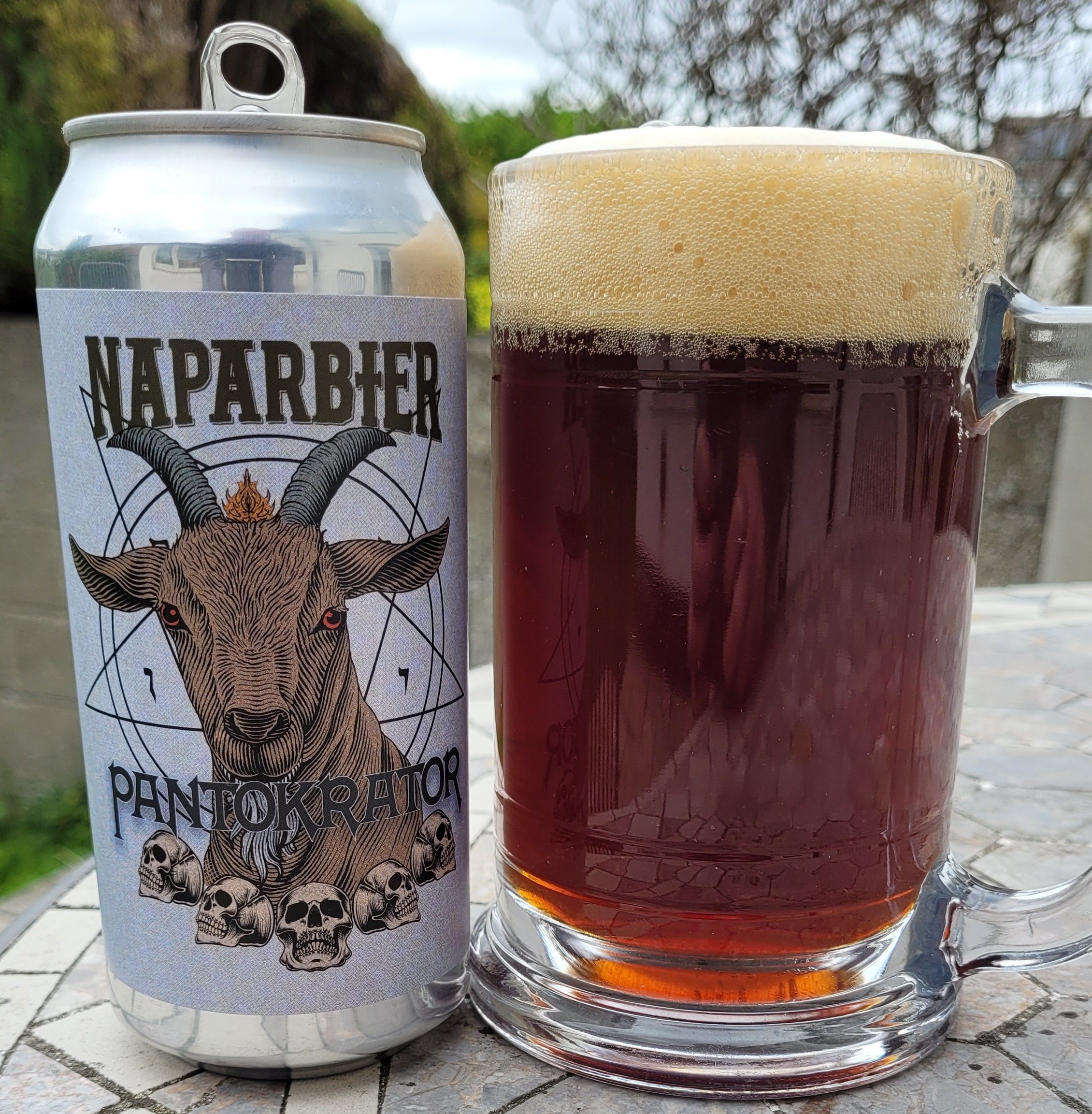
A doppelbock follows, and Pantokrator is a beast of an example at 9.7% ABV. It's the proper dark brown but rather muddy in the glass. Again they've hit the major points of the style, with chocolate and caramel meeting an intense liquorice sweetness, but that extra gravity gives everything a bigger punch compared to the big-brand Bavarians. There's a heat and a jammy stickiness, and whether it's this, the cloudiness, or both, it doesn't have a lager's cleanness. Instead of a quick finish it lingers on the palate longer than is entirely comfortable. All the things I find problematic in doppelbock are here and I can't recommend it as a result. If the previous beer was an attempt to mimic the originators, this one puts a twist on the style, one which I don't think works.

Maybe it's the extra freedom that comes with brewing strong and dark that led Naparbier to take liberties with their doppelbock. While I respect their iconoclasm, I think there's a reason that the Germans tend to brew to a fairly tight specification.

20 July 2022

Springtime for Lidl

Welcome back to the Abbey! I get almost giddy when I see a new Abbaye de Vauclair beer in Lidl, even when it is slightly out of season. This is the Spring edition, de Printemps. It's been around for a couple of years but this the first time I've noticed it.

I expected pale and maybe a bit hazy, like a saison or maybe a Lentebock, so I was surprised when it poured out a clear amber shade. There's a decent though not excessive head, and an aroma of herbs and spices, featuring black pepper, rosemary and oregano: possibly verging on sickly, but promising a level of dry crispness also. Crispness is where the flavour opens -- very much a dry rasp of roasted grains -- and also where it finishes, with an almost pilsner-like herbal bite. The middle is more of a thumper, showing off the full 6.8% ABV as well as the inclusion of caramel and various syrups to bulk it out. There's gooey brown-banana effect, cut with ginger bread and aniseed.

This is a bit all over the place. Piling in the unfermentable sugars while also trying to make it dry and bitter doesn't really work. It's complex, for sure, but in a busy, unwieldy sort of way. "Interesting" is about the best I can say. I see it's landed in with a new batch of the IPA. Buy two bottles of that instead.

18 July 2022

Helping out

Maybe it's no more than a token gesture, but it's something. The invasion of Ukraine has sent the international beer trade off in search of products from that country, to put a bit of cash into companies that can doubtless do with it, and allow drinkers to show solidarity. Ireland got a shipment of two of Kyiv's producers, and I picked up a sample selection of both.

First is Rebrew, who have a tomato gose called Pomo d'Oro. From the artwork on the can it looks like there's chilli in this one too. I mean, how could I not? It looks like a tomato cocktail in the glass, pale and murky brownish-red, but with a lively sparkle too. The aroma is very herbal, like a heavily basiled pizza sauce. A glance at the ingredients tells me there is indeed basil, as well as rosemary, coriander and paprika. Still, the savoury tomato is at the centre of the flavour, with the pepper and herbs seasoning it around the edges. It's not sour, however, and even shows a touch of lemonade sweetness. You don't need me to tell you this isn't a beer to be taken seriously. I liked the crazy complexity, and how everything they've bunged into it can be tasted. That said, it's a little thin, and I would have liked a bit more heft for 5% ABV. Otherwise, it's exactly the sort of properly ridiculous recipe I will always have time for.

It goes without saying that when I noticed there was a black IPA on offer I grabbed that too. This is Plague Doctor, 6.2% ABV and hopped with Citra and El Dorado. The hops' respective attributes are used well: you get the sharp citrus and oily resins of one and the Skittlesque bright candy of the other. Both are complemented by the malt: bitter and roasty coffee meeting milk chocolate and fruitcake. This is another fun one, smooth and accessible, with only barely enough of a nasty poke to qualify as properly black IPA. This isn't a style that usually lends itself to balance, but here's one that has it. I don't normally crave bitterness, in general, but a bit more here would have improved the beer. Despite that, it more than meets the requirements of black IPA.

The Rebrew set finishes on a triple IPA called Trivia, one with added mango, which I don't think I realised when I bought it. It's very apparent from the pour, though: that telltale opaque orange pulpiness. It smells of mango aplenty, concentrated and cloying. The flavour is gentler, however, and it's hard to believe this is a full 10% ABV. Soothingly sweet tropical fruit rubs up against a mild hop bitterness, tasting as much like a smoothie as a beer. This is another where I would have designed it slightly differently had it been up to me, but it still works. I'm sure there's nobody daft enough to describe themselves as a fan of triple IPA, but if there were I suspect they might be disappointed by how low-impact and easy-going this one is: no heat, no punch, just fruit. Technically it's probably an impressive feat but it's maybe just a bit too bland for the claims it makes.

On, then, to Varvar, and their sleek slim cans of stout. Collaboration is the name of the game, and the Smoked Stout is presented with the assistance of North in Leeds. Pouring was a pain as the pretty can was overfilled and overcarbonated. The aroma from the result was worryingly kippery too, but while there's a certain fishy aspect to the flavour, it's predominantly clean. At the base level there's a soft and unctuous stout of 8.2% ABV: somewhere on the cusp of export and imperial. The bitterness is low, but the space where I'd normally be looking for hop wallop is occupied by a sweetly caramelised smoky quality. I really like how it's impactful, assertive and bold while also smooth, balanced and rather cheery. This is another where the alcohol is well hidden, but it doesn't taste compromised as a result. As a stout fan and a smoked beer fan I think they've nailed it here. What's next?

"Imperial chipotle stout" is next, and there was no way I was passing that. It has lactose too, hence the name Double Dragon Milk. The aroma is fairly typical of strong stout, and traditional tarry roasted bitterness with no novelty factors. That's how the flavour starts but it doesn't take long for the burn to kick in: a sharp scorch down the gullet, finishing with a more subtle smoky paprika pepperiness. They haven't skimped on the chilli, which I like, and enjoyed the building warmth in my belly as I drank. While clearly a strong stout (8.3% ABV), and a little sticky, it's not sweet, with no softening influence from the lactose. Overall it's a lovely job, though if chilli in beer isn't your thing, you would be better off to avoid.

If that seemed on the weak side for a professed imperial stout, Naked makes up for it. Its 12.3% ABV appears to entitle it to an excise certificate from the Ukrainian government. This is another collaboration, in association with Kingpin from Poland. As one might expect, it's extremely thick, pouring tarrily; jet black in colour with a short-lived brown head. It smells hot, with all the overclocked stout features: umami, ristretto, putty and jam. Yum. The flavour is a bit more together, running with the red fruit and coffee up front, backed by caramel, aniseed and chocolate sauce. It's not the most complex of powerhouses, but it's decent and, as the name suggests, completely devoid of adornments. If you like a stout big enough to stick your lips together while not doing anything silly, here it is.

For me, this was a fun introduction to craft brewing in Ukraine. It's a shame about the circumstances, but maybe we'll get more from these breweries when things calm down again. I hope so.