18 November 2022

Fully on board

A couple of recent-ish releases from Hopfully today, both featuring the brewery's signature eye-catching artwork on the cans.

With a beer called Ár gCairde the Brazilians have gone fully native. This was created for the Mo Chara bar and restaurant in Dundalk and describes itself in less typically Irish terms as a margarita passionfruit gose. I thought it would be hazy but it's actually quite clear, just a slightly fuzzed-up golden colour with no head. Not that it's flat, as there's a pleasant sparkle on a light body, reflecting the mere 4% ABV. Passionfruit leaps out of the aroma and forms the bulk of the flavour too. I don't think I would have known it was a sour style without having been told in advance. The clean base could easily be a lager. Citrus zest and salt are added to the passionfruit, and I think the missing herbal side is why it doesn't really taste like gose. Leaving aside the stylistic noodling, this is a very decent fruity thirst-quencher, and I hope Mo Chara serves it by the pint. The specs and description may be high-falutin' but the beer itself is nothing fancy and all the better for it. A little extra tartness wouldn't have gone amiss, however.

Next it's an IPA, called Stark. I was expecting hazy and I got full-on hazy: opaque yellow, topped by a fine mousse. The expected vanilla in the aroma is interrupted by a grassy mineral note suggesting a kiwi hop is involved, and sure enough there's Motueka named on the label. The texture is smooth, as these tend to be, and the flavour is typically sweet. So where are the points of difference with run-of-the-mill New England-style IPA? Well, there's that flinty minerality which appears in the foretaste but doesn't last long, fading to make way for a much more ordinary meringue pie and orange icepop. It's... fine. Haze enthusiasts won't find anything to upset them; haze sceptics would be best steering clear. Still, there's no garlic burn and no mucky sludginess: not always a guarantee with this sort of thing. I can think of better uses for Motueka but I don't object to this.

Two pretty decent beers, then. There are so many fruited sour ones and hazy hoppy ones that it's difficult to make ones which stand out. I'm sure both of these will find their fans.

16 November 2022

Not shy

I have a huge collection of backlogged Irish beer posts sitting waiting to be tidied up and slotted into the schedule. To buy myself some time it's just one today: Coco Buzz, a stout from Trouble Brewing. 5.6% ABV with added coconut and hazelnut.

In the glass it looks like... a stout. It's dark brown with a quickly-vanishing skim of off-white foam. There's a little coconut in the aroma but it's no gimmicked-up pastry job. Restraint is the order of the day. Chocolate kicks in early in the flavour, a fully candy bar sweetness, loaded with coconut, Bounty style. It's not sticky or cloying, however, and fades decently quickly, leaving nothing but a dry cocoa powder residue behind.

In an era where "enhanced" stouts vie for bigger and dafter profiles, it's pleasing to find one that could work by the pint. Whatever about the hazelnut, this definitely delivers on the coconut and stout elements. If Trouble were considering adding such a thing to the core range, I think there'd be an audience for this.

14 November 2022

Pull the other one

Late October brought the JD Wetherspoon Autumn Beer Festival, as usual. And as usual the Dublin branches didn't launch straight into the specials on day one so I got to do a little preliminary tippling, not that there's any great difference between what's on for the festival and what isn't.

Starting at The Silver Penny, I thought I'd had Kirkstall's Dissolution before, in York some years ago, but turns out that was the rye version. Plain Dissolution is 5% ABV and despite the absence of rye, I assume, still lands a sharp and punchy bitterness, thanks to American hop classics Columbus and Chinook. Rose gold in colour, its aroma and brief foretaste are freshly floral in a typically English way. The body is as weighty as one might expect, and that delays the bitterness a little but also makes it last longer when it kicks in: an oily, resinous, malt-fuelled tongue fire that's shocking at first, then delightful, then actually moreish. The English don't brew 5% ABV cask ales for session drinking, so this one must be an accident. It's very good though.

A few days later I headed for Keavan's Port in the hope that they might have tapped up the festival beers, but although the bunting was everywhere, it was not to be. I still managed to get three ticks in, however, so it wasn't a wasted journey.

Well, sort of. The Butcombe Gold, gold as you like, had a promising honey foretaste, all sweet and floral. The texture is light and the honey is there in the flavour, but... my third had a twang of vinegar about it, strongly suggesting it may have been on a while. It wasn't ruined, but not at its best either. Such is the way of cask. Especially around here.

Next was Jurassic's Durdle Door, and a description I'd not seen before: "rusty gold". Which is to say, amber. This is 5% ABV, and in the way of such cask beers, tastes stronger, with a rich clove and raisin flavour. That matches with the full body and warming vapours. It doesn't cloy, however, finishing quickly and drily with refreshing tannins, the saviour of many a brown bitter. This is really an enhanced one of those, and definitely nothing fancy, but tasty nonetheless.

Lastly, it's Sambrook's and their porter, Powerhouse. It's always great to welcome a porter, on cask, to my face. It's a sort of cola-esque ruby-brown and has a very faint aroma of caramel with something spicier, like root beer. The texture is light and the flavour quite plain, starting on nothing, before gradually brightening to caramel, milk chocolate and that sassafras effect again, with maybe a lacing of marzipan. It made me work to find those descriptors, and I resent that slightly. I get that a porter, even at 4.9% ABV, should be down-the-hatch drinkable, but that's no reason for it not to be flavourful. More wallop would be welcome.

My first actual festival beer, and the only international collaboration I found, was Telemark Rav, a red session IPA with Norwegian Telemark Bryggeri as the guest collaborator and production happening at Shepherd Neame. I'm generally suspicious of Shepherd Neame beers but this one charmed me from the outset with a fresh lemon and toffee aroma. There's a touch of the house character about the flavour -- a bitter orange rind effect -- but it gels well with the dark malt and fruit candy hops. My first impression was that they're American varieties but it's actually an all-British line-up: Jester, Olicana, Ernest and Godiva. If the intention was to breed a combination that brings an American feel to smooth cask ale then it absolutely worked. This is no barnstormer (it's a while since I found a memorable beer at these festivals) but it's jolly decent, giving a solidly reliable malt base some bright hop topnotes, finishing dry for actual sessionability despite the sizeable 5% ABV.

Another porter next: Astronomer by Black Sheep. This dark brown affair is 4.2% ABV and brewed with chocolate. For all that it's quite dry with a significant bitterness; all classy dark chocolate rather than pastry dessert. Metallic and vegetal notes vie for prominence in a very grown-up flavour profile, before a savoury finish with more than a touch of umami or even putty. I liked the strength of character here. It's a challenging beer rather than an easy drinking one. Although, since I went in expecting something fun and quirky or smooth and mellow, it was still a bit of a disappointment on those grounds. 

White IPA is a style I rarely warm to, and I still associate the next brewer, Bath Ales, with horrific levels of diacetyl, a problem they have successfully resolved since the brewery changed hands a few years back. Still it was a surprise how much I enjoyed their White Rabbit. Uncharacteristically for the style it's perfectly clear -- a pale shade of gold. There's none of the soapy clash of herbs and hops and instead a lightly fruity mix of pear skin and apricot. They've achieved this, somehow, using Cascade and Amarillo, making them perform fun tricks that are out of character but very entertaining. Most amazingly it's all done at a mere 3.6% ABV. A solitary half pint did it no justice at all.
Returning to Shepherd Neame, under their own brand they had Rebel Flame, described as a red IPA but nothing of the sort. For one thing it's a very pale amber colour and the hops are by no means punchy or bitter. Instead it appears to be depending heavily on the complexity of the brewery's distinctive house yeast. That gives it a sweet and greasy make-up bag aroma leading on to flavours of black pepper oils, sandalwood and citrus peel. Despite seeming resinous it's nicely dry, and mercifully missing the rotten wood effect that usually turns me off Shepherd Neame beers. I didn't think I was going to like this and, as with the White Rabbit, was very pleasantly surprised.

Two golden ales followed on a later visit to Keavan's Port, beginning with Hogs Back Home Harvest. This is the slightly darker of the pair, touching on amber. It's a mere 4% ABV and light without being thin. The flavour is fairly sweet, with a candy mix of bubblegum and banana. There's a certain dryness, but not enough to balance the rest, and I was finding it sickly before I was half way through my half. It seems as though an attempt to make a bitter more approachable and less bitter has gone awry here.

Paler but stronger beside it is the 4.6% ABV Olicana, one of many British beers named after this new hop variety. This is another slightly sticky one but it handles it better by ramping up the tannic dryness and adding a definite bitter aniseed kick on the end. Before that, it's a fun mix of peach nectar, white grape and almonds. The sweet side leaves the palate after a respectable time and it's the dry bitterness which lingers on, infinitely preferable to sticky residual sugar.

Fyne Ales is normally a good bet and their contribution was Substructure, described as a tropical session IPA but looking like a witbier to me: pale yellow and lightly hazy. There's a bit of witbier about the aroma too, which is primarily zesty like lemons. It does turn tropical on tasting, however, with softly juicy mango and cantaloupe in the middle. Sadly it's short-lived; I would have liked more depth and a longer finish: not an unreasonable request when the beer is 4.3% ABV. Instead it bows out on a citric bitterness with a faintly soapy twang. Regardless, this is rather good and up to the standard I expect from the brewery. The two flavour aspects delivered by the hops are particularly unusual to find in a single beer.

Finally, another beer named after a new English hop variety: Jester, from Suffolk brewery Green Jack. This is a golden ale of 4.4% ABV, and yes, it's golden. It's a while since I last had an all-Jester-hopped beer so can't quite remember how it's supposed to taste, other than broadly like a new-world variety. This has an earthy citrus, not dissimilar to Cascade, itself descended from English Fuggles, of course. There's a fun bubblegum side as well. The hopping isn't very striking however, offering a muted presence which is still essentially English. The underlying beer is dry and quite grainy. Overall, it's a good effort but not really my sort of thing. There's room for some extra malt sweetness for sure: a bit of honey or golden syrup would be welcome, but howanever.

Eight out of 30 festival specials is an acceptable hit rate, though I'm missing a few particularly intriguing ones from the programme. Now that the chain has a commitment to Irish cask beer I have high hopes of something from Dungarvan and/or Brehon in the Spring Festival when that comes around next year.

11 November 2022

Not saying much

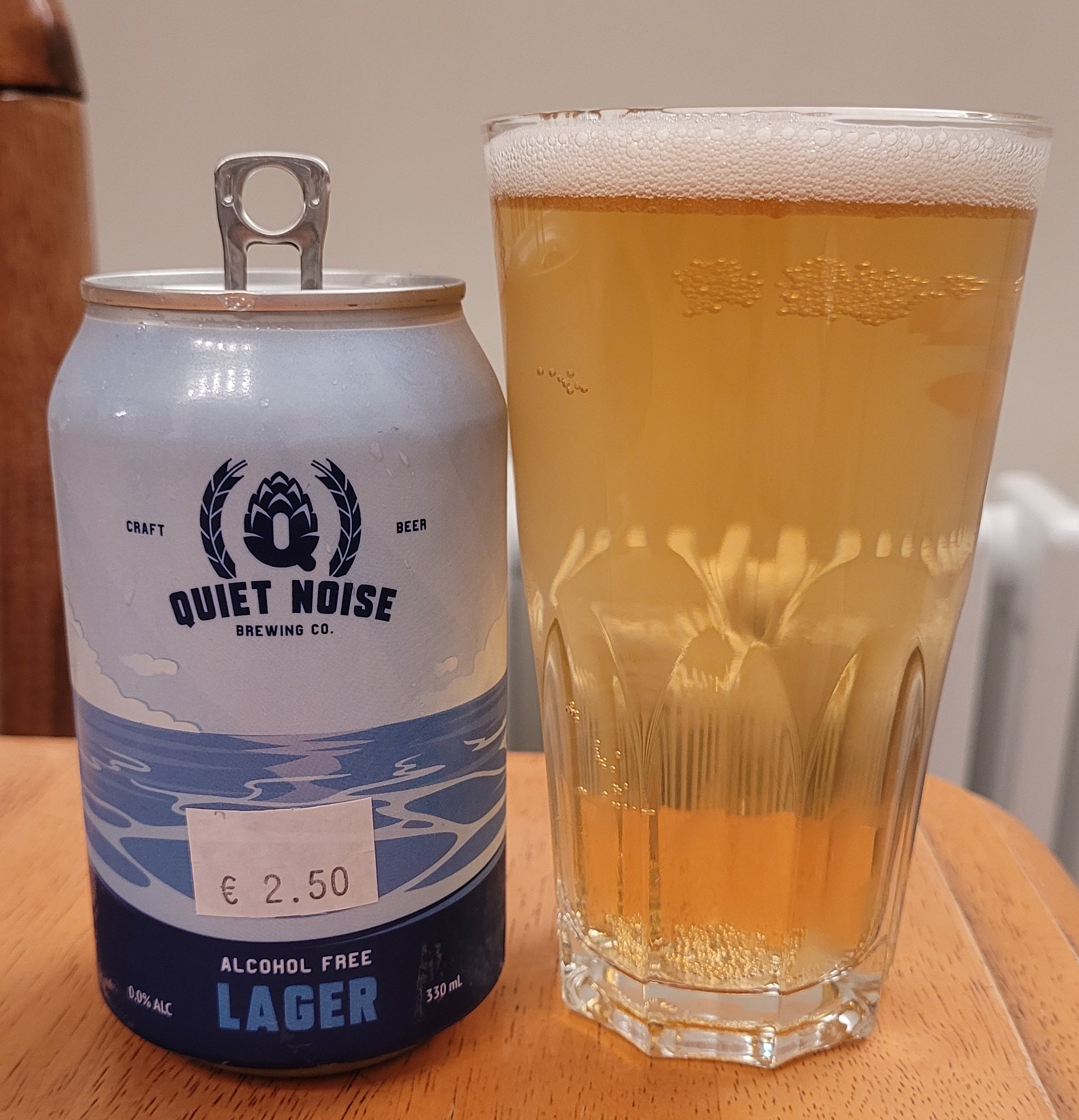
With alcohol-free beer as the market sector that big breweries are falling over themselves to get a piece of, it was perhaps inevitable that Ireland would get a brewery, or at least a brand, that did this and nothing else. Quiet Noise is quiet on where it's actually produced, headquartered at what used to be Boyne Brewhouse, but since no alcohol is involved could be manufactured anywhere. Again, actual information is thin on the ground, but these three appear to be completely unfermented and 0% alcohol, rather than the more usual approach of minimal fermentation or subsequent dealcoholisation.

I started on Quiet Noise Lager, which mostly looks the part, being an appetising clear golden colour. The worty sweetness common to most non-alcoholic beers is present in the aroma from the outset, and a major part of the flavour. A lemony zest effect is perhaps a nod to hops, but this tastes a long way from actual beer. With the sweetness comes a thickness: syrupy and a little cloying, while the finish completes the set of clichés with an aspirin tang. All of this I've tasted before in mass-market alcohol-free lagers and wheat beers so there's nothing new on offer from the first one. If you have a taste for typical non-alcoholic beers then this should be right up your street.

The second beer is also a lager, though Quiet Noise Pilsner promises more hop fun by way of Saaz. I'm in. Again, great visuals. A bigger glass left me at liberty to pour hard, resulting in a proper pilsner head. It's wort again on the nose, however, and no sign of the promised Saaz yet. If anything the flavour is blander here, missing the fun lemons of the previous one. Without it, the sticky malt extract turns to full-on caramel, taking it a long way from how pilsner is supposed to taste and closer to the Becks and Erdinger efforts that ruined non-alcoholic beer's reputation for so long. The aspirin tang in the finish is back, though, just to complete the picture. The promise of something out of the ordinary is not delivered upon. There is one last roll of the die to go.

That's Quiet Noise Pale Ale, promising "delicious citrus flavours of grapefruit and orange ... balanced with a refreshing bitterness". It's very pale, looking like a very basic lager in the glass. There's a definite lemon juice sharpness in the aroma, plus yet more of that aspirin. For once, the aspirin is missing from the flavour and it's light-bodied but otherwise tastes sweet, like the Lager. Although the description overpromises and it doesn't resemble pale ale any more than the others resemble lagers, this is my favourite of the three. It's refreshing and quite drinkable, even if the sweetness probably rules out drinking more than a couple.

Overall, I'm not very convinced by this lot, and they certainly don't offer anything not found in most alcohol-free beers. If they're thinking of introducing a fourth, I strongly recommend a dark one, where the inevitable sweetness won't be as jarring. Third post in a week where I've finished by asking for dark beers instead? That's how I roll.

09 November 2022

'80s bedspreads

They're a colourful pair, the new ones from Lineman. Always a brewery for flipping between the beer styles, these are both hop-forward but quite different.

The first is a 4.6% ABV session IPA called Group Therapy. It's pale and fairly hazy though isn't softly textured or vanilla flavoured. In fact it's rather dry, with the tell-tale pith and minerals of what I thought was Nelson Sauvin but the label tells me is an antipodean mix of Motueka, Galaxy and Topaz. Regardless, the effect is similar and delicious. Zesty citrus spritz in the aroma opens proceedings while the flavour matches its pithy bitterness with soft stonefruit. The texture is sessionably light and the finish quick, leaving only a gentle buzz of peach skin and flint. I have a preference for more of a tropical softness in my session IPA (by which I mean basically Little Fawn) but I have a lot of time for this approach too.

The ABV zips upwards next, to 8.2%, with a gasp of Oh My! It's a double IPA, and here's a bit of that New England energy, it being pillow soft and packing the juice in. Mosaic, Strata, Ekuanot and Cryo Pop are the guilty parties. As well as the pineapple and peach nectar, there's a decent kick of bitterness, though still in the pithy fruit mode, plus a bonus aniseed pop. There's very little fault to find here. It draws on the good aspects of both New England and the west coast -- soft and fruity but also properly bitter. It has me wondering why more double IPA brewers don't cram in this amount of complexity, given the scope granted by the strength.

As usual, Lineman is all about the quality here. Both beers are creative examples of their styles yet hit the essential points perfectly. As with Third Barrel on Monday, however, it must be nearly time for some more dark stuff. Just asking.

07 November 2022

Two sides and three barrels

The busy beavers of Bluebell, Third Barrel, provide today's septet of beers. They're a prolific lot with the specials and one-offs, though I notice something of theme among these: a bit of tinkering with the recipes of previously released beers.

The first example is Day Drinkin Part Deux, switching the Simcoe of the first version for Citra and Strata while keeping it as a 4% ABV hazy session IPA. It smells pithy, in a way that beers like this mostly do, but it's quite an understated aroma. The flavour offers a pleasant mix of tropical grapefruit, mango and coconut, before finishing quickly. The low strength leaves it a little watery, which is slightly unpleasant as regards the flavour, the tasty hopping stopping abruptly, but I can see how it helps its session credentials: no lingering aftertaste means you're straight back for the next mouthful. Much like its predecessor, it delivers the proper hazy profile in a highly quaffable format. I have a slight preference for version one, but with nobody else making beers like this locally, I'll take what I get.

The franchise continued in very short order with the arrival of Day Drinking Part III: Revenge of the Hops, now with Mosaic and HBC 630. It's one of those beers that smells hazy, with a combination of earthy, gritty bits and hot concentrated garlic: striking, but not exactly enticing. There's a hint of that in the flavour but mercifully not too much. Instead, Mosaic tropical juiciness is to the fore, finishing with a greenly bitter rasp of pine. Here, the flavour elements are bold and long-lasting and there's no sign of the thinness which bothered me in the previous one. This tastes like a bigger beer than it is, and despite that aroma is my favourite of the three.

I'm never sure what's meant by "modern style pils" but I see it a lot. Maybe it's because pilsner is so established as a beer style that brewers feel they have to flag any attempt at twiddling with it. Anyway, in Counter Culture it appears to signify that it uses American hop variety Lorien alongside the more traditional Saaz, as well as oats in the grist. At least it's clear, and quite a dark amber colour. Despite that apparent weighty malt, it's light and dry. The grassy Saaz bite is preceded by something fruitier and summery; strawberries maybe, or sweet cherry. It's OK but I think it gets in the way a bit. There's enough green bitter hopping to remind one of what pilsner does best, without delivering the full effect. As modern experimenting goes it's far from a disaster, but nor does it improve upon the fundamentals.

There needs to be a proper IPA as well, and today that's represented by Outside The Lines, described as a west coast IPA. It's rather pale and hazy for that, while the strength seems a little low at 6.1% ABV. The hops are a classic combination of Simcoe and Amarillo, and the latter's orangey quality comes through in particular in the aroma, giving it a lovely but not-west-coast juicy smell. That doesn't hang around for the flavour. While it is fuzzily-textured and with some sweet fruit attributes, there's also a sizeable west coast aspect too -- though not enough to justify claiming to be such. The Simcoe gets busy with a dank and resinous spicing, as well as a harder pine bitterness. Amarillo, meanwhile, is back on the orange thing, almost hitting the grapefruit level of citrus bitterness. Most of all, this brings sunshine in a typical Third Barrel way. That's how it captures California and brings a little of it to west Dublin.

Back to the reboots now, and the Two Sides brand has had Third Barrel amend its summer seasonal Two Yards to feature Citra & HBC 586*. I've long been a fan of this beer so had every expectation that the new version would live up to the old one. It does. It's bright and zesty and fun, packed with mandarin and cantaloupe, needing only a pink cocktail umbrella for the full poolside experience. Though fairly hazy, there's none of the serious haze features/flaws -- no vanilla, no allium, no grit -- leaving room in the modest 4.3% ABV package for all the fun fruit effects. Yet again Two Yards delivers perfect beer garden quaffing fare.

Next, a thematic sequel to last year's Now That's What I Call Mosaic, named Wake Me Up Before You Simcoe. This one is hazier; in fact it's about as hazy as IPA gets: a dense opaque orange. The aroma mixes fresh-squeezed citrus juice with a suggestion of harder rind or pith to come. Sure enough, the juice is relegated to an aftereffect with a strong kick of lime up front, plus a resinous burning hop napalm which can make Simcoe a difficult one to deal with sometimes. Here it's softened with a New England vanilla sweetness which arrives just before the juice kicks in. I wouldn't call the flavour balanced, exactly, but it does have two contrasting sides which help keep the beer drinkable. As does the very faint carbonation: big hops and gassiness would have been a serious problem. In theory, both NEIPA fans and IBU-chasers should find something to like in this. I enjoyed the overall boldness of approach, in both directions.

Finally and most recently there's a new lager called Stairway to Helles. There's not much room for messing with these, and no messing is in evidence. It's perhaps a little drier than I was expecting, giving it an almost sharply crisp bite. As the noble hops gradually kick in it becomes more like a pilsner, and I'm perfectly happy with that. Maybe a softer texture and more malt sweetness would improve it but I simply closed my eyes and thought of Pilsen.

Pilsner and Helles aside, the set does go quite heavy on the haze theme. I guess that's what sells. Still, with winter closing in I'm sure it won't be long before the dark recipe book comes off the shelf for another round of tweaking.

*HBC 586 was subsequently named "Krush".

04 November 2022

Slake it all over

Today's beers are various odds and sods picked up on my way through the Netherlands and Belgium last month.

The first was a gift from Eoghan Walsh, a Vienna Lager created by Brasserie Mule in Brussels to commemorate the fifth anniversary of Eoghan's blog. It's one of the paler Vienna lagers, yellowy orange with a slight haze. It doesn't look very rich but there's a malt-driven density in the aroma suggesting plenty of heft to come. At 5.2% ABV it's no lightweight. I drank it quite cold so it was the hops that came to my palate first, a lemony tartness whose acidity becomes more grassy as it goes. That clean and sharp first impression turns to something bigger and rounder later on. There's a sweetness that's almost cake-like which might be a problem were it not for the bitter tang of those hops. The haze means there's a certain kellerbier-like fuzzy wholesomeness. Overall it's very good. It's definitely not one of those bourbon-biscuit melanoidin-driven Vienna lagers, but I liked the assertive hopping and how it interacts with the rich malt. There's lots to explore in what might appear to be a plain pale lager. Thanks Eoghan!

Sticking with Belgian beer, though acquired in Groningen, a bottle of Oud Beersel Demi-Muids The name of this geuze is from a particular size of French wine barrel that the beer -- brewed and inoculated at Boon, one assumes -- was aged in. The end result is 6.5% ABV and a bright though hazy amber colour, with bags of fizz and excellent head retention. It smells rich in minerals, with more than the usual buzz of saltpetre and old cellar bricks. There's a thick raisin sweetness in the foretaste which I'm chalking up to those wine barrels -- lots of oak spicing -- followed by a hard and long-lasting bitter and dry wax effect. It seems they've set out to deliberately unbalance a geuze, giving the wood a greater role than the souring bugs. I'm not sure I approve, but it still tastes great, retaining all the classic features.

Representing the Netherlands is Puur, one of the La Trappe range I'd never tried before. This is broadly a golden ale, the name referencing its use of organic ingredients. It's very slightly hazy in the glass, the head forming briefly before fading to nothing: far from the "sturdy collar" promised on the label. Fruity Belgian esters -- peach and apricot in particular -- form the aroma. That's it's a very un-Trappist 4.5% ABV is apparent from the thin mouthfeel, not helped by lots of fizz. The flavour takes a moment or two to poke past that, and what's there is good: peach and pear; honey and white pepper. It has a lot in common with tripel, if said tripel has been heavily watered down. It's not unpleasant but I don't really see the point of it. Get a stronger beer and drink it more slowly, is my suggestion.

One of the things I love most about beering around the Netherlands is the sheer variety: beer from places we don't currently get at home. The next set were picked up solely on the basis of their exotic country of origin.

Dois Corvos is the Portuguese brewery whose wares get out and about more than any others. It tends to be good stuff and I liked the look of Vai Nú, an imperial stout. Although it's only 9% ABV, it pours out tarry and headless, as though it were much stronger. There's no shortage of complexity here either, and based around deeply bitter espresso coffee there's harsh tobacco and barbecue beef, plus lighter raspberry and rosewater. Hazelnut and cola nut? You got it. The mouthfeel matches the smooth appearance with not a trace of thinness. Overall it's a top-tier imperial stout with no compromises. Makes me wonder if all those 12-15% ones really need their full gravity.

I have a hit-and-miss record with Swiss Brasserie des Franches-Montagnes (BFM) in recent years, or vice versa, but it had been a while since I'd tried any of their beers. So it was time to turn a new page when their imperial stout, Cuvée Alex Le Rouge, came into view at Bierkoning in Amsterdam. Other than the ABV to three decimal places (10.276%) I don't have a lot of detail on what this is. I'm guessing it's barrel-aged in something interesting, however. There's a Christmas cake aroma, mixing warm raisins, lemon peel and cinnamon, as well as a sweet vinousness suggesting fortified wine -- vermouth and hippocras in particular. The stout aspect is still present under this, with enough coffee and caramel to keep a purist happy. The slightly wild briskness that has been a BFM bugbear for me previously is present here, but it's entirely complementary with everything else going on. I won't comment on whether I think that's deliberate or not and will simply appreciate this highly enjoyable beer.

Continuing upwards in strength, to 11.5% ABV, is this one from Dádiva in São Paulo: Odonata #10. The number refers to its position in a series of barrel aged imperial stouts, and here the barrel is Amburana. It's a Brazilian wood famed for its spicy characteristics and boy is this spicy, though in a Christmassy cinnamon and nutmeg way. I would actually believe that there's tonka bean in the recipe, so pronounced is the cinnamon. There is one non-standard ingredient listed on the label -- flaked hazelnut -- but I couldn't detect what that does, other than the oils preventing any possibility of head formation. It's not terribly stout-like, missing coffee or chocolate, but beside the cinnamon there's a classy red wine character, so perhaps that's what the barrel was used for. I dunno. Anyway, this is quality stuff, managing to transcend its one-dimensional Amburana-ness, as we all must.

We go on to Greece via Estonia and over the 12% mark with the 12.1% ABV bourbon barrel-aged imperial stout called Deisidaimonia. This is by Seven Island Brewery, purportedly in Corfu but stating that the brewing is done by Sori in Tallinn. The geography is more interesting than the beer. It's very very bourbon, absolutely packed with vanilla to the exclusion of everything else. The aroma isn't even that, it's raw and dry oak in an unpleasant sawdust sort of way. Again, this is one of a series of barrel-aged stouts and I hope they've made a better fist of the others than they have of this. If you want your bourbon to be subtle as a brick, this is the stout for you. My tastebuds were crying out for some nuance, however.

Never let it be said that this blog doesn't bring you variety. Particular shouts-out to Slijterij Groningen and Just In Beer in Groningen; Bier Lokaal and The Beer House in Breda; and of course Bierkoning in Amsterdam, for supplying the goods.