16 August 2023

Brummed out

On Monday I wrote about beers in Stratford-upon-Avon, but one cannot simply arrive there from Dublin; it is a necessity to travel through the city of Birmingham and drink some there while doing so. I arrived at lunchtime and thought to check out the recently-opened branch of the Indian streetfood chain Bundobust, in particular because it now has its own brewery at the Manchester branch.

In general, the beer line-up at Brumdobust (staffed by "Bundobabs", as the staff t-shirts have it) is as good as the other ones, with a dozen and more draught options, about half of which are their own. I don't especially enjoy cream ales but I also don't see them very often so am always willing to give one a throw. The house one here is called Manak and is 4.2% ABV. I can safely say it's true to type for this inexplicably craft-credentialed American industrial style, being dry, crisp and very dull. There's a tiny hint of fruity lemon fun hovering in the background, but otherwise it's a straight-up fizzy lager of the nondescript sort. I couldn't leave things there.

At least not with a house black IPA on the board as well: Pachaas 50, a bit of a beast at 7.4% ABV. The charcoal and rosewater aroma did nothing to prepare me for the powerhouse bitterness in the flavour, one which channels crunchy red cabbage in particular. This is overlaid by an exotic mix of flowers and aftershave spices which threatened busyness but faded out respectfully in the finish. It was served very cold which made for very easy drinking. While it's a superb example of the style and very much delivers what's required, I couldn't help wondering if taking a few ABV points off and serving it on cask might improve the experience further.

Immediately next door is central Birmingham's classic Real Ale pub, The Wellington. It would have been wrong not to call in for just one pint. That ended up being Piffle Snonker from local outfit Froth Blowers. This 3.8% ABV pale ale is a purest gold colour in the glass. Extensive Cascade hopping gives it bright sherbet lemon flavours, plus bubblegum, with a harder tang of west-coast resins on the finish. A very English crunchy-biscuit malt base forms the foundation from which this is delivered. I thought it had a lot in common with other high-end American-hopped British beers, the likes of Jarl and Oakham Citra. It's just as lovely and pintable as either.

Back in Brum on the way home, I stopped by The Shakespeare, a Nicholson's pub near New Street station. At 4.30 on a Friday it was packed. From the handpumps I opted for Heroes by Two Tribes, an exceedingly pale pale ale, looking clear but unpleasantly watery. It's not though. 4.4% ABV is enough to give it plenty of heft and support some bright and fresh aroma hops, making it smell of peach and mandarin. Its flavour continues that theme, adding a tang of grapefruit bitterness to the juice. A tiny pop of raw onion is the only minor bum note. I'm guessing Mosaic is the principal hop here, and it's mostly behaving itself. As a single, on-the-hoof pint, this worked well.

Around the corner is The Sommar Tap, a quirky, down-with-the-kids, joint run by the local Sommar Brewing Co. I took the pilsner first: Scoops. This is one of those that I didn't like but can't complain about. It's another very pale beer and is absolutely loaded with noble hops, making it taste of nettles, celery, chicory and, to me, crêpe paper and chalk. I appreciated it as a well-made and properly characterful lager, just not the way I like them.

The stout, Tanks, is another extremely characterful one, 5% ABV and heavy with it, dry hopped by experimental hop HBC 472 which appears to make it taste of bitumen, coffee grounds, sandalwood and burnt toast. The aftertaste carries black IPA vibes of red cabbage and roses. As such, it's a bit of a workout. I waited for the moment where the enjoyment would snap into place, but it kept me on my toes for the whole half. This isn't an easy or accessible beer, and even as a fan of bitterly hopped stouts I struggled a little with it.

At the airport I discovered that Beavertown has a lager, called Bones. It is extremely dull, tasting like exactly the sort of mass-produced commodity lager one would expect from Heineken. There's a stale sort of dryness, like a soggy digestive biscuit. A little hop-derived grass saves it a little but I couldn't help thinking I would have been better treated by the Moretti on the next tap over. That's what everyone else was drinking.

Finally to the airport Wetherspoon and two more pale golden jobs. On the left, Milestone Fletcher's, a bit of a powerhouse at 5.2% ABV. Kiwi hops are promised, though the aroma is sharp and savoury, with a whiff of funky fermenting grass. The flavour is altogether more pleasing, tasting soft and sweet, of kiwifruit and ripe honeydew melon. It doesn't taste strong, though, and the finish is quick. While I liked it, I found myself wanting more of what it does.

And on the right, Twenty Four Seven by Roosters, a little lighter at 4.7% ABV though also claiming New Zealand hop character. Here's the diesel aroma of full-throated Nelson Sauvin, and while it doesn't taste very complex or fruity, there's a solid satisfying freshly bitter kick that I really enjoyed. There are floral and herbal elements, and more of a malt base than in the stronger Milestone one. While again it's not hugely complex, it's a class act and I wish I'd had time for a relaxing pint but my gate was called just as I started into it. Such is the jet-set cask-conditioned lifestyle.

That completes my beer drinking in England for this summer. Luckily there are more travels just around the corner.

14 August 2023

Shakesbeer

Work landed me in Stratford-upon-Avon for a couple of days in July. It's a town, quite a small one, most famous for something else, but I was intrigued by how many different genres of beer outlet it has managed to support. Naturally I sought to try out as many as I could.

Of course, traditional pubs abound. The slightly twee, low-ceilinged and stone-floored, Old Thatch is a charmer, though the pint of Gales HSB they served me was less than stellar. I don't know if that's the pub or the changes at Fuller Smith & Turner down in London which is to blame. At the bottom end of town, The Bear struck me as a kind of gin-and-Jags, golf set, sort of place: sports prints and leather sofas. But it poured a perfectly-kept pint of Landlord. Somewhere in between is the rambling red-brick dining pub The Red Lion, where I settled on the usually-reliable St Austell Tribute but wasn't at all impressed by what they gave me. So, for the beer ticker already familiar with Big Cask, the traditional pubs aren't where you go in Stratford.

The One Elm is a small step sideways in ethos, presenting as a modern and urbane gastropub of the sort that's probably going out of fashion. It retains quite a few grand pub features, though the emphasis is on food and the décor clean and pale and a bit IKEA-ish. I sat out back in the courtyard beer garden and drank kegged Purity Longhorn. The ubiquitous Warwickshire brewery has been making this for a while, and they present it simply as a 5% ABV IPA. It is, specifically, a rye IPA: coloured like one, a deep amber with a fairly dense murky haze. Rye's signature bitterness is promised in an aroma of ground white pepper and fresh green bell pepper. That doesn't quite carry through to the flavour, where caramel and nuts from the darker malt and meadow flowers from the hops are predominant. There is a certain harder earthiness as an added complexity, and I'm guessing the rye is responsible, however it doesn't tip over into being sharp or severe. It's good, though. There's a lovely chewy and smooth texture, making it filling while still quite easy-drinking. I consider it a worthwhile introduction to the world of rye IPA, offering lots of character but no extremes.

Just opposite my hotel was Cox's Yard, a former timber mill that's been converted into a canalside hospitality complex. The bar in the pub building has four shiny chrome handpulls but was only pouring one beer when I dropped in: Origin by Charles Wells, another embattled English ale brand, now working from a new modern brewery in Bedfordshire which they've called Brewpoint. Origin is a down-the-line classic bitter: 3.7% ABV and having the lovely signature English floral garden flavour: elderflower, jasmine and honeysuckle on a base of strong black tea. The finish is quick after this, which dulls its edge somewhat, but no matter: it's designed for session drinking and doubtless works well for that.

There is, I'm happy to say, a micropub. Stratford Alehouse is on a row of shops and very obviously used to be one. At 4pm on the Wednesday I arrived, it was doing a roaring trade, all the beer being served on gravity from a stillage array down the back, with four options on the board to choose from.

For a number of reasons I reckoned the dark beer was the sensible choice and so picked Black Knight, a porter by Goffs brewery in Gloucestershire. It's quite a high strength one at 5.3% ABV, and that combined with relatively low condition and high serving temperature really accentuated the fruity side of the picture, giving me blueberry, blackberry and some assorted Scandinavian berries which I don't know the names of but recognise when I taste them. Cloudberries? Yeah, loads of that anyway. That's set on a slightly sticky caramel base which means my biggest criticism is the sweetness. A balancing dry roast would really have helped the drinkability. But I guess, at the strength, this one isn't intended for drinking more than one or two. I certainly wouldn't have enjoyed doing so. One was fine.

Finally, Ya Bard. That's the name of Stratford's ultra-hip, high-end, beer-shop-with-taps, specialising in all the colourful 440ml cans full of weird barely-beer concoctions. Such venues tend to be sparse and spacious; bare wood, bare lightbulbs and chicken wire. This one is on the carpeted ground floor of what appears to be an 18th century townhouse, stretching from the front room to the rear passageway where a compact bar serves five draught beers, leading out to a tiny back garden. Punters stand about awkwardly throughout, making the place feel like a poorly-planned house party.

Strawberry & Rhubarb New York Cheesecake is the sort of thing that passes for beer here. This one is from Edinburgh's Vault City and is one of those that claim to be sour but are no such thing. To its credit, the murky orange-pink offering has a very real strawberry character, not an ersatz flavouring. The cheese is represented by a softly sweet Petit Filou dairy yoghurt effect. And there's even a crunch of biscuit grain to serve as a base. So full marks for being like a cheesecake; none for being like a beer. It could have been a lot worse, though.

If it's not novelty fruit beers these days, it's double IPA. Pipeline Brewing is all the way down in Cornwall, and they had shipped up some Nectaron Star, an 8% ABV hazy job showcasing one of the current most fashionable New Zealand hop varieties. Or it's supposed to be anyway. To me, this was just another of the usual: smelling of garlic and grit, the flavour packed with vanilla and spring onion. Nectaron is meant to provide pineapple and passionfruit but there was nothing tropical about this mucky pup. It's hazeboi fan service and no more than that.

That's all I had time for in Stratford, but of course one does not simply arrive there from Dublin, or at least I didn't. My journey to and from it went via Birmingham, with a few beers on the way through which I'll cover in the next post.

11 August 2023

Four beers from three brothers

Four beers from O Brother today, a brewery which seems quieter than it used to be but is still turning out the product, and across a range of styles too.

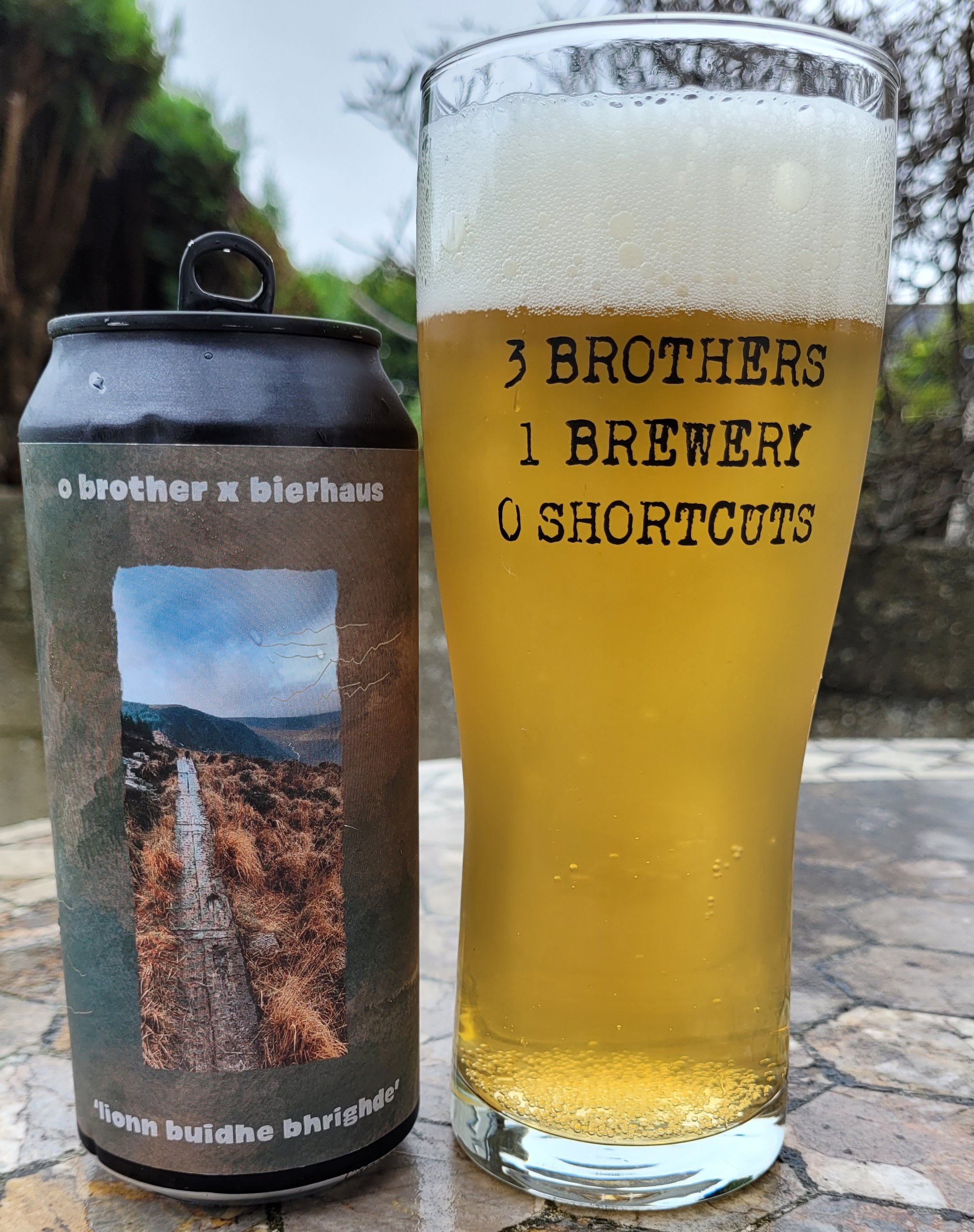
First up, a sour ale brewed in collaboration with Bierhaus in Galway, called Lionn Buídhe Bhríghde. The can is low on information but tells us it's 4.3% ABV and dry hopped with Mosaic. In the glass it's an almost-clear bright yellow and smells deliciously lemony, with an enticing mix of citric sourness and bitterness. The flavour is calmer than the aroma suggests, the sourness more of a gentle mineral sort than highly acidic fruit. It's not puckering, but very clean and refreshing, aided by a texture that's light yet not watery. Mosaic's tropical side is present, with notes of cantaloupe, mango and apricot. It's a little two-dimensional, and not in any way unique: lots of breweries make a beer like this. It is a great example of it, nevertheless.

The second one is called Counterfuture though looks very much of the present, being a custardy wan yellow colour. At 6.4% ABV it's medium-weighty but I got little sense that the body was being used to propel hop flavours. While the aroma has some distinctive lime and grapefruit character from the Citra in particular, aided by pithy Cashmere, it doesn't carry well into the flavour. There's a broad oranges-and-lemons bitterness and some New England vanilla sweetness, but all quite muted and even slightly dull. I didn't drink this at its freshest, but I don't think that a big hop effect could have faded out in just a couple of months. Anyway, it's not the best example of haze that we've had recently.

They did much better with Conn=cted, badged as an oatmeal IPA but very much in the haze zone, being that almost greenish shade of cloudy yellow. Although it's a relatively modest 6% ABV, the flavour is intense, piling in pithy citrus and savoury herbs. I complain about the garlic taste from beers like this, but more because it's a predictable cliché than because it's unpleasant. Here the garlic is properly odiferous and punchy, but enjoyable too, contributing to the overall bang from the flavour. My faith in the brewery's ability to do haze well is restored.

We finish on a stout, a chocolate and oatmeal one. It's only 4.5% ABV but they've given it the high-drama name Dark of Heartness. There aren't many new stouts coming out these days so I was looking forward to this one when it showed up at UnderDog. Alas, it left me disappointed. All the things one associates with chocolate and oatmeal in stouts -- the hefty and smooth body, the sweet and calorific flavour -- are missing from this. Instead, it's very dry and very thin-textured. It's as though the yeast has overextended itself and consumed parts it was supposed to leave behind for the drinker. By way of complexity there's a little summer-fruit tartness and a strange cork or wine twang, but nothing to make up for what I wanted. They could have badged this as a dark mild and it would have fitted the style better. It does not deliver as a stout.

A bit of a 50/50 situation with this lot, then. I'm hoping for better luck with the brewery's next releases, whenever they arrive.

09 August 2023

Hop soup

Three new ones from the busy brewers of Galway Bay today: yellow and hazy IPAs, because summer, I guess, and all at largely the same strength. The similarities don't go much further.

Sister Cities is a sour one, brewed with Nelson Sauvin, Talus and Citra. They're boldly flavoured hops and this is a boldly flavoured hop-forward beer as a result, the sourness having to take a back seat. That said, there's nothing too distinctive from any of the three contributors: none of Nelson's diesel, Talus's pith nor Citra's limes. Instead, it's all smooshed together into a beautifully refreshing package of juicy stonefruit and citrus, offering fancy lemonade, peach nectar, white grape and red apple: a bit of a fruit salad, really, but very summery. The sour side is little more than a dry mineral tang lurking around the finish, playfully pinching the tongue but that's all you're getting. Overall, I liked it, but the high strength gives it a flabby density which means it's not as enjoyable as lighter and zippier sour IPA, my preference. I don't see the benefit of making it 6.2% ABV.

Sacrificial Oats is rather more typical: a straight-up hazy IPA, brewed with an all-Antipodean line-up of Nelson Sauvin, Motueka and Vic Secret. They're a distinct bunch of hops, and usually I would be able to pick out their individual characteristics, especially if I'd been told in advance. Not so in this opaque emulsion, and I suspect more smooshing has been going on. There's lots of garlic, much more broadly typical of the beer style than the constituent hops, and then a mix of peach juice and sweet vanilla essence. I doubt I would have mistaken it for an American-hopped job but I don't think it did the hops justice at all. It should have been special but tasted like another one of those unfortunately fashionable IPAs.

It looks like more of the same from Evil Laugh, a collaboration with top Romanian brewer Hop Hooligans. Here the hops are American: Columbus, Ekuanot and Simcoe, and yes it is very definitely American tasting. The New England garlic is powerful in both the aroma and flavour, almost scorching the palate with its acidity. Big vanilla is perhaps meant to be balancing but just adds a cloying sweetshop stickiness; a different kind of harshness. To complete the trilogy, a ballsy pine-resin bitterness, dank and herbal and unmistakably Simcoe. I mean, it's not bland, but is in that odd space between the IPA coasts -- hazy and fluffy while also aggressively hopped. It may have fans out there, particularly the Simcoe enthusiasts, but I don't think it really works.

Today's lesson: if you're not going to clean your beer to allow the hops to shine, maybe try souring it instead.

07 August 2023

The Hag beckons

It's Hagstravaganza season again, with the fifth festival of the name taking place at the White Hag brewery this Saturday. To maximise my time drinking the guest beers, I made a point of going through all of the host's own new releases that I could get my paws on in advance.

"Blackcurrant-flavoured beers always taste like Ribena" was my thought going into Púca Blackcurrant, the latest in a long series of fruited mixed-fermentation sour beers from The White Hag. This one doesn't look like Ribena, however, being a pale hazy pink colour in the glass. They've included ginger with the berries, and that turns out to be the most distinctive part of the taste, complemented nicely by a serious and sharp tartness which is rare enough in "sour" fruit beers these days, so both literally and figuratively refreshing. Is there any fruit, though? A hint of berry, but it does get a bit lost with the overall tartness. Certainly there's no Ribena or anything else sugary. For me, this doesn't quite have the beatings of original lemon Púca, but it's not far off either. 

On to something rather hoppier next, with Dagda, a 4.8% ABV pale ale. It's pretty hazy, though not advertised as such; an eggy yellow colour with a fetching tall head of loose foam. I get a very modern, tropical-esque, aroma of pineapple, mango, nectarine and the like, achieved with a busy blend of Idaho 7, Citra, Cashmere and Motueka. The texture is New-England fuzzy, though light and cool, on foot of the low gravity. The flavour is softly spoken and stays on the fruit side, perhaps bittering-up the tropicals a little, to the level of peach skin, mandarin peel and candied lemon. There isn't a huge amount of either, really, and it's easy drinking. The massive demographic of Irish people who drink nothing but hazy IPAs will welcome this one which meets all their required points but in a schoolnight-compatible package.

The Answerer is apparently third in a series of fruited IPAs but I have no memory of what the previous ones were. Anyway, it's 5.8% ABV, a mostly-clear pale amber and infused with grapefruit. Well, grapefruit syrup, I suspect, because it smells very sweet and sticky, like sticky sweets. There is at least a solid poke of bitterness at the front of the flavour, one which hangs around drily on the palate, which is nice. The hopping -- Cascade, Simcoe, Mosaic and Idaho 7 -- emphasises the first two of those, adding a different kind of bitterness, all herbal and resinous, rather than anything tropical, finishing on a bite of alkaline minerals. The mouthfeel is full which helps those hop resins stay in the picture. Overall, it works rather well. The added ingredient adds something positive to the taste without lessening the extent to which it's still a proper, if slightly old-fashioned, American-style IPA. Even if it smells like a bag of Skittles.

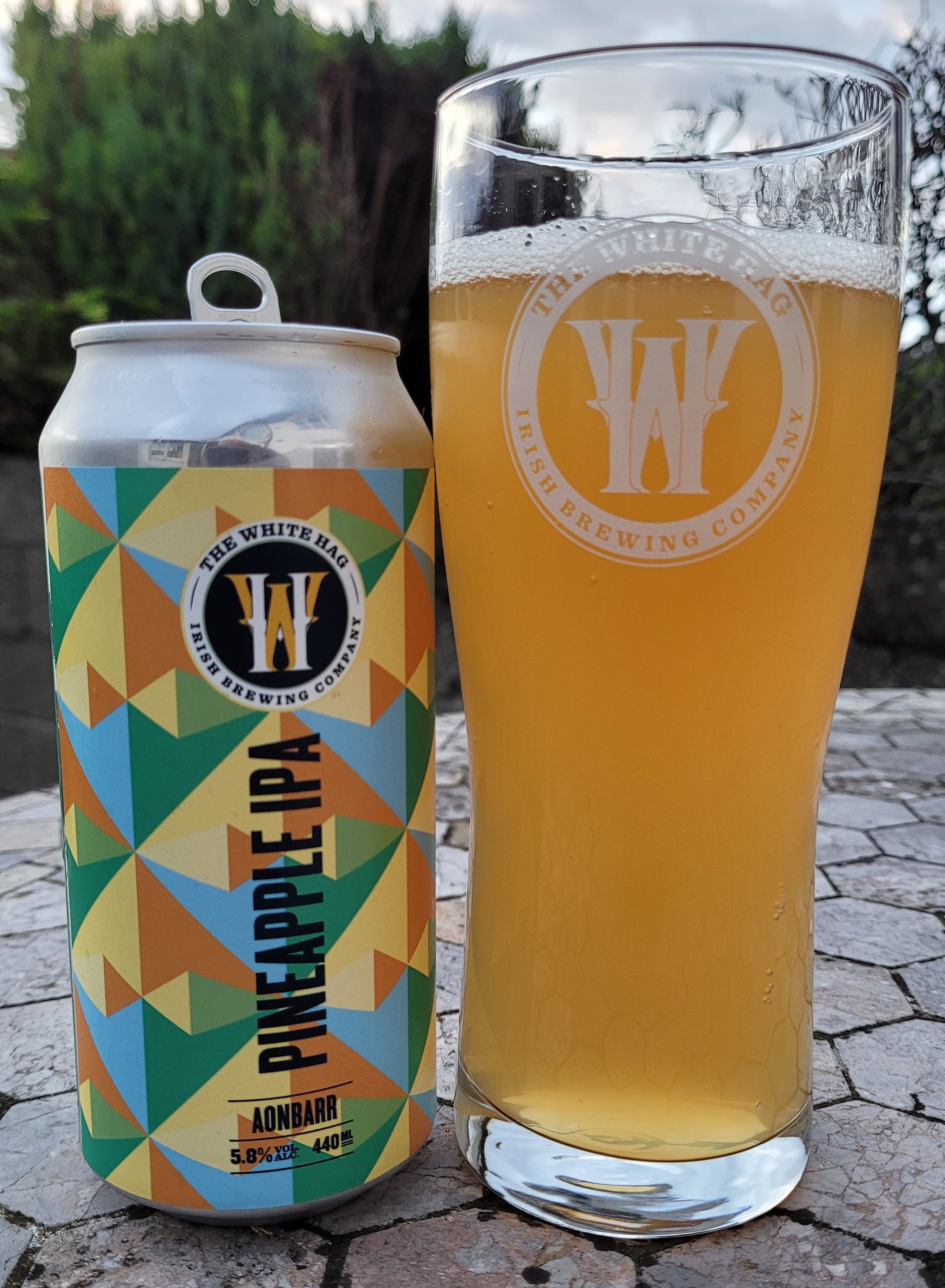
And then came number four: Aonbarr, with pineapple. While it's the same strength, it's a pale translucent yellow and very quickly loses its head, ending up looking more like a fruited sour ale than any kind of IPA. Initially it smells dry; crisp, bordering on papery. After that, again, there's a fruity side which could easily be either the hops -- just Idaho 7, El Dorado and Azacca this time -- or the tropical syrup. More Skittles, basically. There's a disturbing amount of fizz, which makes finding the flavour a bit tricky, but sure enough, there's the pineapple. Syrup being syrup, it's more like an ice pop or soluble vitamin than actual pineapple. There's a sticky, concentrated candy, element in the finish which adds nothing positive. As with the above, however, there's a decent IPA bitterness too, bringing an altogether more grown-up vibe.  It's not my kind of thing, though, and I'm not sure pineapple works as a complementary IPA flavour in the same way that grapefruit can, for obvious reasons.

Marking brews 1000 and 1001 at the nearly-nine-years-old brewery is a pair of light (7.5% ABV) double IPAs called Centennial Millennial. East Coast certainly looks and smells the part, exuding fresh mandarin juice from what appears to be a glass of orange juice. There's a fun and spicy nutmeg edge to this as well. Though the ABV is minimal for the style, it's densely bodied, and where I was expecting something as easy-drinking as orange juice, it requires a bit of pulling from the glass. Perhaps due to that density, it doesn't taste as bright as it smells. The juice turns to cordial; full of oranges but slightly claggy with it. A sweet stickiness begins proceedings, followed by a more savoury onion and garlic effect, about which there's a slightly dreggy, mucky vibe: not uncommon in beers like this, but most unwelcome. It's not awful: the aroma is great fun, and its happy fruitiness returns as the aftertaste. The middle needs cleaned up, however.

Centennial Millennial West Coast, then. It's clear and amber-coloured, so that's good, though lacking in aroma in general. I guessed this would be the sharper-hopped of the two but it was hard to get any flavour from it at all at first. Given a little time to warm, it becomes a kind of fruity-candy IPA: Skittles and Starburst, not grapefruit and pine. The bitterness level grows too, but never quite reaches what I would consider a proper west-coast grade. On the one hand it's clean and inoffensive; on the other it's a little insipid, and unworthy of being a celebration beer for a brewery milestone. A couple of years ago, any IPA in the west-coast style would have been regarded as a treat. With a steady revival in place, however, the standard is higher than this. Full nerd points for the use of the einstein "hat" tile on the labels of this pair, though.

And to finish, the traditional house beer of the festival: Hopstravaganza. The brewery seems to have invented a new style this time around, "Extra Pale IPA". What does that mean? Not much, I suspect. It's not particularly pale, being medium amber, and just a little bit hazed. 6.5% is a fairly middle-of-the-road ABV. There's a bit of promotional bumf on the can for Crosby Hops's CGX lupulin pellets, the Amarillo and Cashmere versions being used here. I can't say I can smell or taste any major difference they contribute. Still, the beer is very decent for all that, softly textured with a peachy/melony effect that I'm well used to from The White Hag, with a bonus poke of hard pithy bitterness. Not for the first time I'm comparing a new release to a beefed-up or toned-down version of Little Fawn, in this case the former. There's a fair whack of boozy heat lurking in the finish after the fruit, but the festival is for considered sipping of quality beers, so this will fit in perfectly.

Right so. See you in Ballymote. The usual drill.

04 August 2023

The Devil went down to Aldi

Unexpected summer lager is today's theme: one beer each from two breweries whom one does not find in Aldi regularly.

We don't see Whitewater at all in these parts any more. It's a bit of a shame because it was one of the greats in Irish brewing, in the early years of this blog. Today we have Whitewater's Helles Lager, the pitchfork and pointy tail on the label making it clear which pun they're going for.

At 4.2% ABV it's a little on the weak side, but it looks dense at least, a honey gold colour, with a properly persistent head. The aroma is absolutely spot-on to style, a clean and fresh white-bread effect, just veering towards cakey sweetness, and backed by a hint of vegetal bitterness. It's properly full-bodied too, and does show the cake and veg, but there's something else. I get a dose of heat, of marker pen solvent, which good examples of this in Germany never have, but which you might get in a rustic brewpub version. The beer is still perfectly drinkable, and has a very pleasant filling and weighty heft. It doesn't quite have the beatings of Germany's polished finest, however.

Iron Maiden played Dublin on the weekend I picked up Sun and Steel, and these facts may not be unrelated. This is the latest in the Trooper collaboration series between the band and the brewer Robinsons of Stockport. The gimmick here, other than the tie-in, is that it's "infused with sake", so I'm guessing that a proportion of the finished product is blended into the base lager. The result, 4.8% ABV, doesn't taste gimmicky, and has a very straightforward pilsner profile: predominantly dry with elements of grain and grass around the edge. It's decent, and it feels dead classy to be drinking it from a 33cl bottle. You don't really need sake to make a good clean lager, though.

Turns out these two shelfmates really have very little in common. Still it's always a pleasant surprise when Aldi gives us unexpected beer. Fair play.

02 August 2023

Einsiedler? I hardly know her!

We've had a gradual trickle of beers from the Saxon Einsiedler brewery, all in resolutely typical German styles. So far there's been a Helles, Weissbier, Schwarzbier and Böhmisch, and now they've sent us their Zwickelbier, presumably an unfiltered version of the Helles, at the same 5.2% ABV.

It looks significantly darker, however: a deep amber colour which I'm not convinced comes entirely from the haze. The flavour is nicely wholesome, consisting mostly of rough granary bread with a marmalade-shred bitterness and a sharper tang of metal on the very end. That finish is quick, however, so while it's not as crisp and clean as a clarified lager would be, it still has enough of its attributes to pass muster. There's a little bit of heat, too, suggesting some potentially headachey esters, but for me this was all part of the unvarnished charm of it.

A bit like the Böhmisch, this is more challenging than your typical factory-brewed German lager. It doesn't follow the usual Zwickel pattern of being a very slightly rougher Helles; it goes all-in with its lack of polish, and may be a little divisive as a result. I enjoyed it for all that.