15 May 2019

Peanuts and Cracker Jack

Baseball season was ending as I was packing up to leave Toronto last September. I'm guessing that's the reason Left Field Brewery's Sunlight Park grapefruit saison was in the discount basket near the till at the LCBO. While I was in shopping for rucksack-fillers I picked up a can, took it home, threw it in the fridge and forgot about it. With the new season well under way, time to take it out and see what gives.

It's a clear and pale beastie, briefly forming a head before that disappears. The grapefruit is strong in the aroma, concentrated and syrupy. This is less sweet on tasting, which ends up coming across a little too much like washing up liquid. There's a level of Belgian spice, but more like a witbier than a saison: peppery and a little soapy too. 5.3% ABV gives it heft and heat.

It's fine, I guess, and I can see it working as a summer season sports beer. There's just enough complexity to keep it interesting though it's not really up there with Belgium's best.

13 May 2019

Life's rich pageant

My drinking life isn't all festivals, though it might seem like that on this blog lately. I do manage to fit the odd pint or can in between them. Like this lot, for example.

I don't know what it is about the term "wheat IPA" but I really expected the wheat to come first and the hops to be an afterthought. That's not the case with Bill's Wheat IPA, released earlier this year from Rye River. It's a middle-of-the-road 5.2% ABV and pours a glaringly bright pale yellow, but with only a gentle haze. "Wheat" doesn't always mean hazy in this mixed-up world of beer we have now. The aroma is softly citric, suggesting lemon sherbets and sweet meringue pies. The flavour has more of an edge on it: a squeeze of lime juice, some naughty herbal dankness and a savoury edge of fried onion. What the wheat brings is the softness: a luxurious pillowy texture which deftly offsets any hop sharpness. This is a non-bitter IPA without any of the New England trappings, and as such is yet another complex, high-end yet accessible Rye River beer, to be filed right alongside Francis' Big Bangin' and the Lidl American Brown Ale. Like the supermarket beers, the branding is understated but there's finely-spun gold inside.

With the announcement that Whiplash is staging a festival in July came a pair of new releases. We begin with Melody Day, a 2.8% ABV "micro IPA", like their award-winning Northern Lights, this time using Enigma and Simcoe hops. It's a murky pale orange, topped by a loose fluffy white head. The aroma mixes citrus pith and juice pleasingly, while the texture is surprisingly full for the strength, continuing the fun and fluffy theme. I got garlic heavily in the foretaste, building to a lime juice crescendo before fading to out leave a gentler vanilla, lemon curd and mango pulp sweetness. Just like Northern Lights this does a great job of squeezing real New England IPA character into a tiny package. The only telltale is the mouthfeel, but that lightness just means it's easy to drink and very refreshing. Perfect for outdoor summer sessions.

At the opposite end of the scale there's Nice Dream, yet another Whiplash double IPA, this one benefiting from Galaxy and Amarillo hops and the usual 8% ABV. Even cold from the keg the aroma was striking: a tart mandarin pith effect. The texture is thick and creamy, in keeping with the hazy yellow appearance. There's a layer of savoury yeast, but nothing drastic; a bitterness that's all hop aggression and quite charming with it; but the centre is those oranges, oscillating between spritzy orangeade, thicker cordial and real fruit flesh. No alcohol heat either. This is highly enjoyable, though the harsher elements do contribute more to the aftertaste than I'd like. Overall, though, a very decent example of Whiplash's stock-in-trade style.

12 Acres has tried its hand at trendy beer with its first canned hazy IPA: The Far Side. This is darker than most, a deep orange rather than yellow. The aroma is more like a weissbier than an IPA, providing a hot hit of butane and ripe bananas. The flavour offers more of that, and a sharp gastric acidity, but no fresh hops, no vanilla or garlic: none of the attributes of New England IPA, for better or worse. "Tropical fruit flavour and a juicy bitterness" says the can. Nope. There's maybe a slight tang of orange juice, but the overall picture is definitely more banana than citrus. The texture is moderately smooth, so I'll give them that. It's not a great beer, though, and definitely not a good example of the genre.

The Eight Degrees Rack 'Em Up series continues with Blue Ball: an unlikely combination of Vienna lager and cold-brew coffee. It's only 4.5% ABV and a pale yellow. I always think Vienna lagers should be darker, but that's just me. It's an interesting effect. There's the crisp and clean malt-forward lager, and then a different sort of crispness from the dark roasted coffee. The finish brings the coffee's oily warmth out, for an almost stout-like effect. I don't know that it works per se, but it's certainly engaging. Those oils, I think, turn it a little cloying by the time the can is half way through. I suspect the underlying lager doesn't have enough going on by itself to counterbalance them. This recipe is suited to being a one-off novelty but no more than that. "Anything but stout" was the brief. Most breweries use stout as the base when adding coffee for a good reason. Thanks to Bradley's of Cork for the freebie can.

Staying in Cork, Black's of Kinsale's latest is Pineapple Express, a sequel of sorts to the OG Kush cannabis-infused IPA they had at Alltech. It's a bright orange colour and a big 6% ABV. I'm certain I detected pineapple from the aroma, but that must just be the power of suggestion in the name as there's no actual pineapple involved in the recipe. That's backed up by a flavour which is in no way sweet, instead being bitter and spicy: a jolt of nutmeg before gentler herbal coconut. While assertive in its hopping, it's not severe, and gets extra complexity from sparks of resiny incense. The texture is properly thick, allowing the hop oils to linger long on the palate. This is really good, clean, hop fun with no perceptible gimmicks.

Meanwhile Franciscan Well did the full-spectrum media launch with Pilgrims, a new pale ale. It shares its 4% ABV with the previous release, Archway: a beer which, for me, torpedoed the remnant of the brand's credibility last year with its vapid taste and try-too-hard marketing. Still, as always, everything gets a fair shake on this blog and I approached my freebie growler with an open mind and a clean palate. Diacetyl. This pale copper job is packed to the gunwales with sickly, buttery diacetyl, especially in the aroma, but stuffed into the flavour as well. It's hard to believe a professional tasting panel for a multinational corporation gave this the thumbs up. It's not heavy and slick, however: for balance there's quite an astringent tannic dryness, while the hops bring a hard, metallic, boiled-sprout tang. To my mind it's closest to the more severe sort of English bitter: Shepherd Neame on a particularly bad day. No, I did not like Pilgrims and I think the recipe is horribly flawed. I'm sure that won't prevent it selling by the bucketload, however.

Following Galway Bay's Crispmas Hell from last December was a new lager for spring, simply called Helles. It's the same 5% ABV, though entirely without haze this time. I thought it might have been literally the same beer, left lagering until now, but the hops have been changed from Mittelfrüh to Saaz, and the water tweaked as well. It's on the dark side for the style and goes big on grassy bitterness (no surprise), the malt only arriving late: sweet and cakey. I was wary of being served my pint in a frozen mug, but it did the beer no harm, and suited the warm afternoon that was in it. This balanced but bitter job is definitely a better fit for summer than Christmas.

And then along came yet another 5% ABV helles from Galway Bay, this one called Trellis. It has been given the distinction of the Motu blend of New Zealand hops plus oats and flaked wheat. The clean lager base is left largely undisturbed, offering soda-water minerals and faint golden-syrup malt. From this follows a layer of spinachy hop bitterness and a softer, sweeter, white-grape effect. It's interesting, enjoyable; but an improvement on the basics of helles? I don't think so. I needed to pause to enjoy the hops, catching the bitterness in the foretaste and the long fruit finish. I prefer a helles I can just knock back. As a hoppy lager, however, it's well ahead of most of those billed as "India Pale" versions.

New from Kinnegar is Barrel Hunter, the latest in their Brewers At Play experimental series. No barrels were involved, but Hunter was: this is the third beer I've had which utilises the Irish heritage malt. It's 5.5% ABV, a pale orange with a slight haze, and offers an intriguing perfume aroma. This expands on tasting into a mix of sharp mandarin citrus, sweet rosewater and spicy cedar. The latter is the strangest feature, lending it almost the feel of a saison. Though the carbonation is high, the texture is decently full, with a definite oiliness. It reminded me a little of a bitter from an old-school English brewery, one of the ones with a very distinctive house yeast. I can't tell you what produced the alchemy in this beer: the exotic barley, a quirk of the yeast, or something else. It's an engaging fellow, anyway, and  -- bottom line -- enjoyable to drink.

My exploration of Boundary's current range continues with Tobi, the first lager of theirs I've tried. They're claiming a Bavarian influence here, although it's a pilsner. The ABV is a helles-like 5.1% and it's an only slightly misty shade of polished gold. The head is promising at first but fades all too quickly. Similarly, the hopping provides a fresh herbal aroma then vanishes on tasting. Instead, the flavour is quite fruity: not full-on banana, but with a sweet edge of apricot and fig. Thankfully the finish is quick and the stickiness short-lived. I think I would have got more out of this had I been drinking it cold-cold, allowing it to be the clean and crisp refresher it's probably meant as. At a slightly higher ale temperature it just doesn't have enough going on.

Staying up north, a collaboration between Beer Hut and Lacada next: 2 Player, a double IPA. Taster kindly provided by Simon. A sizeable 8.1% ABV and lurid yellow in colour, it pumps out strong and raw red onion as the aroma. The flavour is mellower, mercifully, showing sweet orange cordial at the centre, with the onion relegated to a balancing contrast role. The use of lactose gives it a certain heaviness, but not an excessive amount, and there's a pleasing lack of alcohol heat. I'm not sure subtlety was meant to be part of the spec here, but it achieves it, being a calm and measured example of this extreme style.

If your electrolytes need balancing, YellowBelly have just the beer for you with Tide's Out, doubling down on the saline, being a seaweed gose, brewed in collaboration with Neptune Brewery of Liverpool. It's a pale clear golden colour and the aroma and foretaste are dry and biscuity, like a cream cracker or waterbiscuit. Tangy salt and herbs drift in behind this, adding a briney slickness to the mouthfeel, ensuring that 4% ABV doesn't mean it's thin. The sourness is a contributor to the tang as well, lightly done with a gentle gooseberry or redcurrant flavour. Overall it's a crisp and tasty example of the style and, despite the kerr-azy added ingredient, not far off the archetype.

"Blood orange ice pop" is a new sort of IPA for me, delivered via the YellowBelly-Wicklow Wolf joint Super Soaker. We continue the extra-low ABV trend with just 2.7% here. It's a hazy beige-orange colour with a loose and lackadaisical head. The milky lactose is very apparent from its aroma, with the hops providing more of a spicy note than fruit or bitterness. The flavour is almost savoury: pepper and nutmeg against a creamy texture on a sugary base layer, like one of those eggy winter cocktails. The orange side of the equation is faint, with just a trace of sticky tutti-frutti candy and a surprisingly hard bitter-hop kick right at the end. Possibly it's this last element that makes the beer remarkably drinkable for all the syrupy, gungy goings-on. Maybe the low alcohol helps. I can't say I was a huge fan of this, but that mix of spice and fruit certainly held my attention for the full 440ml.

We crank the ABV up to 3.8% for the next Wicklow Wolf -- Eden session IPA: so powerful it has to be packaged in a smaller can. This one feels like the ABV, being much thinner without the benefit of lactose. The oats seem to be asleep on the job. The clear amber colour was unexpected in this Age of Haze, though the clean flavour was a pleasant side effect. I'm not sure I really enjoyed said flavour, though. The can promises juice from a combination of El Dorado, Chinook and Cashmere, but I got a dry and grainy tannic effect with lots of husk and crust. There are mild sherbet overtones, but nothing I'd call juicy, and its rather austere astringent qualities are accentuated by that overarching thinness. There's a definite lack of fun in this bony, scowling fellow.

Shane from DOT kindly delivered a couple of bottles to me at the weekend, including this Rum White Barrel Aged Lager. I wasn't a fan of the last go at barrel-ageing lager so approached this one with caution. The strength is the same 5.2% ABV, suggesting it's the same base beer, but obviously we have rum barrels this time instead of wine. Nevertheless, it tastes much more like wine than rum, showing the beautiful apricot and gooseberry juiciness of a delightful summery new world white. The fizz is quite busy, which adds to the crispness but interfered with my enjoyment of all that lovely fruit. A tiny peppery spice kicks in before it clears off the palate lickety-split. It's a lovely beer and would make for an excellent aperitif, though I'd be quite happy necking it in great big pints too.

And speaking of great big pints, hot on the heels of the new Hope beers at Rye River Rising (see last week's posts) comes another new pair in hop-forward styles. We're up to 14 in the brewery's Limited Edition series, and that's an India Pale Lager of 4.5% ABV. There was a warning signal in the aroma: vanilla and raspberry suggesting something more New Englandish than lagery. The flavour is sweet, no question, but not the way I feared. It's mostly an orangey spritz, with extra thick hop resins and a hard grassy bitterness at the end. This is enjoyable, very full-flavoured in the hoppy Hope way, but it earns my usual complaint of not being lagery enough. I think it's the resins which undo the mature cleanness that lagering brings.

Hop Hash IPA is the brewery's summer seasonal, a sequel, I guess, to last summer's magnificent Hop Hash DIPA. It's beautifully clear, if a little headless. Pith dominates the flavour: jaffa, shading to grapefruit, with a lacing of sweeter mandarin and satsuma. All the citrus, basically, with only a slight savoury edge of red onion. The heavy texture suggests more than 5.5% ABV, but like the previous one I think the effect is down to its hop oils. Much like its DIPA predecessor, this really gets the most out of hops: the essence, the very quiddity. Great stuff this hash.

Finally, I have been a bit rude about the brut IPA style of late, but I still wasn't going to turn down a freebie can of the new limited edition Boyne Brewhouse one when it was offered recently. Et Tu Brut IPA is the chucklesome name, and it comes in a highly informative can with lots of vital statistics. One of same is the belter of an ABV: 7%. It pours the requisite pale yellow colour and the high alcohol is apparent from both the texture and taste: for a beer defined by its dryness, it is considerably sweet and sticky. At the front of the flavour is quite a harsh lemon-rind bitterness, turning to hard candy by the end. But that's all you really get: once again with brut IPA, I think enzymes have allowed the character to be fermented out of it. What's left is OK to drink but I don't really get the point of it. Et tu? indeed.

Woah that's a lot of beers. I'll pause for breath here, but there's lots more new Irish beer still to be covered. They, and you, will just have to wait.

10 May 2019

Half of everything is IPA

Post two from the recent Rye River Rising festival is all about the pale ales, and variations thereon.

Hopfully ran a couple of pilot beers through its tap, beginning with a Hybrid Micro IPA at 2.4% ABV. Although this is a sickly looking yellowy white, it has absolutely nailed the texture, its body properly full, not watery. With Mosaic and Hallertau Blanc hops, it should have finished fruity but instead it's powerfully bitter, the flavour vegetal and green. The overall effect is akin to biting a raw hop pellet. I thought it wasn't bad at all, but the brewer didn't seem happy and replaced it quickly with...

Spelt Session IPA. We're up to 3% ABV here; still milky looking and still deftly avoiding thinness. Citra, Amarillo and Simcoe bring some classic American flavours to the table, yet without turning harsh as before. There's a gentle pithiness, and a zing of lemon tea, balanced by a crème caramel vanilla note. This is not the most exciting of beers, but very decent at what it does.

Before we go to New England and stay there, a trip to Hope's bar and a glass of Overnight Oats, an oatmeal IPA of 7% ABV, turbo-fermented with kveik. It's pale yellow with a full and quite greasy texture. Thankfully there's no alcohol heat, and I think that's because there's no room for it amongst the massive hops. The oiliness brings a sort of avocado effect to the flavour, and there's sharp guava and smooth mango alongside. This is uncompromisingly fresh and sharp, both a shouty wake-up call and a silken whisper. Iron fist in a velvet glove; that sort of thing. I liked it a lot.

The new Wicklow Wolf New England-style pale ale is called Avalanche. This arrived a deeper shade of orange and rather clearer than I was expecting. Idaho 7 and Azacca hops give it a stonefruit aroma: peach and white plum. There's a refreshing pith and peach skin juiciness, the light and quenching effect aided by a modest 4% ABV. In front of this is a more serious fried onion note and a waft of vanilla: both perfectly normal in this kind of beer but both I could do without. Still, the beer's overall easy-going nature means that these are just minor quibbles about a complex yet highly drinkable session beer.

Did someone mention juiciness? Third Barrel's latest is called Don't Blame It On The Juice, still modest at 5% ABV, made with more Idaho 7, more Citra and some Enigma because why not. Juicy? Actually, no, not really. The flavour explodes onto the palate with a hard dankness: fresh and bitter citrus oils; spiky, puckering and invigorating. A luxurious layer of vanilla is the only nod to Vermont here, adding more to the body than the taste; otherwise this is west coast undercover, and all the better for it, frankly.

Poor timing on my part meant I missed the imperial milk stout DOT was pouring but I did grab a glass of the double IPA, Pursuit of Juicy. This is the appropriate New England shade of beige. The aroma is mild, showing a little citrus and a little vanilla but not a lot of either. The texture is spot-on smooth for the style and there's a definite heat, appropriate to the strength. The flavour is... balanced, which I'm not sure is entirely appropriate to the style. There's a spritzy citrus, a kind of lime sorbet effect -- just acceptably hoppy enough, I think. In its favour there's none of the garlic or caraway which so often ruin these sorts of beers. The mildness may be disappointing to some, but I've come to be wary of New England-style double IPAs and this one treated me better than most.

Rye River are onto a winning model with this gig, and I hope they keep it going. Congrats to all who put it together and ran it so smoothly on the day.

08 May 2019

Day drinking

Rye River celebrated its 5th anniversary with a festival last month, bringing a couple dozen Irish breweries, a handful from Britain, and two cider-makers to their headquarters in Celbridge. They very kindly comped me a pair of tickets and a handful of beer tokens.

The set-up was perfect -- a single compact venue, two taps per producer (some with rotating beers), excellent live music and the holy grail for Irish festivals: real glass glasses. The 8pm finish might have caught a few unaware but I found it damnably civilised, though an hour or two's head start from the 2pm kick-off would have improved things.

Six-hour limit notwithstanding, the beer will take two posts to cover, and we'll begin where I began, on My Cherie Ramore by Lacada. "Belgian Cherry Ale" is the official descriptor; it's broadly a fruit-flavoured saison. The earthy aroma is certainly saison-influenced, and while the taste isn't alcopop-sweet there is a touch of cherry cough sweets, with the attendant hot vapours. It's enjoyable, and different, but I don't think it's an improvement on ordinary saison made well.

Wicklow Wolf joined the 1% with their ultra-low-alcohol coffee ale Moonlight. There are cocoa nibs in here too, adding a distinct sweetness. The flavour made me think of drip coffee with brown sugar. Its concentrated coffeeness means the roasted side is slightly overdone, giving it a sweaty edge, but the texture is light, the fizz is cleansing and overall it works as a refresher. I'm really not sure how the market will react to this. It's probably best stored somewhere other than the beer aisle.

Can we have a beer without any unorthodox ingredients? Canvas went some way to answering that call with their two. Mallmann is a smoked beer of no particular style, using malt they've produced themselves. The resulting beer is 4.1% ABV and a deep red colour. It tastes strongly of smoke -- not ham or kippers or any of the usual smoke analogues -- but actual smoke, like a bonfire. An extra dimension is added by a mild tartness, like blackberry or loganberry. For all of the caveman qualities, it's clean and balanced, finishing quickly on the palate and inviting the next sip. This is very much a grown-up beer, a challenge for those more comfortable with milkshakes and pastries. It's tasty though, especially if smoke is your thing.

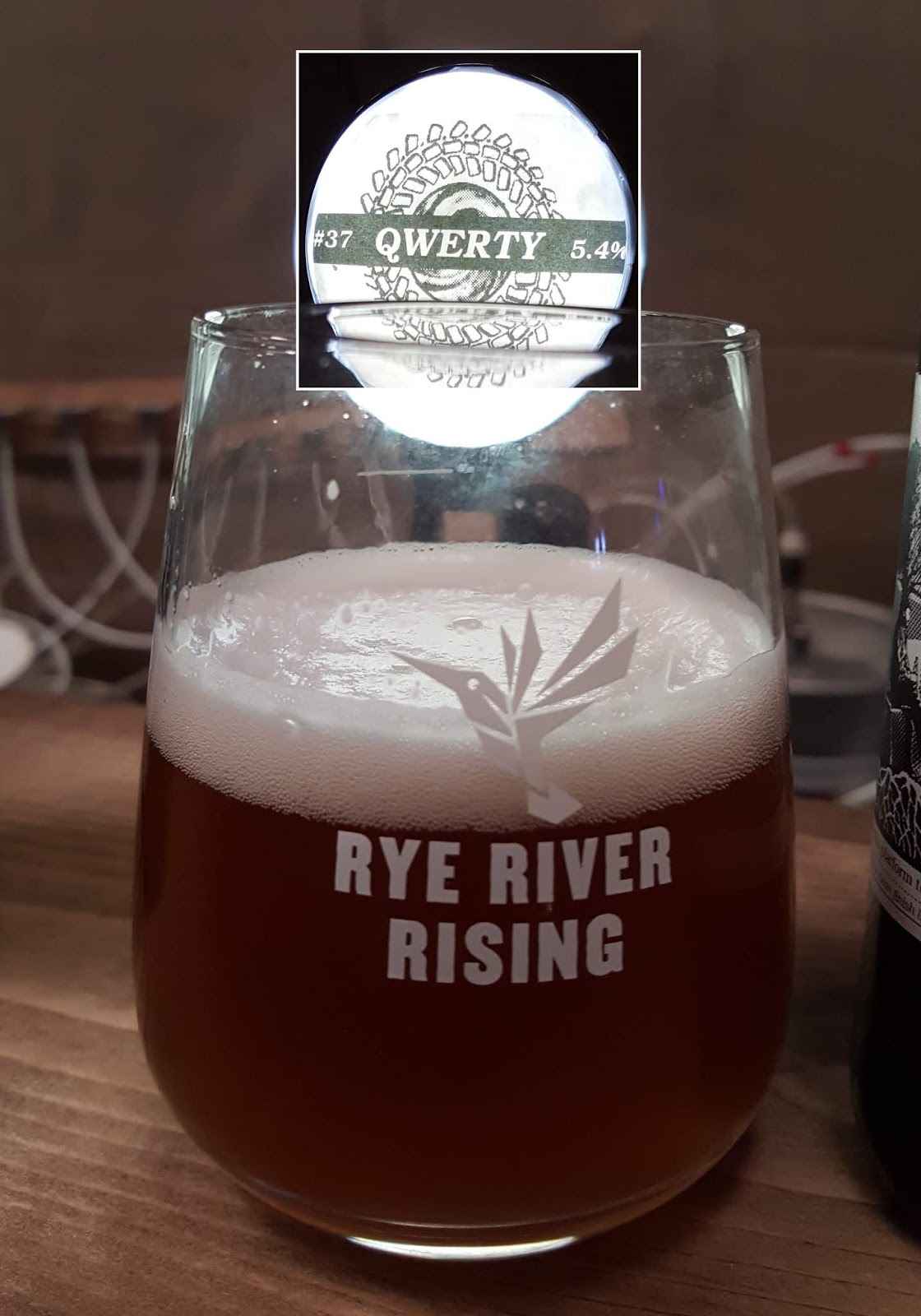
The brewery's gift to beer writers was Qwerty, and I'm pretty sure I've spelled that correctly. This is a saison fermented with kveik yeast; 5.4% ABV and a muddy red-brown colour. The aroma is of ripe-to-rotten apricot and there's loads of fruit in the flavour too: strawberry most prominently, but raspberry and peach as well. I guess it's the darker malt bringing a baked pastry edge, and there's even a touch of smoke. In combination, the jam and pastry make this a poptart of a beer. Another interesting one from Canvas. Regarding "saison" as the style, I guess the kveik had other ideas.

Bigger! Funkier! Weirder! Galway Bay, obviously accustomed to the high-end festival circuit, kept its taps turning over. The range included Lives Well Lived, broadly some sort of souped-up Flemish red. It's 8.3% ABV and goes big on malt. The flavour opens on heavy dark fruitcake, one soaked in booze. It proceeds to a spritzy tartness, like a rustic southern European table wine. The two form an interesting double act. I spent my glassful fascinated by the flavours and their interaction, but I found it hard to just enjoy. It's not the first time something like this has overpowered my palate.

"American stout" is not a style designation we see often around here. The words immediately conjure my first experience with Sierra Nevada's Stout and the joyous melding of dark malts and west coast hops, before the black IPA craze washed ashore here. That's what I was after from 3 Missed Calls by Hope. It certainly delivered in the aroma: even though it was served nitrogenated there was a massive hit of citrus on the nose. The flavour was surprisingly savoury, showing sesame seed most of all. The centrepiece bitterness is that of a roasty stout though it veers grassy, almost unpleasantly so, towards the end. I think a little more malt sweetness would help balance this, but it's an enjoyable novelty nonetheless.

For the overseas breweries I went sour, beginning with Quench Quake by BrewDog. This is a very accessible 4.5% ABV job, allegedly flavoured with grapefruit and tangerine but I couldn't taste either. Instead it's dry and sour all the way down; chalky and minerally with a minimal amount of quite generic citric zing. I enjoyed it for all that: it offers superb refreshment and was the perfect mid-festival reset button for my palate.

Later on I tried the oddly-named Bouba / Kiki from Birmingham's Dig Brew Co. This was rather more full-on: 6.2% ABV and including apricot, mango and (bizarrely) tonka beans. It has an opaque orange-juice appearance, while the beans give it a strong coffee aroma. The flavour mixes sharply bitter fruit acid with the rich and smooth coffee oils, which is a very weird contrast: a mojito served with an espresso on the side. It's fun, but I'm glad every beer isn't this daring.

Our hosts had a range of small-batch beers on their bar. The latest in the official limited edition series, the first for 2019, is Mother Pucker, a sour beer with blackberries. A mere 4.4% ABV, it's a pink emulsion and tastes, as it looks, like forest fruit yoghurt. The sour tang is lactic and definitely not puckering, and while the fruit flavour is very real, the texture is thin and the finish all too quick. This is simplistic and inoffensive; an introduction to sourness but no more than that.

Their oddity was a coffee milk stout made with oat milk instead of cow, called Oat Flatzer. It's very heavy on the coffee, showing lots of bitterness and a significant dash of dark chocolate. Dominating the flavour, however, is a strange cereal bar effect, all wholegrains, sticky with treacle and honey. This was yet another unorthodox beer, to the point of unsettling, but still enjoyable in its oddness. It seemed to be the day for it.

Completing the set of Rye River specials: Mash-Breaker, one of those brews awkward enough to imprint itself on the brewer who named it. This is a tripel at 8.3% ABV. The spice levels aren't as high as I'd like them -- just a pinch of white pepper -- but otherwise it's a classically-constructed example, with plenty of Belgiany banana esters and a quenching hit of fresh mandarin and apricot. They can always buy a new mash tun if they want to make it again.

We've been a little light on hops for this set. I'll rectify that in the next post.

06 May 2019

The Easter sunny

Last year's Franciscan Well Easter Festival got postponed due to snow. There was no chance of that this year: it was a glorious sunny weekend for the festival's 20th birthday outing, and as usual I went along on the Saturday. The two-bar linear format was preserved, so it was just a question of working side to side.

Beginning at the the top, then, my first was Witness Protection from YellowBelly. If you didn't guess from the name, it's a witbier. This is a simple and easy-going take on the style, and little on the dry side, but offers properly balanced quantities of citrus and coriander on a soft wheaty base. Unchallenging, but perfect summer quaffing.

Perhaps less seasonally appropriate was Wicklow Wolf's American Brown Ale, though it was a sessionable 4.2% ABV. The scarcity of brown ales has made me fussy about them and this one didn't deliver. It's thin and bitter rather than creamy and sweet. A few sips in and I found traces of chocolate and caramel but not enough to save it. Too much roast and too heavily hopped for my taste, I think. I'm looking for luxury in this style.

White Gypsy is one of several Irish breweries to have produced a beer using the Hunter heritage variety of malt. I covered the Porterhouse's recently, but didn't get much of a malt character from it. Huntor is different. While it starts out on a fruity waft of mandarin hops, the flavour is an assertive porridgey malt sweetness, wholesome, and glutinous. A hard bitterness follows, bringing North English bitter vibes to the clear gold beer, though it's a bit strong for one of those, at 5.8% ABV. It is interesting, and tasty. Maybe there's something to this Hunter thing after all.

Hilden Brewery was once a reliable fixture of the festival but hadn't been seen in some years. They don't even have a distributor in the Republic at the moment so I had completely lost track of their beers and was happy to see they'd been invited back. Hopended is an IPA in the New England style, and it's odd to see a veteran UK Real Ale brewer take that on. Though inappropriately dark orange, it has a lovely soft texture. The flavour is sweet though not juicy, tasting more of orangeade and sherbet, finishing with an old-school bitterness. It's an understated and charming take on NEIPA; not for the purists but enjoyable drinking nevertheless.

Beside it, Hilden Helles, the first lager I've ever had from them. It's a light 4.8% ABV and a clear pale yellow. I wouldn't normally criticise these for insufficient hops, but a bit more noble character would be welcome in this. As-is, there's a crisp soda-water base and a pinch of banana ester. The texture is spot-on: pillowy, and almost too viscous. Not an exciting beer, but then it's probably not meant to be. It's passable. In my memory, Hilden's Belfast Blonde was more enjoyable.

West Cork were late arrivals so it was a bit later before I got to try their new dry-hopped Mizen Helles. It wasn't straight after the Hilden but I'm very confident that they didn't compare favourably. Something went wrong here as there was a powerful rubbery sulphuric foretaste. They say pale lager gives off-flavours nowhere to hide, and this one wasn't even trying. A water treatment issue, perhaps? The hops give it a mild lemony note, which was nice, but not enough to un-ruin it. And I don't think this is me just being fussy about Helles: the beer was just badly made and frankly not fit for sale. Looks to me like West Cork doesn't have the hang of lager, and should put the warm-fermenting training wheels back on.

At the end of the row was UCC Pilot Brewery, a group which can normally be relied upon for something decently lagery. This year, Oida weissbier was as Teutonic as it got. It was an OK example of a style which is hard to impress with. 5% ABV and neither hot nor thin: the two cardinal sins. There's a gently soft texture, a clean green banana foretaste and some light caramel and toffee afterwards. Grand, like.

The saison next to it was called Thudinie and was 6.5% ABV. Most of the positive saison characteristics were here: gunpowder, spices, a touch of banana. It's clean and not hot, but something wasn't quite right. There was a stale and musty rasp haunting the flavour, a ghost at the feast. There are many reasons why saisons sometimes don't suit me -- it's a broad style, if it even is a style -- but this was a new one.

The intriguing oddity in the set was Orchard Brew, badged as a beer/cider hybrid and really just a mix of wort and apple juice fermented out to 4.4% ABV. The result tastes like cheap industrial cider, or even premium industrial cider: there's little difference. Lots of sugar, a vague appleyness, initially refreshing but cloying very quickly. For all that apple juice will attenuate away to almost nothing, there's no beer character coming up behind it. I don't think we needed the boffins of UCC to reinvent Bulmers for us.

And so to the opposite bar. Black Donkey has joined the barrel-ageing game with a rye ale matured in Jameson casks, called Double Barrel. It's a clear red gold colour, 9.5% ABV and with bags of vanilla. A basic and clean pale ale is rooted firmly in the background of the flavour profile, but the oak and the spirit really dominate the front. By what wizardry it doesn't get cloying or sickly I do not know, but there you go. Nip bottles of this would be super, and would be interesting to cellar a while, to see if it mellows.

JJ's brought a couple of new specials to the festival but I only got to try one: Witty Redhead, a cranberry witbier. The fruit (I guess) gives it a dark copper colour, while the texture is pleasingly light despite a substantial 5% ABV. The cranberries make a big contribution to the flavour, bitter yet summery, conjuring cosmopolitan sea breezes and sex on the beach. This mixes it with more traditional spritzy citrus, though mercifully without any savoury coriander. It's a tremendously fun fusion of classic style and gimmickry. Cranberry witbier definitely warrants further experimentation. You heard it here first.

Larkin's had two new ones on the go, beginning with The Drayman Cometh. It's 6.5% ABV and badged unassumingly as an amber lager, but my immediate thought on tasting is that it's a session doppelbock and I'm going to insist on that until it's official. It has all the smooth, clean caramel of doppelbock, and the requisite bite of liquorice bitterness. The toasted dark grain edges are present and correct too. With perfect balance, multifaceted complexity and effortless drinkability, this rivals their Baltic porters as Larkin's best work to date.

And then obviously there was a double IPA. Loose Cannon, 8% ABV, Citra and Vic Secret, was fine. An opaque orange, thick and sticky, with lots of cordial-like orange, it meets the minimum requirements of modern double IPA but doesn't do anything exciting or different with them.

Lough Gill's No Tracksuits imperial stout is not a new beer, but it's one I'd never tried before, always put off by the €10 price tag on the cans. €2.75 for a glass? I'm in. This feels and tastes every bit of its 12% ABV. The texture is muddily dense and syrup-thick. The alcohol is warming, just shading towards too hot for comfort. The flavour, meanwhile, is an onslaught of creamy milk chocolate and not very much else. A beer of subtle complexity it is not, but when only chocolatey booze will do, it works. There are better and cheaper beers around which meet the spec, however.

And then I ran out of festival. And almost out of time too. Just time for a quick one inside as I didn't want to pass up the rare opportunity to try beer from Dick Mack's brewery of Dingle. It was the Session IPA this time. Maybe it was the time of day and an overloaded palate, but this tasted odd to me. The hops were scant and instead (according to my still-legible notes) it tasted of creamy coconut with a sharp and salty bitterness. Unorthodox, but intriguing. A cursory thumbs up for now, and a promise to revisit this, should the opportunity arise.

A good mix, overall, and plenty besides that I didn't have the time or capacity to get to. This festival is still holding its own after two decades.