29 April 2020

Pistoff

Was it the haze that attracted me to Pistonhead Haze Lager? Was it the Galaxy dry-hopping? The Swedish brewing know-how? Nothing wrong with any of these, of course, but the fact was I had three beers I wanted in my basket and it was four for €10 at Stephen Street News. Bring on the random factor!

The haze isn't done very well. It poured clear to begin with, then hard gritty bits which had settled on the bottom of the can crumbled into the glass. It evened out somewhat by the time between pouring and drinking, but still: not good visuals.

The aroma performed little better, sickly and syrupy, with a tang of sweat too. There were three months still to go on the best-before but I think its glory days were behind it. The flavour continued the sickly theme: orange concentrate and children's medicine. Galaxy at its best offers bright juicy mandarin; this is a dark mirror image of that. Thankfully it's a lager so the nastiness doesn't hang around. I still wouldn't recommend it, though. There are much better hoppy lagers out there, even on the bargain shelves.

28 April 2020

A rate of Exchange

Like an increasing number of people, this blog is spending its birthday in lockdown. Happy 15th oulfella.

To mark the occasion I have retrieved something from the cellar that, honestly, I meant to drink a while ago and now seems the perfect excuse. I bought this bottle of The Exchange Δ Spontaneous Ale when I was at the brewery in Niagara on the Lake in 2018. It came lauded by local expert David Sun Lee, with a recommendation that it be let sit for a year before opening. Well, it got that, and a bit more.

Vital statistics: it's hopped with Hallertau, spontaneously fermented and aged in red wine barrels, finishing up at 6.7% ABV from a starting gravity of 1.051. The brewery reckons it's good for cellaring for up to a decade. It pours a deep autumnal golden, like filtered apple juice, and seems quite thick of body, with a stream of bubbles making their way lazily upwards.

The aroma is sharp and tangy; authentically gueze-like, which is a good start. Sure enough the flavour has plenty of that tang, shading a little close to vinegar for my preference, but with plenty of the earth and spice tones which make this such an enjoyable style. The ghost of the wine is present in a mild sweet and juicy side, making me think more of apples again than grapes, with a side order of Faro. This cider quality could be considered a flaw but I think it helps soften the otherwise very sour beer.

I'm glad I opened this now and I'm not sure I would age it much longer. Any more vinegary acidity could ruin it completely. Overall, this does a very good impression of Belgian geueze, and while it wouldn't feature in the top tier, it's better than several of the real thing that I've tasted. Chapeau to The Exchange, and to David.

27 April 2020

Sunshine status

It's strange and charming that a brewery as established as Anchor in San Francisco still has new beers for me to try. Quite a raft of them are now available in Ireland and I felt I should do some catching up.

I'm a little confused by the name of Brewer's Pale Ale: Citra Hop Blend. If it's Citra, how is it a blend? Is it single-hopped? It doesn't say. 5.3% is the ABV and it pours a dark and hazy shade of yellow, topped with lots of bright white foam. The aroma isn't especially powerful, though I'll admit my bottle may not have been the freshest. It's quite sweet to taste: orange-flavoured chews and lime jelly. There's a mineral, alkaline, bathsalts buzz in the finish. When Citra is the headlining act I expect a solid kick of bitterness, but that's lacking here. As an easy-going American Pale Ale it's fine, but undistinguished.

On to the IPAs next, beginning with Fog Breaker, at 6.8% ABV. It pours like a a witbier, a greyish amber, with a disturbing quantity of gunky clumps floating through it. I think this beer might have died in the bottle. It tastes dead: a dull bread or biscuit quality, dried out and characterless. The brewery says there should be pineapple and yuzu in this; there isn't. A faint citrus quality hovers around the edges of the aroma but it's absent from the flavour. This isn't unpleasant, it's just a big shrug in a glass. I'm actually intrigued to find out what it's supposed to taste like because it can't possibly be this. Moving on...

Did you know the waters of San Francisco Bay are pollution-free? Me neither, but apparently this is ensured by the good ship Baykeeper, according to the label of a beer named after it. It's an IPA, of a full 7% ABV and quite a dense hazy orange colour. The label which speaks so highly of the boat tells us very little about what the beer is made from, other than it's juicy and fruit-forward. Turns out it's another orange-and-minerals job, not juicy but with a pleasing punch of hop. The high-ish strength is well used, giving it a rich texture and a pleasant warmth. Satsuma, tangerine and jaffa all feature in the middle, between the grassy bitterness up front and the long waxy finish. There's a very English vibe to it, that earth-and-orange character that makes me think of Fuggles hops in particular. Drop the ABV and throw it on cask and it would be convincingly Kentish. This is quite retro, but I like it.

Finally, one which feels like old Mr Anchor allowed his grandson to design a beer for him: San Franpsycho juicy IPA with peach and apricot. I thought it would be full-on emulsion but it's only slightly hazy: a bright and sunny golden colour. The aroma is strangely savoury: caraway, shading to rubber, which is worrying. None of that in the flavour though, thankfully. There are two distinct sides to the taste: one is an old school, bitter and clean west coast US IPA with a little crystal sweetness and an almost harsh rasp of citric hop bitters. And then there's the other aspect: the fruit. Does anybody out there remember Magic Hat No. 9? I don't know if it's still being brewed, but this has a lot in common with it. It's a sickly, syrupy, peach-and-apricot flavour which has very little to do with real fruit. It's like someone sprayed the glass with cheap perfume while I wasn't looking. It is not an improvement and it does not render the underlying proper IPA "juicy". A decent beer ruined by fashion, is my verdict. There's a lot of it about.

There's a lack of freshness and vigour in all of these. One could make an obvious observation that hoppy beer which has travelled from San Franciso to Dublin will lose much of its character on the way, but that's far from the case with lots of other American imports. I suspect that veteran Anchor is just taking a more old-fashioned and sedate approaching to its hopping regimes.

24 April 2020

Kinnegar and friends

It's off to Kinnegarland today, to find out what the busy bunnies of Letterkenny have been up to.

Most recently, the Brewers at Play series saw the simultaneous release of numbers 5 and 6. The former is an Apricot Rosemary Sour, created for the Brewgooder project, best known (to me anyway) for the charity lager BrewDog makes for them. This one is a bright and opaque orange colour in the glass, looking and smelling like a fruit cordial. The smell is so sweet I'm not sure I would have identified it as apricot over any other concentrate. That slick and sickly syrup is at the front of the queue on tasting, but it's not the be-all and end-all. A herbal complexity rises behind it, oily and bitter, tasting more like the sharp pine of a classic west coast IPA than novelty rosemary. There's a certain perfumed spice too: an exotic waft of cedar or incense. It's not sour, showing only the fainest tang of acidity. This sort of thing is often quite thin, but here 5% ABV gives it a full and smooth body, carrying the complexity well. It's still a daft novelty, no doubt, but that rosemary adds a dimension of taste that's unusual, creative, and very enjoyable. Sweet fruit "sours" are ubiquitous these days; the opposite side of the hazy IPA coin. It's very pleasing to find one brewer doing something genuinely interesting with the format.

B@P 6 is called Uncle Grumpy, a collaboration with Boundary, and rosemary features again, this time in a saison. The ABV has dropped to 4.5% while the beer has dropped bright: a cheery clear golden colour. Primarily this is one of those dry and peppery saisons; very authentically Belgian tasting. The rosemary oil is apparent in the aroma, pushed up by a very active carbonation. It's sharp on a number of fronts: the fizz, the herb and the earthy saison character. Rosemary helps round it out, taking some of the edge off and lessening the severity. While it's unusual, it's not novelty for its own sake, and I could imagine a Belgian brewer making something very similar, if none have already. I wouldn't go so far as to call it an improvement on classic saison, but it's a fun and playful twist, and it was worth doing.

We finish on an interloper: Big Blue is from Edinburgh's Stewart Brewing and this time Kinnegar is the visiting collaborator. It's 7% ABV and described as a "spiced blueberry stout". Getting blueberry flavour into beer is a challenge at the best of times, doubly so for a stout, and spices? Forget about the fruit. This smells of cakey cinnamon from the very start, and the flavour doesn't get much more interesting: there's a little raisiny sweetness, some bitter roast and the loud cinnamon shouting over the top of both. None of it really stands out though, and the whole picture is less complex than I would expect for something of this strength. The texture is good -- full and soft -- but it doesn't make up for the lack of flavour integration. This is one of those kerr-azy collaborations brewers come up with collectively but which don't do the drinkers -- well, this drinker -- any favours.

I hope Kinnegar has some of that rosemary left over. There's a whole world of recipes it could be brought into.

22 April 2020

Soft border

I had come to think of Boundary as being primarily a brewer of strong beers. They present very much in the contemporary US/Scandi fashion, and low ABV tends to be nothing other than an occasional novelty in that milieu. So it was a bit of a surprise when I pulled two recent Boundary purchases from the fridge to discover both were of a very modest strength.

To begin, Nothing Left To Say, a rye session IPA of 4.1% ABV, dry hopped with Lemondrop and Cascade hops. It's a dull ochre colour in the glass, the head fading quickly. Its aroma is fresher and more exciting than the appearance might suggest, however: fresh satsuma lacing a distinctive grassy spicing. I guessed this one would belong to the rye. Sure enough, that peppery grass bitterness is a big part of the flavour, lending it an almost incense quality. There's a citrus sherbet in the middle, tart and tingly, and then an earthy, savoury finish which one could charitably describe as Belgian-feeling, but also as a bit mucky. While analysing all that I couldn't take my mind off the texture. Beers with this sort of complexity are usually heavy ones but this is very light. I genuinely couldn't decide between finding it pleasingly gulpable or unpleasantly watery. There are elements of both. On balance, I enjoyed it. There's enough rye poke and hop fun to deliver what's promised, and nobody can feel gypped by the description.

A straight-up pale ale next, Double Negative at 4.2% ABV, and this time it's Idaho 7, Simcoe and Azacca, to the tune of 16g per litre. It's a bright and opaque yellow, more Sunny Delight fakery than real juice. The aroma mixes sweet mixed tropical juice with a dry and savoury yeast bite, and the flavour mostly follows through on that. It's not dreggy, more crisp and husky, with overtones of crispbread on the finish. Before that there's a rounded orange juice flavour, less complex than the aroma, and a smack of garlic, bang in the middle. It's very, er, modern tasting, and as such I don't think I really like it. I'm sure plenty of punters will, however: I'm used to yeast-bite and garlic being things I just don't appreciate. And hey, at least there's no vanilla. Once again the low ABV creates a light texture meaning no flavour, whether good or bad, hangs around too long. It manages to avoid being offensive by being, well, inoffensive. If you're after a lighter take on those DDH IPAs you love, here it is. Otherwise I wouldn't really bother.

An interesting diversion, but I'm ready for my next Boundary to have a bit more heft, especially if they're going to insist on my paying close to a fiver a can.

20 April 2020

Zany Lithuany

An "Australian Pale Ale" from Lithuania in a pint can? There was no way I was going to pass that by when I spotted it on the shelves of the local SuperValu, especially when it said "limited supply" on the tin. Volfas Engelman APA, from the "Tastes of the World" series, is hopped with Galaxy, Ella, Topaz, Perle and Kiwi interloper Rakau. It's a medium pale amber colour with considerable haze, some of which had been stuck to the bottom of the can and was unexpectedly disturbed.

No fruity Aussie hops in the aroma, or much else really -- maybe a slight nondescript citrus note. Same for the flavour, unfortunately. There's a sweet cereal core with artificial candy-fruit topnotes, but none of it very strong. The texture is light for 5% ABV and I would all but swear it's a lager rather than an ale. It certainly tastes like it's from a brewery used to cool fermentation. I had high hopes for something exciting but this is actually a bit dull.

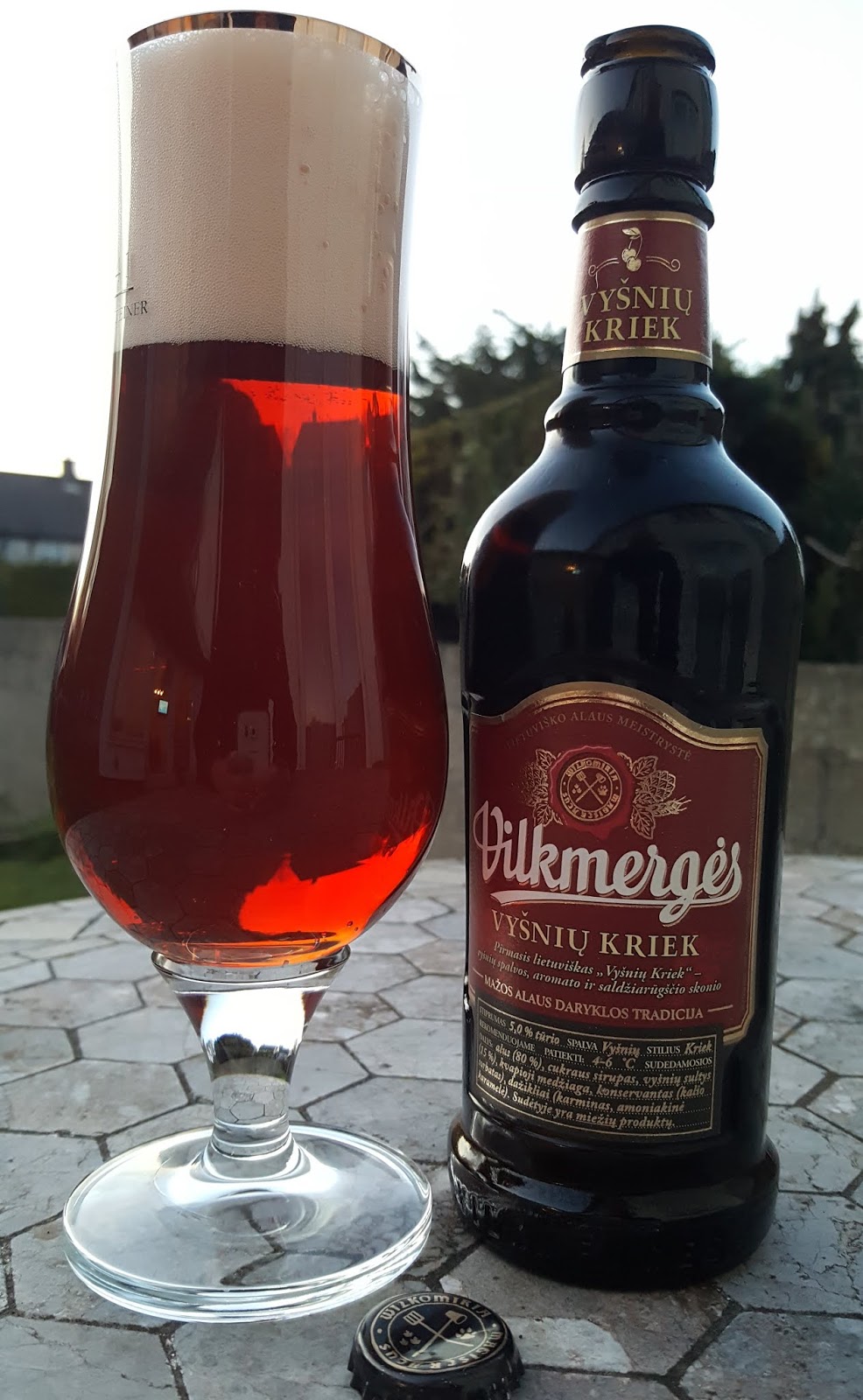
To follow that, Vyšnių Kriek, another style from another place. It was only when I took it out of the fridge that I noticed the fancy embossed bottle wasn't a legit half-litre. You have to really search the label to find where they've hidden "0,4L". They, incidentally, are Kalnapilio-Tauro Grupė, part of Danish giant Royal Unibroue, under the Vilkmergės brand.

It looks well: a deep mahogany red with a head of pink fluff, just like real Belgian kriek, of the sweetened variety. The aroma is pure cherry syrup and I love its frivolity. It's as sweet as might be expected but doesn't taste artificially cherry-like. Instead there's a real sensation of biting into a maraschino. The texture is suitably smooth, full-bodied from 5% ABV, and yet the finish is clean with no cloying sugar left behind. This is very silly but delightful. And yes I'm aware that's likely a minority opinion.

There's a companion stout as well: Juodųjų Serbentų Stout. A pinkish colour with a peachy tint to the head foam had me reaching for the translator, where I discovered "juodųjų serbentų" are blackcurrants in Lithuanian. I could have just sniffed it, of course, because it smells powerfully of hot Ribena. The flavour too is all clangy sweet syrup to the same degree as the kriek. I don't like blackcurrant as much as cherry, and I was looking forward to a proper stout, so I was not as enchanted by this. As well as a complete lack of stout character it's annoyingly thin too. That prevents it being sticky but I would like more substance at 5.5% ABV. Unless you're more into blackcurrants than beer, give this one a miss.

And I couldn't let April 20th go by without something herbal. Aukštaitijos Bravorai has produced the medium-dark hemp lager called, starkly, Cannabis, with a picture of the plant in case you're too stoned to read. It's 5% ABV and the amber colour of Czech polotmavý beer, which is the broad genre I'd place it in. Chocolate malt is listed on the ingredients, but not much, I guessed from the colour. Yet the aroma is very chocolatey, like cake mix. The same goes for the flavour: cheap and dusty ersatz milk chocolate and sweet soft caramel. I'm very glad it's a lager so there's some modicum of cleanness and no long cloying aftertaste, but it's still a bit of an assault. You can pretty much forget about hemp flavour: that was unlikely to survive in this. Maybe there's a little peppery bite at the back of the throat, but that's the full extent of it. A very poor show this, and not at all the beer I was hoping for. Even as an amber lager with no gimmicks it's shonky as hell.

Kriek for the win, then.

17 April 2020

Saisons and seasons

Marks & Spencer offers a significant range of beer styles under its own brand. OK, it's not exactly cutting edge -- no brut IPA or mixed fermentation ales -- but if you want to learn what, let's say, "saison" means, M&S is a safe space where you can explore that in a controlled environment. But how good a steer will this high-end grocer give you? I thought I'd find out.

I'm starting straight with M&S Cornish Saison, brewed by St Austell and I don't know if this is a twist on one of the brewery's own beers, as M&S editions often are. It's 5.9% ABV and perfectly clear, a bright gold colour: there's the first point of differentiation with most saisons. The flavour is properly saisonish, though, delivering a mix of herbal bath salts, crisp grain husk, honey and popcorn. It is all a bit muted, which I guess is to be expected from a supermarket take on the style. You do get an honest impression, however, so I consider this a success.

Moving on to advanced level, there's the Clementine Saison from another West Country operation, Arbor Brewery. This is roughly the same colour as the previous one with just a little more haze to it. And the flavour profile is broadly similar, in that it has the crisp dryness and a touch of spice as well. The farmhouse complexity is buried under a thick fruit syrup sweetness which I'm guessing is the clementine element. If the first one taught you what saison is, this one shows you what happens if you flavour it with clementines. Fair enough, and job done. It's not a great beer, though.

Are the above pair a fair supermarket representation of saison as a concept? Yes, I think so, in a broad supermarket way. You get a sense of the basics and can move on from there to more advanced saison, if you wish.

M&S operates a 3-for-€7 deal which is decent value, and I filled this one out with the latest in the seasonal hacks of Camden Hells. I didn't particularly like the autumn one but let's see what winter brings brought us, in the form of Camden Hells In Hibernation Lager. The strength remains constant at 4.6% ABV. It's the pale and hazy yellow of weak lemon drink, the head fading quickly to nothing. There's a pleasant citrus spritz in the aroma but the flavour concentrates that into a heavy syrupy, perfumey thing. The classic lager vibe which is the Hells signature move is buried under the hop concentrate here, unbalancing the whole thing. I don't know who needs to hear this but Camden Hells is fine as it is and doesn't need dicked around with. Yes I'll keep buying these so yes I'm part of the problem. Save me from myself, Camden Town.

Deep breath. So that's what I got when I went to Marks & Spencer.