Showing posts with label bigfoot. Show all posts

24 September 2025

Complexity through strength

I like a bit of cedar spice in a beer when I can get it, so was attracted on sight to this cedar-aged American-style barley wine from Czech brewer Sibeeria. I don't know why they decided to call it Nostalgie 70s but that's what we're stuck with. It's 10.7% ABV.

In the glass it looks appropriately rich: a luxurious dark amber colour, just very slightly hazed. There's no sign of the cedar in the aroma but I'll grant that it does smell like an American barley wine: sweetly unctuous with a layer of zesty hard candy added to some of the sugar. It's as thick as it smells, and surprisingly not hot for all of the strength and density. I'm guessing it's done with wood chips rather than barrel ageing as there's no spirit aspect either.

The flavour is fairly straightforward, with lots of floral honey, lemon bon bons, and toffee pudding. This is very much a dessert of a beer, making serious use of its caramelised malts. The American hops are present but not much more than an afterthought: if you came to it seeking classic Bigfoot, you'll be disappointed. The cedar takes a moment or two to emerge, but it's there in the finish, adding a seasoned sprinkling of peppery spice. I don't know that the beer needed it, but it's welcome, and helps offset the otherwise intense sweetness.

This is a very fine beer, and it's a shame there aren't more like it. The American barley wine combination of big malt and big hops is an old-school winning formula but unfortunately rather out of fashion these days. I didn't think that need would be answered from Prague, but that's just a lucky break for me.

18 August 2025

Wiccan mix

Hagstravaganza 11, the seventh of its name, took place at The White Hag brewery recently. As usual, a team of guest brewers from Ireland, the UK and Europe brought a wide selection of beers for us to work through, 200ml at a time.

I was looking for a lager to start me off but they were in somewhat short supply, so went for a sour IPA instead, for that post-travel refreshment factor. This was Sour Drop by Lambrate, seemingly a very typical example, being 4.5% ABV and a pale hazy yellow. The aroma is fairly standard too, showing the yoghurt-like tang of a kettle-soured beer. On tasting, however, its all about the hops, making excellent use of the plain base to showcase a firework display of zingy, zesty citrus flavour, with a punchy and invigorating bitterness. The finish is quick, but that only serves to help its thirst-quenching powers. I've been a fan of sour IPAs since my first encounter (hello Eight Degrees!), and while they're not always brilliant, this example was a reminder of why they're worthwhile, especially outdoors on a sunny afternoon.

The drops continued next, with Pressure Drop. Their Pale Fire pale ale is one of those modern British classics, but also a beer I had never tried myself, a bit like Elusive's Oregon Trail, reviewed last week. And a bit like that one, I wasn't a fan. It actually has the same savoury sesame or caraway kick which is one of the peculiarities of my palate when it comes to particular hops, although to a lesser extent here, thanks, I guess, to the beer being only 4.4% ABV. At first I found it dry and a little rough-tasting, followed by a growing pithy bitterness which I felt was a bit overdone in a session-strength ale. I don't doubt its boldness, or that it's exactly what the brewery and its customers want it to be. Too much of it was not to my taste, however. Could it be that the age of soft and fluffy pale ales has ruined my palate for big-boy bitterness?

The following beer proved immediately that this is not the case. Drink While Laughing (great name!) is from White Hag itself, in collaboration with regular festival participant Green Cheek of California. It's another pale ale, and still modestly strong at 5.5% ABV. They say "West Coast" in the description and they really mean it. For one thing, it's a gorgeous clear gold colour, and attention has been paid to the malt side of the recipe, with a lovely big and chewy golden-syrup base. Not that it's sweet; the malt provides a platform for some wonderfully complex yet accessible hop character, starting on the classic grapefruit bite which, instead of building, gives way to a subsequent mandarin softness. This one-two citric hop effect continues all the way through, so while it's quite easy drinking, it still managed to hold my attention. Cans of this are currently in circulation, and I'm very much minded to become more familiar with it. I flag it thus for the attention of all the west-coast whiners out there.

That full-on hop experience necessitated something clean and fizzy to follow. Brewfist -- a blast from my beer-drinking past -- had a lager from their pilot scheme on the board: Italian Pilsner 03. Now, maybe it's not my place to tell a seasoned Italian brewer what an "Italian pilsner" should be like, but this wasn't the beer I expected. Full marks for the visuals: a flawless golden body topped with a perfect fine shaving-foam mousse. The aroma is also that of a top-notch Mitteleuropa pilsner, a pristine grassy note which, if it isn't from Saaz hops, is doing a convincing impression of them. And so it goes with the flavour: spinach and celery on a clean base, perhaps suggesting more German-style than Czech to me, and absolutely delicious, but shouldn't the Italian style have something a bit extra going on with the hops? And shouldn't pilot releases be rather more experimental? I'm probably overthinking it. This is a pilsner from Italy, and an utterly superb one. Version 04 could up the hop quotient a little, but I wouldn't change the fundamentals.

I came back to Brewfist a little later on, when I noticed the strong beers were running out and I didn't want to miss theirs. That was Vecchia Lodi, a 12% ABV barley wine. Style fidelity was in evidence here again, although it's not one of the hopped-up barley wines typified by Sierra Nevada's Bigfoot. Instead, it's sweet all the way through, from a syrupy treacle aroma to a cereal and cake flavour. A tang of grape and cork brings in the "wine" part of the spec, and is perhaps a result of this being a six-year-old vintage. While by no means spectacular, nor showing signs of much development after the extended ageing, it was simple and enjoyable fare; smooth and lacking any overweening alcohol heat or sharp hop edges.

A palate scrub was required again, so I followed this with New Moon, a gose by Manchester's Balance. The brewery specialises in the wild and funky end of things, so it shouldn't be surprising that their gose is a straight-up one, lacking any novelty add-ons. It's 4% ABV, a mostly clear gold colour, and presents flavours of zest and brine, the sour culture doing the work that hops might normally perform, giving the beer acidity and bite. Classic gose is made with coriander as well, and if that's included here, it didn't really make itself known. Still, I had little to complain about as the sticky barley wine residue was washed from my gob.

I stuck with Balance for the next one, a dry-hopped saison called Long Shadows. There was more than a hint of geuze about the aroma of this: an enticing spicy sharpness. The flavour was less impressive, but still good, with a lot more sourness than hops in evidence. The gunpowder spice of the aroma is reduced to a more saison-like white pepper, and there's a residual kick of vinegar, verging on the too-sour. I still enjoyed it, sourness and absent hops notwithstanding. There wasn't a lot of this kind of beer at the gig, so Balance's presence was very welcome. I should have tried their third one too.

At the opposite end of the sour spectrum, there's French brewery Nautile and their "lemon and almond pastry sour", called Sneffels. I'm rarely without apprehension on approach to things like these, but I'd had strong recommendations during the day, and they proved accurate. Although this is 6% ABV and presumably brewed with lactose, it's no sticky mess, and isn't horribly sweet. It's not sour either, but does let the lemon do most of the talking, with a zesty aroma and a lemonade flavour, including a sprig of rosemary for a bonus oily herbal effect. I did not expect clean and refreshing from something of this description, but I welcome it.

Nautile also had a Flanders red on offer, a big one at 9% ABV, called Katsberg. That heft didn't suit some of the drinkers who expressed a preference, but I thought it worked, and covered the style's requirements well. Yes, it's a bigger beer all round, with a denser body and more of a cherry and strawberry sweet side. The sharp and fizzy brisk sourness is not a feature, but I think the heftier spec works almost as well. There was certainly no shortage of complexity in the flavour, with lots of balsamic vinegar and dark chocolate in evidence. Flanders red, especially when produced by a brewery that doesn't specialise in it, can sometimes go too far with the acidity, and you get an unpleasant raw vinegar tang on the end. There's no danger of that in this big sour softie, however. It's unorthodox, but it's made me less of a purist about this style.

And we were spoiled for choice, since White Hag were launching a Flanders red of their own. The name, Oud Foudre No. 1, implies that this isn't the last one of these they'll do. It's another fairly big one, at 6.6% ABV, and picks a different direction from the previous beer, and the style generally. Instead of going all-in for tartness, this is all about the funk, smelling almost like a ripe blue cheese. Not a beer for beginners, then. There's a sweet side represented by exotic dark fruit flavours -- tamarind and date -- plus a peppery spice, giving it a not unwelcome vibe of HP Sauce. It's still plenty sour too, which makes it a little curdling, but it's far too interesting for me to complain about such details. I could have spent the whole evening exploring its strange yet pleasant sensory features. Here's hoping this wasn't beginners' luck.

After all that microbial pyrotechnics, it was something of a comedown to drink a simpler fruited sour ale. Cloudwater's Cherry Gentle Breeze is a mere 4.5% ABV and pink coloured. Although two types of cherry are used, it tasted more like raspberry or redcurrant to me, with that level of tartness, plus a sweeter ripe plum side. That problem tells us that the cherries were added as real fruit, rather than a substance designed to make beers taste like cherries. I approve. This is a simple and well-made affair: smooth and very sinkable, and streets ahead of all the garish syruped-up fruit beers pumped out by lesser breweries. I'm no Cloudwater fanboy, but this was excellent work.

That brings us to end-of-the-festival silliness territory. Before hitting the rails, I took Dave from Wide Street's recommendation of their own Cuvée Spontanée, a geuze clone that was promising on its début in Mullingar last April but has now matured into Boon-like perfection. There was a snifter of barrel-aged Black Boar for the train, but my final tick was Band of Brothers, a triple IPA by Dutch brewer Folkingbrew.

As per, this is custard-yellow and completely opaque, the ABV a full-throated 10%. There's an odd aroma of vanilla mixed with gunpowder, and the spice carries through to the flavour. There, the soft New England vanilla takes precedence, balanced by a slightly harsh and dreggy hop-leaf bitterness, and seasoned by a kind of garlic salt and chilli pepper spice. That doesn't sound especially pleasant, but it all hangs together harmoniously, without any disturbing alcohol heat. I never would have guessed the strength, and it didn't take me long to finish.

But finish I did. It was good to be back in Ballymote after missing last year, though I was reminded, as I always am at Hagstravaganza, that I've never been drinking in nearby Sligo town. That will be changing soon.

19 April 2023

Two big lads from Galway

This pair of whoppers from Galway Bay Brewery arrived simultaneously in late March. When I noticed they were on draught side-by-side in Against the Grain, I went in to try them out.

The lighter of the two is Richer Sounds, a double IPA of 9.5% ABV. To my palate, this has a lot in common with the brewery's flagship DIPA, Of Foam & Fury, though I can't be more specific on which version of that recipe. I mean it as a compliment, however. It's very much classically constructed in a 2013 sort of way, starting on a heavy yet clean malt base, one which leaves a lovely warming glow in its wake. Onto this is piled heaps of citrus bitterness, and I picked out sharp lime in particular. There's nothing else fancy that this does, and certainly no flaws or off-flavours. It's simple but very impressive. If it's a retro powerhouse you're after, here's the beer.

Stronger still is Resin & Rye at 10.7% ABV. They've called it a barley wine rather than a rye wine, so there must have been enough rye to make the name but not change the style. In the glass it's a clear copper colour. The foretaste is pleasingly fruity, offering dry cherry skin and raisin to begin. The malt comes next, toasted and biscuit-like, and then a huge rasp of bitter metal and resin, scraping across the tongue. The brewery had this badged as "American barleywine" so I was fully expecting Bigfoot-like grapefruit notes, but it doesn't have that. It's rounder, mellower and more mature-tasting, suggesting an influence that's English rather than American, to my mind. Regardless, it works, and the result is a very satisfying night-finisher.

In a beer world of relentless hazy IPA, pastry stout and soured fruit beer, Galway Bay has once again shown that the old ways (2013) are the best. I really hope there's a market for products like this because the quality and enjoyment levels are unimpeachable.

17 March 2023

The single Irish

Poking around in the back of the fridge for something suitable to post about on St Patrick's Day, I noticed a few long-term residents in there, standalone beers from Irish breweries that I hadn't managed to fit into a post yet. I thought it might be appropriate to bring them together for the national festivity. Of interest (possibly to nobody else but me) is that they're all on the dark and malty end of the spectrum. It sometimes seems like new Irish beer these days is an endless parade of IPAs, but these aren't.

The nearest to an IPA, in fact, is Full Power from Lough Gill, an "extra special bitter" at 5% ABV, making it the third Irish ESB in a row to do the electrical pun thing. I initially suspected some relabelling shenanigans here because the brewery released a beer in the same style, at the same strength, as an Aldi exclusive last year, called Watt. Have they simply taken it in house? Watt's signature feature was a hard bitter astringency, and I'm not getting that here. It's a soft beer, from the cask-like gentle sparkle to the biscuit malt sweetness. The tannins and English bittering hops wait their turn and appear only in the finish. Before that it's chewy and sweet, subtly blending caramel, chocolate and berries into a highly drinkable combination. Proper bitter, then. I like. If it was a deliberate attempt to improve on Watt then it worked.

The punning continues with the next one from Wicklow Wolf, though you'll need your cúpla focal to get it. Another Nut is a pastry stout, channelling the world's favourite chocolate and hazelnut spread. It's fully black though relatively light at only 5.5% ABV. The aroma really brings the nuts: not hazelnut specifically, but also overtones of peanut and coconut, oily and both savoury and sweet. I've never known a nut-flavoured beer to smell so absolutely nutty. That's present in the flavour too, though here it's joined by the chocolate, and I think of Bounty and Snickers bars ahead of spread. It's not full pastry either, delivering a more serious hop bite at the end. They've brewed this to be fun, and it absolutely is, though there's a well-crafted balance in it as well, keeping the sweetness in check in a way pastry stout brewers rarely do. Like the above there's a lot of understated excellence on display here.

The alcohol level steps up a gear with Kinnegar's Brewers At Play 28: Barleywine. They've set this at 9.5% ABV and it's the requisite deep ochre colour. Indeed, it's requisite all the way down. I sometimes worry that "At Play" can mean doing silly things with recipes in the hope of no consequences, but this is absolutely to-style for an Americanesque barley wine and bloody lovely as a result. There's the dense cakey pudding thing, sharply bittersweet red liquorice ropes and a mix of tangy herb topnotes. The body is as viscous as this requires but all the flavours are clean and distinct; the after-effect warming, not hot. It isn't quite the hop bomb that, say, Bigfoot is, but there's plenty to keep you entertained as you sip.

Last in is Valhalla, described by Wide Street as a dark sour ale. It's certainly dark: a deep black/brown shade, and strong too at 9.7% ABV. I can't think of anything from the mainstream or larger breweries designed to be like this. The aroma isn't far from Flanders red: sour with hints of cherry and raspberry. There's a bit more of a stout character on tasting -- it's still sour but there's some chocolate as well. It has a bright and brisk sparkle, so isn't one of those dense and boozy strong sour beers, and hides the alcohol extremely well. It's a subtle and easy-going affair, well balanced and classy, going to no extremes, other than the hefty €8.50 price tag. The oak ageing does its job, though I would be interested to find out how that develops after another couple of years. We'll get some interesting things when Wide Street has a cellar full of foeders.

That's all for now. Enjoy your St Patrick's Day, and any Irish beers it sends your way.

17 December 2021

Play to winter

Kinnegar's Brewers at Play series reaching 20 coincided with the brewery's tenth anniversary so they celebrated by splitting it into two different lagers.

Brewers at Play 20÷2: Anniversary Pilsner
 was first out. It's 5% ABV and a bang-on medium clear gold. The bang-on-ness continues in the aroma and flavour. The former is mild and unobtrusive, with just a faint dry hay quality suggesting that noble hops are on their way. Said hops get properly delivered in the flavour: grass, spinach, celery, finishing dry and almost shading towards the unpleasant burnt-plastic effect I sometimes get from traditional German hops, but not here. The taste is buoyed up on a thickly textured weighty malt base which sacrifices the beer's crispness a little but does make it a more complex experience: no simple quaffing lager this. I enjoyed how it treads that line between easy lager and multifaceted sipping beer -- something the best German brewers do effortlessly but is unusual for Ireland. Mission accomplished, I guess.

Pilsner is easy but rauchbier is hard. I was intrigued and a little apprehensive about how they would fare with Brewers at Play 20÷2: Anniversary Rauchbier. It took me a while to find out because it's very foamy and I only have a wee Kinnegar glass. That did give me time to appreciate its deep chestnut colouring. The aroma suggests they've nailed it, all warm soft ham and bacon, with no harsh kippers. On tasting it has a lot of the signature Schlenkerla flavour, and the fact that I find myself trying to find points of difference is a testament to its quality. The smooth richness isn't quite there: it's a little sharp and thin, the carbonation interfering with the taste somewhat. And there's a very slightly harsh edge to the foretaste meaning it takes a moment for the smoke's more genteel side to kick in. But these are inconsequential details; they really have managed to recreate the classic Bamberg rauchbier experience in a very impressive way.

Life can't be all play, however. It looks like number 15 in the series has graduated to being a normal part of the range. Winterland is a new milk stout with vanilla, slightly beefed up from BaP 15, the ABV rising to 5.3% from 4.8%. Although it's sweet and creamy, it goes for coffee roast in a big way so ends up tasting like an Italian coffee-infused dessert: tiramisu or affogato, with a crisp wafer biscuit on the side. The gravity boost hasn't given it the full-on creaminess that I wanted from the previous iteration, but it's definitely an improvement. I particularly liked how the dessertish qualities are balanced by quite an intense roasted bitterness. With this one, they're definitely not playing any more.

Play resumed shortly afterwards with Brewers At Play 21: Barleywine. Just barleywine (or "barley wine" if the creeping Americanisation of European beer styles bothers you): no kooky ingredients or post-fermentation treatments, simply a hefty and warming 10% ABV. In the glass it looks comforting and thick, chocolate-brown, turning garnet when held to the light. It smells sweetly of fruitcake and cola, and the mouthfeel isn't as heavy as I had been expecting; though it's far from thin, there's a lightness of touch which really aids the drinkability. With an American name and an American at the helm, I thought we were in for some big Bigfootesque hopping, but that's kept on the downlow to allow the malt take centre stage. It's glacé cherries and strawberry jam in the middle, with a harder metallic bitterness in the finish. Its olde-worlde stylings might miff a few punters more used to the brasher barley wines, but I liked the understated quality here -- perfect calm winter sipping fare.

Keep 'em coming, Kinnegar! The games are only just beginning.

23 December 2019

The Twelve Brewers of Christmas 11: YellowBelly

There was a palpable change of gear for YellowBelly during 2019, with the pace of new releases slowing right down. It didn't stop, though, so I still have a handful of new ones to cover off.

They produced something called a "micro sour" which I found at the Rascals taproom: 1.5% ABV and called Han So Low. It's a hazy orange colour and even smells watery. There's a vague tartness, some grain husk, and a sweet mix of orange cordial and vanilla. It doesn't really work as a beer beer, but as a non-alcoholic substitute it's great.

I was suspicious of the next draught special I found: Elysium. This claims to be a weissbier but is only 3.5% ABV. A leichte weisse, then. Nevertheless it's convincing for the strength, with a proper weight and rich fruitiness. It's very fizzy, which adds a pleasingly champagne-like crispness, and an edge of toasty pale malt goes with that. The surprise finish is a generous slathering of strawberry jam which makes it almost too sweet to be easily drinkable. It works, though. Another passable low-alcohol number, this one sufficiently beery.

More recently, and based on a semi-original idea by Ben Clifford, Sky Tigers is an amber ale. As one would expect for the style it shows a rich and warming toffee base overlaid with fruity and floral hop notes. I get strawberry, predominantly, but also red cherries, roses and apricots. Maybe it could do with a heavier hand on the hops, introducing more of a citrus tone, but as a red ale it does the job well. At 5.5% ABV it's on the right side of sessionable, and winter is the ideal season for its gentle malt warmth.

For Beer Club members, the next release was a fruited ale called Memberberries: a simple recipe to which blackcurrants, blackberries and raspberries have been added. It's an easy-going 4.2% ABV, pouring a hazy orange-pink with a tight head on top. The aroma was a little off-putting, being dry and grainy, like rye bread or cream crackers. However, that simply serves to magnify the rush of berry juice which floods out from the first sip. I'd probably have guessed there was cherry in this: it's richer than what you usually get from raspberries. Mixing raspberry and blackberry also gives an effect like loganberry, which shouldn't be surprising. While it's certainly sweet, there's enough fizz to cleanse the palate afterwards, leaving behind the fruit flavour without the attendant sugariness. This is extremely quaffable and I'm glad I got six of them because a second needs to follow quickly after the first.

The final chapter of Beer Club 2019 (and possibly Beer Club Ever as they don't seem to be running it again) is called The Last Stand. The stress of getting these releases out on time is perhaps apparent in the lack of a proper label. It's 8.2% ABV, a dun brown colour and hopped with Columbus, Citra and Cascade. I was expecting Bigfoot. It's quite a bit different, however, and a lot sweeter. There's an oily orange rind taste up front, and some rosewater high notes, all backed by lots of caramel. The bitterness arrives in the end, tasting quite old-world (I guess that's the Cascade): grass and boiled veg. This is filling, warming and nicely balanced between hop and malt flavours. Just what you want from a barley wine, and a fitting end to the two-year series.

And so: it's almost Christmas Eve and I have just one more of these posts to do. Who will it be?

08 January 2018

Express delivery

The Sierra Nevada Fresh Hop 12-pack was boxed up on 31st October 2017, around the end of the hop harvesting season, I guess. It arrived in Ireland five weeks later and I was lucky to get to try a few when brewery co-founder Steve Grossman was over visiting.

The trilogy begins with Sierra Nevada Fresh Hop Session IPA, with thanks to the UnderDog crew for sharing from their stash. It's pale gold with a powerful weedpatch nose, all nettles and rocket. The flavour brings an intense acidity, much too harsh for my liking. A growing oat-cookie grain taste emerges as it warms, but does nothing for balance or drinkability. Balancing the hops is always the major challenge of session IPA, and this should have had plenty of scope at 4.8% ABV. Sadly, it doesn't manage it. Moving on...
Sierra Nevada Fresh Hop IPA is a surprisingly murky beast: the company is renowned for the way it keeps yeast stuck to the bottom of the container but this one had skeins of grit floating through it. Thankfully that doesn't get in the way of the hops, which start their day's work with a brightly bitter aroma, all eye-watering citrus spritz. The flavour is an entirely predictable mix of grapefruit and jaffa, sharp and hard, though softened by a big malt base (it's 6.4% ABV) that provides texture without adding unwanted sweetness. This is an absolute classic of US flavours, with all the pith and pine we've grown to love, in a balanced and approachable package. No gimmickry or trend-chasing from Sierra Nevada here.

I was surprised by the brownness of Sierra Nevada Fresh Hop Double IPA, though it settled in the glass a clear and handsome amber colour. Hey, SN: fresh means it's supposed to be murky! What are you playing at? An aroma of hazelnuts and coffee does not say double IPA to me, fresh hop or otherwise. The flavour is bitter, almost to the point of being acrid. The roasted note I got in the aroma turns ashen on the tongue and the whole tastes the very opposite of "fresh". At least it's not boozy: the texture is surprisingly light for 8% ABV. This is a dramatic turn away from the previous two beers, and one I don't care for. At least you don't have to worry about freshness with this one: I doubt it has anything to lose as it gets older.

All three of these, and the Fresh Hop Celebration which completes the set, are available at 25% off in the Stephen Street News January sale which runs until 10pm this evening. Worth a detour if you're in the area.

There were a few other specials on rotation during Mr Grossman's visit to UnderDog. The highlight was the first opened: Cocoa Coconut Narwhal, from the brewery's "Trip in the Woods" barrel-aged series. The base imperial stout is 10.2% ABV and that has been boosted to 11.9% here, turning even more unctuous and gloopy. There's a huge dollop of coconut in the foretaste, then a long a smooth rich fudge middle, before an invigorating spirituous finish. All is classically elegant and balanced, with just the merest hint of oak. My only niggle is that the stout itself is a little lost in all the fripperies: I recall Narwhal being properly bitter, and that seems to have been ushered away without ceremony. The texture is still that of a big imperial stout, though, and maybe that's enough. At least it isn't pretending to be a cake.

That set the standard for the other Trip in the Woods beer, Ginger Bigfoot, which unfortunately couldn't match it. It's another bruiser, at 11.4% ABV, though I think the added ginger contributes more than the whisky barrel. The aroma is like freshly baked ginger biscuits, warming and spicy, while the flavour put me immediately in mind of Canada Dry ginger ale. The texture is sticky which adds a medicinal tone to the whole thing, and more than a hint of herbal mouthwash. The barley wine is buried far too deep in the woods to be tasted any more, only the sickly sweetness remains. This is very much a gimmick beer and by no means an improvement on the original. A small sample was loads.

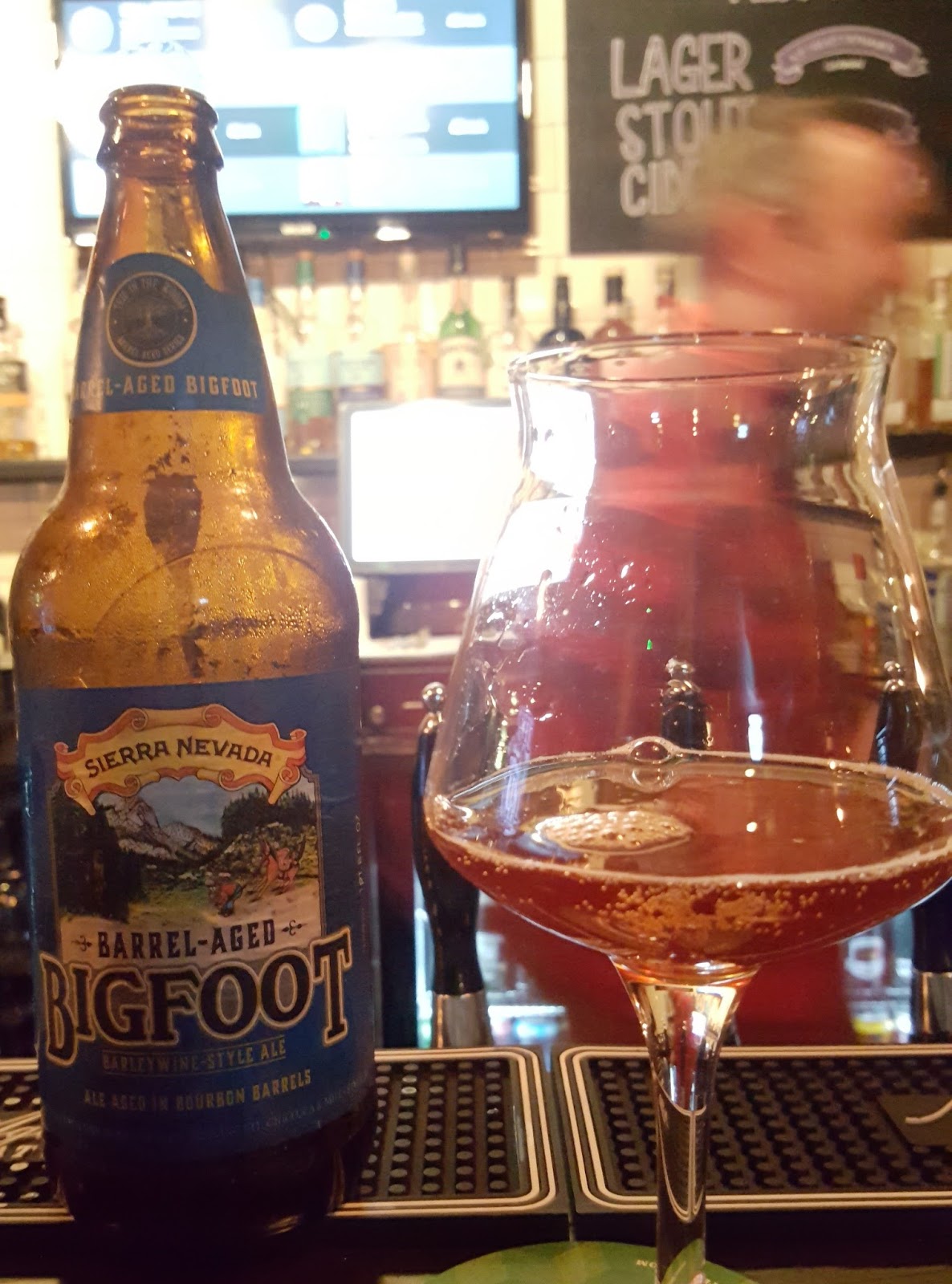
A different Bigfoot variant pre-dates the Trip in the Woods series, going by the simple name of Barrel-Aged Bigfoot. Once again, however, it succeeds in simply dirtying-up a perfectly good clean and hoppy barley wine. The aroma here is immediately off-putting, all hot and sticky. A foretaste heavy with sappy oak segues into syrupy toffee before finishing acridly bitter. There are no smooth edges or added subtle complexities, which should be the point of barrel-ageing. You get all of the downsides and none of the bonuses. Bigfoot ages much better when left to its own devices.

Finally, a beer that isn't a version of something else, just a plain old Cherry Chocolate Stout. This seems modest by comparison, at just 8.5% ABV, and the flavour is similarly reticent. There's not much by way of chocolate, beyond what you might reasonably expect in a stout of this calibre; and almost no fruit: a wisp of pink cherry creeps in at the very finish. What that leaves in the middle is a perfectly decent, simple, strong stout: cleanly dry and with an assertive hop bitterness. I like how, despite the showy label, the novelty features haven't been allowed to spoil it, even if they're all but redundant.

It's great that an establishment player like Sierra Nevada is still bringing us new things, instead of resting on one or two iconic beers. Steve certainly had that air of restless energy about him which is always good to see in a brewer; even more so in an owner. A big thanks to the folks at Grand Cru Beers for introducing him, and the beers, on the night. Now go out and grab all of that Fresh Hop IPA wherever you see it: it's not getting any fresher.

18 September 2017

Getting Lough'd

I had somewhat lost track of Lough Gill Brewery since the beginning of the year, having last tried a new beer from them just before the Alltech festival in February. So when I made enquiries in DrinkStore I ended up coming away with three cans from the Sligo brewery I'd never tasted before.

First to get opened was the Sour Wheat Ale. I was hoping for something light and refreshing, but the 5.7% ABV suggested otherwise, as did the dark and murky appearance. I had plenty of time to contemplate that as I waited for the foam to subside sufficiently to allow me a sip. It's as heavy as I expected, with a slick and briney salinity. There's a touch of lemon behind this which, combined with a grainy crunch, calls witbier to mind. Overall I'm not keen on it. The sourness is too strongly lactic, more like something gone off than deliberately inoculated, and the grain tastes stale and husky, possibly as a result. It's doesn't compare well with the cleaner and lighter Irish sour beers out there.

Time for a complete contrast: 'Round the Clock is a coffee and oatmeal stout, a path that has been trod by many breweries previously. It's 5.2% ABV and a rich chocolate brown colour. They've gone all-out for the coffee here, and there's a lot of dark roasted, even gritty, espresso in the flavour and aroma. The harsh bitterness isn't helped by the thin texture and if that's all there was I'd be giving it up as a bad job. But! This beer does have a redeeming feature in a floral complexity that runs backwards and forwards through it. It's a meadowy sweetness that doesn't quite take the edge off the sharp roast but does manage to distract my attention from its worst excesses. It's still some fairly tough drinking, lacking smoothness. You'd really want to be into your coffee, or at least your beer that tastes of coffee, to enjoy it fully.

Finally for now, Lough Gill's Irish Sloe Barley Wine, the first in a series of strong beers, and at 9.5% ABV it definitely qualifies. I was struck by the colour of this: after two cans of murk it's a gorgeous crystalline garnet. On sticking the nose in I'm met with typical barley wine characteristics: heavy slabs of alcoholic toffee, but there's a cheeky sour twang suggesting the sloes are mixing right in the middle. And so it proves on tasting: there's a chocolatey syrupy sweet thickness that would be cloying if left to its own devices, and where a classic US barley wine (hi Bigfoot!) would lash in a load of big citric hops, this utilises the fruit to give it a tangy edge that cleans up the malty excesses and renders it drinkable, while also giving it a uniquely complex flavour. It's almost plummy, like you might find in a Belgian dubbel, but lighter, spritzier, and altogether cleaner -- think cranberries. For a high-gravity palate-thumper this has been carefully and subtly put together. It's not often you encounter an Irish beer that isn't just slavish copying the way they do things abroad but this expresses a terroir all its own.

So, one super-impressive beer out of three. Not bad. There'll be more from Lough Gill in my round-up of the Irish Craft Beer Festival in a few weeks.

21 November 2016

Trans-Shannon exports

On the daytrip to Galway back in July I managed to sneak a look-in at the Fine Wines off licence just down the street from The Salt House. In there I grabbed a handful of local beers I hadn't seen around Dublin to take home with me.

First up is the charmingly named Bogman from Spiddal River Brewery. "Spiddal River Brewery is based in Spiddal, Co. Galway" says the label, and also that the beer is "Designed in Galway... product of Ireland", indicating that Spiddal River isn't a brewery at all. As far as I know the beer comes from Trouble Brewing, closer to home in Kildare. It's 4.9% ABV and an unattractive murky orange-amber colour, putting me immediately in mind of those rough-and-ready brewpub beers you get in central and eastern Europe.

 A slightly short fill on the bottle left it low in carbonation, and pleasantly so, with a nice cask texture. Though self-described as a "US pale ale" it is extremely sweet, showing a big malty Ovaltine flavour at the front and even a kick of milk chocolate. The hop flavours are almost non-existent, so as a pale ale it's nearly a total failure. The label also describes it as "earthy" and although the suspended yeast doesn't really get in the way, I could just about see how you would describe it as earthy. "Rustic" is the word I'd use. It's not a beer designed to impress the cosmopolitan beer enthusiast, that's for sure, but I guess the name makes that clear from the outset.

I follow it with Limerick Lady Irish Pale Ale from Limerick City Brewery, which doesn't exist either. The brewery pictures they've posted online look like the old Brú brewhouse so I'd take a punt on it being produced there, which would make it another Leinster beer in disguise. It's a similar unpleasant murky brown colour though a tiny bit stronger than the last one at 5% ABV and, oh, is that hops I smell? There's quite an English hop aroma -- slightly metallic -- though also a worrying marker-pen note.

It's all bait-and-switch because neither of these elements show up in the flavour. That has a floral sweetness, a savoury yeast bite, and a harsh melted plastic off-flavour. Not a winning combination. This tastes cheaply put-together and rushed out of the brewery: especially strange for a company that's presumably trying to build a reputation for itself as it gets going. At the same time, however, a cursory glance at Untappd yields not a single negative review, proving my theory that it's impossible to go out of business as an Irish brewer by making substandard beer. There's always a market for your product, regardless of how shoddy it is. Which is depressing, but moving on...

Finally a beer whose provenance is in no doubt. Galway Hooker Double IPA was definitely brewed in Galway and commemorates the tenth anniversary of the brewery opening for business. In Roscommon. Er. It's a downright handsome clear dark amber colour with a heavy aroma of big boozy malt pierced through by citric hops. The first sip brings... density. It's a trifling 8.6% ABV but feels a point or two above that. Bigfoot territory. Chewy malt is the main feature, then a supporting cast of harsh metallic bitterness, biting grapefruit acidity and a greener spinach and cabbage vibe. It doesn't sound very new-world at all, but there's a lightness of touch about it, a smoothness and a quickness in the finish that keeps it nicely drinkable while also being an unmistakable high-alcohol powerhouse.

This is, perhaps unsurprisingly, a beer for special occasions. Something to be taken out and shared, or reverentially sipped. All of its different flavour elements come through clear and clean, despite the big boozy blanket on top of them. Both of the other beers have a lot to learn from the way Hooker turns out its product.

20 December 2012

By the numbers

I didn't realise I'd bought an antique. But it turned out that the XVII barley wine from Utah's Uinta brewery which I acquired at The House of Trembling Madness in York during the summer has a bottling date of 23 November 2010: so over two years in the bottle by the time I opened it. Would this be a good thing or a bad thing?

At 10.4% ABV it's certainly a robust beer, pouring thickly into the glass and presenting a murky mahogany body under a thick old-ivory foam. There's that very American aroma of bags of crystal malt laced with bags of C-hops: a messy collision between the toffee lorry and the grapefruit train. The hop aromas are muted, though, and the sweetness almost shades towards syrup notes, indicating immediately that this is perhaps not the hop powerhouse it once was. It tastes beautifully warming and there's definitely still a sherbety freshness to the hops here, with hardly any trace of bitter harshness. The thick, linctus-like texture spreads across the palate and slips silkily down the throat, spreading smooth caramel and naughty liqueur chocolates as it goes. Only a slight twang of stale cardboard arrives at the end to indicate that everything is not as it once was.

I'm reminded in particular of Sierra Nevada's Bigfoot in its more mature form, so perhaps this one too is a beer that needs a year or two to calm down. A superb sipper, it's really hard to know if freshness would be much of an improvement.

20 February 2012

Start spreading the brews

A couple of weeks ago my friend, The Dubliner's beer columnist and native New Yorker Richard Lubell called over bearing some interesting finds from a recent trip home to the Empire State. Would I help him drink them? Well, let me just check the diary...

Southern Tier's Un*Earthly is an IPA I enjoyed immensely a few years back. Richard brought the oak-aged edition over and I was hoping for a repeat, or improvement, on my recent fun times with Great Divide's Rumble oaked IPA. Unfortunately, balance does not appear to be in the Southern Tier vocabulary. The beautiful fresh hops are simply buried deep beneath layers of cloying loud and sappy oak. There's a small trace of fruit and spice: a bit of sandalwood and a dash of mandarins, but nowhere near enough big IPA character to justify the whopping 9.9% ABV investment in alcohol. It's the hops I feel sorry for. They deserved better.

The other bottle was something of a mystery. Port Jeff is a small brewpub on the north coast of Long Island. They have seven regular beers, but Cold North Wind barley wine isn't one of them. Richard didn't know if the bottle he got was new, aged or what: just that the proprietor was keen for him to have it.

It's 8.7% ABV and poured gloopily to a bright garnet colour. Peaches in the aroma and a beautiful mouth-watering juicy mandarin and jaffa foretaste. The bitterness kicks in after but it plays things smooth avoiding all the pitfalls of big hop barley wines: there's no harshness, no boozy heat and no cloying syrupyness either. They could certainly offer the folks at Southern Tier a few pointers on balance.

We followed it with some 2011 Sierra Nevada Bigfoot barley wine, another beer that seemed hot and harsh in comparison. This one's a victory for the little guys.

Thanks for sharing, Richard.

05 November 2010

Wheat beat manifesto

Session logoIt's wheat beers on The Session this month, a genre I find it hard to get excited about. Sure, I like the odd Schneider-Weisse or Aventinus, and I'm perfectly content holding a Hoegaarden, but generally speaking I don't go out of my way for wheat beer. It's more of a fallback thing.

In an effort to rekindle my interest, I decided to open something a bit special for this post: Hvedegoop, the "wheat wine" brewed as a collaboration between Three Floyds and Mikkeller. Something about the -goop suffix had me expecting dark beer, maybe along the lines of Haandbryggeriet's Dark Force wheat stout. Instead it's quite a pale cherrywood colour, with a short-lived skim of ivory foam on the surface.

The brewers' renowned love of C-hops is immediately apparent from the aroma on pouring: sticky nectarine fruitiness made extra potent by sweet caramel-candy notes from the malt backbone. That this is a strong sipper (10.4% ABV) is never in doubt.

One expects a certain soft mouthfeel from wheat beers but there's none of that here. Instead the gentle fizz and powerful-yet-subtle booze heat gives it a definite wine vibe, much more like an American barley wine. And that continues into the taste: big big hops, but balanced by lots of sticky malt -- I really can't find anything to indicate we're dealing with wheat malt here rather than plain old barley, and I doubt that any of the yeast strains most commonly used for wheat beers have been employed.

More than anything, it reminds me a lot of Sierra Nevada Bigfoot, which brings me on to Mrs Beer Nut's observation. She liked it a lot, but reckons it needs another year or two of maturation to mellow and soften, just like Bigfoot does. Me, I liked the in-your-face double IPA kick and didn't find it remotely harsh or difficult, however I can't help but agree it would be really interesting to find out what happens to it after a couple of years.

As a strong-and-hoppy late-night sipper-to-share I rate Hvedegoop very highly. Whether there was any point in making it with wheat rather than all barley, however, I really couldn't say. But if anyone's using this Session to argue that wheat beers are intrinsically dull or samey, here's the killer argument against.

26 November 2009

The old boys

Back here I mentioned that I'd set aside a box of beers for a year or so, just to see what happened to them with a bit of aging. In fact, the box has spent two years in my oubliette, though hasn't survived completely intact. The strong Belgian ale that Barry and Kieron brewed didn't survive last winter (and was delicious); likewise the 2007 Sierra Nevada Bigfoot, so I've started that process again by cellaring the 2008 and 2009 editions.

But the Old Engine Oil which prompted the experiment remains, and last week I nipped in to DrinkStore to grab a fresh bottle for comparison. The young one had the same rather subtle dark fruit flavours as I recall from two years ago: quality drinking, but with nothing really jumping out of it. And the older one was along very similar lines, but there was a noticeable difference. The fruity sourness had rounded out and become somewhat more pungent -- reminiscent of that almost solvent-like flavour you get with super-strength barrel-aged imperial strength stouts, only with half the impact and allowing all the gentle chocolate and coffee shine through as well. This extra complexity means that aging is definitely the way to treat this beer. It won't turn into the world's greatest strong dark ale, but it definitely adds to the enjoyment.

The last Rip Van Winklebrouw is a Thomas Hardy's Ale, purchased from Redmond's in 2007, though dating from the 2003 vintage. The nip bottle does its best to justify a €5 price tag with a unique number, gold foil and some neck bling. It'll have to do better than that, I thought, taking the cap off. The aroma asserted itself immediately -- that rich sweet pudding scent which I got from the fabulous Samuel Adams Triple Bock. With a slightly murky dark ruby colour, the texture is thick and heavy, but there's definitely a light sparkle there, and no syrup or unpleasant stickiness. The flavour has the sweet, yet bitter, yet dry character of crumbly high-cocoa dark chocolate. It's also nicely spirituous, which all adds up to a wonderful cherry liqueur chocolate effect. End-to-end quality and not a single bum note anywhere.

Apart from the question I ask all beers -- "I wonder what that stuff's like" -- the only other question I had for Thomas Hardy's was "Should I buy some more?", especially now that O'Hanlon's have stopped brewing it so there's only a limited supply floating about in Dublin. That'll be a yes.

19 February 2009

Division of labour

The six-pack I bought at the Big Mikkeller Launch back in September has been sitting quietly in my attic ever since. Most of the bottles could do with a bit more ageing, I reckon, but a couple had dates recommending drinking by next autumn, so I figured they were ripe enough already.

At first glance it's hard to tell what separates silver-labelled Kølle from bronze-labelled TræKølle: both barley wines are the same strength, same bitterness level and from the same company (Amager, in association with Mikkeller, with co-operation from retailers Ølbutikken and ØlKonsortiet). Rather than try to pick a drinking order, Mrs Beer Nut and I decided to open them both at the same time and take it from there.

Kølle has that typical heady, alcoholic barley wine aroma: sweet yet hoppy. It follows this with a massive super-concentrated grapefruit hit, then comes a big metallic, galvanic tang -- nasty, like licking a pencil sharpener -- and then a long slow burn of citric hoppiness. It reminds me a lot of the insanely unbalanced Mikkeller Simcoe IPA being served at the European Beer Festival. A glance at the label suggests that Simcoe is indeed the single hop employed here. A bit more ageing might have let it mellow, but I couldn't be sure that something as good as, say, Bigfoot, would be likely to come out the other end. It's an awful lot thinner, for a start, making it hard to believe the strength is a stonking 10.5% ABV.

TræKølle, it seems, is the same beer matured on bourbon barrels. It's a little darker and strikingly lacks that fresh citric hops aroma -- all taken by those greedy angels, I guess. Unsurprisingly, the flavour is dominated by vanilla oak notes, the bourbon history being more than suggested. I'm inclined to say that the hop character is low, but that could be just by comparison with the other Simcoe bomb. It is bitter, however -- both beers claim 90 IBUs -- though here it's more of an acidic character against Kølle's sharp fruitiness. TræKølle is a mellower, calmer, sipping sort of barley wine, even though it does share the skinny body of its wilder sibling. We both preferred this version.

So there we have an object lesson on the effect of bourbon barrel ageing on outrageously hoppy beers. I reckon we can expect more of this kind of thing as 2009 progresses. Barrels are in.