Showing posts with label of foam and fury. Show all posts

01 December 2025

Veering west

Time for another round-up of Irish hoppy beers. I'm not keeping count, but the west coast seems to be on the rise at the moment, whether that's a blip, a renormalisation, or the beginning of the end of haze's autocratic rule of terror. I know which one I'm hoping for.

First up it's The White Hag and the second in their Experimental Brew Series ("XBS V2", for all the tech bros out there): Grapefruit NEIPA. Wow! What will the boffins of Ballymote think up next? It's 4% ABV and very pale yellow with full-on haze, as one would expect. The grapefruit is not hop grapefruit, it's very real and bursting out of the aroma like a jet of juice to the eyeball. From that, I expected big grapefruit in the flavour, but the gravity lets it down. The first mouthful is watery and hollow, in a way that's totally unacceptable for an IPA invoking New England. The first flavour to arrive is dry and gritty dregs, then a little vanilla sweetness followed quickly by an unsubtle hop-leaf bitterness. The grapefruit is last in the queue, and while it's as fresh and authentic as the aroma, it lacks impact, so we're back to fizzy water in the finish. If the purpose of the experiment was to determine whether they should make more beers like this, my answer is please no.

A rare new canned beer from Trouble Brewing, Wouldn't It Be Nice, is a pale ale with New Zealand hops Nelson Sauvin and Wai-iti. It's a bright rose-gold colour and 5.4% ABV. A funky aroma of fermented grass starts things off, while tasting reveals quite a dry base, with more than a little tannin. The hops take a twin-track approach, with juicy tropical fruit in one stream, and then a bitterer vegetal side, all grass and spinach. I don't think it's as simple as one hop doing one thing and the other another, but the end result is nicely balanced regardless. There's a floral perfume finish for some added complexity. The dry side of it makes for excellent thirst quenching, and the invigorating bitterness helps too. This is classically constructed in the old-school fashion, and well suited to by-the-pint drinking. Though nothing fancy, it's quality all the way through.

Next it's Bullhouse in collaboration with Galway Bay, and the beautifully clear golden Old Crows. The ABV gets a boost to 5.8%, though that's probably not strong enough to class it as an IPA by American standards, which they have. The aroma is dry and spicy, like an onion bhaji, with a touch of kerosene. Heady. Crispness is promised on the can and it's as clean and crisp as it looks -- almost lager-like in its angular precision. They don't tell us what the hop combination is, which is a shame, because it's an odd effect. We're promised pine but it's a highly concentrated version of that, intensely bitter to the point of turning harsh and plasticky. I'm sure they meant it to be rock-n-roll extreme but to this old crow it just tasted unpleasant. I always preferred the west coast IPAs with a bit of a blush to their malt; by going fully pale here they have unbalanced the profile and it makes for tough drinking as a result. I'm reminded of the sort of tongue-burners produced by the IBU race of the 2000s. Try this if you have fonder memories of those than I do.

At the same strength is Third Barrel's Dead As Disco, also badged as a west coast IPA. I see maybe a bit too much haze for that to be strictly accurate, but it's an attractive sunset gold colour regardless. A resinous spice dominates the aroma, plus a sideline of tropical fruit which I wasn't expecting but is rather enjoyable. That spice leads in the flavour, a foretaste of peppercorns and capgun smoke. The fruity side of the hops arrives later and is only slightly citric, with a considerable tropical element. So with your lime and grapefruit, there's a bonus topping of pineapple and passionfruit. I'm not going to ding it for that: the effect may be an east-coast thing but it adds a very welcome complexity, and makes it a better beer than if it were just acid all the way through. The finish is clean, with just a hint of crystal malt caramel to round things out. This is pretty good. Though it doesn't show the precise bitterness of, say, Sierra Nevada Pale Ale, it goes its own way, which is validly west coast but with an extra element of enjoyment too.

I'm taking a bit of a punt on the next one, as it's not specifically marked as "west coast" by the brewery, just "American pale ale", so I'm guessing west coast again. This is Renegade, created by Hope to mark the arrival of the NFL to Dublin, and siding with the "home" team for September's game, the Pittsburgh Steelers. Pennsylvania brewery Tortured Souls has been drafted in as collaborator, and the hops are an all-German mix of Hallertau Blanc and Solero. For all that, and 6% ABV, it's not an especially characterful beer. There's little aroma, while the flavour lacks the melon fruit I would have expected of H. Blanc and instead goes for quite harsh and green vegetal notes, cabbage leaf and kale, with a wisp of lemon zest on the finish. This may not have the full-on citrus and pine of the west coast, but it definitely has the punchy and uncompromising bitterness. The malt side is very low key, evidenced by the pale colour (10 EBC, fact fans) and quite a thin texture. Rather like the Bullhouse beer, I found it hard to get along with, and struggled with the unbalanced bitterness. I do at least feel justified in identifying it as belonging to the west coast genre.

No coastal indication is given on the latest from Ballykilcavan. Clancy's Cans #16: Gate Crasher IPA simply says it's "juicy", so I still expected it to be cloudy, and it was. It's quite a deep orange colour, and fairly fizzy, though there's a substantial body, especially for a modest 5% ABV. Fresh hop character is indicated by the pieces of hop leaf I found floating on the head when the beer was poured. The bitterness leads, however: an orangey pithiness, set on an expansive malt base. After a moment, the two sides coalesce into a sweeter orangeade or marmalade effect. It doesn't have the tropicality of most well-made hazy IPAs, and I had hoped the inclusion of Mosaic as a hop would have brought this. They've paired it with Amarillo, and even that isn't one I associate with this level of bitterness. I don't think "juicy" is an accurate description: it's very citric, sure, but in a pith and zest way, not juice. Maybe this belongs with the west coast examples too. 

At The Porterhouse one afternoon in September, I found two new Dublin-brewed double IPAs which I was keen to try. I started with Voodoo Child by Rascals. This is a clear amber gold,  putting us squarely on the west coast, though its 7.7% ABV barely counts as double in that context. Classic Mosaic, Amarillo and Centennial do their job, bringing bags of piney resin and grapefruit spice, overlaid with juicier mango before it's back to the pine for the finish. There's a little caramel sweetness from the malt, but only enough to highlight the hops, rather than  fight with them. This is very nicely done, showing lots of classic American hop quality given a modern kick which is fun without disturbing the fundamentals. Core range material, I reckon.

Two taps over was Disco Devil, new from Lineman. The ABV goes up to 9% here: nearly at the threshold of triple IPA. The aroma is innocently pithy, like Club Orange, and there's a bit of that in the flavour, but... The alcohol is well hidden, I'll give it that, and it took several mouthfuls before I twigged I was drinking a properly strong beer. The main flavour is quite dry, with crisp and husky sesame seed and a peppercorn spice. That's kind of it, though. In the finish there's the clean spirit burn which I used to associate with triple IPA before they went hazy, but no more hop character. It's all a bit basic and unexciting, lacking richness and resins. While it is clean and without flaws, this isn't how I like my double IPAs. As a caneable 9%-er, though, it can't be beat.

There was a late opportunity for redemption with the most recent Lineman release, Punctuate, a straight-up hazy IPA of 5.6% ABV. It looks like orange squash in the glass, so is broadly to style, while the aroma centres on a spicy dankness, hinting at citrus behind. There's not much of a fluff to the texture; in fact it's quite crisp, in a west-coast way, and is the better for it. Similarly, while there's a sweet element in the flavour, it's a sharper orangeade effect, not vanilla cream and (thankfully!) no sesame. Mosaic and Krush in the hop charge should probably have made it more tropical-tasting than it is, but there's only a mild seam of mango and peach, before we're back to the zesty lemon and grapefruit. Despite not adhering strictly to any sub-category of IPA, it works very well, being brightly and cleanly flavoured, balancing exotic fruit flesh against bitter pith, showing the most fun aspects of both. There's a spice complexity too, and yet it's not overwrought or busy, making for some excellent refreshment. Perhaps it's better suited to the summer, but I found it to be a ray of sunshine on a chilly day. Redemption granted.

Finally, the 12th anniversary celebrations for Galway Bay's Of Foam and Fury double IPA continue, with a Hazy TDH edition, wording that would have left us scratching our heads back in 2013. I can't actually recall what the baseline OF&F is like these days, so I don't know how much of a variation this is from it, but it is hazy, and a very modern pale yellow with that. It smells gloriously dank, tropical and citric all at once, thanks to the Simcoe, Mosaic and Chinook hops. The first surprise was the thin body: this was always a beefy fellow, but it's a bit watery in this iteration, despite being 8.3% ABV. With that comes quite harsh and dreggy hop bitterness, all tongue-coating acid and resin, plus a leafy, vegetal unpleasantness. There's a more enjoyable zesty side to it as well, arriving late in the finish after the hop dregs have faded. That's not much consolation, however. A hazy double IPA needs more than just a cloudy appearance; there should be a soft texture and some juice or sweetness too. Yes, this beer is derived from a very old-fashioned double IPA recipe, and it wouldn't be Of Foam and Fury if it had been completely re-engineered from the ground up. As is, however, it's missing the malt warmth of the original recipe, and isn't harnessing the benefits of modernisation. In 2013 we joked about the ridiculousness of overly-bittered double IPAs, wondering who could possibly enjoy them. Those who did have a new one to try here.

It does look like the American-style pale ales and IPAs brewed in Ireland are recalibrating. There's a new hazy amber sort that might claim to be west-coast, or might not, but doesn't resemble the clear crystal malt jobs of twenty years ago. I welcome the diversity, and will end by noting that it's not the style specs that count, it's how well it's done. Hazy or bright, let those hops sing!

16 June 2025

Hoppy Monday

The advent of summer brought us a raft of new hop-forward beers from Irish brewers. Here are the ones that haven't made it into some other post.

The White Hag has embarked on an Experimental Brew Series -- everyone else is doing it, so why not? First out is XBS: Session NEIPA, a hazy IPA of just 4.5% ABV. It's not especially hazy, being pale orange and not quite opaque. The hops are the not-very-experimental Amarillo, Citra and Motueka and not much else is out of the ordinary about it. Which isn't to say it's a bad beer. There's a very pleasant light tropical fruit quality: mango and passionfruit, joined by juicy peach and soft lychee. The Citra adds a seasoning of zesty bitterness. Even for the modest strength, it's light-bodied and verges on thin, but I think that's all part of the design. You get a lovely sessionable beer, brimming with fresh and juicy hop character. It's the sort of thing White Hag frequently excels at so I really don't know where the experimentation lies, but I probably shouldn't worry about that.

I complained previously that the hazy IPA imperative had infected wild beer specialists Wide Street, and now I see that the AI-slop label disease has too, with another smeary nighttime cityscape, devoid of humanity or artistry, adorning the label of City Lights, their new session IPA. It's as yellow and murky as you like (or not) and smells of the de rigueur mix of vanilla and citrus juice: not unpleasant, but by golly I've smelled it before. I've become somewhat fascinated by how the haze squad do texture at sessionable strengths, and this conducts itself expertly. Though only 4.6% ABV, it's full and fluffy, but there's an initial waxy twang in the foretaste that concerned me at the outset. It softens a little to coconut but never quite gets rid of the plastic note. Any fruit side is seriously low-balled, maybe a little pithy orange but -- and I searched -- nothing else to report. It's not unpleasant, and crucially it's not thin and harsh, but the flavour doesn't deliver anything worthwhile. I can't imagine a session on it.

I'm somewhat surprised that Brú Brewery still exists, never mind that it's had a rebrand and released a new beer, but here we are. "Brú has seen a few changes over the years" says the can, winning the award for understatement from anyone keeping track of Ireland's independent brewing scene over the last decade and a bit. I had been previously informed that Brú beer was produced on contract at Dundalk Bay, but this says it came from its parent's actual production facility, Galway Bay in Oranmore. I'm sure they wouldn't lie. Brú Hazy IPA is barely hazy: a sort of lemonade cloudiness, pouring thinly and crackling fizzily. No pillows here. The aroma is grainy and crisp, more like a lager than any kind of IPA, and with nothing hop-related to say. There's a certain substance to the taste, not feeling as thin as it looked and sounded, but there is nothing by way of fresh hop character, which is a grave error for anything calling itself an IPA in this day and age. Cereal, cordial, fizz and talc are the sum of its parts. It's hard to believe that anyone employed to brew a hazy IPA in 2025 has never actually drank one before, but that's the only explanation. It's not a bad beer; it's not infected or flawed, but it barely passes muster as a sort of stickier witbier, and definitely not as an IPA. Take a look at what you're doing, Brú. The corner cutting won't save your company.

Rascals is next, collaborating with English brewer Rivington, on Crack On, a 5% ABV hazy pale pale. This one is properly murked, though still pale orange rather than the trendier beaten-egg yellow. "Bold haze" and "juicy vibes" are promised on the label. I found it quite restrained, however. A barely-there aroma shows nothing more exciting than orange squash, while the flavour has a lacing of savoury raw onion around the edges and a big fat nothing in the middle. The body is decently full, and it would be a great platform for some exciting hop action, but it's just not there. The label does say it's "smashable" and it is indeed very easy drinking, but in quite a plain and unexciting way. Both of these brewers know their way around the haze genre, so all I can think is that something went wrong here. There aren't any technical flaws, nor any off-flavours. It's the lack of on-flavours that troubles me. This is a beer which is sorely wanting in whirlpool and fermentation tank hops.

From Hope, a 5.5% ABV Summer 2025 New England IPA, this being the third year in a row they've done this, and this time round the usual hops of Idaho 7, Azacca and Mosaic are joined by experimental variety HBC 1019. Juice features prominently in the aroma: it has lots of zesty orangeade and cordial sweetness. The flavour swings that way too, tasting like the fun first punch through the skin of a Capri-Sun: very sweet, very spritzy and very thirst-quenching. They say it's made for outdoor drinking and it absolutely is: piling in bright and fresh New-World hop qualities, set on a light body, and keeping clean throughout. It looks like Hope has largely ceased developing this recipe: neither this year's nor last year's cans carried the year on them. Should they choose to settle on this as every year's summer recipe then I fully support it. We don't have a perennial summer beer in this country, but if we did, I would quite like it to taste like this.

Just because it's hazy doesn't mean it's juicy, and Two Yards has given us a reminder of that with Shiny Hoppy People, the second of its name. Although it looks all bright and sweet, and does have a beautiful soft texture, it is seriously dank and resinous; much more bitter than New England-style IPA tends to be, and gloriously, unapologetically so. A burst of pithy citrus towards the finish is as fruitsome as it gets, and the 5.8% ABV is well concealed. As usual with Third Barrel's Two Sides offerings, this is a high-quality pinter, right in the sweet spot between quaffable and interesting. 

Lineman has extended the Electric Avenue IPA series to number 7, trying a combination of Centennial, Krush and BRU-1 hops. On paper that sounds like it would offer just the sort of lightly citric and softly tropical combination that previous versions have excelled at. A blast of mango and apricot up the nostrils indicates that I might be correct. The flavour is pure summer, centred on sweet and bright passionfruit that I would swear was purée-derived if I didn't know better (correct me if I'm wrong there, Linemen), right up to the slightly sticky texture. There isn't room for a whole lot of complexity beyond this, but I must give credit for a balancing resinous bitterness, a mild grassy spice, and the juicy red-apple finish. At 6% ABV and full-bodied, it's not ideal for the daytime summer session, unless you're really in a mood for celebration. It's well worth including in any sequence of beer consumption this season, when available, however. I'm no brewer, but would be very interested in finding out what happens if you put these hops in a lighter pale ale. For the sesh, like.

Next, here's Lough Gill, and surf's up, with Ocean Swell. The shade of amber is spot on, though the murk is very much un-retro and not welcome. It adds a layer of dirt to the otherwise clean and English-smelling marmalade aroma, and also to the flavour, which is broadly citric, but lacks any edge. It tastes like it should be clean, sharp and invigorating, and I'm fine without the oily richness that the better West Coast IPAs show. But there's no zing here; it's quite savoury by contrast, with notes of onion and peppercorn. This isn't unpleasant, and does impart a somewhat fun retro vibe, but from a time when breweries didn't have excellent quality control. There's an unfortunate wonky-homebrew vibe to it, whereas proper West Coast IPA ought to be very clean and very precise. Whatever reason they've chosen not to give this a proper clean before packing wasn't worth it, in my opinion.

Marking twelve years since they created Ireland's first double IPA, Galway Bay has released a revised version of Of Foam & Fury, incorporating Riwaka hops. It's not the most dramatic or celebratory variety, but let's see what they've done with them. The aroma is intense, and slightly shocking at first, suggesting hot rubber and burnt hair, but mellowing after a moment to grass and pepper with a dusting of gunpowder. That's quite different to classic OF&F, but the first sip reveals both a familiar heaviness and the dry, clean body that have been the beer's hallmarks despite its previous changes over the years. It's 8.3% ABV and has never been shy about letting you know that. The spicy vegetal note continues in the flavour, so the Riwaka wasn't a minor tweak but the beer's whole deal. It dovetails nicely with the almost syrup-like malt base, making something serious, savoury and chewy; a sipper, but not hot or difficult drinking. Above all, it's retro: a reminder of a time when double IPAs were see-through and you could taste their malt. I haven't drank the original in several years, and this made me feel a little guilty about avoiding it. Anyway, if you like your nostalgia with an up-to-date twist, this fellow delivers. For a reliable second opinion, Kill gives it the once-over here.

If nothing else, I think the above shows that there's quite a variation in the quality of Irish-brewed pale ales, even when we're largely past the point of commercial breweries making amateur mistakes. Some brewers seem more interested than others in showing us a hoppy good time.

19 April 2023

Two big lads from Galway

This pair of whoppers from Galway Bay Brewery arrived simultaneously in late March. When I noticed they were on draught side-by-side in Against the Grain, I went in to try them out.

The lighter of the two is Richer Sounds, a double IPA of 9.5% ABV. To my palate, this has a lot in common with the brewery's flagship DIPA, Of Foam & Fury, though I can't be more specific on which version of that recipe. I mean it as a compliment, however. It's very much classically constructed in a 2013 sort of way, starting on a heavy yet clean malt base, one which leaves a lovely warming glow in its wake. Onto this is piled heaps of citrus bitterness, and I picked out sharp lime in particular. There's nothing else fancy that this does, and certainly no flaws or off-flavours. It's simple but very impressive. If it's a retro powerhouse you're after, here's the beer.

Stronger still is Resin & Rye at 10.7% ABV. They've called it a barley wine rather than a rye wine, so there must have been enough rye to make the name but not change the style. In the glass it's a clear copper colour. The foretaste is pleasingly fruity, offering dry cherry skin and raisin to begin. The malt comes next, toasted and biscuit-like, and then a huge rasp of bitter metal and resin, scraping across the tongue. The brewery had this badged as "American barleywine" so I was fully expecting Bigfoot-like grapefruit notes, but it doesn't have that. It's rounder, mellower and more mature-tasting, suggesting an influence that's English rather than American, to my mind. Regardless, it works, and the result is a very satisfying night-finisher.

In a beer world of relentless hazy IPA, pastry stout and soured fruit beer, Galway Bay has once again shown that the old ways (2013) are the best. I really hope there's a market for products like this because the quality and enjoyment levels are unimpeachable.

04 July 2022

Hop whirl summer

It's pale ale round-up time again. Let's see what the nation's hop slingers and haze merchants had for us in the first half of Summer '22.

We'll begin at Third Barrel and an ickle 4%-er called, in responsible fashion, Day Drinkin. Simcoe is the hop and it's very much in tropical mode, starting with mango and pineapple in the aroma, turning a little bitterer and more resinous on tasting, but not by much. Although the texture is as light as one might expect, it's not watery, showing a soft fluffiness commensurate with its haze, and a pleasingly long pithy finish. As such, this is a real best-of-both-worlds job, bringing the full flavour you get from decent New England IPA while still being genuinely sessionable. I've no idea if they intend to keep this in the range but I think it could have a place there.

Kinnegar keeps the session going with another one at that strength: Brewers At Play 24: Summer Ale. There's a lighter touch on the murk here, though it's not completely clear. The aroma doesn't have much to say; a slightly savoury crispness, like bread crusts. The flavour is more interesting. Instead of piling in the hops like Third Barrel they've added citrus peel which gives it a real-tasting orangey zestiness. That's pretty much all it does, however. I reckon they're using its easy-going summer drinkability as a rationale for not making it very complex, however I think there's still room to pull interesting moves at this strength. Regardless, if simple unfussy refreshment is the goal, they have achieved it. Drink it cold, however: that underlying breadiness does the fruit no favours as it warms.

Meanwhile, Ireland's sunniest pale ale is back for another summer. Two Yards, collaboratively brewed at Third Barrel for 57 the Headline and Brickyard, looks like it's been given a recipe tweak, with Citra and Simcoe proclaimed on the can, though the hotside hopping is Strata and Centennial. Despite those dank and bitter aroma hops it still smells fabulously tropical. You get a little pinch of limey citrus on tasting but lots of juice too. The only spoiler is the dry and chalky murk grit which seems to be an unfortunate consequence of the soft New England texture. It's still pretty good though, and fully meets the remit of being an easy-drinking 4.3% ABV pale ale with bags of flavour.

The "session IPA" category gets stretched to its alcohol limit with the new one from Lough Gill. Hazy Seisiún is a sizeable 4.8% ABV, which might make for some very hazy sessions indeed. In the glass it's the pale yellow of lemon squash with a head that crackles away to nothing in seconds. Not great on the visuals, then. The aroma is brightly tropical, suggesting that Mosaic is the hop in charge, over also-ran Citra. The texture is sessionably light without seeming thin, with a cleansing fizz helping boost its thirst-quenching abilities. The flavour stays quite tropical, though with an extra lemon edge from the Citra, finishing with a slight pinch of resinous acidity. Despite the appearance it's very clean and shows off the hops well. It's uncomplicated, unfussy and extremely drinkable: the very picture of proper session IPA, excepting that ABV.

The milkshake IPA trend, in danger of seeming retro these days, is still in full swing at Rascals. Their latest is called Havana Ball, a collaboration with Nottingham's Neon Raptor and designed to resemble a piña colada. It certainly does in appearance: that somewhat bilious yellowy orange, with a faint combover of white bubbles. Coconut, pineapple, mango and vanilla feature in the ingredients and that's exactly what you get in the aroma, every bit as Hawaiian-shirted as the can design implies. A more serious bitterness opens the flavour but is quickly silenced by the cocktail side. It's sweet and creamy, the latter feature impressively created without the addition of lactose (me hole). The coconut is most prominent, making it taste a little like suncream, while the tropical fruit is present but doesn't overcome the bitterness, meaning it's not as sunny-tasting as I'd like. I think this one is for fans of milkshake IPA only. It's perfectly stylistically accurate -- you get what's promised -- but it won't convince anyone of the milkshake IPA's merits all by itself.

We have a new beer brand in Outer Place, based in Kildare but launching with an IPA brewed just across the Dublin border at Lineman: Intergalactic. Oddly, for a beer of this name, it doesn't use Galaxy hops, but Citra and Ekuanot instead. It looks quite like orange juice in the glass, and smells like it too: an enticing sweetness, promising refreshment despite the blousey 6.2% ABV. That strength is well demonstrated in the texture: there's a properly satisfying heft to it. The flavour is much less juicy, mixing tangy citrus, a harder wax bitterness and a savoury fried-onion note. While perfectly pleasant, it's rather more serious than the colourful can and colourful aroma led me to expect. Still, this is a rock-solid IPA; well designed and executed; hazy yet clean-tasting. A good start for any new brand. 

Wicklow Wolf has always been good for classically American takes on IPA, and I expected something along those lines from their latest west coast IPA, West Side Story. In the almost inescapable modern fashion it's quite hazy, a barely-translucent sunset yellow. The ABV is up at 6.6% which suits, as does the aroma, laden with lemon spritz and pine sap: no juice here. The centre of the flavour is citrus, and bergmot in particular, plus lime rind and more lemon zest. It's a sharp one, though softened a little by the fuzz, as well as some chewier dank resin. I was sceptical at first, but this is a proper west-coast-style IPA, despite appearances. The handful of drinkers who still think IPA should be bitter, step this way.

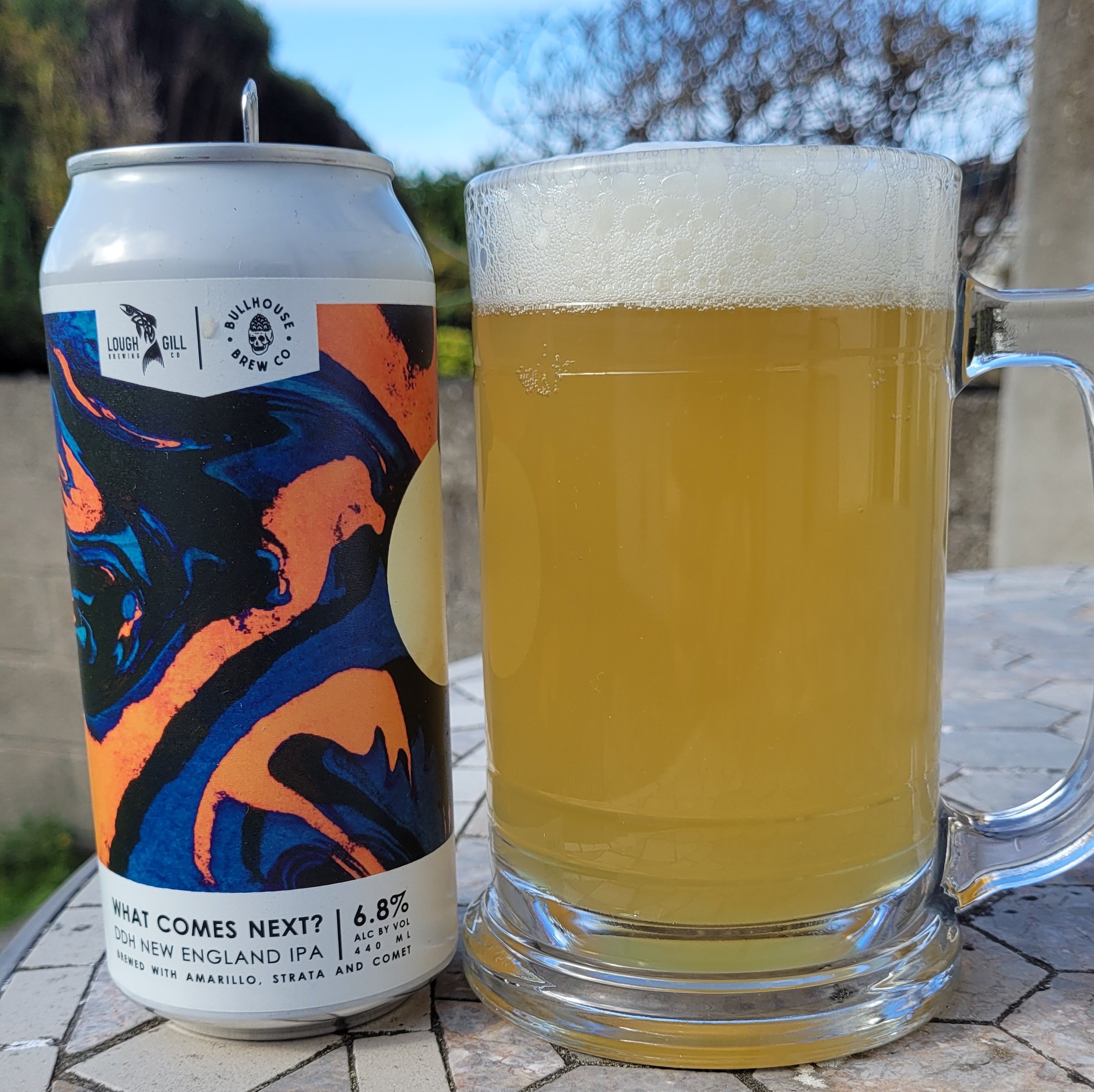
What Comes Next? asks Lough Gill and Bullhouse in chorus. They do so via the medium of a New England IPA hopped with Amarillo, Strata and Comet. Like their session IPA above, it's quite a sickly-looking number, with a greenish tint to the yellow, and appearing a bit watery, despite its 6.8% ABV. And while it's not, it's nowhere near as full bodied as one might expect for this sort of thing. The aroma is flamboyantly tropical, with a spritz of citrus too. It's odd, then, that that the flavour is quite savoury. I get green onion and caraway first, then a little lemon before it finishes on dry grit. I feel cheated out of the mango and pineapple I could smell. From a promising start, this becomes just another of those wonky hazy jobs. Oh well. What comes next?

Here's a surprise: Whiplash's new double IPA is clear! Then again, The First Rebirth is badged as "west coast" so I would be complaining again were it not. It's 8% and brewed with an old-school combination of Cascade, Chinook and Columbus. From that I expected a big whack of bitterness and a sizeable heat, but it's altogether softer. Yes, the big malt is there; no crystal but enough Golden Promise for it to be slightly unctuous. The foretaste is a kind of grapefruit and lemon candy: sweet on the outside, bitter in the middle. Unsubtle, but so was every American double IPA during the IBU wars. Complexity is hard come by here, but there's a little weedy dank, and a little pine. We're back on the lemon oils for the finish, however. This is a pretty good impression of the first wave of double IPAs. Irish drinkers who remember the arrival of Of Foam and Fury and Beoir#1 may get a bit of a Proustian rush.

Staying at 8% ABV, Post Card has its first double IPA out now: Pigeon House. They say it's New England style, but in the fashion of Irish breweries doing this five or six years ago, it's amber coloured and only barely hazed. Citra features on the hop bill and that gives it a lime bitterness in the foretaste. It's only when that settles to sweeter vanilla on a smooth body that we come within shouting distance of Vermont. The bitterness won't quit, however, and with each sip there's a new punch, getting harsher and more annoying as it goes. Then the alcohol burn kicks in and doesn't improve things any either. I tried hard to find an angle from which this works, but it's too sharp, too hot, cloyingly gummy and, oh, savoury as well. It's like they threw everything at double IPA and all of it stuck. I hope it finds an audience but it's not me.

Sticking an extra .1% on that, we have Many Coloured Days from O Brother. It's an opaque orange colour with an impressively long-lasting head for something of this nature. The alcohol gets busy right from the aroma, expressing as a heavy, funky, grassy silage effect. A thick and greasy texture goes along with that: this is a sipper, no alternative is on offer. Strata and Idaho 7 are the hops and they bring a flavour that's every bit as serious as the rest of this. Savoury resin with a brush of garlic is the first impression, with poppyseed and rye bread deeper in. A spark of pith is as fruity as it gets. This isn't how I like this sort of beer. It lacks fun, sunshine and accessibility. It seems rather grey and joyless, and is certainly quite hard work to drink. Not what I thought I would get, given the name.

It seems to me me that the best hopwork being done in these parts is at the low-strength level. Maybe that's a seasonal thing: when the temperature goes up, the session-strength beers press my refreshment buttons just right.

23 December 2016

Last dash

Time for my final round-up of miscellaneous Irish beer for 2016, all the stuff I found in the pubs and off licences of Dublin as the festive season started to bite.

Galway Bay had been especially busy, knocking out a couple of winter specials for starters. First to appear was Banished Sun, an 8% ABV "imperial porter". Yes I'm putting scare quotes on that. It's dark brown in colour and the main feature of the flavour is a flaky ashen dryness lightened only slightly by some warm-fermentation fruit esters. The alcohol is very apparent, making it taste hot, and there's a big bruising bitterness as well. Overall it's a mean and harsh drinking experience, one not to be entered into lightly. I'd guess that time will soften this beer a little but whether it's enough to make it enjoyable remains to be seen.

The companion piece is called Black Forest. Trouble Brewing denied us its cherry chocolate stout this year so I was pleased when Galway Bay decided to pick up the slack. The base beer here is another dry and bitter porter but this time there's a decent layer of smooth chocolate and then a very real-tasting dark cherry acidity. In combination, the base beer and flavourings create an effect like fruit jelly spread on well-done toast. I would definitely have preferred it to be sweeter and heavier -- it's all of 6.2% ABV, after all. The name implies cake and the taste doesn't quite deliver it.

Switching styles completely, Galway Bay's second double IPA since brewer Will took the reins is Hexed. A pale one, it matches Of Foam & Fury's ABV of 8.5% and opens with a stunning fresh mandarin aroma. This was the first part of the flavour I noticed, but behind the juice you'll also find some sweet onion and then a very slight yeasty fuzz which I think actually helps soften the beer. It needs softening because it's very thick and greasy, with an unctuous napalm heat. I didn't take long over it but I suspect that it's best consumed cold when the hop flavours are brightest. This is a real west-coast powerhouse, but a balanced one too.

For '80s kids everywhere, Eight Degrees presents Bandit, a smoked brown ale, which I found on the bar at Alfie Byrne's a few weeks ago. My half pint of this 6%-er looked a bit sad in the glass, arriving without a proper head on it. It's a clear dark red-brown colour with amber highlights around the edges. Despite the strength it's surprisingly thin of body. I expected that to change as it warmed but it didn't. The smoke is dominant, though not overdone, blending peaty phenols with a meaty smoked sausage flavour. It's fun at first but starts to get acrid a few mouthfuls in. What it's crying out for is more of a brown ale base, a bit of that caramel sweetness and definitely more substance to the texture. There's the makings of something very good here but I couldn't quite get into it as-is.

Leaving aside this year's winter trilogy which I'll get to in the new year when the third one is released, the next one from Eight Degrees was Wayfarer, badged as a "sour IPA" (more scarequotes) and a mere 4% ABV. I was looking for something sessionable at the Beoir Christmas party in The Beerhouse, and this fitted the bill perfectly. Pouring a weak-looking hazy yellow colour it's quite a straightforward beer. It's not especially sour, with a dry and chalky background to the tartness. The hops aren't exactly full-on either, giving it just a light and spritzy lemon bitterness. It's flavourful enough to be interesting but most importantly it's extremely drinkable and very refreshing. That they chose to release it in the middle of winter is perhaps the oddest thing as it would make an ideal summer beer, but you won't find me complaining.

The latest seasonal release from JW Sweetman coincided with the launch of a bit of a rebrand for the brewpub's wares. The beer is a Dunkelweisse, which I'll admit at the start is not a style which normally does much for me. This one's not bad at all, though. It's thickly textured and nicely smooth making it filling and warming, almost like a dark weizenbock. There's a light banana flavour keeping it in touch with its weissbier roots, and a mild smokiness. I detected a touch of sulphur as well, for a bit of bonus complexity. Overall a very decent effort at an unexciting style.

To 57 the Headline next, and a couple more dark and wintery beers. Le Rubis is the latest from Two Sides, once again utilising the facilities and expertise of the Five Lamps Brewery. There's a very strange mix of flavours in this and I don't think it quite works. The first thing I got was an enormous wave of dark malt elements: toffee and a rich cocoa sweetness. Hot on its heels there's an intense acidic bitterness which feels like it belongs in a different beer, one that's unwelcome in my glass. It ends up as a very busy effort that's simultaneously too sweet and too bitter.

Moving on to Trouble's remake of last year's red ale, Ripcord. Ripcord 2.0 drops the ABV a little, from 4.7% to 4.1. It's still dark red, though, and still not much more than a straight down-the-line Irish red ale. The texture is probably its best feature, lovely and round and filling, almost like it's nitrogenated. The muted flavours of red summer fruit come through clearly, free of yeasty interference I'm happy to say, but it's all very brief and there's nothing much else going on. As in the first version, the name suggests a level of excitement that's entirely inappropriate for the finished beer.

If it's excitement you want, Kelly's Mountain released a double IPA earlier in the year, though quite a light one at just 7% ABV. It's called Reality Bytes and is a pale shade of copper, smelling quite sweet, of marmalade shred and toffee. And while it is pretty thick, sticky almost, the hops balance it rather nicely. There's more of that bitter orangey tang and some harsher aspirin metallic notes but it's all good clean fun: the heat levels are low and the toffee malt, while present, isn't overdone. You wouldn't mistake it for a San Diego hop bomb (for one thing it doesn't taste of onions) but it's a jolly nice straightforward sort of IPA. I don't know if Kelly's Mountain intends to make it permanent but no harm if they do.

A new swathe of Whiplash beers began with True Love Waits, a pils. I was surprised to find it's quite dark in colour, the dull brownish colour of earwax. Lovely aroma, though: all light and peachy with added watermelon and white plum. The first flavour to emerge is a malt sweetness, an almost candyfloss effect, familiar from many German and Czech lagers. Behind this a sting of bitter noble hops and then the oily vapours of something American. A glance at the brewer's description tells me that the first bit was Hersbrucker and the latter Columbus. The malt and hop elements are nicely balanced. I do get a creeping pine toilet-cleaner note, but the clean finish prevents it from getting too prominent. My biggest criticism is that it's a touch watery: the sweet malt doesn't seem to add the sort of body you'd find in the central European equivalent, especially at all of 5% ABV. I'm not sure if the brewer intended this as one to smash back when thirsty, but I've a feeling that's how it will work best.

Also new from Mr Whiplash is a rebrew of 2013 Otterbank classic Farami coffee stout and a second double IPA, called Since I've Been Loving You. It also sees the operation moving out of its usual home at Rye River, with Farami brewed at Rising Sons and this one on the fancypants Kaspar Schulz kit at Boyne Brewhouse. It's 8.2% ABV and the pale amber colour of a lovely cup of tea. Expecting heat I was surprised to find the nose is subtly fruity with light grapefruit and tangerine. It's not madly hoppy to taste, nor hot and heavy. In fact, the tea analogy continues, with a pleasant tannic dryness being the main feature. The hops are mouthwateringly orangey while the soft malt base makes it taste like chewy orange flavoured candy. Despite over 100 IBUs of American hops this is gentle and balanced: in the Goldilocks zone of double IPAs of not too sweet, not too bitter and not too heavy. Those who prefer the more extreme sort of double IPA may be disappointed but I really enjoyed it.

Dessert is from Mescan, in the form of their Westport Kriek, which has been out a while but has hitherto escaped my notice. It looks the part all right, pouring pink but a beautifully rich maroon colour in the glass. The jammy aroma suggests that they've bypassed any souring part of the process. I was expecting it to taste horribly sweet but there is a sour tang there which I'm guessing is down to the cherry alone: it's a very real flavour, the sort of tartness you get when you bite into a ripe black cherry. There's a heavy and rustic wheat beer behind this, a husky cereal quality, but really the cherries are doing all the heavy lifting. What I miss is the high attenuation you get in Belgian lambic-based kriek: this, at 5.4% ABV, is heavy and chewy, which isn't ideal. It's a good use of cherries and really shows off their character well but I don't know that "kriek" is the best word for it.

And before we batten down the hatches and make final preparations for the big day, one last seasonal. Fairy Ale of New York is the second special commission that Rascals has made for the Molloy's off licence chain and is a hop-bursted IPA of 5% ABV. Dark gold in colour the aroma is surprisingly muted, giving off a lightly lemony buzz. The flavour is a little bit on the down-low as well, with a waxy sort of bitterness balanced by nicely toasty malt, but not much actual hop flavour. The best feature is the aftertaste, where the lemon element hangs around at the back of the palate for ages. It's not the most exciting of IPAs but perfectly serviceable, and at four cans for a tenner would do well as an accessible party beer.

I'll sign off here and wish you all a very happy Christmas. See you next week for Twixtmas ramblings and my 2016 Golden Pints awards.

All together now: It was Christmas Eve, babe, iiiin the drunk tank...

07 September 2016

Round Ireland with a thirst, part 3: Galway

Once a year, presumably for some dodgy tax write-off reasons or bizarre sexual kink, the Galway Bay Brewery fills a coach with its Dublin customers, drives them to Galway and, against all reason, brings them back again. I went in 2014, when the brewery was still out the back of The Oslo in Salthill, and signed up again this year to see how things had developed at the new site in Ballybrit.

Quite extensively, it turns out. A super-shiny new Italian-built brewhouse and tanks has just been commissioned and the aim is to turn out 12,000hL in 2016, bringing them into the big leagues of Irish microbrewing. It was easy to see how the rapid-fire one-offs from Galway Bay come in such quick succession.

New for the day was Goin' Out West, a double IPA by new head brewer Will Avery. It uses a super-simple (and sustainable) hop combination of Columbus and Chinook but makes very good use of them, giving lots of fresh mandarin: sweet candy in the middle and a more acidic tang on the end. It's quite dry but there's a definite warmth, fitting its 7.8% ABV. Best of all the bitterness is low allowing the hop fruit to come through -- exactly like its equally-clean stablemate Of Foam & Fury. It's always nice to meet a double IPA that isn't trying too hard to impress, but does anyway.

After considerable hospitality of the barbecued sort, and a sneaky taste of some new specials (thanks Tom!) we made for The Salt House and instantly destroyed the enjoyably quiet afternoon a handful of punters were having in there. For me it was a rare opportunity to grab something from Soulwater, who've been busy since I first met them in February. On cask there was Cosmic Cow, their milk stout, this version (allegedly) with extra almond. I can't say I found any almond flavour ('cos there wasn't any: see comment), nor much distinctive lactose for that matter. Instead it's a basic but decent cask stout, creamy and smooth, mostly quite sweet with just a very slight roasted edge on it. Easy drinking too, which is just as well as we were back on the bus in short order and off out to The Oslo.

The main draw here was the Micil poitín distillery which has been set up where the brewery used to be. Decent stuff, too: an all-malt wash, flavoured with bogbean. Cheers to Pádraic for showing us around. The final new beer of the day was Super Smash Bros, a Citra-hopped, 5.3% ABV IPA, brewed by one of The Oslo's staff on the Galway Bay pilot kit. It's pale yellow and unattractively murky but oooh that aroma, all pineapple flesh and mandarin pith. Janice, beside me, said it smelled of kiwi and insisted I write that down so here it is. The fresh fruit continues right into the flavour, intensifying as it goes, to become a heavy dankness by the end of the pint. And there's a touch of savoury yeast, but not nearly as much as the opaqueness might suggest. All-in-all surprisingly complex for a SMASH, and worth scaling up if there's enough Citra left.

After that it was just a question of loading up with bus beers and making for The Brew Dock and a late-night pint of Via Maris.

Cheers to Andy, Jenna and all at Galway Bay for the grand day out. There'll be more on here from this brewery soon, without doubt.


02 May 2016

Feel the Gs

We don't have celebrity brewers in Ireland, for very good reasons, but if we did, Alex Lawes would be a candidate. From award-winning homebrew before winning awards for homebrew was really a thing, a spell at James's Gate, to Rye River where his tenure as head brewer has seen some of the best hop-forward beers Irish brewing has produced arriving and making waves, both under the brewery's own McGargle's brand, and the two supermarket house labels it produces. So it's entirely unsurprising that there's been a buzz about the first beers under his own solo marque, Whiplash.

"Brewed under contract for Whiplash by Whiplash at Rye River Brewing" explains the copy on the label: the honesty of the text offers refreshment before I've even taken a mouthful. Scaldy Porter is the first one I opened, a 33cl bottle at 5.5% ABV. It's a thick beast, glugging slowly out of the bottle to become a dense black glassful topped by a dark tan head. Roast looms large in the aroma, and that dark -- almost burnt -- character is the centre of the flavour. Around it orbits an array of other tastes, nothing outré, but it's unusual to find so many in a single beer. You get strong espresso, a milky creaminess, bitter dark chocolate and some chewy butterscotch toffee. It's all rather serious and there's an acridity in the finish that doesn't exactly invite the next sip. The label describes it as a "robust" porter; I'd say downright surly. While definitely tasty and well-made, you do need to be in the mood to do battle with this one. Easy drinking it isn't.

A change of format for its fraternal twin: portentiously-titled Surrender to the Void double IPA comes in a shiny monochrome can styled like one of them high-art Danish contract brews. It's 8.5% ABV and beautifully clear, a pale orange-gold. From the get-go it's another complex one. Various hop elements vie for superiority in the aroma, loudest among them the juicy mandarin and viscous pine resin. There's nothing viscous in the texture however. Though the carbonation is low and strength high, it has a fantastic light touch, the warmth only really becoming apparent after a few swallows, and happening in the belly rather than the mouth. Assuming the best-before is a year from canning, mine had spent a mere week in the tin before I drank it, which goes some way to explaining just how banging the hop flavour was. Bitter pine is the first impression, but it steps off after only a second letting sweeter zesty orange oils come through, lightening further to tangerine and mango. This fades quickly leaving a sticky marijuana funk as the finish. The malt base is... there, somewhere, probably, but you don't really get to taste it: Surrender to the Void is a beer with a hop obsession and wants to share it with you, loudly and at length. Alex received big plaudits for McGargle's Francis' Big Bangin' IPA and I hope this one gets equal attention. It's a better beer, in my opinion, and I'm not the sort of beer geek who thinks that you just need to up the ABV and add more hops to achieve that. There's a roundness and a nuance to Surrender that's rare in strong and hoppy Irish beer but which this pulls off neatly. If anyone fancies putting it in a blind taste against Galway Bay's Of Foam & Fury I'd be interested to see the result: I think the contention would be very close.

Alex very kindly gifted me a couple of cans of his third beer, released the week before last. Rollover is a session IPA of just 3.8% ABV. It's a murky little chap, pouring a cloudy pale orange and looking more like a witbier in the glass than anything else. A clever bit of sleight of hand sees the addition of oats to the grist, presumably to help boost the body of what might otherwise have turned out a little thin, and it works too: the texture is convincingly weighty, providing a perfect platform for the hops, though it's rather flatter than I expected. Sweet satsumas are the aroma, laced with some sharper pine, and the flavour performs a similar double act. First it's juicy orange sherbet but that's quickly upstaged by bitingly acidic resins. The pineyness grows as you go along and does bring the cumulative effect a little too close to floor cleaner for comfort -- I think I'd like a touch more fruit softness than this offers. Those after a bitter bang for their buck will definitely get a kick out of it, and there's no question about the freshness, though its sessionability will depend on your tolerance level for explosively flavourful new world hops.

So that's Whiplash: another front on which Irish beer is rendering imports increasingly unnecessary.