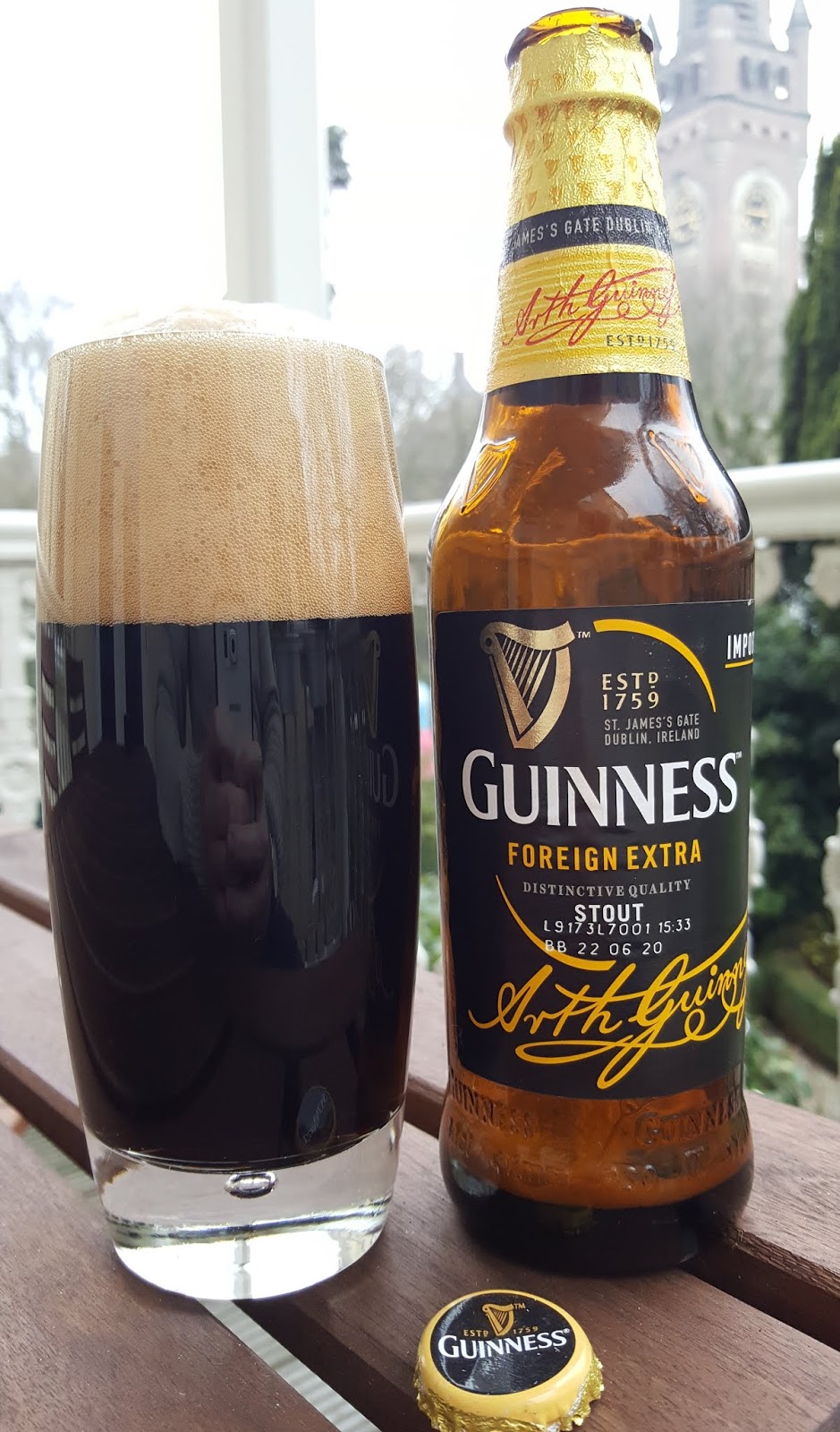
Showing posts with label guinness foreign extra. Show all posts

09 December 2022

Semper Fi

The Fidelity beer festival in July meant that a lot of Whiplash's international brewing buddies were in Dublin for a few days. That gave them an opportunity to get some collaborations in the tanks, which I got to drink a few months later.

We'll begin on a couple of lagers, and for the collaboration with Donzoko they decided to tackle light lager for some reason. Only When I Sleep is 4.2% ABV and certainly light coloured: a flawless shade of white gold. Instead of bland fizz or a metallic tang, the flavour instead is soft and tropical, with exotic notes of lychee, jasmine and rosewater. It's not at all what I expected. I guess they've taken the uninspiring specs and done something worthwhile with them. This is a proper easy-drinking thirst quencher, and the flavour complexity is dialled back enough if you just want to sink it. There's much more enjoyment to be gained from sipping it, however.

New York's Finback collaborated on Witness, a dry-hopped pils, and a strong one at 5.5% ABV. It's a beautiful warm golden colour and smells quite spicy and herbal, with incense shading towards weed. The can doesn't tell us which hops were used, but I suspect something Kiwi from the mix of grass, minerals and soft fruit in the flavour. The high strength means a full body and it's lacking the crispness of pilsner as a result. Nevertheless it's very tasty, offering lager cleanness with a fun multifaceted new-world hop complexity.

Wylam is a regular partner-in-crime for Whiplash, and their latest joint is an IPA called Word With Yourself. It's very hazy, of course, and 6.3% ABV. So far nothing out of the ordinary. Something odd happens in the flavour, however. I figured they used an unusual combination of hops giving it a strange mix of sweet and savoury -- clove rock and nutmeg pastry spicing meeting a raw red onion intensity. Now, they may have used unusual hops but it turns out that the gimmick is an absence of barley. Without any further details I decided they must have used sorghum, and even detected a similarity with the Nigerian version of Guinness Foreign Extra Stout, also sorghum based. But it's not that: the grist is just plain old wheat and oats. Regardless, it's an interesting effect, noticeably different from normal IPA and, being honest, not in a good way.

Moving on to recent solo efforts, the latest in the Fruit Salad Days series is Passion Fruit. As usual it's 3.8% ABV and in the Berliner weisse style. It's hazy and orange, and smells strongly of passionfruit, unsurprisingly. That one-note tropical thing continues in the flavour but I think it has an edge on most other passionfruit sour beers. Here, it's concentrated, into almost a butane heat. It's the very essence of passionfruit, not merely a flavour. The sourness is low key and provides no more than a clean base for the tropical fruit. The end result is bright and extremely sunny, taking the grainy base of Berliner weisse and building Carmen Miranda's hat on top of it. Fair play. 

A new export-strength stout is always a cause for celebration so I broke out the party streamers for the arrival of The Wake. This is 7% ABV and a dense black colour with a tan head, so full style marks for appearance. Cocoa is the main act in both the flavour and aroma: dry and powdery, crying out for a balancing milky sweetness but you're not getting that. I love the bitterness, and I'm not sure if it comes from the grains or hops, but it's exactly the sort you get in high-quality dark chocolate. There's a lightness of touch in the texture, making this a perfect stouty antidote to all the facile sticky kiddie pastry desserts which pass for strong stout these days. The balance and poise which are Whiplash hallmarks are stamped firmly on this. 

We finish with another collaboration, this time it's Cerebral from Denver and a double IPA. This is called At Dusk and is a little stronger than the standard Whiplash DIPA at 8.3% ABV. It smells as tropical as the Fruit Salad Days with oodles of passionfruit and mango, all derived from the hops. The flavour is not overly hot, but it is another dense one, with a feel of fruit-flavoured custard about the unctuous texture and vanilla taste. Beside this sits a strange grassy bitterness, adding an unwelcome savoury element to what is otherwise a dessert beer. It's OK, but I didn't think it up to Whiplash's standards when they make beers like this on their own.

And as of this month, Fidelity's legacy goes beyond a few collaboration beers. It's the name Whiplash and The Big Romance have chosen for their new joint venture, a pub on Queen Street in Dublin. Expect the same level of attention to detail that The Big Romance brought to their original venue and which can be found in every Whiplash beer.

18 March 2020

Arthur in Africa

The Nigerian version of Guinness Foreign Extra Stout is a beer I had been looking for, casually, for some time. When I'm in Britain I check cornershops and minimarkets in search of it. The quest finally ended in an oriental supermarket in The Hague.

This edition differs from Irish Foreign Extra by being based on sorghum rather than barley. The crop is indigenous to Nigeria and brewers are encouraged by the government to make use of it. The story goes, and I'm open to correction on this, the pale sorghum beer is brewed and then added to a Guinness essence produced in Dublin, containing the roasted barley and sour cultures that give the beer its colour and Guinnessy flavour profile. With that in mind I wasn't expecting anything radically different to what I'm used to.

And while it's not radical, it is definitely different. The sticky, treacle character of the Irish version is replaced by a dried flowers effect: pot pourri, with a little woody cinnamon and clove. It's quite harsh in its dry roastiness, lacking the balancing richness. A metallic hop kick doubles down on this, though there's not much of a lactic tang.

Overall, this is quite a tough beer to enjoy. For me, the domestic version still beats both this and the Jamaican one.

05 April 2019

A fair shake

I make no apology for the one-and-done approach this blog takes. There are too many beers, and too many variables affecting how it's perceived, to try and be any way objective. Beer is no more immutable than my palate. So I write about what's in front of me when it's in front of me and then move on. Usually.

I was recently approached by a brewer who wasn't happy with my account of his beer. I reviewed White Gypsy's Vintage in this post last summer. It was on the train home after an afternoon at Hagstravaganza, and he thinks the circumstances were detrimental to my opinion of the beer. Much as I dislike revisiting beers, I'm always up for an experimental challenge, so the next time I saw a bottle of Vintage I bought it: €9.95 for 375ml in Baggot Street wines; almost €2 more than at the festival.

And here we are. I am well rested. I have a clean glass and a clean palate. The beer is still 6% ABV and a pure obsidian black. A tall layer of tan foam builds rapidly as it pours but fades quickly. By the time I had settled in to take a drink it was little more than one bubble thick on the surface. Before a sip, a sniff. A spicy sourness arrives first; a sandalwood or cedar effect. That's complemented by -- but definitely separate from -- a rich stout bitterness, heavy on herbal liquorice. OK, there's no soy sauce this time. The flavour is that spritzy bitterness, mixing bitter marjoram and yarrow with dark chocolate. There's no more than a seasoning of the aromatic wood, plus a tiny nibble of sourness. Why such a light touch on the complexity? It's thin, is why; big on fizz while the bitterness fades last, leaving almost no aftertaste. I'm sure this is part of the spec, but at a tenner a throw it really ought to be more than nice. It may be an obvious statement to make, but Guinness Foreign Extra Stout will give you something along the same lines -- if much less subtle -- at a fraction of the price.

Yes, this was a different experience to the one I had last summer, but my conclusion remains the same: it's not spectacular, but it's priced like it is.

02 February 2018

Gate and switch

An icy gale was whipping the flurries of snow down James's Street and barely a sinner was out in it, except for the trickle of Ireland's beer commentariat filing through the entrance to Open Gate Brewery. The bar was almost eerily quiet this Tuesday night: closed to the regular revellers, and with all the taps blank and the blackboards clean. We had been invited along to taste the latest Guinness beer, without any clue as to what it was. My rumour that a mixed fermentation barrel-aged version of Satzenbrau was in the offing had failed to gain traction.

Out came the tasting trays of the new beer, introduced by brewer John Casey. It's a lager, he told us. While it looked like one, of the clear golden sort anyway, it didn't feel like one. The body was quite heavy, gummy almost, and I suspected that, as with Hop House 13, it was fermented with an ale yeast. There's a somewhat wort-like sweetness up front, but followed and almost fully offset by soft stonefruit hop flavours: mango and peach in particular. Topaz, Galaxy and Mosaic are the hops: the same combination used in HH13, and the main reason for its similarity. The twist is that the new beer, Pure Brew, is alcohol-free, or near-as at 0.5% ABV. Although I spotted the malt-extract sweetness which so often marks these, the hopping was sufficient to completely prevent me making the association. The technicals of it, explained next, are quite interesting. Here comes the science part: concentrate.

I don't know how often this happens with non-alcoholic beer, but it's not brewed to strength and then de-alcoholised. They start with a wort of around 1.030 and pitch a special variety of yeast which brings it down no further than about 1.025 before finishing of its own accord. The quirk of this process that really interested me is that this is one of the very few Guinness beers you'll find out and about that's produced at sale strength rather than brewed and fermented at high gravity and watered down before packaging. Though it bears the name of the Open Gate Brewery like every new release lately, there is a pleasing piece of extra transparency on the back label "Dreamed up at the Open Gate Brewery. Brewed next door in St James's Gate", as are all the Open Gate branded beers that are distributed beyond the taproom itself. A thumbs up for this, and I'll happily overlook the slight topographical inaccuracy.

Pure Brew works well as a non-alcoholic offering. Yes it's a bit sweet and heavy, but that hop profile, if it survives out on the dusty floor-level shelves where pubs keep these products, is enough of a redeeming feature to give it the beatings of its German rivals.

L: Plum Pudding Porter ; R: Olde English Ale
Duty to the new guy done, there was time for some swift catching-up on Open Gate's winter offerings. First out was Plum Pudding Porter. I was imagining a sticky confection, especially given the downright imperialist ABV of 7.2%, but it's pleasingly dry right from the very first sip. The pastry element is present but understated: raisin and prune, lightly spiced with cinnamon. It's a proper winter beer, not gimmicky, and with the fruit and spice additions well integrated into the flavour, not squirted in as an afterthought which seems to be too often the case with this lot.

Olde English Ale is apparently a staff favourite. It's another dark and strong one, 7.5% ABV this time, given 11 months of maturation before serving. It's also quite dry, with a bit of Foreign Extra Stout's bitter bite balanced by toffee in the tail end. While clean and straightforward, I thought it lacked something with regard to complexity: it feels like it should have more interesting mature beer flavours, some coffee or cocoa; even a cheeky savoury edge of autolytic umami, but everything it does arrives in one go and leaves the palate just as promptly.

A total change of tack for the evening's finisher, and a perfect contrast to the heavy stuff. Goodbye Gose is that rare bird: a gose that hasn't been hacked around with in the mistaken belief that the style needs syrupy enhancements. This is absolutely straight up, 5% ABV, offering a refreshing briney salt foretaste countered by tart lemon and all set on a gently effervescent body. You may not think you need cleansing refreshment on a snowy night in January, but this delivers it anyway, and I felt the better for it. It could probably stand to be a little sourer for my taste, but worked absolutely perfectly as-is.

Once again Open Gate excels at a German beer style. Sure you'd wonder why they bother with the dark stuff at all.

 A little over a week later I was back in for something else and two new additions had gone on the bar. Winter Sunshine is another pale ale, 5% ABV, and suffering from the thick syrupyness that seems to beset most Open Gate attempts at doing properly hop-forward beers. It's not unpleasant, having a kind of bittersweet marmalade orange taste, as well as a fun peppery spice. It completely fails to be refreshing, however, coming through heavy and a little cloying. The refreshment quotient is disappointingly low.

The other new one was a complete contrast: Dunkel Hefeweizen, obviously a wheat beer but arriving looking like a stout: black with a beige head. The term "hybrid" gets thrown around to an inappropriate extent in modern beer, but this really did taste and smell like an amalgam of two very distinct styles. There's the rich and sweet brown-banana of a particularly warm-fermented weizen, sitting next to the dry burnt-toast flavour of a particularly roasty stout. A curious mix, and one that shouldn't work, but I quite liked its oddness. The blandness that often besets dunkelweisse is mercifully absent. On the down side it is a bit thin, with a low energy ABV of 4.6%. The fun flavour blend does go a long way to make up for that, however.

That's it from Open Gate for now. I've an appointment there in early March and will be hoping to meet the spring collection then.

09 December 2016

Trouble and Hope

The brewery names sound good together, and they do have a brewer in common, but otherwise this set is unrelated, demonstrating perhaps nothing more than the diversity of Irish beer these days.

Trouble's Gung-Ho I found on draught in The Brew Dock last month. It was badged as a hopfenweisse, though this style councillor regards it as much more of a white IPA: it hosts a punch-up between spicy yeast flavours and bitter hops, resulting in a jarring soapy tangle of tastes that never settles down. It's a bit of a shame because, taken separately, the beer's different elements are lovely: there's a luscious soft wheatiness, a juicy peach aroma, and an invigorating fresh green bitterness, but there's no harmony and the drinking experience suffers as a result. Weissbier of any stripe should be smooth, and this is far too rough and pointy to fit into the genre.

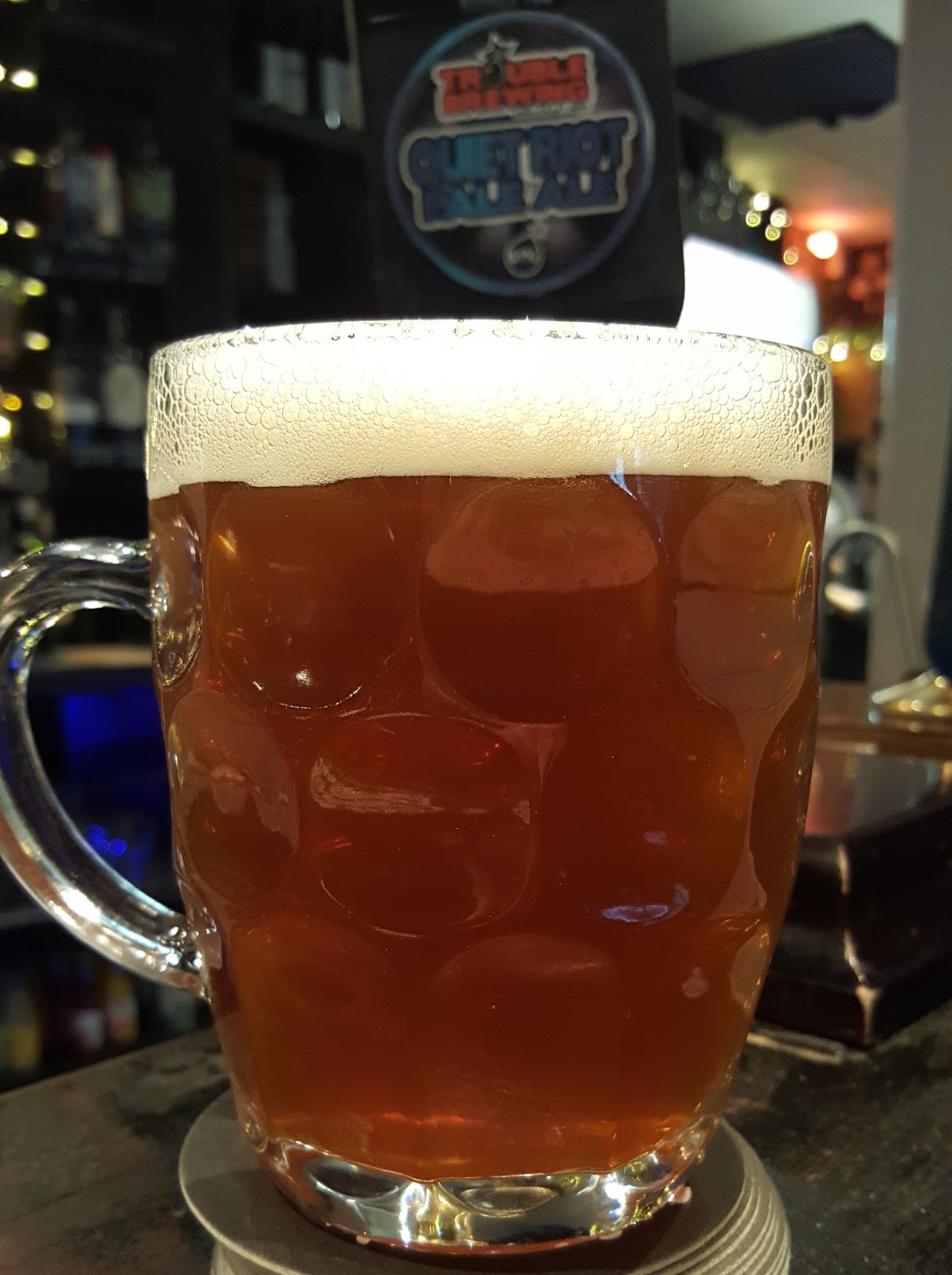
A few weeks later I found another recent Trouble special, Quiet Riot, installed on a cask engine at The Black Sheep. It's described on the badge as a pale ale and is bright orange with a slight murk, so I was expecting new world grapefruit and whatnot, but it's actually quite British-tasting, for reasons more than the dispense method, I think. There's a sweet jaffa aroma which shades toward Terry's Chocolate Orange: it has that sort of concentrated orangey oiliness. Then it tastes massively tannic, with a palate-scouring dryness worthy of the brownest of brown bitters. Behind this there's a satsuma sweetness, going perhaps far enough to resemble candied orange peel, while the finish brings in a big old fashioned hop bitterness given extra punch by the dryness. Unfortunately this is almost ruined by a poopy Brett off-flavour which I suspect is not part of the act and relates more to the cask having been tapped a whole week previously. Ignoring that element, what we have here is a pretty solid bittersweet English bitter, one that doesn't taste its strength.

Crossing over to Hope, Peach & Blueberry Sour is the third in their Limited Edition series. The previous two were among the best beers I've tasted all year, so anticipation was obviously high. It's also the second sour co-production between Hope, YellowBelly and Shane Smith, and the first of those (YellowBelly's Castaway) was also magnificent. Quite the pedigree, all in all.

It blushed out of the bottle, a cheery, rosy pink, forming only the briefest of foam tops. The aroma is a dessertish mix of fruit pie and jelly. The latter was very much to the fore when I took the first sip and got a hit of those sugar-coated sour jelly sweets. As well as the sour kick, there's a similar sort of indistinct fruit flavour. I would never be able to pick actual peaches and blueberries out of this, and it really lacks the lusciousness of Castaway's passionfruit, sacrificing it for a bigger tart hit. It's a decently tangy number, refreshing and drinkable, but nothing special this time.

And a final beer which I'm wedging in following the Christmas Craft Fair at the Teeling Distillery on Saturday last. Hope were pouring and I had the opportunity to try Limited Edition number four, an Export Stout. It's a real return to form after the blip of no. 3: thick and sweet the way a 7.5% ABV stout should be, tasting first of treacle and chocolate but then balancing it with a serious old-world vegetal bitterness. While those two elements were see-sawing on my palate I caught just a glimpse of a lighter, more delicate, meadow flower perfume, a whisper of lavender in the otherwise dark and stormy big-stout flavours. It's beautifully done -- a proper stout-drinker's stout -- and one to rank alongside Leann Folláin and Guinness Foreign Extra, for as long as it lasts. Des from Hope confirmed that limited means limited with this lot, though also that a new IPA, lighter than Handsome Jack, is on the cards for the new year. Can't wait.

07 December 2015

What Arthur did next

The Guinness glasnost initiative has gathered pace over the last year and a bit, from a handful of nosy parkers being shown round the pilot brewery last September to now: the opening of a dedicated bar for serving beers directly from that brewery. Under the new dispensation it's possible to taste Guinness beer which bypasses the multitude of impedances that have, for decades if not centuries, separated the brewers' handiwork from the drinkers' mouths. New hire Jason Carroll, having previously been getting creative at Franciscan Well, is now tasked with brewing fun and exciting, and possibly even unGuinnessy, things, ten hectolitres at a time, for serving at The Open Gate. As he tells it, he has a free hand, access to all the technology and raw materials that Diageo commands and, I think crucially, is brewing at sale strength rather than high gravity. It's an exciting vista and when they invited me to one of their launch evenings to have a look and a taste and a chat, I jumped at it.

The Open Gate has its own entrance from James's Street at the western end of the old Guinness site. The bar is a cordoned off section on a lower level of the building, looking through at fermentation vessels and pipework, though the brewhouse itself is a level up, out of sight to visitors. Decor is minimal: schoolhouse-style distressed wood-and-steel furniture and vintage brewery signage whose authenticity I don't doubt. In keeping with how normal corporate rules don't apply in this space, there's no individual branding on the eight keg fonts: mainstream Guinness and Smithwick's beers are served, but without their tacky illuminated badges: they take their place on the blackboard with the small-batch stuff.

Imperial Dunkel Weisse and Nitro IPA
One intriguing initiative of The Open Gate is to serve those beers that are brewed across the street on the big-boy kit for export but aren't marketed in Ireland. I'm sold on that idea alone. So, first off, I got to taste the much-maligned Guinness Nitro IPA, currently bringing the same bafflement and dismay to the American palate that we Irish drinkers have been experiencing with nitrokeg Guinness for years. First impression, unsurprisingly, is that it's bland and creamy, like every other smoothflow ale. There's an unpleasantly artificial perfume sharpness at the front and a bizarre dry catch in the finish, and then it's gone, leaving no aftertaste. Ordinarily, I'd be happy to leave it at that and move on, but it was free, so I asked for another, and this time took a bit more time over it. There is a proper hop character in this, buried way down and only present when it has warmed a bit. But it's not the bitterness you'd expect in an IPA brewed for Americans; it's the spicy biscuit-laden flavour you'll find in dodgy brown English bitter, though at 5.8% ABV this beer is almost double the strength of one of those. It might be interesting to try it served on cask: I think those hops would get more of an outing. But to be honest it's probably best to leave it aside and pretend it never happened, like so many other Guinness brand extensions.

There were three in-house beers on offer, and I may have detected a bit of new-brewer nerves in them as all were strong and dark. It's hard to go wrong with strong and dark, right? The weakest, at 6.4% ABV, was a Milk Stout, considerably overclocked for the style, I think. It wasn't served on nitro, but was very cold so tasted quite plain to begin with. My first impression was that it was spot-on for this generally pedestrian style, but it woke up later, revealing a sharp carbonic bite and a heavy roast that vied for supremacy with the sweet lactose tang. It's a tough sort of beer to impress with, but I guess there wasn't anything wrong with it per se.

Pictured to the left of the Nitro IPA above, there, is Open Gate Brewery's "Imperial Dunkel Weisse". So not a doppelbock or a weizenbock, then? No. They used Guinness ale yeast for this, so a fully Germanic name didn't seem appropriate. It's 8.4% ABV though doesn't taste it, with the sticky caramel foretaste balanced nicely by a properly bitter finish. It's not Aventinus but it's definitely swerving in that direction: less chewy and with more of a burnt complexity. As an experimental brewpub beer, from any brewpub, it would get a bemused thumbs up before we move on to something else.

You can't be proper craft unless you're doing some barrel ageing, and The Open Gate has got hold of a Scottish whisky barrel from presumably somewhere else in the Diageo empire, though nobody seemed to know exactly which distillery it had come from. They've brewed a dark strong ale and it had been in the cask for about two weeks when we got to it, the ABV hitting 7.4% and rising -- a special arrangement had to be put in place with the resident Revenue official and the cask remained in bond with just the spigot poking cheekily through the wire into the bar. This Barrel Beer wafts vanilla in a big way from the aroma but tastes very harshly woody, yet oddly not of whisky. There's a chewy caramel centre but not nearly enough to balance it. This guy needs bunged up and left somewhere for at least six months to mellow, I reckon. It tastes very much like a first effort.

edited to add: I tasted this again three weeks later and it was much improved: far rounder and smoother than previously, though with a bit of an appley tang.

We were all sent home with a bottle of 6.4% ABV Strong Ale which I'm guessing (though am open to correction) is the base beer that went into the whisky cask (edit: confirmed, it is). It's dark red and smells strangely rubbery: an odd mix of forest fruits and tyre fire. It's rich and heavy; toffee and caramel at the front but immediately overtaken by an almost tart bitterness with a tang of metallic molasses. This is not a nice beer; it's a serious, grown-up and old fashioned one. But that just makes it a bit of a chore to drink. I can see why you'd want to smooth out the edges in a barrel, if that is indeed what they've done.

edited to add: the old-fashioned quality shouldn't be surprising as this is a tweaked version of the Smithwick's Barley Wine recipe, last brewed at the Macardle-Moore brewery before it was closed by Diageo in 2000. It's stronger than SBW's 5.5% ABV and uses Galaxy hops which of course would have been unheard of.

So, while I'm impressed at the concept, the set-up and the scenery at The Open Gate, I remain to be impressed by the beer. On the night, I reverted to Foreign Extra Stout fairly soonish: it was still the best beer present. I hope they don't lose track of the beer as the point of the exercise. I'm also a little dismayed at the access arrangements: they're limited to opening for five hours on just Thursday and Friday evenings, and as a result, you have to book. That's fine for beer tourists looking for an alternative to the showy soullessness of The Storehouse, but I can't see Dubliners making much use of it like that. I do hope a practical solution to allow for walk-ins can be found at some stage. A new beer is promised every fortnight and it would be nice if trying it didn't mean buying a €6 advance ticket for a flight that includes it.

That said, something pale and hoppy would be good next. Is there spare sack of Mosaic lying around?

24 November 2014

Whatever People Say I Am, That's What I'm Not

I can't help but feel that Diageo have fashioned a rod for their own backs with The Brewers Project. It's easy to read it as promising things that it was never really intended to deliver, and that's just going to annoy people.

My experience of it began back in early September when the company invited a small group of bloggy types to St. James's Gate to learn about the Project, the first time they have ever done so. As everyone is doubtless aware at this stage the Project has been launched with two new beers: Guinness Dublin Porter and Guinness West Indies Porter. In answer to my obvious  "Why now?" question, Nick the Innovation Marketing Manager, leading the group, said that the rise in diversity on the Irish beer scene had not gone unnoticed at Diageo. They saw it as an opportunity to play a little, to try something that wouldn't have worked before but could be worth a go. Those of us still lamenting the premature death of the St. James's Gate beers know all about Guinness projects that were tragically ahead of their time.

There are two principal features of the new venture, explained to us when we left the plush surrounds of the Director's Dining Room and donned our protective goggles for entering the pilot brewery: one is that the pilot plant itself plays a central role in creating the beers; the second is that the Guinness archive is also pivotal, providing inspiration for the brewers designing the beers. These are the messages we see again and again in the marketing surrounding the new products: brewers given freedom to create, and a taste of authentic history. The problem is that both concepts are paper thin and disintegrate disappointingly after a mere moment's scrutiny.

Let's take the historical side of things first. An archivist was on hand to show us the logs which were directly relevant to the two new beers, or rather, how they're marketed. One log was from 1796, the earliest to show porter being brewed by Guinness. The other was dated 1801, when Guinness began brewing porter for export, a recipe which evolved into today's Foreign Extra Stout. Gearóid, one of the brewers gathered round  with us, pointed to the figures for hopping, saying that they were much higher than you'd have today. I've read enough Ron to know that's par for the course, but also that no 1796 porter would be anywhere near as weak as the 3.8% ABV of the new one. So what gives? It's an influence on the recipes, say the men from Diageo, an inspiration. But where did the basic specs come from, the original gravity and so on? Oh they were just handed down from above, same as every beer. These porters conform rigidly to modern Guinness ingredients and methods.

I'm not having a go at Diageo for not making Pattinsonian clones of beers in their logs. They are entitled to make what they like. I do, however, think presenting them as any way historically associated was a mistake -- something that will mislead most customers and just irritate the ones who look a bit further into it.

It's all neatly illustrated by the posters which began to appear a couple of weeks ago, ahead of the launch of the beers in Ireland. Try Our New Beer From 1796 / 1801 they exclaim. You have to look at your feet to spot the small print:
That's a lot less fun and I wonder what the point of the whole thing is. A beer that sort-of has some influences from an older one isn't a thrilling window into the past, but nor is it an exciting new recipe. It looks like a brewery wanting my attention but offering nothing to hold it.

The 10hL brewhouse
And then there's the pilot brewery itself. You'll have noticed it on your way along James's Street, its delivery shutter two storeys up the wall on the outside. There are a pair of brewhouses inside: a one hectolitre, fanciest-homebrew-kit-you've-ever-seen, and a ten hectolitre kit, originally installed in the late 1990s to brew the "St. James's Gate" range of proto-craft beers but still very shiny and well looked after. It could be the brewery of any small-to-medium microbrewery, except there's a cereal cooker at the start for adjuncts, and a pasteuriser at the end: St. James's Gate is a totally sterile plant, no beer leaves alive, not even the made-for-destruction test batches.

It's the only pilot brewery in the globe-spanning Diageo empire and it has the job of testing all the ingredients that arrive, be it a new crop of sorghum for use in Nigeria or a fresh batch of foam stabiliser from Kerry. One of the FVs was marked as containing a test run of Tusker, several had the last runs from the former Smithwick's brewery in Kilkenny inside.

The pilot also does recipe development. Every Diageo beer starts life on the small kit, then gets reproduced on the 10hL one. If successful, an Irish recipe graduates to the brand new main brewhouse where Guinness stout comes through 1,000hL at a time, though half-sized batches are often done for other beers and, Gearóid says, they can bring the quantity down to 350hL if they absolutely need to. And the new beers are no exception: both were scaled up through the pilot brewery but the beer you drink came from the industrial-sized facility.

The 1hL brewhouse
I've seen several references to The Brewers Project as "craft beer", or an attempt thereat, by the makers of Guinness. Everyone I met inside St. James's Gate denied that this is what it's supposed to be, and I completely believe them that their intention isn't to fake small-batch, artisan Guinness. But they can't possibly not have noticed that, with all the mention of the pilot kit and the men who work there, and the emphasis on the human input into the product design while totally ignoring the economic aspect, that "craft Guinness" was a perception bound to result. And again that anyone who saw the details of what's actually happening would be disappointed.

Eleven paragraphs on a brewery's marketing is not how I roll normally. But The Brewers Project fascinates me, albeit in a slightly morbid way. That said, the opportunity to look into the Diageo brewing process and see a whole new yet familiar side of brewing is something I'm hugely grateful for -- a big thanks to Julie and Ruth from WHPR for masterminding the event, and the Diageo team for showing us round. I'm hoping it's the beginning of a new era of glasnost initiated by the taciturn Dublin 8 monolith.

We did get a small taster of the two beers when we visited. My first impression of both was that they're very similar to existing Guinness products: Dublin Porter thin and crisp like Guinness Extra Stout while the caramel and mild sourness of West Indies Porter lit up the receptors in my brain which enjoy Guinness Foreign Extra Stout but left them craving the weight and complexity that Foreign Extra delivers at 7.5% ABV which West Indies lacks at a mere 6%. I had to wait until last weekend and the release of the bottles on the Irish market to get my hands on them and do a proper taste test.

Guinness special editions tasting very similar to each other is something I'm used to. Anyone who worked through the Brewhouse Series almost a decade ago may remember. But the brewers I met at St. James's Gate are adamant that all the beers are radically different from each other, even the Brewhouse Series. The amount of aroma Goldings added to West Indies Porter is off the charts for a Guinness beer enthused Gearóid, and again I believe him. I just could not smell that for myself. "Could the common taste be down to the Essence?" I asked, referring to the soured syrup that Diageo produces to give all Guinness worldwide a signature flavour. Gearóid's answer was a phrase I have never heard on a brewery tour before: "We don't talk about that."

And so down to business. A blind triangle tasting of both beers and what I regard as their respective close cousins. Could I tell them apart, and which are better?

The six 100ml glasses of 10°C beer in front of me were a uniform black with barely any difference despite the weakest being half the strength of the strongest. I figured head colour would be a dead giveaway so they were carefully poured with no foam showing. A first go through the set showed clearly which were the strong three and which the weak three, but there was nothing else obvious.

Picking the odd one out from the weaker three was almost impossible: it was just glass after glass of watery fizz. I tried drinking them in different sequences, pausing for water between them, and running through them in quick succession but it was very difficult to spot any distinguishing features. Going past the wateriness, and letting the beer warm and flatten a bit, I started getting hints of chocolate and a green vegetal complexity, just shading towards metal. This was in all three but I half-guessed that I could taste it a tiny bit less in one of the three so I marked that as Guinness Extra Stout and the other two as Dublin Porter, and I was correct.

Interestingly, as I finished off the leftovers once the challenge was over and the beers had been sitting out a while, I found that the Extra Stout got more full-flavoured as it approached room temperature: your classic large-bottle-off-the-shelf. The Dublin Porter did not, however, staying as thin and dull as when first taken from the cooler. So, if faced with a choice of just Dublin Porter and Extra Stout which to pick? I now appreciate that there is a mildly stronger flavour in cool Dublin Porter, but the emphasis is on mild there. But warmer Extra Stout was a revelation: I never would have guessed there would be such an appreciable difference between 3.8% ABV and 4.2% ABV, but that extra 0.4 really does add heft. Room temperature Guinness Extra Stout remains the company's best session-strength option.

The stronger set was easier. One of my glasses contained a hot 'n' heavy sour coffee and caramel madman, the other two a more gently sour, roastier beer with an added metallic edge. It wasn't too much of a reach to guess that the former was Foreign Extra and the latter West Indies Porter. And it's not just the alcohol difference that gave it away. I was on alert for those bonus Goldings that Gearóid had mentioned and though there was no sign at all of them in the aroma (all six smelled of damn all), there was a discernible crunchy green cabbage flavour behind the signature sour Guinnessy tang. I've tasted English hops doing that before, especially when in quantity.

I stand by my initial impression that West Indies Porter does have much in common with Foreign Extra, but this test proved that it is markedly different from it, though I wouldn't at all say that it's an improvement, apart from the bottle size. The next phase of the test should be to determine whether a half litre serving of West Indies Porter delivers more pleasure than 33cl of Foreign Extra Stout, but I think these beers have already taken up enough of my time and your screen.

All four beers are unmistakably Guinness and I think I'll have to agree to disagree with the Diageo bods on whether this is a strength or a flaw. In the microbrewing sector it's commonplace to hear of a company recruiting a brewer who has Guinness experience. While visiting James's Gate I took the opportunity to ask if the reverse happens: do brewers from Irish micros ever take jobs with them? The answer was no. While there's a certain amount of cross-pollination between the big industrial multinationals, nothing from the craft side. I think the result of this inward-looking philosophy can be tasted in these new beers, and every other Guinness brand extension where the consumer complains that it's not different enough. To the brewers and execs for whom Guinness represents archetypal porter perfection honed over centuries these variations are an audacious victory, instilling the quintessence of the brand in a radically different host body. This stout drinker thinks they should get out more.

(For more longer-than-usual blog posts about beer from a variety of authors, check in with Boak and Bailey this Saturday and follow their #beerylongreads project.)

11 February 2013

Knock-out stout

In the black corner, the champ -- brewed since the 1780s at the Barclay Perkins brewery in Southwark, surviving the merger with Courage and now, following nearly twenty years on hiatus, revived under the stewardship of Wells & Young of Luton: the original of the species, Courage Imperial Russian Stout!

And in the other black corner, the contender -- from darkest Yorkshire, representing the entirety of progressive British craft brewing, sporting the modernist typography of the Soviet Ewe-nion: Black Sheep Imperial Russian Stout!

At the weigh-in, the champ had a few points on the sheep: 10% ABV vs. 8.5%. To keep things fair the bout was fought blindfolded. Seconds out; round 1!

No real head on either beer when poured, though what little foam there was showed much darker on the Courage. This extra density came through in the mouthfeel too, with the Black Sheep thinner and fizzier than the beautifully full and rounded Courage. Looks like this might not be much of a fight.

Black Sheep put in a good showing in the aroma, lots of lovely sweet treacle and molasses against Courage's rather bitter liquorice offering. But the knock-out punch is delivered in the flavour: Black Sheep drops its guard with an autolytic tang, producing a kind of unpleasant sour coffee effect, while the Courage avoids any big risky manoeuvers, instead going for a subtle dark smooth caramel with just a mild metallic hop tang. Deft, graceful, and the unanimous winner for the judges.

For its mix of heavyweight brawn and classically traditional flavours I don't know whether to match it against Guinness Foreign Extra or Brooklyn Black Chocolate in the next bout.

27 October 2011

Curd your enthusiasm

Bord Bia have designated the upcoming long weekend as the Irish Farmhouse Cheese & Craft Beer Weekend. They've helped organise a whole raft of events all around the country over the next few days, celebrating two things we produce in Ireland which are well worth making a fuss about. A full calendar of events is available on the Bord Bia website here.

I've been catching up on the new Irish beers which were launched at the All-Ireland Craft Beerfest in Dublin last month, which I missed. BrewEyed Vanilla Amber Ale, for instance, which went on tap in L. Mulligan. Grocer recently. No surprises here anyway: it's certainly amber, attractively dark and enticing. The aroma is a bit off-putting, however: a sickly waft of strong vanilla essence that leaves you in no doubt that this is not a subtle beer. First taste produces a deafening clash as the sweet vanilla smashes headlong into powerful hop bitterness. It's a mercy it's as bitter as it is, otherwise the vanilla could have taken over completely and turned it into an alcopop. But it's definitely a beer, and designed for grown-ups. The pay off comes at the end: the flavours calm down and there's a long lingering finish of vanilla-infused bitter which works rather well. Overall I think it's probably too weird to enjoy in any great quantities, but hooray for novelty and I'm really looking forward to what BrewEyed come up with next.

Following their Coffee & Oatmeal Stout special, Dungarvan Brewing have gone back to basics for their sixth beer: a straightforward 3.7% ABV bitter called Comeragh Challenger, named after the local mountains and the single hop variety employed, respectively. It was back to Mulligan's once again to give this a spin. On the first sip I did a double-take. On the second, I was still confused. Fortunately, Colin was on hand to answer my question: "Are you sure this isn't Helvick Gold?"

It has the same soft fruit palate and the same invigorating gunpowder finish. The light in Mulligan's isn't great (that's my excuse for these crappy photos) but it certainly looked to be the same shade of yellow. There did seem to be an extra smack of bitterness in the middle, but that could easily have been my imagination. Colin took a sample and assured me that it was the correct beer; that it tastes totally different to Helvick; and that I have the gustatory acuity of a donkey with a headcold. Colin doesn't get these things wrong.

I stand by my initial impression, however. Comeragh Challenger tastes very much like Helvick Gold only a little more bitter. As Helvick is one of my favourite Irish beers, especially from the cask, this is by no means a criticism.

But National Beer & Cheese Weekend isn't just about beer. There is also cheese. So with the long-anticipated arrival of Eight Degrees's new porter I reckoned I needed to introduce it to some cheesey goodness. Or some cheesey randomness at least.

Knockmealdown Porter, like its stablemates, is 5% ABV and deftly performs the Eight Degrees signature move of taking a familiar style and beefing it up slightly. It tastes dry at first, followed by a really interesting mature sourness, riding high on the extra alcohol and doing a surprisingly good impression of Guinness Foreign Extra Stout. A dash of chocolate comes right at the end, finishing the whole thing on a smooth and sweet note. I like this a lot. So how does it go with cheese?

My last outing with beer and cheese on this blog concluded, er, inconclusively, with the feeling that beer and cheese matching is a mystery and that the random approach works best. Bord Bia have given us some (PDF) guidelines on what pairs with what, but I still prefer the random approach. This way I get to tick cheeses as well.

The three I picked, pretty much arbitrarily, at the cheese counter were ones I've never had before and know nothing about: Ballintubber, a softish cheddar with chives; Killeen Fenugreek, a goat-milk Gouda clone, seasoned as the name suggests; and Cooleeney, the pungent runny one essential to any cheese session line-up.

Ballintubber was my favourite by itself and faired reasonably well with the porter. The sourness of the beer bounces nicely off the sweetness of the cheese and the chives give it an almost hop-like herbal finish. I really liked the Killeen too because of the domineering fenugreek. It's too domineering for the beer, however and while the taste doesn't get lost completely it's not pulling its weight in the match. The Cooleeny I found tough going: though it has a beautiful socky Camembert finish, the main taste is powerfully acrid and rather off-putting. So I was delighted to find that Knockmealdown Porter puts some manners on it, smoothing the harsh bitter edge with its chocolate while leaving the heady mature cheese vapours to linger at the end. I wouldn't recommend attempting to approach Cooleeny without a bottle of strong porter in your hand.

And at the end of that I wanted to immediately run out and try more cheese with it, explore more taste combinations, but I'll have to leave that to this weekend when hopefully I'll get to visit at least one of the Dublin beer and cheese events. The Bull & Castle's tasting platter looks right up my random-pairing alley. You'll find Eight Degrees at the Ballyhoura Spook mountain biking Halloween party on Sunday while Dungarvan Brewing have organised a beer and cheese pub quiz in The Moorings tonight. There are loads more events going on around the country. As I say, check the website.

In the interests of honesty and transparency I should mention that Bord Bia have paid me absolutely nothing to promote this event on my blog, not so much as a snifter of beer or a sliver of cheese. In fact they didn't even ask. I just think it's incredibly cool for a state agency to be spending my taxes on promoting our breweries and cheesemakers this way, and I'd like to see the event be a roaring success.

10 February 2011

Our American cousin

Chris was a little bemused when, having offered to bring any beer available in California to Dublin for me, I asked for some Guinness Extra Stout. I make no apology: it's just the way I work. There's a version of Guinness brewed in North America that has often featured in conversations I've had, but I've no idea what it tastes like or how it differs from the Guinness beers brewed in Ireland. That needed putting right, and I'm grateful to Chris and Merideth for providing the opportunity to do so (and for the actual Californian craft beer they brought me out of sympathy and which will feature in a later post).

American Guinness Extra Stout (picture, left) is 6% ABV so I reckoned that the best way to get the measure of it was a parallel tasting with the two strong Guinnesses brewed in Ireland: Foreign Extra (7.5% ABV -- second left) and Special Export (8% ABV -- second right). After the first sip I realised that it would be worth adding Irish Guinness Extra Stout (4.2% ABV -- right) into the mix as well. As an aside, when I went stout shopping in St James's Gate (it's cheapest), I was a little disappointed to find that the gift shop has stopped selling the classic returnable pint bottles, substituting the rather squat and ugly half-litre here depicted.

Back to the Canadian Guinness, then. Much like Foreign Extra and Special Export, the most striking thing about it is a caramel and molasses sweetness. It's a different and lighter sort of vibe though, missing the more full-on liquorice bitterness that balances Foreign Extra. Next to Irish Extra Stout it's a sugar bomb and definitely not fitting the dry Irish stout model. Yet nor is it one of the sweet and chocolatey Irish stouts like O'Hara's: the flavour is more treacle than roasted malt. Only a dry and slightly metallic tang on the end marks its relation to any of Ireland's session stouts.

It sounds like it falls between two stools: neither a punchy export-style stout nor a casual drink-and-forget gulper, and perhaps I'm being unfair by judging it against its brethern rather than on its own merits. The fact is that it is nice to drink. Most craft-brewed versions of the same style would wipe the floor with it, but as an accessible beer with a bit of -- but not too much -- character it works well. Much like the bottled Guinness Extra Stout sold in Dublin, I'd say it's a useful fall-back when there's nothing better available.

11 February 2010

Beers in the sun

Dave and Laura were kind enough to bring me back some tropical drinking from their winter trip to Jamaica. All stouts, of course: the preferred drink of hot country dwellers with any sense.

First up, one of those just-plain-bizarre throwback beers you meet from time to time in foreign parts. Mackeson's is an old brand of English stout, now part of the A-B InBev family, and sold for cooking purposes in the UK. I've never got round to trying it, but you can read Thom's account of it here. Over in Trinidad, however, the name is still pitched at drinkers rather than chefs, centred on Mackeson Triple, a milk stout of 4.9% ABV. They seem to have taken a typically laid-back approach to updating the labelling machine in accordance with global developments in the beer trade, as it claims to have been brewed for "Interbrew UK Ltd". That was two mergers ago, lads.

It pours gloopily to form an opaque black body, showing red tints only at the edges. The head is a very dark shade of tan as a final indicator of the sort of density involved -- you can say goodbye to any keyboard this gets accidentally spilled on. Unsurprisingly, the texture is smooth with just a pleasant tingle of sparkle and the taste is equally unsurprisingly sweet. After the initial massive sugar hit there's a slight metallic tang and then a sweet roasted finish of the sort you might expect from caramelised onions or roasted sweet peppers. A sticky residue remains on the lips and I don't want to know what it's doing to my teeth. On the whole it's a very drinkable affair despite the lashings of sugar.

Dragon I'd had before, knowing it to be another thick and sweet stout. It's a fair bit stronger at 7.5% ABV so I was shocked to discover it's nowhere near as sweet as the Mackeson. It's paler too, with a head that's off-white rather than tan, and the flavour overall is almost understated, certainly less in-your-face than the Trinidadian. It's balanced, but balance can be over-rated.

Finally, from the same brewery, the Jamaican version of Guinness Foreign Extra Stout. I grabbed a bottle of the Irish version to compare side-by-side and it's interesting even from the outside to compare them. Great Uncle Diageo has obviously decreed that the bottle shape and label design be the same, though the Jamaican is 275ml while the Irish one is 330ml, in accordance with packaging traditions in the respective regions. I'm guessing it's because Dragon occupies the 7.5% ABV niche that Guinness is a mere 6.5%, a full point weaker than the Dublin-brewed one. Knowing Foreign Extra to be quite a sour beer (it's the extra jolt of lactic acid that does it in this post-vatting era) I was interested to see if the sweet-toothed Jamaicans would put up with that.

Short answer: they don't. Jamaican FES is certainly nowhere near as sugary as the other two, but it's still pretty sweet next to its European counterpart. There are extra heady phenols in there but it lacks the dry, sour complexity which makes Irish FES worth drinking. If you need a come-down from your Dragon-induced sugar high, Foreign Extra is the way to go in Jamaica, but it'll only take you some of the way. And if you're finding it too dry for your palate you can always do what the locals do and lash in some Red Bull. If that doesn't have you bouncing off the walls, nothing will.

I enjoyed getting to know these Caribbean beers, though I don't know how I'd survive in a world with a choice between just them and Red Stripe*. Oh yeah: rum.

*Or similar yellow fizz: expert commentary provided below by Melissa.

17 March 2008

Banished from these shores

It's that day of the year when central Dublin becomes a no-go area and I'm holed up at home with a couple of beers to keep me company.

This year I have something a bit special: O'Hara's Celebration Stout brewed by the Carlow Brewing Company to commemorate ten years of O'Hara's beers, something similar to what The Porterhouse did with their own superb Celebration stout nearly two years ago.

From its distinctive 75cl swingtop, it pours thick and highly carbonated, rather like bottled Guinness. And it has a similar dryness, but at 6% is much heavier, inching towards Foreign Extra territory. On the nose there's a hoppiness which is very unusual for an Irish stout, as well as the roasted barley character one would expect. Moving past the fizzy texture, there are the chocolate notes I love in normal O'Hara's, though these are understated against the hoppy dryness. At the very end there's a metallic tang of the sort I most associate with certain English ales and I'm wondering if it's a feature of the English Northdown and Fuggles hops with which the stout is laden.

O'Hara's Celebration is a considered sipper, as against a quaffable pint of plain. Since Diageo are the only people making something remotely like this for the Irish market, it's great to see one of our own taking them on.

And that brings me on to a more general point this St Patrick's Day: Carlow Brewing were one of the pioneers of the Irish craft beer movement, and one of its success stories. They are the only real Irish brewer to have made much of an impact on the international scene, exporting bottles to the UK, US and further afield. Indeed, here's the rub: O'Hara's Celebration appears to have been made specifically for this market, with 3,000 bottles from the limited edition destined for the States. I don't know how limited the edition is, of course, but it looks like the company know which side of the Atlantic their bread is buttered on. Several of the independent off licences in Dublin that I spoke to had not been allocated any.

Naturally, I don't blame Carlow. I'm just miffed that it's so hard to convince Irish people to drink decent beer, to the point where our good brewers constantly look for outlets abroad: Black Pearl going in its entirety to Russia and Scandinavia is another scandal. And when they're not shipping it out, they're making the good stuff in limited quantities, like the two aforementioned Celebration stouts, or the Imperial from Messrs Maguire (currently enjoying a glorious return to the pumps, but for how long?)

And so, on our national day, I urge any Irish reading to support our locally-owned breweries. We can't expect the situation to get better if we don't do our bit.

15 December 2007

It's windmiller time

"What brings you to Bodegraven?" I was asked three times last Sunday on my short visit to the sleepy village between Utrecht and Leiden. My response, "Why, the brewery, of course", drew unanimously surprised looks, particularly odd since two of the questioners were staffing said establishment, and the other was drinking at the next table.

The De Molen brewery and restaurant, as the name suggests, is in a windmill, much like my beloved 't IJ brewery in Amsterdam. The large back room was occupied by a private party so I took up residence in the sunny front parlour to begin working my way through the beer menu on the adjacent blackboard. Menno, host and brewer, was on hand to offer notes on the background of each. I may even remember some of what he told me.

Pilz first. Menno said he had to make a pils because the market demands it. I was very glad to see that Ireland isn't the only country whose microbreweries have to face this hurdle. It's pretty inoffensive: dry, grainy and generally unchallenging. The red-amber Bock lager is a very different proposition. This one is highly malty, yet bitter, with none of the sugariness often found in dark lagers.

The strangest thing about De Molen Dubbel is its apparent opaque muddy brown colour. Only when held up to the light is the deep red hue apparent. It's heftily bitter and the only hints of fruit -- raisins to be precise -- arrive after a few minutes of warming. Much more fruit is present in the powerful and bitter hazy orange Tripel. 9.2% ABV and deceptively smooth drinking.

Oddity de jour was Ongemoutgraan, a 4.5% ABV pale yellow beer made mostly from unmalted barley. It's a laborious process, says Menno. What it produces is a grainy, worty, porridgey flavour balanced against a zingy hoppy bitterness, and much more flavour and body than the strength suggests. An ideal summer refresher, but pretty good on a December afternoon too. Engels is another masterpiece of originality: its English heritage is apparent from the sweet and hoppy aroma. While there are a couple of English ales with the whole chocolate-and-oranges thing going on (Young's Bitter springs to mind), none have it expressed as strongly, and deliciously, as this one. And, frankly, there aren't enough beers named after the founders of communism.

I was fortunate that Menno chose the time of my visit to show off one of his latest creations to a regular. Cue expectant look from the Beer Nut in the corner. The dry-hopped Amarillos Winter Warmer was just a week in the bottle. It's another 9.2% monster, this time in an IPA sort of style, though made with La Chouffe yeast. The flavour is brimming with peaches and madarins, balanced against that IPA bitterness. Add in the flat and sticky feel of a very young and very strong beer, and you have the ideal dessert accompaniment.

De Molen beers aren't confined to their place of birth, however. Most are bottled, and a shop on site sells them alongside a variety of other artisan products. I took two bottles away with me. My only previous experience of Stoombier was the one produced by Pelgrim in Rotterdam, by which I wasn't terribly impressed. De Molen Stoombier is much much better: brimming with citrusy flavours resulting from its dry hopping. It pours to a lovely foamy head and makes for very easy drinking, despite a fairly weighty 5.7% ABV.

Proudly displayed in the De Molen shop is the brewer's certificate from the 2005 Great British Beer Festival, where Borefts Stout won Favourite Belgian/Dutch beer. Borefts is a very dry and gassy beer, and begins with a carbonic sharpness, reminding me in particular of Guinness Foreign Extra, but in a good way. It's very filling and warming, possessed of a mild chocolatey bitterness. Not the world's greatest stout, but I can see how it would be a "favourite".

In the microbrewery windmill leagues, I think my heart still belongs to 't IJ, just for its sheer oddness. However, the warmth of the welcome and the quality of the beer make De Molen well worth the trip to Bodegraven. The regulars and staff ought not be at all surprised by this.

12 October 2007

The stouts of wrath

Guinness Foreign Extra Stout is a relative new-comer to the Irish market. It took the demands of a growing African community to make Diageo distribute it directly in its country of origin. Before that the stronger Guinness was shipped from St. James's Gate straight to foreign parts and then re-exported back to Ireland in small quantities. A slightly tweaked version, with sorghum, is made in Nigeria for the local market there and occasionally shows up on the shelves in the UK.

It was recently brought to my attention that the new Foreign Extra Stout was not exactly the same product as the re-exported version I was used to. Sure enough, the domestic product is 7.5% ABV, while the export-then-import is 8%. And of course the name is different: Foreign Extra for us, Special Export for everyone else.

Intrigued by this, I decided a parallel tasting was in order, so I'm sitting here with one of each. The Foreign Extra is presented in a distinctive high-shouldered bottle engraved with the trademark harp; Special Export comes in the classically Belgian slope-neck.

Straight out of the bottle, Special Export has a thicker head, though both wind up with just a thin film of foam before long. The biggest difference between the two beers is in their respective mouthfeels, with Foreign Extra offering a prickly fizz, while Special Export is fuller, smoother and altogether more Belgian, frankly.

The tastes are certainly similar, with Foreign Extra drier and hoppier, while Special Export is packed with sweet malty flavours. This one comes down to a matter of personal preference, I suppose, but the export version edges it for me.

So there you have it: I'm not entirely happy with a product Guinness has put on the Irish market. Big surprise, wha'?