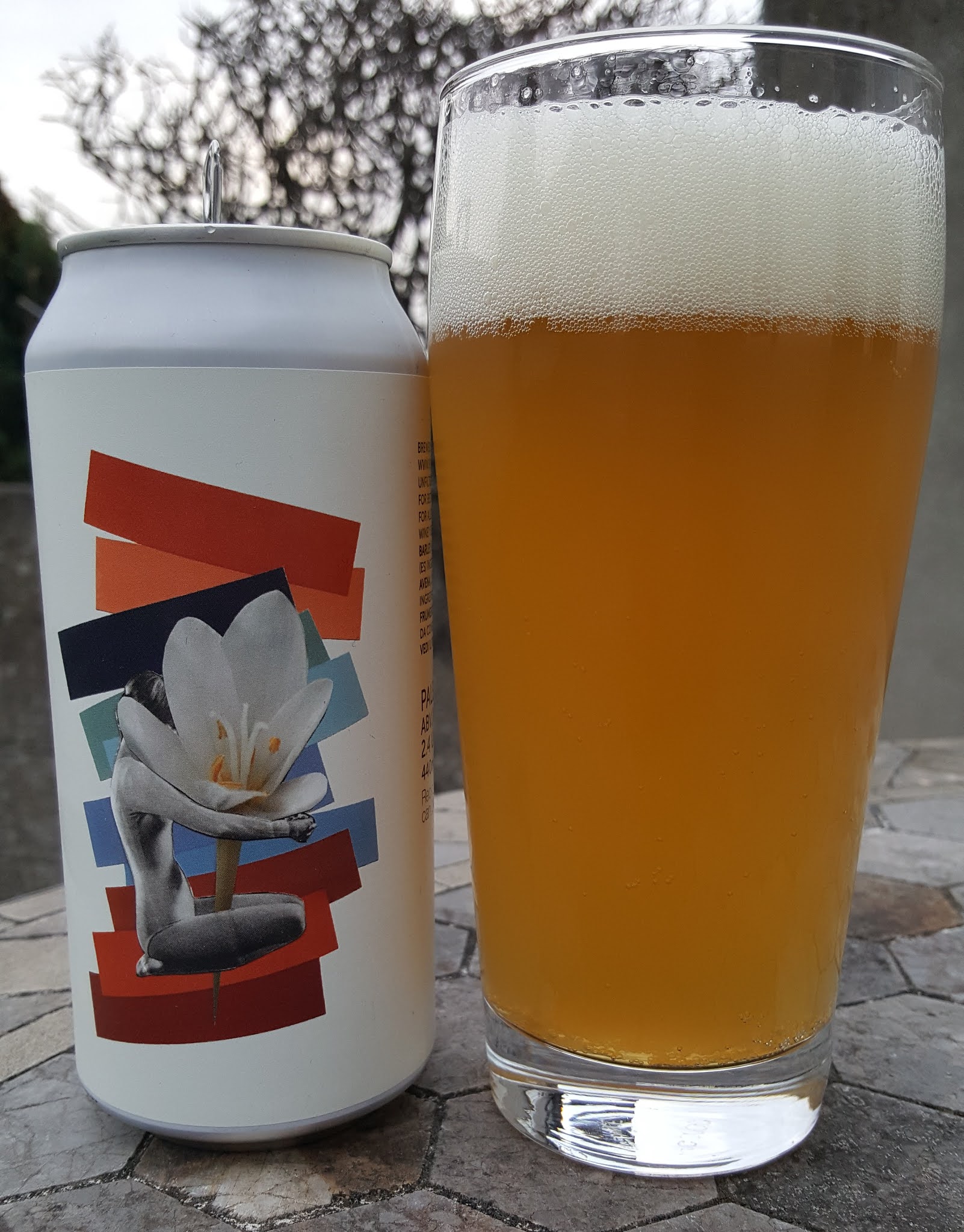
I'm feeling a bit of nominative determinism trying to keep up with the releases from Whiplash. Every week a couple more, then a couple more. It's downright anti-social. I needed to draw a line somewhere so it's here: a hasty core sample of the Whiplash summer output of new beers.
Bulking them out is a new
series of flavoured sour beers called
Fruit Salad Days beginning with a
Mango and Lime example. They're two fruits I wouldn't normally put together: the sweet and fleshy tropical against the sharp citrus, but it works quite well. They've clearly used a lot of both as it doesn't look much like a beer, being a bright and totally opaque orange, like a glass of juice. The lime is loudest, scouring the palate from the outset, to such an extent that I'm not entirely sure where the lime juice ends and the soured beer begins. Mango softens it, though more so in the full texture and sweet aroma than in the taste itself. The tartness, and the light 3.8% ABV, mean it fulfils its remit of being refreshing but it does it without seeming any way thin or harsh, thanks I guess to the mango pulp. The worst accusation I can level at it is that it's a little unbeery, and you might as well be drinking a lime cordial, but once you've accepted that the fruit is in charge it's all rather enjoyable.

The second
Fruit Salad Days is
Apricot. It looks extremely similar, though the strength is slightly higher at 4.1% ABV. Again the fruit is laid on thick and the aroma is very sweet and juicy with no indication of sourness to come. That's possibly because there isn't much sourness to come, only a mildly acidic tang in the finish. Before that it's a total smoothie, from the frothy texture to the heavy fruit pulp. This one indicates how essential the lime was to version 1, adding a much-needed bite. Without that it's rather plain fare, leaning on the apricot to make it interesting, a job the apricot is not up to. A bland Berliner weisse should at least be refreshing, but with the creamy texture offered here that doesn't happen.
I appreciate how enthusiastically all-in they're going with the fruit in Fruit Salad Days, but it's not really working for this sour beer fan. I prefer this sort of thing to be cleaner and crisper.
 Back in May
 I wrote about the challenge of witbier and how the established players have the style so thoroughly sewn up between them. As if in defiance of me, or possibly AB InBev, Whiplash began dropping weekly wits.
Alma is the straight one, though hopped with American Amarillo and eschewing orange peel and coriander for just lemon zest. It's the correct shade of sunny yellow and the correct 5% ABV. It smells very spicy and dry, which I'm guessing is the yeast's doing. It's... interesting. The flavour is quite dry, giving me hints of sage, rosemary and similar oily winter herbs. Lemon arrives late and it too is oily and concentrated, with a lemon-curd sweetness lingering through the finish and beyond. While I enjoyed the combination, I found it a little busy and difficult to relax with. This is a beer which demands your attention in a way that I consider inappropriate for the style. Your mileage may vary; mine is still a boring old Hoegaarden.

"Fruited witbier" is not a style one sees very often in the craft space. For me it is forever tainted by the lurid hypersweet things that large Belgian brewers make, presumably in the belief that people who don't like beer will drink them. This one,
Let It Bleed, is not lurid but a pinkish orange in the glass, showing the milky murky emulsion of proper wit. It does smell quite sweet though: a little classier than jam, so perhaps a berry compote or similar. It's soft and fluffy like a proper wit too, with a touch of peppery spice from a fancy Belgian yeast. And then there's a flavour of two parts. On one side it's the fruit, all sweet and mushy. Other than a vague sense of red berries I couldn't pick what was used and needed the can to tell me it's actually orange and peach. Huh. It's much sweeter than I would expect for that. And that fights with the other side, a herbal bitterness I guessed was coriander but none features so it must just be hops. It doesn't balance the sweetness, it merely offers a different kind of loudness. The mouthfeel is the best part of the offer; the flavour simply didn't suit me, even drinking it al fresco on a balmy evening.

Next in this line was
Tender Things, an intriguing witbier containing melon and pear with coriander and Hallertau Blanc hops. It's the greenish yellow of pear juice in the glass and smells a little hot for 4.6% ABV, full of Belgian esters. The flavour is primarily crisp and grainy with lots of dry husk blowing a dust storm across one's palate. After that there's a kind of sweet and gummy effect from the fruit. I don't think I get the melon but the pear sharpness is definitely present, especially in the finish where it's joined by a sweaty gymbag staleness. This doesn't work for me at all: a beer shouldn't be acrid and sickly at the same time. It curdles in a way I won't get into the deep biology of, but suffice to say it doesn't feel healthy. Maybe served ice cold this would work better; at beer-drinking temperature there's too much angry conflict among the flavours.

Witbier four is called
The White Flash, and it looks very similar to the previous though the added fruit here is white peach. Its aroma makes great use of that, exuding peach nectar vapours -- a little syrupy perhaps, though still a bold and fun sweetness. There's no herbal addition and yet again I can taste very typical witbier coriander, however that's achieved. The expected peach sweetness lands in the middle but is chased off quickly by a clean and wheaty dryness. This combination works: complex and interesting yet balanced; innovative without turning gimmicky. For me, the icing on the cake is the mouthfeel. Atlhough it finishes dry, the texture is big and soft, more like a weissbier than a wit. That makes for very satisfying drinking. So it took them four goes but I think Whiplash finally nailed witbier, putting a spin on the style to produce something different from, but as good as, the Belgian classics.

But still they come. A trio of beers were created for the To Øl beer club though also sold directly by the brewery. Among them, a "double dry zested" witbier called
Il Veliero. It's a much more orthodox recipe, with grapefruit zest the only unusual ingredient, in addition to standard orange and coriander. And it looks like a normal witbier: that middling shade of opaque yellow-orange. You can tell where the zest goes right from the first sniff: a foghorn blast of Lilt greets the nostrils. That's given free rein in the flavour, sitting right up front, covering any subtleties and burying any flaws. The only extra dimension comes in the finish as a buzz of Belgian farmhouse funk, more like a saison than a wit. Overall, though, it's deliciously easy drinking and perfectly sessionable at 4.8% ABV. Perhaps not what a witbier purist will want, but I had no complaints during the handful of minutes I spent downing it. Although a word of warning: two beers later I was still getting Lilt burps.

Also for To Øl, we got a Kölsch-type offering called
Total Control. There's a serious Kiwi influence here with the presence of Nelson Sauvin and Motueka hops, and it's firmly hazy in a way that real Kölsch isn't. There's lots of fruit in the aroma, the white grape and gooseberry of Nelson in particular. Good, but again not Kölsch. It is clean and crisp; the novelty Nelson is not as pronounced in the flavour. And it's another drinker's beer, 4.8% ABV and very easy to knock back. I put a bit of effort into picking out the hop flavours and did find Motueka's concentrated herbal grass thing and well as the hard minerals you get with Nelson -- there's much more about Nelson's attributes to come below. A tropical fruit finish coupled with a certain softness of texture does mean that it's not an accurate Kölsch recreation but, like the witbier above, that doesn't prevent it from being very enjoyable.

It's well past hop o'clock at this stage, and that sequence begins with a pale ale (hazy, natch) called
Midnight Dipper. There's a selection of malts but they don't affect the appearance much: it looks like a pretty normal shade of pale-ale yellow. It's the mouthfeel where they really contribute, as I'm sure was the intention. There's a creamy thickness to this that makes it nicely chewable. That forms a perfect setting for the hops -- Idaho 7 -- to pull a few tricks. Tangy lemon candy is the aroma, followed by a foretaste of more real-tasting lemon peel, perhaps lightly candied. I thought it was going to fade out sweetly at this point but instead it intensifies the bitterness, bringing lime, grapefruit and even a little fresh green veg. Whiplash has the knack of getting the prized soft haze texture without the gritty dreg off-flavours, and this is a brilliant example of that. There's lots to enjoy here, the flavour complexity up there with their top double IPAs yet all at only 5.2% ABV. That'll do.

There seems to be a glut of Nelson Sauvin floating around at the moment: fill thy boots while thee may, say I. Whiplash has put some of its allocation into
Heaven Scent, a 5.5% ABV pale ale. It's lightly hazy and a bit thin looking; pale orange rather than the more typical yellow of their offerings. I try not to be repetitive in my Nelson descriptors but it's such a distinctive hop that this can be difficult. So you get that hard organic-chemistry aroma: kerosene and bitumen with sparks of hot flint. A smooth texture helps build a smooth flavour of apricot, kiwifruit and honeydew, with a pinch of the gooseberry tartness to remind you of Nelson Sauvin's intended affinity with Sauvignon Blanc wine. It's an excellent expression of the hop, maybe a little high on the tart/bitter side as against the juicy fruit, but still beautiful. Long live admirable Nelson!

No fluff next as we head for the west coast
Covered In Dust. Still they couldn't resist a bit of murk, and this pale amber number has a distinct fogginess going on. It's a substantial 6.8% ABV and smells of sticky orange chew sweets, with maybe some other artificial citrus elements mixed in as well. In stark contrast to the previous one it is very dry, which gives the hops a squeaky acidity that's almost harsh, were it not for that candy. With a little warmth on board there's a dankness as well; oily and slightly peppery. I tried hard to like this but the hop sweetness was too overpowering for me. Damn you, Amarillo. Leaving aside my own preferences, this doesn't really meet the standards for west coast IPA. There's an effort at cleanness, and bitterness and dankness, but it fails to hit the mark on each of them. By all means try it, but adjust your expectations beforehand.

Something truer to the Whiplash roots next:
Jungle Window, a 7% ABV IPA with Vic Secret, Mosaic and Cascade. Eggy yellow: check. Aroma: well, there is one. It's a mix of Vic Secret herbal sharpness and the luscious tropicals of well-behaved Mosaic. While it's rather understated, what's there is good. That Vic Secret aniseed kick sits right at the top of the flavour, which I like. It's an almost eucalyptus-like bitterness, balanced by the soft creamy texture. And it's persistent. The Mosaic mango is relegated to the tail end of the aftertaste, while I couldn't locate Cascade's influence at all. Because of the full body, the ABV could be anything: it's not hot in the slightest, and of course it's not watery. I feel they could have dialled down the ABV with a similar recipe and made it cheaper and more sessionable, but I'm aware how much of an objectionable back-seat brewer that makes me. In fact, they don't need to change a thing. The joy of Vic Secret is shown off to great effect here, undiminished by haze and whatnot. I'll take it.

We hit the home straight with
Velouria double IPA, one which contains Strata and Nelson Sauvin, very much the power couple of high-end hops. Eggy: yeah yeah, we've done this bit. Nelson's flinty minerality is right there in the aroma along with a softer fruit which could be either of them. Anyway, it smells great. The fuzzy New England effect is the first thing I tasted and it doesn't sit very well with the hops. The bitterness that rolls in behind clashes with it, like a dry Sauvignon Blanc given a dollop of vanilla syrup. Mango and guava slip in late and calm the situation, and mean this is isn't by any means a disaster. But... I think the Nelson is wasted. This hop has lager ancestry and it's
not happy when it's not in a clean beer. Prove me wrong in the comments below, obviously.

A deep breath before we bring out the big gun.
The Shake Down is another one brewed for To Øl's subscribers, a double IPA with Vic Secret and BRU1. It's downright beige in the glass with a hard aroma of booze and garlicky oils. Not promising. It's a thick emulsion of a beer, feeling quite soupy in the mouth; smooth but heavy. The hops don't pop as I'd like, bringing instead a mix of liquorice bitterness and savoury spice: pepper, nutmeg and red cabbage. There's a hint of lemon-flavoured chew sweet on the end too, which is weird. It's not one of those awful murky DIPAs, but at the same time it's not cleanly flavoured nor jumping with fresh hops. I wasn't in the mood for a creamy, savoury double IPA -- I'm never in the mood for a creamy savoury double IPA -- but this is one; take it or leave it. In fairness it's the sort of thing I expect from To Øl, but Whiplash usually does better.
And that, I think, is me up to date with Whiplash as of the weekend just past. Doubtless it won't be long before my fridge is once again full of new fancy white cans begging for attention. I think we're overdue one with a dark beer inside; just saying.



 Although very much a modern, playful, creative brewery, Heaney Farmhouse built its reputation, for me at least, as a producer of solidly formulated traditional styles in plain-packaged half-litre bottles with names which tell you exactly what they are. Those still exist but I'm sensing a little bit of a shift with some recent output. The minimalist style-as-name thing is still here, as is the minimalist packaging, but the styles are a smidge more adventurous. Maybe this is the midway stepping stone between the nonthreatening bottles and the cans of ginger-infused imperial pastry stout.
 The next one isn't really a proper beer style at all. Double Pale Ale? What? The can says it's 5% ABV and hazy, OK, but in the glass it's weird brownish pink colour. It doesn't look healthy. There's nothing wrong with the aroma, however, smelling bright and zingy like sherbet lemon candy. The texture is very thin, and maybe that's why they shied away from calling it an IPA; there's certainly none of the fluffy weight that normally comes with haze. There's something a bit off about the flavour too. It's mostly fine, bordering on tasty, with vitamin-C-tablet zest meeting a summery apricot and strawberry vibe. But lurking in the finish there's what starts as a chalky dry quality that turns quickly to cardboard. I think this might be oxidised. It's not what I was expecting -- I suppose the name hints at C-hop classics like Sierra Nevada Torpedo -- but I can appreciate what they've tried to do here, making something hop-forward yet accessible and low on bitterness. The execution isn't quite on the money, however.
 Finally and inevitably: New England IPA. Heaney's is 5.7% ABV and the orange colour produced by breweries whose hearts aren't really in the hazy stuff but feel they have to. There's a pithy sharpness to the aroma, grapefruit and plaster dust -- not very New Englandy. The texture is somewhat soft without going full pillow, while the sweetness is more orangeade than orange juice, retaining its pointy side and bolting the fruit sweetness on, rather than integrating it. I found myself judging it on trueness to style before realising that's a daft thing to do and switching to the correct track of whether it's any good or not. And it is. There's a fun interplay between sweet, bitter, dry and savoury characteristics, with no unpleasantness. The strength and texture make it satisfyingly weighty without pushing it, or oneself, overboard. Style shmyle: this is just good beer.