02 December 2024

Bluenosing

Dublin has an unofficial beer twin city in Halifax, Nova Scotia. Their respective annual beer festivals are run by the same person, and for the Dublin event this year he arranged for two Halifax breweries to be represented. I didn't get the chance to try any at the festival, but was happy to see a selection of their cans in Craft Central afterwards, and picked up a pair from each.

Garrison seems like a sober and well-established brewery, with its bold-coloured, all-caps branding. When an IPA is called Hoppy Boy, you know what to expect. 6.5% ABV gives it reasonable heft, and I think they're being a bit playful with the style, referencing Halifax's position on the very east coast, while the beer itself is only slightly hazy. A fine thick head of foam is another sign of a brewery going about its business in a serious and organised way. The aroma is cleanly zesty, offering up a mixed spritz of tart jaffa and sweeter mandarin. The flavour is somewhat more savoury, leading with a kind of dry cracker and fried onion effect, before the fruit arrives later. Said fruit is still oranges, but tastes somewhat processed: dried, candied, or distilled into essence. That's sweet and creamy to begin, turning more oily and bitter towards the end, so there are elements of both coastal styles in here. This is solidly made and workmanlike, but don't expect fireworks. While I'm not saying that breweries running since 1997 have a particular safe-and-steady way of making their beer, this IPA suggests that there might be something to the theory. It's not an exciting beer, but I'd say it's a dependable one.

I also picked a sour beer from Garrison, called Sour To The People. This makes no claim to complexity, stating clearly that it's kettle soured but giving no detailed tasting notes otherwise. It's 5.5% ABV, a hazy orange in the glass, with little by way of lasting head: so far, so typical. The aroma is watery with an uninviting plasticky sweetness, but the flavour is more pleasant. "Tart from the start" says the can, and indeed it is, delivering a punchy mineral sourness right at the front of the first sip. A minimal amount of fruit acidity comes after it: satsuma zest and grapefruit pith. This doesn't last long, and we're back to the almost chemical-tasting sourness soon after. Beneath it, the base beer is dry and crisp, with a little Ryvita wholegrain crunch. This not a beer of nuance: it promises you sour and that's pretty much all you get. I think they could have upped the hop quotient and made it more interesting, but I can't argue with its honest simplicity. Sour beer that's actually sour is enough of a rarity these days that this was a pleasant surprise.

The other brewery is 2 Crows, and I'm starting with their "Northeast IPA", Pollyanna. That means it's hazy, and it's quite a strong one at 7.3% ABV. The aroma is freshly tropical, giving me tinned lychee and pineapple rings. That transfers subtly to the flavour, which is a little understated for a big beer. Pineapple is the core taste, but there's a spiced element to it as well; a little cinnamon or paprika dusting. The internet tells me they've used some class of a wild yeast for this, so maybe that's why it's a little unorthodox, but it's not hugely dissimilar to lots of other hazy IPAs. I found it decent but ultimately a bit boring. This strength and 64 IBUs should add up to something with a bit of wallop. This is more of a gentle tickle. Perhaps the name is a suggestion that you should make the best of it.

Something a bit different is Bière de Coupage, a blend of hop-forward saison and a barrel aged sour beer. This is 5.9% ABV and a bright sunset yellow in the glass with a fine white head. The aroma is luscious, offering up exotic lychee, white pear and botrytised grape, with a pinch of white pepper seasoning. The flavour emphasises the fruit side of the equation, but keeps things clean and dry: a burst of peach cordial fades after a moment, replaced by flinty mineral sparks and crisp dried grapefruit peel. A stronger earthy funk, suggesting blue cheese to me, builds as it goes along. It's all very subtly done, in a way that tastes much more European than new-world to me. I also couldn't see the joins between the blended beers: hoppiness and sourness dovetail perfectly here, and none of it seems efforty or gimmicked. The strength is maybe a little high for the thin-textured and light-tasting beer it is, but it's extremely well done overall, including all one could want from souring, barrel-ageing and blending.

I don't see that we need regular imports of Canadian IPAs: we're quite self-sufficient in that style. It is good to see what they're up to on the sour side, however. For that I appreciated this set.

29 November 2024

Fully hopped

A quick catch-up with Waterford brewery Hopfully. When last seen they were wowing the RDS with cask porter, Helles and Bock. Today, they're back on much more familiar ground.

Swimsuit (the label: can we not?) is described as an easy pale ale, and by easy they mean hazy: it's a very murky pale yellow. The ABV is a modest 4.5% and it has been hopped with Vic Secret, Mosaic and Strata, which sounds like a promising combination. They give it an intense fruit salad aroma, all pineapple segments and peaches in syrup. The texture is a little thin, though helped by the New-Englandish fluffy quality. There's an initial rush of very sweet flavours, led by vanilla cream, with fruity chew sweets after. That fades quickly, and here I would have liked some of Vic Secret's trademark aniseed bitterness, but instead there's no real aftertaste, presumably because of the thin body. A vague lemon-candy bite is as punchy as it gets. This is OK, but unexciting. I think Hopfully is well capable of making more interesting beers at this medium strength point.

By Hopfully's standards, Fingers IPA is a low strength one: only 5.6% ABV. It's hopped with Citra, Mosaic and Comet, and is again hazy, this time an even brighter, sunnier, shade of brilliant yellow. The aroma is similar to the pale ale, though less intense, offering the soft fleshy fruit but not the encoating syrup. The flavour isn't as assertive either. We're spared that excessive vanilla sweetness, and instead there's a gentle tropical juiciness, hinting at mango, passionfruit and mandarin orange, without saying them out loud. It took me a moment to adjust to its subtlety, but when I did, I found myself enjoying it. This is no powerhouse of flavour, and at this strength it doesn't need to be. Instead, you get a mellow thirst-quencher, full of summer fruit and summer days; cleanly unchallenging, but still delicious. It's the sort of thing you might expect a brewery to put in its core range rather than the roster of one-offs. It would be good to see it again when and if the weather turns warmer.

The next round of releases brought Hangout, a pale ale of 5% ABV, described as "triple dry hopped". It looks like very typical Hopfully fare: densely opaque with a coarse and short-lived froth. Expecting a standard juicy aroma, I found that the tagline does seem to mean something: this smells intensely fruity, with generous portions of both sharp citrus and soft tropicals. The flavour doesn't quite deliver on that. For one thing, a very low level of carbonation mutes the hops somewhat. There's the heavy vanilla base of many a hazy pale ale, and while both the spiky bitter and juicy exotic notes are present, neither really sparkles. That's a little disappointing, and so to is the savoury, gritty finish, adding a rough and dreggy coda to an otherwise cheerful experience. The recipe, involving Nectaron, Mosaic and Citra hops, is worth another go, but there are a few wrinkles needing ironing out, not least the carbonation.

Penultimately, a new collaboration with Dublin's online off licence Craft Central. Superposed is an IPA -- hazy, natch -- with a down-under mix of Nelson Sauvin, Motueka and Galaxy hops. It's the usual opaque orange-yellow, and the head, while still loose, does hang together better here than in the previous. The carbonation is still very low, and the aroma quite savoury, blending the diesel notes of Nelson with the menthol and eucalyptus of Motueka. I wasn't expecting any tropicality in the taste, and didn't get it. The flavour is quite herbal, suggesting that Motueka is in charge, and I get warm clove, nutmeg and powdered cinnamon at first, with an orange-cordial sweet fruit track running in parallel. It's good, but it's quite unexciting, lacking the big hop fireworks. Fans of Nelson Sauvin in particular be warned that this does not offer the best Nelson experience going.

And finally a world exclusive. By coincidence, I visited the Hopfully brewery last Saturday, where they were getting on with their 2025 brew schedule and pushing the last of this year's lot out the door. I was too polite a guest to tear open the neatly piled boxes of bourbon-aged sour cherry ale, but did take special care of an unattended can of Closet: the new double IPA. This seemed a little on the weak side at only 7.6% ABV but it punches well above that, with a dense and almost syrupy texture allied with a powerfully sweet flavour. There's an even mix of tinned pineapple and fruit chews meeting a vanilla-custard base. It's interesting how it does quite similar things to Swimsuit, though the hops here are Galaxy, Amarillo and Citra. I guess it's the effect of the hazeogenic yeast, overriding the hops' subtle difference. Anyway, if the lack of oomph in the beers above is a concern, here's oomph aplenty.

Our national appetite for hazy and hoppy shows no sign of waning. Until it does, it seems Hopfully will be right there, serving the need. Citra, Mosaic and Comet is a combination that works well in this space, and would be worth trying again, in my opinion.

27 November 2024

Stan's suitcase

Mr Stan Hieronymus visited Ireland in September and I was happy to be able to meet for a couple of pints in Dublin shortly after he arrived. I was good enough to take a couple of cans which he had shipped over off his hands, to save him shlepping them around the country.

First, and perhaps least remarkable, is the 2024 Sierra Nevada Oktoberfest, this year a collaboration with Gutmann of Titting, Bavaria's most romantic-sounding brewery. It looks like a modern festbier, being a bright clear golden. The ABV is on the high side at 6%. That does the job of giving it a voll und süffig body, with lots of dense fresh white bread leading the flavour. The hops bring quite a spiky bitterness, beyond grass and salad and into quite an English profile, of earth and zinc. A tiny note of celery in the finish is the only confirmation that the hops (Hersbrucker, Loral, Saphir and Spalter) are definitely German. From that list I would have expected something a bit more modern, but this is as trad as they come, small can notwithstanding. It's certainly streets ahead of the orange and sticky Oktoberfest beer which I'm guessing too many American breweries still produce, but here in Europe, this isn't very distinctive and different. It's satisfactory.

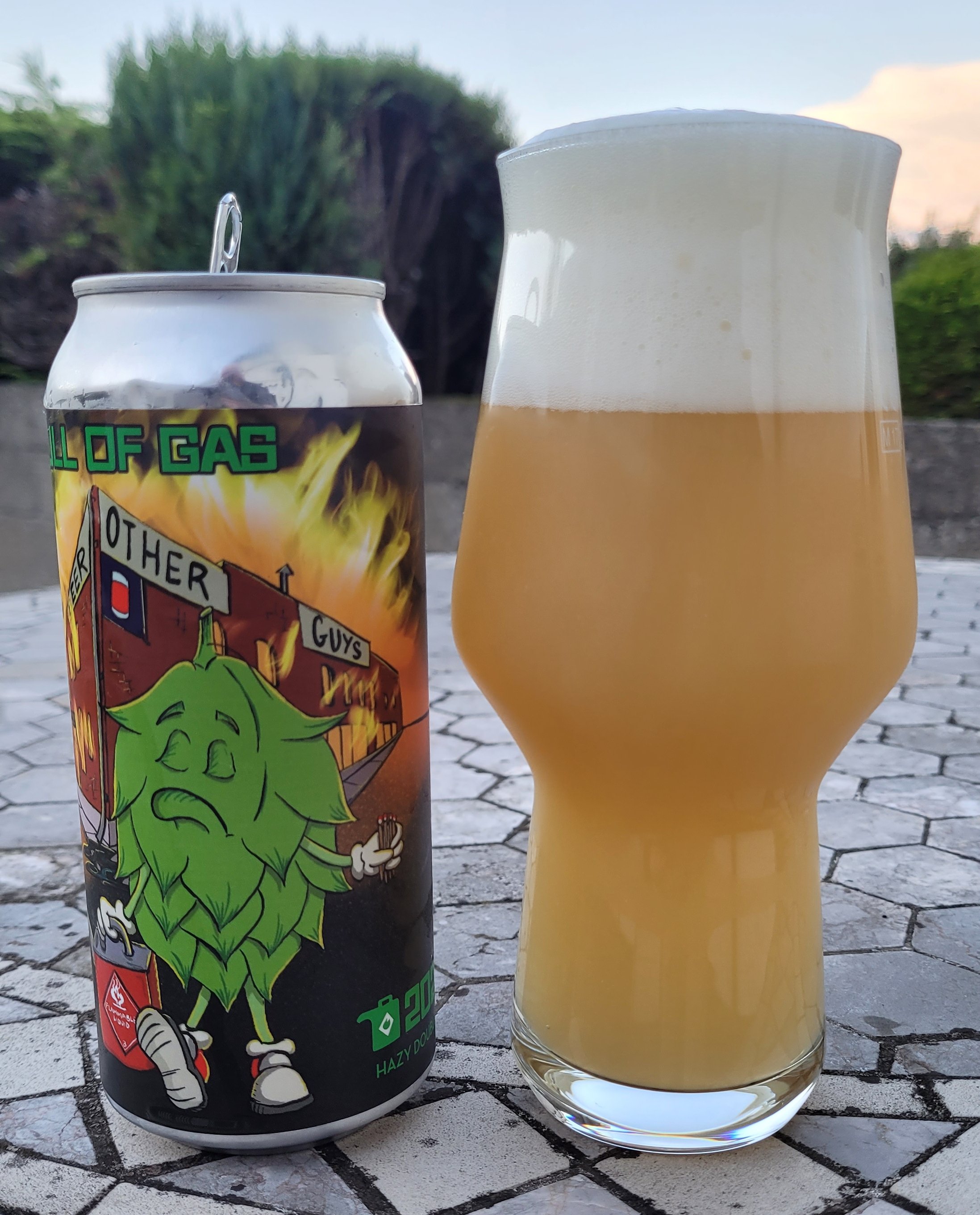
The other can came from one of Stan's local breweries in Colorado, Lyric. It's a double IPA called Can Full of Gas and is one of those eggy-looking hazy double IPAs, the full 8% ABV. It smells quite minerally, with the sort of kerosene effect I sometimes get from Nelson Sauvin, as well as dry plasterboard grit and some softer lemon and lime candy. Nelson is indeed one of the hops used, along with Riwaka. It's full-bodied and slick, feeling barely carbonated despite the substantial head. There's a rawness about the hops; a concentrated leafiness that makes it taste a little dreggy. That gives it a hard bitter finish, before which it's pleasantly citric, with a faint smoky burnt note, presumably from whatever was making it smell like kerosene. There's a certain amount of lemon meringue pie sweetness mixed in with this, but the leafy bitterness prevails. I guess it's a decent example of this sort of strong super-hopped beer, but it's not really to my taste, feeling a little rough or unfinished to me. I'm sure it has its fans though.

Thanks for the beers Stan, and I hoped you and Daria enjoyed your visit to Ireland.

25 November 2024

Europe in four cans

Flemish, Wallonian, German and Czech: these are the origins of the beer styles tackled in today's set, from Czech brewery Zichovec, in collaboration with Swedish, English, Dutch and French brewers, all as part of their Winter Affair Gossip series. That's from last winter -- I bought them several months ago for a knockdown price from the Craft Central bargain bucket.

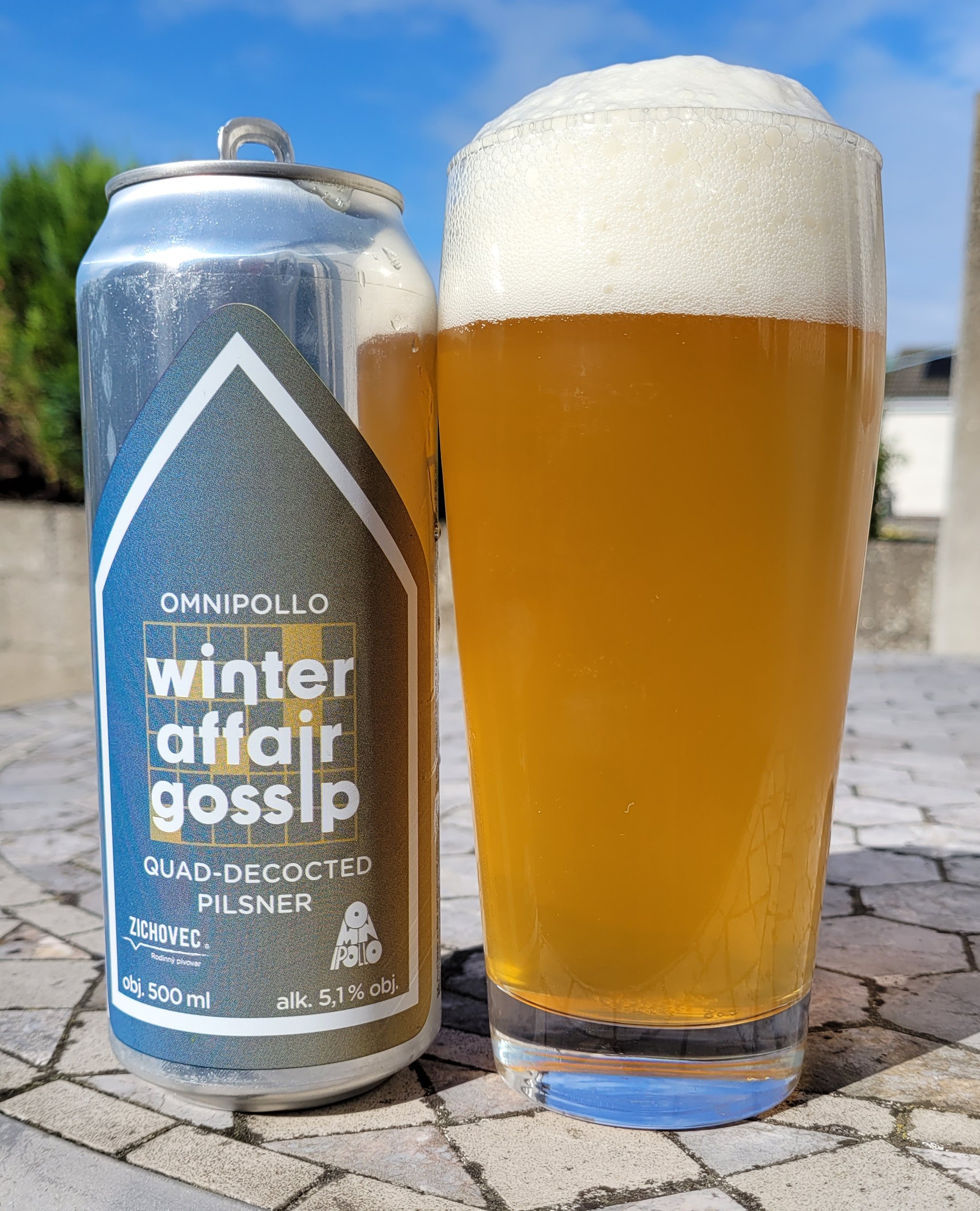
I would like to think that pilsner is exempt from craft-style mucking-about. It certainly should be. When I see something badged as "Quad-Decocted Pilsner" it makes me fear that the beardy craft bros have had a go at it, but they are Czech, so maybe it's meaningful. The collaborator is not a brewer I associate with pilsner: Omnipollo. The result is 5.1% ABV and certainly looks like a Czech pils, of the unfiltered sort: pale amber and translucent. There's nothing surprising in the aroma, which is good. It's a solid balance between crisp and biscuit-like malt and the fresh salad leaves of noble hops. There is a twist in the foretaste, however. It's noticeably sweeter than pils tends to be, and weightier with it. The opening flavour is a kind of soft toffee or gooey caramel effect, and I guess that's what you get when you decoct and recoct a few times. The purpose of the process is to make richer beer, and this is definitely richer than I would expect from a pils, leaning towards bock or Märzen territory. The hops stay in the picture, though, lending it a dryness rather than a bitterness, arriving in the finish and helping clean away the malt excess. It's an interesting twist on pilsner. On balance, I do prefer the more hop-forward takes, and I should note that this can had gone two days past the stated best-before, so maybe it's hoppier when fresh. Overall, though, it's good clean fun and I was interested to find out what other spins on established styles Zichovec and friends had for me.

We stray even further from stylistic orthodoxy, and indeed obeying European labelling laws, with a DDH New Zealand Kölsch, for which Northern Monk is co-responsible. And in keeping with Northern Monk's involvement, it straight-up looks like a hazy IPA, and smells like one too; all vanilla and garlic. The flavour does not follow in that direction, I'm happy to say, but it's still a long way from what anyone could interpret as Kölsch. Were it entered in a homebrew competition it would be an instant fail. We'll leave the distraction of the label behind and evaluate it as a beer. And it's lovely. We're not told which Kiwi hops were used, but there's lots of tropical gourds and stonefruit: cantaloupe and mango most prominent, followed by lychee and then a drier coconut finish. It's a very tasty pale ale, or even an IPA, given the 6% ABV: there's a density and a warmth which absolutely reflects that strength. This one had five days left to run on the best-before clock at time of drinking but still tasted bang-fresh and gorgeous.

I'm not familiar with the collaborator on the Hoppy Witbier: White Dog, a client brewer from Dordrecht. Am I bad people for immediately associating the name with canine pavement fouling? Anyway, it's 5.1% ABV and, on first impressions, suffers from the standard witbier complaint that it's just not as good as the famous and very mainstream ones. Witbier is a style that resists small-batch interpretations. I note the word "Hoppy" on the front but it's nothing of the sort, being predominantly grainy, with a decent-sized dose of coriander herb and a little citrus which, to me, resembles real peel rather than hops. I don't think I can pin the shortcoming on the can's age either, as it's less than six months old. If the hops were ever there, they were subtle. At least I can say that this one is true to style, even if it's not a stellar example. The pint can suits the format: it's a quaffable gulper, to be served cold onto a parched throat. The coriander gets a little sickly if it's allowed warm, but otherwise it's decent and largely unremarkable: witbier very much by the numbers.

French brewery Les Intenables co-brings us the final beer: Grisette. Though not quite limpid, it is the clearest of the lot so far, almost a white-gold shade in the glass, though with a worringly loose head. It smells cleanly farmhouse-y, of hard pears and white plums. Nice. As expected, the carbonation is low, especially for something in a Belgian farmhouse style, but it works, giving it a cask-like subtle softness in place of the usual overactive tongue-burning fizz. That really helps the subtle fruit side come through in the flavour, although here the pears are stewed sweeter than in the aroma and dusted with some fun cinnamon and pepper. It's gently flavoured, gently sparkled, but really nicely done. Grisette may be meant for quenching miners' dusty thirsts but this example is too interesting and complex to rush. Of course, 4.8% ABV is far too strong for a grisette, but I'm beginning to think that style fidelity was not a cornerstone of the Winter Affair Gossip project.

It was a pretty good set, all-in-all, apart from the tricky style of witbier, but even that was workmanlike and decent. I have a longstanding soft spot for when detail-oriented German breweries apply themselves blousey New World beer styles. I think I can extend that to the Czechs and whomever they've invited into their brewhouse for some experimentation on the day.

22 November 2024

Mutually fruity

Bit of an unusual move from me today. Collaboration beers aren't exactly rare on this blog, but I tend to group things together by the production brewery. Today's are centred around one of my locals, Rascals, but are all beers they've made with other breweries, and all share the Rascals fondness for whacking in the fruit purée.

We start at HQ, and Pash 'N Fruit. A note of appreciation goes to that single hanging apostrophe which I'm reading as a tribute to a certain Los Angeles-based 1980s hair metal band who have the same unorthodox orthography in their name. Something for the dads, there. Collaborating on this New England-style IPA are Lervig and The Garden, only one of which is named after a song on Use Your Illusion I. And of course there's passionfruit in it. The can blurb describes it as a "refresher", but it doesn't look like one, being a dense and soupy orange and a sizeable 5.4% ABV. The aroma is quite gently fruity, suggesting a lightness and coolness of the refreshing sort. There's a certain slickness to the texture but it's not soupy and the mouthfeel is light overall. The passionfruit completely dominates the foretaste in a very unsubtle way, starting on a fresh sorbet zest and building quickly to a more artificial metallic-tasting concentrate. There's no room for any IPA characteristics under this, and frankly they've a bit of a cheek calling it one. Equally, it could pass as one of those non-sour "sours" that remain inexplicably popular. While I'm getting the digs in, I can't see how it took three very skilled and creative breweries to create something so basic. It's not a bad beer, and I don't get any of the common problems with contemporary cloudy stuff. But it's nothing fancy either. 

The Garden returned the fruity favour with Rosehip & Orange Sour, although Lervig weren't invited to Zagreb. There's a cliché about this sort of beer looking like carrot soup but it really really does. It's a modest affair at 5.4% ABV and is one of those highly attenuated beers where one suspects that the yeast has chomped through all the interesting stuff. I don't eat a whole lot of rosehip but there's nothing in here that suggests its involvement. Flowers and/or fruit are thin on the ground. There's a broad and vague vegetal funk in the aroma and then a tangy acidic flavour, like a kettle-soured blonde ale without any added ingredient. Again, they say it's "refreshing", and the blandness would be forgivable if it were, but it's not. This is weighty enough to taste sweaty and harsh. Usually the problem is that they're sickly, but this doesn't have enough fruit character for that, nor any proper sourness. The result tastes flat and dull. Collaborations are all about experimentation, and it makes sense that some of them simply fail. This is one of those, unfortunately.

I don't have the matching other half of the final one because I reviewed it back in June. Rascals paired with Mad Scientist to create Loco in Inchicore. The return leg in Budapest has given us Go Loko, allegedly a gose, and I guess the letter from Leipzig's lawyers hasn't yet arrived, because this is brewed with vanilla, cinnamon, rhubarb and raspberry in a way that gose very much isn't. Loko indeed. It's a dense and murky purple in the glass, smelling sweetly dessert-like, of trifle and compote. It's 5.8% ABV, which is hefty, and it has a body to go along with that, aided by the vanilla to create a sweet and smooth sensation. The flavour charmed me instantly with a surprise kick of ripe black cherries -- real, not concentrate -- and even a twist of cakey dark chocolate for the Black Forest effect. It's supposed to be sour, and there is salt in the ingredients, so while I accept it's an absolute affront to common decency to pretend this is gose, there is a sour bite in the finish. That prevents the gateau aspect from turning cloying, giving it more of a cherry yoghurt effect. I like a cherry yoghurt and don't mind drinking one as a beer. More than anything, this is fun. Tying it to your Großvater's salty sour style was a mistake; it's its own thing, and more enjoyable for that. The fruit pops, the sourness zings and the vanilla pushes up the intensity of all of it. Gloopy purple beers of this sort rarely do it for me, but I think I've finally found one that works. 

This sort of beer gets a bad rap from boring people like me, and rightly so, quite frankly, for the most part. That last one gives, me pause, however. Rhubarb and raspberry, with vanilla and a sour culture? It merits further investigation, is all I'll say.

20 November 2024

Clock this

I'm used to Irish breweries having a long gestation, from the first announcement by some ballsy entrepreneur to actually being able to drink a pint they brewed can be a long stretch, and often the second part never actually happens. So I was agog at how fast things moved with Changing Times. The news that a consortium of prominent Dublin publicans had bought the old Kepak warehouse in Glasnevin and were planning to set up a brewery in it only landed last July. Since then we've seen Franciscan Well co-founder Shane Long and former Trouble and Hope brewer Mark Nixon become associated with the project, and now only four months later, there's actual beer pouring.

The consortium of owners includes The Palace pub in Temple Bar, and that's where I went on the day after the high-profile launch to try out the first two. Any excuse to visit such a fine establishment.

Daydreamer is the lager, described on the badge as "snappy". It's a very pubbable 4.2% ABV and arrived extremely cold, with a €7.60 tab -- priced on a par with other independent beers. There wasn't much to say about it at first: lots of fizz and a tiny amount of haze on the pale yellow body. Given a moment, there's a pleasant cracker crispness (snappiness? sure, why not), and a moment later brings some Germanic hopping. That adds a different sort of crispness: crunchy green vegetables. With the pint half empty and warmed a little, there's a threat of butteriness in the aroma but the flavour stays clean and dry. This has the basics of decent lager, and certainly isn't a clone of the cut-corner big brands. At the same time, however, it's no connoisseur's lager and only hints at the fun you can have with good pilsner, Helles or the like. If the mainstream lager drinkers aren't completely tied to the familiar labels, this offers an alternative of acceptable quality. I'm guessing that's what it's meant to do.

Launching alongside is the pale ale, After Hours. They've put "hazy" on the badge, but it's not really much cloudier than the lager. Sorry, hazebros: nothing for you here. It's 4.2% ABV again, which puts in a competitive space with Little Fawn, but it's nowhere near that quality. The aroma is broadly about American hops, with a certain amount of pine resin, though nothing overboard. The texture is thin, and fizz is again central, something much less acceptable in a pale ale than a lager. In the flavour, the hops make a valiant effort to be heard, but can't quite manage it sufficiently. There are token quantities of juice and dank with minimal bitterness, so it fits the hazy profile in the most basic way but, to me, comes across like an Ambush that's been run under the cold tap. It's not offensive, bad, or poorly made, but it tastes cheap and dumbed-down. This sort of beer was radical in Ireland a decade and more ago. These days, I think even mainstream pale ale drinkers will find it lacks character. I wouldn't be fully confident that it's a trade-up from fresh Hop House 13.

So... I don't really know who these beers are for. I can't see any drinkers of the big brands making the switch, when they've already turned down the pre-existing alternatives. And this goes even more for the third in the range, Clockwork stout, arriving soon. Equally, there's not much to attract the seasoned drinker of microbrewed beers. I see After Hours working as a distress purchase, but I think most of us would prefer a Little Fawn, Ambush, Scraggy Bay or Galway Hooker. It's disturbing to hear already of independent breweries' taplines being removed from pubs which are part of the brewery consortium.

A brand new brewery means lots of new potential, but I'm not seeing that realised to any great extent in the first two beers.

18 November 2024

Get 'Er Drank

A big thank you to Ger 'Er Brewed which sent me today's beer, free and unbidden. I hadn't seen these ones on sale here in Dublin so it was nice to have the opportunity to try them. Several have since arrived in good off licences around these parts.

The occasion seems to have been the launch by Get 'Er Brewed's brewery, Our Brewery, of a series of bottled barrel-aged beers, but we'll start on the cans, and a pilsner called Pressure To Pick, created in the hoppy Italian style. It's a little hazy in the glass, pouring a dark gold colour, suggesting more than its mere 4.3% ABV. There's not much aroma, which is fine, but the brightly bitter hopping I was anticipating in the flavour does not materialise. Instead this is rather plain and grainy, suggesting the golden syrup of something Czech style. The hops are mild and grassy, which fits that spec also. There's a decent body for the strength, and it's perfectly clean, just not the craft take on the established style I was expecting. A big brewery could have made this.

Also low strength, only 4.2% ABV, is The Crunch, a brown ale. I like brown ales and always welcome a new one into rotation, but this suffers a bit from that understated gravity. It lacks body, and that has a knock-on effect on the flavour, which I think is a little muted because it doesn't have the malt base to work from. That's a pity, because what's there is excellent: an absolutely classic blend of soft caramel, milk chocolate, and creamy coffee. It deserves a creamy texture to go with that, but doesn't get one. Still, again, it's fine, and a very easy-drinking and approachable beer. I can't help thinking about the beer it could have been with a bit more body, however.

The hoppy ones consist of a pale ale and an IPA. Modern Love is 4.2% ABV. The hops are Cascade, Citra, Simcoe and a type of hop extract called Trident Salvo. It's an attractive clear gold on pouring, and smells quite tropical, though there's definitely an edge, too: Citra biding her time. The yeast they've used is called "Juicy", and that's certainly the effect it has given the flavour. Not quite real juice, though: something more like Capri-Sun or 1980s Fanta; echoing the taste of orange juice, but at a significant remove from the real thing. Sweetness is the core attribute here, with a little honey from the Maris Otter malt, and then whatever the fruitbomb hops are doing. The bitter punchline from Citra is never delivered, with the grapefruit element in the flavour dusted liberally with sugar. I guess if you like your pale ale to taste like a children's soft drink, this has the goods. I would have liked more balance.

Do You Wanna Funk? enquiries the IPA. This looks similar to the pale ale but is 6.5% ABV, and this time two types of the Salvo stuff have been used: Trident and Sultana, with Riwaka thrown in too. With that and the return of the Juicy yeast, I was expecting fruit. Sure enough, the aroma is like Skittles, but the flavour hits different. Here is that bitter edge I was looking for in the pale ale: a sharp pine effect that I would have thought much more likely in the beer with Citra. That intensifies as it goes along, becoming a hard wax tang by the finish, seasoned with piquant pepper. It's invigorating and enjoyable in the way old-school US IPAs tend to be. The sweetness is there to a certain degree -- a seam of mandarin running under the resin -- but I think the main thing the New-England-ish yeast has done is boost the body and give the hops more room to work within. They haven't specifically called this a West Coast IPA, but it fits the specs nicely, I think. The name is silly but the flavour is classic.

The last can wasn't a freebie, but purchased in Craft Central last week. Once in a Lifetime is an oatmeal stout of 5% ABV, including two American hop varieties: Columbus and Centennial. That's promising, though I had qualms about the colour, which is definitely on the brown side, even red (sorry, no photo). Those hops come through on their promise in a delightfully floral aroma, a characteristic which continues well into the flavour. You get a base of dry cocoa, zhushed up with rosewater and a squeeze of slightly bitter citrus on the end. That's fun, but what lets it all down a little, once again, is the texture. The deal with oatmeal stout is it should be full and smooth, and while this is not watery, it's surprisingly light. I'm not judging it to style, but it would definitely be improved by being bigger and darker, and I think there's enough elbow room in the strength to allow that.

On to the fancy bottles, then.

I extended the benefit of the doubt to their putting a lager, Humble, in a green glass bottle. 17 months in a Chardonnay barrel could mean that the hopping is irrelevant. But no: the absolute bang of skunk off it, as soon as soon it was opened, was horrific. It got worse on pouring, and Chardonnay was not to the front of my mind when I went in for the taste. It's certainly not wanting for hops: the flavour goes big on bitterness, flinty and dry, flecked with zinc and granite. You have to wait for the wine, but it does arrive in the finish, softly vinous and vanilla-ish. This is... odd. I liked it, but it wouldn't be for everyone. Neither barrel-aged beer fans nor lager purists will get their money's worth, but it definitely gives insufferable nerds something to stroke their wispy-whiskered chins over. Exercise caution, but give it a go. I can safely say that nobody on this island, nor possibly even the one next to us, is making a beer like this.

Flemish oud bruin is not a style I've seen an Irish brewery tackle before, or at least not deliberately. And it's not one I seek out from Belgian breweries either, preferring the lighter briskness of its cousin, Flanders red. This one, Low Land, aged for 17 months in wine barrels, is a stonking 8.2% ABV, which is one of the problems I have with the style generally. That makes it heavily malt-laden, chewy and gooey like a steamed pudding dessert, but without the fun chocolate. There's a little fruit, emerging more so as it warms (it will; you'll drink it slowly): dried currants and grapefruit peel. The mixed-fermentation sourness and old oak character are present, but held in check by the malt weight. I've had much worse oud bruins than this, but it still didn't suit me particularly. Dark and warm; fine. Dark and sour; OK too. Dark and warm and sour? Unnecessary.

The next one is wild, hi. Untamed is described simply as a wild ale. They don't tell us anything about the fermentation process, but after that, it was aged in a foeder for 27 months. That seems a bit much but it hasn't done it any harm. It's a pale gold colour and smells both sweet and funky, of candied lemon peel, orchard floor and pale dessert wine. Its texture is light and spritzy, despite the substantial 7.5% ABV. The flavour leans in to the apple quality of the aroma, tasting quite like a dry farmhouse cider: juice, oak and lots of earthy, mouldy, tasty, autumnal rot. Though fabulously flavoursome, it's subtle too, showing plenty of refinement. Version 1 of beers like this (and the label is marked as such) are almost always a bit ragged around the edges. Not so here.

The other big bottle was Séasúr, described as a mixed fermentation saison. It's a strong one: 8.5% ABV and quite a dark amber colour, presumably from the inclusion of toasted rye in the grist. For barrel-ageing it's had 18 months in white Bordeaux casks, and there's a distinct, concentrated, white grape effect in both the aroma and flavour. There's plenty of alcohol vapour as well, resulting in a smell like dried-in spilled white wine, which isn't very alluring. Coriander and orange peel are listed as ingredients but don't really feature in the taste. The oak side of it is a little tacked on as well: unsubtle vanilla adding another sort of sweetness to what should be quite a dry beer. I opened this as a pre-dinner spritz, but really it would work better as a dark, after-dinner affair. I had hoped for more spice and more sourness, but this really doesn't play that way. A bit like the lager, it's interesting and different, and enjoyable enough for that. I've tasted this kind of thing done better, however.

The Lithuanian farmhouse styles are new to Irish brewing, I think, first represented by this keptinis, Razma. We're going strong and dark again, with an ABV of 8.8% and a garnet colour. Whereas traditional Lithuanian brewing tends to produce beer to be consumed fresh, this has been left for 18 months inside rum barrels. I suspect that authenticity was not a concern. The spirit element is very strong in the aroma: I wouldn't have guessed rum as there's a significant malt component, but definitely distilled alcohol. The flavour goes in a different direction completely, calling to mind red wine or sweet vermouth. I guess it's the oak that's dominant, but there's a lovely layer of sour cherries and rum-soaked raisins: a mature and luxurious fruit side. That comes with a boozy heat, and the finish in particular is verging on harsh, with its hot dash of spirits. Overall, though, this is very nice. It defies classification a little, but to me the Flanders red or oud bruin genres are what it resembles most. The production process may have been traditionally Lithuanian, but the finished product is all about the barrels.

It's nicely appropriate that we conclude this excursion on an imperial stout, the pinnacle of the brewer's art, according to all those rating websites. Terra Nocturne is an 11.4% ABV example, aged 20 months in bourbon barrels. It seemed a little thin as it poured, finishing without much head, though densely black in colour. The aroma is roasty to the point of burnt, but enticing nonetheless, and there's a bit of marker-pen solvent in there too. I feared something severe, but the flavour is very nuanced, bringing hazelnut, chocolate, a little peat and some vanilla. The peat is an odd one, as only Maris Otter, crystal, black and brown malts are involved. I wonder is something microbial responsible for the phenols? It's no harm: the overall result is mellow and warming: a proper fireside-balloonglass job. Bourbon enthusiasts may be disappointed by the low bourbon quotient, but frankly they've had things their own way for long enough. 

What an adventure! This took about four weeks to assemble, and was a whole heap of fun. Although the beers aren't all perfect, there's more than enough to say Our Brewery has put itself on the map as one of this island's high-end barrel agers. I have no idea if any of it will ever get shelf space down in this jurisdiction, but I'm delighted that the Nordie beer scene has such a promising practitioner of the oaken arts in its midst. Keep 'er lit.